


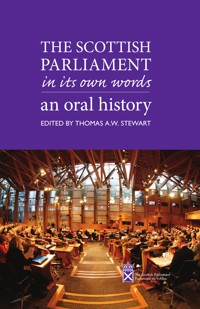
The Scottish Parliament in its Own Words E-Book
Erhalten Sie Zugang zu diesem und mehr als 300000 Büchern ab EUR 5,99 monatlich.
- Herausgeber: Luath Press
- Kategorie: Geisteswissenschaft
- Sprache: Englisch
As part of the Scottish Parliament Oral History Project, around 80 interviews were conducted with staff, MSPs and journalists, old and new, about their careers and experiences at the Scottish Parliament. This book compiles extracts from some of these interviews, detailing the institution's rich history. This is the story of the Scottish Parliament so far, telling its story through those who know it best. Through its comparatively short life, the Parliament has been tested. What was once an upstart institution, unsure of its place in the world, has now become an ingrained part of the nation's political landscape. Now is an ideal moment to take stock of the Parliament's 20-year history – to investigate its origins, its early days and how it has developed over the past two decades.
Sie lesen das E-Book in den Legimi-Apps auf:
Seitenzahl: 330
Veröffentlichungsjahr: 2019
Das E-Book (TTS) können Sie hören im Abo „Legimi Premium” in Legimi-Apps auf:
Ähnliche



















THOMAS A.W. STEWART began working at the Scottish Parliament in December 2017, midway through a Scottish History PhD at the University of Edinburgh, studying the political history of Dundee between the 1970s and the present day. He was originally hired as an intern on a programme supported by the Arts & Humanities Research Council through the Scottish Graduate School for Arts & Humanities, which enables organisations to access the talent of researchers to deliver a specific piece of work or project. As an intern he had a number of responsibilities, one of which included looking into establishing an oral history project that could be included as part of the Parliament’s official archives at National Records of Scotland. Over the course of his internship, lasting between December 2017 and June 2018, he helped establish the Scottish Parliament Oral History Project and conducted 75 interviews with members of Parliament staff, MSPs and journalists, assembling a sizeable collection. Realising that much of this content was unique and interesting, Thomas put the idea of using the output of the project to create a book forward to key personnel within the Parliament. In September 2018, he was rehired to write this book as a member of Parliament staff, and was given almost complete autonomy to bring it together. This vision culminated in the present publication.
First published 2019
ISBN: 978-1-912387-59-5 (HBK)
The Scottish Parliamentary Corporate Body’s right to be identified as author of this book under the Copyright, Designs and Patents Act 1988 has been asserted. The paper used in this book is recyclable. It is made from low chlorine pulps produced in a low energy, low emission manner from renewable forests.
Printed and bound by
Bell & Bain Ltd, Glasgow
Typeset in 11 point Sabon by Main Point Books, Edinburgh
Text and images © Parliamentary copyright.
Scottish Parliamentary Corporate Body, 2019.
Contents
Forewords
Chronology
Introduction
PART 1
A New Scottish Song 1997–2003
PART 2
New Beginnings 2003–2011
PART 3
The End of Consensus 2011–2018
PART 4
Gàidhlig anns a’ Phàrlamaid / Gaelic in the Parliament
PART 5
The Scottish Parliament at 20
Glossary of Terms
Contributor Biographies
Acknowledgements
Many people have contributed to the successful completion of this book. I would like to thank the Information Management and Governance team at the Scottish Parliament where this author was based, and all the other members of Parliament staff who helped to bring this project together. Above all else, I give my thanks to my immediate manager during my time at the Parliament, Gordon Hobbs, without whose support, guidance and confidence, neither the oral history project nor this book would ever have started, let alone been finished. I am thankful for the Scottish Graduate School for Arts & Humanities funding for the internship that first brought me to the Scottish Parliament, during which time the bulk of the interview work was carried out. I would also like to express my gratitude to everyone who agreed to be interviewed and open up about their experiences working at the Parliament, whether as staff, politicians or journalists. This book brings together their words and is, first and foremost, their story.
Forewords
IT IS HARD to believe that it is nearly 20 years since we celebrated the opening of the Scottish Parliament in July 1999. Although that is not a long time in the history of a Parliament, a lot has happened: five general elections, landmark legislation passed, referendums on Scottish Independence and Brexit, and constitutional change. Just as significant in my view, the Parliament has become an established institution; part of everyday life in Scotland. Indeed, for anyone born after the turn of the century the Scottish Parliament has always been there – a simple fact of life.
I have had the privilege of being the Clerk to the Parliament since its establishment, to see it grow and mature. There have, of course, been many challenges, even some controversies, along the way, but that is to be expected in a fledgling political institution at the heart of an open democracy. Tough as it has been at times, it is an inescapable part of the learning process.
This book aims to capture the different experiences of those who have been at the heart of things and lived through the recent history of the Scottish Parliament. I hope you find our memories and perspectives both stimulating and informative, and a good foundation from which to contemplate the next 20 years!
Sir Paul Grice
Clerk and Chief Executive of the Scottish Parliament
THA E DUILICH a chreidsinn gu bheil faisg air 20 bliadhna bhon a dh’fhosgail Pàrlamaid na h-Alba san Iuchar 1999. Ged nach e ùine mhòr a tha sin ann an eachdraidh Pàrlamaid, tha mòran air tachairt: 5 taghadh coitcheann; reachdas cudromach air gabhail ris; reifreann air neo-eisimeileachd na h-Alba agus Brexit; agus atharrachadh bun-reach-dail. A cheart cho cudromach, nam bheachd-sa, tha a’ Phàrlamaid a-nis na buidheann stèidhichte; pàirt de bheatha làitheil na h-Alba. Gu dearbh, do dhuine sam bith a rugadh às dèidh toiseach na linne, chan eil àm nuair nach robh Pàrlamaid na h-Alba ann – tha i na pàirt sheasmhach de ar beatha.
’S e urram a tha air a bhith ann dhomhsa a bhith nam Chlàrc don Phàrlamaid bho thòisich i, agus gum faca mi i a’ tighinn gu inbhe. Gun teagamh, tha dùbhlain air a bhith ann, connspaidean fiù, thar na slighe agus feumar dùil a bhith ri sin ann am buidheann phoilitigeach ùr aig cridhe deamocrasaidh fosgailte. Ged a bha cùisean duilich aig amannan bha e uile na phàirt den phròiseas ionnsachaidh.
Tha an leabhar seo airson cur an cèill eòlasan eadar-dhealaichte an fheadhainn a th’ air a bhith aig cridhe na cùise ann an eachdraidh Pàrlamaid na h-Alba. Tha mi an dòchas gum bi ar cuimhneachain is seallaidhean inntinneach is brosnachail dhuibh agus nan deagh bhun-stèidh airson beachd a thoirt air an ath fhichead bliadhna!
Sir Paul Grice
Clàrc agus Àrd-oifigear Pàrlamaid na h-Alba
I REMEMBER HOW I felt on 6 May 1999 as vividly as if it was yesterday. My hopes, and those of my colleagues elected to our new Scottish Parliament, were boundless. It was such an honour to have been chosen by the people of Scotland to be their first representatives, and I think we all looked forward to making good on the faith we had been entrusted with. We aspired to transform this country, creating a completely new way of doing politics and building a better society.
Most of us in that first Parliament were completely new to politics, and the realities of building a new institution were undoubtedly more complicated than many had expected. We were immediately faced with a baptism of fire, with strong criticism and controversy confronting us from the start. At every moment when things have felt more settled, new events have arisen to challenge us – changes in leadership, governments and, of course, referendums. We have agonised over difficulties and celebrated great achievements. Through all this, I believe we have held firm to our sense of hope and optimism that this Parliament can make Scotland a better place. It has been a privilege to be a part of this institution over the past two decades, and observe from the inside as it has matured into such a vital and central place in Scottish public life.
As we look forward to the next 20 years, this book offers an opportunity to reflect on the Parliament’s history to date. By allowing the voices of those who have worked within it to be heard, whether as politicians, staff or journalists, it will give the reader a chance to see the Parliament from a different perspective and look upon it with fresh eyes.
Rt Hon Ken Macintosh MSP
Presiding Officer of the Scottish Parliament
THA CUIMHNE AGAM mar a bha mi a’ faireachdainn air 6 Cèitean 1999 dìreach cho soilleir ’s gur b’ ann an-dè a bha e. Bha mo dhòchas, agus dòchas mo cho-obraichean a chaidh a thaghadh don Phàrlamaid ùr Albannach againn, gun chrìoch. Abair gur e urram a bh’ ann dhuinn a bhith gar taghadh mar na ciad riochdairean aig muinntir na h-Alba agus cha chreid mi nach robh sinn uile a’ coimhead air adhart ris an earbsa a chuir iad annainn a fhreagradh. Bha sinn a’ miannachadh mòr- atharrachadh a thoirt air an dùthaich seo, dòigh poilitigs ùr a chur an sàs agus comann sòisealta nas fheàrr a chruthachadh.
Bha a’ mhòr-chuid againn sa chiad Phàrlamaid sin ùr gu poilitigs, agus bha an obair gus buidheann stèidhichte ùr a thogail gun teagamh nas toinnte na shaoil sinn an toiseach. Bha sinn air ar cur gu mòr-dhùbhlan anns a’ bhad le connspaid is cronachadh bhon fhìor thoiseach. A h-uile turas a tha cùisean a’ coimhead beagan nas ciùine, tha atharrachaidhean eile air nochdadh – atharrachadh ceannardais agus riaghaltais agus, gun teagamh, reifreannan. Tha sinn air a bhith a’ strì ri duilgheadas agus a’ dèanamh gàirdeachas ri soirbheachadh. Tro na h-uile, saoilidh mise gu bheil sinn air a bhith daingeann nar dòchas gun urrainn don Phàrla-maid seo fìor phiseach a thoirt air Alba. ’S e urram a bh’ ann a bhith nam phàirt den Phàrlamaid seo thar nam fichead bliadhna a chaidh seachad, agus faicinn bhon taobh a-staigh mar a dh’fhàs i na h-àite cho cudromach aig cridhe beatha phoblach na h-Alba.
A’ toirt sùil air adhart don ath fhichead bliadhna, bheir an leabhar seo cothrom meòrachadh air eachdraidh na Pàrlamaid suas gus an latha an-diugh. Le bhith a’ toirt èisteachd don fheadhainn a tha air a bhith ag obair innte, ge bith an e luchd-poilitigs, luchd-obrach no luchd-naidheachd, gheibh an leughadair sealladh eadar-dhealaichte air a’ Phàrlamaid agus cothrom a faicinn le sùilean ùra.
Am Fìor Urr. Ken Macintosh MSP
Oifigear-riaghlaidh Pàrlamaid na h-Alba
Chronology
1997
Referendum on Devolution. Scotland votes in favour of creating a new Scottish Parliament with tax raising powers.
1999
Scottish Parliament opens.
First Scottish Parliamentary elections.
Labour and the Liberal Democrats form a coalition government.
Donald Dewar becomes First Minister.
2000
Donald Dewar passes away.
Henry McLeish becomes First Minister.
2001
Henry McLeish resigns and is replaced by Jack McConnell.
2003
Second Scottish Parliamentary elections.
Labour–Liberal Democrat coalition re-elected with a reduced majority, small parties make significant gains.
2004
Parliament relocates from its temporary accommodation at the General Assembly Hall of the Church of Scotland to the newly constructed Holyrood building.
2007
Third Scottish Parliamentary elections.
The SNP form a minority government.
Alex Salmond becomes First Minister.
2011
Fourth Scottish Parliamentary elections.
The SNP form a majority government.
2012
Edinburgh Agreement between the Scottish and UK governments ensures that an independence referendum will be held.
2014
Independence referendum held.
Scotland votes against independence.
Nicola Sturgeon replaces Alex Salmond as First Minister.
2016
Fifth Scottish Parliamentary elections.
The SNP loses its majority but remains in government.
EU referendum held.
The UK votes to leave the European Union.
2019
The Scottish Parliament turns 20.
Introduction
A Brief History of the Scottish Parliament
ON A SUN-BLEACHED summer’s day, 1 July 1999, crowds thronged Edinburgh and dignitaries flooded into the city for the ceremonial opening of the Scottish Parliament. The moment was weighted down by history, with the presence of Scotland’s ancient crown jewels and Her Majesty the Queen herself, and with inherited memories of the pre-Union Parliament that had closed its doors for the last time almost 300 years before. This was the emotional culmination of a decades-long campaign for devolution that had seen many of those present spend their political lives arguing for and against it. Yet this occasion also marked a clear departure from the past, with the creation of something completely new that was keen to emphasise its modernity at every opportunity. Indeed, the new Parliament formed one of the most significant revisions to the United Kingdom’s constitution in centuries. At the same time, it was laden with the heavy expectation that it could transform Scottish politics and society in a meaningful and lasting way. This had been the promise put to Scots at the 1997 referendum, in which 74 per cent voted in favour of devolution. The institution had then been brought together in a remarkably short space of time. Less than two years separated the referendum and its first elections in May 1999, with business getting under way later that summer. In those brief months, politicians and civil servants had faced the daunting task of forging the foundations of a legislature that could live up to the nation’s hopes.
The Scottish Parliament was consciously designed not to be a copy of its Mother Parliament in Westminster, which had begun to attract criticism for its confrontational style and perceived elitism. It distinguished itself in a number of key ways that it was believed would lead to the development of an open and consensus driven political culture in Scotland. The opposing benches of the House of Commons, famously separating government and opposition by a sword’s length, were to be replaced by a continental European-style horseshoe shaped chamber. Committees were to be given greater influence, deference for members reduced, constricting traditions abandoned, ingenuity promoted and a more consensual, less confrontational, atmosphere encouraged throughout. One of the clearest ways in which the new Parliament departed from British political tradition was in its abandonment of first-past-the-post in favour of the semi-proportional additional member electoral system. This ensured that its political composition would be of a very different hue than Scotland’s representation at Westminster had been. It allowed smaller parties to achieve unprecedented success. The 1999 poll saw the election of the United Kingdom’s first ever Green Party parliamentarian in Robin Harper, alongside the 35-year-old fire-eating left-wing radical Tommy Sheridan of the Scottish Socialists. Meanwhile, larger parties like the SNP and Conservatives, who had significant popular support around the country but struggled to win in head-to-head constituency contests, were able to secure much larger groups of MSPs than of MPs. Most prominently, there was no overall majority in the chamber. Instead, the first Scottish Executive, the Parliament’s new government, was made up of a coalition between the Labour and Liberal Democrat parties. This was the first two-party government elected anywhere in Britain since the Second World War.
From the start, the young Parliament was buffeted by serious difficulties. Even during the two months between its first election in May and official opening in July 1999, it had begun to attract fierce criticism and accusations of inadequacy. These voices continued to grow louder from then, with some disappointed by the slow pace of change and others angered by the policies that were being advanced. As it moved through these challenges, the Parliament was struck by tragedy. Just over a year after its inauguration, the First Minister Donald Dewar passed away following a brain haemorrhage. A lifetime advocate of devolution, Dewar had played a key role in orchestrating the Parliament’s creation as Secretary of State for Scotland between 1997 and 1999, before taking over as the head of the first Scottish Executive. Although a partisan government figure, he had served as a cherished focal point of leadership for the entire Parliament. His death dealt a psychological blow to the whole institution, as it lost one of its most articulate public voices and a key source of authority. Dewar’s successor as First Minister, Henry McLeish, was unable to provide stability, as he was forced to resign after just one year in office in the aftermath of an issue relating to the subletting of a constituency office. This forced the Scottish Executive to appoint a third leader in two years, with Jack McConnell elevated to the leadership. This in itself marked a milestone. Whilst Dewar and McLeish had been former MPs, with lengthy experience at Westminster before becoming MSPs, McConnell had bypassed the House of Commons entirely on his path to the Scottish Parliament. He would remain in place as First Minister for the next six years.
While these issues discomfited the Parliament, they were principally concerns of its government rather than the wider institution. In contrast, the controversy surrounding the Holyrood building project proved to be far more all-encompassing and long-lasting. When it opened in 1999, the Parliament’s debating chamber was housed in temporary accommodation at the General Assembly Rooms of the Church of Scotland on The Mound, overlooking Edinburgh’s Princes Street Gardens with offices scattered through the rest of the city centre. It was expected that the Parliament would be ready to uproot itself to its permanent home at a purpose-built site nestled at the foot of the Royal Mile alongside Holyrood Palace by 2001. This new building had been envisioned as an inspiring statement of the Scottish Parliament’s ambition and modernity. However, it soon emerged as a lightning rod for public dissatisfaction. Many had been unenthusiastic from the start. MSPs were irked by their lack of ownership over the project, with most of the key decisions having been taken at the Scottish Office in the two years before the Parliament was opened. Both within the ranks of Scottish politicians and beyond, large numbers were concerned by the selection of the Holyrood site, with a number of alternate locations around Edinburgh having been discussed. Meanwhile the polarising modernist design of the Catalan architect Enric Miralles largely failed to excite the public’s imagination, leaving many deeply unimpressed. Issues greatly escalated after work got under way on the construction. It faced a series of lengthy delays, the building finally opening a full three years after its initially proposed 2001 completion date. Miralles had died at a very early stage, just months before Donald Dewar in the summer of 2000, robbing the project of his vital direction. Most damagingly, construction costs spiralled to more than ten times the original estimate to over £400 million. While the £10 to 40 million that had first been projected during the 1997 devolution referendum was hopelessly optimistic, it set a bench mark for public expectations that were aggravated by the gradual rise of the actual costs over the years. In 2003, an official inquiry was commissioned that led to the Fraser Report in 2004 going over the numerous missteps that had been made. At times, MSPs debated discontinuing the project entirely, while it seemed that the affair risked souring attitudes towards devolution itself. Indeed, with public frustration clear to all, it appeared that the damage done by the project could be permanent. At the Parliament’s lowest moments in these years, some openly wondered if devolution had a future in Scotland.
Despite the pressures put on the morale of everyone associated with the Parliament, the institution developed rapidly in these years. Captivated by an energetic and pioneering spirit, a mostly young team of staff with comparatively little experience of parliamentary traditions forged ahead with developing the legislature that had been promised to the people of Scotland. With few protocols in place, no past precedent, a need to innovate on a regular basis, and an ethos that celebrated new ways of working, individuals found the institution remarkably malleable as decisions with lasting influence had to be made frequently at a much faster and less bureaucratic rate than is typical of a large public sector body. A similar attitude was present among parliamentarians. The great majority of MSPs elected in 1999 had no prior experience of professional politics, while those raised in the political culture of Westminster were a clear minority. Many of these new politicians faced a shaky start to their parliamentary careers, confronting sharp questions over their ability relative to their colleagues in London. Yet, they soon developed a strong collegiate spirit and began to ease into their own political style as time passed.
Politically, as the Parliament came to the end of its tumultuous first session, its second election in 2003 resulted in a major shift. The two leading parties, Labour and the SNP, both suffered losses to the benefit of small parties and Independents, who flooded into the chamber. This was the so called ‘Rainbow Parliament’, by far the most politically diverse session since the advent of devolution. With seven Greens, six Scottish Socialists, three Independents and John Swinburne of the Senior Citizens Unity Party, taking up their seats, 13 per cent of the chamber was left under their control. The presence of such a large group of members outside the political machines of the traditional parties forced the Parliament to adapt its structures once more and make an effort to integrate them into its processes. Meanwhile, they brought a new riotous tenor to parliamentary business that had not been seen before, with the SSP in particular developing a reputation for unorthodox activity. Despite all this change, the Labour–Liberal Democrat coalition retained its majority and proceeded into its second term under Jack McConnell’s enduring leadership, ensuring continuity in government even as the balance of the chamber shifted.
The most memorable event of the session occurred out with the realms of partisan politics. In 2004 the Parliament finally, and belatedly, moved into its new home at Holyrood. The building was still not loved by everyone in Scotland, but it gave the Parliament a sense of permanence it had previously lacked. Most importantly, it brought the ordeal of its construction to a definitive end. For most associated with the Parliament, and particularly those who had a hand in the building project itself, this was a relief, an opportunity to celebrate and turn a new leaf, putting the struggles of the previous five years into the past. Barring the occasional slip up, notably including a moment in 2006 when a 12-foot oak beam fell from its socket and was left dangling above the debating chamber, a sense of calm did begin to settle in. As memories of the building project began to recede in public consciousness towards the end of its first decade, the Parliament appeared to be more accepted than ever before and at ease with its own role in Scottish life.
While the institution grew more rooted, it went through a process of political change that reordered its party system. The brief flourishing of minor parties was brought to an abrupt end in 2007, with only two Greens and one Independent, the deeply respected Margo MacDonald, returning for the third session. More significantly, the Scottish Parliament experienced its first change of government. After the SNP emerged from the election as the single largest party, pipping Labour by a solitary seat, they were given the opportunity to form a minority government. In one of its first acts, it changed the name of the Scottish Executive to the Scottish Government in a symbolic assertion of authority. Regardless of its new title, the government’s position was very fragile, with the SNP holding only a little over a third of the seats in the chamber and relying on the cooperation of other parties. Having grown used to operating with a government majority during the coalition years, this position renewed stress on the importance of parliamentary arithmetic and the balance between the parties. With the government struggling to cobble together the votes of enough MSPs to remain in business throughout its four-year term, it faced occasional brinkmanship, with the rejection of its budget in the spring of 2009 bringing about a spell of frantic horse-trading to avoid the need for a premature end to the session and fresh elections. This situation was then completely reversed in 2011, as the SNP won a surprise majority, the first of its kind in the Parliament’s history and a feat that had widely been seen as impossible under its electoral system. Majority government put fresh strains on the Parliament’s structures, that had been designed on the assumption that single-party rule would be very rare and cross-party cooperation would predominate. Some observers expressed sincere concern over the ability of MSPs and committees to provide adequate scrutiny in these circumstances, with the government able to push its policies through regardless of the views of opposition parties, and raised the danger of greater polarisation.
The rise of the SNP also led towards a referendum on the party’s existential aim, Scottish independence. In the aftermath of the party’s second election victory in 2011, the Edinburgh Agreement was reached between the Scottish and UK governments that gave the Scottish Parliament the power to legislate for the referendum. A date was then set for the vote in September 2014. The referendum elicited intense attention and emotions both within Scotland and across the world. As the global media descended on the country in the last days of the campaign, the Parliament was used as a backdrop – hosting journalists from far and wide in a swiftly constructed media village and becoming a symbol of the debate raging in every corner of the nation. Polling day would see the highest turnout for a national vote under universal suffrage in Scottish, and even British, history as Scots voted to stay within the United Kingdom by a margin of 55 per cent to 45. While the international media circus left after the vote was finished, the politics of the referendum remained inescapably present within the Parliament. For years, they loomed over its preceding and moulded debate. They remained central to the nation’s political narrative as the country went to the polls for the next Scottish election in 2016, with the SNP government being re-elected, albeit narrowly short of a majority. This meant that it once again had to seek outside support to remain in power, particularly from the independence-supporting Greens who had secured their best result since 2003 and overtook the Liberal Democrats to become the Parliament’s fourth party for the first time. There was also a momentous shift among the leading opposition parties as the Conservatives overtook Labour to become the second largest group, an outcome that would have seemed unimaginable when the Parliament was founded. In this period, the powers of the Scottish Parliament faced their first substantial revisions since 1999. First the Calman and later the Smith commissions led to transfers of new responsibilities from Westminster to Holyrood in the 2012 and 2016 Scotland Acts. Following Britain’s exit from the European Union, the Parliament’s powers will be revised yet further, giving the legislature authority over ever larger parts of Scotland’s governance. These new powers will undoubtedly alter the shape of the Parliament’s activity as it moves into its third decade.
Through its comparatively short life, the Parliament has been concertedly tested. Its elections have delivered an array of political situations. It has seen coalitions, majority government and two very different kinds of single party minority administrations. It has witnessed passion, joy, anger and despair pass through its debating chamber and a constant churn of characters. It has lost cherished members to death, scandal and electoral defeat. It has seen patterns of work transform through technological change and at times been forced to operate under tight budgetary restraint. Through the years it has developed in both its structures and outlook, seeking to become more established while retaining the innovative spirit of a young Parliament. 1999 is deceptively distant from the present day. What was once an upstart institution, unsure of its place in the world, has now become an ingrained part of the nation’s political landscape. The extent to which it has transformed Scottish politics in the manner envisioned by its founders is open to debate, yet it has undoubtedly changed them by providing a venue in which they can be discussed in greater length and detail than had ever been possible at Westminster. Across the United Kingdom, devolution is now a core facet of Britain’s constitutional makeup. In 2016, many Scots born after the Parliament’s foundation voted for the first time. Tens, perhaps hundreds, of thousands more had no recollection of a world without a Scottish Parliament. As this younger generation enters political life, now is an ideal moment to take stock of the Parliament’s 20-year history – to investigate its origins, its early days and how it has developed over the past two decades.
The Scottish Parliament Oral History Project
The Scottish Parliament’s Oral History Project (OHP) was established in early 2018 in order to capture otherwise untold memories from those working within it. This author was working at the Parliament on an internship funded by the Arts & Humanities Research Council through the Scottish Graduate School for Arts & Humanities. He was tasked by the Scottish Parliamentary Corporate Body (SPCB), the non-party political administrative side of the Parliament, to identify means by which it could improve its historical collections, and quickly took steps to begin an oral history project that would target SPCB staff and MSPs. Such a project had been considered in the past, but no action had been taken to bring it forward. With the Parliament moving towards its 20th anniversary, there was more enthusiasm for the project on this occasion and soon approval was granted to begin the first interviews in March 2018. The initial aim of the project was not to produce a publication, but to assemble a collection of recordings to enrich the Parliament’s archive maintained by the National Records of Scotland. It was only after the quality of the content being assembled became clear, that the opportunity to showcase a selection of material from the OHP through this book was explored.
Oral histories seek to collect memories of the past through recorded interviews of varying length with participants in historic events. Unearthing insights and perspectives that would otherwise be forgotten by traditional written records, they have become a key resource for the research of the recent past. Projects based around parliaments and other legislatures have become increasingly common in recent years around the world from Finland to Westminster. As key seats of political power in their respective countries, the past and present of these bodies are the subject of significant public and academic interest. Finding themselves permanently in the public eye, their activities are reported on daily in the media, while they also archive large volumes of official records. Yet, even to experts, they can often appear to be impenetrable and impersonal institutions. Researchers have realised the value of historical interviews in building a more complete understanding of these centrally important institutions. They greatly enrich the historical records available both today and to future generations.
This was a particularly opportune moment to undertake an oral history project at the Scottish Parliament. It is far younger than the great majority of democratic legislatures around the world, making it possible to speak with numerous individuals who were involved at every stage of its development, from its creation up to the present day. This has allowed the OHP to examine the entire lifespan of the Parliament, constructing a more complete story of its history than is possible in more well established institutions. The Parliament’s youth also provides significant practical benefits to the project. Throughout its history, it has had a very low level of employee turnover and a sizeable portion of the staff body have worked in the Parliament since its first few years, offering a rich and unexploited seam of information. This cohort will not be nearly as reachable in the future, as the larger part of it moves towards retirement in the coming years. Despite the depth of knowledge parliamentary staff possess, oral history projects of legislatures in the rest of the United Kingdom and further afield have tended not to engage with them and have instead largely focused on the experiences of parliamentarians. This places the OHP in a position to make an original contribution to the study of parliaments. It is the ambition of this project that it will bring greater attention to this dimension of political institutions, encouraging future scholars and oral historians to pay greater attention to parliamentary staff.
The project has been carried out on behalf of the SPCB. As such, it is explicitly politically neutral. However, it has not shied away from the political nature of its subject. Throughout, it has investigated the ways in which the Parliament has influenced political practise in Scotland, compared its structures to those found elsewhere in the United Kingdom and beyond, examined the political changes it has witnessed within its bounds and sought to understand how it has been shaped by them. In order to achieve this, the OHP felt it necessary to conduct interviews with current and former MSPs. While many staff are well acquainted with the Parliament’s political mechanics, its elected members are most directly involved with them. Although staff have largely remained observers of the political process, members have been direct participants. Despite the inevitable electoral churn that has seen the fortunes of various parties change across the years and many stalwarts lose their seats, there remain a significant number of members who have sat in the Parliament since its first session. Similarly, many others who have left the Parliament remain, to some extent, active in public life, or were in touch with former colleagues, allowing the project to contact them without undue difficulty. As a result, the project has been able to reach many of the key political figures involved at each stage of the Parliament’s history, although there are many individuals who it either failed to make contact with or did not have the time available to interview. There is an even greater imperative to reach these politicians now, than there is for members of SPCB staff. The MSPs elected in the first sessions were generally older than the staff that worked around them and, 20 years on from the Parliament’s inauguration, may not be so easily accessible in the future as some retire from public life and the health of others becomes more precarious. Indeed, the death of the former Presiding Officer Alex Fergusson, who provided an enlightening interview for this project just two months before the end of his life, highlights that there is a risk that the irreplaceable recollections of individuals involved in the first years of devolution may be lost entirely if action is not taken to preserve them while they are still readily available.
As the ambition for the project grew, its scope was subsequently expanded to include a small number of press and broadcast journalists. This group is far more clearly separated from the Parliament than staff and MSPs. Yet they work intimately with the institution, even possessing offices within it. They are able to expand upon a distinct, perhaps more detached, depiction of the Parliament’s history and communicate it in the vivid language of writers and broadcasters. This has aided the project in amassing a more rounded, perhaps more objective, collection of views. The Parliament’s two decade long lifespan has also overlapped with a fascinating period in the history of the Scottish press, during which news reporting has been reshaped by the falling circulation of traditional printed publications and the rise of social media and the internet. The journalists involved have therefore been well placed to shed light on the changing relationship between political institutions and the media through the 21st century, a critical question for the future of democracies around the world. Although small in number, their contribution has added an important new dimension to this project.
The only key groups working at the Parliament that were left out of the project entirely were MSPs’ staff and those employed in third-party contracted services. No parliamentarian in Holyrood or elsewhere would be able to cope with their heavy workloads without the aid of their staff. These individuals view the political process from an extremely close vantage point, at times engaging with the minutiae of the Parliament in greater detail than the MSPs that employ them. They are a resource that has rarely been utilised to its fullest extent by either oral history projects or other academic research. For these reasons, the prospect of pursuing interviews with MSP staffers was taken into consideration. However, there were significant concerns that would have made their inclusion in the OHP impractical. With their employment relatively insecure, there is a high rate of turnover among MSP’s staff. This has meant that fewer staffers have been able to remain in their roles for a substantial portion of the Parliament’s history than the participants in the three categories of individuals who were included in the project. The nature of their employment also provides additional challenges in reaching potential interviewees, who rarely possess the same public profile and easily available contact information as former politicians. This lower profile also contributed to serious difficulties in identifying suitable potential candidates to be interviewed within the short period of time the OHP had available to it.
The collection of staff involved in contracted services are far more amorphous. The Parliament awards contracts to a number of outside companies to provide a variety of services, including IT support, cleaning, catering and hospitality, building maintenance and portering. These companies in turn employ staff to carry out these roles, who work alongside the other groups within the Parliament. The perspectives from which these workers engage with the Parliament is very different to either the MSPs, SPCB staff and journalists whom this project has focused on, with their work completely separate from the parliamentary business of the institution. Furthermore, they generally come from a different social background than the other groups that were interviewed. However, the limitations in the resources of this project precluded the possibility of a significant expansion in scope. Furthermore, with comparatively few contracted staff remaining with the Parliament for lengthy periods of time, and the short period of time the OHP had available, there were notable potential difficulties in identifying suitable candidates to be interviewed. The task of approaching these groups will therefore be left to future projects to grapple with.
A total of 72 interviews were conducted over the course of the project’s initial five-month run, between March and July 2018. Thirty-five of these interviews were with SPCB staff, a further 32 with politicians and five were with journalists. Five more interviews have been held since with key former MSPs and one member of SPCB staff that were not reached during the first series. This project is ongoing, and the Parliament’s oral history archive will be steadily added to in the future. The interviews vary in length between 20 minutes and two hours, with most taking around one hour. Each interview was based around a discussion of the participant’s career at the Parliament, their observation of the institution, its internal workings and their opinions on its wider development. Interviews with SPCB staff were conducted according to a set script that was developed at the beginning of the project which was used as a starting point and guide for conversation. From the first, these scripts aimed to confront the more difficult moments in the Parliament’s history, regardless of the discomfort this might cause the institution. The scripts used for interviews with both MSPs and journalists were adjusted to the careers of each individual beforehand. They asked a range of more political questions, but covered many of the same topics as in the staff interviews. While this meant that many very similar questions were put to all participants, every oral history interview involves a dialogue between interviewer and interviewee and the discussion within each interview varied greatly. Participants were given the opportunity to view these question scripts beforehand if they requested, but the majority of interviewees had no prior knowledge of the questions they were to be asked. All interviews were conducted by a single interviewer, who was also responsible for writing the scripts. Of these interviews, a total of 47 were chosen for inclusion within this volume. Interviews that contained unique information, or particularly evocative insights, were given preference to take up the limited space available.
This project aimed to achieve a well-rounded picture of the Parliament through its history, although it gave especial attention to its early days. This goal guided the process of identifying individuals to be invited for interviews. A different method of selection was used for each of the three categories of interviewees that were involved in this project. Members of SPCB




