


11,99 €
Mehr erfahren.
- Herausgeber: John Wiley & Sons
- Kategorie: Fachliteratur
- Sprache: Englisch
When Rebecca Stephens first formed her goal of climbing Everest she was a young journalist with hardly any climbing experience, but with a strong vision and limitless determination to achieve her dream. It was a highly ambitious goal for such an inexperienced climber. Yet only four years on, she became the first British woman to climb the highest mountain in the world. That achievement led directly to her second great ambition: to be the first British woman to climb the Seven Summits, the tallest peak on each of the world's seven continents.
In this inspiring book, Rebecca Stephens and management guru Robert Heller join forces to explore the mental skills, practical abilities and psychological powers that enabled her to achieve her dream. Whatever your personal ambition may be, the lessons of this unique book will lead you to identify, master and scale your own individual heights.
Sie lesen das E-Book in den Legimi-Apps auf:
Seitenzahl: 344
Veröffentlichungsjahr: 2013
Ähnliche
















Contents
Cover
Half Title page
Title page
Copyright page
Prologue
Acknowledgements
Introduction
Defining the Dream 1
Reflections
Defining the Dream 2
The First Summit
Seizing the Opportunity 1
Reflections
Seizing the Opportunity 2
The Second Summit
Developing the Skills 1
Reflections
Developing the Skills 2
The Third Summit
Moving with the Flow
Trusting to Teamwork 1
Reflections
Trusting to Teamwork 2
The Fourth Summit
Finding True Leadership 1
Reflections
Finding True Leadership 2
The Fifth Summit
Tapping the Talent 1
Tapping the Talent 2
The Sixth Summit
Thinking Positively 1
Reflections
Thinking Positively 2
The Seventh Summit
Never Letting Up 1
Reflections
Never Letting Up 2
Epilogue
Playing the Encore
Postscript
Index
SEVEN SUMMITS OF SUCCESS
Published in 2005 by Capstone Publishing Limited (a Wiley Company), The Atrium, Southern GateChichester, West Sussex, PO19 8SQ, EnglandPhone (+44) 1243 779777
Copyright © 2005 Heller Arts Limited and Rebecca Stephens
Email (for orders and customer service enquires): [email protected] our Home Page on www.wiley.co.uk or www.wiley.com
All Rights Reserved. No part of this publication may be reproduced, stored in a retrieval system or transmitted in any form or by any means, electronic, mechanical, photocopying, recording, scanning or otherwise, except under the terms of the Copyright Licensing Agency Ltd, 90 Tottenham Court Road, London, W1P 0LP, UK, without the permission in writing of the Publisher. Requests to the Publisher should be addressed to the Permissions Department John Wiley & Sons, Ltd, The Atrium, Southern Gate, Chichester, West Sussex, PO19 8SQ, England, or e-mailed to [email protected], or faxed to (44) 1243 770620.
Designations used by companies to distinguish their products are often claimed as trademarks. All brand names and product names used in this book are trade names, service marks, trademarks or registered trademarks of their respective owners. The Publisher is not associated with any product or vendor mentioned in this book.
This publication is designed to provide accurate and authoritative information in regard to the subject matter covered. It is sold on the understanding that the Publisher is not engaged in rendering professional services. If professional advice or other expert assistance is required, the services of a competent professional should be sought.
Robert Heller and Rebecca Stephens have asserted their right under the Copyright, Designs and Patents Act 1988, to be identified as the authors of this work.
Other Wiley Editorial Offices
John Wiley & Sons, Inc. 111 River Street, Hoboken, NJ 07030, USAJossey-Bass, 989 Market Street, San Francisco, CA 94103-1741, USAWiley-VCH Verlag GmbH, Pappellaee 3, D-69469 Weinheim, GermanyJohn Wiley & Sons Australia, Ltd, 33 Park Road, Milton, Queensland, 4064, AustraliaJohn Wiley & Sons (Asia) Pte Ltd, 2 Clementi Loop #02-01, Jin Xing Distripark, Singapore 129809John Wiley & Sons Canada Ltd, 22 Worcester Road, Etobicoke, Ontario, Canada, M9W 1L1
Wiley also publishes its books in a variety of electronic formats. Some content that appears in print may not be available in electronic books.
Library of Congress Cataloging-in-Publication Data is available
British Library Cataloguing in Publication Data
A catalogue record for this book is available from the British Library
ISBN 1841126594
Prologue
The Seven Summits are the highest peaks in each of the seven continents. They are Kilimanjaro (Africa); Denali (North America); Everest (Asia); Elbrus (Europe); Carstensz Pyramid (Australasia); Aconcagua (South America) and Vinson (Antarctica). They represent seven supreme challenges for ambitious climbers. Like them, everyone has seven supreme tests to pass on their way to the top – if they truly want to get there.
People fall into three broad, overlapping groups: first, the achievers and under-achievers; second, the ambitious and unambitious; and third, the able and the unable. Able people who fall short of their achievement potential through lack of ambition are wasting precious talent. Even among the achievers, however, few truly live up to their full potential. The best of them know this to be so. For them, there’s always another, higher mountain to climb.
So there is for everybody. The unable can learn new abilities. The unambitious can discover and develop constructive desires. This book tells how to find and achieve the new heights that are within your reach, even when the peaks seem most daunting. Our argument is not theoretical. It describes and illuminates a crucial fact of real life for individuals and organizations.
One of Japan’s supreme post-war leaders, Ryuzaburo Kaku, based an astonishing career on the mountaineering metaphor. He took over at Canon when this small maker of high-class cameras and other optical gear was in mortal danger. Kaku overrode the threats and seized the opportunities as he set about ‘climbing Mount Fuji’ – creating a premier Japanese company.
When I interviewed Kaku in the 1980s, the great man was ‘climbing Mount Everest’. Now, he said, Canon had to become ‘a premier world company’ – and Kaku also achieved that improbable ambition. My many studies of business heroes, from oil titan John D.Rockefeller in the 1860s to Microsoft’s Bill Gates in the late twentieth century, have shown the same pattern of unstoppable upward drive built on the foundations of intelligent, high voltage aspiration and strong, aware self-management.
Rebecca Stephens understands the force of Kaku’s metaphor better than all but a few people. She has climbed the actual Mount Everest – the first British woman to do so. And she went on climbing until she had scaled all Seven Summits – again, the first British woman to complete this formidable series. She knows as an individual what it takes in ambition, know-how, persistence and endurance to scale the highest challenges in the world. That has given her special insight into the attributes and actions behind the feats of brilliant achievers – people like the tycoons mentioned above.
Rebecca and I first met as co-speakers at an event organized by Will Carling, then England rugby captain, and no mean achiever himself. Carling’s in-company seminars embodied a strong belief about champion athletes (like Adrian Moorhouse, the Olympic gold medal swimmer, and the marvellous runner Sebastian Coe, as well as Carling). The belief is that top-level sport has important lessons to teach business people.
Just as I have developed my own insights further with each successive book, from The Naked Manager to The Fusion Manager, so Rebecca Stephens has built up her ideas, not only in completing the arduous Seven Summits, but through her subsequent speaking and writing. Each of the climbs, we discovered, drew on different, specific, but interlocking areas of applied personality and intellect. Each vital factor proved to have a direct analogy with the key areas of organizational and personal management. Mastering the Seven Summits of Success thus provides a powerful toolkit with which people can achieve the aims on which they have set their hearts.
But there’s the drawback. Few people are entirely without any ambition at all. That has to be especially true in business, where naming and achieving objectives is supposedly the fundamental process. But even in business the majority lack focus. They plan neither for their own advancement, nor for defined, ambitious success in their areas of responsibility. Even if they do form ambitions, what’s more, they undershoot, under-estimating both their strengths and their ability to go well beyond their present horizons.
If Canon’s Kaku and other post-war Japanese tycoons had stuck within their apparent limitations, resting on top of Mount Fuji, they would have missed out on their Everests – the unfamiliar markets of western industries where they had little or no competitive experience. Likewise, the common factor behind all the great entrepreneurs is their boldness, not in taking risks (which, like good mountaineers, they seek to minimize or avoid entirely), but in trusting their own capabilities.
Offered the chance to bid for the operating system for IBM’s nascent personal computer, the very young Bill Gates was undeterred by his lack of anything to sell the giant: he just bought the system that became MS-DOS from a less aware company down the road in Seattle – and got a flying start towards his personal, unprecedented peak.
The object of this book is to awaken readers to their self-imposed restrictions, which hold back their ability and ambition – and thus their achievement; to show how they can transcend past and present to achieve a far more satisfying and successful future; and to inspire them, having achieved a new and dynamic mindset, to turn thought into effective action. The saga of the Seven Summits of Success is about having the desire and the courage to pursue your own chosen path – to climb your own Everest. That may prove to involve a complex route. But the climber’s basic question is simple.
WHERE DO I WANT MYSELF/THE BUSINESS TO BE IN X YEARS’ TIME?
Simple, yes. Yet the effort of looking for the answer is too much for too many people – even though the search process in itself takes you a long way towards the destination. A study of one Princeton graduating class showed that only 3% of the grads had a clear idea of what they wanted to achieve. Follow-up revealed that this tiny minority went on to achieve more, in terms of personal wealth, than all their contemporaries put together.
Once you have found your objective, desire or dream (whatever you want to call it), that vision will act as your lodestar, your guiding light, the benchmark against which you can test all your decisions and actions as you climb your personal mountains. Realizing the dream involves two further, harder questions:
WHERE AM I NOW?HOW DO I GET FROM HERE TO WHERE I WANT TO BE?
The tough part of the first question is being totally, ruthlessly honest. The easiest part of the latter question is: How do I start? By just starting is the simple answer. While on Everest for a journalistic assignment, Rebecca Stephens became so involved in the venture she was reporting, and in the challenge facing the climbers, that she set herself a target, too – to climb to Camp 1. It was far from easy, but she did it:
‘Something profound changed in me that day … for the first time in my 27 years, I could clearly define what it was that I wanted to do … I wanted to climb Mount Everest.’
This was a literally lofty ambition for a woman with no experience. High ambitions always need confirmation by experience. Rebecca’s ascent of Mount Kilimanjaro in Tanzania was the first stage in confirming that the Everest plan was no fantasy. It provides the first analogy, illuminating the first of the Seven Summits of Management that must be mastered for success. The full seven are:
This book is built around seven chapters, each using one of the seven mountains as starting point before expanding to include theory and practice in the relevant area of management summitry. The chapters are designed to deliver powerful and inspiring lessons from which every manager (however far from the summits now) and every organization (however small now) can profit on the upward climb to their highest present ambitions – and beyond. The final chapter describes how to master the next and possibly best stage: what to do for an encore.
Acknowledgements
This book has many co-authors, who may not be aware of their part in its writing, but have none the less been invaluable. Rebecca and I first met, for example, under the aegis of Will Carling, whose management courses were exploring and exploiting the power of analogies between sporting achievement and managerial success. What Carling had learnt as Captain of the England Rugby XV, which was expounded in our book The Way to Win, was augmented by the experiences of several other sportsmen and women – including Rebecca.
What began on a shared platform, speaking for Will, would not, however, have resulted in the current book without the later, timely intervention of our mutual agent, Derek Johns of A.P.Watt. He saw the opportunity, acted as midwife to the project and provided unfailing support all the way to fruition. On my side of the enterprise, business management, that fruition was only possible because of the stimulating material gleaned from publications such as Business Week, Fortune and in particular the Harvard Business Review, whose admirable contributors are acknowledged in the text.
I also learnt much from recent assignments, especially the Ideas Audits commissioned by the East of England Development Agency. A brilliant idea in itself, on which EEDA and its advisers, Omobono Ltd, deserve every congratulation, this project introduced me to three companies, Charles Wells, ARM and HFL, which exemplify the nature and possibilities of management summitry in an age of super-abundant opportunity.
I also owe a great debt to colleagues such as Simon Caulkin, management editor of the Observer; Edward de Bono, my collaborator on the monthly Letter to Thinking Managers; Sally Smith and her team at John Wiley; Anjali Pratap at A.P.Watt; my patient assistant, Aine O’Shaughnessy; fellow-members of the Global Future Forum; and my friends at Dorling Kindersley for engaging me for their Essential Managers and the Business Mastermind series, most of whose high-climbing heroes (Peter Drucker, Bill Gates, Jack Welch, Andy Grove, Charles Handy, Tom Peters and Warren Buffett) feature in these pages.
Robert Heller
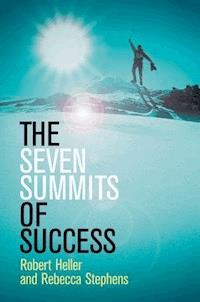
Adding to the above, writes Rebecca, I would like to thank all those who assisted me both mentally and physically up those mountains, and whose names, in the main, appear between the covers of this book. In particular, though, thanks are due to Roger Mear, who first invited me to Everest and unwittingly, perhaps, opened my eyes to a pastime that was to completely turn about my life; and to John Barry, who taught me all that I know about mountaineering. Also to Dave Halton for giving up his chance to climb Aconcagua to look after our sick companion (and whose photo, taken on Vinson, appears on the front cover of this book), to Graham McMahon for dragging me up Carstensz Pyramid, and to Lucy Hannah and Fiona Gately for making their respective climbs such good fun. And to the Sherpas, of course – in particular Chhwang, Ang Passang, Kami Tcheri and Tcheri Zhambu – who enabled me to climb Everest and who I shall thank until the end of my days.
That’s not to forget Peter Earl, who instigated the Everest expedition and successfully secured the funds, and all the companies and individuals who supported us, in particular the whisky people at Glenmorangie who wrote the first sponsorship cheque and gave us hope, and our principal sponsor, DHL International UK Ltd, which funded not only Everest, but also Elbrus, Carstensz Pyramid, Aconcagua and Vinson.
And lastly, to add to those at A.P.Watt and John Wiley who orchestrated the production of this book, my boyfriend, Jovan, who learnt all about the pressure of deadlines and kept his cool.
Rebecca Stephens
INTRODUCTION
Defining the Dream 1
It isn’t often that we get the chance to escape the office for a ten-week break, but the opportunity came my way and I grabbed it. In 1989, I was working for a small, specialist magazine for English-speaking expatriates, when I took a call from a British climber, Roger Mear. He and one other British climber, together with a small band of climbers from Seattle, were off to climb Everest’s North East Ridge. Would I like to join them as a reporter?
‘Well, yes!’ I didn’t pause for breath. And then was fortunate that a chat over lunch with the editor of our parent newspaper, the Financial Times, secured a commission for a series of articles. ‘I’d like to know what is base camp,’ he insisted. ‘We all know the term, but what do people do there? What do they eat? What do they talk about?’
It was a layman’s viewpoint he was after, and I couldn’t have been better positioned to provide it, for at the time I knew very little about mountains, virtually nothing about mountaineering, and less, if that were possible, about mountaineers.
On reflection, I couldn’t possibly have foreseen how completely this assignment to the Himalayas was going to turn my life around. But even in the moment, in the living out of the experience, it proved to be an especially joyous and enriching time. I was 27 years old and my eyes were opened wide as if a student again. Everything was fresh, everything new – and much of it exquisitely beautiful.
One late afternoon, journeying on the road from Kathmandu, north towards the Friendship Bridge and the Tibetan border, the driver of our dilapidated bus stopped short of our proposed destination because of the failing light. It was raining, too, great rivulets of water washing the mud from beneath the wheels of the bus. We stepped out into the wet and up a flight of wooden steps curling around the back of a small wooden teahouse. A lamp beckoned inside and we were led to a small room: three bunks pushed against the walls, a low table with a single candle on a small, chipped saucer, and a window, of sorts. It was a simple, square hole cut in the wood, no glass, and shutters, open to the night.
The rain lashed down on the roof tiles and the smell of the surrounding vegetation infiltrated the room with such forcefulness that, with our eyes shut, we might have been excused for thinking we were lying on the forest floor itself. And there we slept, fully clothed, with a quilt to provide the comfort of a little weight on our tired limbs, until dawn broke and we set out on our way again.
It instilled in me a sense of freedom that was only to be magnified at Everest’s base camp and beyond. Here, with no responsibilities other than to write an article or two, I would wander the moraine banks of the East and Central Rongbuk Glaciers with little concern about the passing of time, knowing that if I didn’t make camp I could always roll out my bivouac bag and sleep exactly where I found myself.
It was in sharp contrast to the tightly scheduled working and social environs of home, and I found it immensely attractive. I liked the simplicity of life away from the telephone and nagging deadlines. I liked the challenge of making myself at home, and comfortable, with no more than could be jammed into a single rucksack. And more than anything, I liked where I found myself, surrounded by the highest mountains in the world.
There is, of course, an austerity to the landscape at high altitudes: barren rock, and ice; the colours, taupe, beige, brown, white, blue. No green to give any hope of life. And yet there is clarity of light – a filter of heavy atmosphere lifted from the air – that razor-sharpens edges and draws distant ridges impossibly near. And there’s the scale of things: a vastness that makes one feel at once humbly insignificant and, paradoxically, acutely alive and confident of one’s place in the world. I had never felt better in my life. Only one thing made me feel a little displaced in this new world I had happened upon, and that was my companions – or more accurately, my companions’ focus and palpable passion to climb Everest.
There must have been at least a hundred climbers at the base camp on Everest’s northern reaches that year – plus several tens of Sherpas climbing in support – and with the exception of a few Tibetan yak herders, an expedition doctor or two and one other journalist, every one of them was there with the sole purpose of climbing this mountain.
Did they know the sacrifices they were making? Or, indeed, the risks to life and limb? I soon learned that few of these climbers held down steady jobs or family lives. And who could be surprised? It surely couldn’t be much fun for those left at home, holding the fort in Tokyo, or Bulgaria, or the Lake District, incommunicado for months at a time (this was before the days of satellite communication), without knowing if their loved ones were alive or dead. For the reality is that death is far from being a rare event in the high mountains. From the early reconnaissance expeditions in the 1920s, when seven Sherpas lost their lives, to the present day, people die high on Everest with tragic regularity. Whatever climbers say, it is more dangerous than crossing the road.
So why do climbers risk their all in the quest to scale an oversized lump of rock? Why do climbers climb? I had been around these people long enough, puzzled but also impressed by their focus, that I wanted to know the answer to this question. And there was only one way to find out: to climb myself.
At the point when this idea struck me I had already been once to a camp the climbers dubbed ABC – advanced base camp. ABC is at an altitude of 6,450m (21,160ft) and although a mere 1,300m (4,265ft) higher than the base camp, it is thirteen horizontal miles from the latter – a long old slog along the lateral moraine of the East Rongbuk Glacier and exhausting for mountaineer and journalist alike. Nonetheless, if I were to add that yaks, too, bearing loads of camping, cooking and oxygen apparatus make the same journey on four delicate hooves, it will be clear that there is nothing on the journey that might be classified as technical.
It was no surprise, then, to any of the climbers on the expedition, that I might join them to this point – or that I might return a second time to ABC, as was my plan. But to go higher? That was a different matter.
‘They’ll think you mad at home,’ muttered Tim, one of the American climbers. Perched on a couple of rocks, we looked out from the camp, across the upper reaches of the East Rongbuk Glacier towards the first feature on the North East Ridge: Bill’s Buttress. The buttress rises straight from the level plains of the glacier at a rakish angle of some 40° for about 680m (2,230ft). At its apex the angle of the ridge changes, like a refracted beam of light, and continues in a diagonal sweep over a cluster of saw-toothed pinnacles towards the summit.
Bill’s Buttress, in effect, is the first step onto the North East Ridge. At the top of this step the climbers had pitched a single tent: Camp 1. This, I decided, was to be my goal, my ‘summit’. At 7,125m (23,380ft) it was a long way from the true summit at 8,848m (29,028ft), but it was high enough to feel the debilitating effects of altitude, and steep enough – on mixed ground of snow and rock – to try out some technical climbing, albeit at an elementary level.
‘You’ll be on your own, kid,’ Tim added. ‘Fall sick up there and there’ll be no one in any state to help you down.’
This wasn’t news that I welcomed. Only the day before Tim had been encouraging. He was the one who had taken the trouble to teach me the ropes, literally as it happens: how to jumar up them using a friction device, and abseil down, full body-weight leaning out from the mountain.
But I realized quickly enough that it wasn’t the technical side of things that gave him concern. His reticence was because of the altitude. He was spelling out the risks to me as a surgeon might to a patient prior to undertaking an operation. There was mountain sickness to consider, he pointed out, and pulmonary oedema. Even cerebral oedema. Frostbite and hypothermia, too.
‘I’m trying to help, that’s all,’ he said. ‘You should think about it.’ Well, I did. ‘So you’re climbing to Camp 1?’ chipped in Chhwang, the lead Sherpa on our expedition. ‘I suppose so,’ I said. ‘Then you’ll need kit.’
This was a small point that I had overlooked. I had fleeces and a pair of leather walking boots – my first, bought especially for the trip – and a ski jacket borrowed from a friend, but that was it.
Chhwang was heading down to base camp, his rucksack already packed. But now he was ferreting deep inside and emptying its contents onto the rocks. ‘Here,’ he said, handing me his plastic mountain boots and his crampons, his harness and his ice-axe. ‘I wish I was climbing with you.’
A few days passed before I mustered the energy to put into action what I had set out in my mind to do. I was only just learning about the effects of altitude but at 6,450m (21,160ft) the oxygen levels in the air are considerably reduced – less than half that at sea level. There were days when I felt I could bounce from my makeshift home in the store tent, and others when I could barely lift my body off the floor – in large part due to a subtle swing in barometric pressure.
There was one morning, though, when the barometer swung in our favour – and the sun shone, too. Tim, who I might have climbed with, had already made his way to Camp 1, and it was with another of the Americans, Kurt, that I roped up and stepped off the moraine and onto the glacier.
It was a surprising place to be – like nowhere I had been before. Empty. Silent, but for the crunching of our own footsteps through the snow. Before long we had left the camp far behind, and the glacier stretched out before us in every direction, like a vast white sheet, a nothingness, but for long, oblong crevasses that lay dark and silent in the snow.
After a short while we had crossed the glacier and stood at the foot of Bill’s Buttress. This is where the test began. The climbers had already fixed rope the length of the ridge from bottom to top. We clipped our jumars onto the rope. Kurt set off and I followed, deliberately placing one cramponed boot in the deep bucket steps he kicked in the snow, and then another.
Progress was good at the start. As the sun climbed in the sky so we climbed higher, each incremental gain in height rewarded with an ever more bewildering view as one distant Himalayan peak popped up behind another, each gleaming a blinding white in the sunshine.
But things change all too quickly in the mountains, as I was to learn. One minute we were squinting into the sunlight; the next, snow was falling in large puffed-up flakes around us, masking our vision and chilling us to the core. The ground was steep. The air was uncomfortably thin; such that I was forced to rest, catch breath, regroup, with every step. And there was no view, no inspiration to struggle on – just a cold, silent greyness, punctuated by the eerie rumbling of avalanches sloughing off unseen slopes.
Alone, I have no doubt that I would have turned about in my steps and clung tight to the ropes all the way back down to camp. The effort to keep going was enormous. Even within twenty metres of our tent – our refuge – I leaned back in my harness and rested on the rope for ten minutes or more, before I could finally muster the energy for the last few paces. But, after seven hours of battling with gravity, heaving the weight of our bodies against its force, we made it.
Tim, my tutor, was in the tent awaiting our arrival. He had been attempting to blaze a trail beyond Camp 1 towards the Pinnacles, but was taking a break for a while, due to a fresh, heavy dump of snow. I collapsed into the tent and beamed a smile that might have cracked my face in two. The relief, the unabashed pride I felt in having elevated myself to this isolated, lofty place, was overwhelming.
Tim passed me a mug of sweetened milk, a square of chocolate, and the flavours burst on my tongue in a rush. Every sense, it seemed, was heightened; everything intensified. I sat on the floor of the tent, looking out into the greyness and falling snow, up a broad ridge burdened with a heavy caking of snow, towards the Pinnacles. Beyond them was the highest point on Earth. How, I marvelled, had I found myself here?
REFLECTIONS
Looking back, that day on Bill’s Buttress was an experience unparalleled in my life: the remoteness and beauty, the pushing of physical limits, the extreme turns in the weather, the relief and the sheer, unadulterated joy. I have a photograph of myself, sitting outside the tent at 7,125m (23,380ft), smiling, with snowflakes falling across my face and in my hair. I look unreservedly delighted to be there.
But that venture onto Everest’s North East Ridge was more than a good day out. Something profound changed in me that day. Firstly, in the doing, I had an answer to my question, ‘why do climbers climb?’ More than that, indeed: it seemed that I, too, had been bitten by the mountaineering bug and wanted more.
And secondly – more importantly – it triggered a sequence of thoughts that led me to know for the first time in my life exactly what it was that I wanted to do. Somewhere on Bill’s Buttress – whistling down the ropes, or lolloping polar bear-like in the fresh, thigh-deep snow on the lower slopes – a germ of an idea was hatched. I wanted to climb Mount Everest – an ambition that in time was to lead to a further ambition: to climb the Seven Summits.
To climb Everest was a bold ambition, perhaps, for one who had climbed only a single day in her life. But one that in the course of a few weeks, or months, I felt with complete conviction. I had discovered something that I loved, and this I believed – in my innocence, perhaps – was enough to drive me to acquire the requisite skills and make it happen.
As an abserver on that first expedition I was already beginning to make a few suppositions about what it took to climb the highest mountain in the world. Nobody reached the summit that year. The snow was so plentiful, so deep, that it proved impossible for the climbers to wade through it at extreme altitude. In the mountains, as in life, there are some things outside our control. But nonetheless it was clear to me that those climbers who reached the loftiest points weren’t necessarily those who were equipped with the fittest body, or who were the most competent in rock and ice-climbing skills – although fitness and skill clearly played a part – but those who most passionately wanted to climb the mountain. It was written in their faces and in every move they made. Desire was the driving force.
In a way it was a surprise to me that I, too, developed this keen desire to climb Everest, for until this point I had rather wandered through life, expressing very little conviction for anything. Decisions at various crossroads of my life had been made on the basis of what I should do, or even what other people felt I should do, in order to give me what might be perceived as the best opportunities in life.
But Everest was different. There were no ‘shoulds’ about Everest. Quite the contrary; at the outset the whole venture looked professionally suicidal and for my health and safety, ill-advised. But it was something that had totally captured my imagination. To climb it was a want that bubbled up from within me, an intrinsic want. It was nothing that was put upon me by an external force.
We forget sometimes, but it is an authentic wish to do something, different for every individual, that energizes and inspires us. We love it, thus we do it.
It is often said that to have a vision – to be able to define clearly what it is we want to achieve – is all-important if we want success. This is true. But it is my belief that we need a very special sort of vision if we want to enjoy the journey on the road to achievement and perform absolutely to our best. We need a vision that is aligned to our intrinsic wants.
Defining the Dream 2
When Soichiro Honda developed his first truly commercial motorbike, a modest two-stroke model, he and his colleagues were celebrating the birth of the still unnamed machine. ‘It’s a dream!’ said the wildly happy inventor. ‘The Dream’ promptly became the bike’s name. Everybody has day-dreams of success and glory, and everybody has had moments, however small and fleeting, of dream realization.
But most people can also recall times when, if only they had backed their own instinct and judgement, they could have entered a future bonanza on the ground floor. Take the world’s best-selling toys. Most of them were not so much invented as discovered, by men who noticed non-commercial phenomena (like children playing happily with pencils and empty thread spools) and dreamt up a related product that would sell in the millions. All the discoverers asked themselves the same question: Why wouldn’t other children share the same pleasure?
Defining the dream always starts with an explicit or implicit ‘Why?’ The section above shows that Rebecca’s Why? on her initial journey to Everest was natural for a journalist. Why do climbers climb? It seemed logical to try a little climbing to find the answer. A walk to the Advanced Base Camp at 6,450m (21,160ft) wasn’t enough to fulfil the need. So she set herself to make a real climb, taking her to Camp 1. Getting to 7,125m (23,380ft) was a gruelling physical and mental test.
But there, as she writes so vividly, she found her answer. Knowing now why climbers climbed, she had also found her own dream: to come back to Everest and reach its (and her) summit. You don’t have to wait for an epiphany to define the dream. Answering some straightforward questions about yourself and the organization in which you work establishes what you and your colleagues can do and truly want to do – with a passion.
Rebecca’s dream and mine had a starting point in common. We were both connected with the Financial Times, though in very different eras. The paper sent her to the Base Camp on Everest from which she literally and metaphorically began her ascent. And the FT sent me to New York, as its one and only correspondent in the whole, staggering, gigantic United States of America.
At that point the US was staggering in more senses than one. President Eisenhower’s highly conservative economics team had engineered an uncomfortable recession. Not that I was a great authority on such matters. I knew nothing of economics save what I had digested of Paul Samuelson’s monumental tome – read while crossing in luxury on the Dutch liner, SS Statendam. So long as the FT was paying for this sybaritic First Class travel, I thought I should do some work on its behalf.
True, the great Samuelson didn’t empower me to interpret the bear market then bothering Wall Street. But I was very soon to learn that nobody was so empowered. Thus, when the market rallied, the pundits explained the rise by hopes that a worsening Cold War would stimulate defence spending. Fine. When the market shortly thereafter suffered a relapse, though, the pundits were ready with an explanation; more or less the same one. The worsening Cold War, it was now feared, would become Hot – and real wars are bad for business.
I asked myself that great three-letter word: Why? Why were the pundits self-evidently wrong? And I realized, a neophyte on Wall Street, but a willing student of American capitalism, that writing about current events was no different from the historical studies which had delighted me at Christ’s Hospital and Jesus College, Cambridge. When interpreting history, clever people, even the most eminent historians, saw what they wanted to see, not what actually was – whatever that might be.
Historical truths are not absolute entities. Today’s truth is often tomorrow’s falsehood, and vice versa. This discovery was little use in my first three years on the FT. Writing about such matters as the output of iron castings left little room for interpretation, and even when I graduated to larger matters, like iron and steel production itself, the FT‘s approach to its subject matter was then too constipated to excite anyone – certainly not me.
I wanted above all to write. Writing seemed to me, as it does still, a summit of the human mind. What climbing became to Rebecca, writing had been for me from the beginning of my remembered time. But what should I write? At school and university, in addition to work, I had poured forth poems, short stories, satires, reviews, even a gossip column – shared with the future film and stage writer Stanley Price, a sidesplitting humorist. Our piece of weekly juvenilia was published in Varsity, the student newspaper, and in hindsight both the column and my previous editing of the school magazine pointed in the same direction; journalism.
My ability must have been greater than I thought, for I was only 26 when Sir Gordon Newton, an editor of deserved renown, sent me to New York. Everything that followed had this as starting point. The US dominated the world of business as mightily as, in the early twenty-first century, it loomed, the sole superpower, over the geopolitical stage. Both dominions, it turned out, were built on shakier foundations than initially appeared. But history had taught me that even the greatest power always has limits, and that efforts to transcend those limits are always (and inevitably) self-defeating.
Peter M. Senge, a star professor at MIT, found the same phenomenon in companies which sought to exceed ‘the limits to growth’. As he wrote: ‘No matter how hard you push, the system pushes back harder’. That pregnant sentence lay far in the future in 1968 when the Statendam deposited me on the New York waterfront. I was soon trying to make journalistic sense of the large events that unfolded around me, including above all the epic struggle between Good and Evil, symbolized respectively by John F. Kennedy and Richard M. Nixon.
Rarely had black seemed blacker or white whiter – but that, of course, proved to be self-deception when the truth about Kennedy’s political impotence and over-exercised sexual potency became clear. Just as history teaches, things are never what they seem to be. And that included the supremacy of American business. It was founded, so the story ran, on the superiority of American management, sustained by marvellous business schools; honed by the ruthless cut-and-thrust of commercial competition; conducted within a political system whose checks and balances automatically combined freedom and firm government, liberty and the rule of law.
There was some truth in this laudatory verdict, but also illusion and delusion. Much of the apparent strength of US business was not based on superior management, and still less on vibrant competition. With huge, protected shares of the largest market in the world, US companies had little to fear. There was no incentive to improve management practices that were sloppy and ineffective (as the Japanese were to prove). And, as President Eisenhower amazingly warned in his valedictory address, the military-industrial complex held the great democracy in a thoroughly undemocratic grasp.
Returning to the FT home base after three years, I had no opportunity to build on these perceptions. I ran a gossip column again (but this time for real, not for undergraduate fun). Men and Matters made me a kind of licensed jester in London. The paper’s style and content had lightened up most remarkably in my absence, and the FT, with its richly talented staff, was now in the mainstream of Fleet Street. After two years on the column, though, I thought it time for me to go – and so, fortunately, did the Observer.
This was my spiritual home, as for all soi-disant right-thinking liberal intellectuals. I was wanted to edit what other papers called the City pages. The word ‘City’ stuck in the Observer’s politically correct throat, but the unit trust advertising was too large and valuable to forgo: so the section was labelled Business (as it still is). The Observer’s strategic need was obvious: producing authoritative coverage of business, financial and economic affairs to convince advertisers that the newspaper took the City seriously.
In some ways, I was the wrong person for the job. I had never covered the City, except peripherally; had few contacts; and had not the faintest idea what to do. In desperation, I turned to what I could do – write feature articles and personalized diary pieces – and married the twain. Thus I gave birth (anyway, so I claim) to the personalized coverage of these affairs that rapidly became the norm. It clicked, and so did my career.




