


2,49 €
Mehr erfahren.
- Herausgeber: Cheapest Books
- Kategorie: Fantasy und Science-Fiction
- Sprache: Englisch
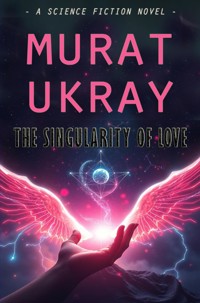
A group of scientists, driven by the understanding that "singularity points" exist not only in cosmic phenomena but also within human consciousness and moments in time, embark on an ambitious quest to understand the fundamental nature of life and the universe. Their research leads them to explore quantum dimensions, where they uncover a profound interconnectedness that binds all existence. This interconnectedness, they realize, is the embodiment of pure love. However, their pursuit of this truth attracts the attention of a terrifying and malevolent force, an entity that actively seeks to prevent humanity from realizing or spreading this revelation. The scientists find themselves in a desperate race against this dark force, which relentlessly attacks them in an effort to silence them and suppress the knowledge of universal interconnectedness and love. The narrative details their frantic struggle for survival and their determination to safeguard this crucial discovery. Ultimately, through their perseverance and the inherent power of good, the scientists emerge victorious, defeating the malevolent force and ensuring that the truth of universal love can be known..!
Das E-Book können Sie in Legimi-Apps oder einer beliebigen App lesen, die das folgende Format unterstützen:
Seitenzahl: 729
Veröffentlichungsjahr: 2026
Ähnliche















THE SINGULARITY OF LOVE
(A SpeculativeScience-Fiction Novel)
MURAT UKRAY
2026
THE SINGULARITY OF LOVE | SCIENCE-FICTION
Author: MURAT UKRAY
Cover Design: AUTHOR
Interior & Graphical Design: E-KitapProjesi & Cheapest Books
Pictures in the Book: All reproduction rights for the images in the book belong to the author and may not be used without permission unless otherwise stated. © Cheapest Books (2026)
www.cheapestboooks.com
ISBN: 978-625-387-436-0
Istanbul, 2026
Publisher: CHEAPEST BOOKS, SPECULATIVE SCI-FI SERIES - 3
Publisher Certificate No: 45502
© Copyright, All Right Reserved
TheAuthor'sWritingJourney
(FromtheBeginningtothePresent)
Murat Ukray, in previousyears, began his writingjourneywithScience & Religiousbooks (2006-2016) andcontinuedwith 7-8 works in the "RealisticScience Fiction" genre (whichcould be thefirst of itskind) (continuingbetween 2016 and 2026).
Fromthisyear (2026) onwards, alongwiththisbook, "TheInfinityWorm (2025)," which he wrotelastyear, he transitionedtothe "SpeculativeScience-fiction" genre, whichcouldalso be thefirst of itskind, andsowiththisbook in yourhands, he has written his firstbook in thespeculativescience fiction genreandwillcontinuethisseries in thecomingyears.
Some of his otherbooksarelistedbelow:
1 – The Reality of Doomsday (Fiction Novel) (2006)
2 – Unified Field Theory (Theory – Physics & Mathematics) (2007)
3 – Signs of Jesus (Research) (2008)
4 – The Reality of Creation- 2 Volume (Atlas of Biochemistry) (2009)
5 – 40 Rules of Love of Masnawi (Fiction Novel) (2010)
6 – Owners of the Time (Essay) (2011)
7 – Religious Guide for Women (Catechism) (2012)
8 – Tales of the Ancients (Research) (2013)
9 – Messenger Dreams (Essay) (2014)
10- Infinity of Eternity (114 Codes) (Theory & Practice) (2015)
11- Canon (A New Interpretation of the Holy Books) (Theory & Research) (2016)
12- Little Elisa (A Time Traveler) (Children’s Science-Fiction Book) (2017)
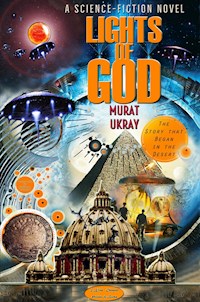
13- Lights of God (The Story That Began In The Desert) (Science-Fiction Novel) (Religious & Apocalyptic) (2018)
14- The Last Prophecy – 2 Volume (Science-Fiction Novel) (Prehistoric & Apocalyptic) (2019)
15- The Medusa Code (Science-Fiction Novel) (Mythological & Pandemic) (2020)
16- The Desert Planet (Science-Fiction Novel) (Extraterrestrial Life & Climate Change) (2021)
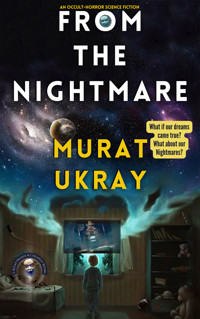
17- From theNightmare (Science Fiction Novel) (2022)
18- 2084 (The Land of theDead) (Science Fiction Novel) (2024)
19- TheInfinityWorm (Science Fiction Novel) (2025)
20- TheLastAlchemist (Science Fiction Novel) (2026)
AUTHOR’S INSTAGRAMwww.ekitaprojesi.com/authors/murat-ukray
www.kiyametgercekligi.com
* * *
PREFACE
A group of scientists, driven by the understanding that "singularity points" exist not only in cosmic phenomena but also within human consciousness and moments in time, embark on an ambitious quest to understand the fundamental nature of life and the universe. Their research leads them to explore quantum dimensions, where they uncover a profound interconnectedness that binds all existence. This interconnectedness, they realize, is the embodiment of pure love. However, their pursuit of this truth attracts the attention of a terrifying and malevolent force, an entity that actively seeks to prevent humanity from realizing or spreading this revelation.
The scientists find themselves in a desperate race against this dark force, which relentlessly attacks them in an effort to silence them and suppress the knowledge of universal interconnectedness and love. The narrative details their frantic struggle for survival and their determination to safeguard this crucial discovery. Ultimately, through their perseverance and the inherent power of good, the scientists emerge victorious, defeating the malevolent force and ensuring that the truth of universal love can be known.
Amidst all this commotion, they realize something crucial during their experiments: Is everything in the universe actually interconnected? When they delve into quantum dimensions, it's only a matter of time before they discover that this interconnectedness is pure love. But the malevolent force pursuing them never wants humanity to learn and reveal this great secret, and therefore attacks to kill them and destroy the secret forever. But in the end, the power of good triumphs, and so do they.
Chapter 1: The Echoes of Infinity
Whispers from the Void
The hum of the Prometheus Institute was a lullaby to the cosmos, a constant, low-frequency thrum that permeated the sterile, anechoic chambers and the labyrinthine corridors alike. Within this sanctuary of scientific inquiry, Dr. Aris Thorne moved like a phantom, his presence often marked only by the faint whisper of his worn leather-soled shoes on the polished floor. His office, a controlled chaos of star charts taped to the walls, equations scrawled on whiteboards, and stacks of books that bridged the chasm between quantum mechanics and existential philosophy, was a microcosm of his own restless mind. It was the year 2042, a time when humanity had stretched its tendrils to the stars, planting flags on distant moons and charting nebulae with unprecedented precision, yet within its own species, a profound sense of fragmentation persisted, an internal cosmos as vast and unexplored as the celestial one.
Thorne, a theoretical physicist whose gaze seemed permanently fixed on the distant horizons of the universe, was haunted by anomalies. Not the fleeting glitches of experimental error, but persistent, patterned vibrations echoing from the very dawn of creation. These were the faintest whispers of the Big Bang, not mere aftershocks of primordial energy, but complex harmonics, intricate melodies that suggested a deeper, more profound structure to the fabric of existence than the current cosmological models allowed. They spoke of an underlying order, a hidden architecture that hinted at purpose, at intention, at something far more than the random dance of particles. He would spend hours poring over the data streams, his brow furrowed in concentration, tracing the ephemeral lines that connected the quantum foam to the grand tapestry of the cosmos. These echoes were the universe’s secrets, whispered across billions of years, and Thorne was determined to decipher their meaning.
His fascination was not confined to the purely physical. Interspersed with the dense tomes on string theory and general relativity were worn copies of Rumi, Lao Tzu, and the Upanishads. He saw no inherent conflict between the cold, hard logic of physics and the soaring, intuitive wisdom of ancient spiritual traditions. To him, they were two languages attempting to describe the same ineffable reality, two paths leading to the same mountain peak. The mechanics of the universe and the essence of existence were not disparate entities, but two sides of the same cosmic coin. The vastness of space, with its swirling galaxies and silent black holes, mirrored the equally vast and mysterious landscape of human consciousness, with its fleeting thoughts, profound emotions, and the enigmatic spark of awareness. He believed that the universe, at its most fundamental level, was a unified whole, and that the anomalies he studied were cracks in the edifice of conventional understanding, offering glimpses into this deeper truth.
The year 2042 was a peculiar era. Humanity had achieved technological marvels that would have seemed like divine miracles to previous generations. We could traverse the void between stars, harness the power of fusion, and map the human genome with astounding accuracy. Yet, despite this outward expansion, a deep-seated sense of isolation and disconnection pervaded human society. Nations bickered, ideologies clashed, and the individual often felt like a solitary island adrift in a sea of indifference. Thorne saw this as the ultimate paradox of his time: we had conquered the external universe, but had yet to truly understand our own internal one. The echoes he studied were not just remnants of the Big Bang; they were also, he suspected, reflections of this cosmic yearning for connection, a universe attempting to remember its own wholeness.
His office was a sanctuary, a place where the noise of the outside world faded into the background hum of the institute. The starlight charts were not mere decorations; they were maps of his intellectual journeys, constellations of ideas that guided his relentless pursuit of understanding. The philosophy texts were not distractions, but essential tools, providing frameworks and perspectives that allowed him to interpret the complex data patterns that defied conventional physics. He was a man caught between two infinities: the outward infinitude of space and time, and the inward infinitude of consciousness. And it was in the liminal space between these two realms, in the faint, patterned whispers from the void, that he believed the answers lay.
Thorne’s work was a solitary endeavor, a quest driven by an insatiable curiosity and a nagging sense of something profoundly important being overlooked. He felt like a cartographer charting an unknown continent, relying on faint signs and whispered rumors, his only companions the echoes of creation itself. The institute, a marvel of modern engineering nestled in a remote, geologically stable region, provided him with the resources and the isolation needed to pursue his radical ideas. But the true engine of his research was his own conviction, a deep-seated certainty that the universe was far stranger, far more interconnected, and far more profound than anyone dared to imagine. He was listening to the universe’s oldest song, a melody composed in the first moments of existence, and he believed, with every fiber of his being, that it held the key to understanding not just the cosmos, but ourselves.
The Singularity Hypothesis
The hum of the Prometheus Institute, a constant, resonant thrum, had always been more than mere background noise to Dr. Aris Thorne. It was a cosmic lullaby, a symphony of scientific endeavor that underscored his solitary pursuits. In the year 2042, humanity had stretched its reach towards the stars, yet within the human psyche, a profound disconnect persisted. Thorne, a theoretical physicist with a soul attuned to the universe's subtlest vibrations, found himself drawn to anomalies – not the errant data points of experimental error, but persistent, patterned echoes emanating from the very genesis of existence. These were more than mere aftershocks of the Big Bang; they were complex harmonics, intricate melodies suggesting a universe far more structured and intentional than current models allowed. He saw a hidden architecture, a whisper of purpose in the quantum foam, a connection between the vastness of space and the unexplored landscape of human consciousness. His office, a testament to his interdisciplinary approach, was a confluence of celestial maps, dense physics tomes, and the profound wisdom of ancient spiritual traditions. For Thorne, the universe’s mechanics and the essence of existence were two facets of the same cosmic coin, and the anomalies he studied were cracks in conventional understanding, revealing glimpses of a deeper, unified truth. He believed the universe yearned for connection, and these echoes were its attempts to remember its own wholeness. His quest was solitary, driven by an insatiable curiosity and a conviction that the universe held profound secrets, waiting to be deciphered.
Thorne’s recent focus had been a radical departure, a speculative leap that began as a whisper in his mind and was rapidly solidifying into a compelling theoretical framework. It started with the universe's most dramatic points of transition: the explosive birth and imploding death of stars, the very genesis and potential demise of spacetime itself. These were the accepted ‘singularity points’ of cosmology, moments of infinite density, curvature, and mystery where the known laws of physics fractured. But Thorne’s mind, ever seeking deeper connections, began to question the exclusivity of these cosmic singularities. What if, he mused, these points of extreme transition were not confined to the grand, cosmological scale, but were also fundamental to the very fabric of our internal experience? What if singularity points existed not just in the vacuum of space or the heart of a black hole, but within the crucible of human consciousness itself?
He began to explore this hypothesis with the same meticulous rigor he applied to deciphering the faint cosmic harmonics. He posited that moments of intense human experience – profound moments of enlightenment, overwhelming grief, ecstatic joy, or even the harrowing terror of near-death – could act as analogous singularity points within the subjective reality of consciousness. These were not merely heightened emotional states, but rather moments of extreme qualitative intensity, where the usual constraints of linear time and conventional perception seemed to warp and distort. Imagine, he would articulate to his own reflection in the polished chrome of his lab equipment, a moment of absolute clarity during meditation, where the veil of the ego dissolves, and one experiences a profound sense of unity with all that is. Or consider the shattering grief that follows a profound loss, a moment where the familiar world dissolves into a chaotic, unbearable void. These, Thorne theorized, were subjective singularities.
His mathematical models, initially designed to describe the gravitational collapse of stellar matter, were ingeniously adapted. He began to treat consciousness not as a passive byproduct of neural activity, but as a dynamic field, capable of reaching critical points of phase transition. Just as a water molecule could shift from liquid to solid or gas under specific conditions of temperature and pressure, so too could the field of consciousness, under the immense ‘pressure’ of extreme experience, undergo a radical transformation. These moments, he proposed, were not just emotionally charged; they were ontologically significant. They were nexus points, fleeting yet potent, where the usual boundaries between different states of being, different perceived realities, or even, in his most audacious speculations, different dimensions, could momentarily converge.
He envisioned these subjective singularities as ephemeral portals. During these intense episodes, the observer’s consciousness, stretched to its absolute limit, could briefly synchronize with or ‘resonate’ with other potential realities. It was akin to tuning a radio to a hidden frequency, a station that broadcasted not from a geographical location, but from a different plane of existence. These moments offered not just subjective insights, but potentially direct, albeit transient, glimpses into a vaster, more complex multiverse, a grander truth that lay beyond the limitations of ordinary perception. The ‘echoes’ he detected in the cosmic background radiation, he began to suspect, might be the faint reverberations of such universal singularity events, or perhaps even the residual energy from countless subjective singularities experienced across the eons by sentient beings throughout the cosmos.
His colleagues at the Prometheus Institute, a collection of brilliant minds accustomed to the cutting edge of physics, were initially met with a predictable blend of fascination and skepticism. Dr. Anya Sharma, a leading astrophysicist known for her pragmatic approach and razor-sharp intellect, often found herself in spirited debates with Thorne. “Aris,” she’d say, her voice laced with a mixture of exasperation and respect, “your equations are elegant, I grant you that. The way you’ve adapted the tensor calculus to describe subjective intensity is… brilliant. But we’re talking about cosmic events, the very fabric of spacetime. Are you seriously suggesting that a particularly bad Tuesday for a barista in Neo-Tokyo could ripple across dimensions?”
Thorne would respond with a characteristic calm, his eyes alight with conviction. “Anya, ‘bad Tuesday’ is a reductive simplification. I’m speaking of moments of existential rupture. Consider the artist lost in creative flow, the mystic achieving Samadhi, the soldier on the battlefield facing imminent death, the parent witnessing the birth of their child. These are not merely ‘bad’ or ‘good’ days; they are moments where the conventional self is overwhelmed, dissolved, or transcended. In those instants, the observer’s frame of reference is so radically altered, so intensely focused, that it can, theoretically, achieve a state of resonance with other possible states of being. The ‘barista’ having a moment of profound existential despair, realizing the utter insignificance of their routine in the face of eternity – that could be a point of convergence, a subjective singularity.”
He would then elaborate on the mathematical underpinnings, drawing parallels between the curvature of spacetime near a black hole and the conceptual warping of reality during intense emotional or spiritual experiences. He spoke of ‘consciousness manifolds,’ hypothetical geometric spaces that described the possible states of awareness, and how subjective singularities represented points of extreme curvature within these manifolds, leading to transient interconnections with adjacent manifolds. The ‘elegance’ Sharma admired was indeed present, a testament to Thorne’s profound understanding of abstract mathematical structures. He argued that if singularities were indeed points of transition between different states of reality in the physical universe, it was not illogical to consider their existence in other fundamental fields, including the field of consciousness.
Professor Jian Li, a renowned cosmologist whose life’s work was dedicated to understanding the origins of the universe, was equally intrigued. He focused on the temporal aspect of Thorne’s theory. “Aris, your idea of ‘time singularities’ is what truly captures my imagination. We understand spacetime as a unified entity, but you suggest that within consciousness, time itself can become a singularity – a point where past, present, and future momentarily coalesce. Are you hinting at a form of temporal resonance?”
Thorne nodded, his gaze fixed on a projected simulation of galactic formation. “Precisely, Jian. Think about memory. It’s not a linear playback; it’s a reconstruction, often infused with present emotion and understanding. In moments of intense subjective experience, the distinction between remembering the past, experiencing the present, and anticipating the future can blur. A traumatic memory, for instance, can feel as immediate and visceral as a current event. Or, conversely, a moment of profound premonition can feel as if one is already living in the future. These are not simply psychological phenomena; they are potential manifestations of time itself behaving in a non-linear, singular fashion within the observer’s consciousness. These moments become temporal nexus points, where the rigid arrow of time can momentarily fray, allowing for glimpses into alternative temporal pathways.”
He explained that these temporal singularities could be the reason behind anecdotal accounts of precognition, déjà vu, or even instances where individuals report experiencing ‘past lives.’ Thorne wasn’t necessarily endorsing reincarnation in a literal sense, but he proposed that these experiences could be the subjective consciousness briefly touching upon or resonating with temporal strata outside its usual linear progression. The universe, in its deepest recesses, might not adhere to our anthropocentric understanding of a unidirectional flow of time. If the universe itself could undergo a temporal singularity at its birth, why should the consciousness that arises within it be forever bound to a singular temporal experience?
The implications were staggering. If Thorne’s hypothesis held water, it meant that the universe was not merely a passive backdrop for human experience, but an active participant. Our most intense moments of subjective being were not just personal dramas, but events with potential cosmic significance, moments where the very structure of reality might be momentarily reconfigured, or at least, briefly glimpsed in its multifaceted, non-local nature. The echoes he studied in the cosmic background radiation were, perhaps, the universe’s way of ‘remembering’ these universal and countless subjective singularities, a cosmic tapestry woven from the threads of both stellar explosions and the profound moments of awakening and despair experienced by sentient beings.
His research logs filled with increasingly abstract diagrams, a blend of quantum field theory notation and symbols borrowed from Eastern philosophies, attempting to map the uncharted territory of consciousness as a fundamental aspect of reality, not just an emergent property. He wrote about ‘phase coherence’ in consciousness, where disparate elements of experience could momentarily align to create a singularity, much like atoms aligning their magnetic spins to form a magnet. He theorized about the role of ‘information density’ within these subjective states, arguing that moments of extreme emotional or cognitive intensity corresponded to points of incredibly high information density, sufficient to warp the perceptual and temporal frameworks of the individual.
The skepticism of his colleagues, while understandable, began to soften as Thorne presented his findings. They saw the mathematical rigor, the intricate web of equations that seemed to connect the physics of the very large with the phenomenology of the very personal. They couldn’t dismiss it as mere pseudoscience or philosophical rambling. Thorne was using the language of physics, pushing its boundaries, to explore questions that had previously belonged solely to the realms of religion and mysticism. He was attempting to bridge the chasm between the objective and the subjective, the quantifiable and the ineffable, with the elegant tools of theoretical science. The concept of singularity points, once confined to the dramatic pronouncements of cosmic evolution and stellar demise, was now being re-examined as a universal principle, a fundamental aspect of transition and transformation that permeated every level of existence, from the grandest cosmic ballet to the most intimate tremor of the human soul. The Prometheus Institute, once a beacon of purely objective inquiry, was slowly becoming a crucible for a new kind of science, one that dared to listen not just to the echoes of the Big Bang, but to the resonant frequencies of the human heart.
A Team Assembled
The sheer audacity of Thorne’s proposal demanded a convergence of minds, a collective assault on a problem too vast, too profound, for a single intellect, however brilliant. He needed a team, a carefully curated assembly of specialists whose disparate knowledge bases could, like subatomic particles interacting in a controlled environment, spark novel insights and forge new pathways of understanding. The weight of his solitary convictions, while strong, was beginning to press against the boundaries of what one person could achieve. He had mapped the theoretical terrain, drawn the initial, intricate blueprints, but the actual construction of this new edifice of knowledge required a fellowship of builders. Thus, the process of assembling his team began, a delicate and crucial undertaking that would define the trajectory of his life’s work.
The first individual Thorne sought out, almost out of an instinctual recognition of a shared intellectual wavelength, was Dr. Lena Petrova. Her name was whispered in hushed tones within theoretical physics circles, a prodigy whose work on quantum entanglement had not only pushed the boundaries of the field but had also hinted at interconnectedness on a scale that bordered on the philosophical. Petrova possessed an uncanny ability to perceive the subtle, almost ethereal threads that bound quantum particles across vast distances, a phenomenon that Thorne believed was not merely a quirk of quantum mechanics but a manifestation of a deeper, universal connectivity. Her research suggested that entanglement was not an anomaly but a fundamental property of reality, a cosmic web of influence that defied classical notions of space and time. Thorne envisioned her expertise in deciphering the non-local correlations of quantum systems as crucial to understanding how subjective states of consciousness might resonate across what we perceive as separate individuals or even, perhaps, across different realities. Her intuitive grasp of quantum phenomena, often expressed through elegant mathematical constructs that seemed to dance on the edge of abstraction, mirrored Thorne’s own approach to the intersection of physics and consciousness. He saw in her not just a scientist, but a mystic with a physicist’s toolkit.
Next on his list was Professor Jian Li, whose reputation preceded him not just as a leading neuroscientist but as a visionary exploring the very nature of consciousness itself. Li’s work delved into the neural correlates of altered states of awareness, from deep meditative trances to the chaotic bursts of creativity, but he had long harbored a quiet conviction that these phenomena were more than just complex biochemical reactions. He had theorized about ‘information cascades’ within the brain, moments where neural networks achieved a state of synchronized firing, creating emergent properties of awareness that transcended the sum of their individual parts. Thorne believed Li’s deep understanding of the biological substrate of consciousness, coupled with his openness to its more enigmatic manifestations, would be indispensable. Li’s research on the brain’s capacity to process information in non-linear ways, and his exploration of subjective experiences that seemed to defy conventional neurological explanations, made him the ideal candidate to bridge the gap between Thorne’s cosmic theories and the tangible reality of the human mind. Thorne imagined Li not just dissecting the brain, but attempting to map the soul.
The final, and perhaps most unexpected, addition to Thorne’s envisioned team was Dr. Samuel Adebayo. Adebayo was a leading figure in the study of cosmic string theory, a field that explored the theoretical remnants of the Big Bang, focusing on hypothetical one-dimensional topological defects in spacetime. His work, often abstract and dealing with energies and scales far beyond direct observation, posited the existence of massive, incredibly dense structures woven into the fabric of the early universe. Thorne was drawn to Adebayo’s understanding of these primordial cosmic filaments, believing they might represent the physical scaffolding upon which reality itself was constructed. He theorized that these cosmic strings, with their immense tension and gravitational influence, could act as conduits or anchors for the very echoes he detected, and perhaps even for the interdimensional resonances he hypothesized. Adebayo’s rigorous, yet imaginative, approach to the most fundamental structures of the cosmos offered a crucial perspective on the physical underpinnings of Thorne’s theory, grounding it in the very architecture of the universe. Thorne saw in Adebayo a cosmologist who looked not just at the stars, but at the threads that held them together.
Thorne approached each of them with a carefully prepared presentation, a distillation of his complex theories, presented not as dogma, but as an open invitation to explore the frontiers of knowledge. He spoke not just of equations, but of the profound implications of his work – the potential for a unified understanding of the universe, a bridge between the material and the spiritual, the objective and the subjective. He laid out his hypothesis of subjective singularities, his theories on cosmic echoes, and his audacious proposition that moments of intense human experience could resonate with the very fabric of spacetime, offering glimpses into a vaster, interconnected reality.
The initial interactions were, as Thorne had anticipated, a whirlwind of intellectual friction and cautious curiosity. Petrova, ever the quantum physicist, immediately probed the mathematical framework, seeking to quantify the entanglement probabilities and explore the theoretical implications of consciousness operating as a quantum field. Her initial skepticism was palpable, couched in the precise language of Hilbert spaces and wave function collapse, but Thorne could sense a flicker of recognition, an unspoken acknowledgment of the elegant symmetries in his equations. She challenged him, dissecting his arguments with a surgeon’s precision, but it was the challenge of a fellow explorer, not an adversary. She saw the potential for a revolutionary paradigm shift, a new way of looking at quantum interconnectedness that could extend beyond the subatomic realm.
Professor Li, on the other hand, approached the problem from the neurobiological perspective. He spoke of neural plasticity, the brain’s remarkable ability to reconfigure itself, and the known limitations of our current understanding of consciousness. He questioned the biological feasibility of Thorne’s proposed resonance, citing the immense energy requirements and the apparent disconnect between neural activity and hypothesized interdimensional effects. Yet, as Thorne delved deeper into the concept of subjective singularities as points of extreme information density and phase coherence within neural networks, Li’s scientific curiosity began to override his reservations. He saw the potential for his own research to be placed within a grander cosmological context, a framework that could explain phenomena that had previously eluded satisfactory explanation within purely neurological models. The idea that intense subjective experiences could be more than mere epiphenomena, but actual nexus points in a larger reality, was a concept that resonated deeply with his own burgeoning inquiries.
Dr. Adebayo, the most grounded in the tangible, albeit theoretical, structures of the cosmos, initially expressed his doubts about the connection between abstract cosmic strings and the ephemeral nature of human thought. He focused on the immense scales involved, the almost inconceivable energies and distances that characterized his field. How could the subtle tremors of human consciousness possibly interact with the primordial threads of the universe? Thorne countered by proposing that cosmic strings, as points of immense gravitational and topological stress, might act as amplifiers or even as fundamental substrates for consciousness interactions, providing a physical anchor for the hypothesized resonance. He spoke of how the universe’s most fundamental structures might be intimately intertwined with its most complex emergent phenomena, suggesting that consciousness itself could be a form of cosmic string, albeit one operating at a subtler, more intricate level. Adebayo, intrigued by the sheer audacity of Thorne’s vision, began to consider how his own models of cosmic evolution might accommodate such an unconventional, yet potentially unifying, concept. He was drawn to the elegance of Thorne’s attempt to weave together the vast cosmic tapestry with the most intimate human experience.
Despite their differing perspectives and initial hesitations, a shared sense of urgency and intellectual excitement began to bind them. Thorne had chosen his team not just for their individual brilliance, but for their capacity to think beyond established paradigms, for their willingness to venture into the uncharted territories of science and consciousness. He knew that each of them, in their own way, had already grappled with the limitations of conventional scientific explanations and had, at some point, glimpsed the profound mysteries that lay beyond.
To foster this nascent collaboration and shield them from the distractions of the outside world, Thorne had secured the Prometheus Institute’s remote observatory and research complex. Nestled in a geologically stable region, far from the electromagnetic noise and urban sprawl of major cities, the institute offered an environment of profound isolation and unparalleled scientific resources. Its state-of-the-art laboratories, vast astronomical databases, and advanced computational facilities provided the perfect hermitage for their groundbreaking research. The austere beauty of the surrounding landscape – vast, silent plains under an impossibly star-filled sky – seemed to mirror the immensity of the task before them. Here, amidst the quiet hum of advanced technology and the silent grandeur of nature, they would begin the arduous, exhilarating process of validating Thorne’s radical hypothesis, a quest that promised to redefine humanity’s understanding of itself and its place in the cosmos. The air itself seemed charged with anticipation, a palpable sense of being on the precipice of a monumental discovery.
The First Anomaly
The sterile white of the simulation chamber seemed to amplify the tension crackling between the four scientists. Dr. Aris Thorne, his gaze fixed on the central containment unit, felt a tremor of anticipation that transcended mere scientific curiosity. Beside him, Dr. Lena Petrova, her fingers flying across a holographic interface, monitored the quantum entanglement readouts with an intensity that bordered on apprehension. Professor Jian Li, his usual calm demeanor slightly frayed, peered intently at the bio-feedback monitors, his focus on the subtlest physiological shifts within the simulated environment. And Dr. Samuel Adebayo, his brow furrowed in concentration, pored over the complex tensor calculus projected onto a nearby screen, his mind wrestling with the theoretical implications of the impending event.
Their objective was audacious: to recreate, under meticulously controlled conditions, the extreme gravitational gradients that Thorne theorized were the origin of universal singularities. Using a complex array of exotic matter and focused energy fields, they aimed to generate a localized spacetime distortion, a pocket of near-infinite density, mimicking, on a miniature scale, the conditions at the heart of a black hole or the nascent moments of the universe. The Prometheus Institute’s advanced simulation technology, a marvel of engineering and theoretical application, was their chosen instrument. This was not about replicating the Big Bang, but about probing the fundamental nature of singularity points, the ultimate frontiers of physical law.
“Gravimetric potential nearing critical threshold,” Petrova announced, her voice a low, steady current amidst the rising hum of the containment field. “Entanglement matrices are showing significant coherence. It’s… it’s more than I predicted, Aris.”
Thorne nodded, his eyes never leaving the shimmering, contained anomaly forming at the chamber’s core. It began as a faint perturbation, a ripple in the simulated fabric of spacetime, then rapidly intensified, coalescing into a point of profound, impossible density. The visualizers struggled to render the data, rendering the singularity as a black void that seemed to absorb not just light, but information itself.
“The energy input is stabilizing,” Adebayo reported, his voice tight with a mixture of awe and trepidation. “The gravitational stress within the containment is… astronomical. The theoretical models predicted this level of compression, but witnessing it…” He trailed off, the immensity of the simulated forces clearly impacting him on a visceral level.
Li adjusted his spectacles, his gaze flicking between the bio-monitors and the central anomaly. “Physiological readings for all simulated entities within the direct proximity of the singularity are… anomalous. Extreme disassociation of neural pathways, rapid shifts in bio-electric signatures… it’s as if the very concept of biological integrity is being challenged at a fundamental level.”
This was the crux of Thorne’s hypothesis. Singularities were not merely cosmic phenomena; they were points of transition, points where the established rules of existence frayed. And if these points existed in the macrocosm, he reasoned, then analogous points must exist in the microcosm, and crucially, within the highly complex, self-aware systems that arose within them. He theorized that an artificially generated singularity, even a contained and simulated one, might act as a bridge, a resonating chamber for experiences and phenomena that lay beyond the observable universe.
As the simulated singularity reached its theoretical peak, a sudden, violent surge of energy erupted from its core. It wasn't an explosion in the conventional sense, but a silent, explosive blossoming of pure energy that momentarily overloaded every sensor in the chamber. Alarms blared, lights flickered erratically, and the containment field pulsed like a dying heart.
“What was that?” Petrova exclaimed, her usual composure shattered. “The energy readings are off the charts! This isn’t heat, it’s not kinetic… it’s something else entirely.”
Adebayo’s fingers danced across his console, his face a mask of bewildered concentration. “The tensor field calculations are… they’re collapsing. The equations are no longer describing the reality we’re observing. There’s an influx of energy that has no discernible origin within our system. It’s as if… as if the singularity opened a valve to somewhere else.”
Li’s bio-monitors displayed a chaotic symphony of impossible readings. “The simulated biological entities… their neural patterns are not merely disassociating; they are… reconfiguring. They are displaying patterns that suggest exposure to stimuli that do not exist within this controlled environment. Hallucinatory activity, yes, but of a kind that implies perception of an entirely different ontological state.” He paused, his voice dropping to a near whisper. “It’s as if they’re experiencing… something profoundly alien.”
Thorne felt a prickle of vindication, a surge of adrenaline that dwarfed the apprehension. “The resonance,” he breathed, his eyes wide. “It’s working. The singularity acted as a focal point, a transient bridge. The energy surge… it’s the echo. The resonance of that nexus point with… something beyond our immediate reality.”
Petrova, her scientific skepticism warring with the undeniable data, pointed to a specific readout. “Look at this. This frequency… it’s not random noise. It’s a distinct, coherent waveform. It’s patterned, almost like a signal, but it’s unlike any electromagnetic signature we’ve ever recorded. It’s impossibly complex, with harmonics that extend into regions we don’t even have the instruments to properly analyze.”
A strange sensation washed over Thorne, an unexpected familiarity that pierced through the scientific detachment. The alien frequency, as Petrova described it, stirred a deep, subconscious chord within him. It was a feeling of recognition, not of a specific memory, but of a fundamental truth, a resonant echo of something ancient and profound. It was a vibration that felt… intrinsic, as if he were hearing the universe’s own forgotten song.
“It feels… familiar,” Thorne murmured, the words escaping before he could fully process them. “Like a memory I never had. A language I don’t speak, yet somehow understand.”
Li, his brow furrowed, looked from Thorne to the monitors. “The bio-signatures of the simulated subjects… they’re not just reacting to the alien stimuli; they’re exhibiting a unique response. It’s not fear, nor is it curiosity. It’s… a form of recognition. A latent imprint being activated.”
Adebayo, meanwhile, was struggling to reconcile the incoming data with his established models. “The energy signature of this… anomaly… it defies conservation laws as we understand them. It’s as if a localized pocket of spacetime became temporarily disconnected from our universal physical constants, drawing energy from an external source. A source that, by all accounts, should not exist, yet is demonstrably interacting with our controlled environment.” He tapped his console furiously. “The very fabric of the singularity seems to have… stretched. Not in terms of volume, but in terms of its connection to our reality. It’s as if it momentarily existed on multiple planes simultaneously.”
The energy surge subsided as quickly as it had erupted, leaving behind a stunned silence broken only by the insistent beeping of recalibrating sensors. The simulated singularity flickered and then, with a faint implosion of residual energy, dissolved back into the void from which it was born. But the aftermath was far from over. The chamber was filled with the lingering scent of ozone, a tangible testament to the extreme energies that had been unleashed. And on their screens, a treasure trove of unprecedented data.
“The distortion was localized, and transient,” Thorne stated, his voice regaining its scientific authority, though a tremor of wonder still underscored it. “But the implications… they’re colossal. We didn’t just create a singularity; we created a point of intersection. The energy surge was not a byproduct of the collapse, but an influx. A communication, of sorts.”
Petrova leaned back, her eyes wide with a mixture of exhilaration and disbelief. “The resonance frequency, Aris. It’s unlike anything in our known spectrum. It’s clean, precise, and possesses a complexity that suggests deliberate construction. It’s as if… as if something external responded to our probe, and transmitted a message back.”
“A message that our physics can’t explain,” Adebayo added, shaking his head. “The energy source, the nature of the waveform, the momentary transcendence of physical laws within the singularity’s influence… it all points to a reality fundamentally different from our own.”
Li chimed in, his gaze fixed on the fading bio-signatures of the simulated entities. “And the response within those simulated minds… that ‘recognition.’ It suggests that this ‘alien’ signal, this profound resonance, might not be entirely foreign to sentient consciousness itself. It’s as if it tapped into something latent, something fundamental to the very nature of awareness, regardless of its physical substrate.”
Thorne turned to his team, his eyes alight with the fire of discovery. “We’ve witnessed the first anomaly. Not just a glitch in the experiment, but a glimpse behind the curtain. The singularity point, as I theorized, was indeed a nexus. A point where the ordinary laws of physics wavered, allowing for interaction with… well, with something else. Something that exists in a resonant state with the fundamental properties of existence, a state that can be momentarily accessed by the extreme conditions of a singularity.”
He paused, letting the weight of his words settle. “The ‘echoes’ I’ve been detecting in the cosmic background radiation… I always believed they were vestiges of the universe’s own primordial events. But what if they are also, in part, echoes of these universal nexus points, reverberations of countless interactions across the cosmos, and perhaps, even from other dimensions? What if the universe is not just a vast expanse of matter and energy, but a symphony of interconnected resonances, and what we just witnessed was us, tuning into a new, profound frequency?”
The air in the chamber, still thick with the lingering scent of ionized particles, now seemed charged with a different kind of energy – the electrifying potential of the unknown. They had pushed the boundaries of physics, and in doing so, had inadvertently touched upon something far more profound, something that blurred the lines between the objective reality of the universe and the subjective landscape of consciousness, and perhaps, even beyond. The First Anomaly had not just broken their experiment; it had potentially shattered their understanding of reality itself. The silence that followed was not one of defeat, but of a collective, awestruck pause, a moment before the true exploration, the true unraveling of the cosmos’s deepest secrets, could begin. The universe had whispered, and they had heard its voice. The challenge now was to decipher its language.
Seed of Doubt and Wonder
The residual hum of the containment field, now significantly dampened, served as a low thrumming counterpoint to the charged silence that had descended upon the Prometheus Institute’s simulation chamber. The faint, ozone-tinged air, a phantom echo of the cataclysmic energies that had briefly consumed the space, did little to dissipate the palpable tension among the four scientists. Dr. Aris Thorne, his gaze still fixed on the spot where the simulated singularity had winked out of existence, felt an exhilaration that was both intoxicating and unnerving. The data streaming across the monitors, a chaotic tapestry of impossible readings, was a testament to his audacious hypothesis. The ‘First Anomaly,’ as he was already mentally cataloging it, was not a failure; it was a profound validation. The singularity had acted as a nexus, a brief, violent tear in the fabric of spacetime, through which an alien energy, a signal of unimaginable complexity, had surged. It was more than just a scientific breakthrough; it was a revelation.
However, the exhilaration was not universally shared. Dr. Lena Petrova, her fingers still hovering over the now-dormant holographic interface, her usual sharp focus replaced by a tremor of unease, voiced the unspoken anxieties that were beginning to unfurl within the team. “Aris,” she began, her voice quiet but firm, “this is… unprecedented. The energy surge, the waveform you’re calling a ‘signal’… it defies everything we understand about physics. We’ve opened a door, yes, but do we truly understand what’s on the other side? Or more importantly, what might come through it next?” Her eyes, usually alight with the thrill of discovery, now held a flicker of apprehension, a scientist’s inherent caution warring with the allure of the unknown. “The entanglement coherence we observed was beyond anything predicted. It suggests a connection, a resonant entanglement, that extends far beyond our localized simulation. We are dealing with forces and phenomena that we have no framework to comprehend, let alone control.” She gestured vaguely towards the monitors, her hand trembling slightly. “That ‘signal’… it wasn’t just complex; it was profoundly ordered, almost impossibly so. To assume it’s a message is one thing, but to assume we can even begin to interpret it, or worse, that it's intended for us, is a leap of faith that even I, with all my belief in your theories, find… disquieting.”
Professor Jian Li, his expression etched with a similar concern, nodded in agreement with Petrova. He had been meticulously observing the bio-feedback readouts from the simulated entities, the digital ghosts of life that had been subjected to the singularity’s brief, bizarre influence. His primary concern was not with the abstract laws of physics, but with the tangible, or in this case, the simulated tangible, consequences. “Lena has a point, Aris,” he stated, his voice a low, thoughtful rumble. “My readings from the simulated biological units were… disturbing. They weren’t simply experiencing anomalous data input. They were exhibiting patterns that suggested an intrinsic restructuring of their perceived reality. Not just hallucinations, but a fundamental reordering of their neural architecture, as if they were being imprinted with a blueprint for an existence utterly alien to their own. The ‘recognition’ they displayed… it wasn’t like recognizing a familiar face; it was more like a dormant code being activated, a latent potential awakened. The psychological implications, even for simulated consciousness, are profound. If this resonance can affect artificial life at such a fundamental level, what might it do to actual, biological consciousness? To us?” He ran a hand over his weary face. “We are delving into realms that might not be meant for our minds to traverse. The very act of perceiving this ‘alien signal’ could be altering us in ways we cannot yet detect, ways that might be irreversible.”
Dr. Samuel Adebayo, ever the pragmatist, his mind a labyrinth of tensors and equations, found himself in a state of intellectual dissonance. The data was undeniable, a stubborn anomaly that refused to conform to his meticulously constructed theoretical models. He had spent years refining the mathematical frameworks that described the extreme conditions of singularities, the gravitational dancers at the edge of existence. But this… this was a phantom limb in his equations, a variable that defied all known constants. “I can’t find a logical explanation,” he admitted, his voice laced with a bewilderment that was rarely heard from him. He tapped a finger against a display showing a cascade of collapsing tensor field calculations. “The energy conservation laws are being violated. The provenance of that influx is non-existent within our system. It’s as if a bubble of spacetime became briefly detached from our universal causality, drawing energy from… elsewhere. And the nature of that energy, its coherence, its complex harmonics… it’s not random fluctuation. It’s structured. It suggests intent, or at the very least, a fundamental property of existence that operates on principles we simply haven’t discovered.” He looked at Thorne, his usual sharp certainty replaced by a troubled curiosity. “Aris, you spoke of ‘resonances,’ of singularities acting as bridges. I’ve always viewed singularities as points of ultimate compression, where spacetime ceases to have meaning. But if you’re suggesting they can also be conduits, points of intersection with… other realities… then my entire understanding of cosmic architecture needs to be re-evaluated. This event, this ‘First Anomaly,’ is forcing me to question the very foundations of my scientific worldview. What if the universe is not a closed system governed by immutable laws, but an interconnected network of emergent properties, where ‘elsewhere’ is not a geographical location, but a state of being?”
Thorne listened intently to their concerns, acknowledging the validity of each point. He understood their apprehension; it was the natural reaction of minds trained to seek order and predictability in a universe that, as they had just witnessed, held secrets far stranger and more profound than they had ever imagined. Yet, beneath their unease, he sensed a shared curiosity, a nascent wonder that was beginning to bloom. Their quest for truth, for understanding the fundamental nature of reality, had just taken a sharp, exhilarating turn into the truly unknown. “I understand your reservations,” Thorne replied, his voice steady, though the tremor of excitement was still present. “And I share them, to a degree. The unpredictability is undeniable, and the potential consequences are, frankly, terrifying. But the allure of this discovery, the glimpse it offers into the true nature of existence, is too powerful to ignore. We have, for the first time, empirical evidence of something beyond our current physical paradigms. The universe has, as I suspected, been whispering its secrets in the cosmic background radiation, in the subtle anomalies of gravitational waves. But those were faint echoes. This… this was a direct transmission. A response.”
He walked over to a display that showed the spectral analysis of the anomalous energy signature, a bewildering cascade of intricate waveforms. “Lena, you mentioned the signal’s complexity suggested deliberate construction. You’re right. It’s not a random emanation of energy; it’s a symphony of information. It speaks of a form of intelligence, or perhaps a fundamental organizing principle, that operates on a level we can only begin to fathom. And the fact that it resonated with the simulated consciousnesses, that it activated something latent within them… it suggests that this principle, this ‘information,’ is not entirely alien to the concept of sentience itself. It might be a fundamental aspect of consciousness, a universal language of awareness that transcends physical form.”
He turned his gaze back to his team, his eyes gleaming with a mixture of scientific rigor and spiritual awe. “Professor Li, your concern about psychological implications is paramount. If this resonance can fundamentally alter simulated minds, we need to proceed with extreme caution. But consider this: if this ‘information’ is a fundamental aspect of awareness, then perhaps understanding it is not about being corrupted, but about achieving a higher form of consciousness, a deeper understanding of what it means to exist. It’s a risk, yes, but it’s a risk that could lead to the greatest leap in our species’ evolution.”
“And Samuel,” Thorne continued, addressing Adebayo, “your struggle with the violation of conservation laws is precisely why this is so significant. It implies that our current understanding of universal laws is incomplete. That there are deeper, more encompassing principles at play, principles that can accommodate phenomena we currently deem impossible. The singularity was not just a point of extreme gravity; it was a key, unlocking a door to a reality where our physics might be mere local dialects of a universal grammar.” He paused, letting the weight of his words settle into the charged atmosphere of the chamber. “We’ve sown the seeds of doubt, yes, and rightfully so. The path ahead is fraught with uncertainty and potential peril. But we’ve also sown seeds of wonder. We’ve touched the ineffable. The quest for truth has begun, and it has led us not to a definitive answer, but to a universe far more expansive, mysterious, and ultimately, beautiful than we had ever dared to imagine. The echoes of infinity are not just ancient whispers from the Big Bang; they are also the ongoing conversations of existence itself, and we have just, for the first time, participated.” He gestured towards the equipment, the silent witnesses to their unprecedented experiment. “We must analyze this data with the utmost rigor, but we must also remain open to the possibility that what we have discovered transcends mere scientific explanation. It touches upon the very essence of being, and the profound interconnectedness of all things, whether they be material, energetic, or something else entirely, something that resonates with the deepest chords of our own awareness.”
Chapter 2: Threads of Quantum Entanglement
Beyond the Standard Model
The hum of the cryo-coolers was a constant, almost soothing presence in Dr. Lena Petrova’s laboratory. It was a stark contrast to the chaotic symphony of lasers and magnetic containment fields that pulsed and thrummed with controlled aggression, each element meticulously calibrated to achieve a state of quantum coherence previously thought impossible for anything larger than a few atoms. The air itself seemed to vibrate with potential, a tangible manifestation of the invisible forces she was meticulously coaxing into submission. Lena, her brow furrowed in concentration, adjusted a micro-manipulator with a surgeon’s precision, her eyes scanning the intricate dance of light projected onto a nearby holographic display. The elegant, impossibly complex patterns represented not just data, but the whisper of a profound truth, a hint that the universe’s most enigmatic phenomena might be far more interconnected than conventional physics allowed.
Her focus had shifted, subtly but irrevocably, in the wake of the Prometheus Incident. Aris Thorne’s audacious hypothesis about singularities acting as conduits had ignited a fire within her, a spark that had quickly consumed her previous assumptions. While Thorne chased the cosmic whispers of alien signals, Lena’s mind, ever the architect of the quantum realm, began to sketch out a new cosmic blueprint. The entanglement observed during the anomaly – a link that defied spatial separation and seemed to resonate across scales far beyond the microscopic – had become her obsession. It suggested something far more profound than mere quantum correlation; it hinted at a substrate, a hidden architecture that bound seemingly disparate points of existence.
She began to conceptualize singularity points not as isolated endpoints of spacetime, but as nodal intersections within a grand, hyper-dimensional network. Imagine, she mused, a vast, intricate tapestry woven not just in three spatial dimensions and one of time, but in many more, dimensions so subtle and interwoven that our current instruments could barely detect their influence. Singularities, in this model, were the points where these higher dimensions folded back upon themselves, creating ephemeral bridges, or perhaps even permanent conduits, between different regions, different universes, or even different states of reality. The ‘First Anomaly’ had been a violent, accidental tear in this fabric, a brief glimpse into the sheer interconnectedness of it all.
This radical departure from established theory demanded experimental validation, a leap that required pushing the boundaries of quantum entanglement research. Traditionally, entanglement had been the domain of subatomic particles – photons, electrons, qubits – their delicate quantum states easily disrupted by the slightest environmental interference. To demonstrate entanglement in larger, more macroscopic systems, even those in a state of controlled cryogenic suspension, was a Herculean task. It required not just immense technological sophistication but a fundamental rethinking of how entanglement itself manifested.
Lena’s laboratory was a testament to this ambition. It was a sanctuary of cutting-edge physics, a symphony of advanced technology designed to isolate, manipulate, and observe quantum phenomena with unprecedented fidelity. Towering arrays of precisely aligned lasers crisscrossed the sterile environment, their beams meticulously sculpted and focused to interact with the chilled samples held within cryogenically cooled vacuum chambers. These chambers, insulated from the thermal noise of the external universe, were the crucibles where Lena sought to forge connections that defied classical logic.
Her experiments involved a novel approach to creating and detecting entanglement. Instead of relying solely on the spin or polarization of individual particles, Lena was investigating the entangled states of collective quantum phenomena. One line of research focused on Bose-Einstein condensates (BECs), a state of matter where a collection of bosons cooled to near absolute zero coalesces into a single quantum entity. The idea was that if a BEC could be prepared in a specific entangled state, and then carefully divided or manipulated, the resulting sub-condensates would retain their entangled correlation, offering a macroscopic demonstration of quantum interconnectedness. This was an audacious undertaking, pushing the state-of-the-art in BEC manipulation and measurement. Creating a BEC was difficult enough; entangling two distinct BECs, even when physically close, and then observing that entanglement persist as they were separated, was a monumental challenge. The slightest thermal fluctuation, a stray magnetic field, or even a single unshielded cosmic ray could decohere the fragile quantum state, collapsing the experiment into a cascade of ordinary, non-entangled particles.
Another avenue of her research involved entangled states of superconducting circuits. Superconducting qubits, while still microscopic, were far more complex and robust than individual photons or electrons. Lena’s team had developed novel methods for creating entangled states between multiple superconducting loops, manipulating their quantum states using precisely timed microwave pulses. The goal was to achieve a sustained entanglement of macroscopic quantum states, where the superposition and correlation persisted for observable durations, allowing for detailed spectroscopic analysis. The challenge here lay in the control systems required. Entangling even two qubits with high fidelity demanded exquisite control over microwave frequencies and durations, often on the femtosecond timescale. Scaling this to multiple, larger superconducting systems, and then attempting to link these systems across non-trivial distances within the lab – even a few meters – was pushing the very limits of quantum information science.
The ‘First Anomaly’ had provided a crucial theoretical hint: the universe seemed to possess an inherent mechanism for maintaining quantum coherence across vast scales, a mechanism that singularities, for reasons yet unknown, seemed to amplify or exploit. Lena theorized that the hyper-dimensional network she envisioned acted as a sort of quantum substrate, a medium through which entanglement could propagate with a resilience that defied conventional understanding. The challenge, then, was to create laboratory conditions that could mimic or tap into this underlying cosmic network, even on a minuscule scale.
Her experimental setup was a marvel of interdisciplinary engineering. It incorporated state-of-the-art optical interferometry, designed to detect minute phase shifts indicative of quantum correlation, alongside highly sensitive magnetic field detectors and advanced cryogenics capable of reaching millikelvin temperatures. The heart of the system was a pair of precisely engineered crystalline structures, cooled to near absolute zero, within which controlled quantum states were to be induced and observed. The expectation was that if her hyper-dimensional network hypothesis held any water, these macroscopic entangled states, once established, would exhibit a peculiar persistence, a resistance to decoherence that would be statistically anomalous.
“The signal-to-noise ratio is still a significant hurdle, Aris,” Lena admitted during one of their late-night debriefings, her voice tinged with exhaustion and a fierce, unyielding determination. She projected a complex waveform onto the shared holographic display, a spiky, almost chaotic line that represented the raw data from a recent entanglement experiment. “We’re seeing correlations, yes, but they’re buried under an avalanche of thermal noise and environmental interference. It’s like trying to hear a whisper in the middle of a rock concert.” She zoomed in on a particular segment of the waveform, highlighting a subtle, recurring pattern. “This spike here, though… it’s not random. It’s too consistent, too patterned to be a statistical fluke. It appears when we achieve a specific configuration of entangled BECs, even when the classical correlation should have long since decohered.”
Aris Thorne leaned closer, his eyes tracing the intricate lines. “A pattern within the noise? Or a new signal emerging from the entanglement itself?”
“That’s the million-dollar question,” Lena replied, a ghost of a smile touching her lips. “I’m developing a new filtering algorithm, based on the principles of quantum noise reduction. If this pattern is indeed a sign of persistent, macroscopic entanglement, then it should exhibit a specific quantum signature that we can filter out from the background. It’s theoretical, of course, but the underlying principle – that the entanglement itself might generate a unique resonant frequency, a sort of quantum hum – is sound.”
Her work wasn’t just about pushing the limits of entanglement; it was about re-imagining the fundamental architecture of reality. The idea of a hyper-dimensional network wasn't merely a speculative add-on; it was a necessary consequence of the observed phenomena. If entanglement could persist across seemingly impossible distances and scales, then there must be an underlying structure that facilitated it, a structure that transcended our familiar three spatial dimensions. Singularities, with their extreme warping of spacetime, were the most obvious candidates for points of access or interaction with this network. They were the knots in the cosmic tapestry, the points where the threads of different dimensions converged.
Lena’s conceptual framework began to solidify. She envisioned the universe not as a vast, empty expanse dotted with particles, but as a continuous, interconnected field, a quantum foam imbued with information. Entanglement was not an anomaly but a fundamental property of this field, a way for distant points to remain intimately connected. The ‘First Anomaly’ had been an event where the field was dramatically perturbed, revealing the underlying network with startling clarity. The alien signal, in this context, was not necessarily a message from extraterrestrial beings, but perhaps a manifestation of the network’s inherent informational properties, a resonance within the cosmic consciousness that had been amplified by the singularity’s destructive power.
The implications were staggering. If reality was a hyper-dimensional network, then our perception of discrete objects and separate selves was an illusion, a localized interpretation of a much grander, unified whole. The physical laws we understood were merely the emergent properties of this network at our particular dimensional intersection. And singularities, those enigmatic points where our current laws broke down, were precisely the places where we could potentially glimpse the deeper, underlying reality.
“The key,” Lena explained to Professor Li during one of their discussions, her hands animatedly sketching shapes in the air, “is that the entanglement is not merely a correlation between two particles. It’s a correlation within the fundamental fabric of spacetime itself. Imagine spacetime as a fluid. Our current physics describes the ripples and waves on the surface. Entanglement, especially macroscopic entanglement, suggests that the fluid itself has a deeper structure, a hidden interconnectedness that can propagate these correlations instantaneously, regardless of the surface distance.”
Professor Li, ever the philosopher of science, nodded thoughtfully. “So, the singularities are not just points of extreme curvature, but perhaps points where this deeper structure becomes directly accessible, or where the ‘fluid’ is




