


9,99 €
Mehr erfahren.
- Herausgeber: 50Minutes.com
- Kategorie: Fachliteratur
- Serie: Management & Marketing
- Sprache: Englisch
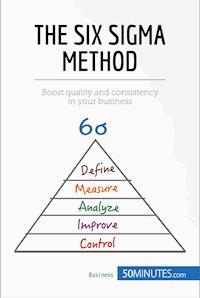
Boost quality and consistency in your business!
This book is a practical and accessible guide to understanding and implementing the Six Sigma method, providing you with the essential information and saving time.
In 50 minutes you will be able to:
• Follow the DMAIC methodology to successfully implement the Six Sigma method in your company
• Focus on the three most important factors: customers, employees and processes
• Form a strategy that focuses on product quality improvement according to the expectations of your customers
ABOUT 50MINUTES.COM| Management & Marketing
50MINUTES.COM provides the tools to quickly understand the main theories and concepts that shape the economic world of today. Our publications are easy to use and they will save you time. They provide elements of theory and case studies, making them excellent guides to understand key concepts in just a few minutes. In fact, they are the starting point to take action and push your business to the next level.
Das E-Book können Sie in Legimi-Apps oder einer beliebigen App lesen, die das folgende Format unterstützen:
Seitenzahl: 22
Veröffentlichungsjahr: 2015
Ähnliche

















The Six Sigma method
Key information
Names: Six Sigma, 6 Sigma, 6 σUses: a qualitative, quantitative and structured approach to business management.Why is it successful? It is a precise approach to improve key business processes for a reliability of more than 99.99%. The objective is to achieve an average of 3.4 defects per one million defect opportunities (where 3.8 sigma, for example, corresponds to 10 000 defects per million).Key words:Customers: all agents interested in a product or serviceDefect: product imperfectionDMAIC: managerial method with the objective of improving a product or serviceInformation: data used to establish a comprehensive view of a given situation, without leaving out detailsPerformance: numerical resultProcess: different stages of productionProject management: approach used within a company for organising a project in different stagesQuality: defining characteristics of a productSigma (σ): Greek letter representing standard deviation in statisticsStandard deviation: variation or dispersion of a variable against a threshold (the average)Statistical tool: analysis method for a database, following a numerical approachStrategic objective: aimed balance, involving actions that lead to the benefit of a favourable market positionIntroduction
Faced with a product offering that does not satisfy customers or the business enough or at all, the latter may decide to reconsider its workflow (manufacturing, etc.) in order to concretely improve its quality. The Six Sigma method allows you to calibrate new objectives and reduce the probability of variation within a process, once a detailed analysis has been conducted to identify the defects that alter the satisfaction of both the customers and employees, but also the company.
History
In the mid-1980s, the US company Motorola faced considerable pressure from Asian producers, especially the Japanese, because its production system, fundamentally different from the Asian systems, no longer seemed suitable for the realities of the market. Throughout the 1970s, Japanese factories had been more focused on durability and reliability and therefore offered simpler models than those from US factories that put more emphasis on quality elements (model design, options, etc.). US factories then looked to inspections in order to control the products (an unreliable and expensive method).
Faced with a decrease in profits, Motorola executives then chose to change their philosophy and combine statistical tools with leadership principles to form the basis of a comprehensive management system: Six Sigma. The results were immediately visible, as the quality of the products improved instantly. The process started to spread in the 1990s and was adopted by General Electric, which quickly experienced the benefits of this management method.




