


35,99 €
Mehr erfahren.
- Herausgeber: John Wiley & Sons
- Kategorie: Geisteswissenschaft
- Serie: New Russian Thought
- Sprache: Englisch
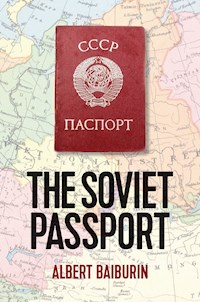
In this remarkable book, Albert Baiburin provides the first in-depth study of the development and uses of the passport, or state identity card, in the former Soviet Union. First introduced in 1932, the Soviet passport took on an exceptional range of functions, extending not just to the regulation of movement and control of migrancy but also to the constitution of subjectivity and of social hierarchies based on place of residence, family background, and ethnic origin. While the basic role of the Soviet passport was to certify a person's identity, it assumed a far greater significance in Soviet life. Without it, a person literally 'disappeared' from society. It was impossible to find employment or carry out everyday activities like picking up a parcel from the post office; a person could not marry or even officially die without a passport. It was absolutely essential on virtually every occasion when an individual had contact with officialdom because it was always necessary to prove that the individual was the person whom they claimed to be. And since the passport included an indication of the holder's ethnic identity, individuals found themselves accorded a certain rank in a new hierarchy of nationalities where some ethnic categories were 'normal' and others were stigmatized. Passport systems were used by state officials for the deportation of entire population categories - the so-called 'former people', those from the pre-revolutionary elite, and the relations of 'enemies of the people'. But at the same time, passport ownership became the signifier of an acceptable social existence, and the passport itself - the information it contained, the photographs and signatures - became part of the life experience and self-perception of those who possessed it. This meticulously researched and highly original book will be of great interest to students and scholars of Russia and the Soviet Union and to anyone interested in the shaping of identity in the modern world.
Sie lesen das E-Book in den Legimi-Apps auf:
Seitenzahl: 1080
Veröffentlichungsjahr: 2021
Ähnliche




















CONTENTS
Cover
Series Page
Title Page
Copyright
Abbreviations
Foreword
‘Remove the document – and you remove the man’
Notes
Preface
Introduction
1.
2.
3.
4.
5.
6.
7.
8.
9.
Notes
Part I The History of the Soviet Passport System
1 The Formation of ‘the Passport Portrait’ in Russia
Notes
2 Fifteen Passport-less Years
Notes
3 The Introduction of the Passport System in the USSR (1932–1936)
General Situation
The Official Version of the Introduction of Passports
Organizational Work
Issuing Passports
‘Legal Excesses’
The Second Phase of the Introduction of Passports
The Consequences of the Introduction of Passports
Notes
4 Passport Regimes and Passport Reforms
Passport Regimes
The Hundred-and-First Kilometre
The Propiska
Registering ‘Natural Population Changes’
Maintaining the Passport Regime 1940 and 1953
Statutes on Passports and Instructions for Passport Work in
Reform Projects of the 1960s
The 1974 Statute
From the Soviet to the Russian Passport System
Notes
Part II The Passport as a Bureaucratic Device
5 The Passport Template and the Individual’s Basic Information
The Passport Template
‘Surname, Name, Patronymic’
‘Place and Date of Birth’
‘Ethnic Origin’
‘The Personal Signature’
‘Social Status’
‘Liability for Military Service’
Notes
6 The Observations and Properties of the Passport
‘Who Issued the Passport’
‘On the Basis of Which Documents is the Passport Issued’
‘People Listed in the Holder’s Passport’
The Photograph
Special Observations
Observations about the Propiska
Notes
Part III What the Passport was in Practice: The Evidence in Documents and Memoirs
7 Receiving a Passport
The Right to a Passport
Defining Ethnicity
Taking the Passport Photograph
How Do I Sign?
The Passport Desk and the Pasportistka
Receiving the Passport
Notes
8 Life With – and Without – the Passport
Look After It; Should You Carry It With You?
The Document Check
Changing One’s Name
A ‘Clean’ Passport
Marriages of Convenience
Lost! What it Meant to be Without Your Passport
Refusing to Have a Passport
‘The Most Important Document’ and Why it was Needed
Notes
Conclusion
Notes
Appendix: Interview Details
Interview Details
The Type of Questions Asked in the Interviews
Glossary
Bibliography
Index
End User License Agreement
Guide
Cover
Table of Contents
Series Page
Title Page
Copyright
Abbreviations
Foreword
Preface
Introduction
Begin Reading
Conclusion
Appendix: Interview Details
Glossary
Bibliography
Index
End User License Agreement
List of Illustrations
Chapter 1
Figure 1.
Passport booklet issued in 1906 to Ivan Ivanovich Kostyrko
Chapter 2
Figure 2.
Warrant for Stepan Arkhipovich Bolotov to inspect the activity of the Special De…
Figure 3.
Employment List, issued to Dina Isayevna Zakharina
Figure 4.
Student’s Certificate from 1918, issued to Ivan Ivanovich Yankovsky by Petrograd…
Figure 5.
Identity document with no end date, issued to Antonina Ivanovna Savelyeva
Chapter 3
Figure 6.
‘A commission under the chairmanship of member of the Smolny Soviet, Comrade Dar…
Figure 7.
Certificate issued in order to allow the processing of a passport
Chapter 4
Figure 8.
A list issued by the Russian Post Office in November 2012 of all documents that …
Chapter 5
Figure 9.
Temporary passport from 1933
Figure 10.
Official Form No. 1, the form that each citizen had to complete when applying fo…
Chapter 7
Figure 11.
Soviet poster from 1956, showing a young man receiving his first passport.
Figure 12.
Invitation to the solemn presentation of passports, to be held on 27 March 1967 …
Figure 13.
1973 poster showing a young man holding his first passport, and quoting the word…
Figure 14.
Poster from 1967, celebrating the passport and the 50th Anniversary of the Revol…
Chapter 8
Figure 15.
Outside and inside of a protective cover for a passport
Figure 16.
Made-up ‘children’s passports’ from 1962, for the Fomenko children
List of Plates
Plate 1:
1933 passports.
Plate 2:
1935 passports.
Plate 3:
1938 passports.
Plate 4:
1951 passports.
Plate 5:
1974 passports.
Pages
ii
iii
iv
vii
viii
ix
xii
xiii
xiv
xv
xvi
xvii
xviii
1
2
3
4
5
6
7
8
9
10
11
12
13
14
15
16
17
18
19
20
21
23
24
25
26
27
28
29
30
31
32
33
34
35
36
37
38
39
40
41
42
43
44
45
46
47
48
49
50
51
52
53
54
55
56
57
58
59
60
61
62
63
64
65
66
67
68
69
70
71
72
73
74
75
76
77
78
79
80
81
82
83
84
85
86
87
88
89
90
91
92
93
94
95
96
97
98
99
100
101
102
103
104
105
106
107
108
109
110
111
112
113
114
115
116
117
118
119
120
121
122
123
124
125
126
127
128
129
130
131
132
133
134
135
137
139
140
141
142
143
144
145
146
147
148
149
150
151
152
153
154
155
156
157
158
159
160
161
162
163
164
165
166
167
168
169
170
171
172
173
174
175
176
177
178
179
180
181
182
183
184
185
186
187
188
189
190
191
192
193
194
195
196
197
198
199
200
201
202
203
204
205
206
207
209
210
211
212
213
214
215
216
217
218
219
220
221
222
223
224
225
226
227
228
229
230
231
232
233
234
235
236
237
238
239
240
241
242
243
244
245
246
247
248
249
250
251
252
253
254
255
256
257
258
259
260
261
262
263
264
265
266
267
268
269
270
271
272
273
274
275
276
277
278
279
280
281
282
283
284
285
286
287
288
289
290
291
292
293
294
295
296
297
298
299
300
301
302
303
304
305
306
307
308
309
310
311
312
313
314
315
316
317
318
319
320
321
322
323
324
325
326
327
328
329
330
331
332
333
334
335
336
337
338
339
340
341
342
343
344
345
346
347
348
349
350
351
352
353
354
355
356
357
358
359
360
361
416
417
418
419
420
421
422
423
424
425
426
427
428
429
430
431
432
433
434
435
436
437
438
439
440
441
442
443
444
445
446
447
448
449
450
451
452
New Russian Thought
The publication of this series was made possible with the support of the Zimin Foundation
Albert Baiburin, The Soviet Passport
Vladimir Bibikhin, The Woods
Alexander Etkind, Nature’s Evil
Boris Kolonitskii, Comrade Kerensky
Sergei Medvedev, The Return of the Russian Leviathan
Maxim Trudolyubov, The Tragedy of Property
The Soviet Passport
The History, Nature and Uses of the Internal Passport in the USSR
Albert Baiburin
Translated byStephen Dalziel
polity
Originally published in Russian as СОВЕТСКИЙ ПАСПОРТ. история — структура — практики. Copyright in the original Russian-language edition © European University at St. Petersburg, 2017.
Copyright © Albert Baiburin 2021
This English translation © Polity Press 2021
This English edition first published in 2021 by Polity Press
This book was published with the support of the Zimin Foundation.
Polity Press65 Bridge StreetCambridge CB2 1UR, UK
Polity Press101 Station LandingSuite 300Medford, MA 02155, USA
All rights reserved. Except for the quotation of short passages for the purpose of criticism and review, no part of this publication may be reproduced, stored in a retrieval system or transmitted, in any form or by any means, electronic, mechanical, photocopying, recording or otherwise, without the prior permission of the publisher.
ISBN-13: 978-1-5095-4320-5
A catalogue record for this book is available from the British Library.
Library of Congress Cataloging-in-Publication Data
Names: Baĭburin, A. K., author. | Dalziel, Stephen, translator.Title: The Soviet passport: the history, nature, and uses of the internal passport in the USSR / Albert Baiburin; translated by Stephen Dalziel.Other titles: Советский паспорт. EnglishDescription: English edition. | Cambridge, UK; Medford, MA: Polity Press, 2021. | Series: New Russian thought | Includes bibliographical references and index. | Summary: “How the passport became a vital means of constructing identity in the Soviet Union” – Provided by publisher.Identifiers: LCCN 2021008016 (print) | LCCN 2021008017 (ebook) | ISBN 9781509543182 (hardback) | ISBN 9781509543205 (epub)Subjects: LCSH: Passports–Soviet Union–History. | Emigration and immigration law–Soviet Union.Classification: LCC KLA3022.7 .B3513 2021 (print) | LCC KLA3022.7 (ebook) | DDC 323.6/709470904–dc23LC record available at https://lccn.loc.gov/2021008016LC ebook record available at https://lccn.loc.gov/2021008017
The publisher has used its best endeavours to ensure that the URLs for external websites referred to in this book are correct and active at the time of going to press. However, the publisher has no responsibility for the websites and can make no guarantee that a site will remain live or that the content is or will remain appropriate.
Every effort has been made to trace all copyright holders, but if any have been overlooked the publisher will be pleased to include any necessary credits in any subsequent reprint or edition.
For further information on Polity, visit our website: politybooks.com
Abbreviations
AMM
– Archive of the International ‘Memorial’ Association (
Arkhiv Mezhdunarodnogo obshchestva ‘Memorial’
).
ASSR
– Autonomous Soviet Socialist Republic; as well as the individual republics within the USSR, there were also ASSRs which had many of the same rights as the SSRs except the right to secede from the Union. In practice, no SSR had this right anyway.
ATsIYeU
– Archive of the Judaica Centre of the European University of St Petersburg (
Arkhiv Tsentra Iudaiki Yevropeiskogo universityeta
).
CPSU
– Communist Party of the Soviet Union (
Kommunisticheskaya partiya Sovietskogo Soyuza
), the name, from 1952, of the party which ruled the USSR.
GARF
– State Archive of the Russian Federation (
Gosudarstvenny arkhiv rossiiskoi federatsii
).
KGB
– Committee for State Security (
Komitet Gosudarstvennoi Bezopasnosti
); the last name of the Soviet era for the secret police, initially established by the Bolsheviks in 1917 as the
Cheka
.
KhPZ
– Kharkov Steam Engine Building Plant (
Khar’kovsky parovozostroitel’ny zavod
).
MTS
– Machine Tractor Station (
Mashino-traktornaya stantsiya
).
MVD
– Interior Ministry (
Ministerstvo vnutrennykh del
).
NEP
– The New Economic Policy introduced in the 1920s, which allowed a certain amount of free market capitalism in order to help the economy recover from the ravages of the Civil War. Those who profited most were nicknamed
NEPmen
and were refused passports when the passport system was introduced in 1932.
NKID
– People’s Commissariat of Foreign Affairs; the original title of what would become the Soviet Ministry of Foreign Affairs.
NKVD
– People’s Commissariat of Internal Affairs; in the early years of the Soviet state, the NKVD RSFSR (for the Russian Republic) was responsible for policing, but not the secret police, which was under the All-Russian Extraordinary Commission (VeCheKa), often abridged to Cheka. The NKVD RSFSR was disbanded in 1930. But in 1934 the USSR NKVD was formed, and the secret police came under its remit. Also
UNKVD
– the Directorate (
Upravleniye
) of the NKVD.
OGPU
– The Unified State Political Directorate (
Obyedinyonnoye gosudarstvennoye politicheskoye upravleniye
), the title of the Soviet secret police from 1923 (before which it was the Cheka) to 1934, when it was re-named the USSR NKVD. The next notable name change came in 1953, when it became the KGB.
OVIR
- The Department of Visas and Registration (
Otdel viz i registratsii
), the office where many Russian documents are issued.
PSZ
– Complete Laws of the Russian Empire (
Polnoye sobraniye zakonov Rossiiskoi imperii
).
RCP(B)
– Russian Communist Party (Bolsheviks); ‘Bolshevik’ (meaning majority) had come from the split of the Russian Social-Democratic Labour Party into two factions, Bolshevik and Menshevik, in 1903. In 1925 the Party was renamed the All-Union Communist Party, and in 1952 it became the Communist Party of the Soviet Union (CPSU).
RGASPI
– Russian State Archive of Socio-Political History (
Rossiisky gosudarstvenny arkhiv sotsial’no-politicheskoi istorii
).
RSFSR
– Russian Soviet Federated Socialist Republic; the official name of Russia within the USSR, until the collapse of the country at the end of 1991.
SNK
– Sovnarkom, or Council of People’s Commissars; the name of the government of the USSR from 1923 to 1946.
SU RSFSR
– Collected Statutes of the Workers’ and Peasants’ Government of the RSFSR (
Sobraniye uzakonenii raboche-krestyanskogo pravitelstva RSFSR
).
SZ SSSR
– Collected Laws and Instructions of the Workers’ and Peasants’ Government of the USSR (
Sobraniye zakonov i rasporyazhenii raboche-krestyanskogo pravitelstva SSSR
).
TsGA
– Central State Archive (
Tsentral’ny gosudarstvenny arkhiv
), St Petersburg.
TsGAIPD
– Central State Archive for Historical and Political Documents of St Petersburg (
Tsentral’ny gosudarstvenny arkhiv istoriko-politicheskikh dokumentov Sankt-Peterburga
).
TsGAKFFD
– Central State Archive of Cinematographic and Photographic Documents (
Tsentral’ny gosudarstvenny arkhiv kinofotofonodokumentov
) in St Petersburg.
TsIK
– Central Executive Committee of the USSR (
Tsentral’ny ispolnitel’ny komitet SSSR
).
UNKVD
– see
NKVD
.
VAPRF
– Bulletin of the Archive of the President of the Russian Federation (
Vestnik Arkhiva Prezidenta Rossiiskoi Federatsii
).
VKP(b)
– All-Russian Communist Party (of Bolsheviks) (
Vsyerossiiskaya Kommunisticheskaya partiya (bol’shevikov)
), the name of the ruling party from the time of the October Revolution of 1917 until it became the CPSU (see above) in 1952.
VTsIK
– All-Russian Central Executive Committee (
Vsyerossiisky Tsentral’ny ispolnitel’ny komitet SSSR
); the highest legislative and administrative body of the RSFSR from 1917 to 1937.
ZAGS
– Russian term for a registry office (
otdel zapisi aktov grazhdanskogo sostoyaniya
).
ZATO
– Closed Territorial-Administrative Formations (
Zakritiye Territorial’no-Administrativniye Obrazovaniya
); ‘closed’ towns and cities; only those who lived there were allowed to enter.
Foreword
‘Remove the document – and you remove the man’
In the English-speaking world, the word ‘passport’ signifies a document that permits free passage beyond the boundaries of the state where the holder resides. The concept is distinct from that of an identity document (ID), which demonstrates to the satisfaction of officials within a person’s home country that they actually are who they claim to be. A passport may sometimes be used in the latter capacity, but does not have to be – in the US in particular, a driving licence is the regular form of ID.1 In Britain, perhaps partly because the right to roam is seen as an essential freedom (the history runs from protests against enclosure in the eighteenth century through the foundation of the Ramblers’ Association in 1935 to campaigns for access to private landholdings and community buyouts in the 2020s), and because of ingrained notions of personal privacy as sacrosanct, the imposition of a unified state ID system has met fierce resistance. In 2004, the then Home Secretary David Blunkett’s plan to introduce compulsory identity cards provoked uproar, and by 2010, the plan had been scrapped.2 It has not been revived.
The resistance to generalized ID means, in turn, that English-speaking observers are by and large peculiarly ill-equipped to understand political and social cultures such as Russia and the USSR, in which the use of identity documents is elaborately institutionalized, and forms an embedded element of everyday practices.3 In a travelogue about a visit to the former USSR, Colin Thubron recorded a meeting with Stepan, an elderly man from the Evenk people (a former hunter-gatherer community in Eastern Siberia). Stepan was Thubron’s neighbour in the local cottage hospital while recovering from being burned during a fire at his house. He described how suddenly the fire had happened:
‘I had time to run in once, before it was too late. Only once.’
What had he carried out, I wondered, in those few seconds? Had he salvaged a few hoarded roubles, a precious garment, a sentimental photograph? ‘What did you save?’
I strained to catch his voice. It came tiny, self-satisfied. ‘My passport.’
He pulled it from his jacket as if to be sure it remained. […] It was a sensible choice to retrieve, I knew; but I felt his degradation. His hand was trembling, until I held it in mine. And I realised I was angry: angry that even into this remote life Moscow had intruded its ossifying order, grounding and claiming him. Without his passport he could not move, did not live. He had risked fire for it.4
To the outsider’s gaze, the situation was simply ‘degradation’, the symptoms of an ‘ossifying order’. Yet, as even Thubron noticed, the man’s voice was ‘self-satisfied’. For Stepan, the ownership of his pasport (the Russian spelling) was not a source of humiliation, but an object of pride.
It is the central ambiguity of a document that was at once a weapon of state control and an instrument for the creation of identities, and even for self-assertion, that lies at the centre of Albert Baiburin’s history of the Soviet ‘internal passport’, or state identity card. As the intricate and sophisticated discussion in the book shows, the Soviet document, especially in the Stalin era, acted as a very real obstacle to freedom of movement. Large categories of the population, particularly in the Soviet countryside, were migrationally disenfranchised, to all intents and purposes tied to their place of residence (this is the reason why political dissidents frequently referred to the political order as a ‘serf system’).5 Denial of passport-holding rights, as we discover, also kept in place other important sections of the population, for instance, former political prisoners or common criminals and their immediate families, and those who were considered actual or potential subversives. In border areas, on the other hand, you could not reside without an internal passport. Some were filtered out by the document and others filtered in. The pasport was without doubt a major factor in the efficient running of the police state.6
Yet possession of the document also acted as a powerful force of social and cultural unification, as a token of citizenship in a positive sense – a resonance that became particularly significant in the post-Stalin era, as the numbers of those entitled to passports broadened, and its repressive function was to a large extent eroded by a constructive one. For Stepan, his passport was not just essential for proving he had the right to leave his village. Nomadic groups registered as members of reindeer, horse-raising or camel-breeding collectives were, like the Russian rural population, migrationally disenfranchised under Stalin. For them, the possession of a passport became an important sign of state favour, a recognition of equality attained. Similarly, it was vital, in the post-war years, for Kalmyk ‘special settlers’ (the population displaced in 1943 as a punishment for alleged large-scale collaboration with the Nazi invaders) both to obtain passports (which signified the right to move about as opposed to the duty to sign on with the local military commandant, as before), and to contest any restrictions that were imposed upon these.7 ‘Opting out’ of the passport system was the last thing the socially disenfranchised wished to do.8 The writer Mikhail Bulgakov’s famous dictum, ‘Remove the document – and you remove the man’, was an acknowledgement not only of the impotence of the individual unsanctioned by a stamped piece of paper, but of the personhood that could be derived from a document.
The enormous resonance of the Soviet passport meant that it became a familiar symbol. Schoolchildren learned by heart Mayakovsky’s boastful celebration of the glories of the Soviet passport, concluding in the ringing lines:
Read this and envy me –
I am a citizen of the Soviet Union!
Mayakovsky’s ‘passport’ was in fact a ‘service’-class foreign passport for travel outside the USSR, an item available to a narrow elite even in the USSR’s last decades, let alone in the isolationist 1930s. However, the schoolchildren who crammed these lines were expected to identify the object of celebration as the passports that they actually received at age sixteen – their state identity cards – and to feel pride in holding a document9 that would prove them a Soviet citizen among Soviet citizens. Just so, the ideal way of granting passports to sixteen-year-olds, as promoted by the Soviet media, advice brochures, and organisations such as the Communist Youth Movement (Komsomol) was a public ceremony at which young people publicly received their new identity documents from the hand of some Party or city dignitary.
It is no wonder that people acquired a sense of specialness verging on awe about the document in a physical sense. As Baiburin records, every element of the pasport, from signatures to the question of what to look like in your photograph, was surrounded by popular mystique. Unlike some present-day passport regimes (e.g. the United Kingdom), the USSR did not in fact explicitly regulate people’s appearance in their photographs; however, the citizenry firmly believed that there were rules, and behaved accordingly.
In other countries too, the national passport can and has easily become the object of sentimental fixation and symbolic resonance. From its inception in 1923, the Irish Free State passport was emblazoned in green, and carried a bilingual text (Pás – Passport, Saorstát Eireann – Irish Free State) and the image of a harp. More recently, the ‘dark blue’ (supposedly)10 cover of the British passport prior to 1988 (when dark red, machine readable passports were introduced) has become a symbol of ‘sovereignty’ in its own right, leading to the post-Brexit introduction of a cover whose hue does not resemble the shade of the original, and which is constructed to different dimensions – as well as being designed in France and manufactured in Poland. In the USSR, such patriotic associations were tied less directly to the colour of the cover (which changed at different points and only in the country’s final decade approximately echoed the scarlet of the Soviet flag), than to the emblem of hammer and sickle and the word паспорт itself, alongside, of course, the abbreviation of the country’s title, CCCP. The first Soviet passports included the word ‘passport’ not just in Russian, but in the languages of the different Soviet republics (a multilingual style also employed for cardinal numbers – one, two, three, five, etc. – on the obverse of rouble notes). The final, 1974, version of the passport was bilingual (Russian plus the official language of the given republic). Yet if this practice acknowledged linguistic and cultural difference, Baiburin also shows how the pasport was, among other things, a conduit of russification, both because of the pressures on holders to assimilate to Russian as the most ‘convenient’ ethnic group, and because they were required to supply a patronymic even when the particular republic or ethnic community was historically devoid of this linguistic and cultural tradition.
All the same, as The Soviet Passport also makes clear, the passport could have all kinds of meanings that official prescription had not anticipated. One particularly insouciant individual even remembers using his for various forms of private annotations – while also recalling how shocked the officials in the passport office were when they observed what he had done. The pasport was by no means only a means of stultification or oppression, though as shown by the heart-breaking letters written in the late 1930s by petitioners fearing they held ‘the wrong nationality’, it sometimes did have exactly that purpose and result. Who would have thought that a major advocate, in the post-war years, of relaxing the regulation of migrancy would have been Lavrenty Beria, the ruthless head of the Soviet secret police? As this unique and fascinating book records, the history of the passport offers an unexpected window on the Soviet (and indeed post-Soviet) world, laying bare a rich imaginative and experiential reality, as well as an at times depressing history of regimentation and bureaucratically-inspired frustration.
Catriona KellyOxford, January 2021
Notes
1
. An obvious reason behind this practice is that foreign passport holders form a minority, though an increasing one, of the US population: in 2007, the proportion stood at 27%, while in 2018 it was 42%, a figure significantly lower than in European countries, with an average of 60%, and the UK, at 73% in 2018.
2
. There were, of course, many other arguments around the ID cards, particularly data privacy versus better access to information (Paul Beynon-Davies, ‘The UK national identity card’,
Journal of Information Technology Teaching Cases
, Vol. 1, 2011, pp. 12–21), and, of course, opinion is not unified on the issue, but all the same, the contrast between the British (and more specifically English) firm belief in the right to move around without ID checks
within
the country seems to be the established counterpart to the conviction that impermeable borders are vital in terms of keeping out those who live
outside
it – a major motivating force in the campaign for Brexit.
3
. This is not a question of a simplistic opposition between ‘Soviet’ (or ‘post-Soviet’, or ‘Russian’) and ‘Western’ prescriptions and realities. As has often been pointed out by specialists on the history of the identity document (see, e.g., Jane Caplan and John Torpey (eds.),
Documenting Individual Identity…
), many European countries, notably France and Germany, also have a lengthy history of national identity cards that share some of the functions of the
pasport
.
4
. Colin Thubron,
In Siberia
, p. 132.
5
. As the Russian scholar Aleksandr Dmitriev has shown, these associations were so pervasive that the centenary of the Emancipation of the Serfs in 1961 provoked as much embarrassment and confusion as celebration. ‘Posle osvobozhdeniya: “Velikie reformy” i khrushchevskaya ottepel’ v perspektive russkoi istoricheskoi mysli’ [After Emancipation: The “Great Reforms” and the Khrushchev Thaw in the Perspective of Russian Historical Thought],
Novoe literaturnoe obozrenie
no. 142 (2016),
https://www.nlobooks.ru/magazines/novoe_literaturnoe_obozrenie/142_nlo_6_2016_spetsialnyy_vypusk_t_2_rabstvo/article/12230/
.
6
. Precisely in this capacity, it figures in, for example, David Shearer,
Policing Stalin’s Socialism: Repression and Social Order in the Soviet Union, 1924–1953
. New Haven, CT: Yale University Press, 2009; Paul Hagenloh,
Stalin’s Police
.
7
. Elza Guchinova (ed.), ‘“All roads lead to Siberia”: Two stories of the Kalmyk deportation’,
Forum for Anthropology and Culture
, Vol. 3, 2007, pp. 239–86.
8
. It is worth emphasizing this point, since one of the achievements of Baiburin’s book is to take discussion of the Soviet passport beyond the migrancy issues that have been central to many previous analyses. As Baiburin emphasizes, the history of the
propiska
, or inscription of a right (and duty) to reside in one particular place, and the
pasport
are closely intertwined, but they are not identical. In post-Soviet Russia, the
propiska
has been replaced by a
registratsiya
(registration) that is more like the advisory notification to be found in, say, France (or the ‘proof of address’ required by many British bureaucracies and also commercial organizations, such as banks, though supplying this is actually more difficult because evidence needs to be no more than three months old).
9
. I say ‘holding’ a document because, as Baiburin points out, no-one really ‘owns’ a passport: rather, it ‘owns’ the holder or the ‘bearer’.
10
. To me and many others, the cover actually looks black.
Preface
As an anthropologist I have worked on a variety of subjects: semiotics of artefacts, rituals, stereotypical behaviour and now, suddenly, the passport. Actually, this is not as sudden as it may seem. The passport brings together in one object symbolism and ritualized practices; issues which have always interested me. Bureaucracy (especially Soviet bureaucracy) is perhaps the most ritualized area of any culture. Traditions in this area are especially rigid. Furthermore, I had to turn my attention to a completely different era, to principally different contexts and to unusual traditions of research.
It has always fascinated me that many people have a very particular, even a nervous, attitude to documents, and especially to the passport. How did this come about? How is it that documents have had such a strong effect on a person’s consciousness and attitude? And why did the passport become ‘the document above all documents’? It was in the Soviet period that the passport came to have a very special significance. Yet even I had not realized how many threads were drawn together by the Soviet passport. Herein lies the whole of Soviet history; the peculiarities of the Soviet person’s self-awareness; the life story of specific people; and much more besides. It was only after a number of years working in archives and libraries that I began to have a grasp of the subject; but even so I am still not absolutely convinced that I fully understand everything about the passport, so intricate and complicated is it.
I am very grateful to the Arts and Humanities Research Council (AHRC) for their support of my project from the outset. I am especially grateful to the Georgi Abdushelishvili Family Foundation for their permanent support of the Professorship in Everyday Soviet Life at the European University of St Petersburg, under the auspices of which work on this project continued.
Of enormous help to me were the comments and advice of Sergei Abashin, Alexander Chistikov, Catriona Kelly, Anna Kushkova, Georgi Levinton, Nikita Okhotin, Yuliya Orlova, Alexandra Piir, Konstantin Pozdnyakov, Arseniy Roginsky, Gabriel Superfin and Nikolai Vakhtin.
This book would not have been possible without access to material in a number of archives and museums. I should like to acknowledge the assistance provided by the staff of the State Archive of the Russian Federation (Moscow); the Russian State Archive of Social and Political History (Moscow); the Archive of the International ‘Memorial’ Society; the St Petersburg branch of the ‘Memorial’ Society; the Central State Archive of Cinematic and Photographic Documents in St Petersburg; the Museum of the Political History of Russia (St Petersburg); the State Museum of the History of St Petersburg; the Central State Historical Archive (St Petersburg); and the Archive of the Judaica Centre of the European University of St Petersburg.
I should like to express my sincere thanks to those who helped me to gather and transcribe the interviews: Alexandra Kasatkina, Catriona Kelly, Anna Kushkova, Maria Morozova, Irina Nazarova, Alexandra Piir and Darya Tereshina; as well as to those who shared with me their own interviews on a variety of topics: Maria Akhmetova, Svetlana Amosova, Marina Hakkarainen and Svetlana Sirotinina.
Whilst I was writing this book I was working in the Museum of Anthropology and Ethnography (the Kunstkamera), teaching in the Faculty of Anthropology of the European University of St Petersburg and producing the Anthropological Forum journal. I am very grateful to my colleagues in the Kunstkamera, the Faculty and the journal’s editorial board for the unfailing support I experienced throughout the whole period.
Finally, the author and the translator would like to give special thanks to Professor Catriona Kelly for her invaluable assistance.
Albert BaiburinNovember 2020
Plate 1(a–d): The 1933 passport.
(Source: State Museum of Political History.)
Plate 2(a–c): The 1935 passport.
Plate 3(a–c): The 1938 passport.
(Source: State Museum of Political History.)
Plate 4(a–d): The 1951 passport.
(Source: archive of Krasheninnikov family.)
Plate 5(a–g): The 1974 passport.
(Source: archive of the Levichkin Family.)
Introduction
Remove the document – and you remove the man.
Mikhail Bulgakov1
1.
The above quotation from Mikhail Bulgakov’s novel, The Master and Margarita, highlights a rarely acknowledged fact: in our modern civilization a person exists only as long as they can be pinned down and represented by a variety of documents. This may be an exaggeration, but it is not a great one. This is exactly the rule which applies when someone is dealing with officialdom. This book focuses, on the one hand, on the individual’s details which are laid out in the passport and their ‘invention’ by the bureaucratic apparatus, and, on the other, how specific people have gained mastery over them. This approach involves examining the creation of the passport system and the development of the image of the passport in the wider context of pre-revolutionary and Soviet social history.
Once the passport system had been introduced, we could say that the Soviet people had been given ‘instructions for identification’. The understanding of the word ‘instructions’ in the Soviet (and, indeed, post-Soviet) tradition has a very direct meaning: it is a particular order – usually written – or a demand from the authorities (such as an instruction to appear at the military call-up office, or an instruction to improve your behaviour). The Soviet passport, which was introduced in 1932, implicitly contained the demand that the individual identify him- or herself according to the descriptions laid down within it. This referred not only to those citizens who received the passport, but also to those who were denied one. In reality, the whole adult population of the country was obliged to apply to themselves the definitions laid down in the passport, thus carrying out their own form of self-identification. In this sense it was not even the authorities who defined the ‘passport portrait’, but the actual passport itself became the means of identification.
The term ‘identity’ does not appear frequently in this book, because this carries with it the inherent sense of referring to something definite. In keeping with the work of Rogers Brubaker and Frederick Cooper, I prefer the term ‘identification’, which refers specifically to a process.2 As they point out, the very term ‘identification’ requires clarification as to who it is that needs to be identified. This is particularly important since the question here concerns the state’s system of the external identification of the individual. Through its particular institutions the state has developed a specially codified categorization system, which is laid out in the passport. This system of identification and categorization imposed from without cannot but have an effect on the self-identification of the individual. The cultural and social effects which such a clash of interests brings about are of particular interest to me.
The passport has traditionally been considered as one of the fundamental symbols of Soviet life. A vast myth grew up around the Soviet passport. Poets, writers, ordinary citizens and, of course, historians and other scholars all played their part in creating it. In this myth the passport becomes an object of special value, one that is inextricably linked with the understanding of what it is to be ‘a citizen of the USSR’. It is perhaps the most interesting document in the history and practice of relations between the person and the state. Originally created to identify the individual and to impose control over their movement (especially over crossing borders), it gradually took on a whole host of meanings, at times far removed from its original purpose. And it was not simply the bureaucrats who endowed the passport with these meanings, but also those to whom it was issued. This is probably more relevant for the Soviet passport than for any other.3 And many aspects have remained the same up to the present day.
Soviet citizens – and Russians now – have two passports. In Soviet legal practice permission to cross state borders was possible only with the so-called ‘foreign travel passport’. The ‘internal’ passport was a particular phenomenon. Its basic role was to certify a person’s identity, but it was used for far more than simply this. In a multiplicity of situations this passport had a far greater significance than did the actual ‘person’ whose identity it proved. There is a huge body of evidence which illustrates that without it a person literally ‘disappeared’ from the life of their society. It was impossible to find employment, or place your child in a kindergarten or a school; a person could not marry or ultimately die ‘correctly’; or even fulfil what seem such simple practices as obtaining a library ticket or picking up a parcel from the post office. It was absolutely essential on virtually every occasion when there was contact with officialdom (including obtaining any other documents), because it was always necessary to prove that the citizen was the person whom they claimed to be. And in the Soviet system of social relations, a person could prove who they were only with the aid of the passport.4
Yet there are also many examples where people say that in Soviet times the passport was hardly ever used. It was essential in only a small number of cases, since people didn’t very often change jobs or start studying somewhere. The main thing was that it existed. It was the presence of the passport that was important, rather than its usage. The passport made a Soviet person ‘just the same as everyone else’, and it was belonging to the body of society that gave the passport its true value.
The passport evoked a variety of emotions, depending on the situation, and not only negative ones. A huge number of passport holders, especially among the post-war generations, were very proud of it. But very surprisingly there wasn’t always a connection with its owner. There was a sense of estrangement from the passport, even in those cases where the person experienced positive emotions about owning it. The process of acquiring it was often traumatic, and using it meant coming into contact with officialdom, something that Soviet people tried to keep to a minimum. The main reason for such wariness towards the organs of the state was that ordinary citizens were often made to feel that they were requesting something – even in situations where they weren’t actually asking for anything. This flagrant inequality in relation to queues and all the other circumstances which went with them meant that people tried to deal with officials only in cases of extreme necessity.
Just how controversial is the status of the passport can be illustrated with the help of one simple question: to whom does the passport belong? To the state, or to the person? Is it ‘my passport’? In reality, it is rather, ‘the passport which is about me’. It’s like a sign hung around one’s neck, or the label on one’s clothing. What is there in it which is specifically mine? Only the signature and the photograph. When it has these it becomes mine, and any changes that are inserted in the passport are the result of changes in me or in what has happened to me (such as the registration of a marriage or of children). The holder of the passport is officially known as its owner. However, an object which belongs to us can be lost or we may simply get rid of it. We are obliged to hold on to our passport, and we risk a fine if we lose it. Making a false passport is considered a crime – not against its owner, but against the state. It turns out that it is at one and the same time both ours and yet not ours; and this dual ownership is the chief characteristic of this document which is unique in so many ways. Nonetheless, the passport is issued by the structures of the state and is issued for temporary use (the maximum period is limited by the lifespan of the ‘owner’), and because of this the owner can never totally feel that it is solely their property.
The Soviet passport was used to certify who a person was; but usually a person does not need to confirm their ‘I’. Or, to be more accurate, they may have to do this but in this case a document is hardly going to help. From this point of view the passport is needed first and foremost for officialdom; but since a person has to interact with officials, the passport becomes something that is essential for the person themselves.
2.
Let’s try to define what exactly a document is. We understand instinctively that among the wealth of texts and artefacts that mankind has created, documents have a special status. This may be simply because they are expected to establish the dividing line between facts and supposition; between the reliable and the unreliable; the truth and the lie; the actual and the imaginary. If this is the case, then they help to create a kind of parallel world, doubling the significance of what society considers to be especially important.
The Great Dictionary of Legal Terminology describes this idea in the following way:
‘Document’: a physical object containing information, consolidated by a man-made method for passing it on in space and time. In automated search and information systems this means any object which is saved within the system’s memory …5
Clearly, such a definition means that a wide variety of items can be considered as documents. In the first instance there are physical documents, such as certificates or other items created specifically to bear witness to something. Secondly, ‘document’ is often used to refer to all sorts of artefacts that originally had a different purpose (for example, letters, diaries or in principle any object that characterizes a particular era, such as objects in a museum – and not only in a museum). Such evidence from the past is given the status of ‘a document’, although, strictly speaking, in such circumstances the word ‘document’ has only a metaphorical significance. Nowadays the understanding of what constitutes ‘a document’ is used as widely as possible; the tiniest piece of information can be considered as such.6
Documents have both a specific and at the same time a rather vague status, both in daily life and in academic study. For example, for historians, documents (if we mean written sources) traditionally make up the bulk of their material; but beyond that there are usually texts that originally were not created as documents. The status of ‘documents’ was given to them artificially later as ‘testimony to the past’. Of course, actual documents come into the category of sources, but in the overall mass of evidence they take up a rather insignificant place. Incidentally, in time these ‘documents’ in the widest sense take on the status of ‘genuine’ documents, while real documents lose this status as their shelf-life runs out; yet they remain documents in the wider sense.
Researchers who use documents often consider them to be bearers of objective information about the past. This is helped by the documents’ anonymity. Frequently no author is cited. Nevertheless, any document, even if it comes from the authorities, is always the result of the overlapping interests of various subjects, with different views on the reality it relates to and which is produced by it. As Yury Tynyanov wrote, ‘documents lie, just as people do’.7 So the question of authorship is relevant for documents, too. There are always specific ‘authors’ of texts hidden behind anonymous definitions such as ‘the authorities’, ‘state procedures’ and so on. But as a rule, they remain unknown.
Furthermore, one way or another a document takes into account the point of view of the recipient. Even if the recipient’s position is completely ignored, an imaginary dialogue is created with them. And the recipient is not only the passport holder, but also those who will read it. This is especially significant for the passport, because a whole host of factors – economic, political and others – played a part in its development, as did various administrative levels and departments. So did the recipients themselves, as I shall try to show.
Documents are traditionally studied in such applied disciplines as source studies and archive methodologies. However, there are matters beyond the boundaries of such studies which both produce and use documents, involving people as well as social and state institutions. The anthropological significance of documents is of no interest to these disciplines. There is a wide circle of social phenomena born out of the very functionality of these documents which has hardly been researched at all. This includes the cultural significance that is given to these documents, as well as the specific relations and practices that have come about by their creation and use.8
In recent times this has started to change. Evidence of this is the project The Status of the Document in Contemporary Culture: Theoretical Problems and Russian Practice, under the guidance of Irina Kaspe. The project’s most significant result was the collective work, The Status of the Document: the Definitive Paper or an Alien Certificate (Moscow, 2013). This was perhaps the first time (at least in the Russian academic tradition) that the question of what ‘the document’ is had been thoroughly examined. This was inspired not just by the appearance of electronic documents, which meant that traditional methods had to be examined in a completely different way (as had happened, for example, in sociological research),9 but also a growing dissatisfaction with the way in which documents of various origins were studied.
Articles in this project contain interesting ideas and thoughts on the role of the document and the peculiarities of the way in which it functions in different cultural contexts, and these ideas will be explored in the relevant sections of this book. Here, perhaps, it is worth noting that Kaspe makes a useful distinction between the Russian terms dokumental’noye and dokumentnoye.10 Indeed, the term dokumental’noye (especially in such combinations as dokumental’nyi zhanr ‘the documentary genre’ or dokumental’nyi diskurs ‘the documentary discourse’) is linked to a particular tradition in research in which there is no significant difference between documents in the broad understanding (in The Oxford English Dictionary, ‘something written, inscribed, etc., which furnishes evidence or information upon any subject, as a manuscript, title-deed, tomb-stone, coin, picture, etc.’) or the narrow one (written documents produced for a given official purpose of the kind normally to be found in archives). We shall be dealing here with the second category, which I shall term the ‘documental’;11 that is, texts that have been specifically created in order to preserve and represent information which, for one reason or another, falls into the category of ‘reliable’. The type and purpose of such documents can be described by words such as ‘attest’, ‘assure’, ‘affirm’, ‘certify’ and ‘identify’. They have a particular period of validity and certain specific features and properties. In common usage, actual documents and documents in the wider sense are grouped in the single category of the ‘documentary’. For the purposes of my discussion here, I shall disaggregate the material into two categories, and will concern myself with the ‘documental’, leaving the broader term ‘documentary’ to analysts for whom the distinction between different types of document has little significance.
Even if we do not understand too well what the different sorts of documents are, what is important is they are easy to recognize. They make up a specific body of texts, or, to be more precise, a class of papers. Their quality and the very paper on which they were printed was so significant that documents frequently came to be referred to as ‘papers’. And it was this paper quality which led to them being described both respectfully and in a pejorative fashion.12 Just as in the post-Soviet period we could immediately recognize advertising fliers that were pushed through our letter boxes, the document has long been instantly recognizable. It always has a certain look to it. Special forms and templates were devised for documents. (In Soviet times we knew them by their number: Form Number 1 was the main one, which a citizen would fill out in order to obtain a passport. This contained far more details about the person than the passport itself. Form Number 9 was needed to apply to register in a particular city, and so on.) This speaks about the limits of their contents, and about the fact that, by their very nature, documents were designed to be used in a narrow set of circumstances. They were instantly recognizable. It was not by chance that the templates for documents were the first texts to be laid out in printed form.13
According to the Russian linguist, Sergei Gindin, there are two types of coherence in a text. One is internal or intrinsic, not requiring anything extratextual, while the other type of coherence depends on the relation to an external matrix or template and cannot be understood without relation to that.14 Like many other documents, the passport falls into the second category; but its layout has become so much a part of the consciousness of ‘the passport person’ that the basic details can be easily understood without referring to the template itself. Texts such as autobiographies written in the Soviet period bear witness to this: they give the sort of personal details found in passports, but with no reference to the actual passports themselves.
We are interested here in written texts. There is a different relationship to the written text than there is to the oral text. Until comparatively recently, the written document was regarded as an object which was endowed with magical powers.15 All the details of the document speak about its authority: the size and quality of the paper on which it is printed; the way in which it is protected; its properties; and so on. This all goes to create a particular aura for the document, which leaves one in no doubt that herein lies special, protected, information. Later on, when documents began to be printed, they were marked out by an indispensable group of handwritten details, such as a specific date, the person’s name, their own signature, and so forth. This combination of the printed and the handwritten can be seen as immediately demonstrating the formal nature of the document as well as the importance of the information contained therein. The printed part gives the standard information, which any similar document would have, while the handwritten entries are there to ensure its uniqueness. This dual nature determines the different attitudes to the printed and the handwritten parts of the document. In particular, when it is checked, special attention is paid to the handwritten entries, which are the ones where forgeries most often occur.
As mentioned above, a document may be regarded as a vehicle for templates, examples or certain standards, and this stereotypical function is so strong that it is reflected in the language of the document, which is typical for its formal nature, both in its address and in its contents. ‘This document is intended to bring to your attention …’; ‘This is hereby to certify that Mr S.V. Ivanov …’. As is well known, red tape is marked out by a high level of conventionality; one often finds that the initial variants of contemporary forms can be found in bureaucratic writing of the nineteenth century or even earlier.
Typically, the drawing up of documents involves both their form and their contents. Perhaps this is true above all for documents relating to identity. We find here a somewhat paradoxical situation: a document which is designed to highlight and emphasize the individual’s characteristics is made up of a conventional collection of evidence, deliberately designed to standardize everything. We shall be discussing in detail the way in which the person’s details are stamped onto this.
Unlike other texts, the document always has certain properties that immediately identify it as such. These include the date, the stamp, the signature, the series, the number, the particular quality of the paper to protect against fraud and so on. Besides, the modern document (in contrast to documents from long ago) always has a reference number which indicates where it is filed in a particular database, so that it can be easily located. This means that the origin of the information contained in the document can be established and verified. In reality, though, it is possible to check and confirm only the source of the evidence (that is, the body which checked the evidence) but not the actual evidence itself. For example, can one prove that Mr X was born on 5 May 1922 if the actual record of his birth has not survived? Or that Ms X is Russian if previously no record was kept of nationality? As Galina Orlova wrote in her paper, ‘Inventing the document: the paper trail of the Russian Office’, ‘Geared as it is to the priority of the written word, the document does not so much confirm the existence of the person it describes as provide a sufficient and definite confirmation of the documentary record.’16 In other words, the document does not definitively demonstrate some kind of correspondence with a previously established fact. Its ‘strength’ lies elsewhere: the fact that it comes from an authoritative source. The true value of the document is indeed magical, rather than an established and verified fact. In this sense we can say that the document is an object enclosed within itself; or, in other words, a self-referencing item.17
3.
It is worth examining in more detail the level of trustworthiness attested to by a document, given that its fundamental purpose is to reflect or confirm certain details as ‘true’. Our everyday impression of the world is based on the supposition (and logic) of truth, sufficiency and identity, given that the truth and the lie are always interdependent. It is natural to want to clarify the dividing line between the two, thus making the world a more orderly place. The authorities are forever conducting various projects aimed at bringing about greater order. They do this with an inexhaustible enthusiasm. For them, the creation of a document is not merely symbolic but a genuine attempt to establish such a dividing line. Within this logic, what is ‘true’ is defined by documents. So the truth is not necessarily ‘the correct order of things’ per se, but something which is artificially created, above all with the help of documents. As a result, the document becomes the embodiment of trustworthiness. In its own way it is a conclusive act. There is no need to check the information contained in the document (for the checking of the documents themselves, see chapter 7). A particular ‘truth’ is created with the help of these documents, suitable for one situation or another.
From this it should be clear that such documents work only when there exist institutions which take upon themselves, if not the place of Almighty God, then at least the position of the ‘bearers of the truth’, since they give themselves the right to define the truth. The history of documents – from the edicts of princes to the certificates of the housing commission – illustrates that first and foremost it is the authorities that take this role upon themselves. Documents always reflect the authorities’ power in any culture (hence the formality and official nature of documents).18
A document, then, is the transfer of some kind of relationship (or of a person’s details, as in the case of a passport) into a different, documented reality. The document acts as a replacement for a particular object: ‘“Here’s my house”, he said, waving a sheaf of papers’. It is significant that when it comes to documents used for identification, they have become metaphors for the person’s surrogate; they are, as David Levy calls them in Scrolling Forward …, ‘talking things’.19
These ideas, which have been added to the document, are borne out in social interaction. A document becomes an actual document only when it is used for its primary purpose: when it certifies, affirms or proves something. Outside these situations, it is, in essence, a worthless piece of paper.20 Its link with what is thought to be ‘trusted’ makes the document a natural target for falsification (the reverse of its ‘truthfulness’).21 It is this link which makes the document a focus for mistrust. Nothing is so closely examined as documents. However, it is not the details contained within the document that are carefully checked (it is usually impossible to verify them) but what the details are encased in (its properties and so on), as it is usually assumed that the actual details have already been checked and verified. Documents can be falsified in two ways: the details of the document may be altered; or it may be made out to a totally different person. However, in this case the contents of the document have to be changed (such as inserting a false photograph). Both the ability to check the information contained in the document, and having a method for doing this are inextricably linked to its contents. So the document has to be examined in a much wider way. It is not just a question of how to create the document but, first and foremost, how it is going to be used. We might call this ‘the pragmatism’ of the document (this will be dealt with in the third part of this book).
4.
Documents that certify who a person is (such as a passport and others) hold a special interest for historical anthropologists, because they demonstrate how the state views the person. Those who created the document certifying who a person is wish that this certificate should bear witness to the fact that this is the person in question (at least in the sense that the person bearing the document is the one whom it claims to represent). This, in turn, presupposes that, before the certificate was issued, a procedure took place that verified who the person was.
Establishing who a person is, is not the same as identification, although they are related. Strictly speaking, it is impossible to identify a person, because a person can never be defined categorically: their personality is constantly changing.22




