


0,49 €
Mehr erfahren.
- Herausgeber: Quickie Classics
- Kategorie: Abenteuer, Thriller, Horror
- Sprache: Englisch
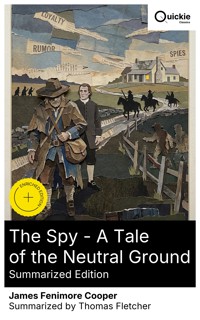
Set amid the Revolutionary War's 'Neutral Ground' of Westchester County, The Spy follows the enigmatic peddler Harvey Birch, suspected by all, secretly serving Washington—who appears in disguise as 'Mr. Harper'—as skirmishes, betrayals, and perils embroil the Wharton household and Major Dunwoodie's dragoons. Cooper blends Scottian historical romance with emerging American realism: rapid scene changes, panoramic topography, and moral ambiguity animate outlaws, Loyalists, and Continentals alike. The novel pioneers the American espionage thriller, probing loyalty, secrecy, and the civic fractures of civil war while providing brisk chases, gallows suspense, and a restrained, stoic hero. Cooper (1789–1851), raised on the New York frontier and married into the Westchester DeLanceys—a family with Loyalist ties—drew on local lore of skinners and cow-boys, veterans' recollections, and Walter Scott's Waverley to craft an American tale after his debut, Precaution. His proximity to contested ground and divided loyalties lent the book granular geography and sympathy for characters trapped between allegiance and survival. Readers seeking the origins of American spy fiction—and a foundational meditation on patriotism's hidden costs—will find The Spy both exhilarating and instructive. It rewards lovers of historical narrative, Revolutionary history, and students of how a literature invents itself from contested terrain. Quickie Classics summarizes timeless works with precision, preserving the author's voice and keeping the prose clear, fast, and readable—distilled, never diluted. Enriched Edition extras: Introduction · Synopsis · Historical Context · Author Biography · Brief Analysis · 4 Reflection Q&As · Editorial Footnotes.
Das E-Book können Sie in Legimi-Apps oder einer beliebigen App lesen, die das folgende Format unterstützen:
Veröffentlichungsjahr: 2026
Ähnliche
















The Spy - A Tale of the Neutral Ground (Summarized Edition)
Table of Contents
Introduction
Between embattled lines where authority frays and rumor rules, The Spy explores how loyalty, identity, and justice tangle in a shadow war that forces patriots, loyalists, and wary neighbors to stake their lives on imperfect knowledge, asking not only who serves which cause but whether any cause can claim the truth when messages travel by candlelight, uniforms mislead as often as they reveal, and the cost of trust is counted in both blood and reputation across a landscape where neutrality is a name without shelter and secrecy becomes the only passport through a country fighting to invent itself.
Published in 1821, James Fenimore Cooper’s The Spy: A Tale of the Neutral Ground is an early American historical novel that marries espionage and romantic adventure. Its setting is the contested corridor of Westchester County, New York, a strip between British-held New York City and the Continental lines during the Revolutionary War. Here patrols cross, farms suffer, and competing authorities overlap. The book appeared when the young nation was defining its literary identity, and its success helped establish Cooper’s reputation. Readers encounter a foundational experiment in American popular fiction, where national history becomes a stage for clandestine maneuver and tense domestic drama.
At the center stands a resourceful peddler whose movements and messages invite suspicion from every side, drawing a provincial household and a web of soldiers, scouts, and magistrates into perilous decision-making. Cooper builds the plot from encounters at thresholds—doorways, bridges, checkpoints—where language is tested and identities must be proved. The narration is omniscient yet slyly withholding, releasing facts with a dramatist’s timing. The prose is richly period, sometimes ceremonious, yet the momentum is brisk, propelled by sudden rides, covert exchanges, and tightly staged confrontations. The mood balances sobriety with romantic feeling, sustaining suspense without sacrificing moral reflection.
In this borderland, neutrality proves less a refuge than a pressure point, and the novel examines how communities fracture when every transaction may carry political meaning. Cooper traces the ethics of espionage with unusual sympathy, emphasizing costs borne not only by soldiers but by farmers, servants, and daughters whose homes become checkpoints of the war. Rumor contends with evidence; reputation wrestles with duty; the visible uniform says less than unseen motives. The book probes the nature of trust under uncertainty, asking how a republic can honor both prudence and generosity when survival seems to demand concealment, disguise, and calculated silence.
Cooper’s Neutral Ground teems with contending forces: regular troops, militia, irregular raiders, and opportunists whose loyalties shift with profit. Lawless bands prowl roads and barns, while officers enforce cordons that rarely hold. Against this turbulence the novel places parlors, farmyards, and taverns, where hospitality, interrogation, and bargaining blur into one another. The cast reflects conflicting allegiances—Loyalist households guarding kin, Continental patrols testing authority, neighbors calculating survival. Scenes hinge on passwords, papers, and gestures as much as on musket fire. The effect is a layered social portrait in which private affection, property, and honor persist, even as war reorders every priority.
As an early American venture into espionage narrative, the book anticipates many conventions later associated with spy fiction: the ambiguous agent, the test of loyalty, the perilous exchange, the revelation deferred. Yet it also maintains the breadth of a historical romance, staging public events alongside domestic scenes to show how national struggle enters ordinary rooms. Cooper’s achievement lies in welding these impulses into a single design, giving the clandestine plot the moral weight of civic argument. The result is a work that helped validate American settings and conflicts as worthy of serious storytelling, while still delivering swift, tightly wound suspense.
For contemporary readers, the novel’s questions feel newly urgent: how to weigh competing accounts, how to act when the facts arrive late, how to sustain community amid surveillance and fear. Its portrait of a contested zone resonates with modern borders and occupied cities, where civilians navigate armed checkpoints and shifting narratives. The language reflects its time, yet the pulse of suspicion, courage, and self-possession remains immediate. Approached as both political meditation and high-stakes entertainment, The Spy invites reflection on what a nation asks of individuals, and what individuals can ask in return, when the difference between safety and betrayal grows razor-thin.
Synopsis
James Fenimore Cooper’s The Spy: A Tale of the Neutral Ground, first published in 1821, is a historical novel set during the American Revolutionary War. The narrative unfolds in Westchester County, New York, a contested strip between British-held New York City and American lines known as the Neutral Ground. In this lawless margin where patrols, partisans, and opportunists collide, the novel examines how wartime blurs civic order and moral certainty. Cooper frames an espionage tale rooted in local households and country roads, where rumor travels faster than dispatches, and where identity, allegiance, and honor must be judged under the pressure of secrecy and fear.
The story centers on the Wharton family, whose country home lies perilously close to roaming bands and shifting pickets. Their loyalist sympathies sit uneasily within the surrounding American-held territory, forcing careful courtesy and concealment. Into their household come two catalytic figures: a plain, wary peddler named Harvey Birch, whose comings and goings draw suspicion, and a reserved traveler known as Mr. Harper, whose quiet authority hints at hidden purpose. Around shared meals and guarded conversations, Cooper builds an atmosphere of watchfulness, suggesting that in the Neutral Ground every guest may be a messenger, every errand a cover, and every kindness a calculated risk.
The danger intensifies when Henry Wharton, a British officer and son of the family, slips home in disguise to see his father and sisters. His return, affectionate yet reckless, immediately collides with the presence of American dragoons patrolling the region under Major Peyton Dunwoodie. Dunwoodie’s sense of duty contends with his attachment to the Whartons, especially to Frances, whose feelings deepen the stakes of every decision. Cooper uses this domestic intersection of loyalty and love to dramatize the war’s central conflict: public responsibilities that cannot be reconciled with private bonds, and choices that will weigh on all involved.
Beyond formal armies, the Neutral Ground swarms with irregulars and freebooters—groups Cooper depicts as Skinners and Cow-Boys—whose shifting allegiances serve plunder as much as principle. These bands exploit the confusion of jurisdiction, setting neighbor against neighbor and forcing honest people to negotiate with the unscrupulous. Harvey Birch moves among them with wary self-possession, his errands and evasions provoking suspicions from civilians and soldiers alike. Mr. Harper, meanwhile, treats the Whartons with measured counsel, suggesting ways to survive the tightening net of patrols without exposing his own identity. The result is a delicate equilibrium that cannot hold.
Inevitably, the web draws taut. Henry’s presence is detected, and American officers move to enforce the laws of war. Dunwoodie faces the conflict between humane impulse and military duty, as rules that seem clear in camp become painfully tangled in a family parlor. Legal processes and field judgments follow, raising questions about how strictly a nation-in-the-making must apply wartime discipline. Harvey Birch’s movements around these events appear incriminating to some and enigmatic to others, while Harper departs as quietly as he arrived. Cooper heightens the tension through formal procedures interrupted by surprise encounters and fast-changing circumstances.
As patrols tighten, Birch navigates hedgerows, lanes, and outbuildings with a spy’s craft, evading capture through local knowledge and calculated daring. These passages showcase the tradecraft of the era: false trails, coded signals, and the use of ordinary commerce as camouflage. Townsfolk, meanwhile, debate his character in tones ranging from contempt to reluctant admiration, showing how wartime judgment often rests on appearance and rumor. Pursuits spill into skirmishes, and small kindnesses or betrayals shape outcomes. The landscape itself becomes an agent in the plot—fords, orchards, and stone fences creating both refuge and trap for the hunted and the hunters.
Cooper situates these intimate conflicts within the larger strategic struggle along the Hudson and around New York. Dispatches, couriers, and sealed orders matter as much as cannon, and intelligence often tips the balance more decisively than open battle. The novel draws a contrast between the orderly integrity of headquarters and the improvisation of the field, where officers must act with incomplete information. A veiled figure of national consequence appears only briefly and obliquely, underscoring the chain through which distant policy depends on local courage. In this layering, the spy’s work emerges as both essential and morally ambiguous.
The narrative threads converge as Henry’s fate nears judgment, Dunwoodie grapples with conscience, and the Wharton household absorbs the pressure of surveillance. Rumors harden into accusations, while acts of quiet assistance or obstruction carry life-and-death consequences. Harvey Birch is drawn into maneuvers that test his resolve and force others to decide whether to trust appearances or accept lingering uncertainties. Cooper arranges tribunals, escorts, and sudden reversals that increase the pace without sacrificing moral weight, moving toward revelations about loyalty and sacrifice that clarify the stakes without resolving every doubt for the characters who must act.
Without disclosing the novel’s final turns, The Spy endures for its clear statement of a theme that became central in American fiction: that appearances are unreliable gauges of patriotism, and that unsung service may require living under suspicion. Published early in the nation’s literary history, the book helped define an espionage tradition built on ethical ambiguity and ordinary settings charged with danger. It closes by suggesting that the survival of a cause may depend on invisible labors as much as heroic proclamations. Cooper’s portrayal of the Neutral Ground remains a resonant metaphor for the hard middle where principle and necessity meet.
Historical Context
The Spy - A Tale of the Neutral Ground is set during the American Revolutionary War in the lower Hudson Valley of New York, particularly Westchester County. After 1776 the region between British-held New York City and the American positions in the Hudson Highlands functioned as a neutral ground, effectively a no-man's-land. Civil authority was weak, and military passes, patrols, and foraging parties governed daily life. British regulars, Loyalist auxiliaries, the Continental Army, and local militias intersected with farming communities along the Bronx and Croton river corridors. Cooper situates his narrative amid these contested roads, isolated farmsteads, and checkpoints that marked the frontier between rival institutions.
In 1776 British forces seized New York City after victories on Long Island and Manhattan, establishing their principal North American headquarters there for the rest of the war. The Battle of White Plains in October 1776 fixed a shifting front in Westchester County. Thereafter, British commanders - first William Howe and later Sir Henry Clinton - projected power from the city and its environs, while George Washington's Continental Army guarded the Hudson Highlands and inland approaches. Skirmishes, raids, and intelligence-gathering defined the theater more than set-piece battles, creating the unstable military geography that Cooper portrays as both physical landscape and moral terrain.
Westchester's Neutral Ground became notorious for irregular warfare. Loyalist light troops such as Lieutenant Colonel James De Lancey's Refugee Corps - popularly called "Cowboys" - operated from British lines, while bands labeled "Skinners," nominally Patriot, often engaged in plunder under the cover of authority. Civilian households faced confiscations, impressment, and reprisals. Committees of safety, justice of the peace courts, and provost marshals sought to regulate movement through passes and oaths, yet could not prevent endemic raiding. Cooper draws on this documented climate of predation and divided allegiance, using roadside challenges, forged papers, and nighttime alarms as features of a society strained by proximity to warring powers.
Espionage framed decision-making in this corridor. Washington supervised a sophisticated intelligence system, including the Culper Ring that relayed reports from British-occupied Long Island through couriers and ciphers. Techniques such as numeric codes and "sympathetic stain" invisible ink, developed by physician James Jay, enabled clandestine correspondence. The 1780 Arnold-Andre conspiracy - uncovered when Major John Andre was captured near Tarrytown carrying plans relating to West Point - illustrated the stakes of secrecy along the Hudson. His subsequent trial and execution at Tappan showed how espionage blurred military and civil jurisdictions. Cooper channels these precedents to depict suspicion, code names, and the perilous status of informants.
Published in 1821, The Spy was James Fenimore Cooper's first major success and an early landmark of the American historical romance. Appearing soon after the War of 1812, it answered cultural calls for a national literature by locating heroism and doubt within the Revolutionary past. Cooper adapted techniques popularized by Walter Scott's Waverley novels - period detail, social cross-sections, and political conflict - while rooting them in New York's geography and institutions. The book engaged a readership centered in New York and Philadelphia's expanding print markets, and it helped define how American fiction could treat recent history with narrative drive and archival consciousness.
Contemporaries associated Cooper's central spy with Enoch Crosby, a Revolutionary operative in southeastern New York who infiltrated Loyalist circles and was repeatedly "captured" and released to continue his mission under Patriot supervision. Crosby's activities became widely known through H. L. Barnum's 1821 narrative The Spy Unmasked. While Cooper avoided confirming any one model, he acknowledged drawing on reports of real Patriot agents. The public linkage to Crosby anchored the novel in recognizable regional espionage, underscoring the era's reliance on informants, staged arrests, and covert identifications - practices documented in military correspondence preserved in collections such as George Washington's papers.
The setting also reflects New York's internal divisions. Loyalism thrived in the city and river towns, while Patriot committees enforced allegiance in the countryside. Confiscation and banishment laws reshaped property and kinship networks. Enslaved Africans lived throughout the region; New York's gradual emancipation began in 1799 and ended in 1827, and during the war British proclamations such as the 1779 Philipsburg Proclamation offered freedom to those who fled rebel masters. Refugees, prisoners, and parolees moved under guard along the same roads as traders and farmers. Cooper's depiction of households negotiating authority mirrors these documented pressures on families and labor.
By dramatizing checkpoints, forged passes, rival patrols, and the uncertain status of informants, the novel explores how civil war conditions complicate republican ideals of transparency and consent. It reflects early national anxieties about loyalty and the rule of law while affirming the necessity - and cost - of secrecy in a revolutionary struggle. The emphasis on local particularity - Westchester farms, Hudson crossings, provincial courts - renders national politics in intimate terms. In doing so, Cooper critiques predation and opportunism on all sides yet contributes to a post-1812 project of national memory, presenting the Revolution as both a source of unity and a study in moral ambiguity.




