


17,99 €
Mehr erfahren.
- Herausgeber: John Wiley & Sons
- Kategorie: Fachliteratur
- Sprache: Englisch
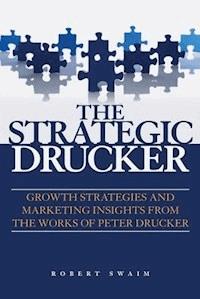
The strategy and marketing wisdom of Peter Drucker, compiled into one handy guide Peter Drucker was widely considered the father of modern management. His 39 books and countless scholarly and popular articles predicted many of the major economic developments of the late twentieth century, and his influence upon modern business is almost immeasurable. In The Strategic Drucker, Drucker associate and student Robert Swaim has distilled Drucker's most important business strategies and philosophies into one valuable book. Swaim recounts and compiles Drucker's insight on growth, strategic planning, sales, marketing, innovation, and a wealth of other vital business topics. For anyone who wants to get to know the real Drucker, without digging through all of his books and articles, The Strategic Drucker is a valuable resource. Robert Swaim, PhD (Beijing, China), has taught at numerous universities around the world and collaborated with Peter Drucker in developing an MBA and executive development program for Chinese executives and managers.
Sie lesen das E-Book in den Legimi-Apps auf:
Seitenzahl: 453
Veröffentlichungsjahr: 2011
Ähnliche



















Contents
Acknowledgments
Preface: Peter F. Drucker (1909–2005)
Chapter 1: Drucker on Managing Growth
The Falling Tide
Drucker on Growth
Drucker on the Need for Management
Porter on the Need for Leadership
An Opposing View: “The Growth Trap”
Chapter Summary
Chapter 2: Strategy and the Purpose of a Business
Part One: Drucker Visits Your Company
A Meeting With Peter F. Drucker
The Morning Session of Drucker’s Visit with You
Summary of Key Questions to Answer
Part Two: The Afternoon Meeting With Drucker
Drucker on Establishing Objectives
Putting Profit into Perspective
Drucker Concludes the Meeting
Chapter Summary
Chapter 3: Dissecting the Interview and Drucker on Marketing
Part One: Dissecting the Interview
Drucker on Mission
Transforming Governance and the Challenge of Maintaining Balance
Drucker’s Strategies
Drucker on Diversification and Drucker’s Law
Part Two: Drucker on Sales and Marketing
Drucker on Marketing
Summary
Chapter 4: The Five Deadly Business Sins
Introduction
The Five Deadly Business Sins
Summary
Chapter 5: Innovation and Entrepreneurship
Part One: Continuing Organic Growth Strategies
Defining Entrepreneurs and Entrepreneurship
Definition of Innovation
Types and Requirements of Innovation
The Principles of Innovation
Part Two: Innovation and Entrepreneurship
Pundits’ Views and Closing Drucker Gaps
Summary
Application Tool
Chapter 6: Getting Rid of Yesterday
Part One: Peter Drucker’s Concept of Planned Abandonment
Part Two: Applying the Concept of Planned Abandonment
Chapter 7: External Growth Strategies
Introduction
Part One: Mergers and Acquisitions
M&A Failure Rate
Drucker’s Rules for Mergers and Acquisitions
Additional Drucker Insight
Additional Views from the Pundits and the Drucker Gap
M&A Integration Planning
Selling a Business or Divesting a Subsidiary
First Rule of M&A
China and Global Mergers and Acquisitions
Part One Summary
Part Two: The Strategic Alliance Spectrum and Drucker’s Rules for Alliances
Non-Equity (Partnership) and Equity Alliances (Ownership)
The Spectrum of Alliances and Time, Cost and Risk
Drucker’s Rules for Alliances
Reasons for Not Forming an Alliance
Part Two: Summary
Chapter 8: Family Business Management
Part One: Drucker’s Rules for Family Business Management
The Family Business in Perspective
Drucker’s Rules
Part Two: Drucker’s Rules for Exit Strategies and Management Succession
Research on Owners of Privately Held Businesses
Six Exit Strategies
Summary and Closing the Drucker Gap
Assessment Tool and Case Studies
Chapter 9: Drucker and the Next Society
Introduction
Drucker and the Next Society
Applying Drucker
The Fourth Information Revolution
Changing Demographics: Declining Birthrates and Aging Populations
The Steady Decline in Manufacturing
The 21st Century and Political Instability and Social Unrest
Closing Some Drucker Gaps
Summary
Next Society Issues Impact Assessment Tool
Chapter 10: Planning and Managing Organizational Change
Part One: Drucker and the Change Leader
Why Change?
Ground Rules for Survival
Reinforcing Drucker
Taking the Mystery Out of Change
What Organizations Can Change
Part Two: Drucker’s Insight on Change
What Organizations Should Not Change
Eight Reasons Why Change Efforts Fail
Drucker’s Requirements for Becoming a Change Leader
Piloting
The Change Leader’s Budget
Change and Continuity
Parts 1 and 2 Summary
Part Three: Planning and Managing Complex Organizational Change
Change Leaders
The Action Research Model
Diagnostic Tool: The Change Equation
Part Three Summary
Chapter 11: Strategic Planning: The Entrepreneurial Skill
What Is Strategic Planning: Drucker’s Definition
What Is “Strategic Thinking”?
Summary
Chapter 12: Strategic Decision Making
Introduction
Drucker on Problem Solving Versus Decision Making
Drucker’s Views on Decision Making (A Review)
What Good Decision Makers Do
What Is a Decision?
Classifying Decisions: Programmable and Nonprogrammable Decisions
Determining If a Decision Is Necessary
Classifying Problems: Generic and Unique Events
Selecting the Problem
Drucker’s Steps in the Decision Making Process
Defining the Problem as Opposed to the Symptoms of the Problem
Specification of the Decision: Establishing Boundary Conditions
Converting the Decision into Action
What Action Has to Be Taken and Who Has to Take it?
Other Decision Making Guidelines
Group Decision Making—An Open Systems Approach
An Open Systems Approach
Chapter Summary
Appendix A: Strategic Management Application Tools
Bibliography
Index
Copyright © 2010 John Wiley & Sons (Asia) Pte. Ltd. All rights reserved.
This edition is published in 2010 by John Wiley & Sons (Asia) Pte. Ltd., 2 Clementi Loop, #02-01, Singapore 129809 on behalf of Jossey-Bass, A Wiley Imprint.
989 Market Street, San Francisco, CA 94103-1741–www.josseybass.com
No part of this publication may be reproduced, stored in a retrieval system, or transmitted in any form or by any means, electronic, mechanical, photocopying, recording, scanning, or otherwise, except as permitted under Section 107 or 108 of the 1976 United States Copyright Act, without either the prior written permission of the publisher, or authorization through payment of the appropriate per-copy fee to the Copyright Clearance Center, Inc. or on the Web at www.copyright.com. Requests to the publisher for permission should be addressed to the Publisher, John Wiley & Sons (Asia) Pte. Ltd., 2 Clementi Loop, #02-01, Singapore 129809, tel: 65-64632400, fax: 65-64646912, email: [email protected]
Readers should be aware that Internet Web sites offered as citations and/or sources for further information may have changed or disappeared between the time this was written and when it was read.
Limit of Liability/Disclaimer of Warranty: While the publisher and author have used their best efforts in preparing this book, they make no representations or warranties with respect to the accuracy or completeness of the contents of this book and specifically disclaim any implied warranties of the merchantability or fitness for a particular purpose. No warranty may be created or extended by sales representatives or written sales materials. The advice and strategies contained herein may not be suitable for your situation. You should consult with a professional where appropriate.
Neither the publisher nor author shall be liable for any loss of profit or any other commercial damages, including but not limited to special, incidental, consequential, or other damages.
Jossey-Bass books and products are available through most bookstores. To contact Jossey-Bass directly, call our Customer Care Department within the US at 800-956-7739, outside the US at 317-572-3986, or fax 317-572-4002.
Jossey-Bass also publishes its books in a variety of electronic formats. Some content that appears in print may not be available in electronic books.
Library of Congress Cataloging-in-Publication Data
ISBN: 978-0-470-82406-1
Working together to bring Drucker’s teachings to China.Claremont, California 2001
Robert W. Swaim & Peter F. Drucker
Acknowledgments
I wish to extend my appreciation to the following individuals who played a significant role in helping me develop Peter Drucker’s teachings for China that eventually led to the writing of this book.
Les Charlton, the Associate Editor of Business Beijing Magazine who encouraged me to write the Drucker Files series of over 20 articles that became the foundation for significant parts of this book.
Xueying “Penny” Peng, my researcher in China who eventually knew more about Drucker than I did and whom Peter also admired.
J. Michael Marks, a friend of over 30 years who was kind enough to provide his creative insight in the editing of this book.
Thomas W. Zimmerer, former Dean of the Saint Leo University School of Business, who worked with me to create nine fully accredited Drucker MBA courses that became an integral part of the Saint Leo University–Peter Drucker MBA Program for China.
Professor Joseph Maciariello, at the Drucker School, who was my content expert in my development of Peter Drucker’s works for the China Drucker MBA and Executive Development Programs to ensure I did not put words in Peter’s mouth.
Peter F. Drucker, who was my teacher, colleague and friend for close to 30 years and always had time to share his insights with me.
Preface
Peter F. Drucker (1909–2005)
THE FATHER OF MODERN MANAGEMENT
Peter F. Drucker is known throughout the world as the Father of Modern Management, and countless articles have been written since he passed away in 2005, relative to his extensive contributions to management and society. I had the good fortune of knowing Peter first as a teacher, then as a colleague and also as a friend for almost 30 years. I also devoted nearly five years to working with Peter to develop the Drucker MBA and Drucker Executive Development Programs that are now offered in China. The programs I eventually developed and taught in many cities in China included nine fully US-accredited MBA courses that were based on the nearly 40 books and thousands of articles he had written on management and other related topics. The reader will therefore find a number of references to China in this book; however, the concepts presented will apply nearly everywhere.
In working together, we had numerous conversations in which he shared additional insight on a number of topics that he had previously not written about. Many of these pertained to his views on strategy and, in particular, on sales and marketing. I therefore feel uniquely qualified to share some additional insight relating to his work as well as to some of his omissions, or what I call “Drucker gaps”. Also, we have to go beyond Drucker to implement a number of these concepts today.
The Strategic Drucker and Beyond
One of the Drucker MBA courses I developed was “Strategy and the Purpose of a Business” and was based on his views on strategy, marketing and other related topics that were contained in, sometimes sandwiched in, his numerous books and countless articles. Throughout Peter Drucker’s many books he discussed the importance of strategy; however, he never devoted an entire book to the subject although he claimed, “I developed the first book on what is now called ‘strategy,’ Managing for Results, which appeared in 1964.”1 To this day, he is still not known to be a strategist like more notable contributors such as Michael Porter, known in particular for his “Five Competitive Forces Model” as described in his 1980 book Competitive Strategy2 and Henry H. Mintzberg of McGill University in Montreal, who has written extensively on the subject.3
Richard Koch in his 1995 book, The Financial Times Guide to Strategy, commented, “Considering his long innings and large tally of books, and the appropriately high esteem in which he is held, it is salutary to reflect that Drucker actually says remarkably little about strategy. His main contribution is the idea of the Theory of the Business. The fit of this theory with the business environment—that is, the degree to which the firm’s theory of the business strikes a market and economic chord—may be as important to the firm’s success as the strength of its core competencies or its market position. Drucker did not exactly say this but he would have done, had he ever deigned to write a book on strategy.”4
I would disagree with Koch’s observations that Drucker’s main contribution to strategy was his Theory of the Business, and furthermore this book suggests that there actually is no “theory” in the Theory of the Business. However, Drucker’s views on the Purpose of a Business, the importance of Mission and Vision, his focus on the Customer, Non-customers and Going Outside (known today as the Voice of the Customer), and on what he considered to be the two most important functions of the organization, Marketing and Innovation, are far more significant contributions than the “theory.” However, Koch is correct in suggesting that Drucker never wrote a book that was entirely devoted to strategy. On the other hand, contained in many of his 39 books and thousands of articles are possibly the critical ingredients for such a book. This book therefore attempts to consolidate many of Drucker’s observations and writings on strategy and other topics related to business growth, such as sales, marketing, innovation, mergers and acquisitions, and strategic alliances into one source, just as I had to do when conducting the research for the development of the Drucker Strategy Course. Even then, the reader will find in a number of cases Drucker’s views to be incomplete, leaving omissions or gaps that need to be filled. Also, to understand the application of a number of his concepts today, or if they are still valid, we must sometimes go beyond Drucker.
What Are Drucker Gaps?
Peter Drucker was very good at describing what should be done, often suggesting the right questions management should be asking itself (Drucker’s Strategic Thinking), as will be seen in the chapter, “Strategy and the Purpose of a Business,” but he often neglected to mention how to do it. I have therefore included my observations on a number of Drucker’s concepts on strategy and related topics. Although I am not the first to identify these gaps, perhaps I am among the first to attempt to close them, at least in the area of strategy, with this book. As an example, William Clarkson, a former CEO of Graphic Controls, a subsidiary of Times-Mirror, in calling attention to the gap between academic theory and its practical application, wrote in 1985, “Yet a major gap exists between academia’s theoretical and conceptual understanding of management and industry’s ability to use this body of knowledge in a practical, relevant, and cost-effective way.” In reference to Drucker, he added, “On one side of the gap, we have Drucker, the seer. On the other side of the gap, we have the US manager, knowing that the Management Bible (Drucker’s 1973 classic book, Management: Tasks, Responsibilities, Practices) has been written by Drucker, but not quite knowing how to have this knowledge become a part of her or his behavior and practice. His writings have been read by more managers than those of any other single author, living or dead. Yet there is that troubling gap between his theory and the practice of US managers.”5
This book therefore also includes practical guidelines on how some of these gaps can be closed and how a number of Drucker’s concepts on strategy can be applied in one’s own organization. This is largely accomplished by referencing and including the work of other contributors to strategy and the other disciplines Drucker commented on that are required to fully understand the application of his concepts. The reader will also find a number of application tools included in Appendix A.
A Focus on Growth
This book will focus on Drucker’s views on strategies to achieve business growth, both organically through sales and marketing, and innovation; and then external growth through mergers, acquisitions, and strategic alliances. Drucker’s Strategic Thinking Process will also be covered in detail, outlining the essential steps that must be taken in order to arrive at the appropriate strategies for growth. Chapter 2, “Strategy and the Purpose of a Business,” will cover most of Drucker’s views on strategy and marketing in a unique hypothetical setting: Your company has retained him to provide you with advice on how to compete more effectively in the global economy. The interview you and your management team will have with him and the topics discussed and the questions asked by him lay the foundation for the other chapters that follow. This chapter illustrates Drucker’s Strategic Thinking Approach to strategy and illustrates the right questions that need to be asked—according to Drucker.
His views on the key roles that senior management and planners must play in the strategic planning process are also reviewed as well as the importance of executive decision making. Drucker’s observations on changing demographics and global trends in society that offer opportunities for innovation and growth help to reinforce some of his views on marketing and marketing research.
Summary: Who Was Drucker?
Nearly 30 years ago, I asked Peter, “How would you classify yourself—as a Professor of Management?”
He replied, “No Bob, I am a social scientist.”6
Some 20 years later, he apparently rebranded himself as a social ecologist in The Daily Drucker (2004): “I consider myself a ‘social ecologist,’ concerned with man’s man-made environment the way the natural ecologist studies the biological environment. The term ‘social ecology’ is my own coinage.”7 In The Daily Drucker he also cited a reference to TheAge of Discontinuity, a book he wrote in 1969 as the first time he wrote about social ecology”8 Webster’s New World Dictionary defines “ecology” from a sociology perspective as, “Sociology the study of the relationship and adjustment of human groups to their geographic environment.”9 Drucker did not see himself as a visionary, but rather as an astute observer of society, hence his initial classification as a social scientist. He did not predict the future, but called attention to what was happening today that would impact the future. As an example, he was ahead of most in identifying the issues of declining birthrates, aging populations, and shrinking populations, particularly in the developed world—trends to assist us in identifying possible opportunities for innovation and growth.
My descriptions of Drucker gaps are not intended to be a criticism of his work, but merely to provide some additional tools for the implementation of many of his concepts and teachings. In other cases, where his concepts were incomplete, the contributions of others were included to close the loop. Drucker wrote in his 1986 book, The Frontiers of Management, “I have never slighted techniques in my teaching, writing, and consulting. Techniques are tools; without tools, there is no ‘practice,’ only preaching.”10 I have taken the position that although this might have been the case, there were situations where more than tools were necessary to close some gaps—it was necessary to go beyond Drucker enlisting the contributions from experts (I have called them pundits) in various disciplines such as strategy, marketing and innovation.
Needless to say, it was a pleasure to have known and worked with Peter. Working with Peter on the China Programs was one of the highlights of my career.
Robert W. Swaim
Beijing, China
Endnotes
1. Peter F. Drucker, “Drucker on Drucker,” New Management 2, no. 3 (Winter 1985): 7.
2. Michael Porter, Competitive Strategy: Techniques for Analyzing Industries and Competitors (New York: The Free Press, 1980).
3. Henry Mintzberg, “Crafting Strategy,” Harvard Business Review 65, no. 4 (July-August 1987); and Henry Minztberg, Bruce Ahlstrand, and Joseph Josepel, Strategy Safari: A Guided Tour Through the Wilds of Strategic Management (New York: Free Press, 1998).
4. Richard Koch, The Financial Times Guide to Strategy: How to Create and Deliver a useful Strategy, 2nd ed. (London: Pearson Education Limited, 2000), 147–148.
5. William Clarkson, “Drucker: Closing the Theory/Practice Gap,” New Management 2, no. 3 (Winter 1985): 21–23.
6. Rosabeth Moss Kanter, “Drucker: The Unsolved Puzzle,” New Management 2, no. 3 (Winter 1988); and Thomas J. Peters, “The Other Half of the Message,” New Management 2, no. 3 (Winter 1985).
7. Drucker’s response to my question at the Claremont Graduate School during the fall of 1977. Drucker held the position of the Clarke Professor of Social Science during his entire tenure at the Claremont Graduate University, not as a “social ecologist.”
8. Peter F. Drucker, The Daily Drucker:366 Days of Insight and Motivation for Getting the Right Things Done (New York: HarperCollins Publishers, Inc., 2004).
9. Peter F. Drucker, The Age of Discontinuity:Guidelines to our Changing Society (London: William Heinemann, Ltd., 1969).
10. Peter F. Drucker, The Frontiers of Management (New York: Truman Talley Books, 1986), 220–227.
Chapter 1
Drucker on Managing Growth
THE NEED FOR BUSINESS GROWTH AND STRATEGY
Growth will continue to be a desirable and indeed a necessary business objective.1
Peter F. Druckera
I start the journey of exploring Peter Drucker’s views on strategy and strategic management with a discussion of growth. After all, what is the purpose of developing a strategy if it is not to provide the direction for the future growth of the firm? As Drucker stated in Management (1973), “Growth will continue to be a desirable and indeed a necessary business objective.” He went on to add, “In a growing economy there is plenty of room. Industries that have passed their peak decline slowly and are being held up by the overall buoyancy of the economy. New industries can grow well and grow more by accident than by management. But when the economy as such does not grow, changes in the economy are bound to be abrupt and sharp. Then indeed a company or an industry that does not grow will decline. Then there is even more need for a strategy that enables a management to plan for growth and to manage growth.”2 Needless to say, the banking and mortgage industries need a strategy.
In his discussions of the need for marketing, Drucker also spoke about what contributed to a growth company. The quotation below is just one aspect of what Drucker suggested needed to be asked of customers and non-customers. (Non-customers is a term he came up with to describe those who are not buying from your company.)
Management has to ask which of the customer’s wants are not adequately satisfied by the products or services offered him today. The ability to ask this question and to answer it correctly usually makes the difference between a growth company and one that depends on the rising tide of the economy or of the industry. But whoever contents himself to rise with the tide will also fall with it.3
Peter F. Druckerb
The Falling Tide
As the first decade of the 21st century draws to a close, the US economy can be best described as having no growth, or only marginal growth, depending on whose numbers we are given, or as Drucker once commented on statistics, “Tell me what you want to prove and I will develop the numbers.” This lack of economic growth can be attributed to many factors including the credit crisis as a result of the greed and stupidity of those who ventured into the subprime mortgage market (as lenders, investors and customers)—compounded by the collapse of the housing market and the highest number of home loan foreclosures since the Great Depression; oil; the falling value of the dollar against most currencies; the huge national debt increasing every day with the cost of US military commitments in lraq and Afghanistan, and a volatile capital market witnessing triple digit swings in the stock markets depending on what day it is, to name but a few factors.
Lesen Sie weiter in der vollständigen Ausgabe!
Lesen Sie weiter in der vollständigen Ausgabe!
Lesen Sie weiter in der vollständigen Ausgabe!
Lesen Sie weiter in der vollständigen Ausgabe!
Lesen Sie weiter in der vollständigen Ausgabe!
Lesen Sie weiter in der vollständigen Ausgabe!
Lesen Sie weiter in der vollständigen Ausgabe!
Lesen Sie weiter in der vollständigen Ausgabe!
Lesen Sie weiter in der vollständigen Ausgabe!
Lesen Sie weiter in der vollständigen Ausgabe!
Lesen Sie weiter in der vollständigen Ausgabe!
Lesen Sie weiter in der vollständigen Ausgabe!
Lesen Sie weiter in der vollständigen Ausgabe!
Lesen Sie weiter in der vollständigen Ausgabe!




