


13,99 €
Mehr erfahren.
- Herausgeber: The History Press
- Kategorie: Geisteswissenschaft
- Sprache: Englisch
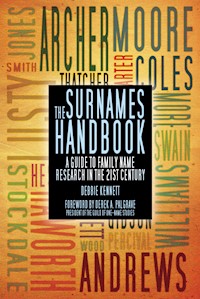
Every surname has its own story to tell, and a surname study is a natural complement to family history research. The study of surnames has been revolutionised in the last decade with the increasing availability of online resources, and it is now easier than ever before to explore the history, evolution, distribution and meaning of your family name. The Surnames Handbook provides a comprehensive guide to researching your surname using genealogical methods in conjunction with the latest advances in DNA testing and surname mapping. The book explores the key resources that are used to study a surname and is packed with links to relevant websites giving you everything you need to research your surname in one compact volume.
Das E-Book können Sie in Legimi-Apps oder einer beliebigen App lesen, die das folgende Format unterstützen:
Veröffentlichungsjahr: 2012
Ähnliche



















To Guy, Tim and Alex
ACKNOWLEDGEMENTS
This book builds upon the pioneering research of all my predecessors who have written about surnames over the last 400 years and who have each in their different ways contributed to our understanding and knowledge. I have quoted freely from many of these authors as their wise words still resonate today. I am particularly grateful to the late Philip Dance. I never had the pleasure of knowing or corresponding with him, but he effectively laid the foundations for twenty-first-century surname research with his Modern British Surnames website, where he gathered together all the many resources on surnames from many different disciplines. Philip’s work is now preserved on the new Surname Studies website (www.surnamestudies.org.uk), which is sponsored by the Guild of One-Name Studies and serves as a lasting tribute to his memory. I am indebted to Mike Spathaky who took on the responsibility of transferring Philip’s work to its new home, and who now maintains the new website. Without this resource the task of writing this book would have been much more difficult and many obscure sources would have remained undiscovered.
I would like to thank Derek Palgrave for kindly writing the foreword to this book, and for allowing me to reproduce his selective substitution table. Derek also provided particularly helpful comments on my chapters on one-name studies and variants and deviants, and pointed me in the direction of some useful references. James Irvine kindly read the first draft of my manuscript, and provided many helpful and thoughtful comments, as well as providing guidance on sources for Scottish research. Andrew Millard also kindly read the entire manuscript and provided me with some very useful comments and valuable suggestions. Chris Pomery gave me constructive criticism on a number of key chapters.
I am grateful to John and Sheila Rowlands for permission to reproduce a table from The Surnames of Wales. Sheila Rowlands also kindly checked and corrected my Welsh sections, and helped with the compilation of the list of Welsh lay subsidy rolls in Appendix C. Oliver Padel kindly shared some of his research with me, pointed me in the direction of some very useful references, and also helped with the compilation of the list of lay subsidy rolls. John Plant and Ralph Taylor both commented on my DNA chapter.
Stephen Archer’s British 19th Century Surname Atlas CD has been an invaluable resource while writing this book, and I am also grateful to Stephen for permission to use maps generated from his CD as illustrations. I would also like to thank Fiona McElduff, Pablo Mateos, Angie Wade and Mario Cortina Borja for permission to reproduce their tables of the top twenty surnames in England, Scotland, Wales and Northern Ireland.
Family historians are always generous with their time and advice. Karen Williams went out of her way to help me when I made my first tentative steps into family history research. Chris Gibbins has helped me enormously with my Devon research, and has tracked down many obscure references for me. Elizabeth Glover Howard has been a helpful and friendly correspondent on all matters relating to Devon and heraldry, and has also kindly assisted with various aspects of my research. The late John Overholt provided guidance on the most useful medieval sources for family history research.
I would like to thank all the members of the Guild of One-Name Studies who have generously shared their knowledge in the Journal of One-Name Studies, in the Guild’s wiki and on the Guild’s mailing list. I am very grateful to all the people who have shared their research with me for my Cruse/Cruwys/Cruise one-name study, as well as all my relatives who have helped me to research all the other branches of my family tree. I would also like to thank all the people who have participated in my DNA projects.
I am grateful to Katharine Reeve for suggesting that I write this book, and to The History Press for once again putting their faith in me.
Finally, I would like to thank my family who have endured my preoccupation with surnames for the last year and who have had to put up with the prevailing domestic chaos, especially in the last few months as the deadline loomed ever closer.
CONTENTS
Title
Dedication
Acknowledgements
Foreword
Definitions
Introduction
1 The History of Surnames
2 The Classification of Surnames
3 Variants and Deviants
4 Surname Mapping
5 Surname Frequency
6 Has it Been Done Before?
7 Laying the Foundations: the Key Datasets
8 Surname Origins: Pre-1600 Resources
9 DNA and Surnames
10 One-Name Studies
APPENDICES
A Genealogy Websites
B Surname Websites
C Lay Subsidy Rolls
D Organisations and Journals
E Linguistic Resources
F Place-Name Resources
G Population Statistics
Bibliography
Copyright
FOREWORD
It is a privilege to have been invited to write this foreword and it gives me great pleasure to be able to introduce readers to this new work. The author has a formal background in European languages which, I suspect, may well have provided her with some unique insights into the meaning and structure of surnames. Furthermore she also spent several years working for a publisher, accumulating the necessary experience required in the production of specialist periodicals. As an editorial manager she was involved in writing, editing, and supervising layout – all in the days prior to the general adoption of word-processing techniques.
From quite an early age she has been fascinated by her own family surname, Cruwys, which very few people seemed able to spell or pronounce. I have sympathy with her, as in spite of my surname being easy to spell its pronunciation is remarkably variable. It is, of course, not enough just to be interested in a surname – action is required. This is not usually convenient during the first few decades of one’s life when formal education, marriage and children normally take precedence. Nevertheless there comes a time, often a specific event, when the family’s history comes into focus.
In Debbie’s case it was the death of her father-in-law which brought about a resurgence of interest. Sudden access to a large collection of family photographs prompted her to write around to relatives in order to identify the images of the individuals represented. One of those she contacted had already done some research into her mother-in-law’s family, Woolfenden, so it seemed appropriate to extend this project. This soon provided the further incentive for her to investigate her own family of Cruwys. This eventually developed into a one-name study with the objective of painting a comprehensive picture of the evolution of this surname and its subsequent ramification. Registering that surname with the Guild of One-Name Studies was a natural outcome.
She found the generation of her one-name study a fascinating process embracing a great deal more than the mere drafting of family trees. She realised just how important it was to establish how and where the surname had emerged and that some appreciation of early linguistics needed to be invoked. The paucity of early records and their lack of consistent spelling alerted her to the widespread occurrence of variant spellings as there were no means of standardisation when the largely illiterate bearers migrated from place to place.
Her experience of research in this field, coupled with her earlier years in publishing, made her an ideal candidate to take on a systematic review of the wide range of evidence, which is available to anyone embarking on an enterprise of this nature. This book is a careful distillation of her findings. It is also a valuable guide to the published literature in this field, not only that in book form, but also a great deal of the reference material now available on the internet. Most of the classic texts by known writers in this field are mentioned in context: Guppy’s pioneering work on surname distribution receives due credit, as do the more recent surname texts by Reaney, Redmonds, Hanks and Hodges, Hey and Rogers.
She devotes a sizeable portion of her review to pre-1600 resources pointing out that quite a significant number are now accessible as published transcripts. Family historians rarely make use of such data as they omit evidence of genealogical linkages. However for details of distribution and early spelling these are particularly useful. Published versions of subsidy rolls, pipe rolls, hundred rolls, poll taxes, inquisitions post mortem, etc. are often accessible in major libraries and occasionally online. Older texts that are out of copyright can often be accessed in the Internet Archive.
Modern developments relating DNA analysis to specific surnames are also included and the author’s detailed explanations about this complex topic are remarkably clear. She provides very useful information relating to several practical studies which have been instituted during the last few years.
The final chapter traces the development of what we now define as one-name studies. It recognises that although there were some nineteenth-century family histories which concentrated on a single surname and its variants, it was not until the mid-twentieth century that endeavours of this type attracted this modern definition. In 1979, the Guild of One-Name Studies was launched to support those who had adopted this distinctive approach. The Guild, which has grown in size and stature, recently recruited its 6,000th member.
Among the Guild’s members are several who have either pioneered or utilised some of the research procedures described by the author. She has spent a great deal of her time and effort explaining their value and importance within a one-name study. I believe this handbook, which is a significant contribution to our understanding in this field, deserves not only our admiration and gratitude, but also a place on our bookshelves.
Derek A. Palgrave
President, Guild of One-Name Studies and
Vice-President, Federation of Family History Societies
DEFINITIONS
Surname and family name
The terms surname and family name are, to all intents and purposes, synonyms. The word surname is derived from the Anglo-Norman word surnoun and the Old French word sornom, which have their roots in the Medieval Latin words supernomen and supranomen. The earliest printed reference cited in the Oxford English Dictionary (OED) dates from 1325: ‘Richard queor de lyoun, That was his sournoun.’ The OED has no separate definition for family name, but quotes an early reference from 1699 in its entry for the word family: ‘He shewed me the Catalogue of Authors … alphabetically disposed by Family Names.’1 In most Western cultures the surname follows the given name, but in some countries, such as China and Hungary, this order is reversed and the surname is listed before the given name. Surname has the sense of a second name that is added to or follows the forename or given name, whereas family name is used in a more generic sense, regardless of the name order used. As the surnames of the British Isles are the primary focus of this book I have used the terms surname and family name interchangeably throughout.
Given name and forename
In today’s secular and multicultural society the terms Christian name, baptismal name and font name are no longer appropriate to describe the name or names bestowed on a child by its parents. The term personal name has been used by some English surname writers as a synonym for a Christian name, but personal name usually has a broader meaning and is used to denote all the components of a person’s name. I have instead preferred to use the term given name, though the word forename has also sometimes been used where it has been dictated by the meaning.
The British Isles
The terminology used to describe the different regions and countries that comprise the British Isles is the source of much confusion, even to those of us who live here. For the sake of clarity, I have provided definitions below:
• Great Britain is an island in the British Isles that consists of England, Wales and Scotland.
• Ireland is an island in the British Isles that now consists of two countries: Northern Ireland and the Republic of Ireland. The name Ireland has been used throughout this book in its historic sense to define the country that existed prior to partition in 1922.
• The United Kingdom now consists of four constituent countries: England, Wales, Scotland and Northern Ireland, and the modern definition has been used throughout. Note, however, that between 1801 and 1922 the United Kingdom included Great Britain and the whole of Ireland.
• The British Isles is the name given to the group of islands off the north-west coast of Continental Europe that includes the islands of Great Britain, Ireland, and several thousand smaller isles. Although for political reasons the term ‘the Isles’ is sometimes now preferred, it is not yet accepted usage. The alternative form ‘Britain and Ireland’ is not appropriate as it excludes the Channel Islands and the Isle of Man, both of which are self-governing Crown Dependencies and are not part of the UK.
Note
1Oxford English Dictionary, 2nd edn (1989); online version March 2012: www.oed.com.
INTRODUCTION
In my view, all genealogists should carry out a detailed investigation into the surname which they are researching; they should study its frequency and distribution at different periods, and build up a picture of its spelling history. It should always be looked at in the context of the other surnames and place-names in the community. If that means acquiring new skills, and an involvement in other disciplines, so be it, it is the vested interest of the genealogist which can, in the end, help to solve many of our long-standing surname problems.
George Redmonds, Surnames and Genealogy: a New Approach (2002), p.194
Every surname is unique and has its own story to tell. Some surnames have their roots in the Middle Ages with a single man. In contrast, surnames such as Smith, Taylor and Carpenter have multiple founders, for every town or village would have had at least one smith, tailor or carpenter whose descendants eventually adopted their occupation as a hereditary surname. Smith is now the most common surname in the UK and it is a name that is shared by 1.2 per cent of the population. However, while surname rankings are dominated by a few high-frequency surnames, the distribution starts to drop off dramatically outside the top 100 names. Counterintuitively, most people have an unusual name. Consequently, while everyone is likely to have a Smith, Jones or Williams somewhere in their family tree, they will also have many more ancestors with a rich diversity of unusual surnames derived from minor place-names and obscure occupations. These surnames have an astonishingly rich vocabulary and are an important linguistic record, providing evidence of the evolution of the English language through their changing spellings and pronunciations. The online OED has definitions for over 600,000 words, yet there were over 1.5 million different surnames recorded in the 2001 electoral register in the UK alone.1
The study of surnames is no longer the preserve of gentleman genealogists and university academics with a special interest in linguistics or philology (the study of the historical development of a language). Geneticists are exploring the relationship between the Y-chromosome and the surname, and geographers are using surnames to study the structure of populations, patterns of migration and levels of cultural diffusion. Most importantly, however, surnames are being studied in their thousands by family historians, many of whom are now beginning to make very significant contributions to the field. The academic studies are mainly focused on studying the broader picture of surnames, whereas family historians enjoy the luxury of being able to study a single surname in depth. Consequently, family historians can provide unique insights, and there is much scope for collaboration between academic researchers and the family history community.
Surname research is a natural complement to family history research, and there is much to be learnt by studying a single surname in its entirety rather than focusing specifically on one’s own ancestral line. There are many different aspects to a surname study. For less common surnames one of the primary aims will be to reconstruct all the family trees of the surname, and for very rare surnames it is sometimes the case that everyone with the surname can be slotted into one big family tree. It can also be an interesting exercise to study the migration patterns of the surname, both within the country of origin and overseas. There can be few surnames that are now confined to a single country, and most names have left their mark in many different countries around the world. The researcher might also be interested in tracing the surname as far back in time as possible, either in an attempt to discover how many of the different branches of the surname are related or in order to find out where the surname originated. The researcher will need to look at the distribution and frequency of the surname over time, and study the variant spellings of the surname to see which ones are connected and how they have evolved. DNA testing is a new tool that can be used to explore different variant spellings and will help to establish which trees are related, even in the absence of a paper trail. A surname study is not just about the bare facts of names and dates. It can be very rewarding to research the lives of the people who bore a certain surname. Every surname will have its own famous bearers who have left their mark in the history books, as well as a few black sheep who have fallen on the wrong side of the law. There can be few surnames that have been unaffected by the First and Second World Wars, and by researching the lives of the men who lost their lives for their country we can ensure that their contribution is properly acknowledged. The history of a single surname can provide a microcosm of the social history of a country.
A surname study often develops by accident rather than by design during the course of a family history research project. Many genealogists find that they develop a special interest in a few particular surnames in their family tree, and decide to study these surnames in more detail. Men will often study their own surname, whereas women will research their maiden name, but equally any ancestral surname could become the subject of a study. Often a surname study is started when the researcher gets stuck and is unable to trace the line back any further. By widening the scope of the research and reconstructing all the trees in a specific locality it is often possible to work out who belongs where by a process of elimination. Breakthroughs occur in the most unexpected places, and sometimes the missing piece for one tree will be found by chance when researching a different tree altogether.
The amount of research to be done on a surname will vary depending on the size of the surname, the amount of time available and the interests of the researcher. A very rare surname can easily be researched by one person working alone. It might well be possible to study the lives of all the bearers of the surname in depth and to fit everyone into one big family tree. With more common surnames the task will be more manageable and more enjoyable if the work can be done on a collaborative basis. It might be possible to join forces with researchers in other countries, with each researcher taking responsibility for researching the surname in their own particular country. The research can also be subdivided at a more local level with different researchers taking responsibility for specific regions or particular lineages. For some surnames a group of researchers get together to form a one-name society. Members pay a small subscription fee to support the running costs of the society and to defray the costs of the research. Societies usually have a website where the research is collated and often publish a regular newsletter or blog.
Computerised databases and the advent of the Internet have transformed the research process in the last few decades, and it is now easier than ever before to study a surname. Much of the information is readily accessible online on a mixture of free and subscription websites with more datasets being added on a regular basis. These websites now include indexes to millions of surnames and also digital images of the original records. Research that once took months or years to complete can now be done in a matter of days or weeks, and often from the comfort of your own home. Mapping tools can be used to generate an instant picture of the distribution of a surname, and statistics on the frequency of a surname can be produced with a few quick searches in online census indexes or other databases. Many out-of-print and out-of-copyright old books that were previously only available in a few large reference libraries have now been digitised and are freely available in the Internet Archive. Computers and new software programs now enable us to store and organise our data more effectively, and allow us to manipulate that data and find connections that might have been missed when everything was done on paper.
Surnames have generated a vast amount of literature in the last 150 years or so, but it is surprising that most of the books on the subject have had a very narrow focus and have only been concerned with the classification of surnames and their etymology: the meaning, origin and earliest form of the surname. Numerous surname dictionaries of varying degrees of quality have been published. Some of the etymologies given are sound, but many more are misleading or inaccurate, and many rarer names do not even merit a mention in a dictionary at all. Only a few books have looked at the distribution and mapping of surnames. Some books, notably the English Surnames Series, have investigated surnames within specific English counties, but surnames do not stay within the confines of a single county and this narrow approach does not present a true picture of an individual surname. In contrast, family history books are concerned with researching the direct ancestral line in detail rather than studying a surname as a whole, and I am not aware of any book that provides detailed guidance on how to research all aspects of a surname.
My purpose in writing in this book was, therefore, to fill that gap in the market, and to provide a handbook that looks at all the different components of a surname study and outlines all the key resources to undertake that research in one compact volume. I’ve attempted to synthesise the findings from all the many disciplines that are now involved in surname research but with a particular focus on the research of family historians whose contribution is so often overlooked by the surname scholars. The first three chapters provide an overview of the history and classification of surnames and look at the difficult subject of identifying variant spellings. Chapters 4 and 5 look at methods for measuring the frequency and distribution of a surname, and websites and software that can be used to generate surname maps. Chapters 6, 7 and 8 review the key resources and datasets that are used in a surname study from the present day back to 1066. The final two chapters discuss the application of DNA testing in surname studies and the specialist art of one-name studies. Finally I have provided a lengthy bibliography and detailed appendices with links to all the essential online and offline tools and resources.
I have confined the scope of the book primarily to surnames from the British Isles, and to research in the British Isles, though I have included background information on surnames in a few other countries, and some resources for investigating surname distribution in the main emigrant-receiving countries. I am conscious that my approach is somewhat Anglo-centric. This is partly the consequence of my own research experience but is also dictated to a certain extent by the availability of records and sources. I have assumed that anyone reading a book of this nature will already be familiar with the basics of family history research. If not, the BBC’s family history website (www.bbc.co.uk/familyhistory) provides a good introduction to the subject, and has lots of useful links. Mark Herber’s Ancestral Trails (2nd edn, 2005) is the genealogist’s bible and discusses all the family history sources in detail, though it has not been updated since 2005 and does not include all the many new online developments of the last few years. Other specialist books for research in Ireland, Scotland and Wales are listed in the bibliography.
I have taken it for granted that anyone reading this book will have access to a computer and the Internet, and preferably a fast broadband connection. Data can be stored in word-processing files and in spreadsheets, and some family historians use a relational database such as Access to assemble their family trees. For most researchers it will be more practical to invest in a dedicated family tree program. There is a list of genealogy software programs on Wikipedia at http://en.wikipedia.org/wiki/Comparison_of_genealogy_software. Most of these programs allow the user to download a free trial version. Although there is much genealogical information that is now freely available on the Internet, at some point every surname researcher will need to sign up for a subscription or pay-per-view access to one or more of the main genealogy websites such as Ancestry, Findmypast, and ScotlandsPeople (see Appendix A). Many of the records, and particularly the censuses and civil registration indexes, are available on multiple sites, and the choice of provider will very much depend on the additional datasets that are of most relevance to the individual researcher. Some people pay for simultaneous subscriptions to more than one provider, whereas other researchers prefer to alternate their subscriptions until they have extracted all the records they need. New records are being added to these collections on a regular basis but many of the key resources for surname research are not yet available on the Internet. Every family historian should join his or her local library. Most libraries now subscribe to a number of online databases such as The Times Digital Archive and the Oxford English Dictionary, which can be accessed from home by signing in with your library ticket. Libraries also provide a valuable inter-library loan service, whereby any book, however obscure, can be borrowed on payment of a modest fee. For some records it will be necessary to visit the relevant county record offices, The National Archives or other repositories. If you live within travelling distance of London you will find a variety of useful surname resources in the Society of Genealogists’ library. It is also worth joining the relevant local family history societies.
A surname study can be a very rewarding project. It will give you the immense pleasure of being in contact with many different people from around the world, and the research process itself can be an intellectually stimulating and satisfying exercise. A detailed study of a surname provides a unique opportunity for a family history researcher to become the worldwide expert on his or her chosen surname. I hope that this book will inspire you to start your own surname study and will help you on your journey of discovery.
Notes
1Oxford English Dictionary, 2nd edn (1989); online version March 2012: www.oed.com. The actual number of words in the English language is not known. For a discussion see: http://oxforddictionaries.com/words/how-many-words-are-there-in-the-english-language. For the 2001 electoral register unique spellings (e.g. Clark and Clarke) were counted as separate surnames. The figure is taken from Mateos, P., Longley, P. and Cheshire, J., ‘Family names as indicators of Britain’s changing regional geography’, UCL Working Papers Series, Paper 149, 1 May 2009. Available from www.bartlett.ucl.ac.uk/casa/publications/working-paper-149.
1
THE HISTORY OF SURNAMES
About the yeare of our Lord 1000 … surnames began to be taken up in France … But not in England till about the time of the Conquest, or else a very little before, under King Edward the Confessor, who was all Frenchified. And to this time do the Scottish men also refer the antiquity of their surnames … Yet in England certain it is, that as the better sort, even from the Conquest by little and little took surnames, so they were not settled among the common people fully, until about the time of King Edward the Second …
William Camden, Remaines Concerning Britain … 1605, 7th impression (1674), pp.135–6
The historian and antiquarian William Camden (1551–1623) wrote his observations on surnames over 400 years ago in a chapter of a book containing an idiosyncratic and entertaining range of essays on various aspects of British history. No evidence has been found that surnames were in use in England before the Conquest, but otherwise Camden’s description paints a remarkably accurate picture of the development of surnames in France, England and Scotland, though his politically incorrect vocabulary might cause offence to modern ears. Around the world surnames were adopted in different countries at varying times. The use of surnames dates back for several thousand years in China, and the practice later spread to other Asian countries. The Koreans adopted surnames from the Chinese during the Three Kingdoms period in the first century BC, and the aristocracy in Japan began using family names in the fifth century AD. The Romans were known by both family names and nicknames, but the modern hereditary surnames that are used today in Europe evolved much later. Surnames began to be used in Byzantium in the tenth century AD. Some Irish clan names can also be traced back before the year 1000. However, in most western European countries surnames started to develop from the eleventh century onwards. The fashion began with the nobility and the wealthy landowners, and slowly spread to the rest of society. By the fourteenth century surnames were well established in most parts of Continental Europe and the British Isles, though usage was by no means universal. In Scandinavia, some parts of Wales and in Shetland in Scotland the traditional patronymic naming system persisted until the nineteenth century, and sometimes later. The reasons for the introduction of surnames are not fully understood but appear to be tied up with the need to prove ownership of land and property for inheritance purposes, the introduction of taxes, and the increasing use of written records during the twelfth to fourteenth centuries, all of which required a more precise means of identification than a single unadorned name.
In some places the population was forced to adopt surnames by government decree. In the Philippines, for example, people were required to adopt Spanish-style surnames in 1849, and in Hawaii a surname law was passed in 1857. Although surnames had been used by the noble clans in Japan for as many as fifteen centuries, it was not until 1870 that the rest of the population was permitted to use surnames. Surnames became mandatory for all Japanese people in 1875 when a new civil registration system was introduced. In Turkey surnames were brought in by decree in 1934 as part of the range of reforms introduced by Mustafa Kemal Atatürk. Special laws were enacted in eastern European countries that required all Ashkenazi Jews to assume a surname. The first legislation of this kind was passed in 1787 by the Austrian Emperor Joseph II, and required all Jews to assume a German surname. In some countries surnames are an even more recent innovation. In Mongolia a law requiring the use of surnames was passed in 1997, but it was largely ignored until 2004, when the government introduced a new identity card that necessitated the use of surnames. Now, more than 90 per cent of Mongolia’s population have adopted surnames.1 There are still some societies that have no surnames. Iceland famously uses a patronymic naming system, and all Icelanders are listed by their first name in the telephone directory.2
In most Western societies the convention is to use the given name or forename first followed by the family name. In some countries, such as China, Japan, Korea, Vietnam and Hungary, the family name is traditionally placed before the given name.
China
The Chinese are generally regarded as having been the first culture to adopt surnames. The vast majority of surnames in use in China today existed in fully developed form about 2,000 years ago, with many surnames originating during the Zhou Dynasty (1046–256 BC).3 Historically ninety-seven of the 100 most common surnames today originated during the Spring and Autumn Period (722–476 BC) and the Warring States Period (476–221 BC) when the territory of China was limited to the central plains. The Han people are the largest ethnic group in China and the ethnic minorities that invaded or migrated into central China were assimilated by the Han people, and adopted Han surnames. In the Confucian culture people were discouraged from changing their surname unless there was a special reason to do so, such as to receive a noble surname from an emperor.4
China has a population of over 1.3 billion, and is the world’s most populous country, but it is notable for its very limited stock of surnames. In the last decade or so Chinese researchers have made a number of attempts to quantify the number of surnames in use in the country and their frequency. A study published in 2006 by Yuan Yida from the Chinese Academy of Sciences collected surname data from almost 300 million people in China. It was found that 87 per cent of the population shared just 129 surnames. A total of just 4,100 surnames were identified in the survey. Li (Lee), the most common surname, was shared by 7.4 per cent of the population, Wang (Wong) accounted for 7.2 per cent of the population and Zhang (Chang) was used by 6.8 per cent.5,6 A more recent report, cited in the New York Times, lists the top three surnames in a slightly different order: Wang was the most common surname with more than 92 million bearers, followed by Li with 91 million and Zhang with 86 million.7 The most comprehensive study to date was published in 2012. The researchers studied the surnames of 1.28 billion people in China’s National Citizen Identity Information System. The dataset excluded Hong Kong, Macao, and Taiwan. It was found that the population of China shared just 7,327 surnames.8
Historically, there were many more surnames in use in China, the vast majority of which have now become extinct. All known Chinese surnames are recorded in the Great Dictionary of Chinese Surnames, the latest edition of which is reputed to include more than 23,000 surnames.9 The classic Chinese text known as the Hundred Family Surnames, composed in the early Song Dynasty (960–1279), is a rhyming poem listing the most common surnames in ancient China. The word ‘hundred’ in Chinese often just means a large number and the title should really be translated as ‘The Many Surnames’. The book originally contained 411 surnames but was later expanded to include 504. Ronald Eng Young’s Chinese surnames website (http://freepages.family.rootsweb. ancestry.com/~chinesesurname/index.html) has lists of the names in the Hundred Family Surnames book and their meanings, shown in both numerical and alphabetical order.
In Chinese culture the surname precedes the given name, but Chinese people settling in the West usually adopt the Western convention of placing the surname last. Most Chinese surnames consist of just a single syllable. Orphans in China were traditionally given generic surnames such as Dang (party) and Guo (state), which defined their status. New regulations were due to be introduced in 2012 that would require orphanage officials to choose from the list of the 100 most common Chinese family names.10
The Romans
In the West the beginnings of surnames can be seen in the naming system used by the Romans, who adopted a binominal (two-name) system from around the seventh century BC, though its origins remain obscure. Individuals were given a praenomen (a forename), which was followed by a hereditary nomen or nomen gentilicium that indicated the bearer’s gens (clan) membership. There was only ever a very limited stock of praenomina. In the regal and republican period 99 per cent of Roman men shared one of only seventeen praenomina. Outside the family it was the custom to address people by the praenomen and nomen together, and if only one name was used it would be the nomen not the praenomen. In the late second century BC a third type of name known as a cognomen first started to appear. This was a nickname that was specific to an individual but was often hereditary. Evidence suggests that the use of the cognomen was pioneered by the elite, who were perhaps keen to differentiate a noble family ancestry. A rigid convention developed and names were bestowed in accordance with family tradition. The tria nomina (three-name) system – praenomen, nomen and cognomen – only became commonplace in the first century AD, and by the middle of the third century AD nearly all men possessed the tria nomina. A person could also be distinguished by an additional cognomen – known as an agnomen – which denoted a particular quality or exploit. With such a limited pool of praenomina the new individual cognomina became the main identifying names. In formal public usage people were now universally known by the nomen and cognomen used in combination. The praenomen was reduced to a standard abbreviation.
By the second century AD the nomenclature became increasingly complicated. Multiple cognomina and even praenomina began to be adopted by the senatorial aristocracy. The new fashion for polyonymy, as it was known, was the result of a new practice of ‘testamentary adoption’ whereby beneficiaries were required to adopt the testator’s name as a condition of accepting an inheritance. This was especially the case if the mother’s wealth or noble pedigree was considered to enhance the family’s reputation. There was no limit to the number of names that could be adopted, and some people acquired an exceptionally large collection of pedigree names. In AD212 the emperor Caracalla granted all free subjects Roman citizenship by means of an edict known as the Constitutio Antoniniana. A nomen was now required of all Roman citizens for official purposes and a limited number of default nomina, such as Aurelius and Iulius, were adopted by the new citizens. The nomen thus became a mark of citizenship rather than hereditary status for these New Romans. It was then a natural development for the nomen to be changed to reflect status and imperial rank. Flavius became established as the nomen indicating higher status, and Aurelius was the default nomen for those of lesser status. In parallel with these developments, the influence of Christianity also saw the introduction of new cognomina of Hebrew and Aramaic origin from the scriptures. With the ubiquity of Aurelius and Flavius, the New Romans used the cognomen as a distinguishing name, and the nomen also became increasingly less important for the Old Romans. The identifying cognomen evolved naturally into a single-name system, and the nomen had effectively disappeared by the seventh century AD. In most Western European countries it was not until the High Middle Ages (c. 1000–1300) that hereditary surnames once more came into usage.11
The Normans
The Normans began to use surnames in the first half of the eleventh century. The early Norman surnames were tied up with the feudal system of heritable tenure, and consequently many were toponymics – surnames derived from place-names and landscape features – though nicknames were also favoured. James Holt, a former Master of Fitzwilliam College, Cambridge, and a professor of medieval history, provides an informative account of Norman surnames, with names and dates backed up with extensive references, in What’s in a Name? Family Nomenclature and the Norman Conquest (1982):
In the charters of the Norman dukes and in such original documents that remain from the families themselves, toponymics, indeed any kind of by-name other than the occasional patronymic, were exceptional before the reign of Duke William. The general impression of the ducal acts is that toponymics and other hereditary names spread and spread fast, only from the 1040s and 1050s. Some names of the more important families can be driven a little earlier. The oldest of them all is the name Tosny (Toeni) which was in use by 1014 and probably earlier; that is the first appearance of a toponymic in any of the ducal acts. Bellême makes its first appearance in 1023–25, Beaumont and Montgomery in 1035–40, Warenne in 1037–53, Mortimer in 1054, Grandmesnil in 1055, Montfort in 1063. These dates have to be based largely on attestations of the ducal acts and other charter material; there is no other reliable evidence.
The fact that the use of hereditary toponymics was not just an accident is evidenced by the appearance of other forms of byname that became hereditary during the same period. Holt cites the examples of Taisson, which first appears in ducal acts in 1025, Giffard in 1035–47, Malet in 1035–66, and Marmion, which appears in 1060. Patronymics were also used by the Normans at this time in the form ‘Richard fitz Gilbert’ but they do not appear to have become hereditary surnames until much later. Holt suggests that the fitz Alans of Oswestry (after 1175) and the fitz Gerolds (1177–78) were the first to make this transition. He concludes that the nomenclature in Normandy was gradually changing in the first half of the eleventh century, and the roots were firmly planted by 1054 when William’s victory at the Battle of Mortemer secured his position as the Duke of Normandy and paved the way for the future conquest of England.12
William the Conqueror probably had 7,000 men or more under his command at the Battle of Hastings, but research in the 1930s by members of the Society of Genealogists has shown that the names of only nineteen companions can be identified from reliable contemporary sources, one of which is the Bayeux Tapestry. Of these nineteen men, it has been proven that fifteen fought at the Battle of Hastings, and four ‘almost certainly’ fought at the battle. The nineteen names are as follows (the last four names on the list are those who have only been identified as being present at the battle):
Robert de Beaumont, afterwards Earl of Leicester
Eustace, Count of Boulogne
William of Evreux
Geoffrey of Mortagne, afterwards Count of Perche
William FitzOsbern, afterwards Earl of Hereford
Aimery IV, Vicomte of Thouars
Hugh de Montfort, Lord of Montfort-sur-Risle
Walter Giffard, Lord of Longueville
Ralf de Tosni, Lord of Conches
Hugh de Grandmesnil, Lord of Grandmesnil
William de Warenne, afterwards Earl of Surrey
William Malet
Turstin FitzRou
Engenulf de Laigle
Odo, Bishop of Bayeux, and afterwards Earl of Kent (William the Conqueror’s stepbrother)
Geoffrey de Mowbray, Bishop of Coutances
Robert, Count of Mortain, afterwards Earl of Cornwall (William the Conqueror’s younger half-brother)
Wadard, a tenant of the Bishop of Bayeux
Vital, a tenant of the Bishop of Bayeux13
A probable descent in the male line can be traced to the present day from only one of those names, William Malet, though there are some gaps.14 A document known as the Battle Abbey Roll exists in various versions and purports to list the names of those who were present at Hastings, but this is not a contemporary document and is not considered to be a reliable source. Many names appear to have been added at a later date. The earliest version of the Battle Abbey Roll, with a list of 551 surnames, is included in a document known as the Auchinleck Manuscript, which was produced in London in the 1330s. This manuscript is now held in the National Library of Scotland, and is one of the library’s greatest treasures. A full transcription with a digital facsimile is now available online at http://auchinleck.nls.uk. Other versions of the Battle Abbey Roll were published from the sixteenth century onwards, all of which were seemingly unaware of the existence of the earlier manuscript. Many of these volumes can now be easily accessed in the Internet Archive (http://archive.org) by searching for ‘Battle Abbey Roll’. The Dives Roll, compiled by Leopold Delisle in 1866, is supposedly a list of Companions of the Conqueror but the author cites no sources. In 1931 the French government arranged for a plaque to be put up in the Castle of Falaise in Normandy containing the names of 315 men who supposedly fought at the Battle of Hastings, but this list was again drawn up from late and unreliable sources. A list of names from the Falaise Roll, the Dives Roll and various versions of the Battle Abbey Roll (with the exception of the Auchinleck Manuscript) is provided in My Ancestors Came with the Conqueror (Camp, 1990). While it might not be possible to prove that an ancestor came with the Conqueror, these sources might nevertheless provide pointers to the Norman origin of a surname.
Domesday Book, William the Conqueror’s detailed survey of his newly acquired lands in England, is discussed in Chapter 8. The Origins of Some Anglo-Norman Families (1951, 1999) by Lewis Christopher Loyd is a scholarly work containing extensive background information on 315 Anglo-Norman families and their places of origin in Normandy where known. The Norman People and their existing Descendants … (Anonymous, 1874) has an extensive alphabetical listing of about 6,900 Norman names. These were extracted from the London Post Office Directory and compared with the names in a variety of medieval records such as the pipe rolls, the hundred rolls and the curia regis rolls. The book identifies the possible home of each family name in Normandy and provides some valuable early references.
England
The Norman Conquest not only changed the course of British history but also introduced an entirely new system of family nomenclature. The new fashion for surnames caught on first among the great landholding families who took their names either from their estate in Normandy or their new lands in England. By about 1250 the majority of these families had acquired hereditary surnames.15 As Holt comments: ‘The toponymic served home sickness, family tradition, political domination and social snobbery at one and the same time.’16
There is less documentary material to inform us about the development of surnames amongst the minor landowners, but the evidence suggests that the majority of landowning families in the south of England, the Midlands and East Anglia had acquired surnames by about 1250, with the process being a little later in the rest of the country and particularly in the north, though there were some exceptions.17
It is impossible to say with any certainty when hereditary surnames began to be used by the lower social classes as the records are inadequate. McKinley (1990) suggests that ‘Between about 1250 and 1350, many families belonging to various classes acquired surnames’ and that in the south of England and East Anglia ‘rather more than half the population had surnames by about 1350 … In the north of England, developments occurred about a century later than in the south and Midlands.’18 The population grew dramatically during the twelfth and thirteenth centuries in this early period of surname formation. The bubonic plague pandemic, popularly known as the Black Death, spread to England in 1348 and within three years had wiped out between one-third and a half of the population. As a consequence, many of the newly formed surnames became extinct. Of the surnames that did survive, some spread to different parts of the country as families moved to new places to take over vacant farms. This movement helps to explain why some locative surnames are no longer very close to their place of origin.19
The fourteenth-century lay subsidy rolls and poll taxes (see Chapter 8) provide a fascinating snapshot of the rich stock of names in use in England at that time. It can be seen that large numbers of people had already acquired what appear to be hereditary surnames, though there were still many people, particularly in the north, without any surnames at all or who were merely described in terms of their relationship to their father. However, without the genealogical evidence it is not possible to prove whether the names that appear in these records are actually hereditary surnames or merely bynames (a second identifying name that was unique to the individual and never developed into a hereditary surname). It is thought that most English people had acquired fixed hereditary surnames by the fifteenth century, though there were undoubtedly exceptions, and there were substantial differences between regions. There are surnames that seem to appear for the first time in the Tudor subsidy rolls (see Chapter 8), and it is quite possible that these names had been in use for many years but had simply not been documented in written records. Alternatively, the surnames might have migrated from their place of origin or undergone various changes in spelling and pronunciation, making it difficult to prove continuity, though DNA testing can now sometimes help to bridge such gaps in the records.
Since the Conquest, the diverse surname landscape of England has been enriched by the assimilation of immigrant surnames. Some of these families can be recognised by their distinctive names, whereas others adopted anglicised spellings. The Flemish and the Walloons from the Low Countries (the area consisting of Belgium, the Netherlands, Luxembourg and parts of northern France and Germany) started to arrive in East Anglia in the thirteenth and fourteenth centuries. Many of these early immigrants were weavers and textile workers. By 1440 it was estimated that there were 16,000 ‘foreigners’ in England.20 Between 1540 and 1600, over 50,000 people from Continental Europe arrived in England and settled mostly in London, Kent and East Anglia. Many of these immigrants, such as the French Huguenots, were forced to leave their home country because of religious persecution.21 England has had small Jewish communities for several centuries, but the population increased considerably towards the end of the seventeenth century, and by 1800 there were reckoned to be around 20,000–25,000 Jews living in England, mainly in London and the major seaports. However, most of the Jewish people living in Britain today are descended from immigrants from Russian and eastern Europe who arrived between 1880 and 1914.22 The mass immigration of the twentieth century introduced a rich tapestry of new surnames from all over the world.
Toponymic surnames constitute a sizeable portion of the English surname pool, a feature that had been noted in an old English proverb cited by Richard Verstegan, writing in the seventeenth century:
In foord, in ham, in ley and tun
The most of English surnames run.23
But although there are large numbers of toponymic surnames in England they all occur at relatively low frequencies, and only the names Wood and Green appear in the list of the top twenty most common surnames (see Table 4, Chapter 5). Richard McKinley surveyed the surnames found in sixteenth- and seventeenth-century taxation lists in fourteen English counties and calculated the percentages of people bearing each type of surname. Toponymic surnames were subdivided into locative surnames (from place-names) and topographical surnames (from landscape features). Thirty-seven per cent of the individuals in his survey had toponymic surnames, 25 per cent of which were locative and 12 per cent of which were topographical. Patronymic surnames were carried by 28 per cent of the people, occupational surnames by 20 per cent, and nicknames by 8 per cent. The remaining 7 per cent of surnames fell into other categories or were of uncertain origin. Marked regional differences were found. In Lancashire 59 per cent of the population had locative surnames. Shropshire had the highest percentage of people with patronymic surnames, with 42 per cent falling into this category. Suffolk had the lowest concentration of toponymic surnames; 30 per cent of Suffolk surnames were occupational and a further 30 per cent were derived from given names.24




