


2,49 €
Mehr erfahren.
- Herausgeber: 50Minutes.com
- Kategorie: Fachliteratur
- Serie: Management & Marketing
- Sprache: Englisch
Develop strengths to decrease the weaknesses of your business
This book is a practical and accessible guide to understanding and implementing the SWOT analysis, providing you with the essential information and saving time.
In 50 minutes you will be able to:
• Determine the strengths, weaknesses, opportunities and threats of your business
• Distinguish the factors that affect the internal functioning and external environment of your business
• Develop a coherent strategy
ABOUT 50MINUTES.COM | Management & Marketing
50MINUTES.COM provides the tools to quickly understand the main theories and concepts that shape the economic world of today. Our publications are easy to use and they will save you time. They provide elements of theory and case studies, making them excellent guides to understand key concepts in just a few minutes. In fact, they are the starting point to take action and push your business to the next level.
Das E-Book können Sie in Legimi-Apps oder einer beliebigen App lesen, die das folgende Format unterstützen:
Seitenzahl: 24
Veröffentlichungsjahr: 2015
Ähnliche













The SWOT analysis
Key information
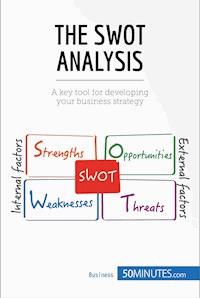
Name: the SWOT analysis or SWOT method is an acronym of the terms Strengths, Weaknesses, Opportunities and Threats. Uses: this model allows organisations (businesses, public administrations or associations) to quickly identify both its internal factors linked to internal functioning and external factors that depend on the environment in which it is evolving. The SWOT analysis is used as a decision-making tool and to facilitate the development of strategic plans.Why is it successful? The power of the SWOT analysis lies in its simplicity. As well as being easy to use, it also collects results that can be easily communicated to the public.Key words:External factor: an element that an organisation cannot influence, linked to the environment in which it evolves.Internal factor: an element that can be influenced or modified by the organisation. Strengths: internal factors of the business that reinforce its competitive position.Weaknesses: internal factors that weaken the competitive position of an organisation.Opportunities: external factors that have the power to positively influence the competitive position of an organisation.Threats: external factors that negatively influence the external environment of an organisation.Introduction
History
The SWOT analysis originated from the publication Business Policy: Text and Cases (1965), created by four professors at Harvard University – Edmund Philip Learned (1900-1991), Roland Chris Christensen (1919-1999), Kenneth Richmond Andrews (1916-2005) and William D. Guth. This method is one of the first models to consider the external environment of an organisation. Before, strategy models restricted themselves to strategic planning, without taking their environment into account.
Today, the SWOT analysis is mainly used within the marketing departments of large businesses. Many SMBs also use it as a decision-making tool.
A number of consultancy firms also use the SWOT analysis because it allows them to quickly analyse the situation and present it to their clients schematically and more simply. Other companies, such as McKinsey and BCG, have their own analysis models.
Definition
The SWOT analysis is a multidimensional tool for strategic analysis:
it identifies an organisation’s internal factors (strengths and weaknesses) and its external factors linked to its environment (weaknesses and threats);it also allows organisations to prioritise factors in terms of expected impact, whether they are positive (strengths and opportunities) or negative (weaknesses and threats).A SWOT analysis has no intrinsic value unless it is used for strategic purposes.
Theory
The SWOT analysis investigates the current situation of an organisation at a given time, in a forward-looking manner as opposed to a retrospective one. It also analyses the structure, keeping future prospects in mind. At the same time, the SWOT analysis focuses on the internal functionality (strengths and weaknesses) and on the external environment (opportunities and threats) of an organisation.
Strengths




