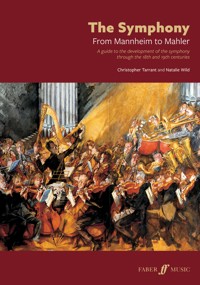
the symphony: from mannheim to mahler
The Symphony: From Mannheim to Mahler
christopher tarrant and natalie wild
© 2022 by Christopher Tarrant and Natalie Wild
All rights administered worldwide by Faber Music Ltd
Bloomsbury House 74–77 Great Russell Street London wc1
b 3da
Music processed by Donald Thomson
Cover designed by Chloë Alexander
Text designed by Agnesi Text
Printed in England by Caligraving Ltd
All rights reserved
ISBN10: 0-571-54240-9
EAN13: 978-0-571-59214-2
Cover image:
The orchestra
(Gustav Mahler conducting the Vienna Philharmonic Orchestra)
by Max Oppenheimer 1923
(Photo by Imagno/Getty Images)
Contents
Foreword
by Christopher Tarrant and Natalie Wild
1
Timeline of events
4
Case studies
6
1 A genre in crisis?
9
Part I: Contexts
2 The early symphony
19
3 Patronage and public concerts
49
Part II: Materials
4 Melody, harmony, and syntax
59
5 Form, structure, and cycle
80
6 Sonata form
99
7 Tonality
116
Part III: Ideas
8 Absolute music and programme music
131
9 The symphony outside Germany and Austria
156
10 The symphony’s second age
169
Glossary
183
Bibliography
189
To all music teachers and educators,
especially those who helped to shape our own musical development:
Sarah Brown, Peter Burbridge, J.P.E. Harper-Scott, Jane Higgins, Pearl Mace,
Nikki Rogers, Keith Smith and Graham Tear.
In memory of Alan Broadbent, whose generosity, charisma
and energetic passion inspired generations of musicians.
Foreword
The idea for this book came from a chance conversation between the two authors – one an
academic, one a teacher – about the challenges facing music education. A review of teaching
materials suggested that symphonic repertoire from the eighteenth and nineteenth centuries,
which takes up substantial space in A-level syllabi, is largely taught chronologically, without a
critical angle, and without teaching students to draw together contexts, materials, and ideas.
The ethos of this project has been to build a connection between cutting-edge, academically
rigorous ideas and practical, pedagogically informed communicative strategies. Inevitably,
compromises have to be made in terms both of content and structure in order to create a
one-volume introduction to such a broad subject. Our hope is that the chapters contained in
this volume will not be read as the final word, but rather an opening-up and opening-out of a
subject that readers will continue to pursue independently.
The structure of the book, while chronological in certain limited respects, approaches dif-
ferent topics related to symphonic composition in a way that reflects recent academic debates
about instrumental music in the eighteenth and nineteenth centuries. In discussions of a topic
that spans a century and a half, the trap is to lapse into purely chronological description, and
a Whig view of history. The idea of constant progress is resisted in this book, along with the
idea that the symphony was a stable category in the 150-year period under discussion. We
have tried to give fair emphasis not just to the continuities and the sense of progression and
development during this time, but also the discontinuities and ruptures that have character-
ised the genre, especially in the nineteenth century, while also shining a light on marginalised
composers forgotten by history.
We have attempted to strike a balance between idealist and materialist approaches to this
topic. A material study of the symphony includes all the obvious concrete objects that bring
the genre to life: instruments, concert halls, printed music, published scores, and the like. We
are also crucially and critically interested in musical materials – the ‘stuff’ of composition –
which includes things like melodies, textures, cadences, and forms. These materials contrast
with the much grander ‘ideas’ which have propagated, supported, fuelled, shaped and chal-
lenged the enterprise of symphonic composition; such ideas as nationalism, programmaticism,
historicism, and the canon have all had an impact. The two approaches – one concerned with
materials, which we focus on in Part II of the book, and the other focusing on contexts and
ideas, which forms much of Parts I and III – are interdependent. One cannot succeed without
the other.
the symphony
2
1
Carl Dahlhaus,
Foundations of Music History
(Cambridge, 1983).
This tension, which was articulated by Carl Dahlhaus in 1983, helps us to frame one of the
central issues of so-called ‘historical music’ and its ‘relevance’ in the third decade of the twenty-
first century.
1
Much of this music, particularly in the earlier stages of its development, would
have been created and performed simply for the enjoyment of the wealthy and the powerful,
and as a means for them to project their wealth and power. For much eighteenth-century
orchestral music this is simply a truism, and one that has been used by some as a lever in an
attempt to discredit the entire pursuit of performing, listening to, and studying this repertoire
as elitist. The problem with this view is that this music is not simply an historical artefact. The
strange thing about pieces of music is that they can be brought into life again and again. Pieces
of music endure. They were created at a specific historical moment, but they have the unique
ability to transcend epochs: they appear to us now, here in the present, and it is our responsi-
bility to try to understand them and to bring all the knowledge that has accrued since the time
of composition in order to broaden and deepen that understanding. In other words, works
of art repay study, and these particular works of art exist here, in the present, where they are
no longer the preserve of only the very rich and the very powerful. The responsibility, and the
rewards, are ours.
Some words of thanks are owed. We would first like to thank Lesley Rutherford for her sup-
port throughout this project, which was first initiated before the coronavirus pandemic; her
crucial advice and guidance has endured through the writing stage, much of which took place
during the various lockdowns. We would also like to thank Rachel Topham for her encourage-
ment at the proposal stage. Many friends have kindly read parts of the book and have given
valuable feedback before it went to press. In some cases these have been colleagues in the
teaching profession who have offered their expert advice in terms of how the book could best
be geared towards use in the classroom. Our thanks go to Hatty Ekbery, Caleb Sibley, and Matt
Mitchell for their words of advice and encouragement. A number of academic colleagues have
also spent time reading samples of the project and their help, especially in matters of historical
and theoretical detail, has been hugely valuable. We warmly thank Jon Banks, Oliver Chandler,
David Curran, Sarah Moynihan, and James Savage-Hanford for their expertise. Lastly, we would
like to thank Craig Lawton for sharing his specific knowledge on sources for Mahler’s music.
christopher tarrant and natalie wild
Timeline of events
from mannheim . . .
Johann Stamitz (1717–1757)
Joseph Haydn (1732–1809)
C
. 1741
Johann Stamitz begins employment at the Mannheim court
Joseph Bologne, Chevalier de Saint-Georges (1745–1799)
1748
Holywell Music Room, Europe’s first purpose-built concert hall,
built in Oxford
1750
Sinfonia in D, Op. 3 No. 2 by Johann Stamitz
Wolfgang Amadeus Mozart (1756–1791)
Ludwig van Beethoven (1770–1827)
1775
Hanover Square Rooms established as the venue for subscription
concerts in London
1778
Symphony No. 31 in D, ‘Paris’, by Wolfgang Amadeus Mozart
1779
Symphony No. 1 in G by Joseph Bologne, Chevalier de Saint-Georges
1789
The storming of the Bastille signals the start of the French Revolution
1795
Symphony No. 104 in D, ‘London’, by Joseph Haydn
Franz Schubert (1797–1828)
1800
Symphony No. 1 in C by Ludwig van Beethoven
Hector Berlioz (1803–1869)
Louise Farrenc (1804–1875)
1804
Napoleon crowns himself Emperor of the French
1805
Première of Symphony No. 3 in E
b
, ‘Eroica’, by Ludwig van Beethoven
5
timeline of events
Felix Mendelssohn (1809–1847)
Robert Schumann (1810–1856)
Franz Liszt (1811–1886)
Richard Wagner (1813–1883)
1817
Philharmonic Society of London (now the Royal Philharmonic Society)
commissions a new symphony by Ludwig van Beethoven
1824
Première of Symphony No. 9 in D minor, ‘Choral’,
by Ludwig van Beethoven
Anton Bruckner (1824–1896)
1830
Symphonie Fantastique
by Hector Berlioz
1831
Philharmonic Society of London commissions a new symphony
by Felix Mendelssohn
1833
Première of Symphony No. 4 in A, ‘Italian’, by Felix Mendelssohn
Johannes Brahms (1833–1897)
Pyotr Ilyich Tchaikovsky (1840–1893)
Antonín Dvořák (1841–1904)
1854
Première of
Les Préludes
(the first tone poem) by Franz Liszt
Gustav Mahler (1860–1911)
Carl Nielsen (1865–1931)
Jean Sibelius (1865–1957)
Amy Beach (1867–1944)
1870
Women allowed to enrol in composition classes
at the Paris Conservatoire
1871
Unification of Germany
Samuel Coleridge-Taylor (1875–1912)
1876
Première of Symphony No. 1 in C minor by Johannes Brahms
1893
Symphony No. 9 in E minor, ‘From the New World’, by Antonín Dvořák
1895
The ‘Proms’ begin at Queen’s Hall, London
(later moved to the Royal Albert Hall)
1896
Symphony No. 3 in D minor by Gustav Mahler (revised 1902)
. . . to mahler
Case studies
Performances of all case study works included in this book can be found by following
the links below.
Scores for all examples used in this book can be found on imslp.org
Chapter 2
Sinfonia in D, Op. 3 No. 2, Johann Stamitz
Recommended performance: Academy of Ancient Music
(Christopher Hogwood)
bit.ly/StamitzSinfonia
Chapter 2
Symphony No. 31 in D, ‘Paris’, Wolfgang Amadeus Mozart
Recommended performance: London Mozart Players (Jane Glover)
Mvt 1 – bit.ly/MozartParis1
Mvt 2 – bit.ly/MozartParis2
Mvt 3 – bit.ly/MozartParis3
Chapter 4
Symphony No. 4 in A, ‘Italian’, Felix Mendelssohn
Recommended performance: Vienna Philharmonic Orchestra
(Sir John Eliot Gardiner)
Mvt 1 – bit.ly/MendelssohnItalian1
Mvt 2 – bit.ly/MendelssohnItalian2
Mvt 3 – bit.ly/MendelssohnItalian3
Mvt 4 – bit.ly/MendelssohnItalian4
Chapter 6
Symphony No. 1 in G, Joseph Bologne, Chevalier de Saint-Georges
Recommended performance: BBC Symphony Orchestra (Rafael Payare)
bit.ly/BologneSymphony
Chapter 7
Symphony No. 104 in D, ‘London’, Joseph Haydn
Recommended performance: Vienna Philharmonic Orchestra (Bernard Haitink)
bit.ly/HaydnLondon
7
case studies
Chapter 7
Symphony No. 1 in C, Ludwig van Beethoven
Recommended performance: West-Eastern Divan Orchestra
(Daniel Barenboim)
bit.ly/BeethovenSymphonyNo1
Chapter 8
Symphonie Fantastique
, Hector Berlioz
Recommended performance: London Symphony Orchestra (Colin Davis)
Mvt 1 – bit.ly/SymphonieFantastique1
Mvt 2 – bit.ly/SymphonieFantastique2
Mvt 3 – bit.ly/SymphonieFantastique3
Mvt 4 – bit.ly/SymphonieFantastique4
Mvt 5 – bit.ly/SymphonieFantastique5
Chapter 10
Symphony No. 3 in D minor, Gustav Mahler
Recommended performance: Lucerne Festival Orchestra (Claudio Abbado)
bit.ly/MahlerSymphony3
1
A genre in crisis?
The symphony and the ‘canon’
The
symphony
is viewed traditionally as the most important genre in classical music. More
than any other musical genre from the eighteenth and nineteenth centuries, the symphony
– an extensive work for large ensemble – embodies the abstract ideas of music for its own
sake: seriousness, transcendence, unity, even universality. This is more than can be claimed for
other public genres such as
opera
with its reliance on text, or the
concerto
which hinges on
the virtuosity of the soloist. This book will approach the symphony, not via the linear narrative
that we are familiar with, but from a number of different perspectives: analytical, historical,
and critical.
It is easy to construct a history of the symphony that only includes a handful of well-known
composers, and it is even easier to write a history of the symphony that only includes male
composers from the German-speaking area of Central and Northern Europe. Such histories
were common during the twentieth century, and we therefore have a small group of big names
that form a core repertoire (which we refer to as a
canon
of works). The vast majority of
symphonies that were composed in the period 1750–1900 are invisible even to regular concert-
goers, let alone the general public, and of the thousands of symphonies composed during this
time, we regularly hear only a handful of them (for instance, many people have heard music
by Mozart and Beethoven, but few have heard Wagenseil or Reicha). It is also important to
acknowledge the extreme underrepresentation of women in the symphonic canon. This comes
as a result of many complex social and economic factors. The access that most women had to
a professional musical education was virtually non-existent outside the context of the opera
house. Though many middle-class women received education as amateur musicians, a career
as a symphonist would have been unthinkable in the eighteenth and nineteenth centuries. Even
for Clara Schumann (1819–1896) and Fanny Hensel (1805–1847), two of the most successful fe-
male composers of the nineteenth century, the public genre of the symphony was out of reach.
Unlike the traditional view of the symphony as a fixed genre on a pedestal, in reality it
has been constantly in flux since its development in the middle of the eighteenth century. It
began as a hybrid of the Italian orchestral concerto and the opera overture, and this fusion of
influences is expressed in the great diversity of works that were composed around 1750. As
overtures became longer and more structurally complex, sometimes incorporating music at
different contrasting tempi, there seemed to be as many different ways of writing symphonies
as there were composers interested in writing them. Before conventions had been established,
a definition of the symphony would have been virtually impossible.
the symphony
10
Defining a genre
Joseph Haydn (1732–1809) is credited with laying down the standards of the symphony as we
know it today – a large-scale work set in four movements for orchestra. However, this claim
ignores three important points. First, it was in fact an older generation of composers including
Stamitz and Sammartini who started writing works for orchestra following a multi-movement
plan that Haydn would later adopt and develop. Stamitz’s court orchestra in Mannheim was
the original catalyst for symphonic composition in the middle of the eighteenth century,
and Haydn drew significant influence from the Mannheim School for his own compositions.
Secondly, Haydn’s output of symphonies only stabilised in its final third (chronologically); his
practice before this point was strikingly unpredictable. And thirdly, as soon as they had been
established, Haydn, as much as any other composer, began to play with those conventions,
often in an experimental way, frequently stretching them to the limit of audience expectations
(and sometimes beyond them).
So, how do we define the symphony? Let us consider a hypothesis:
◆
A symphony is structured in four movements
Although this at first appears to be a basic, elementary, even banal comment, the number of
exceptions to this rule starts to multiply as we begin to think about it. There are many
examples
from around 1800 that can be used to undermine this simple statement. Take Mozart’s (1756–
1791) ‘Prague’ Symphony, or his ‘Paris’ Symphony, both of which contain only three movements
(both lack a Minuet). Or Beethoven’s (1770–1827) Sixth Symphony, the ‘Pastoral’, which contains
five movements (the last three of which are connected together and are performed without
breaks). What about Schubert’s (1797–1828) Symphony in B minor, the so-called
‘Unfinished’,
which is constructed in only two movements (not because he died, as some
people think,
but because of a number of personal, compositional, and aesthetic reasons)? And we find
the
occasional radical exception such as Haydn’s Symphony No. 60 in C major, nicknamed ‘Il
Distratto’ (‘The Distracted’) which is structured in six movements.
It is easy to shoot down the claims that define a genre, yet such claims still persist. Here
are some more statements about the symphony during this period, some, all, or none of which
might be true. Can you think of any exceptions to these statements?
◆
A symphony is a piece written for orchestra
◆
The symphony is an example of
absolute music
(i.e., it is not influenced by
non-musical ideas)
◆
Symphonies were written for performance in the concert hall
◆
Symphonies do not feature soloists
◆
The symphony is an Austro-German genre
◆
The symphony is an Italian genre
◆
The symphony is a European genre
◆
Only men wrote symphonies
11
a genre in crisis?
◆
Only white Europeans wrote symphonies
◆
The symphony is a serious genre
◆
Beethoven represents the end of a tradition
◆
Beethoven represents the beginning of a tradition
◆
Berlioz wrote symphonies
◆
Berlioz did not write any symphonies
◆
A symphony can be constructed in one single movement
◆
Symphonies have form
As you can see, as soon as an attempt is made to describe something in terms of genre, the
concrete examples escape those descriptions. This is what makes it such an exciting genre
to study and explore, as well as to contribute to as a composer. Haydn certainly must have
thought along these lines, for without a clear conception of what the rules of the game were,
he would have found it difficult to play against them.
The ‘Eroica’ and the romantic turn
While the symphony may be viewed now as the most important instrumental genre in the
late eighteenth century, it was not so important at the time, and certainly not as popular as
the piano concerto or opera. The concerto offered the composer a chance to show off their
virtuosity at the keyboard and opera was by far the more popular genre with audiences. While
the opera house was a well-established institution, the purpose-built concert hall was still a
new concept in the late eighteenth century, and the symphony was viewed as the type of com-
position that might bring you some prestige as a composer, and even some measure of fame,
but rarely much money. Things began to change, however, in the first years of the nineteenth
century. It was during this time that Beethoven became the pioneer of a new generation.
It is difficult to overestimate how radically Beethoven changed the essence of the sym-
phony in the years after 1800. In his first two contributions to the genre there is a clear expan-
sion of the materials inherited from Haydn and Mozart. These musical materials often involve
pithy themes and elegantly proportioned forms; ideas of balance and closure were strongly
expressed in the eighteenth-century repertoire, and even as Beethoven began to experiment
with classical norms as a young composer, the eighteenth-century inheritance was audible.
It is with his Third Symphony, the ‘Eroica’ (meaning ‘heroic’, composed in 1804), that we see
the first instance of what the future of the genre would be. After this, the symphony would
no longer be a poor relation to opera or the concerto, with composers able to produce them
quickly in their hundreds. The symphony was now a major work, self-standing and serious in
nature. It represented a shift away from the technical virtuosity of the star performer and
towards unity and the importance of the collective effort, often having philosophical, political,
or sometimes nationalistic overtones.
The symphony had expanded in length, shape, volume, and weight with Beethoven, and
the ultimate radical move in his Ninth Symphony (1824) was to include a chorus and a quar-
tet of vocal soloists in its final movement (which is as long as an entire symphony on its
own). There was a feeling at this point that the genre had been stretched to such an extreme
the symphony
12
that its continued existence would be called into question. Efforts were made to follow in
Beethoven’s footsteps, notably by figures such as Felix Mendelssohn (1809–1847) and Robert
Schumann (1810–1856), but this seemed to stall in the middle of the nineteenth century. This
is not to say that there were no symphonies written at this time. Mid-nineteenth-century
symphonic composition was marked by an acute crisis that was played out in the so-called
‘War of the
Romantics’ – a series of musical and philosophical debates, exchanges, and con-
troversies which raged around that time. On one side were those advocating for the objective
purity of the genre as so-called
absolute music
. This term was originally coined by Richard
Wagner (1813–1883) as an insult, but it was later self-applied by those who were advocating for
it. Important figures included the academic Johannes Brahms (1833–1897) and the lawyer and
philosopher Eduard Hanslick (1825–1904). On the other side of the debate stood a radical new
generation of composers that included Hector Berlioz (1803–1869), Wagner, and Franz Liszt
(1811–1886). Each was reimagining music by forging a new path with a distinctive voice, and all
were interested in composing
programme music
(more of which in Chapter 8).
The radical changes that the symphony underwent in the middle of the nineteenth cen-
tury included new possibilities such as soloists (vocal or instrumental), implied or explicit ‘pro-
grammes’ taken from literary or extra-musical sources, a vastly increased palette of orchestral
colours and combinations, and the abandonment of a structure that had been regarded as
more-or-less obligatory since Haydn. These developments were closely linked to the birth of
two new genres which would jostle for position for the next hundred years. These were the
music drama
(
Gesamtkunstwerk
or ‘total artwork’) which Wagner had been developing as
a way of bringing the different art forms (music, text, drama) together in his operas, and the
tone poem
or
symphonic poem
(
Tondichtung
) which was a piece for large orchestra, much
looser in construction than the symphony, and usually taking inspiration from, if not explicitly
modelled on, a literary source. Franz Liszt was its most important pioneer (examples include
Les Prèludes
,
Hamlet
,
and
Prometheus
).
Centre and periphery
Vienna continued to be the centre of gravity for symphonic composition and performance
during the second half of the nineteenth century, but this period is also marked by a consider-
able expansion of symphonic practice beyond the historical hubs of Vienna, Paris, and London,
and importantly, well beyond the German-speaking world. Interestingly, it was just at the point
when the perceived crisis was coming to a head that symphonic composition began to move
away from Austria and Germany and take up residence in areas that have problematically been
described as the European ‘peripheries’. In the final quarter of the century it became normal
(or perhaps even necessary) for composers in the UK, France, Denmark, Finland, Bohemia,
Poland, and Russia, to name only a handful of countries, to be writing symphonies – and
particularly ones that were political, patriotic, or nationalistic in tone. It was also around this
time that such far-flung places as Copenhagen, Helsinki, and St Petersburg were developing as
important concert-giving cities.
The concept of centre and periphery makes the figure of Gustav Mahler (1860–1911)
particularly intriguing. Mahler was active as a composer from the 1880s until his death in 1911.
13
a genre in crisis?
On paper he has all the markings of an Austro-German canonical composer in the romantic
tradition: he lived and worked in Vienna, his music is now considered part of the core repertoire
and he wrote nine (which, for some reason, is a magical number for composers) symphonies.
As soon as we peer beneath the surface, however, we find a much more complex relationship
with tradition. Although he worked in the undisputed epicentre of symphonic composition,
he came from Moravia, which lies in the modern-day Czech Republic, but which in Mahler’s
time formed part of the vast Austro-Hungarian Empire. Although by no means a backwater, it
was not a major cosmopolitan centre. During his time in Vienna he was considered something
of an outsider, not just because of his Bohemian heritage but crucially because of his Jewish
faith, which meant he was subject to various restrictions imposed by the Viennese musical
establishment.
Mahler was not a composer by trade. Rather, he made his living on the conducting podium
and spent his summers, when he was not required to conduct opera, in the country working
on his vast symphonies. Many of these works, which are now widely considered to be time-
less masterworks, were met with scant praise at the time they were first performed. It took
the efforts of musicians, conductors, and scholars decades later to promote and, to a certain
degree, rehabilitate his output. The most important figures in this effort were the conductor
Leonard Bernstein (1918–1990) and the philosopher Theodor Adorno (1903–1969). There is
also an aesthetic argument to be made: although superficially we might consider Mahler’s mu-
sic to be a contributor to romanticism (however that may be described
musically: big tunes,
lush orchestration, dramatic tension), digging deeper, it becomes apparent that there are
some strikingly un-romantic and often overtly modernist ideas that can be found in his output,
and that it may be more advantageous to consider Mahler as belonging to the beginning of the
twentieth century rather than as a residue of the nineteenth.
Historical problems
The paragraphs above are not intended to provide a complete picture of the history of the
symphony over 150 years. Rather, they are an attempt to challenge, question, and probe con-
ventional ideas, including that the symphony is somehow ‘core’ or privileged over and above
other forms of composition, or that the history of symphonic composition unfolds in a straight-
forwardly linear fashion. Addressing the second point, the fact that Hector Berlioz’s radical
and at times monstrous
Symphonie Fantastique
(1830) was composed before Mendelssohn’s
much more classically conservative ‘Italian’ Symphony (1833), and that both symphonies retain
their place in the established and timeless concert repertoire, should arguably give us enough
cause to abandon any idea of a linear progression from classicism to romanticism and then
to modernism (whatever those words might mean in practice). Regarding the symphony as
the core of the concert repertoire, these works were not easily accessible at the time of com-
position to anybody who wanted to listen – quite the contrary. The vast majority of the sort of
notated compositions that we understand to belong to the Western Art Music tradition (one
in which the musical conception is notated and then reproduced in sound in a performance)
would have been heard in churches – not venues where symphonies would have been regularly
performed. It is therefore all the more remarkable that the symphony has survived.
the symphony
14
Such a sense of survival is not just a surprise in economic terms (after all, paying for large
numbers of musicians can be expensive); it is also striking on purely aesthetic grounds. This
became particularly noticeable after Beethoven’s Ninth Symphony (first performed in 1824). It
is remarkable that anyone could compose a symphony after such an existential threat to the
identity of the genre, and critics at the time had declared that the genre was now dead. This
was a mantra that was repeated throughout the nineteenth century: someone writes a sym-
phony that seems to kill the genre stone dead, as if to say ‘the symphony is done – THE END’,
only for someone else to come along and write another one. There are few better examples
of this than Pyotr Ilyich Tchaikovsky’s (1840–1893) Sixth Symphony in B minor, ‘Pathétique’,
Op. 74, which ends with a slow finale that descends to the bowels of the orchestra in a morbid
farewell (the composer died less than a fortnight after the première). Yet this was followed
only a matter of months later in spring 1894 by the first performance of Carl Nielsen’s (1865–
1931) First Symphony – a work with a youthful disregard for conventions of tonality, form, and
scoring, and which belongs to the output of a new and younger generation of early-modernist
symphonists. In many respects, the history of the symphony in this period is a history, against
the odds, of its survival.
The structure of the book
This book aims to provide a starting point for those who are interested in the symphony from a
pedagogical position, for students, as well as for those who may simply be interested in learning
more about the music they hear on a regular basis. It is divided into three parts, each of which
has a distinct aim. Part I establishes some of the main contexts for symphonic composition.
Who was composing these things? What were the criteria that regulated the genre? Where
were these compositions performed? Who was performing them? And who was paying for
it? Part II deals with the material detail of the symphony during the period in question. These
works, which are perceptible to us through the trace they leave in their scores, exist not only
in history but also now in the present, and as musicians we have a responsibility to engage with
them independently of what others may have said. Therefore, the central section of the book
aims analytically to deepen our engagement with individual works as well as the genre more
broadly. Topics covered include the small-scale structure of the music – individual themes and
motives (broadly referred to as musical
syntax
); the large-scale organisation and combination
of these smaller components (which we usually consider in terms of musical
form
); and closely
linked to both of these, the question of how
tonality
operates in the period under discussion.
After this excavation of the musical detail, Part III turns to broader questions of genre. What
makes a symphony? What might ideas such as politics, nationality, and nationalism have to do
with symphonic composition during this time?
The structure of this book is neither chronological (though there is a sense of this) nor
composer-centred, but rather it is organised thematically. It cycles through the various topics
as they relate to the whole 150-year period under discussion with the aim of repeatedly
revisiting composers, events, and ideas, each time from a new and different perspective. The
structure builds up a series of interlaced layers, with each chapter deepening and enriching
the others. During this process the book will focus in on important milestones, touchpoints,
15
a genre in crisis?
case studies, events, works, and composers as they serve to exemplify the debates and contro-
versies surrounding the genre. This generates a deeper and more engaging narrative than can
be provided by a linear historical account. The book has been written to be enjoyed from
cover to cover, but it might also be employed in a more piecemeal fashion; readers may wish
to dip in and out, reading certain sections as the need arises. Prior knowledge of the genre is
not a prerequisite for a fruitful engagement with the debates and materials contained here,
and,
although the ability to engage with notated scores is necessary to fully grasp the ideas
presented in Part II, the majority of the book will be accessible to anyone who is interested in
listening to this music and learning more about it.
Part I: Contexts
2
The early symphony
Eighteenth-century music and the figure of the
Kapellmeister
For eighteenth-century composers the role of
Kapellmeister
(master of the chapel choir)
at a wealthy court was a desirable position to hold. The scope of the job stretched beyond
simply composing music for the court orchestra. Other duties the
Kapellmeister
would have
been expected to undertake included rehearsing, conducting, administrative tasks, and teach-
ing members of the household and other wealthy courtiers. It is therefore useful to think of
this role as something similar to a civil servant who could produce new works at speed, in
step with fast-changing musical fashions, and for immediate use. The more familiar idea of
the composer as a romantic artist concerned with carefully shaping masterpieces for future