


Erhalten Sie Zugang zu diesem und mehr als 300000 Büchern ab EUR 5,99 monatlich.
- Herausgeber: THP Ireland
- Kategorie: Geisteswissenschaft
- Sprache: Englisch
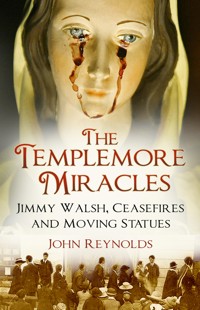
In the aftermath of the 1916 Rising, the ensuing guerrilla war reached its peak in August 1920, in the garrison town of Templemore, when a series of extraordinary events occurred. 16-year-old farm labourer Jimmy Walsh claimed that he was experiencing Marian apparitions, and that religious statues owned by him were moving and bleeding. Miraculous cures were claimed and the religious fervour that gripped Ireland led to an influx of thousands of pilgrims. The phenomenon of the 'Templemore miracles' or 'bleeding statues' lasted for several weeks and an informal ceasefire arose while the rebels, the police, military and civilian population struggled to comprehend the surreal situation. With the logistics of conducting the war disrupted by the flood of pilgrims, the IRA stepped in. They interrogated Walsh and, with the direct involvement of Michael Collins, planned to deter further pilgrimages to Templemore. In due course, Walsh had left Ireland, never to return, and the war resumed with an even greater degree of ferocity. Here, John Reynolds charts the bizarre goings-on that intersected the spiritual, social and martial fixations of early twentieth-century Ireland based around a small town and a boy with visions.
Sie lesen das E-Book in den Legimi-Apps auf:
Seitenzahl: 170
Veröffentlichungsjahr: 2019
Das E-Book (TTS) können Sie hören im Abo „Legimi Premium” in Legimi-Apps auf:
Ähnliche




















‘The age of miracles is not past - go to Templemore’
Tipperary Star, 20 August 1920
First published 2019
The History Press
97 St George’s Place, Cheltenham,
Gloucestershire, GL50 3QB
www.thehistorypress.co.uk
© John Reynolds, 2019
The right of John Reynolds to be identified as the Author of this work has been asserted in accordance with the Copyright, Designs and Patents Act 1988.
All rights reserved. No part of this book may be reprinted or reproduced or utilised in any form or by any electronic, mechanical or other means, now known or hereafter invented, including photocopying and recording, or in any information storage or retrieval system, without the permission in writing from the Publishers.
British Library Cataloguing in Publication Data.
A catalogue record for this book is available from the British Library.
ISBN 978 0 7509 9161 2
Typesetting and origination by The History Press
Printed and bound in Great Britain by TJ International Ltd.
eBook converted by Geethik Technologies
CONTENTS
Introduction
1 Violence: ‘The town is a wretched place’
2 Visionaries: ‘Supernatural manifestations, accompanied by cures’
3 Aftermath: ‘A second Lourdes!’
4 Australia: ‘Alone in the world!’
Conclusion
Notes
INTRODUCTION
In the aftermath of the 1916 Easter Rising and subsequent execution of the leaders of that rebellion, Irish Republicans moved relentlessly towards open conflict with the British Empire. Hostility between the Royal Irish Constabulary (RIC) and militant activists gradually escalated, culminating in the Soloheadbeg ambush of 21 January 1919 near a quarry in South Tipperary. Two constables of the RIC, James McDonnell and Patrick O’Connell, were shot dead by members of the 3rd Tipperary Brigade of the Irish Republican Army (IRA) as they escorted a consignment of explosives to the quarry. While there had been sporadic attacks on the RIC since 1916, the Soloheadbeg ambush had a new element of ruthlessness which distinguished it from attacks of previous years. The brutal nature of the ambush came as a shock to many moderate members of Sinn Féin and the Volunteer movement, as well as the wider population, not only in Ireland but internationally. The Daily News reported on the wider significance of the killings and what might result from them, stating that the ‘well-meaning idealists in Dáil Éireann were utterly unable to control the physical-force men in the provinces’. The Soloheadbeg ambush also caused profound shock within the RIC and was viewed as an ominous escalation in the recent pattern of attacks on the police, and as a sign of approaching danger.
The Soloheadbeg ambush acted as a catalyst for many activists who had grown disillusioned with politics and believed that military action was the way to achieve an Irish Republic. A full-scale guerrilla war ensued, and having been a garrison town since 1813, Templemore was at the epicentre of events in Tipperary. When violence reached a peak during the summer of 1920, a series of extraordinary events occurred in Templemore and the nearby townland of Curraheen near the village of Gortagarry. James Walsh, a 16-year-old farm labourer, claimed that he was experiencing Marian apparitions, and that religious statues owned by him were moving and bleeding. He also said that a ‘holy well’ had sprung up in the floor of his bedroom. Miraculous cures were attributed to Walsh, and the religious fervour which subsequently gripped the area led to an influx of thousands of pilgrims from all over Ireland and abroad. The phenomenon of the ‘Templemore Miracles’, or ‘bleeding statues of Templemore’, lasted for several weeks. A bizarre situation arose as an informal ceasefire came into effect while both sets of combatants and the wider civilian population struggled to comprehend the surreal circumstances which existed. After several weeks, local IRA commanders interrogated Walsh, concluding that the so-called miracles and apparitions were not genuine. They also decided that the multitude of pilgrims coming to the area each day must be stopped as it was having a detrimental effect on their military operations. The IRA inquiry reached the highest level of the Republican hierarchy, with the direct involvement of Michael Collins. Deliberate, decisive and violent action was taken to deal with Walsh and to stop visitors from coming to Templemore. When the last pilgrims had departed, the conflict resumed in earnest, with a greater level of ferocity and brutality than previously. This book provides a comprehensive account of the supposed ‘Templemore Miracles’ which transfixed Ireland and gained worldwide notoriety and attention during the late summer of 1920.
1
VIOLENCE: ‘THE TOWN IS A WRETCHED PLACE’1
Travelling into Templemore along any of the roads which encircle this small town, the skyline is dominated by the bell tower, accommodation blocks and of Richmond Barracks, the vast military complex built in the early years of the nineteenth century. On 22 October 1808, notices were placed in Irish newspapers by the commissioner of garrisons in Ireland, Major General Freeman, seeking proposals for the building of new infantry barracks at Parsonstown in Kings County (now Birr, County Offaly) and Templemore in Tipperary.2 An intensive programme of barrack-building had begun following successful revolutions in America in 1776 and France in 1789. The revolutionary fervour which followed inspired a new generation of home-grown insurrectionists in Ireland, which culminated in the 1798 Rising and the United Irishmen rebellion of 1803 led by Robert Emmet. Aside from the fear of further uprisings, England was at war with France and the threat of invasion from the army of Napoleon was a possibility, given that French fleets had arrived at Bantry Bay in 1786 and Killala Bay in 1798.3
To guard against invasion, over forty Martello towers were constructed around the coast, and between 1789 and 1814 the strength of the military garrison in Ireland increased from 40,000 to 225,000.4 Sir Arthur Wellesley, the Duke of Wellington, commented on the positive attitude of Irish landowners towards the building of new barracks in their area, saying that the establishment of a barracks not only afforded a prospect of security, but ‘required the expenditure of a large sum of money immediately, and if occupied by troops, the outlay in the neighbourhood of their subsistence and maintenance’.5 In 1809 Sir Robert Peel, member of parliament for Cashel in Tipperary and the politician who would subsequently introduce a constabulary to rural Ireland, attributed the high level of disorder in the country to ‘a natural predilection for outrage and a lawless life which I believe nothing can control’.6 Making reference to the county which he represented in the House of Commons, Peel stated, ‘You can have no idea of the moral depravation of the lower orders in that county … in fidelity towards each other they are unexampled, as they are in their sanguinary disposition and fearlessness of the consequences.’7
Peel was also harshly critical of the influence of the Roman Catholic Church, believing that the dominant religion of Ireland operated as an ‘impediment rather than an aid to the ends of the civil government’.8
In 1804 the decision was made to build a large new barracks in Thurles, adjacent to the Ursuline convent which had been founded in 1799. Believing that the presence of a garrison so close to her school would be undesirable, Mother Clare Ursula, the head of the Order, wrote to Dublin Castle to protest, saying that she would close the school if the barracks was built beside it. On 10 November 1804, the Lord Lieutenant’s secretary replied to Mother Clare Ursula, stating, ‘His Excellency, having taken the facts therein set forth into consideration has been pleased to agree that the scite [sic] of the intended barracks at Thurles shall be changed, and has issued the necessary orders accordingly.’9
Following this exchange of correspondence, the decision was taken that the new barracks would instead be built in Templemore. Construction began in February 1809 and had been completed by 1813 at a total cost of £42,500, some £500 under budget. The Peninsular War, largely fought between the French and English, with armies led by Napoleon Bonaparte and the Duke of Wellington respectively, was in progress while the barracks was being built. To commemorate British military victories in that conflict, streets in Templemore were named after locations in Portugal connected with those victories. This resulted in somewhat exotic names being applied to places in a small town in North Tipperary, such as Wellington Mall, Talavera, Vimiero Mall and Busaco Street. The barracks itself was named Richmond in honour of Charles Gordon-Lennox, the fifth Duke of Richmond, who served on the staff of the Duke of Wellington during the Peninsular War. It was built on a 57-acre site owned by local landowner Sir John Craven Carden (1757–1820).
In 1816 Captain Thomas Borrow and 800 soldiers of the West Norfolk Militia marched to Templemore from Clonmel barracks. Borrow’s son, George, accompanied his father and lived in the barracks with him. George subsequently became a well-known author and in his book Levengro he described Richmond as a ‘large military station, situated in a wild and thinly inhabited country … extensive bogs were in the neighbourhood’. He referred to notable local landmark the ‘Devil’s Bit’ mountain as ‘exhibiting in its brow a chasm or vacuum, just for all the world as if a piece has been bitten out, a feat which, according to the tradition of the country, had actually been performed by his Satanic majesty’.10
When completed, Richmond was one of the largest military complexes in Ireland, with accommodation for fifty-four officers, 1,500 men and thirty horses, an eighty-bed hospital, a prison, fever hospital and dispensary.11 Richmond was vitally important to the local economy, not only providing employment but also supporting local businesses such as merchants, publicans and farmers who catered for the large garrison. The presence of Richmond also provided the opportunity for local men to enlist. The main function of the barracks was as a base for ‘depot battalions’, where regiments which had been overseas on campaign were posted for a period to recruit, train and then depart on campaign throughout the British Empire. Irishmen were considered good recruits, described by one military surgeon as ‘physically and morally the best adapted for service’, and they signed up in large numbers to accept the ‘Queen’s shilling’.12 In the late Georgian and Victorian era, the British Army could not have managed without Irish recruits. In 1830, for example, 40,979 Irishmen were in the Army, a figure of over 42 per cent of the total strength.13
Having such a large military installation in the town also brought many of the problems for which garrison towns gained notoriety, including drunkenness and prostitution. In 1844, for example, it was reported that the Templemore constabulary found a local woman called Ellen Stapleton in a field near the barracks ‘in a dying state from the effects of a wound inflicted on her thigh by two other women of bad character … she was conveyed to hospital but died the following day’.14 In 1855 a dramatic court case took place in Templemore Assizes, during which it was alleged that local parish priest Father Fennell had gone around the town to:
seek out and chastise any of the females who so much infest garrison towns. On this occasion however he mistook the wife of a Private Logan from Richmond for a prostitute and assaulted her. This resulted in a £1 fine in the magistrate’s court, and the case caused a great sensation locally.15
Writing about Irish garrison towns including Templemore in 1864, the novelist Charles Dickens referred to ‘open noonday immorality and drunkenness, and nightly licentious revelling … vice is out of doors wandering shameless and defiant through the streets’.16
In 1847 Harry Loft, a 16-year-old ensign in the 64th Regiment of Foot (2nd Staffordshire), was garrisoned in Templemore. In a letter to his mother at home in the town of Louth, Lincolnshire, he described Richmond as, ‘Splendid barracks, with two large squares, and all the buildings three stories high.’ The town itself, however, he described as ‘a wretched place … there is only one street with three or four respectable shops’.17 During the late 1850s, many Irish soldiers were sworn in as members of the ‘Fenian’ movement, and in 1857 it was reported that the 11th Depot Battalion from Templemore had been moved to Newry and replaced by the 59th Regiment from Glasgow, as it was ‘strongly suspected that the 11th was tainted with Fenianism’.18
The nineteenth century saw a large turnover of regiments passing through Richmond, but by 1909 the barracks had largely been vacated. Templemore Town Council wrote to the War Office in London pleading for the army to return as the town was suffering substantial economic difficulties because of their absence, but were informed that there was ‘no prospect of troops being quartered there in the near future’.19 The outbreak of the Great War in August 1914 brought about a reversal of this policy, however, and by October 1914, Richmond had become a large prisoner of war camp, holding over 2,300 German soldiers who had been captured in France. This was the only place in Ireland where German military prisoners were detained. The PoWs were guarded by Irish soldiers of the 3rd Leinster Regiment. In March 1915 the prisoners were rapidly moved to camps in England when the Royal Irish Constabulary received intelligence that local members of the Irish Volunteers had formulated a plan to break into the barracks and release the prisoners. Given the connections which existed between Irish Republicans and the German government, which included the efforts of Roger Casement to form an ‘Irish Brigade’ from Irish soldiers imprisoned in Germany, the hope was that the Templemore PoWs would join in the rebellion that was then being planned, which would become the 1916 Easter Rising. Following their hasty departure, Richmond became a large training barracks for Irishmen who were joining the British Army in huge numbers as the Great War progressed, primarily from the Munster Fusiliers and the Leinster Regiment.
Following the unsuccessful 1916 Easter Rising, the war correspondent Henry Nevinson wrote in Atlantic magazine, ‘We execute a worthless rebel, and for Ireland a heroic saint emerges from the felon’s grave.’20 Nevinson astutely predicted that the decision to execute the key figures behind the Rising, including P.H. Pearse and James Connolly, would generate enormous sympathy and thus provide iconic figures to the Republican movement, who viewed them as martyrs. In Tipperary there had initially been little public support for the Rising, with the Tipperary Star newspaper describing it as ‘inexplicable imbecility – how a body of men could embark on such a desperate enterprise passes common sense comprehension … it is the old story, everything lost, nothing gained’.21
Notwithstanding the absence of an insurrection in Tipperary at Easter 1916, two members of the RIC, Sergeant Thomas Rourke and Constable John Hurley, were shot dead on 25 April while trying to arrest Volunteer Michael O’Callaghan for making a ‘seditious’ speech near Tipperary town. Following this incident, O’Callaghan went on the run and fled to America. Tipperary militants such as Dan Breen and Seán Treacy, the men who subsequently took part in the Soloheadbeg ambush, regarded O’Callaghan as ‘having saved the name of Tipperary during Easter week’ through his actions.22 Some militant nationalists concluded that their aspirations could only be achieved by what they termed ‘positive military action’.23 Nonetheless, in the immediate aftermath of the Rising, overt volunteer activity had actually diminished, and almost 2,000 men had been interned.24 The public empathy which manifested itself after the executions of the 1916 leaders was capitalised on, however, and the Volunteers gradually reorganised, increasing in number and engaging openly in acts of defiance. During late 1916 and early 1917, those arrested after the Rising were released and returned home to a rapturous reception. In 1917 Sinn Féin clubs and additional Volunteer companies were formed in Tipperary, with commensurate sharp increases in Volunteer activity and membership.25
An uneasy peace prevailed, but in December 1917 one British military intelligence officer described the growing and increasingly militant nationalist movement as ‘peculiarly well disciplined, in comparison with similar political organisations in the past’. He went on to say that drunkenness was almost unknown amongst those deeply implicated, and was apparently severely dealt with. He found this to be ‘in sharp contrast to the usual state of things in similar movements’.26 Tipperary proved to be fertile ground for recruitment to the militant movement, and during the conscription crisis of early 1918 parades and field exercises were frequently held and plans formulated for the acquisition of arms. In January 1918 the IRA adopted a new national brigade structure to replace the previous inefficient command system whereby hundreds of companies had reported individually to IRA GHQ in Dublin. Three brigades were formed in Tipperary, 1st (North) Tipperary, 2nd (Mid) Tipperary and 3rd (South) Tipperary. Brigade officers and staff were elected by the membership, and Volunteers such as Seán Gaynor felt that ‘the tempo of the organisation was stepped up, and we got into our stride as a military force’.27
The Soloheadbeg ambush was undertaken in contravention of instructions which had been issued by IRA Chief of Staff Richard Mulcahy, thus causing tension between GHQ and those who carried it out. In later life, Mulcahy wrote that he ‘frequently despaired’ of Volunteers in south Tipperary as they failed to respond to his efforts at instilling military discipline.28 He also believed that as the ambush had been undertaken entirely on the initiative of Tipperary Volunteers, they could not be endorsed by the IRA leadership, and if they were captured or killed by the police, it could not be acknowledged that they had acted with authority and they would therefore be branded as ‘common murderers’.29 Mulcahy ordered members of the ambush party, including Breen and Treacy, to leave Ireland and go to the United States, but they refused to do so. Following the intervention of Michael Collins, they went instead to Dublin and joined a group of IRA Volunteers known as ‘the squad’ who were ordered by Collins to carry out targeted assassinations of key military, political and police personnel. Collins believed that ‘the sooner fighting is forced and a general state of disorder created throughout the country, the better it will be for the country. Ireland is likely to get more out of a general state of disorder than from a continuation of the situation as it now stands.’ 30
Following the electoral success of Sinn Féin in December 1918, which saw it take seventy-three parliamentary seats out of a possible 105, many Volunteers had grown frustrated with politics and were anxious to continue the struggle for independence which they believed had started with the Rising.31 Militants were frustrated that the events of 1916 had not led to a full-scale rebellion, and also at their own lack of involvement in the Rising.32 The conscription crisis of early 1918 had passed, and that factor, allied to significant electoral success for Sinn Féin, meant that less-militant members assumed primacy. During one brigade meeting at the end of 1918, Treacy was angered by the lack of enthusiasm displayed by some Volunteers for drill and parades, and asserted, ‘If this is the state of affairs, we will have to kill somebody and make the bloody enemy organise us!’33
In December 1918 Volunteers in Templemore devised a plan to raid Richmond barracks and seize the contents of its arsenal, as weapons and ammunition were in critically short supply. While Richmond was a formidable complex, the Volunteers received intelligence that on Sunday afternoons it was customary for officers from the barracks to dine at Hickey’s Hotel in the town while a military band played outside, and enlisted men went for walks in the surrounding countryside. This left the barracks virtually undefended. Sunday was therefore the obvious day for an attack. Plans were made to cut railway tracks and telephone lines before storming the barracks, but to the anger of local Volunteers, GHQ in Dublin refused approval for the operation.34
In January 1919 the name ‘Irish Republican Army’ was adopted by the Irish Volunteers. In Tipperary, as in many other counties, militant Republicans moved unavoidably towards conflict with the police and military. The formation of an aspirational counter-state commenced with the inaugural public meeting of Dáil Éireann in Dublin on 21 January 1919 at 3.30 p.m. This would prove to be an historic event, but was overshadowed by the Soloheadbeg ambush, which entirely by coincidence took place on the same day. On 31 January 1919, An t-Óglách




