


104,99 €
Mehr erfahren.
- Herausgeber: Thieme
- Kategorie: Fachliteratur
- Sprache: Englisch
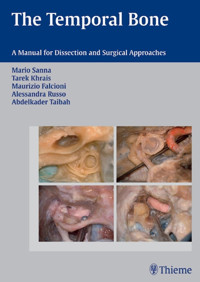
The anatomy of the temporal bone is one of the most complicated areas in the human body. The vital structures, the three-dimensional relationships involved, and the fact that these structures are hidden within bony canals make the anatomy difficult to grasp. Described as a dream come true by the authors, Professor Sanna and his colleagues have devoted a major effort to creating this book to serve as a guide for young trainees wanting to learn more about temporal bone dissection. It provides comprehensive, high-quality, full-color pictures of the detailed steps of all the major surgical approaches that can be performed in the temporal bone, supplemented by images of cadaveric dissections as an aid to understanding the intracranial anatomy when indicated by the approach. Dr. Sanna is part of The Grupppo Otologico, a world-renowned specialist center for the diagnosis and medical and surgical treatment of diseases of the ear, skull base, facial nerve, head and neck, and paranasal sinuses. More information is available on the group's website, www.gruppootologico.it/eng.
Das E-Book können Sie in Legimi-Apps oder einer beliebigen App lesen, die das folgende Format unterstützen:
Seitenzahl: 259
Veröffentlichungsjahr: 2005
Ähnliche













The Temporal Bone
A Manual for Dissection and Surgical Approaches
Mario Sanna, M.D.
Professor of Otolaryngology Department of Head and Neck Surgery University of Chieti Chieti, Italy Gruppo Otologico Piacenza and Rome, Italy
Tarek Khrais, F.R.C.S., D.H.S., M.D.
Department of Otolaryngology Jordan University of Science and Technology Irbid, Jordan
Maurizio Falcioni, M.D.
Gruppo Otologico Piacenza and Rome, Italy
Alessandra Russo, M.D. Gruppo Otologico Piacenza and Rome, Italy
Abdelkader Taibah, M.D. Gruppo Otologico Piacenza and Rome, Italy
With contributions by
Antonio Caruso, Guiseppe De Donato, Guiseppe Di Trapani, Enrico Piccirillo, Guglielmo Romano Gruppo Otologico, Piacenza and Rome, Italy
539 illustrations
Thieme
Stuttgart • New York
Library of Congress Cataloging-in-Publication Data
The temporal bone : a manual for dissection and surgical approaches / Mario Sanna… [et al.] ; with contributions by Antonio Caruso… [et al.].
p. ; cm.
Includes index.
ISBN 1-58890-383-4 (TNY : alk. paper) – ISBN 3-13-141271-2 (GTV : alk. paper)
1. Temporal bone–Surgery. 2. Temporal bone–Dissection.
I. Sanna, M.
[DNLM: 1. Temporal Bone–surgery. 2. Dissection–methods. 3. Surgical Procedures, Operative–methods. 4. Temporal Bone–anatomy & histology. WE 705 T2886 2006]
RF126.T36 2006
617.8'059–dc22
2005020359
© 2006 Georg Thieme Verlag, Rüdigerstrasse 14, 70469 Stuttgart, Germany http://www.thieme.deThieme New York, 333 Seventh Avenue, New York, NY 10001 USA http://www.thieme.com
Typesetting by primustype Hurler, Notzingen
Printed in Germany by Druckhaus Götz, Ludwigsburg
ISBN 3-13-141271-2 (GTV)
ISBN 1-58890-383-4 (TNY) 1 2 3 4 5 6
Important note: Medicine is an ever-changing science undergoing continual development. Research and clinical experience are continually expanding our knowledge, in particular our knowledge of proper treatment and drug therapy. Insofar as this book mentions any dosage or application, readers may rest assured that the authors, editors, and publishers have made every effort to ensure that such references are in accordance with the state of knowledge at the time of production of the book.
Nevertheless, this does not involve, imply, or express any guarantee or responsibility on the part of the publishers in respect to any dosage instructions and forms of applications stated in the book. Every user is requested to examine carefully the manufacturers' leaflets accompanying each drug and to check, if necessary in consultation with a physician or specialist, whether the dosage schedules mentioned therein or the contraindications stated by the manufacturers differ from the statements made in the present book. Such examination is particularly important with drugs that are either rarely used or have been newly released on the market. Every dosage schedule or every form of application used is entirely at the user's own risk and responsibility. The authors and publishers request every user to report to the publishers any discrepancies or inaccuracies noticed. If errors in this work are found after publication, errata will be posted at www.thieme.com on the product description page.
Some of the product names, patents, and registered designs referred to in this book are in fact registered trademarks or proprietary names even though specific reference to this fact is not always made in the text. Therefore, the appearance of a name without designation as proprietary is not to be construed as a representation by the publisher that it is in the public domain.
This book, including all parts thereof, is legally protected by copyright. Any use, exploitation, or commercialization outside the narrow limits set by copyright legislation, without the publisher's consent, is illegal and liable to prosecution. This applies in particular to photostat reproduction, copying, mimeographing, preparation of microfilms, and electronic data processing and storage.
Preface
The anatomy of the temporal bone represents one of the most complicated areas in the human body. The vital structures, the three dimensional relationships involved and the fact that these structures are hidden within bony canals and a drill is needed to expose them makes the understanding of the anatomy a difficult task. To add to the complexity a pathology involving the area generally leads to some degree of alteration of the anatomy. For this reason it is essential for any physician interested in otology neurotology or skull base surgery to be perfectly familiar with the anatomy. The best way is to study the anatomy in a temporal bone dissection laboratory creating a situation as close as possible to live surgery.
At the beginning of my training such an opportunity was easier said than done due to the scarcity of well equipped laboratories and the difficulty of acquiring temporal bones. Seeking a good quality training I had to travel to different places all over the world. In spite of the paucity of such centers at the time, I was fortunate enough to get high quality training at some of the leading centers in the world. Nevertheless, after each course I was left only with the memories of what I have seen supplemented only by some few notes. As a beginner I always felt the need for something tangible to remind me of what I have learnt in these few days and to serve as a guide for further training. This dream has accompanied me during all my clinical life, and kept growing every time a training course was held at our center.
Today this book represents a dream come true. With the help of hardworking and skilled young surgeons Dr Tarek Khrais and Dr Maurizio Falcioni, we dedicated a major share of our time and efforts to create this book to serve as a guide for young trainees. A comprehensive high quality full color pictures of the detailed steps of all the major approaches that can be performed in a temporal bone, supplemented at the end by a set of cadaveric dissections to help understand the intracranial anatomy where indicated by the approach.
I would like to express special thanks to my great teachers. Carlo Zini introduced me to the secrets of microsurgery of the middle ear, Jim Sheehy had a great influence on me regarding the middle ear surgery he also passed on to me the art of teaching. William House had taught me how to go beyond the bone and introduced me to the world of skull base surgery.
We hope that this work would serve as a sufficient and satisfactory guide for helping fresh trainees and overcoming the obstacles we faced earlier.
Mario Sanna
Acknowledgments
When I first joined Gruppo Otologico in the fall of 2002 I realized right from the first day that a lot of dedication and hard work is need to catch up with their advanced clinical level. My efforts were met by the generosity of Prof. Sanna. In addition to willingly giving me his vast knowledge, he made sure that I get a great deal of surgical training both live and in the temporal bone lab. For me this work not only did help me in refining my surgical skills but also represents the fruit of two years of hard work. After finishing my clinical fellowship, I feel that I have started my clinical practice on solid grounds.
I would like to express my warmest thanks to my teacher prof. Sanna, to the beloved, friends and colleagues at Gruppo Otologico, to my teacher and friend Dr. Mahafza. Special thanks go to my country Jordan, to my late mother and to my beloved father sisters and brothers without the presence of which I would have had no motivation.
Tarek Khrais
In 1990, when I first met Prof. Sanna, I was a first year resident at the ENT Clinic of the Parma University. Dr. Sanna invited me to follow his private activity in Piacenza and it was then that I first entered a temporal bone lab. After the first dissection I was fascinated by the possibility to discover step by step the anatomy of the temporal bone, and started to dedicate more and more time to this activity. Prof. Sanna was of great help in allowing me to use the lab whenever I want (often also during the night) and teaching me continuously. Progressively my skills started improving and I started collecting picture shots during the dissection. This required additional effort, because a good dissection is not enough to obtain beautiful picture, but should be accompanied by some cleaning and preparation of the bone itself, as well as by a basic knowledge of photography. When I finished my residency I started working at Gruppo Otologico, and it became difficult to find time for the dissection. However I started to use the pictures to teach the surgical anatomy during the dissection courses and this allowed me to present my work to other people, and sometimes to modify some steps according to their criticism. Presently after more than 10 years of dissections and even if I routinely perform middle ear and skull base surgery, every dissection still allows me to discover or better delineate some anatomical details, and every time I promise myself to perform a more didactic dissection in the next future.
Maurizio Falcioni
Table of Contents
1 Temporal Bone Dissection Laboratory
Surgical Instruments
General Guidelines for Drilling
Suction Irrigation
Preparation of the Specimen
Temporal Bone Holder
2 Anatomy of the Temporal Bone
Squamous Bone
Tympanic Bone
Mastoid Process
Petrous Bone
The Middle Ear
The Tympanic Membrane
The Ossicular Chain
The Tympanic Cavity
The Antrum
The Labyrinth
Internal Auditory Canal
The Carotid Artery
The Sigmoid Sinus and Jugular Bulb
The Intratemporal Facial Nerve
Labyrinthine Segment
Tympanic Segment
Mastoid Segment
3 Transmastoid Approaches
Closed Tympanoplasty
Indications
Surgical Steps
Hints and Pitfalls
Open Tympanoplasty
Indications
Surgical Steps
Hints and Pitfalls
Modified Bondy Technique
Indications
Surgical Steps
Hints and Pitfalls
Radical Mastoidectomy
Indications
Subtotal Petrosectomy
Indications
En-Bloc Excision of the External Auditory Canal
Indication
Surgical Steps
Hints and Pitfalls
Endolymphatic Sac Decompression
Surgical Anatomy
Indication
Surgical Steps
Hints and Pitfalls
Facial Nerve Decompression
Indications
Surgical Technique
Hints and Pitfalls
Cochlear Implantation
Indications
Surgical Steps
Hints and Pitfalls
4 Translabyrinthine Approaches
Basic Translabyrinthine Approach
Indications
Surgical Steps
Hints and Pitfalls
Management of High Jugular Bulb
Surgical Steps
The Enlarged Translabyrinthine Approach with Transapical Extension Types (I & II)
Rationale
Indications
Surgical Steps
Hints and Pitfalls
Translabyrinthine Facial Nerve Decompression
5 Middle Cranial Fossa Approaches
Basic Middle Cranial Fossa Approach
Indication
Surgical Steps
Hints and Pitfalls
Reference
Middle Cranial Fossa Approach for Tumors of the Labyrinthine Segment of the Facial Nerve
Surgical Steps
Hints and Pitfalls
Combined Middle Cranial Fossa Transpetrous Approach
Indications
Surgical Steps
Hints and Pitfalls
Combined Transmastoid Middle Cranial Fossa Approach
Indications
Surgical Steps
Hints and Pitfalls
6 Retrosigmoid–Retrolabyrinthine Approach
Indications
Surgical Steps
Hints and Pitfalls
7 Transotic Approach
Indications
Surgical Steps
Hints and Pitfalls
8 Modified Transcochlear Approach (Type A)
Indications
Surgical Steps
Hints and Pitfalls
9 Infratemporal Fossa Approaches
Infratemporal Fossa Approach Type A
Indications
Surgical Steps
Hints and Pitfalls
Infratemporal Fossa Approach Type B
Indications
Surgical Steps
Hints and Pitfalls
Bibliography
Index
1 Temporal Bone Dissection Laboratory
Surgical Instruments
A minimum set of surgical instruments is needed in order to carry out a temporal bone dissection that as far as possible imitates live surgery:
• A good-quality microscope
• A nonsterilizable micromotor with various sizes of diamond and cutting burrs
• Suction tubes and suction irrigation tubes of different sizes
• Surgical knives
• Tissue scissors and microsurgery scissors
• Tissue elevators and dissectors. The following set is recommended: Lempert periosteal elevator, two Freer elevators, three straight dissectors, four round dissectors (right-angled), five round dissectors (straight), six fine dissector hooks (right-angled), and a fine dissector needle
• Self-retaining retractor
• Rongeur
General Guidelines for Drilling
In general, a lower level of magnification is preferable to provide comprehensive orientation in relation to the relevant anatomy. On the other hand, a higher magnification level is important for appreciating minute details. Magnification by four is rarely needed in temporal bone dissections, though it does become important in extensive skull base procedures in order to provide a general view of the whole approach.
• Use the largest possible burr; small burrs are very dangerous.
• Adjust the length of the burr according to the depth of the area to be drilled. In general, the shorter the burr, the better the control you have.
• Most bone work is done using cutting burrs. Diamond burrs are reserved for working near delicate structures such as the facial nerve, dura, or sigmoid sinus, or for stopping bleeding originating from the bone.
• Straight handpieces are preferable to angulated ones, since the surgeon has much better control with the former.
• Hold the drill like a pen, and always try to make the direction of the drill strike in a tangential direction rather than perpendicular to the structures you are drilling, so that the drilling is carried out with the side rather than the tip of the burr.
• Drilling should start from the most dangerous areas and progress to the least dangerous ones, always parallel to the important structures, and always in one direction.
• Apply minimal pressure or no pressure during drilling, especially near important strucures.
• In delicate work near important structures, the direction of rotation can be adjusted so that the burr rotates away from the structure rather than toward it.
• In fine work, the little finger is placed on the patient's head to support the hand while drilling.
Suction Irrigation
Ensuring adequate suction irrigation is indispensable in otologic and neuro-otologic surgery. Suction irrigation removes bone dust that impedes vision and becomes clogged between the flukes of the burr end, making it less sharp. It also cools the surface being drilled, avoiding thermal injury. Ample irrigation is important when the facial nerve is being identified, or during blue-lining of a semicircular canal.
The suction irrigator should not be held steady during burring. Instead, it should wander around the burr. A useful trick is to place the sucker between a structure of importance (especially when already exposed) and the burr. In this way, if control of the burr is lost, it strikes the sucker instead of going through the structure.
There is a special type of suction tip called the Brackmann sucker. The tip of this is blunt, and it has side holes to avoid direct suction being applied to neurovascular structures during neuro-otologic work in the cerebellopontine angle.
Preparation of the Specimen
We prefer freshly obtained bones preserved in formalin. Older bone is subject to color changes, and the vessels are usually obliterated by hard, difficult-to-remove coagula. Before dissection, the bones are immersed in water for 2 hours to remove the unpleasant odor of formalin. The specimens should never be left exposed overnight, since this causes the dura and soft tissues to become dry, resulting in color changes and increased fragility.
The injection technique described here was developed at our center by Dr. M. Landolfi. The internal jugular vein and internal carotid artery are identified in the neck. The vessels are washed with tap water repeatedly, using a 20 mL syringe, to remove all the small coagula. Once the water begins to flow freely, colored silicone is injected. In cadaver heads, we prefer to inject into the transverse sinus rather than the internal jugular vein in the neck, while the internal carotid and external carotid arteries are injected in the neck. The dye is left to harden before dissection is started.
Fig. 1.1 A temporal bone mounted on a House—Urban temporal bone holder.
Preparation of colored silicone. The materials used are as follows:
• Transparent silicone
• Coloring agent (water or oil colors)
• A solvent—e. g., any commercially available benzene solution
• Syringes, catheters, butterflies, etc.
The density of the solution injected can be varied by modifying the relative amounts of the components used:
• Dense solution: 20 mL silicone, 10 mL solvent, and 5 mL coloring agent
• Medium-density solution: 10 mL silicone, 10 mL solvent, and 5 mL coloring agent
• Fluid solution: 15 mL silicone, 20 mL solvent, and 5 mL of coloring agent
A dense solution has the advantage of providing rapid hardening, with better filling of large vessels that have relatively thin walls—e. g., the lateral sinus and jugular bulb. In addition, minor injuries to the sinus or bulb during dissection will not involve any risk of the dye spreading all over the bone, producing a poor appearance. The disadvantage of a dense solution, however, is that the dye sometimes fails to pass through the smaller venous channels (e.g., the superior petrosal sinus). Amedium-densitydye is used when injecting the internal carotid artery, while a more fluid dye is used when injecting the small intracranial vessels when carrying out a cadaveric dissection.
Fig. 1.2 For half-head preparations, we use this holder that we designed ourselves.
The dye is injected using a 20 mL syringe with a mounted catheter. The catheter is then withdrawn while the injection is still continuing.
Temporal Bone Holder
To facilitate dissection in the temporal bone laboratory, the bones are mounted on a House—Urban temporal bone holder (Fig. 1.1). For half-head preparations used for skull base approaches, we use a special temporal bone holder that we designed ourselves. This has a larger diameter and five fixing rods, making it suitable for these large specimens (Fig. 1.2).
2 Anatomy of the Temporal Bone
The temporal bone actually consists of four fused parts—the squamous, tympanic, mastoid, and petrous bones.
Squamous Bone
The squamous part of the bone represents the major part of the lateral surface of the bone. Above the level of the zygomatic process, the vertical portion of the squamous bone extends upward to cover part of the temporal lobe of the brain. The zygomatic process is actually part of the squamous portion of the bone. It originates anterior to the external auditory canal at the level of the junction of the vertical and horizontal parts of the squamous bone. The root of the zygomatic process shows an initial swelling known as the posterior zygomatic tubercle. Traced anteriorly, the root thins out to form the glenoid fossa for the articulation of the head of the mandible, and then thickens again to form the anterior zygomatic tubercle. The zygomatic process then thins out and flattens as it separates from the squamous bone and ends by articulation with the zygomatic bone. Posterior to the external auditory canal, the zygomatic process can be traced as a somewhat faint line, the supramastoid crest, indicating the level of the middle cranial fossa. The squamous bone then extends inferiorly in its retromeatal portion, forming the flattened lateral part of the mastoid process. The squamous part of the temporal bone also forms the superior parts of both the anterior and posterior walls of the bony external auditory canal. On the posterosuperior border of the canal, the spine of Henle can be seen. The squamous part of the temporal bone also forms the superior parts of both the anterior and posterior walls of the bony external auditory canal. On the posterosuperior border of the canal, the spine of Henle can be seen.
Tympanic Bone
The gutter-shaped tympanic bone forms the inferior wall and major parts of the anterior and posterior walls of the bony external auditory canal. Two sutures between the elementary structures that form the temporal bone appear in the canal. The tympanosquamous suture is located anterosuperiorly, and the tympanomastoid suture posteroinferiorly. Connective tissue enters into these suture lines, and sharp dissection may be required during meatal skin elevation. The temporomandibular joint is located just anterior to the canal and is separated from the canal only by a thin bony shell. The lateral border of the tympanic bone is roughened for the attachment of the cartilaginous part of the external auditory canal, which forms the outer two-thirds of the canal. The inferior edge of the tympanic bone expands to form the vaginal process where the styloid process lies.
Mastoid Process
The mastoid process can be seen at the posterior and inferior border of the temporal bone, protruding anteroinferiorly to variable levels, depending on the pneumatization of the mastoid. The process serves as the anterior part of the attachment of the sternocleidomastoid muscle. On its medial surface lies the digastric groove, from which the posterior belly of the digastric muscle originates. On the posteromedial end of the groove, an impression of the occipital artery can be seen. The stylomastoid foramen, from which the main trunk of the facial nerve exits the temporal bone, can be seen at the anterior border of the digastric ridge posterior to the styloid process.
The temporal component of the jugular foramen can be seen anteromedial to the stylomastoid foramen and medial to both the tympanic bone and the styloid process. From the lateral border of the foramen, the jugular spine of the temporal bone can be seen extending into the foramen toward its occipital counterpart and separating the foramen into the what are known as the vascular and nervous compartments. Through the fossa and at a more superior level, the dome of the jugular bulb can be seen. Posteriorly lies the small canal for the passage of Arnold's nerve (the auricular branch of the vagus nerve), while anteriorly the end of the groove of the in ferior petrosal sinus can be seen lateral and anterior to the opening of the cochlear aqueduct. The foramen of the internal carotid artery is separated from the anterior border of the jugular foramen by a thin wedge of bone called the jugulocarotid spine, through which a canal for the passage of Jacobson's nerve (the tympanic nerve) to the tympanic cavity lies.
Petrous Bone
The most prominent feature of the medial aspect of the temporal bone is the petrous part. Shaped like a pyramid, this part protrudes in an anteromedial direction, with the base located laterally and formed by the semicircular canals, vestibule, cochlea, and carotid artery. The apex of this bone forms part of the anterior foramen lacerum. Through the apex, the internal carotid artery exits the petrous bone to the anterior foramen lacerum, where it curves superiorly on its way to the cavernous sinus. The end of the bony part of the eustachian tube, the isthmus, is also located in the apex anterior to the carotid opening and just medial to the spine of the sphenoid. The superior surface of the petrous bone forms part of the middle cranial fossa. It begins from the arcuate eminence and ends at the foramen lacerum. The groove of the greater petrosal nerve can be seen coursing close to the bone near the anterior border of this surface; in 10% of cases, the nerve can be traced posteriorly into a dehiscent geniculate ganglion. The bisection of the angle formed by this groove and the arcuate eminence marks the position of the internal auditory canal. Near the foramen lacerum, the impression of Meckel's cavity can be seen. The posterior border of this surface is marked by the groove for the superior petrosal sinus, which separates the superior and posterior surfaces.
The posterior surface of the petrous bone forms part of the posterior cranial fossa. The opening for endolymphatic duct and sac can be seen at the lateral end of this surface. This opening represents an important landmark for the posterior semicircular canal in procedures using the retrosigmoid approach. The most important feature of the posterior surface is the internal auditory meatus.
The Middle Ear
The Tympanic Membrane
The conically shaped tympanic membrane is tilted anteroinferiorly. As a result of this, the anteroinferior bony wall is longer than the posterosuperior one, and the anterior tympanomeatal angle is more acute than the posterior. The anterior angle is often obstructed by a bony protrusion of the anterior wall. Adequate visualization of this angle is the key to successful tympanic membrane reconstruction. The tympanic membrane is composed of three layers. Laterally, it is covered with an epidermal layer, and medially with a mucosal layer. Between these two layers, there is a fibrous layer, the laminapropria. The tympanic membrane is divided into two parts. The pars tensa, located inferior to the lateral process of the malleus and the anterior and posterior malleal folds, represents the majority of the tympanic membrane. The lamina propria thickens in the periphery of the pars tensa to form the tympanic annulus. The tympanic annulus is attached to a groove on the bony canal, called the tympanic sulcus. The pars flaccida is located superior to the lateral process of the malleus and is delineated superiorly by a bony notch in the superior canal wall, called the Rivinus notch. Medial to the pars flaccida and lateral to the neck of the malleus is Prussak's space, in which epitympanic cholesteatomas start to invaginate medially from the pars flaccida.
The Ossicular Chain
The malleus. The manubrium of the malleus is firmly attached to the tympanic membrane. Its tip corresponds to the umbo of the tympanic membrane, which is the bottom of its conical shape. The lateral process is located at the superolateral end of the manubrium. Due to its proximity to the superolateral canal wall, meticulous care should be taken not to touch this process with burrs during canalplasty. The head of the malleus is located in the attic, and its neck connects the head and the manubrium. The tendon of the tensor tympani muscle attaches to the medial surface of the neck. Contraction of the muscle pulls the ossicle medially, and the resulting tension on the tympanic membrane limits sound transmission to the inner ear to some extent. The head of the malleus is supported by the superior and anterior suspensory ligaments.
The incus. The anterior surface of the body of the incus forms an articulation with the head of the malleus. The short process of the incus projects posteriorly. The short process is lodged in the fossa incudis. The long process projects into the tympanic cavity, and forms an articulation with the stapes at its lenticular process. The incus is supported by the malleus anteriorly and the posterior incudal ligament posteriorly.
The stapes. The smallest bone in the human body, the stapes, is located in the oval window. The head of the stapes forms an articulation with the incus. The stapedius muscle inserts onto the head and the posterior crus. The footplate is accommodated in the oval window, which opens into the vestibule. The connective tissue lying between the footplate and the edge of the oval window is called the annular ligament. Contraction of the stapedius muscle tilts the stapes and its footplate, and the resulting tension on the annular ligament limits sound transmission into the inner ear to some extent.
The Tympanic Cavity
The mesotympanum is a portion located just medial to the tympanic membrane. Superior to the epitympanum (attic), it is bordered by the tympanic segment of the facial nerve. A recess inferior to the tympanic membrane is the hypotympanum. The protympanum, located anteriorly to the tympanic membrane, has the tympanic orifice of the eustachian tube, just inferior to the semicanal of the tensor tympani muscle. A branch of the facial nerve, the chorda tympani, courses lateral to the long process of the incus and medially to the manubrium of the malleus after emerging from the posterior wall. The nerve contains sensory fibers for taste and secretory fibers innervating the submandibular and sublingual glands.
Medial Wall
The facial nerve (see below).
The cochleariform process. The cochleariform process lodges the tendon of the tensor tympani. It is located just medial to the neck of the malleus, anterosuperior to the oval window, and just inferior to the tympanic segment of the facial nerve. At this bony process, the tendon of the tensor tympani muscle makes a right angle and courses laterally to attach to the neck of the malleus.
The promontory. The promontory is a prominent eminence located anteroinferior to the oval window and anterior to the round window. It corresponds to the basal turn of the cochlea. The axis of the cochlea is directed anteriorly and laterally.
The oval window. The stapes footplate is lodged in this window to transmit mechanical energy to the scala vestibuli of the cochlea. The window edge and the stapes footplate are connected by connective tissue known as the annular ligament. The tympanic segment of the facial nerve runs just superior to the window, and near its posterior edge, the nerve turns inferiorly toward the stylomastoid foramen.
The round window. The round window is located in the round window niche, inferior to the oval window. The round window is the other opening of the labyrinth to the middle ear. With this window, the cochlear fluid packed into the bony structure is vulnerable to mechanical vibration. The round window membrane lies in the roof of the round window niche, and lies mostly in the horizontal plane. It is therefore difficult to see the membrane directly without removing the superior overhang of the niche.
Posterior Wall
The posterior tympanum contains deep recesses. The facial nerve running in the middle divides them into the tympanic sinus medially and the facial recess laterally.
The facial recess. The facial recess is bordered by the bony annulus laterally and the facial canal medially. This is the portion to be drilled for posterior tympanotomy in canal wall-up tympanoplasty. The facial recess is also subdivided into two segments by a bony bridge called the chordal crest that connects with the pyramidal eminence and the emergence of the chorda tympani called the chordal eminence.
The tympanic sinus. The sinus is located medial to the facial nerve. The posterior extension of the tympanic sinus is variable, and it may extend far medially to the facial nerve. Since direct visualization of its base is impossible in the majority of cases, eradication of disease from this sinus requires considerable experience. The tympanic sinus is subdivided into two segments, located superiorly and inferiorly, by a bony bridge known as the ponticulus, which connects the pyramidal eminence and the promontory. The tympanic sinus is bordered inferiorly by another bony bridge lying between the posterior wall and the round window niche, called the subiculum.
The Attic
A bony spur known as the cog extends vertically from the tegmen to a point just anterior to the head of the malleus. With this structure, the attic is divided into a posterior division and an anterior division, known as the supratubal recess. Cholesteatoma often advances into the recess, and the recess often becomes a site of residual disease if it is not fully opened during surgery. Since the cog is located superior to the facial nerve, with its tip pointing to it, the structure serves as one of the landmarks for the nerve. The floor of the anterior attic recess contains the postgeniculate portion of the facial nerve. An opening of the antrum called the aditus ad antrum is located posterior to the attic.
The Antrum




