


9,99 €
Mehr erfahren.
- Herausgeber: 50Minutes.com
- Kategorie: Fachliteratur
- Serie: Management & Marketing
- Sprache: Englisch
Why specialisation is the key to success
This book is a practical and accessible guide to understanding and implementing the theory of comparative advantage, providing you with essential information and saving time.
In 50 minutes you will be able to:
• Master the notions of absolute and relative advantage rapidly
• Specialise in producing goods or services for which you have the strongest, or least weak productivity compared to others.
• Understand which are the strengths underlying the interactions of free trade at work within International trade.
ABOUT 50MINUTES.COM| Management & Marketing
50MINUTES.COM provides the tools to quickly understand the main theories and concepts that shape the economic world of today. Our publications are easy to use and they will save you time. They provide both elements of theory and case studies, making them excellent guides to understand key concepts in just a few minutes. In fact, they are the starting point to take action and push your business to the next level.
Das E-Book können Sie in Legimi-Apps oder einer beliebigen App lesen, die das folgende Format unterstützen:
Seitenzahl: 23
Veröffentlichungsjahr: 2015
Ähnliche

















The theory of comparative advantage
Key information
Names: The law of comparative advantage or the law of relative advantage.Uses: Justification of international trade, the outsourcing of tasks in companies, the division of labour, specialisation and trade.Why is it successful? The theory offers answers to the questions raised by the principle of absolute advantage put forward by Adam Smith (Scottish economist, 1723-1790), and provides proof that specialisation and trade are mutually beneficial and sources of wealth. It also provides advice to increase efficiency, and consequently productivity.Key words:Absolute advantage: The advantage held by a person who is able to produce the same product as someone else, but with a greater output for the same amount of resources.Factor endowment: The resources that a country possesses, including land, labour, capital and entrepreneurship.Markets: Efficient organisational structures for economic activity, in which households and companies freely choose to allocate their resources.Opportunity cost: What is given up produce a unit of a good, measured in units of another good.Relative advantage: The advantage held by a person who has a lower cost of production in comparison to a country, company or a household.Specialisation: A focus on the production of a particular good instead of others.Trade: The action of exchanging one good for another.Introduction
Nowadays, specialisation and free trade are the norm in the global economy. In order to better understand the motivations behind interactions between economic agents, it is necessary to return to the roots of these exchanges.
To do this, we will first contextualise and define comparative advantage, before presenting the model and its potential limitations and extensions. We will then use the application of the model to illustrate our analysis.
History
David Ricardo (English economist, 1772-1823) wrote his book On the Principles of Political Economy and Taxation in 1817, in a difficult socio-economic context dominated by the Corn Laws (laws which imposed restrictions on the importation of grain and brought landowners into conflict with middle-class intellectuals). In this book, the law of comparative advantage was formulated for the first time.
Good to know: The Corn Laws
Opponents of the Corn Laws thought that they were harmful to the English economy, as they resulted in increased food prices and a decrease in the population.
Definition of the model
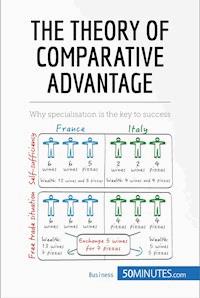
According to Ricardo, a country with several absolute advantages should specialise in the sector which represents a comparatively greater advantage for it, while a country that has no absolute advantage should focus its efforts in the area that offers comparatively the least disadvantage. This law of comparative advantage helps us understand how trade can be mutually beneficial.




