


9,99 €
Mehr erfahren.
- Herausgeber: 50Minutes.com
- Kategorie: Bildung
- Serie: History
- Sprache: Englisch
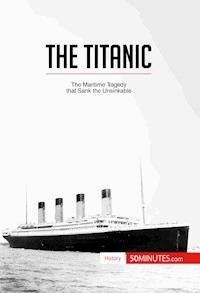
Keen to learn but short on time? Get to grips with the history of the Titanic in next to no time with this concise guide.
50Minutes.com provides a clear and engaging analysis of the voyage of the
Titanic.When the
Titanic liner set sail from Southampton on 10 April 1912, the passengers on board had no idea of the terrible fate that awaited them four days later. Everything was in place for an unforgettable journey: the brand new ship was proclaimed the largest, fastest and most luxurious in the world. But, on the night of 14 April, the unthinkable happened when an iceberg loomed in the horizon. Within just a few hours, the magnificent vessel was headed towards the depths of the ocean.
In just 50 minutes you will:
• Understand the historical and social context of the time and how this led to the building of the largest and most luxurious ship, the Titanic
• Learn more about the people involved in the tragedy, including the captain, the architect and the ship owner
• Analyse the development of the event, from the ship’s departure on 10 April to the moment it began its descent to the seabed at 2.20am on 14 April
ABOUT 50MINUTES.COM | History & Culture
50MINUTES.COM will enable you to quickly understand the main events, people, conflicts and discoveries from world history that have shaped the world we live in today. Our publications present the key information on a wide variety of topics in a quick and accessible way that is guaranteed to save you time on your journey of discovery.
Das E-Book können Sie in Legimi-Apps oder einer beliebigen App lesen, die das folgende Format unterstützen:
Seitenzahl: 33
Veröffentlichungsjahr: 2016
Ähnliche















The Titanic
Key information
When: On the night of 14-15 April 1912Where: In the Northwest AtlanticContext: The Belle Époque (the era of liner ships)Main actors:Edward John Smith, British sailor (1850-1912)Thomas Andrews, British naval architect (1873-1912)Joseph Bruce Ismay, British businessman (1862-1937)Repercussions:New legislation on maritime safetyThe creation of the International Ice PatrolThe birth of a myth surrounding the TitanicGigantic, luxurious, beautiful, unsinkable; ever since its creation, the Titanic has been the subject of the most beautiful descriptions. For travelers of the early 20th century, there was no doubt about it: the ship, a masterpiece of its industry, was indeed the largest liner in the world. The jewel of the shipping company White Star Line, the Titanic was designed, through its luxuriousness and more advanced technology, to far outshine the ships of rival companies in the transatlantic crossing, which connected the Old Continent to New York.
On 10 April 1912, the ship began its maiden voyage, under the command of Edward John Smith, a veteran of the seas who had great confidence in the ship’s abilities. 2 200 passengers and crew members were onboard, including some of the biggest celebrities of the time. They all anticipated taking the journey of their dreams, unaware that the prestigious ship was doomed.
On 14 April 1912, sailing at an ever-increasing speed, the Titanic headed towards a zone of drifting ice. Although messages of caution continued to warn of the danger looming on the horizon, none of them were really taken into account. But, at 11:40pm, lookouts noticed that the ship was racing towards an iceberg. Despite the quick response of the crew, the starboard side of the Titanic struck the ice. The damage was heavy and there were only 1 178 seats available in the lifeboats. One of the worst maritime tragedies in history was about to take place.
Context
Europe: master of the world
The Titanic alone certainly could not summarize the context of its time. Nevertheless, many similarities can be drawn between the fate of the luxury liner and the coming doom of European society, which was about to be destroyed by the iceberg that was the Great War (1914-1918). Like the ship, the Europe of the late 19th century and early 20th century really was the master of the world. Within a few decades (1830-1870), its economy had been transformed forever by the first industrial revolution (iron, coal and the steam engine). As the first was so successful, a second revolution inaugurating the era of oil, steel and electricity began in 1896. Capitalism became king on the Old Continent, which, following these great changes, saw its population double in just 50 years.
This incredible economic and population growth led Europe to turn to the rest of the world. Indeed, the Old Continent no longer had the food resources or the raw materials needed for its growth. Therefore, it was essential to seek new markets that would provide it with resources, but also consumers. This context thus opened Europe to colonialism and imperialism. Africa and Asia were the victims of this new colonization, which saw the European powers arguing over each plot of land. In 1900, the Old Continent truly dominated the world with its colonies, so much so that one in four people in the world lived in a territory belonging to Britain. Only the United States and Japan managed to escape this hegemony.
After this process of expansion, Europe submitted the rest of the world by imposing its values, its policies and its industry. To the detriment of the colonized peoples, it monopolized all the wealth and redistributed its products, inexorably increasing its own profits. The world was now organized by Europe and for Europe. However, the continuous search for riches created inequalities and divisions between the European nations, to the point where a war seemed inevitable.




