


48,99 €
Mehr erfahren.
- Herausgeber: John Wiley & Sons
- Kategorie: Fachliteratur
- Serie: Bloomberg Professional
- Sprache: Englisch
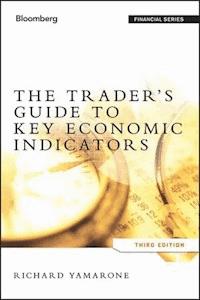
A handy reference to understanding key economic indicators and acting on them New economic data are reported virtually every trading day. Investors, big and small, have to understand how these reports influence their investments, portfolios, and future sources of income. The third edition of The Trader's Guide to Key Economic Indicators examines the most important economic statistics currently used on Wall Street. In a straightforward and accessible style, it tells you exactly what these reports measure and what they really mean. Filled with in-depth insights and practical advice, this reliable resource sheds some much-needed light on theses numbers and data releases and shows you what to look for and how to react to various economic indicators. * Covers everything from gross domestic product and employment to consumer confidence and spending * Author Richard Yamarone shares his experience as a former trader, academic, and current Wall Street economist * Illustrated with instructive graphs and charts that will put you ahead of market curves Engaging and informative, this book will put you in a better position to make more informed investment decisions, based of some of today's most influential economic indicators.
Sie lesen das E-Book in den Legimi-Apps auf:
Seitenzahl: 443
Veröffentlichungsjahr: 2012
Ähnliche

















Table of Contents
Cover
Series page
Title page
Copyright page
Dedication
Acknowledgments
Introduction
The Business Cycle
Indicators and the Markets
How to Use This Book
Who Can Benefit from This Book?
CHAPTER 1 Gross Domestic Product
Evolution of an Indicator
Digging for the Data
What Does It All Mean?
How to Use What You See
Tricks from the Trenches
CHAPTER 2 Indexes of Leading, Lagging, and Coincident Indicators
Evolution of an Indicator
Digging for the Data
Lagging Index
What Does It All Mean?
How to Use What You See
Tricks from the Trenches
CHAPTER 3 The Employment Situation
Evolution of an Indicator
Digging for the Data
What Does It All Mean?
How to Use What You See
Tricks from the Trenches
CHAPTER 4 Industrial Production and Capacity Utilization
Evolution of an Indicator
Digging for the Data
What Does It All Mean?
How to Use What You See
Tricks from the Trenches
CHAPTER 5 Institute for Supply Management Indexes
Evolution of an Indicator
Digging for the Data
What Does It All Mean?
How to Use What You See
Tricks from the Trenches
CHAPTER 6 Manufacturers’ Shipments, Inventories, and Orders
Evolution of an Indicator
Digging for the Data
What Does It All Mean?
How to Use What You See
Tricks from the Trenches
CHAPTER 7 Manufacturing and Trade Inventories and Sales
Evolution of an Indicator
Digging for the Data
What Does It All Mean?
How to Use What You See
Tricks from the Trenches
CHAPTER 8 New Residential Construction
Evolution of an Indicator
Digging for the Data
What Does It All Mean?
How to Use What You See
Tricks from the Trenches
CHAPTER 9 Conference Board Consumer Confidence and University of Michigan Consumer Sentiment Indexes
Evolution of an Indicator
Digging for the Data
What Does It All Mean?
How to Use What You See
Tricks from the Trenches
CHAPTER 10 Advance Monthly Sales for Retail and Food Services
Evolution of an Indicator
Digging for the Data
What Does It All Mean?
How to Use What You See
Tricks from the Trenches
CHAPTER 11 Personal Income and Outlays
Evolution of an Indicator
Digging for the Data
What Does It All Mean?
How to Use What You See
Tricks from the Trenches
CHAPTER 12 Consumer and Producer Price Indexes
Evolution of an Indicator
Digging for the Data
What Does It All Mean?
How to Use What You See
Tricks from the Trenches
CHAPTER 13 The Fixed-Income Market
Evolution of an Indicator
Digging for the Data
What Does It All Mean?
How to Use What You See
Tricks from the Trenches
CHAPTER 14 Commodities
Evolution of an Indicator
Digging for the Data
What Does It All Mean?
How to Use What You See
Tricks from the Trenches
About the Author
Index
Since 1996, Bloomberg Press has published books for financial professionals on investing, economics, and policy affecting investors. Titles are written by leading practitioners and authorities, and have been translated into more than 20 languages.
The Bloomberg Financial Series provides both core reference knowledge and actionable information for financial professionals. The books are written by experts familiar with the work flows, challenges, and demands of investment professionals who trade the markets, manage money, and analyze investments in their capacity of growing and protecting wealth, hedging risk, and generating revenue.
For a list of available titles, please visit our Web site at www.wiley.com/go/bloombergpress.
Copyright © 2012 by Richard Yamarone. All rights reserved.
Published by John Wiley & Sons, Inc., Hoboken, New Jersey.
Published simultaneously in Canada.
No part of this publication may be reproduced, stored in a retrieval system, or transmitted in any form or by any means, electronic, mechanical, photocopying, recording, scanning, or otherwise, except as permitted under Section 107 or 108 of the 1976 United States Copyright Act, without either the prior written permission of the Publisher, or authorization through payment of the appropriate per-copy fee to the Copyright Clearance Center, Inc., 222 Rosewood Drive, Danvers, MA 01923, (978) 750-8400, fax (978) 646-8600, or on the Web at www.copyright.com. Requests to the Publisher for permission should be addressed to the Permissions Department, John Wiley & Sons, Inc., 111 River Street, Hoboken, NJ 07030, (201) 748-6011, fax (201) 748-6008, or online at http://www.wiley.com/go/permissions.
Limit of Liability/Disclaimer of Warranty: While the publisher and author have used their best efforts in preparing this book, they make no representations or warranties with respect to the accuracy or completeness of the contents of this book and specifically disclaim any implied warranties of merchantability or fitness for a particular purpose. No warranty may be created or extended by sales representatives or written sales materials. The advice and strategies contained herein may not be suitable for your situation. You should consult with a professional where appropriate. Neither the publisher nor author shall be liable for any loss of profit or any other commercial damages, including but not limited to special, incidental, consequential, or other damages.
For general information on our other products and services or for technical support, please contact our Customer Care Department within the United States at (800) 762-2974, outside the United States at (317) 572-3993 or fax (317) 572-4002.
Wiley also publishes its books in a variety of electronic formats. Some content that appears in print may not be available in electronic books. For more information about Wiley products, visit our web site at www.wiley.com.
Library of Congress Cataloging-in-Publication Data:
Yamarone, Richard.
The trader’s guide to key economic indicators / Richard Yamarone.—3rd ed.
p. cm.—(Bloomberg financial series)
Includes index.
ISBN 978-1-118-07400-8 (hardback); ISBN 978-1-118-22250-8 (ebk.); ISBN 978-1-118-23313-9 (ebk.); ISBN 978-1-118-26110-1 (ebk.)
1. Economic indicators—United States. 2. Investments—United States. I. Title.
HC106.83.Y35 2012
330.01'5195—c23
2012001610
To Suzie,
Milton, Oskar, and Nash—felinus economicus
Acknowledgments
This project could never have been completed without the support and assistance of my wife, Suzie. She has helped in countless and immeasurable ways. Families play an integral role in dreams, aspirations, and accomplishments. My family has paved a clear path for any and every ambition that I could possibly have. They are indubitably responsible for all of my successes. My mother and father have always instilled the importance of education, hard work, free thinking, and discipline. For that I could never thank them enough. A special thanks to my brother Robert and to my in-laws, Richard and Nancy McCabe.
Educators can have a profound influence on one’s life. My life—as well as this project—was no exception in the way of encouragement and wisdom disseminated by those in academia. Professors and mentors have helped, not only in the understanding of some of the roles that economic indicators and statistics assume, but as counselors to a not-so-quick-to-learn student. They include, and are not limited to, David W. Ring, William O’Dea, Robert Carson, and Thomas Gergel of the State University of New York at Oneonta. Prof. Ring taught me to work hard, Prof. Carson to look at each situation from alternative perspectives, and Prof. Gergel to have a passion about whatever task I might take on. I practice these three lessons every day of my life.
At John Wiley & Sons I must thank Meg Freeborn, Kimberly Monroe-Hill, and Evan Burton. Meg, thanks for your diligent efforts and for identifying the previously unnoticed errors of the first two editions. Kimberly, a big thanks for fixing and polishing up the final product. Evan, your professionalism is second to none; I hope we work together on many projects in the future.
The list of professional associates who have helped me with this project could easily take up the entire book, but some individual recognition is essential. In my 25-plus years of work experience on Wall Street I have never been associated with a more professional firm than Bloomberg LP, particularly Bloomberg News. It is for this reason that I formally decided to join the Multimedia Group in the fall of 2009.
To the hundreds of friends, acquaintances, and colleagues at the Bloomberg offices all around the world, thanks for all your help and input into this project. You are unaware of how helpful you have been. I especially wish to thank Kevin Tynan—the best auto analyst on Wall Street, Vinny DelGiudice, Vince Golle, David Yanofsky, Tom Keene, Sandra Mosiello, Tony Bolton, David Nogeroul, Alex Tanzi, Michael McKee, Sara Eisen, Rachel Wehrspann, Caroline Baum, Mark Crumpton, Ellen Braitman, Dominick Chu, Janice Slusarz, and Jackie Jozefek.
I must extend my thanks to my new team at the Bloomberg Economics BRIEF newsletter group, including Ted Merz—a true guiding light and the ultimate voice of reason. To my editors, Kevin Depew and Jennifer Rossa, I continue to improve because of your tremendous efforts. To the economists at the Economics BRIEF, Michael McDonough, David Powell, Joseph Brusuelas, and Niraj Shah, I can’t think of a better and more intelligent bunch of guys to work with. (Actually, I can name a few thousand, I’m just being nice.) Special thanks to Michael Nol, James Crombie, Aleks Rozens, and Nick Ferris—even though I can’t help but think I am entitled to some royalties for entertaining you four on a daily basis. Seriously.
Acknowledgment wouldn’t be complete without special thanks to those who have helped with this project from the first edition: Charles Gilbert and Michele Johnson (Board of Governors of the Federal Reserve System); Lynn Franco (the Conference Board); Richard Deitz (Federal Reserve Bank of New York); Guhan Venkatu (Federal Reserve Bank of Cleveland); Scott Scheleur (Service Sector Statistics Division, U.S. Census Bureau); Kristen Kioa (Institute for Supply Management); Jeannine Aversa and Marty Crutsinger (Associated Press); Garrett Bekker; Steve Berman (U.S. Department of Commerce, Bureau of Census); Barbara Hagenbaugh, Sue Kirchhoff (USA Today); Jason Hecht (Ramapo College); David Jozefek; Thomas Feeney (Shippensburg University); Jeffrey J. Junior; Stacie Negas and Bob Israel; and Joe Pregiato (Arbor & Ivy).
And a very special thanks to Lakshman Achuthan and Anirvan Banerji from the Economic Cycle Research Institute (ECRI) in New York. They oversee some of the finest economic indicators on the Street today.
Any errors or oversights that may exist in this book were not intentional and are not the fault of any of those individuals named above.
Introduction
Investing without understanding the economy is like taking a trip without knowing anything about the climate of your destination. Inclement weather can wreak havoc on a vacation, especially if it involves outdoor activities. Just so, putting hard-earned money into the stock or bond market when economic conditions are unfavorable can destroy financial plans for a comfortable retirement, a new house, or a child’s college education.
No one understands this better than Wall Street investment banks, brokers, and research institutions. All of these have adopted a top-down approach to securities analysis that begins with a forecast of the general economic climate, including interest rate projections, currency forecasts, and estimates of domestic and foreign economic growth. In this, they are following one of the precepts laid down by Benjamin Graham and David Dodd in their 1940 investors’ bible, Security Analysis: “Economic forecasts provide essential underpinning for stock and bond market, industry, and company projections.
You don’t need to manage millions or billions of dollars, however, to study economic conditions and plan your investment strategy accordingly. You can get much of the same information that Wall Street professionals use in their analyses from the business sections of the nation’s newspapers, magazines, and evening news programs. Furthermore, you don’t need a degree in economics or mathematics to interpret this information. In fact, many graduates of such programs at the nation’s top universities find themselves entirely unprepared for the real world of finance. This book attempts to bridge the wide gap between the sometimes mind-numbing theories of textbook economics—the principles that are taught on college campuses across the country—and the everyday world of Wall Street. It does so by focusing on a dozen economic indicators and several others from the fixed-income and commodity markets that are among the most important of any analyst’s or economist’s tools. Understanding these indicators will make the study of economics more palatable and exciting.
Over the past century, thousands of economic indicators have emerged, predicting everything from the demand for gasoline to the size of harvests. Some are more fun than functional, such as those claiming links between stock performance for the year and which conference—the NFC or the AFC—wins the Super Bowl, or whether women’s hemlines rise to midthigh or fall to midcalf. Other indicators are more serious, solidly based in economic observations. These range from the arcane—such as the indicator connecting the production level of titanium dioxide, an ingredient of pigments used in paints and plastics, with the demand for building materials—to the commonsensical. The price of copper, used in wiring and many other construction elements, for instance, has a clear relationship to the pace of housing activity. The same could be said of economic growth and railroad car loadings, shipping container production, wooden pallet shipments, and the manufacture of corrugated boxboard and packaging, all of which are connected with transporting freight or manufactured goods.
Over time, economists have weeded out the least successful indicators, based on the most dubious relationships, to arrive at a core of about 50 consistently reliable ones. This book presents the dozen or so that are must-haves in any analytical toolbox. Virtually all Wall Street economists use these indicators in their analyses and their writings. Federal Reserve officials conduct monetary policy based on the trends that these indicators project. They are also considered must-haves in the sense that they are among the most accurate at depicting economic relationships as well as attendant market-movability. That is, each of these indicators at one time or another typically figures among the top-tier factors that can presage big swings in the financial markets.
Some of the dozen-plus indicators discussed in this book are constructed by U.S. government agencies such as the U.S. Department of Commerce’s Census Bureau, the U.S. Department of Labor, and the Board of Governors of the Federal Reserve System. Others are the products of private organizations such as the Institute for Supply Management, the Conference Board, and the University of Michigan. Some have excellent predictive powers. Others reflect principally the current state of the economy, and still others highlight industries that might outperform and so help identify the likely path of economic activity. All have one thing in common, however: In one way or another, they all relate to the business cycle.
The Business Cycle
The business cycle is one of the central concepts in modern economics. It was defined by celebrated economists Arthur Burns and Wesley Mitchell in their pioneering 1946 study, Measuring Business Cycles, written for the National Bureau of Economic Research (NBER), which today is the official arbiter of the U.S. business cycle. According to Burns and Mitchell, the business cycle is “a type of fluctuation found in the aggregate economic activity of nations that organize their work mainly in business enterprises: a cycle consists of expansions occurring at about the same time in many economic activities, followed by similarly general recessions, contractions, and revivals, which merge into the expansion phase of the next cycle.”
No two business cycles are the same. As illustrated in Exhibit I.1, during the relatively short time that people have been measuring the U.S. economy, the length of expansions, from economic trough to peak, and of contractions, from peak to trough, has varied widely—although expansions, especially recently, generally have been longer and steadier than contractions. Expansions have ranged from 120 months (April 1991 to March 2001) to 10 months (March 1919 to January 1920), and downturns from 43 months (August 1929 to March 1933) to 6 months (February 1980 to July 1980). The amplitude of the peaks and troughs has also differed significantly from cycle to cycle.
EXHIBIT I.1 U.S. Business Cycle Durations
Source: National Bureau of Economic Research
One way to think of the business cycle is as a graphical representation of the total economic activity of a country. Because the accepted benchmark for economic activity in the United States is currently gross domestic product (GDP), economists generally identify the business cycle with the alternating increases and declines in GDP. Rising GDP marks economic expansion; falling GDP, a contraction (see Exhibit I.2). That said, the business cycle, as defined by Burns and Mitchell, can’t be fully captured by one indicator, even the nation’s GDP. Rather, it is a compendium of indicators that reflects various aspects of the economy.
EXHIBIT I.2 GDP and Highlighted Recessions
Source: U.S. Department of Commerce, Bureau of Economic Analysis; National Bureau of Economic Research
Economic indicators are classified according to how they relate to the business cycle. Those that reflect the current state of the economy are coincident; those that predict future conditions are leading; and those that confirm that a turning occurred are lagging.
Indicators and the Markets
The organization responsible for an indicator generally distributes its report about an hour before the official release time to financial news outlets such as Bloomberg News, Dow Jones Newswires, Thomson Reuters, and CNBC. The reporters, who are literally locked in a room and not permitted to have contact with anyone outside, ask questions of agency officials and prepare headlines and analyses of the report contents. These stories are embargoed until the official release, at which time they are transmitted over the newswires to be dissected by the Wall Street community. Most Wall Street firms employ economists to provide live broadcasts of the numbers as they run across the newswires, together with interpretation and commentary regarding the likely market reaction. This task, known as the “hoot-and-holler” or tape reading, is among the most stressful performed by an economist. One slip-up can cost a trader or an entire trading floor millions of dollars.
The more an indicator deviates from Street expectations, the greater its effect on the financial markets. A 0.1 percent decline in retail sales, for example, might not move the markets much if economists were looking for a flat reading or a 0.1 percent rise. But if the consensus was for an increase of 0.7 percent, and instead the 0.1 percent decline hit the tape, the markets might well be rocked. That said, it is always prudent for traders and other market participants to keep apprised of what the Street expectations are for key economic indicators such as those covered here.
How to Use This Book
You’ve no doubt read in a paper or heard on television or the radio forecasts of economic expansion or recession. You also probably realize that the one is desirable and the other is not. But you may not know how the economists quoted came up with their predictions. Without this knowledge, how can you judge how well considered or rash they are—and whether to trust them in creating your investment strategy? This book seeks to help you form your own opinions about the possible direction of the economy and the markets and to decide how to act based on those opinions.
Each chapter corresponds to an indicator, beginning with the most comprehensive—the GDP and indices of leading, lagging, and coincident indicators—and continuing with those tied to particular aspects or segments of the overall economy, such as consumer prices, manufacturing, housing, and retail sales. Every chapter contains four principal sections: an introduction sketching out the major attributes of the indicator and its effect on the markets; a discussion of its origins and development; a description of how the relevant data are obtained, analyzed, and presented; and an explanation of how to incorporate these data into your investment process. The last section also contains at least one trick—involving either a little-known subcomponent of the indicator or a combination of subcomponents—that Wall Street economists use to get a clearer or more timely picture of business activity. At the end of each chapter is a listing of additional reading and resources, pointing those interested to references that discuss the relevant indicator in greater detail.
In putting what you learn from this book into practice, you might take some pointers from Wall Street. Just about every investment firm has a pre-market-opening meeting in which the day’s events and potential trading strategies are presented. This always includes a discussion of the economic indicators scheduled for release that day. No trader wants to be caught off guard by an unexpected market-moving release. For the same reason, many traders have on their desks calendars showing which economic release is scheduled for a particular day and indicating both the value or percentage change of the previous report and the Street’s estimates—highest, lowest, and consensus—for the upcoming one. That way, when the actual figure is released, they will know how it compares with expectations and can react accordingly.
Of course, no single economic indicator will tell you all you need to know about the current or future economic climate. Each has drawbacks and may send false signals because of unforeseen shocks, faulty measurements, or suspect collection processes. Piecing together the information from all of the indicators discussed in this book like tiles in a mosaic will give you a dynamic representation of the economy. But if you are truly serious about understanding the macroeconomic climate and individual industry conditions, you should also take advantage of the Securities and Exchange Commission’s Regulation Fair Disclosure of 2000, which mandates for individual investors the same access to companies’ quarterly earnings conference calls that professional analysts have.
These calls provide a great deal of insight into corporate spending plans, manufacturing and production activity, international conditions, pricing, and the general business climate. Especially informative are the announcements of industrial behemoths such as Alcoa, Boeing, Caterpillar, Cummins, Emerson Electric, Ford Motor Company, General Electric, Illinois Tool Works, Johnson Controls, and United Technologies. Many companies also offer slide presentations, handouts, and supplemental data with these quarterly presentations, which often provide even greater detail on their buying intentions, prospective employment changes, and any threats to performance that they foresee. There’s no cheaper and easier way to gather anecdotal evidence about business conditions. If you can’t listen in, the presentations are almost always archived on company web sites, from which they may be readily retrieved 24/7.
Who Can Benefit from This Book?
This book was written primarily for those traders and investors lacking a formal introduction to the most popular economic indicators on Wall Street. Just because an individual is entrusted with investing millions of dollars does not guarantee a practical command of economic indicators and their meaning for investment. When newly minted MBAs arrive on the trading floors of financial firms, for example, few are equipped with a complete appreciation of these indicators—no matter from which institution that degree has come. My years of experience on a few of the largest trading floors in the world has suggested the need to fill what can be viewed as a surprisingly expansive void regarding indicators, statistics, the economic meaning of the associated figures, and the market’s likely reaction.
Those new to the field of investing and economics, including students of the subject, also should benefit from the fundamental, application-oriented nature of this book. As most academics know, if students cannot see the results or directly test theories with practical data, the knowledge they hold tends to remain more theoretical than real-world and they eventually may lose interest in the field. It is here that many future economists are lost. As exercises within an imperfect science, experiments conducted in the social discipline of economics are predominantly theorized or hypothesized and seldom tested with tangible data. In this sense, economists are not as fortunate as physicists or natural scientists, who conduct experiments in a controlled environment such as a laboratory, riverbed, or ocean. The economic indicators contained in these chapters serve as concrete guideposts within the discipline of economics, and as such make experimentation, testing, and study for investments not only possible but understandable.
References
Bartolini, Leonardo, Linda Goldberg, and Adam Sacarny. 2008. “How Economic News Moves Markets.” Federal Reserve Bank of New York Current Issues in Economics and Finance 14, no. 6 (August).
Burns, Arthur F., and Wesley Clair Mitchell. 1946. Measuring Business Cycles. New York: National Bureau of Economic Research.
Cottle, Sidney, Roger F. Murray, and Frank E. Block. 1988. Graham and Dodd’s Security Analysis. New York: McGraw-Hill.
Crescenzi, Anthony. 2002. The Strategic Bond Investor: Strategies and Tools to Unlock the Power of the Bond Market. New York: McGraw-Hill.
Goldberg, Linda, and Deborah Leonard. 2003. “What Moves Sovereign Bond Markets? The Effects of Economic News on U.S. and German Yields.” Federal Reserve Bank of New York Current Issues in Economics and Finance 9, no. 9 (September).
Graham, Benjamin, and David Dodd. 1934. Security Analysis. New York: McGraw-Hill.
Hagenbaugh, Barbara. 2003. “Hints of Optimism Point to Rebound.” USA Today (August 21).
Hager, George. 2001. “Economists Seek Clues in Daily Life.” USA Today (February 12).
Mitchell, Wesley Clair. 1927. Business Cycles: The Problem and Its Setting. New York: National Bureau of Economic Research.
Mui, Yian Q. 2009. “Blue Chip, White Cotton: What Underwear Says About the Economy.” Washington Post (August 31).
National Bureau of Economic Research. 2003. “U.S. Business Cycle Expansions and Contractions.” http://www.nber.org/cycles/cyclesmain.html.
Vance, Julia. 2001. “Titanium Dioxide’s Message.” The Dismal Scientist, Economy.com, April 12. http://www.dismal.com/todays_econ/te_041201_2.asp.
Yamarone, Richard. 1999. “The Business Economist at Work: Argus Research Corporation.” Business Economics (July): 65–70.
CHAPTER 1
Gross Domestic Product
Economics has received a bad rap. In the mid-nineteenth century, the great Scottish historian Thomas Carlyle dubbed this discipline “the dismal science,” and jokes abound on Wall Street about economists being more boring than accountants. But truth be told, there is nothing more exciting than watching the newswire on a trading floor of a money-center bank minutes ahead of the release of a major market-moving economic report. One of the top excitement generators is the report on gross domestic product (GDP)—an indicator that is a combination of economics and accounting.
Economists, policy makers, and politicians revere GDP above all other economic statistics because it is the broadest, most comprehensive barometer available of a country’s overall economic condition. GDP is the sum of the market values of all final goods and services produced in a country (that is, domestically) during a specific period using that country’s resources, regardless of the ownership of the resources. For example, all the automobiles made in the United States are included in GDP—even those manufactured in U.S. plants owned by Germany’s BMW and Japan’s Toyota. In contrast, gross national product (GNP) is the sum of the market values of all final goods and services produced by a country’s permanent residents and firms regardless of their location—that is, whether the production occurs domestically or abroad—during a given period. Baked goods produced in Canada by U.S. conglomerate Sara Lee Corporation, for example, are included in U.S. GNP, but not in U.S. GDP.
Lesen Sie weiter in der vollständigen Ausgabe!
Lesen Sie weiter in der vollständigen Ausgabe!
Lesen Sie weiter in der vollständigen Ausgabe!
Lesen Sie weiter in der vollständigen Ausgabe!
Lesen Sie weiter in der vollständigen Ausgabe!
Lesen Sie weiter in der vollständigen Ausgabe!
Lesen Sie weiter in der vollständigen Ausgabe!
Lesen Sie weiter in der vollständigen Ausgabe!
Lesen Sie weiter in der vollständigen Ausgabe!
Lesen Sie weiter in der vollständigen Ausgabe!
Lesen Sie weiter in der vollständigen Ausgabe!
Lesen Sie weiter in der vollständigen Ausgabe!
Lesen Sie weiter in der vollständigen Ausgabe!
Lesen Sie weiter in der vollständigen Ausgabe!
Lesen Sie weiter in der vollständigen Ausgabe!




