


Erhalten Sie Zugang zu diesem und mehr als 300000 Büchern ab EUR 5,99 monatlich.
- Herausgeber: XSPO
- Kategorie: Geisteswissenschaft
- Serie: MASTERWORKS OF WORLD ART
- Sprache: Englisch
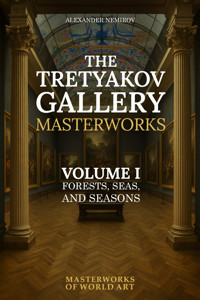
Immerse yourself in one of the world's greatest art collections through this definitive volume from the State Tretyakov Gallery, Moscow's legendary museum and home to an unparalleled treasury of masterworks. Volume I presents over 720 iconic landscape paintings from the golden age of Russian art (1850s-1900s)—a period when artists like Isaac Levitan, Ivan Shishkin, Ivan Aivazovsky, and Arkhip Kuindzhi revolutionized landscape painting with unprecedented emotional depth and technical mastery. From Shishkin's monumental forest scenes and Aivazovsky's legendary seascapes to Levitan's hauntingly beautiful seasonal studies, this collection showcases works that rank among the finest landscape paintings ever created. Featuring stunning, high-quality reproductions prepared from the Gallery's own archives, this volume captures forests rendered with almost photographic precision, seas painted with dramatic power, and atmospheric effects that transform ordinary moments into visions of extraordinary beauty. Essential for art lovers, collectors, and anyone seeking to discover masterworks that rival the greatest European and American landscape traditions.
Sie lesen das E-Book in den Legimi-Apps auf:
Seitenzahl: 52
Veröffentlichungsjahr: 2025
Das E-Book (TTS) können Sie hören im Abo „Legimi Premium” in Legimi-Apps auf:
Ähnliche



















Immerse yourself in one of the world's greatest art collections through this definitive volume from the State Tretyakov Gallery, Moscow's legendary museum and home to an unparalleled treasury of masterworks.
Volume I presents over 720 iconic landscape paintings from the golden age of Russian art (1850s-1900s)—a period when artists like Isaac Levitan, Ivan Shishkin, Ivan Aivazovsky, and Arkhip Kuindzhi revolutionized landscape painting with unprecedented emotional depth and technical mastery. From Shishkin's monumental forest scenes and Aivazovsky's legendary seascapes to Levitan's hauntingly beautiful seasonal studies, this collection showcases works that rank among the finest landscape paintings ever created.
Featuring stunning, high-quality reproductions prepared from the Gallery's own archives, this volume captures forests rendered with almost photographic precision, seas painted with dramatic power, and atmospheric effects that transform ordinary moments into visions of extraordinary beauty. Essential for art lovers, collectors, and anyone seeking to discover masterworks that rival the greatest European and American landscape traditions.
Public Domain Notice
All artworks reproduced in this publication are in the public domain and originate from the collection of the State Tretyakov Gallery, Moscow. These images are presented here as part of an independent art publication for educational and cultural enrichment. The Tretyakov Gallery is not affiliated with, nor does it endorse, this edition.
The Tretyakov Gallery Masterworks
Volume I: Forests, Seas, and Seasons
MASTERWORKS OF WORLD ART
Introduction
The State Tretyakov Gallery in Moscow stands as one of the world's great art museums, housing over 180,000 works that span centuries of artistic achievement. Founded in 1856 by the visionary merchant and philanthropist Pavel Tretyakov, the Gallery has become synonymous with excellence in art collecting, preserving masterpieces that range from medieval icons to avant-garde experiments, from intimate portraits to monumental historical canvases. Among the Gallery's vast holdings, one collection shines with particular brilliance: the landscape paintings created during the golden age of Russian art, roughly spanning the 1850s through the early 1900s. This was an extraordinary period when a generation of supremely talented artists—many trained at the Imperial Academy of Arts in St. Petersburg—devoted themselves to capturing the natural world with a level of emotional intensity, technical skill, and poetic vision that places their work alongside the finest landscape traditions of Europe and America. This first volume of our comprehensive catalogue presents over 720 carefully selected paintings from that remarkable era, focusing entirely on nature: forests, seascapes, seasonal transformations, and atmospheric phenomena rendered by some of the greatest painters who ever lived.
At the heart of this collection stand artists whose names deserve to be as familiar to art lovers as Constable, Turner, or the painters of the Hudson River School. Ivan Shishkin (1832-1898) earned the sobriquet "tsar of the forest" through his monumental woodland scenes, painted with such meticulous attention to botanical detail and such grandeur of composition that each tree becomes a portrait, each forest an epic. His technical mastery was legendary—he could render the texture of bark, the play of light through pine needles, the density of undergrowth with scientific precision, yet never lose sight of the emotional power inherent in these wild spaces. Working en plein air whenever possible, Shishkin filled countless sketchbooks with studies before creating his large-scale canvases, each one a testament to both observation and artistic vision. His forests are populated by individual trees, each one studied with the care of a portrait painter—ancient pines with massive trunks, birch groves where white bark catches the light, oak trees spreading their crowns like natural cathedrals. The forest floor receives equal attention: fallen logs, moss-covered stones, wildflowers, mushrooms, all painted with minute precision.
Ivan Aivazovsky (1817-1900), the most celebrated marine painter of the nineteenth century, created seascapes of almost supernatural beauty and drama. With a palette dominated by luminous blues and greens, and a compositional sense that could make waves appear to move on canvas, Aivazovsky captured every mood of the sea—from glassy calm to apocalyptic storm. His ability to paint moonlight on water, the translucence of waves, the atmospheric effects of mist and spray, remains unmatched in the history of maritime art. Remarkably prolific, Aivazovsky created over six thousand paintings during his long career, many of them from memory in his studio, yet each one displays fresh observation and genuine feeling. The Tretyakov collection includes numerous examples of his genius, each one a masterclass in light, color, and movement. His storm scenes show vessels fighting mountainous waves under lightning-split skies, while his calm waters reflect perfect mirror images of ships and clouds. Dawn and sunset bathe his seas in gold and crimson, and rocky coasts meet crashing surf in compositions of timeless power.
Isaac Levitan (1860-1900), who died tragically young, achieved what few landscape painters ever manage: he made mood itself the subject of his art. Levitan's paintings don't simply depict places—they capture states of consciousness, moments of profound feeling that transcend mere representation. His autumns carry the weight of melancholy and memory; his twilights seem to hold the world suspended between day and night, presence and absence. Working with a sophisticated understanding of color harmony and atmospheric perspective, Levitan could transform an ordinary country road, a quiet river, or a cloudy sky into something that touches the deepest chambers of human emotion. His paintings of spring's tentative arrival, with melting snow and bare branches against pale skies, capture the fragile hope of renewal. His golden autumn scenes, with their rich yellows and ochres, speak to both beauty and transience. And his winter landscapes, with their muted palettes and vast spaces, evoke silence and contemplation.
Arkhip Kuindzhi (1841-1910) brought an almost visionary quality to landscape painting, working with bold contrasts of light and shadow, dramatic color schemes, and compositional daring that sometimes shocked his contemporaries. His moonlit scenes, where silver light breaks through dark clouds to illuminate forests or steppes below, create effects that seem almost theatrical yet remain grounded in careful observation of natural phenomena. Kuindzhi's famous "Moonlit Night on the Dnieper" caused a sensation when it was first exhibited, with viewers unable to believe that such luminous effects could be achieved with paint alone. His birch groves, bathed in golden light, demonstrate his ability to push color to its expressive limits while maintaining believable spatial relationships and atmospheric depth.




