


Erhalten Sie Zugang zu diesem und mehr als 300000 Büchern ab EUR 5,99 monatlich.
- Herausgeber: Biteback Publishing
- Kategorie: Geisteswissenschaft
- Sprache: Englisch
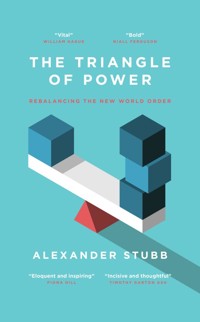
The liberal world order that emerged after the Second World War – and expanded triumphantly following the Cold War – is unravelling. Multilateral cooperation is giving way to multipolar rivalry and conflict. Global norms are eroding. What comes next will define the rest of the century; the search is on for a new global framework – a rebalancing of power. In The Triangle of Power, Finnish President Alexander Stubb argues that we are living through a hinge moment in history, akin to 1918, 1945 or 1989. A new international system is taking shape, driven by three major forces: the Global West, the Global East and the Global South. At the centre is the escalating competition between the United States and China, as both try to forge bilateral deals and regional alliances, but it is the Global South that will ultimately determine whether the future tilts toward cooperation or fragmentation. Drawing on decades at the front lines of diplomacy, and blending personal insight with political and academic experience, Stubb delivers a passionate call for values-based realism and dignified foreign policy – and warns that unless the West learns to listen, it will lose its place in the world it once led.
Sie lesen das E-Book in den Legimi-Apps auf:
Seitenzahl: 261
Veröffentlichungsjahr: 2026
Das E-Book (TTS) können Sie hören im Abo „Legimi Premium” in Legimi-Apps auf:
Ähnliche



















PRAISE FOR The Triangle of Power
“Alexander Stubb is one of the most incisive, experienced, and thoughtful political leaders in Europe today. In this book, he argues that we are at a moment in history as important as 1918, 1945, or 1989, and need a ‘values-based realism’ to confront the challenges that confront us from the east, the south, and now the west as well. One can only hope that Europe will listen to his advice.”
TIMOTHY GARTON ASH,
author of Homelands:APersonalHistoryofEurope
“It is rare for a foreign policy practitioner to write a profound work of scholarship, but Alexander Stubb has done just that. He identifies the central weakness in the international system today and has an ingenious plan to address it. It is easier said than done, but it is a crucial first step to say it clearly and intelligently, as this book does. Now President Stubb must help turn these words into action.”
FAREED ZAKARIA,
CNN 2
“This book could not be more timely or necessary in an era of geopolitical upheaval and turmoil. Finnish President Alexander Stubb draws on his skills as a political analyst and his unique insights as a prominent statesman to lay out a path toward a new international system. President Stubb reminds us that we all have agency as citizens and offers an eloquent, heartfelt, and inspiring exhortation to individual and collective action in defense of democracy and the beleaguered ideal of global cooperation.”
FIONA HILL,
senior fellow, the Brookings Institution, former senior director for Europe and Russia at the US National Security Council
“The liberal world order is dying, writes the Finnish President Alexander Stubb, for whom the Russian invasion of Ukraine was conclusive proof that the post-Cold War era was over. But what comes next? For Stubb it’s a choice between ‘Yalta’ and ‘Helsinki’—between a chaotic multipolarity and a more stable multilateralism. Only the latter, he argues, can reconcile the conflicting interests of the established Global West, the rising Global East, and the populous but less powerful Global South. But that means halting the recent decay of international institutions—a hard thing to do if the US president disparages most of them. It’s even harder when the technological advances are happening in only two of three corners of Stubb’s TheTriangleofPower. This is a bold attempt at a geopolitical synthesis by one of those rare scholars who can not only talk the talk but also walk the walk in the corridors of power—not to mention play golf with President Trump himself.
NIALL FERGUSON,
Milbank Family senior fellow, Hoover Institution, Stanford 3
“At a moment of transition in international affairs from the post-Cold War order to an uncertain new system, President Alexander Stubb has provided Europe and the world with a precise diagnosis of how we got to his moment of disorder, and a cogent and compelling prescription for how we can rebalance and thereby create a new world order. Informed by his dignifiedforeignpolicyguided by values-basedrealism, Stubb’s TheTriangleofPower provides a fresh, pragmatic, and optimistic vision for a new grand strategy for international relations anchored in cooperative multilateralism, but of benefit to all in the Global North, Global East, and the Global South. At a time when illiberal nationalism seems ascendant in Europe and the United States, Stubb’s clarion call for a reformed liberal internationalism is exactly what the world needs.”
MICHAEL MCFAUL,
author of FromColdWartoHotPeace
“History hath returned, and with a vengeance. In TheTriangleofPower, Alexander Stubb deftly argues what comes after the postwar liberal order will be determined by the struggle for power between the West, East, and South. Informed by his unique blend of academic analysis and political acumen, President Stubb makes a compelling case that the West can only secure a future guided by freedom, democracy, and cooperation if it manages to persuade the rest of the world of its merits. This book is a passionate call to action from a hardened practitioner who, despite being on the front lines of some of the twenty-first century’s fiercest geopolitical battles, understands that the path toward a more stable global order runs through greater empathy rather than force.”
IAN BREMMER,
political scientist, author, and president of Eurasia Group 4
“This is not just another book on world politics—it is the quintessential guide to the new world disorder from the ultimate scholar-statesman. In TheTriangleofPower, Stubb delivers an unflinching analysis of the seismic geopolitical shifts reshaping today’s global order. Stubb takes readers inside the corridors of power, drawing from firsthand encounters with world leaders like Putin, Trump, and Xi. Bursting with gripping anecdotes and razor-sharp insights, this is the must-read playbook for navigating the chaos ahead.”
MARK LEONARD,
director of the European Council on Foreign Relations
“If I was asked to choose any leader in Europe to lead a discussion of the state of the world, I would choose Alex Stubb. He has the breadth of experience, the intellectual reach, and the clarity of thought to analyze for all of us what is really going on. His thoughts on a world moving from order to disorder could not be more timely or relevant as old certainties fall away. And his reminder that we have agency—that we can do something about the disordered world before it disintegrates—is vital advice that should help stir us all into action. This is a book that policymakers and the public need to read.”
WILLIAM HAGUE,
Rt. Hon. The Lord Hague of Richmond 5
“Alexander Stubb is a rare, perhaps unique, figure who manages to combine the role of head of state and public intellectual. As president of Finland, he has become an important voice speaking out for Europe and describing the challenges ahead. In his new book, he describes the emerging new world order with insight and authority.”
GIDEON RACHMAN,
associate editor and chief foreign affairs commentator, FinancialTimes
“Alexander Stubb provides a thoughtful and challenging account of the seismic changes underway in the global order. These changes make a compelling case for an inclusive multilateralism founded on the principles of the United Nations Charter and underpinned by faithful adherence by all countries to international law. At a time when the world is confronting the existential threat of climate change, growing inequality, conflict, and instability, human happiness and progress depend more than ever on cooperation between nations and peoples. As this book makes plain, we need a world order in which the rights and interests of the vulnerable can no longer be trampled beneath the ambitions of the powerful.”
CYRIL RAMAPHOSA,
president of South Africa 6
“Alexander Stubb’s important work could not have come at a more important moment. As the world undergoes tectonic geopolitical shifts that will shape the international landscape for years to come, Alex draws on his deep knowledge of history, his expertise in interpreting global power dynamics, and his experience on the front lines of diplomacy to offer guidance for understanding and navigating today’s challenging context. There is no scholar or practitioner of foreign policy better suited to bringing clarity to this complex and consequential period for the world.”
BØRGE BRENDE,
president and CEO of World Economic Forum, former foreign minister of Norway
“President Stubb has presented us with a timely and compelling book about some of the most important issues we are faced with today. His case for a values-based realism and a dignified foreign policy is an insightful contribution, one which should interest all readers who want to promote a rules-based international order.”
JENS STOLTENBERG,
finance minister of Norway, former NATO secretary general, former prime minister of Norway78
9
12
Contents
Introduction
February 27, 2022. Three days into the war in Ukraine. From my home in Espoo, I am mere hours from Russia, a border that has stayed quiet for eighty years. I can scarcely believe that full-scale war has returned to the continent. It threatens to strain an already frayed world order. I send a text to Russian Foreign Minister Sergey Lavrov.
“Please, please stop this madness. You are the only one who can stop him.”
Lavrov replies within a minute: “Whom? Zelenskyy? Biden?”
I’ve heard this line of defense from Lavrov before. This time it cannot stand.
“No. You know what I mean,” I reply. “It’s gone too far. History is on your shoulders.”
His next text parrots the usual Russian propaganda: claims of Russian culture bans and Russians murdered in Ukraine.
I know Lavrov, and I know he’s smart enough to understand what’s going on. I try again.
“There is no point in the blame game. This is about life and death. We need to stop this.”16
No dice. Lavrov continues with the same tropes. I quit after the sixth fruitless message.
I feel angry and disappointed. More than that, I feel the tectonic plates of history shifting.
Fast-forward three years.
March 29, 2025. I stand on the first tee of the Trump International Golf Club in Florida. My playing partners are Senator Lindsey Graham, golf legend Gary Player, Fox anchor Trey Gowdy, and President Donald Trump. I used to be a collegiate golfer, though I’m rusty.
Over seven hours, President Trump and I discuss an array of world issues. I tell him what I know about Lavrov and Putin and explain why Ukraine needs to win the war. Coming from a small country, I have no illusions about outsize impact. But if I can make a convincing case that Putin can’t be trusted, I’ve done my job.
At the same time, I understand that Trump’s world is more transactional than multilateral. His presidency will change the way we conduct diplomacy across the Atlantic. More than that: it will accelerate the transition from the existing international order to something new.
Amid such upheaval, people tend to get het up. My advice: stay calm. Be a Finn. Take an ice bath, visit a sauna, and reflect. The global stakes are rising. And I am more convinced than ever that only global cooperation can contain competition and prevent broader conflict.
There are moments in history when we understand that the world is changing but don’t yet know exactly where it is going. One look around the globe tells us we face such a moment now.
The rules-based world order that the West established after World War II is in tatters. Liberal democratic values are 17challenged by rising authoritarian powers in the East and South and populist forces within the West. Instant, universally accessible social media puts a potent weapon in the hands of political opponents plus extremist groups seeking to unravel democracy. Facts are contested like subjective opinions, truth dismissed as a matter of choice.
On the global stage, the open trading system is in retreat. The US president uses tariffs as a negotiating chip in unprecedented ways. With its America First approach, the new administration calls into question the way the US has exercised global leadership since the Cold War. This new time may indeed require new ways of thinking. But the risk of disruption and fragmentation runs high.
At the same time, China is asserting growing dominance across economic, technological, and geopolitical spheres. Russia is breaking international rules and sovereign borders without blinking. Ballistic missiles fly across the Middle East, no matter how outside nations protest. Power vacuums open and fill everywhere. Power is shifting from West to East and South, with a rising emphasis on national sovereignty at the expense of international rules. This is not the world that we in the West expected.
The trust that has been the basis of the international system has been broken. Russia’s war of aggression against Ukraine was the signal that the world had changed. It showed us, clear as a missile trail, that the assumptions we rested on for decades no longer hold. The things that were supposed to bring us together—open trade, technology, energy, and global financial markets—can also pull us apart. Economic interdependence does not guarantee peace. Market economics do not assure free trade. 18Liberal democracy is not a universal desire. After the Cold War, we assumed Western values were destined to become universal. Instead, they are in danger.
This is our generation’s equivalent of 1918, 1945, or 1989. The next few years will decide the dynamics of the new international order for the rest of the century, or at least for decades to come. The outcome will fundamentally shift the way we live our lives. What’s certain is that the world order as we know it—the power structures, relationships, and foundational principles that guide them—will be reborn. The order that emerges will depend on how we meet this moment.
TheEndoftheEndofHistory
The country that I am sworn to protect shares an 832-mile border with Russia. Our history books recount centuries of bloody conflict and a brutal civil war with Bolshevik meddling in the aftermath of independence in 1917. My great-great-uncle, Emil Nestor Setälä, co-authored the Finnish declaration of independence. Soviet aggression in World War II forced us to concede 10 percent of our territory, including the cities where my paternal grandparents and father were born. My maternal grandfather stepped on a Soviet mine in 1941 and almost lost his life. He met his future wife, my grandmother, in the hospital.
The timing of history made me luckier than my grandparents. I started studying political science and international relations at Furman University in the United States in 1989. When the Berlin Wall fell that autumn it felt like decades were crumbling before our eyes. Germany reunified. Central and Eastern Europe escaped the shackles of communism. The bipolar world order, a balance of power between a communist, authoritarian Soviet Union and 19a capitalist, democratic United States, became unipolar. The US was the undisputed superpower. The markets and freedom won. The West won. The liberal world order—with its rules, norms, and institutions—won.
I still remember the sense of excitement. There was a feeling that all of the world’s roughly 200 nations would pivot toward liberal democracy, freedom, and market economies. (Here and throughout this book, I mean “liberal” in the classical, not political sense: upholding an open society and the values of democracy, such as free speech and rule of law.) The East would join the West. The North would unite with the South. Globalization would lead to economic interdependence. War would become impossible. The world would become one. Francis Fukuyama wrote about “the end of history.” I believed it.
I even took a wager, a bottle of champagne with author Jari Tervo, that Russia would become a liberal democracy sticking to international rules and norms. I lost.
Now, more than thirty years later, my job as president of Finland hinges on engaging the world as it is, not as I wish it to be. To achieve the latter, I must navigate the former.
Yaltavs.Helsinki
What the West failed to understand in those heady days is that you must be humble in victory. In international relations this means giving agency to those who lost, or more importantly those who feel they have no say in global governance. The West did not.
And so, in the first decade of this century, the world started drifting toward disorder. It became more authoritarian, multipolar, and complex. There was no longer a single leader, no clear 20nexus of power. America began to retreat from international responsibility after the costly failures of its wars in Afghanistan and Iraq. China emerged as a superpower through rocketing exports and economic growth. The global financial crash of 2008 delivered a severe reputational blow to the West’s economic model, rooted in global markets. The US no longer drove global politics alone.
Two pivotal moments in history illustrate the crossroads at which that places us.
In 1945 the winners of World War II—the US, UK, and Soviet Union—met in Yalta, on the Crimean Peninsula. There Franklin Roosevelt, Winston Churchill, and Joseph Stalin laid the groundwork for a postwar order based on big powers. They carved up Europe into spheres of influence. Soon after, the UN Security Council arose as a platform for superpowers to address differences, with a veto for each of them but little influence for others. It was a deal made by big states over small states.
The Conference on Security and Cooperation in Europe summit in Helsinki in 1975 was different. Thirty-three European nations, plus the US and Canada, created a European security structure based on rules and norms applicable to all. They established fundamental principles governing states’ behavior toward their citizens and each other. A central tenet was that all participating states had equal ability to influence decisions. This was a remarkable feat of multilateralism in a time of major tensions, and it became instrumental in precipitating the end of the Cold War.
These two watersheds underscore the difference between multilateralismand multipolarity. Multilateralism is a system of global cooperation based on international institutions and common rules—the kind of system the Allies endeavored to build 21after World War II, with the UN at its core. Its key principles apply equally to all countries, irrespective of size.
Multipolarity, in contrast, is an oligopoly of power. A multipolar world runs on several, often competing nodes of power, or poles. This can lead to ad hoc and opportunistic behavior and a shifting array of alliances based on states’ real-time self-interest. The concern is that a multipolar world leaves small and medium-sized countries out—bigger powers make deals over their heads. Whereas multilateralism leads to order, multipolarity leans toward disorder and conflict.
Helsinki was multilateral. Yalta was multipolar. Now as a world we face a choice, and we must choose Helsinki, not Yalta. That means my fellow Western leaders and I must convince our counterparts in the many countries that the old order ignored that Helsinki has something to offer them. And we cannot achieve that by continuing to do things the way we have before.
TheTriangleofPower
I believe February 24, 2022, was the day that ended the post-Cold War era. Putin’s Russia, a permanent UN Security Council member, blatantly broke the rules that were supposed to guarantee peace and stability by invading Ukraine. And not only did the invasion reflect global change, it accelerated it. That day forced the world to take a position: for, against, or somewhere in between. We now see new alliances emerging in a multipolar and essentially fragmented world. The war in Ukraine became a snapshot of the new world disorder, of things to come, or of how they already were.
The core argument of this book is that the forces molding our emerging world represent a Triangle of Power—the Global 22West, Global East, and Global South—and the interplay among these three will decide the shape of the world to come. These are not traditional blocs or poles, but despite their internal diversity they share similar values and interests. The Global West and East are at the two extremes. The Global South, in the middle, holds the power to decide in which direction the pendulum will swing.
The Global West is composed of the United States, Europe, and their democratic allies around the world, including Japan, Australia, New Zealand, Canada, and South Korea, to name a few. The G7, the European Union and their Pacific allies—the hard core of the Global West—represent around 15 percent of the world population and over 50 percent of the global economy. This group, led by the United States, has traditionally defended the rules-based liberal world order. Most Global West countries rely on democracy, social market economy, fundamental rights, and freedoms.
I fully admit that this definition of the Global West contains a possible weakness: the rest of the Global West will have to work hard to persuade President Trump that the liberal world order is in the US interest. Yet I do not think we should jump to hasty conclusions about deterioration of the century-old trans-Atlantic partnership. The values and interests of the Global West carry more weight than the way in which we drive them. We should also see that some elements of a Trump presidency can be useful for peace, stability, and security. He has made clear his aim of peace in Ukraine and the Middle East. Of course, how these goals are achieved—and what price is paid—matters enormously.
The Global East is led by China and supported by Russia and a set of smaller autocratic regimes including Belarus, North 23Korea, and Iran. These five key Eastern countries represent around 20 percent of both global population and world GDP (both mostly China’s). The Global East is challenging the current world order, seeking to rewrite the international system of rules, norms, and institutions. It believes in inviolable state sovereignty with non-interference over universal human rights and freedoms—and autocracy over democracy. Yet some Global East countries routinely question the sovereignty of smaller states. Russia, notably, wants a return to the nineteenth-century world of “spheres of influence,” in which big powers make the decisions in their own neighborhood. China’s military advances in the South China Sea speak to the same doctrine.
The Global South, i.e. the global majority, is broadly composed of countries from Asia, Africa, the Middle East, and Latin America. The group represents over half the world’s nations and population, but less than a quarter of global GDP. India, Indonesia, and Pakistan are key Global South states in Asia. South Africa, Kenya, and Nigeria are strong in Africa. Saudi Arabia, Qatar, and the United Arab Emirates lead in the Gulf region. Brazil, Argentina, and Mexico lead in Latin America.
There are overlaps between the spheres. Many countries in Latin America, for instance, see themselves as a part of the Global West andSouth. The same goes for India and Turkey. Global South nations also are obviously diverse. They include democracies and autocracies, rich and poor states. The common denominator is that they are all underrepresented in the current world order. They lack sufficient agency and want a redistribution of power in their favor. And as everyone who wants to shape the new world order should understand, they are likely to get what they want.
24Competition,Conflict,Cooperation
I argue in this book that our collective future will be forged by the prevalence and balance of three dynamics within the Triangle of Power: competition, conflict, and cooperation. Competition, at least, is a certainty, and potentially a healthy one. It will feature prominently in realms from economy to technology to military—and already does.
The emergence of conflict and cooperation, however, depend on how we manage competition. Competition among the three global spheres could spill into conflict, especially in a world where anything—from technology to energy to currency to information to trade—can be weaponized. Those same tools could become instruments of cooperation, but only if we collectively agree upon a new set of global norms and institutions to guide how we use them.
Within the Triangle of Power, each realm has its own set of interests influencing these dynamics. The core of the East-West divide lies in the geostrategic competition between the US and China: the established versus the rising power. This competition is about high politics, and as much about world order as regional power. It encapsulates an ideological rivalry between two systems of governance: democracy and autocracy, freedom and control. At the same time both camps do, at least in theory, believe in free trade and globalization. They differ on the rules and principles that should govern the system. The West, or at least a majority thereof, wants to preserve multilateral order. The East wants to rebuild the system on multipolarity.
The Global South is not agnostic about the emerging world order; on the contrary it wants agency in the system. But it does not necessarily want to take sides. A new cohort of middle powers 25such as Turkey, Saudi Arabia, South Africa, and India take a trans actional, rather than ideological, approach. They make deals where it suits them. They decline to frame the world as simply “us versus them.” To maximize autonomy and flexibility, the Global South wants the opportunity to pick and choose depending on the issue at hand, to gain fair and equal access to global goods that affect its development. And while it is not a single entity, geographically or ideologically, it wants a genuine seat at the table in governing multilateral institutions and global trade.
This explains why the Global South has remained more neutral and less engaged in the war in Ukraine. And it means that those of us in the West who believe in democracy, freedom, and cooperation cannot rest anymore on our triumphs of the twentieth century. We cannot sit this new contest out. We need to engage with our colleagues from all corners of the globe, with new creativity and humility, to determine where shifting global forces will land.
ANewPrescription
As a small country living next to an imperial power, you learn that sometimes you must put some values to one side. Other times you get what you want. During the Cold War, Finnish foreign policy centered on “pragmatic realism.” We had to compromise our Western values just to survive, to keep the Soviet Union from attacking us again. At times this accommodation went too far; this era in Finnish history is not one we can be particularly proud of. Therefore, when anyone suggests that a solution for Ukraine is “Finlandization,” I vehemently disagree. There should be no anticipatory compliance, which amounts to giving up sovereignty.
26 Yet my job as president of Finland is to work with global leaders to preserve the liberal world order that can protect and sustain us all. In more than three decades in international governance, from the European Parliament to Finland’s Ministry for Foreign Affairs to the presidency—managing global crises from the war in Georgia to the euro crash to climate change—I have seen how this can and cannot be done. Our path toward a steadier future starts with seeing the world as it is. And defining a way to hold our liberal values while working humbly and respectfully with those who do not share them.
I call this approach “values-based realism,” and it represents a critical evolution for the Global West. Perhaps you could call it Helsinki realism. After the Cold War, Finland swiftly moved to “values-based idealism,” like many Western countries that believed history was over. But after Russia’s attack on Ukraine, Finland embraced values-based realism as its foreign policy philosophy. Values-based realism is not a doctrine. For me, it is an instrument of foreign policy used for a limited time, and that time is right now.
Nor is values-based realism a conflict in terms. The ideological battle of the post-Cold War era was between Francis Fukuyama’s end of history (values) and Samuel Huntington’s clash of civilizations (realism). Perhaps the paradigm shift we are witnessing is toward a bit of both: values andinterests. In other words, a cooperative world order of values-based realism—rule of law alongside respect and understanding of difference.
I define values-based realism as “a set of universal values based on freedom, fundamental rights, and international rules, which take into account the realities of global diversity, culture, and history of the nation states, regions, and continents that 27make up the global order of international relations.” A mouth ul, perhaps. But its message to the Global West is to stay true to your values but understand that the world’s problems will not be solved with like-minded countries alone.
The challenges we all face—demography, technology, and climate—know no borders. They don’t care about autocracy or democracy, don’t divide themselves according to tradition, law, or trade policy. And their solutions, if we are to forge them, will not either.
Past,Present,Future
Thousands of years ago, ancient Greek historian Thucydides identified a risk that often leads great powers into war. Political scientist Graham Allison calls that risk the “Thucydides’s Trap.” As Thucydides himself wrote: “It was the rise of Athens and the fear that this instilled in Sparta that made war inevitable.” Over the past five hundred years, Allison counts, a rising power challenged a ruling more than a dozen times. More often than not, it ended with war.
Geopolitical determinists gloomily predict that the world again confronts Thucydides’s Trap—an inevitable clash between the long-standing great power the United States and its rising rival China. A more useful perspective is to ask how we can rebalance the international system to underwrite shared security and prosperity. The Global East argues (self-servingly) that multipolarity will produce material gains for disenfranchised nations. The far better outcome is for the Global West to refashion multilateralism so that it genuinely works for everyone.
We can get it wrong, as after World War I, when the League of Nations could not contain great power competition. Or we 28can get it mostly right, as after World War II with the creation of the United Nations. In other words, the next decade (and consequently the next century) could go well, it could go badly, or it could go really badly. It could carry us toward a balance of power and global cooperation—or global war.
What should be clear is that in an age of nuclear weapons and AI the stakes of the race to shape a new international system are higher than ever. My text to Lavrov on February 27, 2022, was a desperate call for help, even if I knew it would fall on deaf ears. In international relations you sometimes come face-to-face with those willing to slaughter innocent people in their quest for dominance. Yet the Global West, East, and South all have an existential interest in preserving peace. Whichever supposed superpower wants its paradigm to prevail, East or West, will have to find an effective way to bring the South along with it. So far, the Global East has done this better.
This book unfolds in three sections, corresponding to the past, present, and future. The first part analyzes how we got here—the evolution from ordertodisorder. This understanding of our recent past is essential to see our present clearly.
The second part explains the present balanceof power among the Global West, East, and South. Both democracies and autocracies grapple with similar structural challenges: demography, climate change, economy, technology, and welfare. Understanding present conditions enables us to see the choices (some uncomfortable) that lie ahead for the West.
The third part forecasts the dynamics that will shape the twenty-first century, asking howwe can make the best of competition, prevent conflict, and promote cooperation. This is where we translate understanding into action. I contend that if the West 29is to maintain a central role in global power it will have to shift toward a more dignifiedforeignpolicypaired with values-basedrealism. A dignified foreign policy is one grounded in mutual respect, where we lead by example not exhortation. We try consistently to walk our talk of political freedom and ethical warfare, for ourselves and our allies, even when it’s inconvenient. We engage in dialogue, not monologue. And we understand that we cannot dictate solutions to others.




