


17,99 €
Mehr erfahren.
- Herausgeber: John Wiley & Sons
- Kategorie: Fachliteratur
- Sprache: Englisch
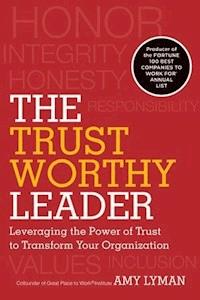
How leaders from the best workplaces build trust in their organizations The Trustworthy Leader reveals the benefits organizations enjoy when trustworthy behavior is practiced consistently by their leaders. Drawing from examples from the Best Companies to Work For, Lyman, cofounder of Great Place to Work Institute, explains that being trustworthy means that leaders' behaviors are rooted in their commitment to the value of trust and not simply in an imitation of the practices of others. She identifies six elements that reflect a leader's trustworthiness: honor, inclusion, engaging followers, sharing information, developing others, and moving through uncertainty to pursue opportunities. * Features leaders from great companies such as REI, Wegman's, R.W. Baird, TDIndustries, and more * Based on more than 20 years of rigorous research into the value of trust in companies large and small and its link to financial and organizational performance * Published to coincide with the release of the FORTUNE 100 Best Companies to Work For 2012 list This book offers a key to developing high levels of trust, a critical endeavor in an age when seemingly every day a story of a leader's lapse in ethical behavior makes headlines.
Sie lesen das E-Book in den Legimi-Apps auf:
Seitenzahl: 358
Veröffentlichungsjahr: 2011
Ähnliche



















Table of Contents
Cover
Praise for The Trustworthy Leader
Title page
Copyright page
DEDICATION
PREFACE
CHAPTER ONE: THE TRUSTWORTHY LEADER
WHAT IT MEANS TO BE TRUSTWORTHY
WHAT IS TRUST?
THE MYTH OF THE SUCCESSFUL LEADER
THE VIRTUOUS CIRCLE
WHAT THE TRUSTWORTHY LEADER LOOKS LIKE
WHAT NEXT: HOW TO USE THIS BOOK
CHAPTER TWO: THE HONOR OF LEADERSHIP
HUMILITY
RECIPROCITY
POSITION AWARENESS
CONTINUING THE CIRCLE
CHAPTER THREE: INCLUSION
GENUINE BELIEF IN THE VALUE OF OTHERS
ACTIVELY SEEKING OTHERS’ IDEAS
SHARING THE BENEFITS
CONTINUING THE CIRCLE
CHAPTER FOUR: VALUING FOLLOWERSHIP
CHOICE
ACCOMPANIMENT
CONNECTION
NOT CONVENTIONAL WISDOM
CONTINUING THE CIRCLE
CHAPTER FIVE: SHARING INFORMATION
PROMOTING UNDERSTANDING
ENHANCING PARTICIPATION
EXTENDING INFLUENCE
CONTINUING THE CIRCLE
CHAPTER SIX: DEVELOPING OTHERS
CREATING FULL LIVES
PURSUING MANY ACCOMPLISHMENTS
PROVIDING A PATH TO FOLLOW
CONTINUING THE CIRCLE
CHAPTER SEVEN: UNCERTAINTY AND OPPORTUNITY
MAYO CLINIC: ADDRESSING RISK
ROBERT W. BAIRD & CO.: UNCOVERING AND DEVELOPING KNOWLEDGE
W. L. GORE & ASSOCIATES: APPLYING WISDOM
CONTINUING THE CIRCLE
CHAPTER EIGHT: HOW IT ALL COMES TOGETHER
THINGS WILL BE DIFFERENT . . .
DAY-TO-DAY CONSISTENCY
DOING WHAT FEELS RIGHT
CREATING YOUR OWN VIRTUOUS CIRCLE
ACKNOWLEDGMENTS
ABOUT THE AUTHOR
Index
Praise for The Trustworthy Leader
“Amy Lyman shows that trust is not something that rare folks just happen to create. Instead, her stories of incredible corporate leaders show how their core commitments run deep and their practices build powerful trust, which in turn generates consistently exceptional results. Lyman offers nothing short of a path to greatness.”
—Daniel Mulhern, Distinguished Practitioner of Business, Haas School of Business, University of California, Berkeley
“Amy Lyman has a wealth of experience and data to show us how to create and maintain trustworthy employee relations, which benefits both employees and the firm’s bottom line. An enlightening read!”
—Doug Kruse, professor, Rutgers University School of Management and Labor Relations
“Amy Lyman gets it! She understands that trust is the heart of creating a successful organization and strong relationships. Need help being the best leader you can be? Start working on the foundation—trust.”
—Elizabeth R. James, vice chairman, CPO, and CIO (retired), Synovus Financial Corp.
“Want to know the lessons of leaders whose companies make the FORTUNE 100 Best Companies to Work For list? Let Amy Lyman include you in her highly readable conversation about their ideas, their companies, their aspirations, and their challenges. These leaders are serious about leading great organizations, and this book brilliantly tells their stories. What a wonderfully learned book!”
—Joseph R. Blasi, J. Robert Beyster Professor, Rutgers University School of Management and Labor Relations
Copyright © 2012 by The Great Place to Work® Institute, Inc. All rights reserved.
Published by Jossey-Bass
A Wiley Imprint
One Montgomery Street, Suite 1200, San Francisco, CA 94104-4594 www.josseybass.com
No part of this publication may be reproduced, stored in a retrieval system, or transmitted in any form or by any means, electronic, mechanical, photocopying, recording, scanning, or otherwise, except as permitted under Section 107 or 108 of the 1976 United States Copyright Act, without either the prior written permission of the publisher, or authorization through payment of the appropriate per-copy fee to the Copyright Clearance Center, Inc., 222 Rosewood Drive, Danvers, MA 01923, 978-750-8400, fax 978-646-8600, or on the Web at www.copyright.com. Requests to the publisher for permission should be addressed to the Permissions Department, John Wiley & Sons, Inc., 111 River Street, Hoboken, NJ 07030, 201-748-6011, fax 201-748-6008, or online at www.wiley.com/go/permissions.
Limit of Liability/Disclaimer of Warranty: While the publisher and author have used their best efforts in preparing this book, they make no representations or warranties with respect to the accuracy or completeness of the contents of this book and specifically disclaim any implied warranties of merchantability or fitness for a particular purpose. No warranty may be created or extended by sales representatives or written sales materials. The advice and strategies contained herein may not be suitable for your situation. You should consult with a professional where appropriate. Neither the publisher nor author shall be liable for any loss of profit or any other commercial damages, including but not limited to special, incidental, consequential, or other damages. Readers should be aware that Internet Web sites offered as citations and/or sources for further information may have changed or disappeared between the time this was written and when it is read.
Jossey-Bass books and products are available through most bookstores. To contact Jossey-Bass directly call our Customer Care Department within the U.S. at 800-956-7739, outside the U.S. at 317-572-3986, or fax 317-572-4002.
Wiley also publishes its books in a variety of electronic formats and by print-on-demand. Some material included with standard print versions of this book may not be included in e-books or in print-on-demand. If the version of this book that you purchased references media such as CD or DVD that was not included in your purchase, you may download this material at http://booksupport.wiley.com. For more information about Wiley products, visit www.wiley.com.
Library of Congress Cataloging-in-Publication Data
Lyman, Amy.
The trustworthy leader : leveraging the power of trust to transform your organization / Amy Lyman.—1st ed.
p. cm.
Includes bibliographical references and index.
ISBN 978-0-470-59628-9 (cloth); ISBN 978-1-118-15765-7 (ebk); ISBN 978-1-118-15766-4 (ebk); ISBN 978-1-118-15767-1 (ebk)
1. Leadership. 2. Management. 3. Trust. 4. Organizational behavior. I. Title.
HD57.7.L94 2012
658.4'092—dc23
2011035622
This book is dedicated to Marc Simon and Simeon Lyman-Levering.
Thank you for all you have given me, for how you have helped me to learn and grow, and always for the trust we share.
PREFACE
I have long been fascinated with leadership and the qualities that distinguish excellent leaders from those who try, yet don’t quite reach those heights. I have worked for a few great leaders—people who inspired and challenged everyone to do more, to try harder, to use our brains and talents. I’ve also worked for leaders who did not measure up.
Although I’d had both successful and not-so-successful examples of leadership on which to reflect, when it was my turn to be in a leadership position, I experienced the role of leader from yet a new perspective. Like many people, I brought personal strengths with me yet I did not see myself as a natural leader. Nor did I have the inclination or perseverance to develop into a great one. My attention was always more drawn to researching the practices of other leaders, observing and assessing people’s responses, analyzing employee survey and focus group data, and sharing my findings. My time in leadership positions became invaluable to my research efforts, as my personal experience affirmed for me many of the challenges leaders face. It also gave me new insights into the skills, talents, and commitments of great leaders.
Over the years, I have worked with many people who have wanted to become successful, Trustworthy Leaders. I have learned that those people who succeed do so because their talents, ability, willingness to learn, and desire to lead propels them to success. I’ve also learned that the most successful leaders exemplify a consistent integrity between their actions and their words. A leader who simply mouths the words yet shows no ability to put them into practice creates a demoralized or disenchanted workforce. Trustworthy Leaders commit themselves to live up to the highest aspirations found in their words.
Although there is more to leadership than this, the central concept of integrity between actions and words drives the success of the Trustworthy Leaders I’ve studied. But how and around what content? What is it that is so singular about these leaders that causes people to choose to follow them? I committed to uncovering the qualities and characteristics of great leaders. I wanted to understand and document their experiences and discover exactly what makes them so special. I did this to satisfy my own curiosity and so that you could learn from these great leaders as well. And that’s how this book was born.
I first began my extensive research on why great leaders are able to create positive outcomes for themselves and their organizations—and on what exactly they do well—by digging deep into the leadership literature. What I found is a mixed bag. Many books and studies focus on how leadership actions lead to the end result of high profits or high status, without uncovering the foundation of leadership that contributes to an organization’s ability to be positive, profitable, and successful. Although a reasonable level of profits is absolutely essential to the successful functioning of any organization, leaders do not “lead” money; they lead people. And it is through great people leadership that organizations succeed and become great themselves.
In a good portion of the leadership literature, great people leadership is not acknowledged as the key to success. Yet there is some research that speaks poignantly to this heart of leadership. These studies and reports identify the unique qualities and characteristics of people who are seen as great leaders, tying those qualities back to the outcomes essential to organizational success. It is this material that provided support for my deepening understanding of the role of trust in leadership success.
The most significant influence on my understanding of leadership, however, did not come from reading books and articles, nor did it come through my own professional experiences with leadership. Rather, my strong views on leadership have come from the more than twenty years I’ve spent working with people in great companies through my work at the Great Place to Work Institute, which I cofounded in 1991 and which today continues to help companies transform their workplace culture.
The Institute is best known for its role in researching and selecting the 100 Best Companies that appear each year in Fortune magazine. A group of international affiliates also produces similar lists for their markets. The Institute’s first work, before the lists came out in Fortune, began with consulting and educational services. People wanted to know how to create great workplaces, and they came to the Institute to find out. And this is where I spent much of my time.
Our Trust Index—the survey that we designed during the early days of the Institute to measure the quality of relationships between employees and their leaders and managers—has provided me with an abundance of data. In 2011 in the United States alone, we received 40,000 responses to the Trust Index from employees in companies that made it onto the Fortune 100 Best Companies to Work For list. Close to 100,000 responses came in from employees in companies that applied to the list but didn’t make it. And over 40,000 more came from employees in companies that made it onto the Institute’s Best Small & Medium Companies to Work For list. I have suffered from no data shortage over the years of my consulting and research work, and I was able to call on this rich information while writing this book.
In addition to analyzing these Trust Index survey results, I also reviewed hundreds of “Culture Audits” for my research. When companies apply for the 100 Best Companies list, they answer a series of closed and open-ended questions about the organization’s demographics, structure, benefits, and guiding philosophy and values. This information makes up the Culture Audit. I have been studying both the Trust Index and Culture Audit data for years, looking at survey response patterns, reading employee comments, examining shifts and long-standing trends, looking for the story all of this information has to tell.
Specifically for this book, I conducted a series of interviews with leaders at many of the companies that have earned a spot on one of the Institute’s Best Companies lists. Although I am a strong believer in the power of combining quantitative and qualitative data to tell a story, in this book I’ve avoided almost completely the numbers, charts, and graphs I often use in my articles and presentations. Though quantitative data is incredibly valuable, and you need to know the numbers to support planning, forecasting, and tracking, numbers alone will not move your organization forward. Currently leaders are inundated with too many numbers and receive too little support for their own personal development of the leadership qualities that will actually help them to lead. What we need now are more overarching theories—based in solid research and backed up with real stories to offer guidance—and more analysis of the actions that work. That’s what I provide in The Trustworthy Leader.
The interviews I conducted with leaders across industries allowed me to explore in detail a number of recurring themes about leadership. They provided me with the heart of what I share with you in the rest of this book. The topics I discussed with the interviewees included the challenges faced by leaders and how each leader’s perspective guided their decision making at critical times. The leaders’ stories echoed the themes that I heard twenty years ago when I first started talking with people about their experiences in great workplaces. Back then, as now, leaders talked about the importance of trust, of acknowledging people, of being supported and supporting others, of seeing people as human beings first and employees second—of being trustworthy.
Putting these interviews together with decades of experience and observation, I am able to state clearly what it is about Trustworthy Leaders that sets them apart and makes them so successful. In The Trustworthy Leader, I share this knowledge with you, so that more and more of you will become Trustworthy Leaders and make a difference in workplaces all around the world.
Amy Lyman
San Francisco, California
October 2011
CHAPTER ONE
THE TRUSTWORTHY LEADER
Some of the more poignant moments in my consulting career have come during discussions with leaders and their “people” person (often a representative from Human Resources) as they seek help motivating employees to take on the next challenge. The difficult part of these discussions comes when leaders ask me how to fit time for people issues into their busy schedules. They then await the golden answer they hope I can provide that will help them to convince staff that they care.
One particularly memorable discussion took place after I had surveyed the employees at a large insurance company about their workplace experience. The CEO, vice president of Human Resources, and I were meeting briefly prior to my presentation of the survey results to the entire senior management team. The VP of HR, sitting to my right, leaned into the conversation and asked me what the CEO, on my left—a very busy man—could do if he had only five minutes each day to devote to people issues.
I was a bit stunned by the question. Five minutes is barely enough time to greet a single employee and ask him how he’s doing, let alone show support for people’s growth and development, convey your vision as a leader, and provide people with a sense of direction. And this company had over ten thousand employees!
I turned to the CEO on my left and addressed him directly. “Leading is a full-time job,” I said. “If you want to be successful as a leader, you need to devote all of your time to people issues. Strategy, product development, customer service, innovation—they all depend on people. Five minutes a day—or even five minutes an hour—is the wrong approach.”
Initially taken aback by my directness, the CEO was now paying attention. He also heard in my response the resolution to a dilemma he experienced. He said he was not comfortable switching on his usual care and concern for people at certain times and then switching it off when he considered strategic decisions, business partnerships, financial opportunities, or marketing proposals. Yet all of his management training, and many of his peers, had encouraged him to do just that—respond to people issues when asked, yet focus his intellectual talents on the mechanics of the specific tasks in front of him.
I reminded him that people were integral to his ability to be successful in every single arena within his organization and that if he did not include consideration of people in every aspect of his work, then he was doing himself and the organization a great disservice.
He paused for a moment, mulling this over before responding. What I had said made sense, yet no one had ever said it so directly. He understood himself and his role as a leader well enough to know that clarity and consistency in actions and words is important for successful leadership. He had also previewed the employee survey report and knew that people had raised concerns about actions they felt were inconsistent with his stated goal of creating a great workplace. The question now was what to do about it.
The answer was both simple and complex: this leader needed to focus on being trustworthy.
WHAT IT MEANS TO BE TRUSTWORTHY
For the past twenty years I have listened to people talk about the importance of trust in their workplace relationships and of the devastating effects of its absence on productivity, job satisfaction, and commitment.
In 1991, I cofounded the Great Place to Work Institute, best known for its role in researching and selecting the “100 Best Companies to Work For” feature that appears each year in Fortune magazine. Prior to the lists in Fortune, the Institute was known for its work promoting the concept that great workplaces could be created by focusing on the development of trust between leaders/managers and employees. A book about the 100 Best Companies was published in 1984,1 and initial financial analysis comparing the performance of the Best Companies to their industry peers showed strong evidence that the 100 Best were better financial performers as well as better workplaces. A related book, A Great Place to Work, published in 1988,2 laid out the analytical framework for creating great workplaces. It is from this book that the initial ideas for the Institute were developed.
People began paying attention to the possibility of creating great workplaces, and the Institute’s work had a ready audience. I spent much of my time developing the consulting and advising services that helped leaders understand why trust is so important to organization success, and also how they themselves could become more trustworthy. Leaders saw that they could become stronger leaders by being trustworthy and could also increase the likelihood of success for their organizations.
During the early years at the Institute, my colleagues and I developed and used an employee survey as our primary data source—a tool designed to ascertain the quality of relationships between employees and their leaders and managers. That survey, now called the Trust Index, is used around the world by the Great Place to Work Institute and international affiliates that produce Best Company lists for their markets. To develop and refine the survey, we used the first-person employee interviews conducted for the original 100 Best Companies to Work For book and the research for A Great Place to Work.
We had the luxury of time to develop the Trust Index, so we were able to study the interview transcripts in great detail. We noted that three elements came up again and again in the words of employees when they described why they trusted their managers and leaders: credibility, respect, and fairness. Therefore, our first goal in developing the survey tool was to accurately capture employees’ perceptions of the credibility of their leaders, the respect with which they felt treated, and their experience of the fairness of workplace policies and practices. To this day, when asked why their workplace is great, employees who have never seen a description of the Great Place to Work model or heard the Institute’s definition of a great workplace—one where “you trust the people you work for, have pride in what you do, and enjoy the people you work with”—speak of the power of trust. And when employees are asked to tell stories about how they experience trust, as they reflect on the behavior of their leaders, the words credible, respectful, and fair come up all the time.
WHAT IS TRUST?
We use the word trust to explain a bond that is created between and among people. Trust is an emotional and a cerebral connection, characterized by an ability to rely on someone to act in ways that will be of benefit to one’s own health and well-being. Trust often comes into play during challenging times, when stress, miscommunication, or poorly conceived actions place a strain on people’s bonds. Trust is what helps people to have faith that they can work through the challenges and arrive at a positive outcome. Trust-based relationships are also deeply enjoyable, as they bring comfort and stability, with the experience of trust providing support to the relationship and contributing to an individual’s sense of security and belonging.
Trust develops through interaction. An interaction can be a conversation between two people, a look that passes between a father and child, or collective hard work among a group of people rebuilding a home. These actions convey a willingness on the part of one person to do something that is of benefit to another’s health and well-being. The more the actions are repeated, the deeper the connection developed, and the greater the likelihood of a long-term trust relationship.
In the workplace, trust can infuse every element of a leader’s actions. Even if a leader isn’t obviously engaging in a trust-building action—if, say, she’s just going down the hallway to refill her coffee cup—her interactions with those she passes en route reflect on her trustworthiness. Does she make eye contact? Say anything? How do the people she acknowledges respond? With a sharp focus on the details, even a minor coffee break can be seen as fertile ground for trust-building.
And a sharp focus is exactly what has been used at the Great Place to Work Institute to study people’s experience of trust in the workplace. Actions that build trust affirm a person’s credibility, convey respect to others, and embody a spirit of fairness in their implementation. Everyone is capable of acting in ways that will lead to the creation of trust. Everyone. When we act in ways that convey our credibility, show respect to others, and affirm a commitment to fairness, we are showing others that we are trustworthy.
As commonsensical as all of this seems, there are still many leaders who struggle to develop trust-based relationships with their employees. Why?
THE MYTH OF THE SUCCESSFUL LEADER
For many years a stereotyped notion has reigned of the successful leader. This leader is portrayed as all-knowing, a bit greedy, a tough decision maker, and consumed with work. These are not generally the characteristics you’d want in a friend, yet these qualities have often been cited—and exaggerated—as prerequisites for business success. In this definition of the successful leader, “success” is equated with making considerable sums of money—for oneself and, ideally, for the company—and often living with the trappings of conspicuous consumption and excessive display. People who follow this leadership model are actually less successful in the eyes of their employees, who see the great distance between themselves and the person leading the enterprise and often feel that the leader’s excesses come at their expense. This mythical leader is also less likely to create an organization that will be successful in the marketplace.
If the only goal of a business leader is to create a financially successful company, then he or she will want to be a Trustworthy Leader. Although Trustworthy Leaders do not choose to be trustworthy for the sole purpose of making more money, it is one of the notable benefits of building trust. My research and that of others confirms this. From 1998 through 2011, the publicly traded 100 Best Companies, as a group and over time, have outperformed the Russell 3000 and S&P 500, posting annualized returns of 11.06 percent versus 4.26 percent and 3.83 percent, respectively.3 The primary factor that gets a company to be selected for the 100 Best Companies list is the level of trust between employees and management. As you’ll see again and again throughout this book, Trustworthy Leaders lead fiscally sound companies, weather economic storms while their contemporaries struggle, attract and keep the best talent, and encourage high levels of innovation and problem solving.
Trustworthy Leaders are so successful because they do see beyond the goal of dollar signs. They understand the complexity of bringing together a group of human beings to pursue extraordinary accomplishments. They are masters at guiding, directing, encouraging, and challenging people to contribute their best, in part because they ask the same of themselves. Trustworthy Leaders know that their relationships with others throughout the organization are key to their success—however success is measured.
Trustworthy Leaders are also independent-minded enough to think for themselves and not just follow the pack. They choose to create their own leadership style and approach—one that is inclusive and respectful rather than one that is selfish and mercenary. At their core, Trustworthy Leaders believe in the inherent value and dignity of people—all people—a belief that influences their choices and guides their actions. Most importantly, they understand that great leadership is a way of being, not something that can be switched on and off.
This new model that I was developing of the Trustworthy Leader—from the five-minute people person, through my deep understanding of the power of trust, to a challenge to the popular myth of leadership success—called for a compelling framework. As I considered what I was learning, I kept going back to the transcripts of my conversations with Trustworthy Leaders. I looked for the pattern in their experiences, the key moments when they understood the power of trust. I pushed myself to understand what had happened to them that set them on the path to being trustworthy. The pattern that emerged, illustrating the shared path of leaders who are widely considered trustworthy, is one in which aspirations are high, consequences are acknowledged, responsibility is accepted, and leaders move forward. I call this path the Virtuous Circle of Trustworthy Leadership.
THE VIRTUOUS CIRCLE
Usually we think of a path as a straight line from one point to another. Yet for most of us, our growth and development never moves forward in a straight line. There are always shifts and changes, times when things seem to speed up and other times when we feel stuck. There are lessons we circle back to even as we move forward. The Trustworthy Leader’s path is similar, always moving forward, yet—as in our own lives—each step that leads to the next is connected to the previous one as well, creating a circular path of growth and learning. And as we complete one circle with some new experience, something to put into practice, we begin again, only stronger. The next round through the Virtuous Circle both reinforces and strengthens the lessons learned from the previous round.
There are six distinct elements in a Trustworthy Leader’s Virtuous Circle that combine to both create and reflect his or her trustworthiness:
HonorInclusionValue and engage followersSharing informationDeveloping othersMovement through uncertainty to pursue opportunitiesEach of these elements both influences how a leader acts and reflects how that person thinks about being a leader. Thinking about what you are doing and the impacts that your actions have on others is a singular requirement of effective, Trustworthy Leadership.
The honor felt by Trustworthy Leaders is continuous and greatly influences their actions. Many of us feel honored when we receive an award or recognition for a special accomplishment or a contribution we’ve made to the good of others. Trustworthy Leaders extend this sense of being honored to their roles as leaders, expressing gratitude for being asked to lead and acknowledging the responsibility that comes with it.
The inclusion of all people in an organization’s community is a hallmark of Trustworthy Leadership. A leader’s active involvement in promoting the inclusion of every person into the larger community of the organization is critical. One of the most important ways that leaders accomplish this is by building bridges of trust that extend beyond the boundaries of individual departments or divisions. This is of great benefit to the enterprise that wants people across the entire organization to work well together.
The ability to value and actively engage followers is a further sign of leadership excellence. Great, Trustworthy Leaders engage those who are following them by paying attention to them and learning from them. They acknowledge people’s choice to follow, seek to support their contributions, and connect with them as people beyond their work roles. They celebrate the leadership of followers who may take on specific projects or create new efforts that open markets or improve existing products and services. Evidence that a leader is trustworthy will come from his or her followers.
Trustworthy Leaders openly share information with people to help them participate in and influence the life of the organization. They invite people into discussions that will support the expansion of the organization’s products and services. These leaders know that employees’ contributions will be magnified to the degree that they have access to useful information.
A leader who is focused on developing others will help employees to learn, grow, and discover their talents. In great organizations with strong trusted leaders, career and professional development programs reach broadly and deeply throughout the organization, providing everyone with a path to travel. Developing people is part of the perspective of Trustworthy Leaders because they think about others more than they think about themselves.
Finally, the success of any organization is dependent on the leader’s ability to move through uncertainty and find opportunities. The skillful weighing of risks and rewards attached to the opportunities available is one of the most important actions that leaders can take on. When employees see their leader act with honor, feel included, choose to follow, have access to information they can use, and are supported in their development, they will support the leader’s efforts to try novel approaches and find the best way forward. They will do this from a place that is deeply embedded in their own values and the values of the organization. This provides Trustworthy Leaders with an incomparable advantage in the marketplace.
Given that these elements of the Virtuous Circle are key to understanding the Trustworthy Leader, we explore all of them in more detail in the following chapters.
WHAT THE TRUSTWORTHY LEADER LOOKS LIKE
You might be surprised to learn who Trustworthy Leaders are, and what they look like—and not because of any unexpected resumé trait, but because their resumés are all so different. They come from varied backgrounds and work in completely disparate industries. Many have the business pedigree you’d expect from a CEO, while others have worked their way up from positions such as security guard, part-time support staff, cashier, or stocking clerk. Still others have left jobs from far afield in order to take leadership positions in great organizations.
For example, Sally Jewell, the president and CEO of Recreational Equipment, Inc. (REI )—which has made the Great Place to Work Institute’s list of 100 Best Companies each year since the list’s inception—is known for her accomplishments, which fit the typical profile of a corporate leader. Yet Jewell completely shatters the profile when you consider her approach to leadership. Jewell is smart, assertive, and a bold decision maker. She is capable of holding detailed discussions not only about finance, retail marketing, and merchandising—which you would expect—but also about oil and gas engineering and banking, two industries with which she was previously associated. What sets Jewell apart, though, is her compassion, ability to listen, her attention to the lives of all employees, her deep understanding of the workings of human beings alone and in groups—and, most importantly, her use of all of this knowledge in her role as CEO. To put it simply, she brings her humanity to the workplace every day.
“There are some nonnegotiables that I’ve always followed,” she says of being a Trustworthy Leader, a designation given to her by her colleagues. “Greet people authentically and say hello. Create a sense of safety for yourself and your team members so that all can work for the common good and shared success. Listen as an ally. Listen, listen, listen, and engage.” She goes on to say, “I am naturally comfortable saying hello to everybody I meet. I make a point of not missing eye contact, and in some way, as long as it doesn’t feel forced, to acknowledge that somebody’s there. Whether or not I know their name, I am not going to walk by as if they don’t exist.”
In Jewell’s case, greeting those she passes by comes naturally. But it doesn’t come naturally to everyone. In fact, many qualities of Trustworthy Leadership may not come naturally to you, but that doesn’t mean they’re out of your reach. “Several of my colleagues just do not see other people,” says Jewell. “They are very focused and targeted on the people they are talking with [and thus can walk by other people without acknowledging them]. This can come across as aloof and dismissive. When that happens, I let them know, ‘It is not optional for you to not say hello to the people you walk by. I know it does not come naturally, but you really need to practice.’ ”
Being visible and accessible and acknowledging employees is vital to Jewell’s view of effective leadership. She puts as much emphasis on the development of a leader’s openness and ability to connect with others as she does on the more traditional leadership skills of public speaking, operations management, or creating new product strategies. If one of the skills Jewell believes to be nonnegotiable isn’t present, she’ll work with the individuals to help them develop it. Honor, inclusion, and developing others are all embedded in this small slice of Jewell’s vision.
Like Jewell, Dan Warmenhoven has a career profile that looks, on the surface, much like that of a prototypical CEO. He is ambitious and driven and has served in many significant leadership roles. Warmenhoven is now chairman of the board of directors at NetApp (the #1 Best Company to Work For in 2009, and #5 in 2011). He was NetApp’s CEO from 2005 to 2009, and before that spent ten years as the company’s president. During his tenure, he steered NetApp along an aggressive course to become one of the leading storage and data management companies in the world. Aside from his traditional business experiences and successes, Warmenhoven describes his Jesuit education—in which, along with standard coursework, he was taught the value of service to others—as having had a considerable impact on his leadership style.
When Warmenhoven first joined NetApp, it was a smaller company with the promise of a great idea—an idea in need of leadership. He took the company public in 1995, and over the next fifteen years he helped to create a culture of openness that fueled innovation and creativity as well as intense employee loyalty to the organization’s mission. At the time of this book’s publication, NetApp is closing in on $4 billion of worldwide revenue; it has roughly 5,500 employees in the United States and more around the world. And many, many people want to work there.
At an all-company meeting I attended in 2007, Warmenhoven spoke about the challenges the company was facing. He began by speaking broadly about what he was going to share—information about the company’s financial performance, strategic initiatives, and competitive position—and then proceeded to emphasize the importance of trust. He reminded people that sharing information was key to ensuring that all the people in the company were well-informed and able to contribute their best to their shared success. He talked about the valuable and confidential nature of the information he was about to share, and the importance of everyone trusting each other and knowing that people would keep this information in-house. He specifically noted that the sharing of this type of information was a sign of the confidence that NetApp’s leaders had in all the employees, of their importance to the enterprise, and of the faith that leaders had in employees’ ability to use the information wisely. And then he shared, calling out people and departments and their roles. Honor, inclusion, sharing information, and balancing uncertainty and opportunity are the Virtuous Circle qualities most evident in this anecdote about Warmenhoven.
Jewell and Warmenhoven embody what a Trustworthy Leader can do. I also want to share a story that demonstrates how a leader’s mastery of the Virtuous Circle can permeate an entire organization, making the whole enterprise stronger.
Griffin Hospital, a community-based hospital in Derby, Connecticut, has been recognized for years as a great workplace with a high-trust culture. As part of their efforts to always improve, the hospital conducts regular patient satisfaction surveys. In 2008, a survey revealed that a number of patients felt discomfort when they had blood drawn. So Griffin put plans in place to hire an external trainer to retrain all bedside staff in phlebotomy procedures. Griffin leaders shared this training plan with staff at a regular weekly staff meeting. When Tracy Huneke, an emergency room technician, heard the news, she raised her hand and said that she was qualified to teach phlebotomy.
The very next day, Huneke met with Barb Stumpo, vice president of Patient Care Services, to talk about how she could lead the phlebotomy training efforts at Griffin. As Stumpo describes it, Tracy Huneke was a hidden gem; she was doing an excellent job in the emergency room, yet she clearly had much more to offer at Griffin. After Huneke’s initial meeting with Stumpo, she began to develop curricular materials for training—and retraining—all bedside staff on phlebotomy procedures. Within one year, everyone had been retrained, and phlebotomy-related complaints were down to zero. Yet Huneke didn’t stop there.
“She had a vision,” Stumpo said. “She wanted to open a school where we could offer courses on phlebotomy and also branch out into other allied health professions. We put together a business plan and contacted the State of Connecticut. We were authorized at the end of August 2009 through the State of Connecticut Department of Higher Education, and shortly thereafter we began a twelve-week phlebotomy course open to the community. We have thirty-one students who are enrolled in both the day and evening program.”
Huneke describes it: “I took it upon myself to launch this initiative and went forward with it. I worked on the plans for about a year and a half, completed the state application, and worked to get everything signed and approved. I couldn’t be happier [with the results]. We’re having fun, learning, and things are all coming together. We’ve received four grants for some simulation equipment [to expand the school’s offerings], and I don’t plan on stopping. It’s been great.”
This story demonstrates the real business benefits of the Virtuous Circle. Huneke spoke up, her clinical director listened, the director had easy access to senior leaders at Griffin (who practice open-door management), and the very next day the process started moving at warp speed. Huneke had a vision of ways in which she could contribute to the betterment of Griffin and to patients, her community, and her own future. Griffin’s culture of openness and support—made possible by Trustworthy Leadership—created an environment in which she was comfortable offering both her current skills and her aspirations.
Leaders at Griffin have always encouraged professional development, and the practice of developing others is a strong part of their Virtuous Circle. Without Trustworthy Leadership, the sharing of information that led to Huneke’s learning about the phlebotomy training would not have happened. Griffin’s strong commitment to the practice of inclusion helped Huneke feel comfortable about speaking up and volunteering to run the training, and a successful new business venture—being managed by an up-and-coming Trustworthy Leader—is now a reality.
WHAT NEXT: HOW TO USE THIS BOOK
If any of the examples of trustworthy behavior that I share with you in the pages that follow seem out of reach, rest assured that they are not. Trust is built over time, not overnight, and it takes a deep understanding of yourself and your values to develop successful trust-based relationships. As you come to understand the roots of trust, you will find that you have a rich source of lessons and experiences to learn from in your own life.
In addition to identifying the actions and values that contribute to the development of trust at a fundamental level, I want the stories in this book to inspire you. Great leaders come in many packages. The profiles of leaders you will see in this book are designed to show you how ordinary people have built extraordinary trust-based relationships throughout their work lives—and, as a result, extraordinary companies. To this end, I share stories about how these leaders came to understand the power of being trustworthy—what experiences and insights guided them, how they deepened their understanding of human nature, and how they have been able to take action in different ways, large and small, to create trust-based relationships. And I document how these leaders believe that being trustworthy contributes directly to the success of their organizations.
Through the stories of these Trustworthy Leaders, I want to show you a path. This path involves taking your own unique experiences, plus your positive beliefs about the inherent value of people, and combining them into a commitment to take action. Once you do, you will create strong, positive relationships throughout your organization that will support success and achievements at a level not possible without the presence of trust.
Notes
1. R. Levering, M. Moskowitz, and M. Katz, The 100 Best Companies to Work for in America (Reading, MA: Addison-Wesley, 1984).
2. R. Levering, A Great Place to Work: What Makes Some Employers So Good (and Most So Bad) (New York: Random House, 1988).
3. Russell Investment Group, Stock-Market Performance of Fortune “Best 100 Companies to Work for in America,” January 2011, http://www.greatplacetowork.com/what_we_believe/graphs.php.
CHAPTER TWO
THE HONOR OF LEADERSHIP




