


22,99 €
Mehr erfahren.
- Herausgeber: John Wiley & Sons
- Kategorie: Fachliteratur
- Serie: Wiley CIO
- Sprache: Englisch
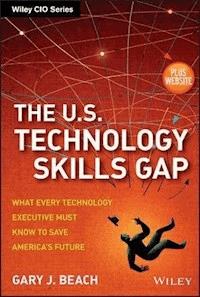
Is a widening "skills gap" in science and matheducation threatening America's future? That is the seminalquestion addressed in The U.S. Technology Skills Gap, acomprehensive 104-year review of math and science education inAmerica. Some claim this "skills gap" is"equivalent to a permanent national recession" whileothers cite how the gap threatens America's future economic,workforce employability and national security. This much is sure: America's math and science skills gapis, or should be, an issue of concern for every business andinformation technology executive in the United States and TheU.S Technology Skills Gap is the how-to-get involved guidebookfor those executives laying out in a compelling chronologicformat: * The history of the science and math skills gap in America * Explanation of why decades of astute warnings were ignored * Inspiring examples of private company efforts to supplementpublic education * A pragmatic 10-step action plan designed to solve theproblem * And a tantalizing theory of an obscure Japanese physicist thatsuggests America's days as the global scientific leader arenumbered Engaging and indispensable, The U.S. Technology SkillsGap is essential reading for those eager to see America remaina relevant global power in innovation and invention in the yearsahead.
Sie lesen das E-Book in den Legimi-Apps auf:
Seitenzahl: 537
Veröffentlichungsjahr: 2013
Ähnliche



















Contents
Cover
Series
Title Page
Copyright
Dedication
CIOs Speak
Preface
Notes
Acknowledgments
Note
Part One: How Did We Get Here?
Chapter 1: 1941: The Subject We Love to Hate
Math? Not for Me!
“Minimize the Effect of Schooling”
Young Adults with IQs of Eight-Year-Olds
The Fall Continues
President Roosevelt Understands Science
An Opportunity Lost
Americans Still Hate Math and Science
Notes
Chapter 2: 1945: Operation Paperclip
Nazis Hailed as “Outstanding” Scientists
Germany's Rocket Man
The Nazis Get to von Braun
Time Magazine Paints a Dim Picture of von Braun
America's Best Rocket: The Bazooka
Shipped to America
America Had Space Technology before the Soviets
Germany Developed the Atomic Bomb First
Notes
Chapter 3: 1950: Deming Says
Deming Has an Idea
The Lecture Series That Changed the Balance of the World Economy
Japan Embraces, America Ignores
Datsuns Arrive in Los Angeles
American Business Leaders Finally Listen
Lessons from Deming
Can Total Quality Management Fix the American Education System?
Notes
Chapter 4: 1952: Boomerang
What It Means to Teach
A Teacher Shortage Exacerbates the Educational Challenges
Another Problem: Crumbling Infrastructure
Media Critiques Begin
Back in the USSR
Boomers Perform Poorly on SATs
Connecting the Dots
The Boomerang Theory
Notes
Chapter 5: 1962: Too Hard to Follow
The Rationale for the Lunar Landing
Kennedy in His Own Words
“It's Just So Darn Hard”
Students: Math and Science Are Irrelevant
Culture Counts
Industry Leaders Offer Advice
Do Something about It
American Students Not Measuring Up
The Results, Please
How to Do Something
High School Seniors: No, Thank You
Perception Is Reality: The Importance of the Guidance Counselor
The STEM Pipeline Shrinks More in Higher Education
Putting Words in the President's Mouth
Notes
Chapter 6: 1962: Empires of the Mind
Did You Know?
The Shift Is On
The Components of Yuasa's Phenomenon
Fast-Forward
Yuasa's Phenomenon Arrives in America in 1920
Youth Rules
Look to the East?
Three Patents to the Win
America's Innovation Ecosystem at Risk
Does It Work for You?
The World in 2050
Slip Sliding Away?
Survival Is Not Compulsory
Notes
Chapter 7: 1963: SAT Down
The History of the SAT
Asleep at the Wheel for 14 Years
The College Entrance Examination Board Responds
More Competition for the SAT
Why the SAT Scores Dropped
How to Get 100 More SAT Points
Too Much Mediocrity
Notes
Chapter 8: 1976: Too Many Chiefs
A Tale of Two Documents
Keep It Local
The Great Society Era Ushers in Federal Involvement
ESEA: Not All Things Considered
Teacher Unions Create the U.S. Department of Education
Did I Really Promise That?
President Carter's Top 10 List
Eight Years Is Too Short
Reagan Shifts from Compliance to Competency
Bush Sets Voluntary Education Goals
Other Issues Get in the Way
Clinton Unsuccessfully Shifts Education Goals from Voluntary to Compulsory
No Child Left Behind Ushers in Compulsory Education Compliance
Obama Is Stymied by Gridlocked Washington
Close Down the U.S. Department of Education
Notes
Part Two: And the Hits Just Keep on Coming
Can You Hear Me Now?
Road Trip
The Eighth-Grade Focus
Connect the Dots
It Takes a Village That Cares
The Warning System Works
Notes
Chapter 9: The Skills Gap Warnings Begin
1964: The First International Mathematics Study
1971: The First International Science Study
1971: The National Education Trust Fund
1978: The Nation's Report Card
1982: The Second International Mathematics Study
1983: A Nation at Risk
1985: Global Competition: The New Reality
1985: Corporate Classrooms: The Learning Business
1986: A Nation Prepared: Teachers for the 21st Century
1987: Workforce 2000: Work and Workers for the Twenty-first Century
1987: The National Science Foundation Annual Report Introduces STEM
1987: The Fourth R: Workforce Readiness, a Guide to Business Education Partnerships
1989: Winning the Brain Race: A Bold Plan to Make Our Schools Competitive
Notes
Chapter 10: The Skills Gap Emerges
1990: America's Choice: High Skills or Low Wages!
1990: The Second International Science Study
1990: The National Assessment of Educational Progress
1993: John Sculley: “America Is Resource Poor”
1995: The Third International Mathematics and Science Study
Different Measurement, Improved Ranking
1996: The National Assessment of Educational Progress
1999: New World Coming: American Security in the 21st Century
Notes
Chapter 11: The Skills Gap Widens
2000: Ensuring a Strong U.S. Scientific, Technical, and Engineering Workforce in the 21st Century
2000: Before It's Too Late
2000: The Programme for International Student Assessment
2000: The National Assessment of Educational Progress Test
2002: Unraveling the Teacher Shortage Problem: Teacher Retention Is the Key
2003: Building a Nation of Learners
2004: Sustaining the Nation's Innovation Ecosystem
2005: Losing the Competitive Advantage: The Challenge for Science and Technology in America
2005: The Knowledge Economy: Is the United States Losing Its Competitive Edge?
2005: The World Is Flat: A Brief History of the Twenty-first Century
2005: Rising above the Gathering Storm: Energizing and Employing America for a Brighter Economic Future
2005: The National Assessment of Educational Progress
2006: Teachers and the Uncertain American Future
2006: The Quiet Crisis: Falling Short in Producing American Scientific and Technical Talent
2007: We Are Still Losing Our Competitive Advantage: Now Is the Time to Act
2007: How the World's Best-Performing School Systems Come Out on Top
2007: Into the Eye of the Storm: Assessing the Evidence on Science and Engineering Education, Quality, and Workforce Demand
2007: Tough Choices or Tough Times
2007: The Role of Education Quality in Economic Growth
2008: Foundations for Success: The Final Report of the National Mathematics Advisory Panel
2008: “Lessons from 40 Years of Education Reform”
2009: Rising Tigers, Sleeping Giant: Asian Nations Set to Dominate the Clean Energy Race by Out-Investing the United States
2009: The CIO Executive Council's Youth and Technology Careers Survey
2009: The Economic Impact of the Achievement Gap in America's Schools
2009: The Widget Effect: Our National Failure to Acknowledge and Act on Differences in Teacher Effectiveness
2009: Steady As She Goes? Three Generations of Students through the Science and Engineering Pipeline
Notes
Chapter 12: The Consequences of the Skills Gap Become Apparent
2010: Rising above the Gathering Storm Revisited: Rapidly Approaching Category 5
2010: Why So Few Women in Science, Technology, Engineering, and Mathematics?
2010: Waiting for Superman
2010: Education Next’s Public Perception of Education Survey
2010: Interview with Craig Barrett
2010: Closing the Talent Gap: Attracting and Retaining Top-Third Graduates to Careers in Teaching
2011: The National Assessment of Educational Progress
2011: The Intel Corporation’s Survey of Teens’ Perceptions of Engineering
2011: Globally Challenged: Are U.S. Students Ready to Compete?
2012: How Well Are American Students Learning?
2012: U.S. Education Reform and National Security
2012: Prosperity at Risk: Findings of Harvard Business School’s Survey on U.S. Competitiveness
2012: The World Economic Forum’s Annual Global Competitiveness Report
2012: Where Will All the STEM Talent Come From?
2012: SAT and ACT Scores Reveal Disappointing News
2012: Five Misconceptions about Teaching Math and Science: American Education Has Not Declined, and Other Surprising Truths
The Long and Winding Road
Notes
Part Three: Let’s Build Some Arks
Notes
Chapter 13: Patchworking the Tech Skills Gap Begins
1965: Skills USA
1968: The Xerox Science Consultant Program
1989: Women in Technology International
1990: Teach for America
1994: Tech Corps
1995: NetDay
1996: SAS Curriculum Pathways
1997: The Cisco Networking Academy
1998: I.C.Stars
1998: Intel Teach
Notes
Chapter 14: The Pace of Remediation Work on the National Skills Gap Accelerates
2000: Year Up
2000: The Juniper Networks Foundation Fund
2002: Technology Goddesses
2002: nPower
2003: The Microsoft Imagine Cup
2004: Engineering Is Elementary
2004: The Junior FIRST Lego League
2005: Raytheon’s MathMovesU
2005: IBM’s Transition to Teaching
2006: The Khan Academy
2006: Cognizant’s Maker Faire
2007: The National Math and Science Initiative
2008: AT&T Aspire
2008: AMD’s Changing the Game
2009: Microsoft’s TEALS
2009: The Salesforce.com Foundation
2009: DIGITS
2009: Change the Equation
Notes
Chapter 15: The Pace of Ark Building Quickens
2010: The Broadcom MASTERS
2011: CA Technologies and the Sesame Workshop
2011: IBM’s P-TECH
2012: Udacity
2012: CA Technologies: Tech Girls Rock
2012: Microsoft’s Teach.org
2012: The Dell Education Challenge
2012: The Girl Scouts of America’s Generation STEM: What Girls Say about Science, Technology, Engineering, and Math
News Alert: More Arks Needed!
Notes
Epilogue: For What It’s Worth
The Top 10 Recommendations for Action
Closing Time
About The Author
About the Website
Index
Founded in 1807, John Wiley & Sons is the oldest independent publishing company in the United States. With offices in North America, Europe, Asia, and Australia, Wiley is globally committed to developing and marketing print and electronic products and services for our customers’ professional and personal knowledge and understanding.
The Wiley CIO series provides information, tools, and insights to IT executives and managers. The products in this series cover a wide range of topics that supply strategic and implementation guidance on the latest technology trends, leadership, and emerging best practices.
Titles in the Wiley CIO series include:
Cover image: © Mick Wiggins/Alamy Cover design: Michael Rutkowski
Copyright © 2013 by John Wiley & Sons, Inc. All rights reserved.
Published by John Wiley & Sons, Inc., Hoboken, New Jersey. Published simultaneously in Canada.
No part of this publication may be reproduced, stored in a retrieval system, or transmitted in any form or by any means, electronic, mechanical, photocopying, recording, scanning, or otherwise, except as permitted under Section 107 or 108 of the 1976 United States Copyright Act, without either the prior written permission of the Publisher, or authorization through payment of the appropriate per-copy fee to the Copyright Clearance Center, Inc., 222 Rosewood Drive, Danvers, MA 01923, (978) 750-8400, fax (978) 646-8600, or on the Web at www.copyright.com. Requests to the Publisher for permission should be addressed to the Permissions Department, John Wiley & Sons, Inc., 111 River Street, Hoboken, NJ 07030, (201) 748-6011, fax (201) 748-6008, or online at http://www.wiley.com/go/permissions.
Limit of Liability/Disclaimer of Warranty: While the publisher and author have used their best efforts in preparing this book, they make no representations or warranties with respect to the accuracy or completeness of the contents of this book and specifically disclaim any implied warranties of merchantability or fitness for a particular purpose. No warranty may be created or extended by sales representatives or written sales materials. The advice and strategies contained herein may not be suitable for your situation. You should consult with a professional where appropriate. Neither the publisher nor author shall be liable for any loss of profit or any other commercial damages, including but not limited to special, incidental, consequential, or other damages.
For general information on our other products and services or for technical support, please contact our Customer Care Department within the United States at (800) 762-2974, outside the United States at (317) 572-3993 or fax (317) 572-4002.
Wiley publishes in a variety of print and electronic formats and by print-on-demand. Some material included with standard print versions of this book may not be included in e-books or in print-on-demand. If this book refers to media such as a CD or DVD that is not included in the version you purchased, you may download this material at http://booksupport.wiley.com. For more information about Wiley products, visit www.wiley.com.
Library of Congress Cataloging-in-Publication Data:Beach, Gary J., 1950– The U.S. technology skills gap : what every technology executive must know to save America’s future / Gary J. Beach. pages cm. — (CIO series) Includes bibliographical references and index. ISBN 978-1-118-47799-1 (cloth); ISBN 978-1-118-66044-7 (ebk.); ISBN 978-1-118-66047-8 (ebk.); ISBN 978-1-118-68070-4 (o-book); ISBN 978-1-118-79232-2 (custom) 1. High technology industries—United States. 2. Labor supply—United States. 3. Skilled labor—United States. 4. Vocational qualifications—United States. 5. Information technology—United States. 6. Science—Study and teaching—United States. I. Title. HC110.H53.B43 2013 338’.0640973—dc23 2013007117
To the 49,266,000 schoolchildren in America’s public schools and their futures.
CIOs SPEAK
Most books have forewords authored by one individual who often explains his, or her, passion for the topic covered by the book. For this book I decided to go a different route and invited 16 chief information officers to share their opinions about the importance of the skills gap challenge facing our nation. Their statements follow.
• • •
“Unless we build a stronger curriculum in science, technology, and math and raise our expectations for K–12 education, we will foster a generation of tech-savvy users with few skills to build or innovate technology. The results will be detrimental to our country and our potential ability to compete in the global digital economy.”
Adriana Karaboutis, Vice President and Global CIO, Dell Inc.
“Success in IT requires a mastery of the fundamentals underpinned by strong ‘C’ skills: critical thinking, collaboration, and communication. Our best people apply critical thinking to determine how emerging technologies can be harnessed to deliver value for clients, ever mindful of changing marketplace and business requirements.”
Frank B. Modruson, CIO, Accenture
“America has a rich tradition of making things. The increasing technical sophistication of the world, combined with historically low numbers of science, technology, engineering, and math (STEM) graduates, at best fails to honor that history. And at worst it threatens to severely limit America’s future.”
Ralph Loura, CIO, Clorox Company
“In the past few years I have hired many deeply technical people. The vast majority of résumés for my most technical jobs come from graduates of colleges in India and China. It is clear to me that we are not preparing American students with the skills that high-tech employers deem necessary.”
John Halamka, CIO, Beth Israel Deaconess Medical Center, and Professor, Harvard Medical School
“When I talk to high school and college students, I find that the connection of the skills learned in math and science to the skills used in work and life is missing. Educators need to make this connection. How does a lab in science relate to work and life? How does calculus relate? The lack of these connections is a serious gap in our education system.”
Nancy Newkirk, CIO, International Data Group
“Information technology plays a pervasive and critical role in driving business capabilities and enabling corporate strategies. In order for American industry to sustain its renowned capacity to innovate, it must have a workforce equipped to develop and apply future generations of advanced information technologies.”
James Nanton, Senior VP and CIO, Hanesbrands Inc.
“The American educational system has lost touch with the reality of providing people with the practical skills and competencies required for young professionals to add meaningful value to our corporations. America needs to rethink how we prepare young people to have meaningful careers that are both financially and intellectually rewarding.”
Larry Bonfante, CIO, U.S. Tennis Association
“One of the most difficult roles I have as a chief information officer is finding and recruiting talent. In a growing business, with average turnover rates, I run at a constant talent deficit because I cannot find people with the skills I need to fill the job openings I have. If the American education system cannot produce a workforce with the appropriate skills, then these jobs will be filled by global providers. The need to focus on creating career-ready individuals is not an educational imperative. It is an economic imperative.”
Gary King, Executive VP and CIO, Chico’s Inc.
“The K–12 years are critical foundational years that ‘plant the seed’ for a desire to learn, to teach vital study and research habits, to develop skill sets, and to discover areas of interest and proclivity. These are pivotal years that work to shape the whole person. The K–12 educational phase is also the ideal period to generate interest in and a desire and passion for technology. Sadly, more and more of our underserved demographic groups are participating as consumers of technology rather than as developers or innovators of such.”
Gina C. Tomlinson, CTO, City and County of San Francisco
“I became astutely aware that America had a problem communicating and getting children interested in technology based on an experience I had with my middle school–age daughter, who told me one day, ‘Dad, I am terrible in technology.’ The first thing I told her, partly kidding, was not to say that in public too loudly, because that would not look good for Dad, since his job is heading a technology group! But it illustrated a problem our country has: most children are not being exposed to the possibilities of technology; to how the field could be interesting, challenging, and a great job opportunity for them; and to the fact that they should not have any fears about being able to utilize technology in many ways, since they already use it far more than they comprehend.”
Michael Gabriel, Executive VP and CIO, Home Box Office
“The historical position of the United States as a global technology innovator has brought us prosperity and growth. These effects will dry up quickly, however, if our country does not produce a steady supply of thinking leaders who are able to compete in the global technology marketplace. As our world shifts more and more from atoms to bits as the currency of economic growth, America will be left behind if we are not able to compete as global innovators. As a result, we will soon find ourselves handing our global economic leadership over to a new set of leaders and, along with it, our ability to determine our own future and control our own destiny. The United States must make profound, wholesale changes to our education system in a way that emphasizes science, technology, engineering, and math (STEM) and encourages and motivates students to excel in these critical areas. If we fail to do so, we will lose our global competitiveness.”
Steve Mills, CIO, Rackspace Hosting Inc.
“‘Survival of the fittest’ has shaped the evolution of our species for hundreds, thousands, even millions of years. In the twenty-first-century business context, the fittest are those with the ability to think critically, solve problems, innovate, and collaborate effectively with one another. If we fail to equip our children with these skills through significant enhancements to our education systems, how will they ever survive?”
Bill Schlough, Senior VP and CIO, San Francisco Giants
“I highly encourage and support the preservation of a technologically strong America through education. An influx of human talent into the science, technology, engineering, and math fields is necessary to accelerate the innovation that will ultimately change companies, people, and society for the better.”
Thaddeus Arroyo, CIO, AT&T
“The shortage of qualified resources in the technology and engineering sector has weakened the job market and the talent pool of the American workforce. As a CIO, I have a much tougher time finding qualified candidates today compared to 20 years ago. This shortage of qualified staff is forcing businesses to outsource more work to developing markets.”
Atti Riazi, CIO, New York City Housing Authority
“The United States has a storied history of invention and innovation that fueled its twentieth-century journey to become a global economic and military power. Working at a federal government research and development center for 35 years, I have become more sensitive to the importance of technical innovation, particularly information technology, to the security of our country. But today we find ourselves losing ground to competing countries in science, technology, engineering, and math education, and with it our technology leadership. These are trends we must reverse. It is truly a matter of national security.”
Gerald R. Johnson, former CIO, Pacific Northwest National Laboratory
“Not that long ago, America’s system of education was considered the world’s incubator of innovation, but sadly we have lost our dominance in this area. Fortunately for America, we can correct our course, but it will require cooperation from parents, faculty, industry, government, and students. If we fail to do so, the American Dream will regrettably remain a Dream Deferred.”
Tony Coba, Senior VP and CIO, Miami Heat
PREFACE
These educational gaps impose on the United States the economic equivalent of a permanent national recession.
—MCKINSEY & COMPANY1
In a country that spends $583 billion each year on public education, the taxpayer deserves a better return on investment.2 For nearly two decades, America’s fourth-, eighth-, and twelfth-grade students have performed poorly in math and science compared to their peers in other countries. Over a slightly longer time frame, as our country’s education policy shifted to accountability under President George H. W. Bush, the results in domestic math and science assessment tests have been worse: SAT scores for math have stagnated since the 1980s, and verbal scores are now the worst on record for the SAT.
I have no “street cred” as an educator, although I did teach theology to high school freshmen in my first job out of college in 1972. But 30 years of conversations with information technology (IT) executives does afford me a small soapbox to step up on and broadcast loud and clear an escalating point of pain they shared with me: America’s schools are not producing individuals with the strong quantitative and communicative skills necessary to compete in the twenty-first-century global economy.
The skills landscape has changed significantly in America over the past 173 years. In 1840, 79 percent of the American labor force worked in the agricultural and manufacturing sectors.3 Only 21 percent were employed in service jobs. By 2010, the composition did a near-complete reversal, with 88 percent of American jobs in services and 12 percent in agriculture and manufacturing.4 Critics of the American school system claim that what, and how, we teach schoolchildren is largely based on the 1840 percentages. And a 2012 McKinsey and Company report flatly states that “a skills shortage is a leading reason for entry level vacancies that cause significant problems [for American firms] in terms of cost, quality, time, . . . or worse.” The Computing Technology Industry Association reported in 2012 that a whopping 93 percent of employers indicated that there is an overall skills gap.
Lesen Sie weiter in der vollständigen Ausgabe!
Lesen Sie weiter in der vollständigen Ausgabe!
Lesen Sie weiter in der vollständigen Ausgabe!
Lesen Sie weiter in der vollständigen Ausgabe!
Lesen Sie weiter in der vollständigen Ausgabe!
Lesen Sie weiter in der vollständigen Ausgabe!
Lesen Sie weiter in der vollständigen Ausgabe!
Lesen Sie weiter in der vollständigen Ausgabe!
Lesen Sie weiter in der vollständigen Ausgabe!
Lesen Sie weiter in der vollständigen Ausgabe!
Lesen Sie weiter in der vollständigen Ausgabe!
Lesen Sie weiter in der vollständigen Ausgabe!
Lesen Sie weiter in der vollständigen Ausgabe!
Lesen Sie weiter in der vollständigen Ausgabe!
Lesen Sie weiter in der vollständigen Ausgabe!
Lesen Sie weiter in der vollständigen Ausgabe!
Lesen Sie weiter in der vollständigen Ausgabe!
Lesen Sie weiter in der vollständigen Ausgabe!
Lesen Sie weiter in der vollständigen Ausgabe!
Lesen Sie weiter in der vollständigen Ausgabe!
Lesen Sie weiter in der vollständigen Ausgabe!
Lesen Sie weiter in der vollständigen Ausgabe!
Lesen Sie weiter in der vollständigen Ausgabe!




