


7,68 €
Mehr erfahren.
- Herausgeber: Faber Music Limited
- Kategorie: Geisteswissenschaft
- Sprache: Englisch
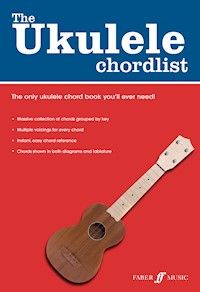
The Ukulele Chordlist is the essential chord book for ukulele players of every level, and the perfect companion to Faber Music's best-selling Ukulele Playlist series. Contains: - A massive collection of chords grouped by key - Multiple voicings for every chord - Instant, easy chord reference - Chord shapes suitable for every style of music - Easy to read diagrams in a variety of fret positions - Handy chord sequence suggestions - Moveable chord shapes
Das E-Book können Sie in Legimi-Apps oder einer beliebigen App lesen, die das folgende Format unterstützen:
Veröffentlichungsjahr: 2017
Ähnliche




















The
chordlist
Ukulele
FretDiagram
MoveableChords
12-BarBlues
© 2011 by Faber Music Ltd
First published by Faber Music Ltd in 2011
Bloomsbury House 74–77 Great Russell Street London WC1B 3DA
Written by Alex Davis
Designed by Lydia Merrills-Ashcroft
Photography by Ben Turner
Printed in England by Caligraving Ltd
All rights reserved
ISBN10: 0-571-53605-0
EAN13: 978-0-571-53605-4
Reproducing this music in any form is illegal and forbidden by theCopyright, Designs and Patents Act, 1988
To buy Faber Music publications or to find out about the full rangeof titles available, please contact your local music retailer orFaber Music sales enquiries:
Faber Music Ltd, Burnt Mill, Elizabeth Way,Harlow, CM20 2HX EnglandTel: +44(0)1279 82 89 82Fax: +44(0)1279 82 89 [email protected]
History of the Ukulele
Whatever point of view you take, one thing you can’t ignore about the Ukulele is that it’s fun.
It originally comes from Hawaii which is, after all, a pretty fun place. To be even more exact
it arrived in Honolulu aboard a ship called the Ravenscrag, carrying 419 Portuguese
immigrants from the island of Madeira to work in the sugar cane fields, on the afternoon of
August 23, 1879. To alleviate boredom during the long Atlantic sea journey these
newcomers had brought with them a few small, four stringed, fretted instruments known as
a Machete de Braga (sometimes known as a Machete or Braguinha, a smaller but similar
instrument to the modern Cavaquinho) which immediately captured the imagination and
hearts of the native Hawaiians – not least of all their King Kalakaua who ended up
incorporating Ukulele performances into Royal gatherings! His successor, Queen Lili’uokalani,
believed that the word ‘Ukulele’ meant “the gift that came here” from the Hawaiian words
uku (gift or reward) and lele (to come), although there are many other theories.
Three of the newcomers had been cabinet makers back in Maderira and had no difficulty
in transferring their skills to Ukulele manufacture by the mid -1880s. Things must have gone
crazy from that point – by the time Hawaii had joined the United States in 1900 the Ukulele
was by far and away the island’s most popular instrument. The Hawaiian exhibit at the
Panama-Pacific International Exposition of 1915 did much to open American eyes to this
island of sunshine and Ukuleles, and it didn’t take long for Hollywood studios and Tin Pan Alley
songwriters to start using the instrument in films and songs. Stars such as Cliff Edwards in the
US and George Formby in the UK helped popularise the Ukulele beyond even the guitar,
(sheet music from the ’20s and ’30s generally features Uke chords!), and mainstream
instrument manufacturers such as Martin and Gibson were knocking out thousands of them.
The Ukulele has had its ups and downs since then – the Great Depression saw a fall in
popularity, followed by renewed interest after the 2nd World War, helped by Maccaferri’s
manufacture of cheap plastic Ukes, television performances by Arthur Godfrey and the
memorable recordings of Tiny Tim. Things tailed off again by the end of the ’60s – rock’n’roll
had placed the guitar at the forefront of the popular musician’s arsenal and the
social/political unrest surrounding things like the Vietnam war didn’t really go hand-in-hand
with the cheerful sound of the Uke. Things changed yet again in the ’90s with all kinds of
musicians around the world bringing the instrument back into the public eye (ranging from
traditional Hawaiian artists like Israel Kamakawiwo’ole to the Ukulele Orchestra Of Great
Britain, not to mention a good few Indie bands), many new manufacturers bringing out Ukes
at prices to suit everyone, and the likes of George Harrison and Paul McCartney singing the
praises of the Ukulele to us all.
Tuning
The standard Ukulele string tuning is G–C–E–A,shown here on the treble stave and pianokeyboard. Note that the G string is tuned higherthan the C string.
You can tune your Ukulele using a piano orkeyboard (or any other instrument that youknow is in tune!) or by using an electronicchromatic tuner.
If just one string on your Ukulele is in tune thenyou can use it to tune the other strings as well.
This diagram shows which fretted notes matchthe note of the open string above. Eg. Pluckthe first string at the 5th fret and match thenote to the second open string, and so on.
(Sounds anoctave higher)
Reading Chord Boxes
A chord box is basically a diagram of how a chord is played on the neck of the Ukulele. Itshows you which string to play, where to put your fingers and whereabouts on the neck thechord is played.
This tells youto play thestring “open”(not fretted at all)
This tells younot to playthe string at all
The thick black lineindicates the “nut” atthe top of the Ukulele.
Dots show where yourfingers go
Vertical linesindicates stringsG–C–E–A fromleft to right
Horizontal linesindicate frets
The chord nameis shown abovethe chord box
This shows you whichfret the chord starts on(if played further up theneck fromthe nut)
This indicates a“barre” – lie your firstfinger across thesenotes to play thischord.
C chords
6
C chords
7




