


22,99 €
Mehr erfahren.
- Herausgeber: John Wiley & Sons
- Kategorie: Fachliteratur
- Sprache: Englisch
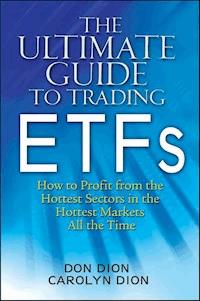
An essential guide to trading trends with ETFs At any given time, a particular country's market or a particular segment of the market-such as energy or technology-might be booming. The Ultimate Guide To Trading ETFs provides a time-tested strategy for using exchange-traded funds (ETFs) to profit from these trending markets and sectors. By monitoring the performance of ETFs, authors Don Dion and Carolyn Dion show how to capitalize on these fast-moving, ever-changing trends. He then discusses how to stay ahead of the curve by identifying markets and sectors that are gathering momentum and monitoring those markets for signs that the momentum is losing steam. Dion also explains how you can build a balanced portfolio of ETFs and manage your allocations to profit from the shifting trends. * Provides advice for both aggressive investors who are willing to utilize leveraged and short market ETFs, as well as more conservative investors who want to limit risk * Highlights a wide variety of ETFs currently available to investors * Shows how to profit from fast-developing trends across all markets and sectors The world of ETFs has created many options for individual investors, and The Ultimate Guide To Trading ETFs shows you how to make the most of those opportunities.
Sie lesen das E-Book in den Legimi-Apps auf:
Seitenzahl: 270
Veröffentlichungsjahr: 2010
Ähnliche



















Table of Contents
Cover
Table of Contents
Title page
Copyright page
Dedication
Preface
Acknowledgments
Part I: ETFS: A NEW WAY TO INVEST AND TRADE
Chapter 1 Taking an Active Approach with ETFs
Understanding ETFs
Basic Tenets of ETF Investing
Active Investing Approach
Three Must-Know Types of ETFs
The ETF Investor
Portfolio Approach
Conclusion: The Discerning, Active Investor
Chapter 2 Judging ETFs
Launching a Fund
A Book Is More than the Proverbial Cover
Beware of Zombies
Nontraditional ETFs
Keep Your Eyes Open
Chapter 3 Understanding Indexing: New Options for Investors
Traditional ETFs
Targeting Sectors with Cap-Weighted Indexes
Beating the Market with Customized Index ETFs
Dynamic ETFs
Life-Cycle and Hedge Fund ETFs
Currency Carry Trade ETFs
Active ETFs
Looking Ahead
Part II: ASSET ALLOCATION STRATEGIES
Chapter 4 Building a Portfolio Using ETFs
The Super Hands-On Active Trader
The High-Touch Satellite Investor
The Portfolio Builder
Investment Continuum
The Importance of Diversification: Nothing to Excess
Intelligent Diversification with ETFs
Chapter 5 Trading: Navigating the Storm
Placing Your Trades
Be Aware of the International Disconnect
All about Liquidity
When Newer Isn’t Necessarily Better
Big Picture and Short-Term View
Chapter 6 International Investing
Gaining Exposure through Regional Funds
Single-Country Promise and Pitfalls
Commodity Plays
ADRs versus Ordinaries
Shifting Targets
New Offerings Ahead
Chapter 7 Gaining Exposure to Commodities
Physical Commodity ETFs—Panning for Profits
Equity-Based Commodity Exposure
Beware the Futures-Backed Commodity Fund
Using ETNs to Gain Access to Commodities
Commodity Exposure: A Cautionary Tale
Chapter 8 Staying Current with TIPS and Currencies
Dealing with Inflation
Currencies
Summing It Up
Part III: TYING IT ALL TOGETHER
Chapter 9 Looking Ahead: A Changed Landscape
Victims of Their Own Success
Searching for Opportunity
It’s Time for a Change
Back to the Future
APPENDIX A ETF Ranking System
APPENDIX B Tax Guide for ETF Investors
Qualified versus Ordinary Dividends
Preferred Stock ETFs
Equity Sector Dividends
International
Exchange-Traded Notes (ETNs)
Fixed Income ETFs
Capital Gains
Currency ETFs
Commodity ETFs
Precious Metals
Futures
Leveraged ETFs
APPENDIX C Growth of the ETF Industry from 2000 to 2009
APPENDIX D Sample Model Portfolios
The Super Hands-On Active Trader
The High-Touch Satellite Investor
The Portfolio Builder
The Core Holder
The Armchair Investor
The Autopilot Investor
About the Authors
Index
Copyright © 2011 by Don Dion and Carolyn Dion. All rights reserved.
Published by John Wiley & Sons, Inc., Hoboken, New Jersey.
Published simultaneously in Canada.
No part of this publication may be reproduced, stored in a retrieval system, or transmitted in any form or by any means, electronic, mechanical, photocopying, recording, scanning, or otherwise, except as permitted under Section 107 or 108 of the 1976 United States Copyright Act, without either the prior written permission of the Publisher, or authorization through payment of the appropriate per-copy fee to the Copyright Clearance Center, Inc., 222 Rosewood Drive, Danvers, MA 01923, (978) 750-8400, fax (978) 646-8600, or on the Web at www.copyright.com. Requests to the Publisher for permission should be addressed to the Permissions Department, John Wiley & Sons, Inc., 111 River Street, Hoboken, NJ 07030, (201) 748-6011, fax (201) 748-6008, or online at http: www.wiley.com/go/permissions.
Limit of Liability/Disclaimer of Warranty: While the publisher and author have used their best efforts in preparing this book, they make no representations or warranties with respect to the accuracy or completeness of the contents of this book and specifically disclaim any implied warranties of merchantability or fitness for a particular purpose. No warranty may be created or extended by sales representatives or written sales materials. The advice and strategies contained herein may not be suitable for your situation. You should consult with a professional where appropriate. Neither the publisher nor author shall be liable for any loss of profit or any other commercial damages, including but not limited to special, incidental, consequential, or other damages.
For general information on our other products and services or for technical support, please contact our Customer Care Department within the United States at (800) 762-2974, outside the United States at (317) 572-3993 or fax (317) 572-4002.
Wiley also publishes its books in a variety of electronic formats. Some content that appears in print may not be available in electronic books. For more information about Wiley products, visit our web site at www.wiley.com.
Library of Congress Cataloging-in-Publication Data:
Dion, Don, 1954-
The ultimate guide to trading ETFs : how to profit from the hottest sectors in the hottest markets all the time Don Dion, Carolyn Dion.
p. cm.
Includes index.
ISBN 978-0-470-60437-3 (cloth); ISBN 978-0-470-91519-6 (ebk); ISBN 978-0-470-9152-0 (ebk); ISBN 978-0-470-91521-9 (ebk)
1. Exchange traded funds. 2. Stock funds. I. Dion, Carolyn, 1983- II. Title.
HG6043.D56 2010
332.63'27–dc22
2010039911
Printed in the United States of America
10 9 8 7 6 5 4 3 2 1
To my parents, Donald R. Dion Sr. and Hilda Dion
—D.D.
To Pauline T. Dion and Tamara P. Carl
—C.D.
Preface
Since their beginning, exchange-traded funds (ETFs) have been nothing less than revolutionary. Transparent, liquid, and low-cost, these instruments allow investors to take positions in underlying indexes as easily as buying shares in a favorite stock. No wonder their popularity spread among institutions and, increasingly, retail investors.
What no one could have foreseen in the early days, perhaps, is the magnitude of the impact ETFs would have on the investment industry. In addition to products that track the major indexes such as the S&P 500, NASDAQ, and Russell 2000, there are myriad choices across sectors and strategies, from the straightforward to the complex.
As of this writing, as recovery continues from the financial crisis that pummeled the stock market and bruised Wall Street as well, ETFs appear to be the right product at the right time. For investors who want to call their own shots, ETFs are a near-perfect solution. One major caveat, however, is that ETFs have become so popular, the playing field is crowded with potential candidates. Look-alikes and sound-alikes may potentially confuse investors who do not take the time to educate themselves.
In The Ultimate Guide to Trading ETFs, our goal is to demystify the process of choosing ETFs. Whether an investor is looking at the plain vanilla of an S&P fund or a more exotic offering in an emerging market, or to gain access to a commodity such as platinum or palladium, there are criteria to keep in mind: among them, liquidity, transparency, and cost. The number one factor with any ETF, as readers will learn, is that it must do what it says it will do—namely, track its underlying portfolio. Sounds simple, but not so easy to execute, as we have seen with a number of ETFs that suddenly develop steep premiums or deep discounts to their net asset values (NAVs). In order to avoid funds that are thinly traded, inefficiently priced, or fail to live up to their objectives, investors must empower themselves with the information they need to make smart choices. Our hope is that this book will provide that education.
Both of us have made ETFs a centerpiece of our professional lives. Don Dion is the publisher of ETF Action, and the president and founder of Dion Money Management. Working with clients in 49 states and 11 countries, Don has more than 25 years of experience in the financial markets, and is regarded as an expert in ETFs and mutual funds. He is also the publisher of the Fidelity Independent Adviser family of newsletters, which provide broad market commentary. For him, the combination of market knowledge, investor support, and education has been a longtime passion.
Carolyn Dion is an analyst and associate editor for the Fidelity Independent Adviser newsletters, and a vice president of Dion Money Management. Before joining the firm, she was an ETF market maker for Kellogg Specialist Group on the New York Stock Exchange and the American Stock Exchange. Her experience put her literally on the frontlines of ETF launches and trading, giving her a bird’s-eye view of what distinguishes between a successful fund and one that fails to meet its objectives.
We bring together the best of our worlds in a book meant to enlighten and empower. Investors can make good decisions for themselves. It takes diligence and dedication, and it can be done. In the pages of this book, we hope you find your questions answered and your curiosity piqued.
Acknowledgments
We wish to express our gratitude to those who helped make this book a reality, especially:
At Dion Money Management: Matthew Cowie, Nicholas Botto, Jonathan Buoni, Matthew Sauer, and Dave Bogonovitch for their help and guidance.
At TheStreet.com: Glenn Hall, William Hennelly, Poilin Breathnach, Eric Harding, and David Tong.
At our publisher, John Wiley & Sons: Kevin Commins, Executive Editor, who encouraged us to take on this project; Meg Freeborn, Development Editor, for her assistance; and Tricia Crisafulli for editorial assistance to help make this book possible.
For Don, I would like to thank my partners at both Dion Money Management and Focus Financial Partners. Special thanks also to my friends and family.
For Carolyn, I would first like to thank Kirk Kellogg, Stephen O’Grady, and my former colleagues at Kellogg Specialist Group. Special thanks to Richard Farrell, Michael Feehan, Josh Rosen, Howard Shallcross, Daniel Madden, and Paul Shust.
This book would not have been possible without the support of my family and friends. Special thanks to Colin O’Connor, Theresa Patry, Donald R. Dion Sr., Hilda Dion, Liora Hickman, Kathryn Swiatek, Jason Scherman, and Noah Kyman.
We would also like to acknowledge with gratitude the clients at Dion Money Management and our loyal readers at TheStreet.com. Your interaction with us every day reminds us why we are in this business.
Part I: ETFS: A NEW WAY TO INVEST AND TRADE
Chapter 1
Taking an Active Approach with ETFs
In the last decade, exchange-traded funds (ETFs) have experienced strong growth, offering increased access to the market through a host of new products. With advantages such as transparency, liquidity, tax efficiency, and lower costs compared to other instruments, ETFs have become highly appealing to independent-minded investors. Whether you are a sophisticated investor who is well versed in ETFs or you are a novice who is just becoming familiar with these funds, there is a wider range of choices today to help you put your investment ideas to work for the short or long term without relying on a fund manager as an intermediary.
Although growth in the industry is positive, it’s important for you to understand that not every new offering is appropriate for you to consider. The surge in ETFs has brought a number of new funds and issuers into the mix, hoping to catch the wave of investor demand. Not all the products that venture out, however, will make it. Some will founder without sufficient investor interest to remain afloat. To keep your portfolios from being dragged under by poorly performing ETFs, you need to be particularly discerning as you pick the exposure you want and when you want it; whether to a broad-based index such as the S&P 500, an industry sector such as biotech or retail, or a particular country or geographic region such as emerging markets.
Lesen Sie weiter in der vollständigen Ausgabe!
Lesen Sie weiter in der vollständigen Ausgabe!
Lesen Sie weiter in der vollständigen Ausgabe!
Lesen Sie weiter in der vollständigen Ausgabe!
Lesen Sie weiter in der vollständigen Ausgabe!
Lesen Sie weiter in der vollständigen Ausgabe!
Lesen Sie weiter in der vollständigen Ausgabe!
Lesen Sie weiter in der vollständigen Ausgabe!
Lesen Sie weiter in der vollständigen Ausgabe!
Lesen Sie weiter in der vollständigen Ausgabe!
Lesen Sie weiter in der vollständigen Ausgabe!
Lesen Sie weiter in der vollständigen Ausgabe!
Lesen Sie weiter in der vollständigen Ausgabe!
Lesen Sie weiter in der vollständigen Ausgabe!




