


9,99 €
Mehr erfahren.
- Herausgeber: 50Minutes.com
- Kategorie: Geisteswissenschaft
- Serie: History
- Sprache: Englisch
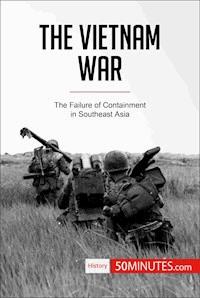
Keen to learn but short on time? Get to grips with the events of the Vietnam War in next to no time with this concise guide.
50Minutes.com provides a clear and engaging analysis of the Vietnam War, a brutal conflict that spanned two decades and resulted in catastrophic human and material losses. After the end of the First Indochina War in 1954, Vietnam was partitioned into two ideologically opposed states, namely the Communist North Vietnam under the leadership of Ho Chi Minh and the nationalist South Vietnam, which soon allied itself with the USA. This resulted in a lengthy conflict characterised by the use of guerrilla warfare which made a quick victory impossible, the intervention, whether covert or overt, of various foreign powers, and the widespread use of chemical weapons, the effects of which are still felt in Vietnam today.
In just 50 minutes you will:
• Find out about the background to the Vietnam War, including the First Indochina War and the Geneva Accords
• Learn about the key events of the conflict, including the Tet Offensive in 1968
• Understand the human and material costs of the war for American and Vietnamese soldiers and civilians
ABOUT 50MINUTES.COM | History & Culture
50MINUTES.COM will enable you to quickly understand the main events, people, conflicts and discoveries from world history that have shaped the world we live in today. Our publications present the key information on a wide variety of topics in a quick and accessible way that is guaranteed to save you time on your journey of discovery.
Das E-Book können Sie in Legimi-Apps oder einer beliebigen App lesen, die das folgende Format unterstützen:
Seitenzahl: 34
Veröffentlichungsjahr: 2018
Ähnliche


















The Vietnam War (1955-1975)
Key information
When: 1 November 1955 to 30 April 1975.Where: Vietnam.Context: an ideological and military conflict between Communist North Vietnam (the Democratic Republic of Vietnam) and nationalist South Vietnam (the Republic of Vietnam), which was backed by the US armed forces, after the end of the First Indochina War (1946-1954).Participants: the Communist North Vietnamese army and the Viet Cong against the South Vietnamese and American armies.Key protagonists:Ho Chi Minh (1890-1969), Vietnamese Communist leader and prime minister of the Democratic Republic of Vietnam (1945-1955), considered the father of North Vietnam.Ngô Đình Diệm (1901-1963), Vietnamese anti-Communist politician and president of the Republic of Vietnam (1955-1963).Nguyên Van Thiêu (1923-2001), South Vietnamese army general and president of the Republic of Vietnam (1967-1975).Lyndon B. Johnson (1908-1973), American politician and US president (1963-1969).Death toll:Two million Vietnamese, including 1.3 million soldiers.60 000 American soldiers.Introduction
The Vietnam War was one of the key events of the Cold War (1947-1991), as well as the longest and most destructive conflict in the history of US-Vietnamese relations.
After the First Indochina War against the French colonisers between 1946 and 1954, Vietnam was split into two territories, the Democratic Republic of Vietnam in the north and the Republic of Vietnam in the south. This division led to a military and political conflict which devastated the Vietnamese population during the 20 years of war that followed. When US forces entered the conflict in 1964, the discord between these two ideologically opposed populations only intensified, resulting in profound national trauma. Constant battles and bombing campaigns left the country drained and powerless to manage the vast quantities of toxic waste which continue to pose health risks to its inhabitants even today.
The Vietnam War had unprecedented consequences not only on American policy, but also on the American population, who witnessed the horrors of an all-out war against enemies who were sometimes impossible to detect or even figments of the US imagination. The conflict is etched into the memory of American veterans as a human disaster, and the damage inflicted on the Vietnamese population has yet to heal.
Political and social context
French colonialism in Indochina
Vietnam was a French colony from 1883 to 1954. It was made up of three states, Tonkin, Cochinchina and Annam, and from 1887 onwards was part of the Indochinese Union, which also comprised Laos and Cambodia. The country was partly run by the French colonisers, who developed an increasing number of tea, coffee, rice, pepper and rubber plantations and mined coal, zinc and tin for the profit of mainland France. The country’s indigenous inhabitants did not have the same rights as its European minority: even though the Code de l’indigénat (“Code of the Indigenate”) and the system of forced acculturation were not applied, unlike in France’s African colonies, the native Vietnamese formed a diverse proletariat who worked in the country’s rice fields, factories and mines.
The Code de l’indigénat
The Code de l’indigénat was a piece of legislation introduced in French colonies in 1887. It divided the population into two categories: French citizens from France and French subjects (Africans, Algerians, Malagasy, Antilleans, and so on), who were deprived of most of their freedoms and political rights. Their civil rights were limited to the right to follow their religion and traditional customs. The code’s discriminatory measures included forced labour, the requisitioning of indigenous inhabitants’ property and head taxes on the reservations, among others.
Acculturation in the colonies was based on assimilation or coexistence: indigenous inhabitants were forced to learn about the colonisers’ culture through secular and religious schools, and their traditions were denigrated in favour of Western customs. The colonial administration rejected traditional thinking and ways of life, and imposed a system and lifestyle modelled on those of Europe.




