


30,99 €
Mehr erfahren.
- Herausgeber: John Wiley & Sons
- Kategorie: Geisteswissenschaft
- Serie: Uncovering the Past: Documentary Readers in American History
- Sprache: Englisch
The Vietnam War is an outstanding collection of primary documents related to America's conflict in Vietnam which includes a balance of original American and Vietnamese perspectives, providing a uniquely varied range of insights into both American and Vietnamese experiences.
- Includes substantial non-American content, including many original English translations of Vietnamese-authored texts which showcase the diversity and complexity of Vietnamese experiences during the war
- Contains original American documents germane to the continuing debates about the causes, consequences and morality of the US intervention
- Incorporates personal histories of individual Americans and Vietnamese
- Introductory headnotes place each document in context
- Features a range of non-textual documents, including iconic photographs and political cartoons
Sie lesen das E-Book in den Legimi-Apps auf:
Seitenzahl: 573
Veröffentlichungsjahr: 2015
Ähnliche




















Uncovering the Past: Documentary Readers in American History
Series Editors: Steven Lawson and Nancy Hewitt
The books in this series introduce students in American history courses to two important dimensions of historical analysis. They enable students to engage actively in historical interpretation, and they further students' understanding of the interplay between social and political forces in historical developments.
Consisting of primary sources and an introductory essay, these readers are aimed at the major courses in the American history curriculum, as outlined further below. Each book in the series will be approximately 225–50 pages, including a 25–30 page introduction addressing key issues and questions about the subject under consideration, a discussion of sources and methodology, and a bibliography of suggested secondary readings.
Published
Paul G. E. Clemens
The Colonial Era: A Documentary Reader
Sean Patrick Adams
The Early American Republic: A Documentary Reader
Stanley Harrold
The Civil War and Reconstruction: A Documentary Reader
Steven Mintz
African American Voices: A Documentary Reader, 1619-1877
Robert P. Ingalls and David K. Johnson
The United States Since 1945: A Documentary Reader
Camilla Townsend
American Indian History: A Documentary Reader
Steven Mintz
Mexican American Voices: A Documentary Reader
Brian Ward
The 1960s: A Documentary Reader
Nancy Rosenbloom
Women in American History Since 1880: A Documentary Reader
Jeremi Suri
American Foreign Relations Since 1898: A Documentary Reader
Carol Faulkner
Women in American History to 1880: A Documentary Reader
David Welky
America Between the Wars, 1919-1941: A Documentary Reader
William A. Link and Susannah J. Link
The Gilded Age and Progressive Era: A Documentary Reader
G. Kurt Piehler
The United States in World War II: A Documentary Reader
Leslie Brown
African American Voices: A Documentary Reader, 1863-Present
David Freund
The Modern American Metropolis: A Documentary Reader
Edward Miller
The Vietnam War: A Documentary Reader
The Vietnam War
A Documentary Reader
Edited by Edward Miller
This edition first published 2016 Editorial material and organization © 2016 John Wiley & Sons, Ltd
Registered OfficeJohn Wiley & Sons Ltd, The Atrium, Southern Gate, Chichester, West Sussex, PO19 8SQ, UK
Editorial Offices350 Main Street, Malden, MA 02148-5020, USA 9600 Garsington Road, Oxford, OX4 2DQ, UK The Atrium, Southern Gate, Chichester, West Sussex, PO19 8SQ, UK
For details of our global editorial offices, for customer services, and for information about how to apply for permission to reuse the copyright material in this book please see our website at www.wiley.com/wiley-blackwell.
The right of Edward Miller to be identified as the author of the editorial material in this work has been asserted in accordance with the UK Copyright, Designs and Patents Act 1988.
All rights reserved. No part of this publication may be reproduced, stored in a retrieval system, or transmitted, in any form or by any means, electronic, mechanical, photocopying, recording or otherwise, except as permitted by the UK Copyright, Designs and Patents Act 1988, without the prior permission of the publisher.
Wiley also publishes its books in a variety of electronic formats. Some content that appears in print may not be available in electronic books.
Designations used by companies to distinguish their products are often claimed as trademarks. All brand names and product names used in this book are trade names, service marks, trademarks or registered trademarks of their respective owners. The publisher is not associated with any product or vendor mentioned in this book.
Limit of Liability/Disclaimer of Warranty: While the publisher and author have used their best efforts in preparing this book, they make no representations or warranties with respect to the accuracy or completeness of the contents of this book and specifically disclaim any implied warranties of merchantability or fitness for a particular purpose. It is sold on the understanding that the publisher is not engaged in rendering professional services and neither the publisher nor the author shall be liable for damages arising herefrom. If professional advice or other expert assistance is required, the services of a competent professional should be sought.
Library of Congress Cataloging-in-Publication Data
The Vietnam War : a documentary reader / edited by Edward Miller. pages cm. – (Uncovering the past: documentary readers in American history) Includes index. ISBN 978-1-4051-9677-2 (cloth) – ISBN 978-1-4051-9678-9 (pbk.) 1. Vietnam War, 1961-1975–Sources. I. Miller, Edward Garvey, editor. DS557.4.V573 2015 959.704′3–dc23
2015019089
A catalogue record for this book is available from the British Library.
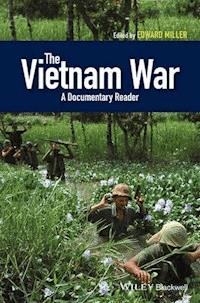
Cover image: US Marines wade through a marsh, Vietnam, November 1965. Photo © Paul Schutzer/Time Life Pictures/Getty Images
Contents
Series Editors' Preface
Acknowledgements
Introduction
From Dai Viet to Vietnam
Colonialism, Nationalism, and the Making of French Indochina
War, Decolonization, and the Two Vietnams
Lyndon Johnson's War
The Tet Offensive and the Quest for “Peace with Honor”
Victories, Defeats, Legacies, and Lessons
Reading the Documents: Key Questions
Chapter 1 Colonialism, Nationalism, and Communism
Tam Lang, I Pulled a Rickshaw (1932)
The Trial Testimony of Phan Boi Chau (1925)
Ho Chi Minh, The Path which Led Me to Leninism (1960)
Nguyen Ai Quoc (Ho Chi Minh), Appeal Made on the Occasion of the Founding of the Vietnamese Communist Party (1930)
Ho Chi Minh, The Declaration of Independence of the Democratic Republic of Vietnam (1945)
Discussion questions
Notes
Chapter 2 The First Indochina War and the Origins of American Involvement
Oral History of Xuan Vu, Viet Minh War Reporter and Propagandist (1987)
U.S. Department of State Airgram on French–Vietnamese Relations (1946)
Basic French-Vietnamese Difficulties
Truong Chinh, “We Struggle for Independence and Democracy” (1948)
U.S. National Security Council, Report on the Position of the United States with Respect to Indochina (1950)
Robert Blum, Telegram on US Economic Aid to France in Indochina (1951)
Memorandum of a Conversation with President Eisenhower about Dien Bien Phu (1954)
Final Declaration of the Geneva Conference (1954)
Discussion questions
Notes
Chapter 3 The Two Vietnams
Col. Edward G. Lansdale, Report on the activities of the Saigon Military Mission (1955)
Ngo Dinh Diem, Message to the RVN National Assembly on the Foundations of the Constitution (1956)
Wolf Ladejinsky, A Visit with President Ngo Dinh Diem (1955)
Vietnam Worker's Party Politburo, Directive Regarding Land Reform (1953)
Oral History of Han Vi, Musicologist and Communist Party Cadre
Discussion questions
Notes
Chapter 4 The Rise of the “Viet Cong”
Le Duan, The Path to Revolution in the South (1956)
A Communist Party Account of the Situation in the Nam Bo Region of South Vietnam (1961)
A Poor Farmer's Account of the 1960 “Concerted Uprising” in My Tho Province (1967)
Program of the National Liberation Front of South Vietnam (1960)
Notes
Chapter 5 The Fall of Diem
The Caravelle Manifesto (1960)
Report of the Taylor Mission to South Vietnam (1961)
The Self-Immolation of Thich Quang Duc (1963)
Transcript of a Phone Conversation between Ngo Dinh Diem and Henry Cabot Lodge, (November 1, 1963)
John F. Kennedy, Comments on the Saigon Coup (November 4, 1963)
Discussion questions
Notes
Chapter 6 Escalation
Resolution of the Central Committee of the Vietnam Workers' Party: Strive to Struggle, Rush Forward to Win New Victories in the South (December 1963)
Recording of a Phone Conversation between Lyndon Johnson and Robert McNamara about Vietnam (April 30, 1964)
The Tonkin Gulf Resolution (August 1964)
U.S. Senator Wayne Morse, Speech on the Tonkin Gulf Resolution (August 5, 1964)
George Ball, A Compromise Solution for South Vietnam (1965)
Notes of a Meeting at the White House (July 21, 1965)
SUBJECT: Viet Nam
Discussion questions
Notes
Chapter 7 On the Battlefield
A South Vietnamese Account of the Battle of Ap Bac (1995)
Interrogation of a Captured NLF Fighter (1967)
Oral History of Tom Esslinger, US Marine Lieutenant and Veteran of the Battle of Khe Sanh (2003)
Varnado Simpson, Testimony about the My Lai Massacre (1969)
Oral History of Wilson Key, US Navy Pilot and Prisoner of War (2004)
A North Vietnamese soldier remembers the Bombing of North Vietnam (1970)
Kim Phuc and the Napalm Attack on Trang Bang Village (1972)
Discussion questions
Notes
Chapter 8 The Tet Offensive
Resolution of the 14th Plenum of the VWP Central Committee (January 1968)
U.S. Central Intelligence Agency Report on the Communist Tet Offensive (January 31, 1968)
The Execution of Nguyen Van Lem
General Huyng Cong Than, The General Offensive and Uprising in the Southern Sector of Saigon (1994)
Walter Cronkite, Remarks on the Tet Offensive (February 1968)
Lyndon B. Johnson, Address to the Nation Announcing Steps to Limit the War in Vietnam (March 31, 1968)
Discussion questions
Notes
Chapter 9 Home Fronts
Students for a Democratic Society, “Build, Not Burn” (1965)
Young Americans for Freedom, “Aid and Comfort to the Enemy” (1965)
Student Non-Violent Coordinating Committee, Statement Against the War in Vietnam (1966)
Nicholas Garland, Cartoon of Lyndon Johnson (1966)
Pete Seeger, “Waist Deep in the Big Muddy”(1967)
Senator George McGovern, Speech in Support of the McGovern–Hatfield Amendment to End the War in Indochina (1970)
Ngo Cong Duc, “Anti-Americanism: Common Cause in Vietnam” (1970)
Terry Nelson and C-Company, “The Battle Hymn of Lt Calley” (1971)
Daniel Ellsberg, “Murder and the Lying Machine” (2002)
Discussion questions
Notes
Chapter 10 Pacification, Vietnamization, and “Fighting While Negotiating”
William Westmoreland, “The Refugee Problem” (1968)
Robert Komer, “The Phoenix Program and the Attack on the Viet Cong Infrastructure” (1969)
A Communist Cadre Describes Pacification in My Tho Province During 1969–1970
Le Duc Tho and Chinese Foreign Minister Chen Yi Discuss the Paris Peace Talks (1968)
Henry Kissinger Negotiates with Le Duc Tho (1971)
Richard Nixon and Henry Kissinger Discuss the Fate of South Vietnam (August 1972)
Discussion questions
Notes
Chapter 11 Victory and Defeat
Jacques Leslie, A Visit to Viet Cong Territory (1995)
Bui Tin, An Account of the Surrender of South Vietnam (1981)
Nguyen Thi Hoa, “Mom, I'm leaving now. I will make you very proud of me.”
Discussion questions
Notes
Chapter 12 Memories and Legacies
The POW/MIA Flag
Excerpt from Quang X. Pham,
A Sense of Duty: Our Journey from Vietnam to America
(2005)
A US Army Nurse Remembers Vietnam (2004)
A Letter Left at the Vietnam Veterans Memorial
Airborne
George W. Bush, Speech at a Veterans of Foreign Wars Convention (2007)
Vo Van Kiet, “Healing the Wound” (2005)
Discussion questions
Notes
Index
EULA
Guide
Cover
Table of Contents
Chapter
Pages
x
xi
xii
xiii
xiv
xv
xvi
xvii
xviii
xix
xx
xxi
xxii
xxiii
xxiv
xxv
xxvi
xxvii
xxviii
xxix
xxx
xxxi
1
2
3
4
5
6
7
8
9
10
11
12
13
14
15
16
17
18
19
20
21
22
23
24
25
26
27
28
29
30
31
32
33
34
35
36
36
37
38
39
40
41
42
43
44
45
46
47
48
49
50
51
52
53
54
55
56
57
58
59
60
61
62
63
64
65
66
67
68
69
70
71
72
73
74
75
76
77
78
79
80
81
82
83
84
85
86
87
88
89
90
91
92
93
94
95
96
97
98
99
100
101
102
103
104
105
106
107
108
109
110
111
112
113
114
115
116
117
118
119
120
121
122
123
124
125
126
127
128
129
130
131
132
133
134
135
136
137
138
139
140
141
142
143
144
145
146
147
148
149
150
151
152
153
154
155
156
157
158
159
160
161
162
163
164
165
166
167
168
169
170
171
172
173
174
175
176
177
178
179
180
181
182
183
184
185
186
187
188
189
190
191
192
193
194
195
196
197
198
199
200
201
202
203
204
205
206
207
208
209
210
211
212
213
214
215
216
217
218
219
220
221
222
223
224
225
226
227
228
229
230
231
232
233
234
235
236
237
238
239
240
241
242
243
244
245
246
247
249
250
251
252
253
254
255
256
257
258
259
Series Editors' Preface
Primary sources have become an essential component in the teaching of history to undergraduates. They engage students in the process of historical interpretation and analysis and help them understand that facts do not speak for themselves. Rather, students see how historians construct narratives that recreate the past. Most students assume that the pursuit of knowledge is a solitary endeavor; yet historians constantly interact with their peers, building upon previous research and arguing among themselves over the interpretation of documents and their larger meaning. The documentary readers in this series highlight the value of this collaborative creative process and encourage students to participate in it.
Each book in the series introduces students in American history courses to two important dimensions of historical analysis. They enable students to engage actively in historical interpretation, and they further students' understanding of the interplay among social, cultural, economic, and political forces in historical developments. In pursuit of these goals, the documents in each text embrace a broad range of sources, including such items as illustrations of material artifacts, letters and diaries, sermons, maps, photographs, song lyrics, selections from fiction and memoirs, legal statutes, court decisions, presidential orders, speeches, and political cartoons.
Each volume in the series is edited by a specialist in the field who is concerned with undergraduate teaching. The goal is not to offer a comprehensive selection of material but to provide items that reflect major themes and debates; that illustrate significant social, cultural, political, and economic dimensions of an era or subject; and that inform, intrigue, and inspire undergraduate students. The editor of each volume has written an introduction that discusses the central questions that have occupied historians in this field and the ways historians have used primary sources to answer them. In addition, each introductory essay contains an explanation of the kinds of materials available to investigate a particular subject, the methods by which scholars analyze them, and the considerations that go into interpreting them. Each source selection is introduced by a short head note that gives students the necessary information and a context for understanding the document. Also, each section of the volume includes questions to guide student reading and stimulate classroom discussion.
Edward Miller's The Vietnam War: A Documentary Reader makes a substantial contribution through primary sources to understanding the long history of the Vietnam War or what was really a succession of conflicts. Unlike many other books, this volume ranges beyond the American experience to include the viewpoints of the Vietnamese on both sides of the struggle. It provides American-authored documents such as photographs, memoirs, songs, and speeches as well as selections offered by Vietnamese and people of other nationalities. By combining both American and Vietnamese primary sources, Miller opens up new possibilities for interpreting the origins and consequences of the war. Rather than focusing on the morality of the war, Miller succeeds in helping readers understand why the legacy of the Vietnam War remains so powerful today and an issue that is still hotly debated among Vietnamese and Americans.
The Vietnam War furnishes an assortment of rich documents with head notes and questions in each chapter that will encourage students to create history and show that facts do not speak for themselves. Students can analyze the views of politicians, diplomats, journalists, military leaders, soldiers, protesters, and peasants as they grapple with the experiences and memories of the Vietnam War. In addition, Professor Miller furnishes an incomparable introduction that places this long and costly war in its broad historical context and provides a framework for understanding its evolution.
Steven F. Lawson and Nancy A. Hewitt
Series Editors
Acknowledgements
The study of the Vietnam War poses special challenges for historians. In addition to being a deeply controversial war – not only in the United States and Vietnam, but around the world – the Vietnam War was a very long and complex event, which involved multiple nations and governments, and which profoundly affected the lives of millions across the globe. Documenting such a war in a single volume has proved much more difficult than I anticipated. Yet my work on this book has been made immensely easier by the help and advice I have received from fellow scholars and colleagues. Thanks are due first of all to Uncovering the Past editors Nancy A. Hewitt and Steven F. Lawson, who invited me to contribute to their fine series and who provided sage counsel and direction along the way. In my efforts to identify particular primary sources or to track down especially elusive documents, I drew heavily on the expertise of other historians who specialize in the history of the Vietnam War and Modern Vietnamese History; I am indebted to Larry Berman, David Biggs, Haydon Cherry, Kelly Crager, Gregory Daddis, David Elliott, Christina Firpo, Stuart Finkel, Chris Goscha, Tuan Hoang, David Hunt, Matt Masur, Lien-Hang T. Nguyen, Hue-Tam Ho Tai, and Tuong Vu. Special gratitude is due to Merle Pribbenow, who generously permitted me to use his translations of some of the Vietnamese documents contained in these pages, and whose knowledge of Vietnam War history is unsurpassed. I must also acknowledge the aid rendered by the late Vinh Sinh, a model scholar and a pioneer in the field of Vietnamese studies. At my home institution of Dartmouth College, Gail Patten and Bruch Lehman furnished excellent technical and administrative support, while Fran Oscadal and John Cocklin delivered invaluable guidance on library and archival matters. Finally, I thank the outstanding team at Wiley, including Julia Kirk, Carolyn Hensman, Georgina Coleby, and especially Peter Coveney for their dedication, advice, and patience. Their work is apparent on every page.
Introduction
In a city full of monuments, the Vietnam Veterans Memorial in Washington, DC stands apart. Compared with the majestic structures around it, this memorial appears simple and understated. Its central feature is a long, low wall of black granite that is set into the earth and stands only ten feet high at its apex. However, the simplicity of “the wall” belies its extraordinary emotional power. Its reflective panels display the names of more than 58,000 American military personnel who died or went missing while serving in Indochina (the countries of Vietnam, Cambodia, or Laos) between 1959 and 1975. Every year, around three million people visit the memorial. Many of them come to find a particular name, or to remember a friend, loved one, or fallen comrade-in-arms. Others come to reflect on questions about war, peace, and America's place in the world.
On the other side of the world from Washington, another memorial stands in the city of Hanoi, the capital of Vietnam. The Tomb of the Unknown Soldier is located on the edge of Ba Dinh Square, part of an elaborate collection of monuments built by the Vietnamese state and its ruling Vietnamese Communist Party (VCP). Although the tomb is less visually dramatic than the nearby mausoleum of VCP founder and hero Ho Chi Minh, it features a strikingly beautiful archway, similar in some respects to the Arc de Triomphe in Paris. Unlike many other monuments to unknown soldiers, this one does not contain any human remains. This is because it is dedicated to the uncounted “nameless” (vô danh) Vietnamese soldiers who died in the fight against the United States, and whose final resting places remain unknown even today. In Hanoi and throughout Vietnam, these soldiers are remembered as “martyrs” who sacrificed themselves on behalf of Vietnam's national struggle against American imperialism.
Back across the Pacific Ocean, in the city of Westminster in southern California, stands a third monument to fallen soldiers. Known simply as the Vietnam War Memorial, it was constructed mostly with funds donated by Vietnamese Americans and dedicated in 2003. In contrast to its counterparts in Washington and Hanoi, this memorial explicitly honors the wartime service of both Americans and Vietnamese. Its central element is a statue that depicts a US soldier standing back-to-back with a soldier of the Army of the Republic of Vietnam (ARVN), the main military force of the anti-communist state of South Vietnam.
Although separated by thousands of miles, the three memorials in Washington, Hanoi, and Westminster are all part of the complex historical legacy of the conflict known as the Vietnam War. Even in comparison to other twentieth-century wars, the Vietnam War was bloody and costly. Over nearly two decades, it claimed perhaps as many as three million lives and consumed billions of dollars. But mere statistics alone cannot reveal the larger historical forces that gave rise to the war, or capture the diverse human experiences that it produced.
For people in Vietnam and the adjacent countries of Cambodia and Laos, the Vietnam War was part of the ongoing process of decolonization in Indochina. As they saw it, the war was a continuation of the political and military conflicts that began in Indochina during the century-long period of French colonial rule. Following the dismantling of the colonial state in 1954, the most obvious axis of conflict within Indochina was the rivalry between communist North Vietnam and anticommunist South Vietnam. However, the communist–anticommunist divide was not the only fault line running through Vietnamese society. Other points of friction had to do with region, religion, social class, and ethnic identity, as well as deep disagreements over what kind of postcolonial nation Vietnam ought to be. Vietnamese therefore perceived the Vietnam War as a civil war, despite the massive involvement of the United States and other foreign powers in the conflict.
For most Americans, the Vietnam War was something rather different. Americans initially perceived the conflict not as a war of decolonization but as an episode in the larger geopolitical clash known as the Cold War. Then, over the course of the 1960s, the war evolved into a bitter struggle on the US home front – indeed, it divided Americans as no issue had since the US Civil War a century earlier. For both supporters and opponents, the war in Vietnam became a touchstone issue not only in debates about US foreign policy, but also in clashes over politics, culture, and morality at home. By the late 1960s, the controversy over the war had provoked acrimonious arguments over whether or not the United States was a “sick” society that had lost its moral bearings.
This documentary reader uses primary sources to explore the history of the Vietnam War from diverse perspectives. Unlike many other books on the war, this volume does not focus only or even primarily on American experiences and viewpoints. Instead, it uses American-authored materials (including government documents, photographs, memoirs, songs, and speeches) in conjunction with other sources authored by Vietnamese and people of other nationalities. My decision to include these non-American sources is not intended to promote a particular interpretation of the war; nor do I seek to provide definitive, unambiguous answers to the enduring questions about the wisdom and morality of the war. Instead, the main objective of this book is to furnish students with the means to craft their own interpretations and to formulate their own answers to these important historical questions. By incorporating both American and Vietnamese primary sources into the study of the war, we can gain new insight into the origins, evolution, and consequences of the conflict. We can also begin to understand why the memory of the war remains so controversial and so fiercely contested today, among Vietnamese and Americans alike.
From Dai Viet to Vietnam
Since the early twentieth century, it has been common for Vietnamese nationalists – both communists and non-communists – to refer to Vietnam as an “ancient nation.” Many nationalist writers have traced the origins of this national identity to the period of the Hung Kings (Hùng Vương) who are said to have ruled a kingdom based in the Red River Delta of northern Vietnam for more than 2000 years. This kingdom fell to an invading army from Southern China in 207 BCE, inaugurating a millennium-long era of Chinese “domination” of Vietnam. However, despite this lengthy period of subordination, Vietnamese nationalists insist, the residents of the Red River Delta maintained their identity as a separate nation and people. This identity was said to have manifested itself in local rebellions against their Chinese overlords, leading eventually to the re-establishment of independence and the founding of a new Vietnamese monarchy in 939 CE. For the next nine centuries, a succession of dynasties ruled a kingdom known as Dai Viet from its capital at Thanh Long (present-day Hanoi). Meanwhile, Vietnamese settlers and administrators were gradually expanding southward, toward the fertile lands of the lower Mekong river delta. In the early nineteenth century, this “southern advance” culminated in the establishment of the Nguyen dynasty, the first royal house to rule over all of Vietnam's present territory. According to Vietnamese nationalists, this centuries-long process of territorial defense and state consolidation made Vietnamese determined to resist any future foreign invaders—no matter if they were Chinese, French, or American.
In recent years, historians have questioned some aspects of this nationalist historical narrative. One problem has to do with the narrative's anachronistic qualities – that is, its projection of modern-day notions of nationhood backwards onto earlier times. It is doubtful that the ordinary farmers and merchants of Dai Viet ever thought of themselves as members of a Vietnamese nation; they felt much more loyalty to local communities and patrons than to any emerging sense of nationhood. Indeed, the name “Viet Nam” was itself coined only in the early nineteenth century, during a diplomatic exchange between Nguyen officials and the Chinese imperial court in Beijing.
Another problem with the nationalist version of Vietnamese history has to do with its overemphasis on military conflict. Although Dai Viet endured occasional Chinese invasions after becoming an independent polity in the tenth century CE, these attacks were relatively few and far between. Moreover, in the long intervals between wars, Vietnamese engaged in extensive diplomatic, economic, and cultural exchanges with China. Vietnamese politics were therefore defined less by any external rivalry with China than by the fierce internal competitions among Vietnamese elites. During the seventeenth and eighteenth centuries, for example, the territory of Dai Viet was split in two, with one noble house in control of Hanoi and the Red River Delta and another faction ensconced in the provinces around the city of Hue on the central coast.
The nationalist narrative is further undermined by the inconvenient fact that Vietnamese were not always the victims of foreign aggression. Indeed, as the historical record demonstrates, Vietnamese could also play the role of invaders and overlords. This is particularly apparent in the history of the “southern advance,” which required the conquest and subordination of non-Vietnamese states and populations. By the early nineteenth century, Vietnam had become an imperial power in its own right, as the Nguyen kings seized control over parts of Cambodia. However, nationalist sentiment was still not yet widespread among ordinary Vietnamese. The emergence of nationalism as a mass phenomenon in Vietnam would come only in the wake of a new conquest of the country – one carried out not by Chinese armies, but by French colonialists.
Colonialism, Nationalism, and the Making of French Indochina
In 1858, a French naval armada appeared off the coast of Central Vietnam. Over the next few decades, French military forces carried out a gradual conquest of Vietnam and the neighboring territories of Cambodia and Laos. In the process, they created a patchwork of colonies and protectorates that collectively became known as “French Indochina.” This colonial federation would endure for nearly a century and profoundly shaped the lives of the millions of people who lived within its borders.
The first parts of Vietnam to be ceded to the invaders were its southern provinces, including the city of Saigon and the lower Mekong Delta. In this region, which the French called Cochinchina, a tiny elite of French settlers and wealthy Vietnamese built large rice and rubber plantations that produced crops for export to world markets. The bulk of the southern population consisted of poor farmers and laborers, many of whom either rented land at unfavorable rates or earned subsistence wages on the big plantations.
By the 1880s, the French had also seized control of northern and central Vietnam (known as Tonkin and Annam, respectively). While landowning patterns were relatively more equitable in the northern and central provinces than in the south, most residents of those regions were still poor farmers engaged in subsistence agriculture. In all three regions, ordinary Vietnamese struggled to cope not only with poverty and economic exploitation but also with the onerous policies of the colonial state. These policies included a much-hated “head tax” as well as other levies on commodities such as salt and opium. Rural residents particularly resented the practice of corvée labor, in which men were forced to perform backbreaking work on roads, canals, and other public works projects, often for little or no pay.
The emergence of Vietnamese nationalism during the colonial era can be understood as a product of the interplay between two seemingly opposite impulses: resistance and collaboration. From the first stages of the French conquest, many Vietnamese struggled and fought against the colonial state. The most obvious examples of this resistance involved armed uprisings, such as those organized by former Nguyen court officials during the 1870s and 1880s. Vietnamese also engaged in more everyday forms of resistance, such as refusing to show deference to a European, or simply invoking the forbidden term “Vietnam” when they spoke. Paradoxically, however, such acts of resistance were most frequently undertaken by those Vietnamese who were most familiar with – and most admiring of – colonial institutions, ideas, and practices.
The tensions produced by these contradictory impulses can be glimpsed in the activism of Vietnam's first cohort of self-proclaimed “revolutionaries” during the 1900s and 1910s. Phan Boi Chau (1867–1940), the pre-eminent member of this cohort, tried to undermine the French colonial state through various acts of violence, including rebellion and assassination. Yet he also argued that Vietnam needed to appropriate and assimilate European knowledge and culture in order to become a modern nation. The generation of nationalist leaders who followed Phan – those who came of age in the 1920s and 1930s – were even more steeped in the language and culture of colonialism, due to their education in French schools in Indochina and in Europe.
The linkages between colonialism and nationalism are apparent in the life and early career of Vietnam's most famous revolutionary: Ho Chi Minh (1890?–1969). Born in Central Vietnam, Ho harbored patriotic sentiments from an early age. However, he also studied at a school with a French curriculum, and as a young man he applied to be trained as a colonial administrator. After leaving Vietnam in 1911, Ho lived for several years in France, where he first learned about socialism and communism. In the 1920s, Ho became a devoted follower of Vladimir Lenin and moved to the Soviet Union, where he received training in theory and strategy from the Comintern, the Soviet agency set up to promote communist revolutions around the world. In 1930, he founded the Vietnamese Communist Party while living in southern China.
Although Ho would subsequently be criticized by some of his fellow communists for being too focused on Vietnam's national liberation from colonial rule, he insisted that there was no contradiction between his nationalist and socialist convictions. When he finally returned to Vietnam in 1941, he resolved to focus first and foremost on expelling the French from the country. Once the “national question” had been resolved, he reasoned, the communist party could turn its attention to the “social question” and the realization of its socialist goals.
Ho's strategy during World War II was embodied in his 1941 decision to create a new organization known as the Vietnamese League for Independence, or “Viet Minh” for short. The league was a front organization dedicated to fighting the French colonial regime and the Imperial Japanese occupation forces that had just arrived in Indochina. Although ostensibly non-communist, the Viet Minh was in fact secretly controlled by the communist party (which by this time had been renamed the Indochinese Communist Party, or ICP). Over the next four years, Ho and his ICP comrades built the Viet Minh into a formidable organization with substantial popular support. The party also established the first elements of what would eventually become a formidable fighting force, the People's Army of Vietnam (PAVN).
In August 1945, when Japan surrendered to the Allies, the Viet Minh suddenly found itself in prime position to seize power. In a series of events known as the August Revolution – a term selected in conscious imitation of Russia's October Revolution of 1917 – Viet Minh forces took control of Hanoi and many other cities and towns across Indochina. On September 2, 1945, Ho Chi Minh stood before a huge crowd of his compatriots in Hanoi's Ba Dinh square and proclaimed Vietnam independent. He also announced the formation of a new Viet Minh-sponsored state, the Democratic Republic of Vietnam (DRV). In this moment of triumph, Ho spoke only of national liberation, and said nothing about socialist revolution or communism. He also quoted from the American Declaration of Independence – a calculated move designed to impress a small group of US military officers who were present. Vietnam's independence had not yet been secured, but it was clear that the country would never be the same.
War, Decolonization, and the Two Vietnams
The August Revolution of 1945 marked the beginning of the end of French colonial rule in Indochina. Yet it also marked the point at which the United States first emerged as a key actor in Indochinese affairs. Over the next 30 years, the lives of Americans and Vietnamese became intertwined in ways that no one could have foreseen. During this period, Vietnam and the neighboring countries of Laos and Cambodia endured not one but two massively destructive wars: the First Indochina War of 1945–1954 and the Second Indochina War of 1959–1975. While the second of these was the conflict that Americans would come to know as “the Vietnam War,” Vietnamese knew that the roots of that later struggle could be traced directly to the earlier one.
The First Indochina War pitted France, which was determined to restore its colonial dominion in Indochina, against Ho and the Viet Minh movement. Although both antagonists appealed to the United States for assistance – Ho asked US President Harry Truman in 1946 to “interfere urgently in support of our independence” – Washington initially opted to remain neutral. However, by the late 1940s US strategists had come to view Indochina as a key front in the global Cold War against the Soviet Union. Following the 1949 victory of Mao Zedong's communist movement in the Chinese civil war, many American leaders began to worry about a “domino effect” in which Asian nations would fall to communism one by one. Truman's calculations were also affected by an emerging “red scare” within the United States, and especially by allegations of communist subversion within his administration. In early 1950, Truman endorsed a State Department proposal to militarize the Cold War through massive increases in defense spending. Shortly afterwards, he announced the dispatch of military and economic aid to French forces in Indochina. By 1954, American assistance covered more than three-fourths of the cost of France's war effort.
The massive influx of American aid to the French after 1950 was matched by the Soviet Union and the People's Republic of China, both of which began supplying the Viet Minh with weapons, supplies, and strategic advice. This outside aid greatly increased the firepower wielded by both sides in the war, but did not allow either to gain a decisive edge on the battlefield. After years of stalemate, the Viet Minh finally scored a dramatic victory in 1954, when they besieged and captured a French base in a remote northern valley known as Dien Bien Phu. In the midst of the siege, desperate French officials asked Truman's successor, Dwight D. Eisenhower, to use American airpower to save the garrison. Eisenhower initially seemed in favor of meeting the French request – and may even have toyed with the possible use of a tactical nuclear strike – before deciding against intervention.
The Viet Minh victory at Dien Bien Phu held enormous symbolic value, and it convinced French leaders to make peace. However, the ensuing negotiations, held at an international conference at Geneva during the summer of 1954, resulted in a compromise settlement. The agreement, known as the Geneva Accords, stipulated that Vietnam was independent, but that the country would be temporarily split in two. All territory north of the 17th parallel was to be administered by Ho's DRV government from its capital at Hanoi. The land to the south of that line was placed under the jurisdiction of the Saigon-based State of Vietnam, soon to be renamed the Republic of Vietnam (RVN). The Accords specified that this arrangement would last for no more than two years, and would end with nationwide reunification elections to select a single, all-Vietnam government. These terms were considerably less than the complete victory that Ho and his communist comrades had hoped to claim. However, they decided to accept the accords, with the expectation that the prestige they had gained in the war against France would translate into popularity at the ballot box.
The reunification elections were never held. The primary reason was the opposition of Ngo Dinh Diem, a devout Catholic and staunch anticommunist who became the leader of the Saigon regime in mid-1954. After outmaneuvering his rivals and consolidating his grip on power in the south, Diem announced that he would not be bound by the terms of the Geneva agreements (which his government had not endorsed) and that he had no intention of consulting with DRV leaders about the elections. Hanoi protested bitterly, but to no avail. After some initial hesitation, American leaders backed Diem strongly and the US media hailed him as the “miracle man” of Southeast Asia. By 1955, Washington had displaced the French as the primary provider of military, economic, and diplomatic support to Diem's RVN government. The divide between North Vietnam and South Vietnam (as the DRV and RVN states were now unofficially called) seemed to be hardening into a permanent separation.
Diem proceeded to implement an elaborate array of nation-building programs in South Vietnam. These included various schemes to relocate large numbers of rural residents to newly created communities, many of them in remote parts of the Mekong Delta and Central Highlands. Diem also launched the “Denounce Communists” campaign, which used propaganda and surveillance to root out the covert network of communist operatives who had remained in the south after Geneva. The regime's methods were brutally effective, at least in the short term. By the late 1950s, more than 80% of these stay-behind cadres – whom RVN officials disparagingly referred to as “Viet Cong” – had been detained or killed. Diem's ruthless efficiency in the south seemed a sharp contrast with the situation in North Vietnam, where the DRV government's harsh land reform program resulted in the executions of thousands of people, including many who had previously supported the revolution. In 1956, Ho Chi Minh felt obliged to issue a public apology for the “errors.” By the end of the decade, it seemed to many observers that South Vietnam had begun to pull ahead of the North in the competition between the two states.
It was at this seemingly inauspicious moment that insurgents in South Vietnam launched the rebellion that would eventually become the Vietnam War. Small-scale attacks on isolated government targets during 1959 gave way to a series of “concerted uprisings” in the Mekong Delta in 1960. By the following year, the rebels had seized the initiative and controlled large swaths of territory and population. In its initial stages, the insurrection was fueled by popular anger with official corruption and Diem's indiscriminate security measures. The latter included his draconian 10/59 law, which permitted summary executions by guillotine. However, the insurgency was also driven by the actions of communist party cadres, who played a critical role in organizing the resistance and in mobilizing popular participation in it – by persuasion if possible, but also by manipulation and coercion when necessary. In December 1960, the rebels announced the formation of the National Liberation Front for South Vietnam (NLF). Although it was ostensibly a noncommunist organization open to anyone who was willing to fight the South Vietnamese government, the NLF was in fact controlled from the outset by communist operatives, who took their orders from the senior party leadership in Hanoi.
The rapid expansion of the insurgency was cause for concern in both Saigon and Washington. In 1961, the newly inaugurated US President John F. Kennedy rejected his advisors' recommendations to send American combat units to South Vietnam. However, he sharply increased economic and military aid to Diem's government, and also greatly expanded the number of American military advisors working with the South Vietnamese army, the Army of the Republic of Vietnam (ARVN). At first, this new approach seemed to work. During 1962, the ARVN's battlefield performance against the NLF improved dramatically, thanks in part to the increased mobility conferred by US-supplied helicopters and armored vehicles. Meanwhile, the Diem government launched an ambitious counterinsurgency initiative known as the Strategic Hamlet Program, which aimed to fortify every rural settlement in South Vietnam to protect the population from the “Viet Cong.” However, the insurgents soon devised new tactics to counter these threats. At the Battle of Ap Bac in January 1963, an NLF unit mauled a much larger ARVN force and shot down five helicopters before escaping. The revolutionaries also discovered that many of the Strategic Hamlets had been built too quickly and were inadequately defended.
In the end, Diem's fate was sealed not by his communist enemies, but by his former supporters and allies. In spring 1963, South Vietnam was plunged into crisis by anti-Diem protests led by Buddhist monks. Although many of the protest leaders had previously enjoyed good relations with the government, they now accused Diem of religious favoritism and persecution. The movement garnered worldwide attention due to the self-immolation of the monk Thich Quang Duc, who was photographed as he burned himself to death on a Saigon street. As the political crisis in Saigon escalated, Diem disregarded US warnings not to use force against the Buddhists. In August, RVN security forces crushed the movement with a series of midnight raids against the pagodas that served as the movement's headquarters. Shortly after the crackdown, Kennedy gave his approval – albeit in a highly qualified and ambivalent manner – to a plan to encourage the ARVN's senior generals to overthrow Diem.
The ARVN coup against Diem was launched on November 1, 1963, and Diem and his brother Ngo Dinh Nhu were detained and killed the next day. Kennedy himself would be assassinated in Dallas just three weeks later. This historical coincidence meant that the president did not have to face the consequences of the regime change he had authorized. It would also spark a retrospective debate about what further choices Kennedy would have made in Vietnam if he had lived. A few weeks before his death, Kennedy approved a plan to begin withdrawing US military advisors from the country, a decision that some commentators would later cite as evidence of his determination to get out of the war. However, others note that the withdrawal seemed to be based on the mistaken assumption that the ARVN was marching toward victory over the NLF – a belief that events would soon disprove. Because the question of what Kennedy might have done is a counterfactual one, it will never be settled definitively. There is no doubt, however, that the events of November 1963 would have far-reaching and devastating effects for the United States and Vietnam. For the citizens of both countries, the war's destruction and turmoil was about to begin in earnest.
Lyndon Johnson's War
The coup against Diem helped to set the stage for a massive escalation of the Vietnam War over the next two years. A few weeks after the coup, the communist party's central committee in Hanoi endorsed a plan to bring down the South Vietnamese government quickly, by stepping up the rate at which PAVN soldiers were infiltrating South Vietnam from the North. This shift in strategy was the work of Le Duan, the party's First Secretary and a longtime advocate of a more aggressive strategy in the south. During the first months of 1964, it appeared that Le Duan's objectives might be within reach. Saigon endured a series of short-lived governments, each seemingly less competent than the previous one. Meanwhile, NLF forces made rapid gains in the countryside. In May, the US Central Intelligence Agency warned that the “tide of deterioration” could result in the collapse of the RVN state by the end of the year.
Unfortunately for Le Duan, the new US president had escalatory plans of his own. Lyndon Johnson brought a unique mix of ambition and insecurity to the White House. Although he dreamed of ending poverty in America and promoting development in Third World nations, Johnson was also anxious not to become “the first American president to lose a war,” as he put it. In August 1964, the president seized on reports that PAVN torpedo boats had twice fired upon US destroyers operating in international waters in the Gulf of Tonkin, off the coast of North Vietnam. At Johnson's behest, Congress quickly passed a resolution that denounced the DRV's “deliberate and systematic campaign of aggression” and authorized the president to take “all necessary measures” in response. The White House did not disclose that the US ships had been supporting a covert mission to infiltrate South Vietnamese commandos into North Vietnam; nor did it acknowledge that the reports of the second of the alleged torpedo attacks turned out to be erroneous. The resolution was endorsed unanimously in the House of Representatives, and with only two dissenting votes in the Senate.
In his initial moves after the Tonkin Gulf incident, Johnson was careful to display restraint, insisting that the US sought “no wider war” in Vietnam. However, following his landslide victory in the November 1964 presidential election, he moved quickly both to expand the war and to transform it into an American conflict. In February 1965, Johnson ordered the US Air Force and Navy to launch Operation Rolling Thunder, a strategic bombing campaign against North Vietnam that was intended to force Hanoi to cease its support for the insurgency in the south. For the next three-and-a-half years, American bombs fell on North Vietnam on an almost daily basis.
The start of the air war led in short order to the deployment of US ground forces to South Vietnam. In June 1965, in response to a request from General William Westmoreland, the top US Army commander in Vietnam, Johnson ordered the dispatch of tens of thousands of troops and promised to send additional units as necessary. In doing so, he disregarded the advice of Undersecretary of State George Ball, who presciently warned the president that victory in Vietnam might prove impossible. By the end of the year, there were 184,000 US military personnel in South Vietnam, with more on the way.
Le Duan's and Johnson's decisions paved the way for a massively more violent and destructive war. Between 1965 and 1968, General Westmoreland pursued a strategy that combined “pacification” operations in South Vietnamese villages with large-scale “search and destroy” missions against enemy main force units. In this way, he aimed to isolate the NLF from the rural population that sustained it, while also waging a war of attrition against the PAVN. Such a strategy seemed sensible, insofar as it was designed to exploit the substantial firepower advantages enjoyed by US forces.
However, Westmoreland's strategic objectives led him to adopt controversial tactics: the forced relocation of civilians and the deliberate destruction of their homes and farms; the establishment of “free fire zones” in which US and RVN units were allowed to treat any human being they encountered as a hostile combatant; the heavy reliance on post-battle “body counts” of dead Vietnamese as an indicator of progress in the war. Such tactics, critics charged, were counterproductive, since they often alienated the Vietnamese hearts and minds that US officials claimed to want to win. Even worse, these tactics were blamed for creating a permissive environment in which US soldiers, sailors, airmen, and marines could violate the laws of war with impunity. As the war ground on, journalists, veterans, and others alleged that American forces routinely committed torture, rape, mutilation, and murder in Vietnam. For many Americans back home, these charges were powerfully substantiated by revelations about the My Lai massacre, a 1968 incident in which a US Army company slaughtered hundreds of defenseless civilians in a village in Central Vietnam.
While media attention in the United States and around the world focused mainly on the fighting in South Vietnam and the bombing of the North, a more hidden – but no less violent – struggle was taking place across the border in landlocked Laos. Laos had been in upheaval since 1960, following the collapse of a power-sharing agreement among the country's communist, anticommunist, and neutralist factions. North Vietnamese forces exploited the turmoil by using Lao territory to smuggle soldiers and supplies into South Vietnam via a network of paths and roads known as the “Ho Chi Minh trail.” In late 1964, in a bid to interdict the traffic along the trail, Lyndon Johnson launched what would become a nearly decade-long bombing campaign in Laos. By 1973, US warplanes had dropped more than 2.1 million tons of explosives on Laos, making it the most bombed country on a per capita basis in world history. Meanwhile, CIA operatives funneled weapons and money to anticommunist forces, including a guerrilla army made up mostly of members of the Hmong ethnic group. To finance these activities, the agency became involved in the Lao opium trade. All of these measures were conducted illegally and secretly, to preserve the fiction that the US was supporting the neutrality of Laos. However, they mostly failed to disrupt traffic along the trail, which actually expanded during the late 1960s and early 1970s.
The Tet Offensive and the Quest for “Peace with Honor”
The infiltration of men and supplies via the Ho Chi Minh trail was merely one component of the larger strategy for victory that the PAVN and the NLF were pursuing. Although the communists claimed to be following Mao Zedong's model of “people's war,” Le Duan was not content to rely only on guerrilla tactics. Instead, he instructed his commanders in the south to fight and win “decisive victories” against US and ARVN units. According to Le Duan, such victories would pave the way for a “general offensive, general uprising” – an all-out military attack on South Vietnam's cities and towns, followed by a general uprising of the population against the RVN state. Although the revolutionaries mostly failed to win the “decisive victories” on the scale that Le Duan envisioned, by mid-1967 he was convinced that the time had come to move to the next stage of the plan.
NLF and PAVN units scheduled the Tet Offensive for the first day of Vietnam's lunar new year holiday in late January 1968. In keeping with the “general offensive” component of the plan, the attackers struck high-profile targets inside all of South Vietnam's major cities and towns. In Saigon, NLF fighters took over part of the US embassy compound for several hours. However, despite having achieved tactical surprise, the revolutionaries were quickly thrown back in most areas following counterattacks by American and South Vietnamese troops. Although US forces sustained their heaviest losses of the war during the offensive, the casualties on the communist side were far higher, especially among NLF units. Even worse for the revolutionaries, the expected “general uprising” of the urban population did not materialize. In these respects, Tet ’68 was clearly a defeat for the insurgents.
However, in many other ways, the Tet Offensive would redound to the communists’ benefit. In the first days of the offensive, the extent of the insurgents' losses was far from clear. What was clear to most Americans was that the victory that Johnson and Westmoreland had promised was nowhere in sight, even after three years of fighting. It was also apparent that the toll of American dead and wounded was rising, overall support for the war among the US public was waning, and the deficit spending that Johnson had used to fund the war to that point had become unsustainable. Americans were shocked by some of the media coverage of the offensive, especially an Associated Press photograph that depicted the RVN National Police Chief shooting a captured “Viet Cong” suspect to death on a Saigon street. Among those who realized that Tet marked a turning point in the war was Lyndon Johnson. On March 31, he announced that the US was curtailing the bombing campaign against North Vietnam and offered to begin peace talks with Hanoi. He then stunned the country by withdrawing from the 1968 presidential race.
In January 1969, Johnson handed over the White House to Richard Nixon, who had eked out a narrow win in the election two months earlier. Nixon, who ran on a promise to get America out of the war, realized that outright military triumph in Vietnam was infeasible. However, he was still determined to secure what he called “peace with honor.” He would spend the next four years in pursuit of this ill-defined goal. Along with his National Security Advisor, Henry Kissinger, Nixon envisioned a negotiated settlement with Hanoi that would preserve South Vietnam's status as an independent and non-communist state – if not indefinitely, then at least for a period of time. In the meantime, he planned to unilaterally withdraw American troops from the war – US force levels peaked in 1969 and declined steadily thereafter – and to systematically strengthen the ARVN in a process dubbed “Vietnamization.” Unfortunately for Nixon, this scheme did not produce the diplomatic breakthrough he wanted. Although DRV representatives agreed to hold secret talks with Kissinger beginning in 1969, they did so mainly to buy time in which to rebuild their forces and recover from the losses sustained during Tet. As his frustration grew, Nixon tried to increase the pressure on Hanoi by launching “incursions” against PAVN units operating inside Cambodia (1970) and Laos (1971).
Like Johnson before him, Nixon had to contend with one of the strongest domestic antiwar movements in American history. From its origins in 1965, the movement was diverse and diffuse. It began as a “movement of movements,” a coalition of peace groups, civil rights activists, and leftist student organizations. Its participants initially concentrated on legal forms of antidraft activism, protest marches and demonstrations, and educational “teach-ins” on college campuses. By the late 1960s, the antiwar cause had gained significant support among politically moderate Americans, including several members of Congress. However, it also attracted more radical adherents, including some who embraced the use of violence as a form of protest. At the same time, movement supporters were increasingly subjected to violence, including attacks perpetrated by US government agencies and police forces. In Chicago during August of 1968, antiwar demonstrators who had gathered in a park outside the Democratic Party's National Convention were brutally assaulted by city police officers. In the spring of 1970, National Guardsmen shot and killed four students during an antiwar protest at Kent State University in Ohio; a few days later, two more demonstrators were gunned down by police at Jackson State University in Mississippi.
While many Americans deplored the use of violence against peaceful antiwar demonstrators, such sentiments did not always translate into sympathy for the movement or its goals. For all of its considerable strength, the American movement to end the Vietnam War failed to gain majoritarian support. Media coverage of the movement tended to focus disproportionately on the violent forms of protest embraced by radical groups such as the Weather Underground, a Marxist–Leninist organization that advocated the overthrow of the US government. Meanwhile, conservative critics of the movement associated it with hippies, drugs, and other elements of the 1960s counterculture; they also exploited growing racial tensions in US society, and the resulting white backlash against the African American freedom struggle. Nixon proved especially adept at appealing to what he described as the “silent majority” of Americans who found the antiwar movement distasteful. In the 1972 presidential election, despite having failed to deliver on his 1968 campaign promise to get the United States out of Vietnam, Nixon trounced the antiwar candidate George McGovern, winning more than 60% of the popular vote. By that point, both the war and the antiwar movement were deeply unpopular in the United States – an ironic turn of events that would have enduring implications for postwar battles over the meaning and memory of the war.
Victories, Defeats, Legacies, and Lessons
Nixon finally reached a negotiated settlement with North Vietnamese leaders – albeit one that seemed to fall short of “peace with honor” in the eyes of many. In March 1972, PAVN forces launched a massive new offensive designed to smash the retooled ARVN. However, after making strong initial gains, the attackers were forced back by stiffer-than-expected South Vietnamese resistance and by Nixon's massive deployment of US tactical airpower. In the wake of this latest setback, DRV leaders signaled they were finally ready to make a deal. The Paris Peace Accords of January 1973 obliged North Vietnam to return several hundred US prisoners of war and also permitted South Vietnamese President Nguyen Van Thieu to remain in power. However, in a critical concession to Hanoi, the Accords made no mention of the hundreds of thousands of PAVN soldiers who had been infiltrated into South Vietnam and who continued to pose a mortal threat to the RVN regime.




