


Erhalten Sie Zugang zu diesem und mehr als 300000 Büchern ab EUR 5,99 monatlich.
- Herausgeber: And Other Stories
- Kategorie: Gesellschafts- und Liebesromane
- Sprache: Englisch
Full of wit and music, The Villain's Dance shows Booker-Prize longlisted author Fiston Mwanza Mujila is back with a bang. A journey into the chaotic heart of the Zaire-Angola borderlands of the 1990s, where a rollicking cast of characters see their fortunes rise and fall. Things are drawing to a head, but at the Mambo de la Fête, they still dance the Villain's Dance from dusk till dawn.
Sie lesen das E-Book in den Legimi-Apps auf:
Seitenzahl: 325
Veröffentlichungsjahr: 2026
Das E-Book (TTS) können Sie hören im Abo „Legimi Premium” in Legimi-Apps auf:
Ähnliche




















123
The Villain’s Dance
Fiston Mwanza Mujila
Translated from the French by Roland Glasser
Contents
5
6
8
1. The incendiary and outlandish life of Tshiamuena, nicknamed (posthumously and entirely appropriately) Madonna of the Cafunfo Mines—notwithstanding the jealousy of certain diamond panners short on ambition, enthusiasm, and charisma.
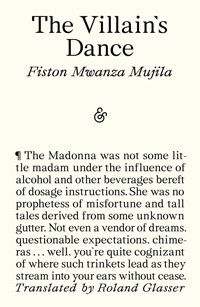
The Madonna was not some little madam under the influence of alcohol and other beverages bereft of dosage instructions. She was no prophetess of misfortune and tall tales derived from some unknown gutter. Not even a vendor of dreams, questionable expectations, chimeras … well, you’re quite cognizant of where such trinkets lead as they stream into your ears without cease. We were only too familiar with the petulant refrains of those curmudgeons who quibbled over such details. They rehashed the same remarks all day long as if there were fuck all else to do on this earth but poke fun at the Madonna—“Tshiamuena this, Tshiamuena that. Tshiamuena’s got wings, big wings, and as soon as night falls, this witch takes off and flits about for miles and miles without a drop of kerosene, jinxing us from above and sabotaging any chance of finding diamonds in the otherworld.” We’d heard it all! Pointless babbling, rumour-mongering, pure humbuggery; for when it came to Tshiamuena, all ears were pricked; everyone became a scientist, a university professor, a sociologist, a linguist, an ethnologist; each proffered their own two-bit philosophy to dissect her every word and deed. Even the most crestfallen rediscovered a 10taste for life, the necessary inspiration, the appropriate panache, the smooth words of a politician on the stump. Go hard on the drink if you will, but concocting poppycock just to sink a person (and an authority like the Madonna no less)—that beggars belief. How can people equipped with a cock, a belly, arms, legs, and a brain spend eight hours a day trying to hamstring someone? All the blame for the woes of tropical Africa they laid at her door: miscarriages, failed coups, wars, Emperor Bokassa’s delusions of grandeur … They speculated without a break, concocted conspiracy theories, strived to detect relationships of cause and effect between the Madonna (blessed be her memory) and any reversal of fortune that befell the Zairian diaspora. And always (and ever still) those rumours of cannibalism. What a topsy-turvy world! The Madonna, a habitual witch with a fancy for flesh and fresh blood? Even if you detest an individual (for plausible reason) it is still insane to make them carry the can for each cave-in, bout of diarrhoea, or act of mischief. They’d not even slept off their beer, polished their teeth, and zipped up their trousers than they were opening their gobs to erratically gun down a living legend.
They made you want to puke, the whole greasy lot of them. Weirdest of all was that the scandalmongers proliferated in direct proportion to the quantity of energy and cash Tshiamuena expended in assisting the masses. Without going back as far as the Flood, you could spread gossip and tittle-tattle and tell tall tales, yet the truth would not budge by one iota: Tshiamuena was a grande dame, an exceptional being, a mother to many of us, a queen, a powerful woman. She lacked an opera singer’s figure, a beauty queen’s splendour, or a 11duchess’ imperial bearing, but she captivated and hypnotized as soon as you met her gaze. Look her straight in the eye and you’d be seized with epilepsy on the spot. We Zairians (mostly born after 1960) would burst into tears as soon as we started to chew the fat with her. When Tshiamuena talked of smuggling in the 1970s, just after Angola’s independence, not one man dared lift his little finger to challenge the veracity of her words. She rattled off entire family trees of the diggers, be they patrocinadors, dona moteurs, lavadors, plongeurs, or karimbeurs. She was not the memory of Angola, she was Angola, the other Angola, the Angola of mines, money, diamonds, cave-ins, the diamantiferous River Kwango; the Angola that any man dreams of at least once in his life (be he a lover of money or not). Tshiamuena was informed of all the rackets going on between Zaire and Angola; she had a detailed knowledge of the Zairians’ comings and goings; she knew when such and such had entered Angola for the first time, which back road they had taken, and what capital they carried in their haversack. In her rare moments of madness (for Tshiamuena did lose her marbles, going by her long tirades and her agitated brow) she enumerated the deceased: long lists of kids, all Zairian, felled in their frantic quest for hasty enrichment by way of someone else’s diamonds—that is to say Angolan stones. Not a hiccough, credulous utterance, or laugh interrupted her narrative flow, even though it was normal in the Cafunfo Mines to come across young Zairians laughing, mouths agape, for no apparent reason. Her beaming features gave everyone the chance to admire her dimples.
Tshiamuena was born to reign. What a woman! Arms raised, as if a rifle were pointed at her, she pontificated in 12pizzicato, and we, in our tattered rags, as still as salt statues, indifferent to heat or cold, to famine, fatigue, or fear of the next cave-in, we swallowed her reminiscences like bread rolls spread with soya paste. Tshiamuena was raving, but with such nonchalance. Her fantasies, we lapped them up. Toxic and excessive masculinities were crushed in the bud. Her words touched you, plunged down your oesophagus, smashed your cerebral system, and you emerged exhausted, truly breathless, as if you’d escaped a nasty pogrom or done a thousand years’ forced labour. Her uncontrolled exhaustions, her nervous breakdowns, her secretions of drool, her vomitings, her momentary losses of speech, of hearing, and of smell too, her tremoring feet and head, and her inopportune drowsiness added grist to the mill of those who accused her of belonging to a sect and sabotaging people’s fortunes, not to mention preventing them from hitting pay dirt without sacrificing a member of their family. Her incantations concluded with sumptuous moments of silence that even the foot soldiers of the UNITA rebellion didn’t dare transgress. This natural silence fell heavier than starved bodies gorged on digging or the despair of returning to Kinshasa empty-handed. The silence, along with her grating voice and the rare assurance with which she recounted her inanities, was the daily fare of those protracted nights deprived of light bulbs, oil lamps, or even the Good Lord himself.
“In the 1970s,” she declared, with a dry throat and an empty gaze like that of the dying or of someone who has lost both parents that very day, “Angola was heaven for audacious and opportunistic Zairians besotted by easy money. Any Zairian 13from Kinshasa and Kasai old enough to be wed and eat their fill swore only by Angola. The Portuguese colonists had packed up and cleared out in a hurry. Dr. Jonas Savimbi’s UNITA and José Eduardo Dos Santos’s MPLA, which had actually fought alongside each other in the war of independence, were embroiled in a rearguard battle for the monopoly of power. At this juncture,” whispered Tshiamuena, with a defeated air and on the verge of tears, “Angola was becoming a colander. Porous borders. A stampede in both directions. Zairians of your age breezed in by the dozens, the hundreds, carrying all sorts of goods. Angola was cut off from the world. And staples such as wax fabrics, cigarettes, beer, transistor radios, tinned foods, rubber boots, sugar, salt, soap, and second-hand clothes were snapped up like you haven’t the slightest idea. We bartered gems for these products thousands of times.”
Tshiamuena was an unparalleled raconteur. She would recap the same tale fifty times. And with each telling, the story took on a different flavour. A living, ancient eyewitness to this golden age (war being the most generous period for doing business: it’s double or nothing, you fill your boots or you lose your money and your skin too), she lamented the fact that some Zairians shamefully stuffed their pockets at Angola’s expense, yet she herself had no shortage of stones about her person. She said that the Angolans were in a far from celebratory mood and consequently did not keep their eyes on the diamonds. They were at each other’s throats while the stones lay idle. Ah, the Madonna! A remarkable woman, Tshiamuena! Any Zairian who had cut their teeth in Angola would have testified for her, even with a gun to their head. The Madonna of 14the Cafunfo Mines was certainly not of the same flesh as we who strayed for centuries in Angola’s alluvial mines. She was a wonderful person. An oasis in the Kalahari Desert. Drinking water. Mother Earth. Temple Guardian. Railway through the scrubland of our dog-eared dreams. Goddess of Grub. Zaire River in miniature. Architect of our opulent desires. Eldest Daughter of money and abundance. Patron Saint of the Zairian diamond panners of Lunda Norte. Ah, the Madonna! Miles of love in the service of the Zairian diaspora. Take the diplomatic service of the Republic of Zaire in Angola, which was out of action—closed, padlocked, null and void—for reasons of belligerency: the Madonna embodied the Zairian Embassy all on her own.
In that period, a whole swathe of Angolan provinces (including Cafunfo) found itself under the control of the rebellion, which held the mining concessions in an iron grip. They regulated who entered or exited the mines to the nth degree and earned a few kopecks for each diamond found. The quarries were only accessible at prescribed hours. The diggers needed a permit both to stay in the camps and to enter the mines; without it, they could be harassed to the point of death.
It was amid these vexing circumstances that the Madonna entered the scene. She delivered the captives from the rebels’ clutches; leveraged her contacts, starting with her Angolan husbands in chronological order (Mitterrand, Kiala, Augustino, José), to enable each and every one to come into possession of the proper papers; cared for the sick and those injured in cave-ins; handed out food to the most destitute; and managed to sort out the repatriation of the mortal remains of those whose 15families couldn’t venture into Angola. The list of her good works is as long as the Zambezi River.
The story went round in Luanda and Lunda Norte that when she was just a slip of a girl she managed to save her parents from an arson attack. Here’s how it goes: the fire blazes through the kitchen and spreads towards her parents’ bedroom. From her crib, the child realizes the danger. She shrieks and somersaults, but her mother and father are in a deep sleep. With superhuman effort, she climbs out of her cot. Here there are two conflicting versions. Either she crawls to her parents’ bedside and, alerted by her screams, they wake. Or—even more fantastical—she remains in her cradle and starts to cry, first teardrops, then tears as vast as the (Zaire) River until they extinguish the flames.
All those who returned from Angola, their pockets empty or brimming with stones, spoke in purring tones when mentioning the Madonna, perhaps to guard against probable sobbing. They were unanimous that the Republic of Zaire should pay Tshiamuena back in her own coin. Render unto Caesar the things which belong to Caesar. Render unto the Madonna of the Cafunfo Mines the things which belong to the Madonna of the Cafunfo Mines. Emotion getting the better of them, they went all in, insisting that Cabu Bridge bear her initials henceforth, that Avenue Saio be rechristened after her, and that on Place Victoire a monument seven metres tall be erected portraying her holding a diamond aloft in her left hand.
2. A family distraught, where we learn the damage caused by Molakisi’s departure.
Molakisi had upped sticks without leaving an address, dispatching a postcard, or even making a phone call—“Dear parents, I’ve put a stop to my smooth chat, facile insults, and habitual thieving.” His precipitous and poorly arranged abscondment exacerbated conflicts among his kin and sowed disorder in their minds. His father stopped getting smashed and clamouring for the carving up of the province (Tata Mobokoli was known for his excesses) and expressed his despondency with much salience:
“There’s more to life than the Secession,” he lamented. “Sure, my kid’s steeped in petty criminality, a lustreless little lout you’ll say, but he’s my son after all. You’ll not make me gloat when I don’t even know where he crashes, if he eats his fill, or how he’s managing to cope. It’s a farce been going on since Babel: the little brats are as headstrong as the river. The river has no nationality. Consequentially, it holds neither vaccination card nor passport. The river crosses whatever country it pleases without due notice. What nationality is the Zambezi or the Danube, which crosses nine countries? The river has that primal insolence, it mills around and wanders according to its fancy. You find children who behave in this manner. They pick their own path: the wise way or, in extreme cases, the smuggler’s. You can pull out absolutely all the stops, provide them with opportunity and give them your blessing, pay scrupulous 17attention to their upbringing, love them to bits; ultimately it’s the little brats and them alone who choose which future to embrace. What would you have me do? Am I the guilty one? I’m not holding out for happier days but it seems insensitive all the same to be constantly condemning me behind my back on the pretext that I’m a deficient father.”
Tata Mobokoli almost always concluded his jeremiads in the same way:
“All the children marauding the streets of Lubumbashi and Kinshasa constitute a race, the race of the outcast and the destitute; so what’s my progeny doing among them? Well, show me a parent without at least one little brat who’s flown the coop.”
Molakisi’s sisters went nearly crazy. One couldn’t say for sure that their dissolution wasn’t also connected to a poorly assimilated pubescence. They verbally assaulted law enforcement officers, hit on passersby, and pissed in the open air, laughing like mad. Not to be outdone, Mama Mobokoli skipped her Pentecostal Church and boycotted the Good Lord, along with the fasting and praying that characterized her housewife’s day-to-day. Many saw in her attitude, as well as in her husband’s distress, a grain of cynicism. They were dejected, tearful, physically wrecked, and yet, barely a few weeks earlier, they’d been berating their progeny, calling him butane bottle, amoeba, catfish-faced coward, and other profanities of the same sluice, to the extent that it became awkward to be in their company given that one or the other or both (in seasoned unison) disparaged the kid without pause. The most dreadful aspect of this uproar, however, was that Molakisi couldn’t care less. Damien and Ézéchiel, the second-youngest and the baby of the family, were 18perhaps the only ones who didn’t give a shit about the fugitive. Following the departure of their fuckwit brother, they pranced around in his shoes, chests thrust out, faces beaming.
One man’s tribulation is another’s delight. As Sanza—a pal of Molakisi’s who’d been living with the family for a while—was preparing to roll out his mattress, the two clowns turned on him.
“Clear the floor and never set foot in our crib again.”
“Piss off and don’t bother us no more!”
Despite their seven-year age difference, Damien and his bruv hatched all their little plots together, going so far as to parrot each other in any squabble. This earned them the nickname “Clone Brothers.”
“Playtime’s over, it’s bye-bye to the comprador-bourgeoisie,” declared Damien, while his brother, armed with a chair, stood watch. Sanza turned his gaze on the pair. His left hand quivered. He had an insane desire to let rip. But realizing that sticking up for himself would serve little purpose, he picked up his odds and ends—an empty schoolbag, two pairs of trousers, a cardigan—and stepped out the door, shooting them a deathly glare.
3. Sanza by a night without fuel oil.
The city of Lubumbashi hadn’t aged a bit. Just as back in the day those living in La Cité on the outskirts would pile Downtown as soon as the Angelus struck to their jobs as manservants, childminders, cooks, houseboys, gardeners, mechanics, builders, and errand boys for the Belgians, the French, or the Americans and had to leave by nightfall on pain of prison or a thrashing, the inhabitants of Kamalondo stepped over the rails separating La Cité (or what was left of it) and Downtown each God-given morning and rushed to regain their hearths as soon as night fell—in the absence of a cogent car, a bus ticket, or out of fear of fainting amid the monstrous traffic jams. Everything was concentrated in the old town. Taxi drivers, office workers, traders, school kids, bankers, the jobless, robbers (there wasn’t much to pinch in La Cité and also it didn’t look good to be caught red-handed by your neighbours) returned from work in a celebratory mood. Automobile headlights clashed like fireworks in a sky deprived of electricity. Hens, pigs, and goats also dashed to doze (some inhabitants owned livestock—nostalgia for the village? mercantile minds? both perhaps). So the animals hurried too. Worn down by the sun, the fatigue, the mud, or the dust, they were basking already in incipient torpor, slumber, mandatory easement, for they spent all day outdoors, snouts to the wind, amusing themselves, bickering, boning, lazing around, nibbling at random detritus and—in the case of the 20dogs and other canines—barking for trifles. The dust—or the river or the sludge (when it rained gallons)—merged with the black night. Car horns in the African night. Car horns. More car horns, which were met with laughter, sarcasm, or scowls.
“Day go well?”
“Err, Zaire kinda pace.”
“And the little one, she’s good? Eating fufu yet?”
“How handsome you’ve become!”
“A lovely romance, you know.”
“That’s Zairians for you!”
People hailed each other, took the temperature of the country, or waved hello from afar.
Lost in his thoughts, the young man made his way over the railway tracks—as a vast crowd crossed it in the opposite direction dumbfounded by the sight of this kid doing the reverse at such a late hour of the day—dove down Chaussée des Usines, passed Jason Sendwe Hospital on his left, then the Central Market, and turned onto Avenue du Maréchal Mobutu.
Might as well sleep in front of the Post Office, when all’s said and done! mused the lad.
Night had already grasped the whole province to its bosom. Downtown was completely dead, its occupants double-padlocked in their hovels as in the ancient days of the Colony.
All the kids who flew the family nest naturally emigrated Downtown until they found a profession (shoeshine boy; pickpocket; dishwasher in a cheap restaurant; detective at the service of cuckholded husbands and ladies in distress; docker at the Central Station; hawker of second-hand plastic carrier bags, sandals, and West African boubous; taxi tout; diamba smoker; 21mechanic’s assistant; street sleeper) or else climbed aboard the first train for Mbuji Mayi or washed up in a mine as a sifter or a kasabuleur (a diver equipped with an air-supplied helmet).
Not knowing what route to take, Sanza tramped the back-streets blindly. At one point he even contemplated returning to the family home, then recanted. Thinking about his parents who, because of his many months away, would send him packing, dole him out a good hiding, or scold him like never before, he decided to stay out in the wild—what the fuck would I do back there? he tried to convince himself, I’m not giving up my rights and my freedom!
4. Back when the Madonna was living in Angola, it warmed your heart to be Zairian.
The Madonna was engaged in a long rant (“the Lunda Norte of this afternoon, this morning, or even this evening is not the marvellous province we Zairians once knew when we arrived in Angola just after Independence. It is buried forever in the muck of history and will not show its face for anything in the world. There is no lifeline. We’re set for centuries of poverty, my brothers; shortages, rotten luck …”) when we heard a creak. A filthy young man, whose ugliness was perceptible a mile off, stood in the doorway. The clothes he wore were so dirty that making out their original colour was hit or miss. In his left hand he held a suitcase that didn’t close, into which was stuffed some underwear, two pairs of trousers, some socks and a pair of scissors. The teen blinked as if he were seeing for the first time in his life. As exhausted as he was by the Corta Marta, the route through the back country taken by the diggers and merchants on their way to or from Zaire, he seemed astonished by the spectacle that confronted him. In the course of his incredible journeyings on goods trains, his jaunts round the tortuous streets of Kinshasa’s shadiest neighbourhoods, and his disreputable frequentations in the Kasai province, the boy had come to hear of this enigmatic woman, but, like any good sceptic, he had underestimated her feats.
Tshiamuena, who, caught in the torrent of her words hadn’t noticed the weird arrival, continued in her mourner’s 23voice—deep and languid and peppered with cries—to talk of the land of plenty:
“The Angola of old, the Angola of inexhaustible diamonds, the Angola of fortune, of the days when the stones abounded and were even gleaned from dustbins; when the few intrepid Zairians who poked their noses into the hive departed blessed, yea, until the fourth generation. It was right at the start of the war, and the Angolans, who were fighting among themselves, did not have sufficient time at their disposal to deal with the stones. We, however, were pioneers in the hunt for Angolan diamonds. The Angola that we barely brushed with our fingers after the Portuguese took flight will never return. Today—and you are all better informed than any seer—the earth boycotts us with its diamonds. Worse still, the number of wealth-seekers is increasing so hugely that one wonders who will remain in Zaire if all its youth descends upon Lunda Norte. Ah! Angola, when you hold us in your grip!”
The young man made his move.
“I’m looking,” he mumbled, without even stepping forwards, “for Tshiamuena …”
No one in the august assembly paid him any heed. The Madonna’s inanities had the effect of a fine wine. As you absorbed them, you became merry, and then you lost the plot. Tshiamuena preached her head off, and the Zairians (along with a few cherry-picked Angolan subjects) lashed themselves to her incantations, totally drunk on them.
The kid collapsed. The diggers were so beguiled that none of them noticed a thing, or got aggravated, or cried in astonishment, or ran to help. Seconds, minutes, hours passed until 24Tshiamuena, in the middle of an anecdote, raised her head and caught sight of the limp body. She screamed then:
“So this is the Angola of today: someone’s dying and you sit on your hands!”
Anger, sadness, stupefaction. The vociferations of the First Lady were followed by a general commotion. Everyone rushed towards and pounced upon the recumbent stranger. This one wanted to give first aid, that one second aid, another begged the Good Lord out loud or else set to expelling the demons of disease, accident, and death—“spirits of darkness, leave this body; I order you in the name of Jesus Christ to piss off!”—so that the young guy would breathe again. An opportune moment for each to prove to Tshiamuena that they, too, had a big heart. The masquerade around the youngster made her all the more incensed. She felt offended, humiliated, sickened, and emptied of her humanity.
“Eles são todos mentirosos …” she whispered. She only ever expressed herself in Portuguese in cases of emergency. Without going back as far as the Flood, we had heard her make use of this language on just two occasions. The last time was when Zeze, a young Angolan kasabuleur, failed to resurface. His demise caused quite a stir within the Zairian diaspora of Lunda Norte. Every avenue was pursued: suicide, contract killing, human error, equipment failure related to the outdated nature of the watercraft, accusations of witchery, white magic. To put an end to the most persistent, far-fetched, stupid, and inappropriate rumours, the Madonna summoned all the Zairian garimpeiros old enough to make an attempt on another’s life or to do something foolish—including those from Kasai, her 25home province—and furnished us with her four truths. I had never seen that expression on her face before. She grouched in faultless Portuguese about the Angola of the mines and its (intimate!) secrets. Where had she learned to speak Angolan with such finesse?
Two colossal fellows moved the body to the very back of the room, where they took turns administering cardiopulmonary resuscitation without any convincing result. Tshiamuena began to weep, her past as a professional mourner getting the better of her. Fat teardrops streamed down her cheeks. Suddenly, one guy had a brilliant idea.
“A wet flannel!”
The Madonna slipped out, reappearing a second later with a cloth that she herself applied to the kid’s forehead, and he soon stirred, to the compulsive applause of the assembled company.
The Madonna was a woman of great moral probity, and extremely maternal. We would all have liked her as our wife, mother, grandmother, sister-in-law, forebear, ancestor, clan founder, matriarch, and so on and so forth. I know guys who’d have auctioned off everything—down to the last diamond carat—to have her just as a distant cousin despite her chidings that were borderline ridiculous: “Franz, you’ve not had a shower for months and your breath is distracting when you talk to people!”
With Tshiamuena, her emotions were so mixed up it was hard to figure out her misgivings. Even when she was happy, she griped, pouted at greetings, and harangued the Zairians (of both the male and female sexes) and the Angolans left, right, and centre. 26
•
Whereas we stupidly believed that she had left to go and relax, she eventually showed up with a cooking pot full to the brim with spicy beans and sweet potato, an enamelled steel cup, a container of juice, a spoon, and even a napkin!
A woman of her calibre never rests, for how can you nap with such a weight on your shoulders? There were the mortal remains of Zairian diggers to be repatriated to Kinshasa and to the Kasai; the dozens of mouths to feed; the rescuing of people pressed into service by the Angolan government forces or the UNITA rebels; the wounds and aching carcasses of casualties (of cave-ins) to be dressed; the brawls and other generational conflicts to be arbitrated; the psychological support for the most vulnerable; the Portuguese and Tshiluba language classes provided for all; the weddings to be overseen; the succour to be given to those struck down by smallpox and typhoid; and so on.
We let her lurch these trinkets over all on her own. Out of jealousy. Why should a boy from some scrubby patch in the sticks enjoy these almost princely honours? The young man licked his chops as soon as he viewed the beans. He sat with his legs akimbo and masticated without taking his eyes off the pot, as if the grub were going to evaporate. Swallowing the last mouthful, he dusted off his mush and, without displaying any sign of gratitude at all, stood up to leave for goodness knows where. The furore cooled his zeal.
Every evening, conclaves were held in her living room. Zairian and Angolan diggers, young and not so young, standing 27or straddling the benches, smoked, played cards, parleyed and palavered, and recruited potential work colleagues. Back then, the Cafunfo Mines in the Angolan province of Lunda Norte were the most bountiful in central Africa. Zairians who went there got rich in record time. Then they returned to Kinshasa, or left to go live in Libreville in Gabon, or in Europe, and came back only when they’d blown all the cash. The Cafunfo Mines were also known to be a death trap that ran at a rhythm of three cave-ins a day. Either way, the operation required a plentiful workforce as pliable as could be. When someone died in a cave-in, they were buried as quickly as possible and new diggers were hired immediately. Digging candidates who’d arrived that day took part in this ritual without which it was hard to get access to the stone. They identified themselves, then answered in turn the sometimes-humiliating questions of the mistress of the house, and those of the diggers who’d come to witness the recruitment test en masse. The diamond panners worked in cooperatives called écuries, or teams, and each of these had its speciality. When a candidate’s profile enraptured a gang of diggers, they incorporated him in their écurie. Since mining requires some of the greatest teamwork on planet Earth, each écurie comprised young and not-so-young guys: ace free divers; frogmen; kasabuleurs (for hunting the stone in the River Kwango); dona moteurs who supplied the boat and the diving equipment; karimbeurs, or diggers, who could withstand the fatigue as their excavations progressed ever deeper; muscular mwétistes to haul the gravel out of the river when the kasabuleur had finished filling the buckets to the very top; a highly mobile team not unlike infantry to escort the merchandise to 28the riverbank where it was sorted and weighed by the lavadors, then transported by the same lavadors or by other mwétistes to makeshift repositories; a good sponsor or patrocinador if the dona moteur wasn’t rich enough to supply the work tools, buy food, beer, and cigarettes, and settle the bill for exploitation rights with the soldiers of the UNITA (Jonas Savimbi’s rebels who controlled the Cafunfo region), in return for which the patrocinador received a percentage on each stone. The chain of collaborations of diggers and the like stretched as far as Antwerp via Kinshasa and the Bandundu province through multiple dealers and middlemen. A diamond, or indeed any stone in the Angolan province of Lunda Norte or the Kasai, had no value until it reached the international marketplace.
The Madonna suggested—the term is inappropriate, she insisted upon the way of action, whether you liked it or not, whether it fuelled rumour or provoked slander—to skip the session devoted to miscellaneous news and start straight into the job interviews. She decided to let the newcomer go first. Aided by the oil lamp, those of us with ringside seats had the remarkable opportunity to admire the boy up close. You had to be there to see the face he made. Incapable of looking up. Shifting about like a rheumatic. Teeth unpolished for aeons. Crumpled shirt. Faded, threadbare trousers. Ditto the vest. Warped sandals. And, as if that wasn’t enough, a boxer’s nose. We used to say in the mines that money diminishes ugliness, and if you’re skint and gruesome to behold, and don’t sufficiently stuff your face, the unsightliness increases, deteriorates, and multiplies. Tshiamuena held this view also, though she didn’t much go into detail about it. Naturally ill-formed, the young man had kind of broken his 29own record. Tshiamuena—and this only happened once a year—defenestrated into raucous laughter for no apparent reason. Not wanting to seem dumb, he imitated the grande dame. The perfunctory, poorly spelled laugh lent his face the features of a carnival mask. Tshiamuena had grown into her role—and the extravagant sobriquet of Madonna of the Cafunfo Mines—by force of mixing with this rough company. She suddenly ceased her guffawing and fired off the first question:
“You got a name I can call you?”
“Yes.”
“What is it?”
“Molakisi.”
“Where you from?”
“Zaire.”
“That we know.”
“Lubumbashi. I also lived in the Kasai and Kinshasa.”
“That’s some roll of honour!” came a shout from the room.
The comment provoked unexpected hilarity.
“You looking for work?”
“Yes. They told me I could make a diamond haul too.”
Laughter among the congregation. Gibes. A spiteful remark about his nose and his outdated suitcase.
“Your age? Your natural age, from your birth, not your official age.”
The Madonna clung fast to age and all that went with it. It was one of her many themes of predilection—“you really can’t live without knowing your age or at least making use of some far-fetched dating,” she would say by way of excusing her voracity on the subject. 30
“Sixteen next November.”
Tshiamuena stiffened.
“And you want to be rich at sixteen? At sixteen! Sixteen and bourgeois too, isn’t that a bit much?”
Molakisi chafed at this.
“Do you take me for your little doggy?”
He had compromised himself by playing the nice boy—which he really wasn’t. Back when he lived in Lubumbashi and Kinshasa, and even in the Kasai, he was known as a scrapper who’d pile on you for the merest slight. The Madonna was sort of dazed. She hadn’t seen it coming.
“You’ll be asking me to show my parental permission next. You don’t even know me, yet you’re picking my life apart.”
Boos. A soldier drew his piece. Wound up, the diggers hammered at the benches: What gives you the right to talk to Tshiamuena like that? Have you ever once looked at yourself in the mirror? Youngsters today! We’re in Angola, a little respect for Tshiamuena! Take those words back, Australopithecus! You’re not even in the same league as her. You’re just a virgin, you’ve never even had sex in your life, and you think you can look down on your elders? Go fornicate first and then we’ll talk on equal terms. These twentieth century Zairians!
Molakisi had confused the mine with the street. He who swore only by brawling, blackmail, threats, and dirty tricks had happened upon folk who adored those same activities. He apologized:
“I didn’t mean to offend you.”
The Madonna accelerated the series of questions. The quips enjoining him to return to Zaire intensified. As one might 31have expected, it was again Tshiamuena who came to the young man’s rescue:
“He’s only a child.”




