


7,49 €
Mehr erfahren.
- Herausgeber: Open Book Publishers
- Sprache: Englisch
The image of a giant sword melting stands at the structural and thematic heart of the Old English heroic poem
Beowulf. This meticulously researched book investigates the nature and significance of this golden-hilted weapon and its likely relatives within
Beowulf and beyond, drawing on the fields of Old English and Old Norse language and literature, liturgy, archaeology, astronomy, folklore and comparative mythology.
In Part I, Pettit explores the complex of connotations surrounding this image (from icicles to candles and crosses) by examining a range of medieval sources, and argues that the giant sword may function as a visual motif in which pre-Christian Germanic concepts and prominent Christian symbols coalesce.
In Part II, Pettit investigates the broader Germanic background to this image, especially in relation to the god Ing/Yngvi-Freyr, and explores the capacity of myths to recur and endure across time. Drawing on an eclectic range of narrative and linguistic evidence from Northern European texts, and on archaeological discoveries, Pettit suggests that the image of the giant sword, and the characters and events associated with it, may reflect an elemental struggle between the sun and the moon, articulated through an underlying myth about the theft and repossession of sunlight.
The Waning Sword: Conversion Imagery and Celestial Myth in 'Beowulf' is a welcome contribution to the overlapping fields of
Beowulf-scholarship, Old Norse-Icelandic literature and Germanic philology. Not only does it present a wealth of new readings that shed light on the craft of the
Beowulf-poet and inform our understanding of the poem’s major episodes and themes; it further highlights the merits of adopting an interdisciplinary approach alongside a comparative vantage point. As such,
The Waning Sword will be compelling reading for
Beowulf-scholars and for a wider audience of medievalists.
Das E-Book können Sie in Legimi-Apps oder einer beliebigen App lesen, die das folgende Format unterstützen:
Veröffentlichungsjahr: 2020
Ähnliche


















THE WANING SWORD
The Waning Sword
Conversion Imagery and Celestial Myth in Beowulf
by Edward Pettit
https://www.openbookpublishers.com
© 2020 Edward Pettit
This work is licensed under a Creative Commons Attribution 4.0 International license (CC BY 4.0). This license allows you to share, copy, distribute and transmit the work; to adapt the work and to make commercial use of the work providing attribution is made to the authors (but not in any way that suggests that they endorse you or your use of the work). Attribution should include the following information:
Edward Pettit, The Waning Sword: Conversion Imagery and Celestial Myth in Beowulf. Cambridge, UK: Open Book Publishers, 2020, https://doi.org/10.11647/OBP.0190
In order to access detailed and updated information on the license, please visit https://doi.org/10.11647/OBP.0190#copyright
Further details about CC BY licenses are available at http://creativecommons.org/licenses/by/4.0/
All external links were active at the time of publication unless otherwise stated and have been archived via the Internet Archive Wayback Machine at https://archive.org/web
Digital material and resources associated with this volume are available at https://doi.org/10.11647/OBP.0190#resources
Some of the images have been reproduced at 72 dpi in the digital editions of this book due to copyright restrictions.
Every effort has been made to identify and contact copyright holders and any omission or error will be corrected if notification is made to the publisher.
ISBN Paperback: 978-1-78374-827-3
ISBN Hardback: 978-1-78374-828-0
ISBN Digital (PDF): 978-1-78374-829-7
ISBN Digital ebook (epub): 978-1-78374-830-3
ISBN Digital ebook (mobi): 978-1-78374-831-0
ISBN Digital (XML): 978-1-78374-832-7
DOI: 10.11647/OBP.0190
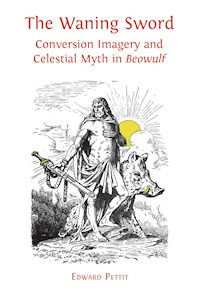
Cover image: Freyr, adapted from an illustration by Johannes Gehrts (1855-1921). Wikimedia, Public Domain,https://commons.wikimedia.org/wiki/File:Freyr_by_Johannes_Gehrts.jpg
Cover design by Anna Gatti.
Very bright was that sword when it was made whole again; the light of the sun shone redly in it, and the light of the moon shone cold, and its edge was hard and keen. And Aragorn gave it a new name and called it Andúril, Flame of the West.
J. R. R. Tolkien, The Lord of the Rings
Grendel by Russell Marks. © Russell Marks. All rights reserved.
Grendel’s mother by Russell Marks. © Russell Marks. All rights reserved.
In memoriam
Alan Paul Pettit
24 January 1918–15 May 1995
Hazell Macdonald Pettit
4 October 1923–16 March 2016
Robert Charles Pettit
20 June 1955–10 March 2011
ic him æfter sceal
Contents
Acknowledgements
xvii
Signs and Abbreviations
xix
1.
Introduction: Beowulf, an Early Anglo-Saxon Epic
1
Part I. Ice, Candle and Cross: Images of the Giant Sword in Beowulf
33
2.
The Giant Sword and the Ice
35
Prior Views on the Melting of the Giant Sword
37
Old Norse Ice-Swords
42
3.
The Giant Sword and the Candle
47
Vargeisa’s Candle-Sword
51
Grýla’s Icicle-Candle
65
The Giant Sword as Solar Candle
71
Sörli and Sigrljómi ‘Victory-Light’
79
The Giant Sword as Paschal Candle
84
4.
The Giant Sword and the Cross
93
The Cross in the Lake
94
Three Old English Heavenly Candle-Crosses
98
Sword-Hilts, Sword-Blades and Crosses
100
Beowulf and Christ as Bearers of the Sword-Cross
112
The Battle-Standard and the Cross
113
Wiglaf as Sword-Bearer and Cross-Bearer
118
Part II. Sun-Swords and Moon-Monsters: On the Theft and Recovery of Sunlight in Beowulf and Other Early Northern Texts
121
5.
Whose Sword Is it, Anyway?
123
Giant-Forged and Giant-Stolen?
124
The Giant Sword and the Theft of Mjǫllnir
129
The Cup-Thief, Grendel’s Glove and Grendel’s ‘Un-Sword’: Aspects of Recurrent Thievery in Beowulf
131
The Basis for Detecting Germanic Myth in Beowulf
137
6.
Ing, Ingvi-Freyr and Hroðgar
143
The Ingwine ‘Ing-Friends’ and Ing, Son of Man
143
Ing and Ingi-/Yngvi-Freyr
145
Freyr, the Friendly God
147
Worship of Ing in England?
147
Ing in the Old English Rune Poem
148
The Inge-Peoples and the Sun-God of Psalm 112
156
Hroðgar and Danish Worship of an Unnamed Devil
158
Hroðgar, Healfdene’s ‘Firebrand’ and the Incgelaf
159
Ingunar-Freyr and Freyr’s Sword
166
Hroðgar as Frea
167
Wealhþeo’s Brosinga Mene and Freyja’s Brísingamen
168
Freawaru
169
The Danes and the ‘Life-Lord’
169
7.
Freyr, Skírnir and Gerðr
171
Fǫr Skírnis and Beowulf’s Mere-Episode
172
Lokasenna, Gylfaginning and the Gifted Sword
184
Gymir and Gerðr as Sea-Giants
185
Hjálmþér, Ýma and Margerðr
188
The Burning Candle and the Barley Isle
194
8.
Lævateinnand the Maelstrom-Giantess
197
Svipdagr’s Quest for Menglǫð
197
Loki’s Taking of the Twig
206
More About Lævateinn and Mistilteinn
210
Saxo’s Hotherus, Balderus and the Sword of Mimingus
212
Lævateinn in the Lúðr
216
The Maelstrom-Giantess in Sagas of Hjálmþér, Grettir and Samson
219
Grendel’s Mother as Maelstrom-Giantess
222
9.
Freyr’s Solar Power and the Purifying Sword
225
Solar Aspects of Freyr in the Eddas
225
Skírnir as Purifier
227
Beowulf and the Giant Sword as Purifiers
230
Freyr as Thawer
232
10.
Freyr, Heorot and the Hunt for the Solar Stag
235
Freyr, Beli and the Hart’s Horn
235
Heorot, the Hart-Hall
236
The ‘Hunted Hart’ Passage in Beowulf
238
The Solar Stag in Early Europe
244
The Hunt for the Sun
251
The ‘Battle-Thief/Wolf of the Sky-Shield’
252
Skǫll and Hati
252
The Old One, the Pitchforker and Mánagarmr
255
Wolf-Snake versus Sun-Stag: Norse Myth on the Gosforth Cross
261
Hunted Stags on Other Anglo-Saxon Crosses
279
The Ovingham Stone
281
One Man (in the Moon) and His Dog
282
11.
A Tale of Two Creatures: The Theft and Recovery of Sunlight in Riddle 29
287
The Lunar Thief and Grendel
289
The Solar Repossessor and Beowulf
291
12.
Another Tale of Two Creatures: The Loss and Recovery of the Solar Draught-Beast in Wið Dweorh
293
An Old English Dwarf-Horse-Deer?
298
A Headache(?)-Causing Dwarf from Denmark
304
Another Headache-Causing Dwarf and a Radiant Sword
305
The Sun as Healer, Especially in Old English Remedies
308
The Dwarf and Grendel as ‘In-Going’ Fever-Demons
309
13.
The Solar Antler in Sólarljóð
315
The Buried Antler and Christian Legends, Especially of the Cross
317
The Solar Antler, the Dwarf-Horse-Stag(?) and a Solar Sword
321
Svafrlami and Dvalinn
324
Dvalinn and the Deaths of Alvíss and Hrímgerðr
328
Runes of Resurrection
335
Sólarljóð and Beowulf
337
14.
Grendel, His Mother and Other Moon-Monsters
339
Trees of Sun and Moon, and a Monster Called Quasi Caput Luna
340
Grendel the Wan
346
Grimm Brothers’ Fairy Tale 175: Der Mond ‘The Moon’
351
The Dead Moon, a Blickling Homily and Beowulf
352
Nið ‘Waning/Dark Moon’(?) in Beowulf
358
Grendel and Glámr, the Monster with Moonlit Eyes
368
Grendel’s Mother and Norse Moon-Giantesses
372
Mána, Moon-Giantess and Thief
373
Mána and Brana
374
Skjaldvör, the ‘Dark-Moon Chest’ and More about the Nið-Dragon
376
Hyndla at the ‘Darkness of Darknesses’
388
Þórgunna, Mána-Ljótur and the Half-Moon
390
The Old One and the Pitchforker, Again
391
Ýma and the Boatforker
395
Two More Male Forkers and a Sword of Lunar Waning
399
King Dagr and the Hayforker
399
Kolr the Gibbous, His Fork-Wielding Son and the Sword Angrvaðill
400
Anger, Death and the Dismembered Moon
406
The Lunar Head and the Solar Head
408
15.
The Sun in the Pike
411
Three Golden Eggs, a Fallen Spark and a Pike
412
Tyrfingr and the Pike
413
Mistilteinn and the Pike
414
Hrómundr Gripsson, Þráinn and Mistilteinn
415
Grendel’s Mother as Pike
418
16.
Conclusion:Beowulf, an Anglo-Saxon Song of Ice and Fire
425
Bibliography
471
Supplementary Note
519
List of Illustrations
521
Index
523
Acknowledgements
Sadly, my greatest debts by far cannot be acknowledged in person, being to the members of my family to whom I dedicate this book.
More happily, I acknowledge my debt to the many scholars whose works appear in the bibliography. I apologize to the many others whose writings doubtless ought to feature but do not.
Thanks are also due to my former teachers of Old English, Old Norse, Old Irish and medieval Latin at various colleges of the University of London: Professor Janet Bately, Professor Jane Roberts, Mr John Porter, Professor Alison Finlay, Professor Richard North, the late Dr Paddy Considine, Mr Robert Ireland, Professor Katie Wales, Dr Eirian Davies and Dr Stuart Lee. None of these people, however, are in any way responsible for the approaches taken or opinions expressed in this book, some of which may prove controversial. I am solely accountable for any errors it contains.
Russell Marks deserves special thanks for generously allowing me to include his splendid illustrations of Grendel and Grendel’s mother. More of his work can be found at www.artstation.com/russellmarks
Finally, I warmly thank Dr Alessandra Tosi, the anonymous reviewers of this book, and the cover design, typsetting, editorial and indexing staff (Anna Gatti, Luca Baffa and Adèle Kreager) at Open Book Publishers for accepting and improving this volume.
Signs and Abbreviations
*
Hypothetical or reconstructed word-form
AbäG
Amsterdamer Beiträge zur älteren Germanistik
AEW
F. Holthausen, Altenglisches etymologisches Wörterbuch, 3rd edn. (Heidelberg, 1974)
ANEW
J. de Vries, Altnordisches etymologisches Wörterbuch, 4th edn. (Leiden, 2000)
ANF
Arkiv för nordisk filologi
ANQ
American Notes & Queries
ASE
Anglo-Saxon England
ASPR
G. P. Krapp and E. van K. Dobbie (ed.), The Anglo-Saxon Poetic Records: A Collective Edition (New York, 1931–53)
BJRL
Bulletin of the John Rylands Library
BT
T. N. Toller (ed.), An Anglo-Saxon Dictionary Based on the Manuscript Collections of the Late Joseph Bosworth, D.D., F.R.S. (Oxford, 1898)
BTS
T. N. Toller, An Anglo-Saxon Dictionary Based on the Manuscript Collections of the Late Joseph Bosworth:Supplement (Oxford, 1921), with A. Campbell, Enlarged Addenda and Corrigenda (Oxford, 1972)
C&M
Classica et Mediaevalia
corr.
corrected
CV
R. Cleasby and Gudbrand Vigfusson, An Icelandic-English Dictionary, 2nd edn. (Oxford 1957)
DOE
A. Cameron, A. C. Amos, A. diP. Healey et al. (ed.), Dictionary of Old English: A to H online (Toronto, 2016)
EDD
J. Wright (ed.), English Dialect Dictionary (Oxford, 1898–1905)
EETS
Early English Text Society
ELH
English Literary History
ELL
English Language and Linguistics
ELN
English Language Notes
e.s.
extra series (EETS)
ES
English Studies
FSN
Guðni Jónsson (ed.), Fornaldar sögur norðurlanda (Reykjavík, 1950)
GD
K. Friis-Jensen (ed.) and P. Fisher (trans.), Saxo Grammaticus: Gesta Danorum: The History of the Danes (Oxford, 2015)
HG
R. North, Heathen Gods in Old English Literature (Cambridge, 1997)
ÍF
Íslenzk fornrit
ÍO
Ásgeir Blöndal Magnússon, Íslensk orðsifjabók (Reykjavík, 1989, corr. rpt., 1995)
JAF
Journal of American Folklore
JAOS
Journal of the American Oriental Society
JEGP
Journal of English and Germanic Philology
JWCI
Journal of the Warburg and Courtauld Institutes
KB
R. D. Fulk, R. E. Bjork and J. D. Niles (ed.), Klaeber’s Beowulf and the Fight at Finnsburg, 4th edn. (Toronto, 2008)
LP
Sveinbjörn Egilsson, Lexicon poeticum antiquæ linguæ septentrionalis: Ordbog over det norsk-islandske skjaldesprog, ed. Finnur Jónsson, 2nd edn. (Copenhagen, 1931)
LSE
Leeds Studies in English
MÆ
Medium Ævum
MED
F. McSparran et al. (ed.), Middle English Dictionary,https://quod.lib.umich.edu/m/middle-english-dictionary/dictionary
MHG
Middle High German
MIFL
S. Thompson, Motif-Index of Folk-Literature: A Classification of Narrative Elements in Folktales, Ballads, Myths, Fables, Mediaeval Romances, Exempla, Fabliaux, Jest-Books, and Local Legends, rev. and enlarged edn. (Bloomington, 1955–8)
MGH
Monumenta Germaniae Historica
MLN
Modern Language Notes
MLR
Modern Language Review
MP
Modern Philology
NM
Neuphilologische Mitteilungen
N&Q
Notes and Queries
OE
Old English
OED
J. Simpson (ed.), Oxford English Dictionary, 2nd edn. on CD-ROM, v. 4.0 (Oxford, 2009)
OHG
Old High German
ON
Old Norse
ONP
Aldís Sigurðardóttir et al. (ed.), Dictionary of Old Norse Prose, https://onp.ku.dk
o.s.
original series (EETS)
OT
Oral Tradition
pl.
plate(s)
PL
J. P. Migne (ed.), Patrologia Latina (Paris, 1844–64)
PMLA
Publications of the Modern Language Association of America
PQ
Philological Quarterly
PTP
K. E. Gade and E. Marold (ed.), Poetry from Treatises on Poetics, SPSMA 3 (Turnhout, 2017)
RES
Review of English Studies
SASE
H. R. E. Davidson, The Sword in Anglo-Saxon England: Its Archæology and Literature (corr. rpt. Woodbridge, 1994)
SASE5–7
P. Mortimer and M. Bunker (ed.), The Sword in Anglo-Saxon England from the 5th to 7th Century (Ely, 2019)
SBVS
Saga-Book of the Viking Society
SnEGylf
A. Faulkes (ed.), Snorri Sturluson: Edda: Prologue and Gylfaginning (Oxford, 1982)
SnESkáld
A. Faulkes (ed.), Snorri Sturluson: Edda: Skáldskaparmál, 2 vols (London, 1998)
SP
Studies in Philology
SPSMA
Skaldic Poetry of the Scandinavian Middle Ages
s.s.
supplementary series (EETS)
SS
Scandinavian Studies
s.v.
sub verbo (or subverbis): ‘under the word(s)’
v.l.
varia lectio:‘variant reading’
1. Introduction: Beowulf, an Early Anglo-Saxon Epic
© Edward Pettit, CC BY 4.0 https://doi.org/10.11647/OBP.0190.01
The Old English heroic poem known today by the editorial title of Beowulf survives, albeit damaged, in a single source: Cotton Vitellius A.xv of the British Library in London. This is a composite of two manuscripts, often called the Southwick Codex and the Nowell Codex, which were probably combined in the late sixteenth or early seventeenth century. The latter manuscript, which contains Beowulf, is thought likely to date from between the late tenth and early eleventh centuries AD.1
Beowulf, however, is almost certainly older than its sole surviving witness. How much older has long been a matter of scholarly debate, with opinions ranging widely, in the main from the seventh to the early eleventh centuries. However, recent detailed research into the poem’s language, metre and textual transmission argues forcefully that there was a version in the Mercian dialect c.AD 700, and for the existence of a written archetype in the early eighth century.2 In this study I accept such a date for the earliest traceable form of the Old English poem, if somewhat anxiously, given that scholarly dissension is likely to continue over what remains, for this field, a hot topic.3 The many arguments that have been advanced down the years to date Beowulf’s composition are often highly detailed and highly divergent in their conclusions. They will not be rehearsed in this book, but two fundamental and readily apprehensible linguistic points strike me as most significant. The first is that Beowulf appears to contain no loanwords from Old Norse, despite comprising well over three thousand lines of verse about Scandinavians in Scandinavia.4 The second is that none of the poem’s many proper nouns, some of which have equivalents in Old Norse texts, appear to show any influence from Old Norse phonology.5 In my view, these points (and others) swing the pendulum of probability firmly toward an early, pre-Viking Age origin.
Very recently, the likelihood of such an origin has, I incline to think, been substantially increased by the Swedish archaeologist Bo Gräslund.6 He has rather thrown the cat amongst the pigeons by proposing that behind the c. 700 Old English Beowulf there lies a product of sixth-century East Scandinavian oral tradition, a poem which, having taken Old English form c. 600, was subsequently retold, with the addition of a veneer of Christianity, by Anglo-Saxon poets in Mercian and West Saxon dialects. I am persuaded by Gräslund’s linking of key aspects of Beowulf’s material culture and many of its events and characters to the late Migration Age in Gotland, Sweden and Denmark. I am also attracted by his claim that the poem’s core narrative was transmitted from Scandinavia to Anglo-Saxon England, perhaps through the court of King Rædwald of East Anglia. It remains to be seen, however, what the wider scholarly community will make of Gräslund’s findings, which effectively propose an Anglo-Gotlandic/Swedish Beowulf, the core of which originated in Scandinavia and was transmitted across time, space, languages and dialects by a series of poets (number and identity unknown) using mainly oral techniques. Convincing validation or refutation of this bold proposal will require considered judgements, over a period of years, from many scholars with expertise in a wide range of disciplines, including Old English language and literature, Germanic philology, mythology, oral and literary poetics, translation, archaeology and early Christianity.
Given that Gräslund’s basic proposal may receive wide acceptance, it is important for me to stress at the start of this book that the Beowulf I discuss is not his putative pagan Nordic ur-Beowulf, but rather the Old English poem preserved inCotton Vitellius A.xv and its presumed Mercian predecessor, complete with Judaeo-Christian elements.
As will become clear, I am not persuaded by Gräslund’s claim that Beowulf acquired merely a thin veneer of Anglo-Saxon Christianity, or at least that its Judaeo-Christian elements may be deemed superficial, and therefore by implication less worthy of respect, even if they may well be secondary in terms of the poem’s development through time. Rather, I consider most, if not all, of them the sensitive, considered—though not necessarily highly sophisticated—integrations of a Christian Anglo-Saxon poet or poets (although not ideal, for simplicity’s sake I henceforth refer simply to a single Anglo-Saxon Beowulf-poet) who in retelling the basic story extensively recreated it. Lacking any evidence to the contrary, it seems at least respectful to suppose that both this poet and his audience found the Judaeo-Christian elements unobjectionable at worst. In fact, these elements, whether explicit, inexplicit or so finely woven into the poem’s fabric as to be inseparable from it (or even undetectable), seem to me integral to the Old English composition and vital to its interpretation in an Anglo-Saxon context.7 Whatever its background, therefore, I treat the Old English Beowulf as an artistic entity worthy of appreciation in its own right on its own terms.
The poem’s Judaeo-Christian elements would have been especially important if, as now seems likely, the poem circulated in Mercia in the sixth and seventh centuries, because, as we shall see, this places Beowulf within a period of religious flux in Anglo-Saxon England. This finding prompts my fundamental view (pursued later in this Introduction and further in my Conclusion) that the Anglo-Saxon poem implicitly addresses the nature of the Conversion process from Germanic paganism to Christianity and assuages associated anxieties.
That said, many of my other findings depend neither on an early date, nor a Mercian background, nor an interest in the Conversion, although an early date would help to explain the preservation of the many old traditions and word-meanings that Beowulf seems to contain. Most of my findings could also suit an essentially East Anglian poem (an attractive possibility),8 a poem from the Mercia-Wessex border area,9 or one composed or revised elsewhere in the country, even during a later period of widespread Scandinavian settlement. Indeed, it might be thought that the presence of many Norsemen in England during later centuries could explain Beowulf’s Scandinavian setting and the correspondences between some of its episodes and those of Old Norse texts.10 However, in my view, Gräslund’s findings, together with the apparently total absence of Old Norse linguistic influence on Beowulf, weigh strongly against this possibility. Such a context might have encouraged the poem’s preservation, but probably did not stimulate its creation.
If Beowulf did exist in sixth- or seventh-centuryMercia, where exactly (or even inexactly) within this large region it circulated or resided is another uncertainty.11 However, the poem’s reference to Biblical events, together with its deep interest in the actions and characters of kings and military nobles, as well as kin-slaying and dynastic succession, might point to a monastery linked to Mercian royalty, or to an affiliated community such as a non-monastic church.
One such potential home for Beowulf was the double monastery at Repton, Derbyshire, founded c. 675.12 It housed noble monks and nuns, and became the burial site of Mercian royalty, including Æthelbald (757), Wiglaf (c. 839) and Wigstan (849).13 It might even be Æthelbald who is depicted as a rider armed with sword, shield and knife—equipment also used by the eponymous hero of Beowulf during his (unmounted) fight with a dragon—on one face of a fragmentary stone carving from Repton. Other faces on the same stone appear to show the Crucifixion—an event alluded to in Beowulf (line 1600)—and a serpentine monster with a man-like face devouring the heads of two men. The latter scene may well represent the mouth of Hell; its monster is somewhat suggestive of Grendel, the poem’s troll-man, who, although not ostensibly snake-like, was a human-devouring demon who inhabited a serpent-harbouring mere identified with Hell.14 Additionally, it so happens that among Repton’s monks was one Guðlac (c. 674–714),15 parts of whose story resemble aspects of Beowulf,especiallythe central mere-episode. These merit summary here because, if nothing else, they show that a tale rather similar to, and conceivably influenced by, Beowulf’s mere-episode existed in England in the first half of the eighth century.
According to the Vita Sancti Guthlaci ‘Life of Saint Guthlac’, written by the monk Felix c. 730–40,16Guðlac descended from kings whose lineage stretched back to Icel, a legendary Germanic ruler whose father, Eomer, appears briefly in Beowulf (1960–2). As a young man, Guðlac had been inspired to take up arms by remembrance of the valiant deeds of ancient heroes, which he had presumably heard about from recitations of Old English poems. After fighting gloriously for nine years on the western borders of Mercia, he was struck one wakeful night by the wretchedness of the deaths of his royal ancestors and the transitory nature of earthly riches and glory. This realization prompted him to enter the monastery at Repton. After two years of spiritual education and exemplary virtue, he left to live as a hermit in a hut on a barrow in the marshy wilderness of Crowland, Lincolnshire. There he kept watch by night, but was attacked by demons who submerged him in the fen’s dark waters and took him to fiery Hell. Guðlac defied his abductors, though, identifying them as the semen Cain ‘seed of Cain’.17 Immediately afterwards he was saved by the miraculous appearance in Hell of St. Bartholomew, bathed in a golden, heavenly light so glorious that the demons could not bear it. Bartholomew commanded them to escort Guðlac safely back to his home, which they did.
Similarly, Beowulf was an exemplary warrior, both physically and temperamentally, who won all his battles. As Guðlac kept watch by night in his hut in a marshy landscape, so Beowulf kept watch by night in Heorot, hall of the Danes, not far from Grendel’s marshy home. As Guðlac was attacked by demons identified as the offspring of Cain, so Beowulf was assaulted by the devilish Grendel and Grendel’s monstrous mother, themselves descendants of Cain (102–14, 1258–67). As demons dragged Guðlac through dark fen-water and down to fiery Hell, only to be thwarted by the sudden appearance of heavenly light, so Grendel’s mother drew Beowulf down through the polluted waters of a fenland mere to her fiery, hellish lair,18 only to succumb in a sudden illumination by heavenly light.19
For what it is worth given the huge gaps in our knowledge, we know of nowhere other than Repton that can claim all of the following: existence c. 700 in Mercia; close ties to Mercian royalty; carvings of an armed warrior, the Crucifixion, and a partly man-like man-eating monster at the mouth of Hell; and a prominent alumnus whose story resembles Beowulf’s in key respects. We have no direct evidence of a link between Beowulf and Repton,20 but in view of the probably highly diverse nature of monastic communities at this time, and of their links to lay society and monarchy, it would at least make sense for the poem to have been associated with some such milieu.21
That poems about ancient Germanic heroes were recited for clergy in Anglian (perhaps Mercian) communities in the eighth century, though probably in a non-monastic context, is indicated by a passage from a letter written by the Anglo-Saxon scholar and churchman Alcuin. In 797 he addressed a certain Bishop Speratus, who is possibly identifiable as Unuuona (Unwana, Unwano) of Leicester.22Alcuin declared that Speratus should feed the poor, rather than host istriones vel luxoriosos ‘entertainers or persons of extravagant behaviour’.23 He continued:
Verba Dei legantur in sacerdotali convivio. Ibi decet lectorem audiri, non citharistam: sermones patrum, non carmina gentilium. Quid Hinieldus cum Christo? Angusta est domus: utrosque tenere non poterit. Non vult rex celestis cum paganis et perditis nominetenus regibus communionem habere; quia rex ille aeternus regnat in caelis, illes paganus perditus plangit in inferno. Voces legentium audire in domibus tuis, non ridentium turbam in plateis.24
Let God’s words be read at the episcopal dinner-table. It is right that a reader should be heard, not a harpist, patristic discourse, not pagan song. What has Hinield [Ingeld] to do with Christ? The house is narrow and has no room for both. The Heavenly King does not wish to have communion with pagan and forgotten [or ‘damned’] kings listed name by name: for the eternal King reigns in Heaven, while the forgotten [or ‘damned’] pagan king wails in Hell. The voices of readers should be heard in your dwellings, not the laughing rabble in the courtyards.25
Some around Speratus’ table had presumably taken a different view. They enjoyed listening to what were probably Old English poems, perhaps sung to the accompaniment of a lyre, about pagan heroes. These heroes included Hinieldus, who appears briefly in Beowulf as Ingeld, a prince of the Germanic Heaðo-Beardan tribe (2064–6). Conceivably, Beowulf was among the poems recited at Speratus’ table.26
It seems most unlikely that an Anglo-Saxon Beowulf-poet will ever be conclusively located, let alone identified. But if the poem was probably in existence c. 700, even this single finding is potentially highly valuable for efforts to contextualize and interpret it.
For one thing, this date places the poem well before the period of Viking attacks on England, which began in the late eighth century and led to the settlement of large parts of Mercia by Norsemen.27 This could explain both thelack of Old Norse linguistic influence upon Beowulf and the poem’s committed and generally sympathetic approach to the world of early sea-faring Norsemen.
For another, such a dating places the poem roughly three hundred years closer than the scribes of Cotton Vitellius A.xv to the events and people described, many of which have been dated to the fifth and sixth centuries.28 This encourages belief that many of the tales told in the poem could well reflect traditions that had passed down the generations, encapsulated in oral verse.
Such a sense of communal knowledge and of the re-enactment of common story-traditions seems prominently indicated by the poem’s opening words: Hwæt we Gar-Dena ingeardagum, þeodcyninga þrym gefrunon ‘How(?) we have heard of the glory of the Spear-Danes, of the people-kings in days of yore!’29 Ostensibly, the audience is to hear what it has already heard; the poet introduces Beowulf not as something new, but as a restatement of shared traditions inherited from long ago.
This is not to deny the importance of individual authority, imagination and artistry in the creation and re-creation (performance) of Beowulf, especially as the reciter subsequently speaks in the first person (38, 62, 74, etc.). Nor is it necessarily to claim that the Danish and Geatish societies described accurately reflect the historical realities of sixth-century Scandinavia—though it now appears that they may well do, in key respects at least.30 But it is to emphasize that the poem was not created ex nihilo, and that although subsequent reciters might update tradition—most obviously, it appears, by introducing Christian elements—and perhaps invent new material (though arguably not the very existence of the poem’s elusive hero),31 they may not have been at liberty fundamentally to misrepresent—in the opinion of their audience—communal lore. In other words, it appears likely that the essence of many of the episodes related could have come from earlier, heathen times, even if they may have been given some ‘new clothes’. Furthermore, the somewhat elliptical manner in which the poem relates complex passages such as the Finnsburg-episode and later detailed sections concerning tribal wars and dynastic relations strongly suggests that, unlike us, his audience had considerable prior knowledge of these matters. The same may be the case for much of the poem’s other, more mythical and fantastic material, on which this book focuses.
Certainly, poems composed using oral-formulaic techniques, examples of which Beowulf may itself incorporate,32 are more than capable of preserving the essentials of stories for a period of less than two hundred years, which is all that separates the times of which the poet tells from c. 700. Consequently, it is reasonable to assume that one basic historical fact was known to the Old English poet, namely that, unlike him, the Scandinavians he described were pagans, worshippers of northern gods.33 That point presumably constituted a fundamental difference for a Christian, but could also have served as a source of connection. For Anglo-Saxon pagan traditions, many of which are likely to have been akin to those of related peoples in Scandinavia, were probably neither forgotten nor always far from the surface c. 700. This likelihood presumably extends to heathen mythology, which, though doubtless never uniform and homogeneous but subject to considerable variation, would, like the mythologies of other peoples, also have had ‘capacity for long-term continuities’, for ‘historical endurance’.34
In Anglo-Saxon England, the seventh century was an age of ferment characterized by the clash of Germanic paganism and Roman Christianity. The former stemmed from traditions brought to England by invaders from northern Germany and southern Scandinavia in the fifth century, the latter from St. Augustine’s arrival in Thanet in 597. Whatever their political motives for fighting, the armies of kings of rival religions had clashed on the battlefield. Most notably, in 633 the Christian convert Edwin, king of Deira and Bernicia, had died fighting an alliance of enemies led partly by the heathen Mercian Penda; the Christian King Oswald of Northumbria had succumbed to Penda in 641/2; and in 654/5 Oswald’s brother and successor, the Christian Oswiu, had finally managed to slay Penda. In the process, Oswiu had struck a decisive blow against paganism—Mercia became officially Christian.
At least that is the authorized, high-level picture after Penda’s death. However, it is important for the contextualization and interpretation of Beowulf to recognize that, by 700, although Anglo-Saxon England was ruled exclusively by Christian kings, far from all of its people’s ingrained heathen ways had been eliminated. As one scholar concludes, following a review of Anglo-Saxon laws forbidding heathen practices:
It is evident … that while Anglo-Saxon England in the eighth century was Christian in name, heathenism had not been wiped out; it had been driven underground, and apostasy, open or secret, was an ever-present possibility. It seems probable that considerable segments of the people remained to some degree pagan at heart, while practicing a minimum of outward conformity.35
The implication is that elements of heathen thought, of pagan myth, retained relevance to many people in England at this time.36
For some Anglo-Saxons, a contributing factor to the survival of certain heathen ways was probably experience, or at least awareness, of the severe plagues that ravaged England in the second half of the seventh century.37 Judging from the evidence of cemeteries, these plagues coincided with ‘a revival of traditional beliefs about the potentially dangerous dead and a consequent resort to traditional means to de-activate them’.38 This conclusion chimes with the testimony of the Anglo-Saxon monk Bede (c. 673–735) about apostasies prompted by plague in East Anglia and Northumbria in 664.39 It was only natural that disease, and the threat of it, should have prompted some Anglo-Saxons to return to familiar heathen ways.
Also contributing to the survival of elements of paganism into the early eighth century was a major aspect of the Conversion process, one that supplemented military force, legislation, promises of eternal bliss and threats of perpetual damnation: the methodology of limited accommodation and adaptation. As is well known, Pope Gregory wrote a letter to Bishop Mellitus (d. 624), one of his missionaries to England, instructing him to advise Augustine how to proceed with the people’s Conversion.40 He commanded that although their heathen idols—presumably often wooden statues of Germanic gods—should be destroyed, the shrines containing them should be blessed with holy water and converted into houses for Christian altars and relics. Similarly, their sacrifices of cattle to devils (Germanic gods) should be converted into slaughters of cattle for food and accompanied by praise of God for his generosity. Gregory’s recommendation is pragmatic: ut dum eis aliqua exterius gaudia reseruantur, ad interiora gaudia consentire facilius ualeant. Nam duris mentibus simul omnia abscidere inpossibile esse non dubium est ‘thus while some outward rejoicings are preserved, they will be able more easily to share in inward rejoicings. It is doubtless impossible to cut out everything at once from their stubborn minds’.41
From these findings it is apparent that, if we envisage a Beowulf-poet of mature years c. 700, he and presumably members of his audience had experienced, and continued to witness, complex times of religious and societal turbulence. These experiences would have influenced their outlooks on life. Some of these people would most likely have been converts to Christianity themselves. They would not be human if they did not retain some emotional attachment to their old ways or to some of the heathens they had known personally, not least their parents. Many such people would surely have welcomed efforts to incorporate aspects of the old ways into the new—to salvage important parts of their identity—or at least to smooth the transition to the new religion.
In my view, Beowulf represents one such effort. Of course, the poem is not set in seventh- or eighth-century Mercia or anywhere else in Anglo-Saxon England, notwithstanding the poet’s possible hints of monstrous mearcstapan ‘Mercia(?)-steppers’.42 But if my view is correct, the poem subtly assuages what for many Anglo-Saxons must have been extreme concern about the fate of deceased ancestors who had not known or accepted Christ. Were those people damned for eternity, regardless of their character and actions? Was there no hope of salvation for even the best of them? Many people must have asked such questions, and the official answers would often have been uncompromisingly bleak. By contrast, Beowulf appears to offer hope, though only subtly and obliquely, through hints and ambiguities, not forthright answers.43 Understandably, the poet mainly addresses such inflammatory questions delicately, through the ambiguous use of allusive mythological symbolism,44 which raises potential for the salvation of at least the most virtuous men of old. This he does from a safe temporal and geographical distance. He treats events of long ago and far away, but initially in a country, Denmark, with which many Englishmen would still feel some ancestral connection, and whose people implicitly serve as ‘the imaginative stand-ins of the poem’s Anglo-Saxon audience’.45
That the poet recognized and to some extent respected the heathen status of his characters, and presumably knew that at least some of his audience did too, is indicated by his apparent decision not to ‘update’ them into Christians. In fact, not only do none of his characters mention Christ or Christian practices, but neither, explicitly, does the poet speaking in his own voice.46 What he appears to do instead is ‘the best he can’,47 reasonably, for the best of them: he portrays them as virtuous believers in a single benign deity, whom they address in terms compatible with the Judaeo-Christian God, whereas, in reality, pre-Christian Scandinavians were probably polytheists, even if they may have had a single favourite or governing god. Encouraged by the identification of Grendel and his mother as devilish descendants of the Old Testament fratricide Cain (102–14, 1258–66), and later perhaps by a reference to ealde riht ‘old law’ (2330), a sympathetic Anglo-Saxon audience would naturally equate this single deity with the God of the Old Testament, who was also the God of the New Testament. In other words, the Anglo-Saxons’ Christian God is effectively smuggled into the poem by inference. What is more, since Christianity taught that there was only ever one true deity, who created all things and who governed all peoples at all times, noble pre-Christians must, in a sense, always have attended to God through their appreciation of, and care for, his creations, albeit inadequately due to their ignorance of his true nature and requirements.48 This implicitly puts those good people—whom the poet does not label ‘heathens’ (for him a pejorative term)—on the path to salvation, whether or not they would all reach that destination.49 He strongly implies that at least two would by recording firstly, in Beowulf’s words, how in death King Hreðel, Beowulf’s grandfather, Godes leoht geceas ‘chose God’s light’ (2469); and secondly, in his own words, how Beowulf’s sawol ‘soul’ departed secean soðfæstra dom ‘to seek the glory/judgement of the righteous’ (2820).50
Many of the poem’s worst Danes do not receive the same sympathetic treatment: the poet does label them ‘heathens’ (hæþenra 179).51 In an uncharacteristically forthright passage early in the poem,52 he explicitly condemns the devil-worship resorted to by many Danes during the twelve years in which Grendel preyed on them almost like a recurring plague:53
Þæt wæs wræc micel wine Scyldinga,
modes brecða. Monig oft gesæt,
rice to rune, ræd eahtedon,
hwæt swiðferhðum selest wære
wið færgryrum to gefremmanne.
Hwilum hie geheton æt hærgtrafum
wigweorþunga, wordum bædon
þæt him gastbona geoce gefremede
wið þeodþreaum — swylc wæs þeaw hyra,
hæþenra hyht. Helle gemundon
in modsefan, metod hie ne cuþon,
dæda demend, ne wiston hie drihten God,
ne hie huru heofena helm herian ne cuþon,
wuldres waldend. Wa bið þæm ðe sceal
þurh sliðne nið sawle bescufan
in fyres fæþm, frofre ne wenan,
wihte gewendan! Wel bið þæm þe mot
æfter deaðdæge drihten secean
ond to fæder fæþmum freoðo wilnian! (170–88)
That was a great misery to the friend of the Scyldingas [i.e., Hroðgar], a grief of the spirit. Many often sat, powerful ones in council, considered what was advisable, what would be best for the strong-minded to do against sudden terrors. At times they made vows of idol-worship at hill(?)-temples, requested that the soul/demon-slayer bring them aid in their national distress—such was their custom, the hope of heathens. They brought to mind Hell, they did not acknowledge the Measurer, the Judge of Deeds, they did not accept the Lord God,54 nor, indeed, did they know to praise the Helmet of the Heavens, the Ruler of Glory. Woe will be to the one who, through dire affliction, shall shove his soul into the fire’s embrace, (who shall) not expect comfort, for anything to change at all! Well will it be for the one who, after his death-day, can seek the Lord and ask for protection in the Father’s embrace!
To be sure, this is not explicitly a condemnation of the heinous sin of apostasy, but given the poem’s otherwise sympathetic portrayal of the Danes, it is rather suggestive of the backsliding to heathenism that accompanied the plague in seventh-century England.55 At any rate, it seems that here the poet is careful not to implicate Hroðgar, king of the Danes, in the devil-worship practised by many of his noblemen.56 Unlike them, but like Beowulf, Hroðgar remains, in my view, a virtuous man throughout the poem, albeit one without direct knowledge of Christ.
As many scholars have observed, Hroðgar resembles an Old Testament patriarch.57 This is an important resemblance, as salvation for such virtuous pre-Christians was believed to have been forthcoming through Christ’s Harrowing of Hell at Easter. This was an apocryphal tradition, treated in various Old English texts, according to which Christ, having died on the Cross, descended to Hell where he redeemed virtuous pre-Christians from Satan’s captivity. I (following others) am confident that the poet evokes this tradition during his hero’s adventure in the Danish mere, which sees Beowulf first decapitate Grendel’s mother and then behead Grendel himself. The Harrowing tradition is likely to have been of especial interest and comfort to Christian Anglo-Saxons concerned for the fate of heathen forebears, as it implicitly offered hope that virtuous people might be saved even if they had not known Christ.
Aspects of Beowulf’s adventure in the mere and its aftermath are the focus of the present study, this being the episode that forms Beowulf’s structural centre and represents a highlight in terms of drama and imagery. More specifically, the following pages investigate the nature of the two swords with which Beowulf attacked the monsters of the mere, the first of which, called Hrunting, failed in its task; they also aim to offer fresh insights into the mythological aspects of these monsters (and others, including the climactic dragon), of Beowulf himself and of the mere-episode in general. My prime interest, however, is in the second of these two swords, a huge weapon forged by giants but perhaps unnamed, which the hero discovered at the bottom of the mere and with which he beheaded both of the devilish giants who lived there. I argue that this great weapon, which I henceforth call ‘the giant sword’,58 held great significance for both Christians and heathens, and that a remarkable image of its blade ‘waning’ by a process of melting and burning in hot monster-blood (1605–17) is interpretable chiefly as a subtle symbol of the transition from Germanic paganism to Christianity.59
That my principal concern with the giant sword is neither misplaced nor exaggerated is suggested not just by the wondrous nature of its blade’s demise. The sword is introduced in superlative terms when first spotted by Beowulf, whose discovery of it fulfils the will of God (1554–6), from whom it is evidently a divine gift:60
Geseah ða on searwum sigeeadig bil,
ealdsweord eotenisc, ecgum þyhtig,
wigena weorðmynd. Þæt wæs wæpna cyst,
buton hit wæs mare ðonne ænig mon oðer
to beadulace ætberan meahte,
god ond geatolic, giganta geweorc.
He gefeng þa fetelhilt, freca Scyldinga,
hreoh ond heorogrim, hringmæl gebrægd … (1557–64)
He saw then among the armour a victory-eager bill [i.e., sword], a giantish old-sword, doughty in its edges, the pride of warriors. It was the choicest of weapons, except that it was more [i.e., larger] than any other man might bear into battle-play [i.e., battle], good and splendid/well-equipped,61 the work of giants.62 He seized then the ringed/chained/belted(?) hilt,63 the champion of the Scyldingas,64 savage and sword-grim, drew the ring-marked (sword) …
More details about the giant sword emerge later in Beowulf’s speech to Hroðgar upon returning from the mere. Beowulf reports: on wage geseah wlitig hangian / ealdsweord eacen ‘I saw hanging beautiful on the wall [of the monsters’ lair] an increased65 old-sword’ (1662–3), a hildebil ‘battle-bill’ (1666), a brogdenmæl ‘wavy-patterned object [i.e., a sword with a pattern-welded blade]’ (1667).
Additionally, after the sword’s blade has melted away, when Beowulf presents its hilt to Hroðgar we hear that it is gylden ‘golden’ (1677), the enta ærgeweorc ‘early/ancient work of giants’ (1679), the wundorsmiþa geweorc ‘work of wonder-smiths’ (1681). The passage containing these details merits quotation in full for its threefold repetition of the sword’s presentation, a rhetorical technique that produces a sharpening of focus and a slackening of pace analogous to a slow-motion close-up repeated from slightly different angles. It is indicative of an event of great importance and solemnity:66
Ða wæs gylden hilt gamelum rince,
harum hildfruman on hand gyfen,
enta ærgeweorc. Hit on æht gehwearf,
æfter deofla hryre, Denigea frean,
wundorsmiþa geweorc. Ond þa þas worold ofgeaf
gromheort guma, Godes ondsaca,
morðres scyldig, ond his modor eac,
on geweald gehwearf woroldcyninga
ðæm selestan be sæm tweonum,
ðara þe on Scedenigge sceattas dælde. (1677–86)
Then the golden hilt [or ‘Golden Hilt’?], the ancient work of giants, was given into the hand of the old man, the hoary battle-chief. It, the work of wonder-smiths, passed [or, better, ‘returned’?],67 after the fall of devils [i.e., Grendel and his mother?], into the possession of the Danes’ lord. And when the fierce-hearted man, God’s enemy [i.e., Grendel], guilty of murder, gave up this world—and his mother, too—it passed [or ‘returned’?] into the control of the best of world-kings between the two seas, of those who distributed treasures in Skåne [i.e., the Danish realm].
No less arresting, in a different way, is the poet’s subsequent description of the giant sword’s hilt as Hroðgar beheld it:
hylt sceawode,
ealde lafe, on ðæm wæs or writen
fyrngewinnes — syðþan flod ofsloh,
gifen geotende, giganta cyn,
frecne geferdon; þæt wæs fremde þeod
ecean dryhtne; him þæs endelean
þurh wæteres wylm waldend sealde.
Swa wæs on ðæm scennum sciran goldes
þurh runstafas rihte gemearcod,
geseted ond gesæd, hwam þæt sweord geworht,
irena cyst, ærest wære,
wreoþenhilt ond wyrmfah. (1687–98)
He examined the hilt, the old leaving/heirloom, on which was inscribed the origin of ancient strife—then the Flood, the pouring sea, slew the race of giants (they fared [or ‘behaved’?] terribly); that people was estranged from the eternal Lord; for that the Ruler gave them end-reward through water’s surging. Thus it was on the guards/hilt-plates(?) of shining gold by means of rune-staves [i.e., runic letters] rightly marked, set down and said, for [less likely, ‘by’]68 whom that sword was first wrought, the choicest of irons, with wrapped hilt and worm-patterning.
This complex passage has been the subject of much scholarly debate.69 For now, it is sufficient simply to note the poet’s emphasis on the hilt, evasiveness about the precise nature of the inscription, and reticence about the identity of the sword’s original owner. The sword impresses as a unique weapon of great importance, one probably linked to Judaeo-Christian tradition and divine retribution against giants.
Suggestive evidence that the giant sword may have left such an impression on at least one Anglo-Saxon who knew the poem comes immediately after Beowulf in the Nowell Codex. It appears that Beowulf was originally the last text in this manuscript, but since at least some time after 1731, when the manuscript was first foliated, it has been followed by an acephalous text of another Old English poem about the Biblical heroine Judith, this text having been written by the same scribe who recorded the last twelve-hundred-odd lines of Beowulf. Whether or not Judith was originally the first poem in the Nowell Codex, as some have suggested, it may be no coincidence that the highlight of this version of her story sees Judith, fortified by divine courage, behead the devilish heathen general Holofernes as he lay dead drunk on his bed using a sword apparently discovered in his abode (a description much expanded from the Biblical account), and then take his head to the shining city of Bethulia.70 This parallels Beowulf’s use of the giant sword to decapitate the lifeless heathen Grendel on his bed, followed by the hero’s departure for the shining hall of Heorot along with the giant’s head.71
For me, though, it is the extended image of the blade’s melting—not paralleled in Judith—that impresses most. As we shall see in full, the poet describes how the blade of the giant sword, which I believe to be radiant with sunlight, waned (i.e., dwindled) hildegicelum ‘with battle-icicles’ (presumably semi-molten strands of iron), and declares it a wundra sum ‘great wonder’ that it melted ise gelicost ‘just like ice’ (1606–7). It is this image that forms my study’s point of departure and return.
This book has two main parts between the present Introduction and the Conclusion.
Part I, comprising Chapters 2, 3 and 4, examines medieval descriptions of swords in terms of ice/icicles, candles and crosses in an attempt to interpret symbolic aspects of Beowulf’s image of the melting giant sword, which I suggest allude to prominent symbols of Easter.
Chapter 2 begins by surveying previous scholars’ comments on this image, which in my view fail to explain it adequately. I then adduce descriptions of swords in terms of ice and icicles in later Old Norse skaldic poetry, which, notably, seem most significant for their differences to the giant sword’s melting.
Chapter 3 argues that an important aspect of the image may have been overlooked—namely that the melting giant sword is implicitly likened to a burning wax candle. I find other radiant ‘candle-swords’ in medieval Irish and Norse texts, though none that melt. Especially significant may be an instance from the Old Norse Hjálmþés saga ok Ölvis ‘Saga of Hjálmþér and Ölvir’: a ‘corpse-candle’ called Snarvendill in the possession of a monstrous female called Vargeisa. Vargeisa appears analogous to Grendel’s mother, and she yields the ‘corpse-candle’ to a hero called Hjálmþer who seems comparable to Beowulf. Also noteworthy is the ‘candle’ of another monstrous Norse female, Grýla, who likewise appears comparable in many respects to Grendel’s mother. Grýla’s ‘candle’ is actually a large icicle, which might also have been conceptualized as a sword. Her ‘icicle-candle’ does not represent a wholly satisfactory parallel to Beowulf’s candle-sword that melts like icicles, but it nonetheless merits consideration in this context. Finally, I suggest a Christian dimension to the image of the giant sword as a symbol of both the sun and a candle, perhaps even the traditionally large Paschal Candle. If present, this dimension exists very subtly—I stress that the poet’s technique throughout appears allusively symbolic, not mechanically allegorical.
Chapter 4 continues to investigate the symbolism of the giant sword. I suggest that this weapon, both before its melting and especially after being reduced to its golden hilt, may well also intimate the other principal symbol of Easter, namely the Cross of Christ.
Part II, comprising Chapters 5 to 15, investigates further the possible Anglo-Saxon and Norse mythical background to, and the significance of, Beowulf’s fight with Grendel’s mother, the giant sword and Hrunting. Likely celestial aspects of these swords, Beowulf, Grendel, Grendel’s mother, and of other aspects of the mere-episode and the broader poem—together with many of its analogues—are revealed in this part of my investigation. I examine evidence, much of it comparative, from five main groups of sources: Beowulf itself; preceding Old English texts in Cotton Vitellius A.xv; analogous Anglo-Saxon texts in other manuscripts; comparable episodes in medieval Icelandic and Scandinavian texts, especially Old Norse poems and sagas; and, more controversially, Finnish folk-poetry recorded in the nineteenth century. Additionally, I refer to one of the Grimm Brothers’ fairy tales and to an evocative English folk-tale from Lincolnshire. If Beowulf recedes from focus for periods during Part II, and my argument therefore appears somewhat etiolated, I request the reader’s patience while I examine analogous texts in order to gather comparative evidence to support my proposals about Beowulf. It is my hope, too, that the intrinsic interest of these texts will itself sustain the reader’s attention.
Chapter 5 addresses the question of who may be the rightful owner of the giant sword. I argue that there is reason to think that this giant-made weapon was originally the possession of a righteous solar deity, from whom Grendel stole or arrogated it, quite possibly with his mother’s approval. If this was the case, the monsters’ motivation probably combined a desire for self-protection with a lust for sunlight. I adduce a parallel in the theft of the lightning-hammer of Þórr, the Norse thunder-god, and highlight the recurrent theme of thievery in Beowulf. I end this chapter with remarks on the basis for detecting Germanic myth in the poem.
Chapter 6 investigates the potential significance of two of Hroðgar’s grand titles. They indicate that his people were devotees of a god or demigod called Ing, the only pagan divinity named (clearly at least) in the poem. He appears equatable with the better-known god Ingvi/Yngvi-Freyr, or simply Freyr, of Norse mythology. I acknowledge that it is arguable whether much significance for the meaning of Beowulf may be read into Hroðgar’s Ing-titles, but pursue the possibility that it may. Hroðgar, I tentatively suggest, was Ing’s human representative, possibly even, as frea ‘lord’, his incarnation. Examination of the (admittedly scant) Old English evidence for Ing raises the possibility that he was a god of heavenly light, who perhaps ploughed his land and sowed his crops by night as the constellation Boötes, before growing them by day as the sun-god. Also examined is evidence suggesting that Hroðgar may have given an ancestral sword of Ing to Beowulf, who subsequently wielded it as king of the Geats.
Chapter 7 focuses on Fǫr Skírnis ‘Skírnir’s Journey’, an Old Norse Eddic poem about the quest undertaken by Skírnir, Freyr’s emissary, to win for his master a radiant giantess called Gerðr. I argue that this poem contains a series of overlooked parallels to Beowulf’s mere-episode. Examination of correspondences between these texts, supplemented by other Old Norse accounts, suggests that, despite ostensible differences, they may preserve variants of much the same underlying myth. It seems especially significant that Gerðr appears situated, like Grendel’s mother, in a fire-enclosed environment both marine and terrestrial, and that the texts’ similarities extend to the weapons used by their heroes. Here Freyr’s sword seems to correspond principally to Hrunting, while a mysterious twig-weapon called a (or the) gambanteinn, which Skírnir wields subsequently, appears to parallel principally the giant sword; in bothpoemsthe distinction between the two weapons is somewhat blurred. Parallels in Hjálmþés saga corroborate Gerðr’s close association with the sea and point to another manifestation of the idea that a monstrous female, analogous to Grendel’s mother, greedily took temporary possession of Snarvendill, a blade comparable to the giant sword. Finally in this chapter, I examine a curious passage from a twelfth- or thirteenth- century English chronicle which might have some bearing on matters.
Chapter 8 turns to Svipdagsmál ‘The Lay of Svipdagr’, a more neglected Old Norse mythological poem (or rather poems). Its hero’s quest to claim a sun-like maiden is rather suggestive of Skírnir’s quest for Gerðr. My examination uncovers, among other things, a giantess called Sinmara who guards another remarkable twig-weapon, called Lævateinn, beneath a ‘milling’ maelstrom. Sinmara appears analogous to Grendel’s mother, who similarly possessed the giant sword beneath turbulent, grasping waters. Additionally, Lævateinn appears to have been concealed beneath the whirlpool by the arch-thief Loki, who had plucked it—doubtless illicitly—from what was probably a radiant branch of the world-tree. This encourages the suspicion that the giant sword was also a stolen solar weapon. Other parallels suggest that Lævateinn, like the gambanteinn, bears some relation to the mistletoe-weapon which slew the god Baldr. I conclude this chapter by adducing comparable whirlpool-giantesses in other Old Norse sagas.
Chapter 9 describes the solar attributes of Freyr and the likely purifying function of Skírnir and his weaponry. I advance parallels between Beowulf’s cleansing of Heorot with the giant sword and, following that sword’s melting, his purification of the mere and the implicit arrival of the thawing sun in springtime.
Chapter 10 continues to examine the mythology of Freyr by focussing on his connection with the stag. Freyr, having lost his sword, used an antler to slay a giant. Since he was shining when he did so, his antler may well have been solar. Comparably, Hroðgar is associated with the stag through his lordship of, and implicit identification with, his hall Heorot ‘Hart’, which shone in a manner suggestive of the sun. An identification of Hroðgar with a stag hunted by hounds and with an antler-hilted(?) sword—the giant sword—hidden in Grendel’s mere is implied by a punning passage describing a stag-hunt shortly before Beowulf enters the mere. In support of these suggestions, I adduce evidence for the concept of a solar stag more widely in early Europe, along with Old Norse myths about the hunting and devouring of the sun by wolfish lunar eclipse-monsters. These, I argue, may include an old female giantess and her son, a pitchfork-wielding wolf-troll, in the Eddic poem Vǫluspá ‘The Prophecy of the Seeress’, and the earliest surviving detailed depiction of Ragnarǫk, the Norse apocalypse, carved on the Viking Age Gosforth Cross in Cumbria, England. Also significant may be traditions about the folkloric Man in the Moon, who stole twigs—originally, I suggest, beams of sunlight.
Chapter 11 continues the theme of moon-creatures as thieves of sunlight by analyzing an Old English riddle. Riddle 29 of the Exeter Book describes how a horned creature made off with sunlight and concealed this booty in its home, until another creature arrived on the scene and reclaimed its possession. The two creatures are identifiable most immediately as a crescent moon and the morning sun. I argue that they bear comparison to Grendel and Beowulf, respectively.
Chapter 12 aims to provide further evidence for the treatment of this basic mythic theme in Old English poetry by venturing a related interpretation of the obscure metrical charm Wið dweorh ‘Against a Dwarf’. I argue that the incantatory section of this text describes the arrival of a sun-deity or solar emissary to reclaim a radiant draught-horse, which by night had taken the form of (or been possessed by) a lunar dwarf and concealed itself (or been hidden) inside the skull of a human, who consequently suffered a convulsive fever. The sun-god or a solar emissary harnessed this errant dwarf-horse, which may also have had a cervine aspect, to his chariot and then journeyed into the sky, perhaps over the cooling sea, with the result that the patient’s fever cooled. Again, the argument is bolstered by parallels in Old English and Old Norse literature. Especially noteworthy for the appreciation of Beowulf may be correspondences between the dwarf’s invasion and occupation of a human’s head and Grendel’s invasion and occupation of Heorot, which caused Hroðgar mental suffering.
Chapter 13 attempts to interpret two obscure stanzas concerning a buried, probably solar, antler in Sólarljóð ‘The Song of the Sun’, an Old Norse poem which refers explicitly to a solar stag. I endeavour to interpret them on two levels—Christian and heathen Germanic—and relate them to the mere-episode of Beowulf. My Christian interpretation sees the antler, which is recovered by God from a dwarf (probably), as a symbol of the Cross, perhaps also of the souls of the righteous in Hell. From a Germanic perspective, these stanzas may represent another recreation of a heathen myth about a lunar creature’s illicit concealment of sunlight and its repossession by a sun-god or his emissaries. It is of considerable interest, too, that the solar antler comparable to the radiant giant sword is probably associated with Freyr’s close relatives. Furthermore, the identity of those relatives may indicate that the solar antler was once, like the giant sword, submerged beneath the waves.
Chapter 14 marshals evidence to strengthen the possibility that Grendel and his mother are, like analogous characters adduced earlier, creatures identified with the moon, especially during its waning or dark phase. This evidence, which also raises the possibility of a similar lunar nature for the poem’s climactic dragon, comes from preceding texts in Cotton Vitellius A.xv; one of the Grimms’ fairy tales; a Lincolnshire folk-tale about the ‘dead’ moon; the language of Beowulf itself, including its use of wan/won and wanian (words of ‘waning’) and of nið, a noun which, I suggest, sometimes refers to the waning or dark phase of the moon;72 the Old Norse revenant Glámr as an analogue of Grendel; further examples of Old Norse lunar giantesses comparable to Grendel’s mother; and more general congruences between Grendel and his mother and traditions about the moon in world mythology. This long chapter aims to demonstrate the widespread presence of lunar creatures in Germanic literatures and thereby increase the likelihood that they may inhabit Beowulf, too. If I am correct, the most important findings of this chapter are that Grendel’s mother and her son may well be previously unrecognized counterparts of Vǫluspá’s old female giantess and her son, the sun-seizing lunar pitchforker (himself akin to the Man in the Moon)—and that, if Beowulf’s climactic fire-drake equates to the dragon Niðhǫggr ‘Waning/Dark-Moon Striker’ of Vǫluspá, then all three of the Old English poem’s main monsters find parallel, in the same order, in the most admired poem of Old Norse mythology.
Chapter 15 examines the Beowulf-poet’s description of Grendel’s mother as a ‘sword-greedy she-wolf’ of the sea. I propose that this characterization may identify her, if only fleetingly, as a wolfish fish, perhaps specifically a pike, with an appetite for swords of heavenly light. This idea finds parallel more or less closely in Finnish accounts of a pike’s swallowing of a spark of heavenly fire or of golden eggs from which the sun was formed; in Old Norse accounts of pike that swallowed, or trembled on, swords analogous to Beowulf’s giant sword; in a sun-devouring (and possibly solar-staff-swallowing) wolf-serpent on the




