


21,99 €
Mehr erfahren.
- Herausgeber: John Wiley & Sons
- Kategorie: Fachliteratur
- Serie: World Economy Special Issues
- Sprache: Englisch
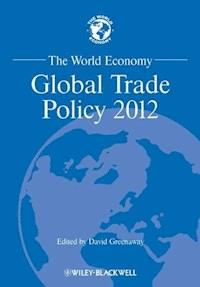
This is the nineteenth volume in an annual series in which leading economists provide a concise and accessible evaluation of major developments in trade and trade policy.
- Examines key issues pertinent to the multinational trading system, as well as regional trade arrangements and policy developments at the national level
- Includes chapters exploring WTO issues, and agricultural trading issues
- Provides up-to-date assessments of the World Trade Organization's current Trade Policy Reviews
- Analyses global trade policy in areas such as Australia and Sri Lanka, and includes special sections on both China and Malaysia
- A vital resource for researchers, analysts and policy-advisors interested in trade policy and other open economy issues
Sie lesen das E-Book in den Legimi-Apps auf:
Seitenzahl: 345
Veröffentlichungsjahr: 2013
Ähnliche


















Table of Contents
Title page
Copyright page
Notes on Contributors
TRADE POLICY REVIEWS
1: Australian Trade Policy Strategy Contradictions
1. Background
2. The Australian Trade Policy Context
3. Trade Policy Review
4. Moving Forward from Preferentialism
5. Conclusion
2: Trade Policy Review for China: Continuing Globalisation Amidst the World Financial Crisis
1. Introduction
2. Main Developments of China’s Trade Policies
3. Economic Development and Structural Changes
4. Key Challenges on China’s Economy and Trade
5. Conclusions
3: Sri Lanka’s Trade Policy: Reverting to Dirigisme?
1. Introduction
2. Policy Context
3. Economic Environment
4. Policy Measures Directly Affecting Imports
5. Export Duties and Incentives
6. Foreign Direct Investment
7. Other Policies Affecting Trade and Investment
8. Conclusion
SPECIAL FEATURE ON MALAYSIA
4: Malaysia: A Success Story Stuck in the Middle?
1. Introduction
2. Malaysia’s Development Record
3. Is Malaysia ‘Stuck in the Middle’?
5. Conclusion
CURRENT ISSUES IN CHINA
5: Zhu Rongji Might Be Right: Understanding the Mechanism of Fast Economic Development in China
1. Introduction
2. Some Stylised Facts About Capital Accumulation in China Over the Past 20 Years
3. How Did the New Fiscal Reform Change the Growth Pattern?
4. Role-Play of Regional Governments and Local Finance
5. Conclusion
6: China and the World Trading System
1. Introduction: The Challenge
2. The WTO’s Responsiveness in Historical Context
3. China’s Current Trade Ascendancy and its Implications
4. The Dominance to Come
5. What would Future Trade Dominance Imply?
6. Anticipating Dominance: Implications for Policy and International Cooperation
7. Concluding Remarks
7: Chinese Networks and Tariff Evasion
1. Introduction
2. Literature Review
3. Theoretical Background
4. Data and Empirical Strategy
5. Results
6. Conclusions
Supporting Information
8: Trading Partners, Traded Products and Firm Performances of China’s Exporter-Importers: Does Processing Trade Make a Difference?
1. Introduction
2. Data
3. Exporting, Importing, Processing Trade and Firm Performances
4. Trading Partners, Processing Trade and Firm Performances
5. Traded Products, Processing Trade and Firm Performances
6. Concluding Remarks
Appendix A
Index
This edition first published 2013
Originally published as Volume 35, Issue 12 of The World Economy
Chapters © 2013 The Authors
Editorial organization © 2013 Blackwell Publishing Ltd
Blackwell Publishing was acquired by John Wiley & Sons in February 2007. Blackwell’s publishing program has been merged with Wiley’s global Scientific, Technical, and Medical business to form Wiley-Blackwell.
Registered Office
John Wiley & Sons Ltd, The Atrium, Southern Gate, Chichester, West Sussex, PO19 8SQ, United Kingdom
Editorial Offices
350 Main Street, Malden, MA 02148-5020, USA
9600 Garsington Road, Oxford, OX4 2DQ, UK
The Atrium, Southern Gate, Chichester, West Sussex, PO19 8SQ, UK
For details of our global editorial offices, for customer services, and for information about how to apply for permission to reuse the copyright material in this book please see our website at www.wiley.com/wiley-blackwell.
The right of David Greenaway to be identified as the author of the editorial material in this work has been asserted in accordance with the UK Copyright, Designs and Patents Act 1988.
All rights reserved. No part of this publication may be reproduced, stored in a retrieval system, or transmitted, in any form or by any means, electronic, mechanical, photocopying, recording or otherwise, except as permitted by the UK Copyright, Designs and Patents Act 1988, without the prior permission of the publisher.
Wiley also publishes its books in a variety of electronic formats. Some content that appears in print may not be available in electronic books.
Designations used by companies to distinguish their products are often claimed as trademarks. All brand names and product names used in this book are trade names, service marks, trademarks or registered trademarks of their respective owners. The publisher is not associated with any product or vendor mentioned in this book. This publication is designed to provide accurate and authoritative information in regard to the subject matter covered. It is sold on the understanding that the publisher is not engaged in rendering professional services. If professional advice or other expert assistance is required, the services of a competent professional should be sought.
Library of Congress Cataloging-in-Publication Data
9781118513026 (paperback)
A catalogue record for this book is available from the British Library.
Cover design by Workhaus.
Notes on Contributors
1
Australian Trade Policy Strategy Contradictions
Shiro Armstrong
1. Background
THE WTO’s trade policy review (TPR) of Australia in 2011 – its fourth and first since 2007 – was undertaken in the context of a strong Australian economy that avoided going into recession in the 2007–08 global financial crisis and an economy which was enjoying historically high terms of trade in its aftermath. Australia managed to weather the financial crisis despite, as the TPR acknowledges, being one of the most open economies in the world. It was also undertaken soon after an inquiry into bilateral and regional trade agreements by the government’s independent policy review institution, the Productivity Commission. With the multilateral trading system weakened because of the stalled Doha Development Round at the WTO and the continued proliferation of bilateral and regional trade agreements in the Asia Pacific region and beyond, Australia has been among many countries actively pursuing its own preferential trade agreements (PTAs).
Previously, a champion of non-discriminatory, unilateral liberalisation and open regionalism (Garnaut, 1996), in the past decade and a half, Australia has pursued PTAs while espousing the primacy of the multilateral system and the consistency of its PTAs with that system. Australia continues to negotiate PTAs with key trading partners.
Yet Australia does not yet have PTAs with either of its two largest trading partners, China or Japan (see Table 1.1). Australia has been negotiating PTAs with both China and Japan, but negotiations have been stalled, and the trading relationships have prospered nonetheless.
TABLE 1.1 Australia’s top 10 two-way trading partners ($A million), 2011
The WTO’s TPR report was mostly positive about Australia’s openness and its progress in removing residual barriers to trade. Australia continues to reduce some of its remaining tariff barriers unilaterally, albeit gradually, and to review and reform its institutions and domestic settings to increase competitiveness and productivity. The results have been mixed. Increases in national welfare in the past decade have mostly derived from a high and rising terms of trade, and there is a lack of evidence that it is from productivity growth (Gruen, 2012).
Given the largely positive TPR report of Australia, this paper focuses on the question of Australia’s role in the multilateral system as it prosecutes PTAs and examines ways of multilateralising some of those preferences, especially in a broader regional setting and under the WTO. It is argued that the current strategy of supporting the multilateral system while signing, negotiating and concluding preferential agreements is not consistent – creating contradictions in Australia’s strategic policy choices.
Lesen Sie weiter in der vollständigen Ausgabe!
Lesen Sie weiter in der vollständigen Ausgabe!
Lesen Sie weiter in der vollständigen Ausgabe!
Lesen Sie weiter in der vollständigen Ausgabe!
Lesen Sie weiter in der vollständigen Ausgabe!
Lesen Sie weiter in der vollständigen Ausgabe!
Lesen Sie weiter in der vollständigen Ausgabe!
Lesen Sie weiter in der vollständigen Ausgabe!




