


9,99 €
Mehr erfahren.
- Herausgeber: 50Minutes.com
- Kategorie: Bildung
- Serie: History
- Sprache: Englisch
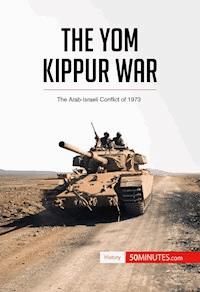
Keen to learn but short on time? Get to grips with the history of the Yom Kippur War in next to no time with this concise guide.
50Minutes.com provides a clear and engaging analysis of the Yom Kippur War.On 6 October 1973, the Egyptians and Syrians attacked the Sinai Peninsula and the Golan Heights, which had fallen into the hands of the Israelis. One of the most dramatic conflicts of the Arab-Israeli hostilities finally came to an end after several negotiations, US intervention and the forced establishment of a cease-fire.
In just 50 minutes you will:
• Understand the political and social context of the 1970s and how this led to the outbreak of the conflict
• Identify key figures who contributed to the development and outcome of the war
• Analyse the impact the conflict has had on the Middle East
ABOUT 50MINUTES.COM | History & Culture
50MINUTES.COM will enable you to quickly understand the main events, people, conflicts and discoveries from world history that have shaped the world we live in today. Our publications present the key information on a wide variety of topics in a quick and accessible way that is guaranteed to save you time on your journey of discovery.
Das E-Book können Sie in Legimi-Apps oder einer beliebigen App lesen, die das folgende Format unterstützen:
Seitenzahl: 32
Veröffentlichungsjahr: 2016
Ähnliche


















The Yom Kippur War
Key information
When: 6-26 October 1973Where: On the banks of the Suez Canal, Sinai Peninsula and Golan Heights (south west region of Syria) and the neighboring regionsContext: The Arab-Israeli conflictBelligerents: Israel against Egypt and Syria, supported by Morocco, Saudi Arabia, Jordan and IraqCommanders and leaders:Golda Meir, Israeli Prime Minister (1898-1978)Anwar Sadat, Egyptian President (1918-1981)Outcome: Israeli victoryVictims:Arab camp (Jordan, Iraq, Syria and Egypt): 9 500 dead and 19 850 woundedIsraeli camp: 3 020 dead and 8 135 woundedIntroduction
The Yom Kippur War was the fourth armed conflict between Israel and the Arab countries, namely Egypt and Syria, which would later result in the 1973 oil crisis.
On 6 October 1973, the day of Yom Kippur (Day of Atonement) for Jews, the Egyptians and Syrians carried out an armed attack in the Sinai Peninsula and the Golan Heights. First belonging to Egypt and Syria, these territories were conquered by Israel during the Six-Day War in 1967. Although the Israeli fighting force was outnumbered, it managed to move gradually through Syria and cross the Suez Canal to finally reach the south and west of Egypt. A cease-fire was then declared by the United Nations Security Council in cooperation with the USSR and the United States in order to make room for negotiation. A peace plan was then agreed. However, the Israelis, not wishing to be interrupted in their advance, used the truce to continue their conquest, sparking further debates. New peace negotiations were then opened and led to the normalization of relations between Israel and Egypt. These negotiations were concluded in 1978 by the Camp David Accords, which stated that, in exchange for peace with Israel, Egypt would recover the Sinai Peninsula. The border between the two countries was opened once again.
Political and social context
Crisis in the Middle East
Since the creation of the State of Israel in May 1948, relations between the country and the neighboring states in the Middle East were tense. The situation intensified even further during the 1960s. Indeed, during the Six-Day War in 1967, the Israeli army was very hostile towards Egypt, Syria and Jordan, from which it took several territories: the Gaza Strip and the Sinai Peninsula in Egypt, the Golan Heights in Syria and, finally, the West Bank and East Jerusalem in Jordan. Following these events, the Arab countries adopted the Khartoum Resolution in September 1967, which proposed:
an ongoing struggle against Israel to regain the territories lost during the war;the use of Arab oil and its extraction as a diplomatic weapon;solidarity and military cooperation between the Arab countries;the defense of the rights of the Palestinian people;economic aid for Egypt and Jordan.This became known as the “Three No’s” resolution, because in its third paragraph, it turned against Israel and stated:
no to peace with Israel;no to the recognition of Israel;no to negotiations with Israel.Good to know
The Six-Day War was one of the countless episodes of the Arab-Israeli conflict, fought by Israel against Egypt, Syria and Jordan, from 5-10 June 1967. Following the blockade of the Strait of Tiran led by Egypt against the Israelis, they decided to launch a preemptive attack against Egypt which was a success. After this feat, Israel decided to attack Jordan and Syria. The sixth day marked the defeat of the Arab armies against the Israeli offensive. Through this victory, the surface area of the Jewish state began to grow.




