


Erhalten Sie Zugang zu diesem und mehr als 300000 Büchern ab EUR 5,99 monatlich.
- Herausgeber: The History Press
- Kategorie: Geisteswissenschaft
- Sprache: Englisch
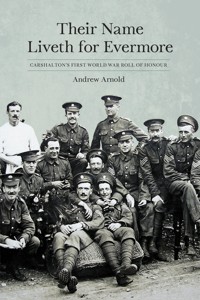
Carshalton in Surrey was deeply affected by the First World War: over 1,900 local men enlisted to fight. Of those men, 243 lost their lives and are commemorated on the war memorial. As we find ourselves commemorating the centenary of the war, it is more important than ever that these men are not forgotten. Drawing on over six years of research, this book brings together the stories of the lives – and deaths – of these men. Utilising a wide variety of sources and complemented by many previously unseen photographs, their stories are told here, from the fourteen sets of brothers who were killed, to the devastating effect of the Somme campaign in which nineteen local men lost their lives on the opening day alone.
Sie lesen das E-Book in den Legimi-Apps auf:
Seitenzahl: 383
Veröffentlichungsjahr: 2014
Das E-Book (TTS) können Sie hören im Abo „Legimi Premium” in Legimi-Apps auf:
Ähnliche




















Dedication
For Charlie and Evelyn
Dedicated to all the men and women from Carshalton
who served during the First World War
And did you leave a wife or sweetheart behind
In some loyal heart is your memory enshrined?
And, though you died back in 1916,
To that loyal heart are you always 19?
Or are you a stranger without even a name,
Forever enshrined behind some glass pane,
In an old photograph, torn and tattered and stained,
And fading to yellow in a brown leather frame?
Eric Bogle, No Man’s Land
(Copyright Larrikin Publishers, Sydney)
Acknowledgements
In the course of my research I have been fortunate to have made contact with relatives and descendants of many of the men named on the memorial, and this book would not have been possible without the information they have provided and their permission to reproduce photographs and letters. In particular I am indebted to Mario Fuller, who is connected to no fewer than ten of the men on the memorial, and Rowena Preston, granddaughter of Frederick Parsons, for their continued support for my research and for encouraging me to develop it into a book. My thanks also go to Des Adams, Jackie Askew, Nick Cannon, June Davies, Ann Dowsing, Sue Ealing and family, Peter Etter, Paul Evans, Nick Fairbrother, Keith Fazzani, Stephen Glanville, Michael Hayball, Barbara Holmes, Sue Hutton, Hazel Kirby, Jean Lambert, Jane Morey, Liz Moss, Roger Pickering, Wendy Pogmore, Derek and Shirley Prothero, Glenys Rands, Cheryl Rogers, Barbara Russell, Lindsay Seagrim-Trinder, Nick Shepherd, Jim Shirley, Mike Stepney, Anne Stevens, Bryan Stokes, Jim Stracey and Susan Wicks.
Many other people have also provided me with information, records and photos of the men. Some have visited their graves in France and Belgium on my behalf. Much of the information in the book has been gleaned from sources held by Sutton Local Studies and Archives Centre, and I am very grateful to Kath Shawcross and the staff there for their help and assistance with my research, along with Margaret Thomas and Bev Walker from the Circle library in Carshalton. Special thanks also go to Steve Garnett, with whom I travelled to the battlefields on a bitterly cold February weekend in 2013, and who accommodated my many requests to stop at cemeteries where the Carshalton men lie. My thanks also go to All Saints church, Stuart Baxter, Eric Bogle and Larrikin Publishers, Gill Clarke (Churchers College), Humphrey Clarke (St Barnabas church), Peter Collins (archivist at Sutton Grammar School), Dick Flory, Mark Gardiner, Clive Gilbert, John Murray publishers for permission to quote from Martin Gilbert’s Somme: The Heroism and Horror of War, Russell Gore, Andrew Holmes, David Humberton, Simon Jervis, Peter Leonard and St Olave’s School, Pam and Ken Linge, Andrew Lock, Bill MacCormick, Mick McCann (British War Graves), Neil Mackenzie, Penguin for permission to quote from Lyn MacDonald’s 1914–1918: Voices and Images of the Great War, John Porter (Prudential), Susannah Schofield (Alleyn’s School), Frederik Sohier, Dave Stuckey, Michael Taylor, David Underdown, Neil Uwins, and William Wood for pictures of the old Whitgiftians, reproduced with the kind permission of the Headmaster of Whitgift School. To The History Press I am grateful for the opportunity to share the stories of the men and the belief that they are worth telling. My sincere apologies to anyone I may have missed from this list.
Finally, I would like to thank my family and friends, who have encouraged and supported me, not least my wife, who has tolerated my interest (some might say obsession!) despite a number of competing priorities over the last few years including wedding preparations, a house move and the birth of our daughter. For her support and understanding I am especially grateful.
Every reasonable effort has been made to trace copyright holders and the author welcomes correspondence on this matter from any sources where it has not been possible to obtain permission to quote.
All information presented has been researched and is evidenced where possible; however, due to the length of time that has passed since the war and the nature of some of the sources used, it is possible that some errors have been introduced. Any errors are mine alone, and any clarifications or additional information about these men will be gratefully received.
Note on the text: Any mention of ‘the local paper’ in the text refers to the Wallington and Carshalton Advertiser.
Contents
Title
Dedication
Acknowledgements
Introduction
1.
Carshalton before the War
2.
Carshalton War Memorial
3.
Other Memorials
4.
The Second World War
5.
The Men
6.
The Roll of Honour
7.
The Western Front
8.
Gallipoli
9.
Mesopotamia, Egypt, Palestine and Salonika
10.
The War at Sea
11.
The War in the Air
12.
Other Deaths
13.
Afterword
Sources
Glossary
Bibliography
Copyright
Introduction
Carshalton war memorial sits in an idyllic spot on the edge of the Carshalton ponds and was officially unveiled on 13 March 1921. A further dedication ceremony and opening of the Garden of Remembrance took place after the Second World War, in 1951.
The names of 249 men are inscribed on the memorial’s plaques. Although it is now dedicated to the men who fought and died in both world wars, almost all of the names on the memorial are from the First World War.1 At the time of writing a further memorial displaying the names of those who died in the Second World War has recently been unveiled in the Garden of Remembrance.
The motivation for compiling this record about the men named on the memorial came from my own experiences researching my family tree. In 2008 I found out that my great-great-uncle had been killed in the war. I started researching his military service and gradually pieced together the story of his life and death. Until then the sacrifices of those who had fought in the war, although always respected, had meant little to me personally. I started thinking about all those who died but have been forgotten, or who have no descendants to remember them. Around this time I paid my first visit to the Carshalton memorial, and looking at the names wondered about the stories behind them. My first trip to the Somme in April 2008 really reinforced the scale of the losses suffered during the war and the effect this must have had on communities across the country. Visiting memorials such as Thiepval on the Somme, one cannot help but be overwhelmed by the sheer number of names inscribed upon them.2 The countless cemeteries in the region feature row upon row of headstones, some named and some indicating only the final resting place of ‘A Soldier of the Great War, Known Unto God’. On my return from the Somme, I started researching the men recorded on Carshalton war memorial in earnest.
War memorials exist in almost every town and village yet most of the year are often passed by without a second glance. However, with the centenary of the First World War now upon us, it is clear that the war remains a subject that evokes passionate feelings and fierce debate. Those who fought in the conflict and survived are gone; it is therefore now more important than ever to keep alive the memories of those who laid down their lives. As Martin Gilbert expresses in his book about the Somme campaign, ‘Every headstone in each cemetery, each name on the long lists of those whose bodies were never found, hides a human being, a man, a story, a cry of pain and a grieving family.’3 The aim of this book is to tell some of these stories.
Notes
1 There are four names from the Second World War and two from subsequent conflicts (Aden and Northern Ireland).
2 Thiepval memorial to the missing has over 72,000 names inscribed on it.
3 Gilbert, Martin, Somme: The Heroism and Horror of War (John Murray, 2007), p. 266. Copyright © Martin Gilbert 2006. Reproduced by permission of the publisher John Murray.
1. Carshalton before the War
The original settlement of Carshalton had sprung up along the road between Sutton and Croydon, later on spreading to the north and south. By the early 1800s it was developing faster than other villages in the area, including Sutton, a trend that continued until the turn of the century. During the Edwardian period it was still relatively small, but expanding rapidly, covering 2,926 acres in 1914. In 1901 the population stood at 6,746; by the time of the 1911 census it had nearly doubled to 11,634.4 When war broke out it is likely to have been approximately 13,000. There were 2,247 inhabited buildings, with an average of 5.18 people living in each and, whilst overcrowding was present, it was not rife. The main residential areas were situated south of the railway line. The most built-up area was Mill Lane and the roads around it, with their rows of terraced houses. The area north of the railway line was mainly taken up by larger houses with big plots of land. Alongside palatial mansions such as The Oaks and Carshalton House (now St Philomena’s Catholic High School for Girls), Carshalton had a number of other fine family houses such as Honeywood, Bramblehaw, Strawberry Lodge, Shepley House and Barrow Hedges.
The presence of the River Wandle meant that water power could be harnessed for industry. Several watermills were developed (ten by 1842) for processing commodities such as snuff and corn, providing some industrial work for local residents. The 1911 census recorded 3,055 men and 1,735 women engaged in work, the predominant employment being building work and agriculture for men (including lavender and watercress growing) and domestic service for women.
The High Street formed the hub of the community with a diverse array of shops serving the needs of the local population. They included Woodman’s butchers, a general store, Comyn’s chemist shop, Wardill’s cycle shop and garage, the London and Provincial Bank, a timber and builder’s merchant, a saddler, a corn merchant, a hairdresser and tobacconist, a grocer’s, a watchmaker and optician, a draper, ‘Holts library, stationery and fancy warehouse’, a children’s outfitter, the post office and a dairy. At the eastern end of the High Street, Carshalton Public Hall5 had been built in the 1870s and was later converted to a skating rink before being requisitioned by the military during the First World War. Those in need of liquid refreshment could visit one of the local pubs, many of which still exist today, including The Greyhound, The Sun, The Windsor Castle, The Fox and Hounds and The Coach and Horses. At least two of the local landlords would lose sons in the war.
A leisurely stroll could be taken in the 19 acres of Carshalton Park, or, for those of a more active disposition, Carshalton Lawn Tennis Club had been formed in 1912. Carshalton St Andrews football club had been founded in 1897 and they played at Wrythe Green. Mill Lane Mission had been founded in 1903 for boys to play football at Carshalton Park, and later changed its name to Carshalton Athletic Football Club. The St Andrews team merged with the club in 1908.
The structure of the historic All Saints church dominated the skyline of the area. A programme of enlargement commenced in 1890 overseen by architect Sir Arthur Blomfield, whose nephew Reginald Blomfield would go on to design war memorials such as the Menin Gate in Ypres. The rector of the church, Revd G.B. Vaux, acted as referee for many of the Carshalton men who applied for an officer’s commission during the war. In addition, the village was served by Emmanuel church, Park Lane; a United Methodist chapel in North Street; the Church of the Good Shepherd in Stanley Park Road; the United Methodist Free Church in Ruskin Road; and a non-denominational chapel, West Street Hall, in West Street. The education of local children fell to a number of schools including Carshalton College, Barrow Hedges School, St Philomena’s and a national infant school in Mill Lane. Law and order was maintained by the presence of a police station at the junction of West Street and Pound Street.
Carshalton was connected to Croydon by the tramway which ran down Park Lane, along Ruskin Road and onto Carshalton Road, before terminating on Westmead Road. Carshalton’s first railway station opened in 1847, at the site of what is now Wallington station; the current Carshalton station opened in 1868. Carshalton Beeches station was built in 1907 to cater for those living in the new houses to the south of the village. Sewers had been installed in 1899, and gas street lighting lit the area at night. Medical needs were met by Queen Mary’s Hospital for Children (opened in 1909), a large facility with over 1,000 staff and patients, and Carshalton and District Hospital on Rochester Road (also known as Cottage Hospital), which had opened in 1899. Village matters were governed by the Urban District Council which operated from the building in The Square, built in 1908, that until recently housed Carshalton library. This building also served as the fire station.
On the northern periphery of Carshalton, the area known as ‘the Wrythe’ formed a distinct entity geographically and socially. It formed the backbone of working-class Carshalton, and the people who lived there were fiercely proud. It was made up of just four main roads – St Andrew’s Road, St John’s Road, St James Road and William Street – yet men from these four roads were to contribute over 10 per cent of the men from Carshalton who enlisted during the war, and would account for 15 per cent of the casualties. Many of the families were closely related and the effects of the war on them was typical of many communities up and down the country. After the war the Wallington and Carshalton Advertiser wrote about the area:
There is something very distinctive about the people there. They are very clannish, very proud of their record in the war, and very sensitive as to the way in which the Wrythe is spoken of by Carshaltonians who happen to reside in other parts of the parish. In this respect the Wrythe and Beddington Corner are very much alike. They are both outposts of their respective parishes, little communities which resent any attempt on the part of neighbours to patronise, criticise, or advise.
From 1887 the spiritual needs of the Wrythe community were served by St Andrew’s Mission church, situated on the corner of Wrythe Lane and Brookfield Avenue. However, the church was never consecrated and it closed in 1962, later to be demolished. The Cricketers public house was a focal point for the local community and its landlord a prominent figure both within the Wrythe and the wider community of Carshalton. The pub also acted as the headquarters for Carshalton Athletic Football Club, which was to be deeply affected by the war. Play stopped during the war due to the shortage of players and Wrythe Green recreation ground where they played was put to agricultural use.
Notes
4 5,221 males and 6,413 females.
5 Now the Charles Cryer Studio Theatre.
2. Carshalton War Memorial
As in towns and villages across the country, after the war ended the civic leaders of Carshalton turned their thoughts to how to commemorate the area’s fallen. As early as April 1916 the Urban District Council had discussed what form a memorial should take, one suggestion being a memorial fountain in Carshalton Park. In January 1919 the local newspaper reported that a committee had been appointed and a proposal put forward for the erection of a permanent memorial, as well as the provision of an enlarged hospital. As prominent local figure Hugh Peirs emphasised, they wanted ‘something which would look well a hundred years hence’.
Unfortunately, the records of the war memorial committee do not appear to have survived, though the updates in the newspaper suggest that several schemes were considered prior to the current memorial. The memorial was paid for by public subscription, and there was enough money left over to contribute to the construction of the war memorial hospital as well – an indication perhaps of how deeply the local community had been affected by the war.
The design of the memorial has more than an echo of Edwin Lutyens’ Cenotaph that dominates Whitehall in London. The Cenotaph (literally ‘empty tomb’) was first unveiled as a temporary structure in 1919, and made permanent in 1920. It was deliberately non-denominational, and it would be interesting to know if the Carshalton committee also took a conscious decision to erect a non-religious structure. Many memorials are located in the grounds of the local church, but the location by Carshalton Ponds was probably chosen as it was more prominent, and at the time quite a tranquil location given the relative absence of traffic. The design contrasts with other war memorials in the area which are religious, such as Sutton’s, which features a cross and angels mounted at each corner of its plinth, and Wallington’s, which has a cross cut into the obelisk. The inscription on the memorial – ‘Their Name Liveth Forevermore’ – does, however, have religious origins.6
The memorial was unveiled on Sunday 13 March 1921 bearing an inscription of 237 names. An account of the unveiling appeared in the two local newspapers; both are worth quoting at length as they help to paint a picture of the feelings and emotions of the time. The Wallington and Carshalton Advertiser reported:
The memorial takes the form of a tomb, the design of which is based on a fine 18th century example. This surmounts a simple base and platform, the whole composition forming a dignified monument free from any ornate features and depending for its effect entirely on its proportions and simple lines. It is of Portland stone, and has on each side panels containing the names of upwards of 200 men of Carshalton to whose sacrifice the memorial stands as a permanent record, and which is expressed in the quotation over each panel: ‘Their name liveth for evermore’.
With appropriate symbolism, the memorial has been placed on the banks of the pond in the constantly moving waters of which it is reflected. A margin of stone flagged paving affords the public every opportunity of reading the names, and a raised platform is provided for flowers.
The memorial has been executed by Messrs. Burslem and Son, 7 Tunbridge Wells, from the designs and under the supervision of Messrs. Bouchier, Tatchell and Galsworthy, architects, of London.
The unveiling was performed by Major-General Longley, officer commanding the Woolwich district, of which Carshalton forms a part, who was received by Major Lovelock (honorary secretary of the War Memorial Committee). His approach was signalled by a fanfare of trumpets by the buglers of the local Boy Scouts, whose colours were draped in black.
At each corner of the Cenotaph was a soldier standing with arms reversed, on the right was drawn up a contingent of the East Surrey Regiment from Kingston, and on the left was a party of Territorials from Sutton.
The memorial after the stolen panels had been replaced in February 2012. (Author’s collection)
Dr Pealing (Chairman of the Cenotaph Sub-Committee) said:
‘Major-General Longley – on behalf of the Carshalton people I have to ask you to unveil our memorial to those men from the parish who died in the Great War. We are proud of the fact that the men of our village did not hesitate when they knew their country to be in danger, but proudly gathered together, rank on rank, to the number of nearly 1,000 volunteers, in answer to the bugle call of war. In all Carshalton sent more than 2,000 men to fight their country’s battles, and of all of those valiant hearts who hopefully marched away 237 never returned. Upon that rising ground across the water where now stands our Parish Church the first inhabitants of this village, barbarous in customs, pagan in their religion, raised a mound above the body of their dead chief. It was the first Carshalton memorial to a dead hero, and throughout the changes of time and the difference of faith that spot has always been and always will be hallowed ground.
‘Today in a brighter and happier belief in the future state we have raised another memorial to the dead heroes of this village. We cannot inter them here with the honour that is due to them. Peacefully their bodies lie upon the battlefields of three Continents, and we have here an empty tomb. But this spot will ever be sacred and always associated with grateful memories of those men who left their homes and loved ones, who laid aside their hopes and ambitions and cheerfully marched out into the great unknown.
‘The memorial is erected upon ground given by the Urban District Council for the purpose, and will be taken over by them and carefully tended.
‘I will now ask you, sir, to unveil this memorial and to reveal for all time the names of those Carshalton men who fought and died for their King and country.’
Major General Longley: ‘I unveil this memorial in the honoured memory of the men of this place who gave their lives for their King and country in the Great War. Let us consider for a moment all that this implies. Let us think also of those whom it commemorates – what they did for us and our children, of how they died in the performance of duty to preserve the liberty and freedom of the world. When we reflect on the truth of the words inscribed on this memorial we shall lose some of our sadness and be tinged instead with a glow of pride and satisfaction that those who have been taken from us have added to the glory and power of the country and the freedom of the world.
They do not die who fall in freedom’s name
Their souls live on, a pure and holy flame.
This memorial will remind us who are living and those who come after us of the splendid sacrifices made by our brothers, fathers, and sons for the glory of the place they held so dear, and may we all be inspired by their noble example.’
Dedicatory prayers were then read by the Rector of Carshalton (the Revd W.R. Corbould), after which Major Lovelock read a list of the names of the fallen. Three volleys were discharged by the firing party, and The Last Post and Reveille sounded by the buglers brought an impressive ceremony to a conclusion.
Representatives of the local branch of the National Federation of Discharged and Demobilised Sailors and Soldiers were present under Major Miller, DCM, and headed by two children, Allan and Ernest,8 the sons of the late Private Baker (East Surreys), who carried a wreath, which was placed on the Cenotaph on behalf of the federation. Mr F.W. Bird headed a procession of war widows from the Wrythe carrying a large Union Jack surmounted with a laurel wreath, and a floral wreath, which was also placed at the foot of the memorial, while among others who placed their tributes were the Rev. J.E. Jasper9 and Couns. R. Brownsmith, J.P., and W.E. Davis.
Before and after the ceremony peals were rung on the bells of the Parish Church.
The Wallington and Carshalton Times’ report was more emotionally charged:
Carshalton never lags behind. At Duty’s call her sons were amongst the first citizens who became soldiers and the first soldiers who became heroes. Those heroes were the foremost in the thickest of the fight, bore the brunt of the early days of the war, but unyielding, wrote in letters of precious blood, ‘Victory’. They did not wait to ask themselves what would be the fruits of that victory; they did the one great thing which lay before them – duty in, above and through, and left all thoughts of right adjustments abroad and at home, and even in little Carshalton, to the politicians. The world knows how well they did their duty, how bravely they fell for their country. On Sunday was unveiled on an ever sacred spot a memorial token of thankfulness to God and in gratitude, in honour, in love, to those who made the supreme sacrifice of their lives. Engraved on that cenotaph, as reverently as on a tomb, are the names which will never be forgotten so that posterity shall lay laurel wreaths upon it to the memory of the best, the bravest, the flower of Britain’s sons. Many in the future will die unknown: these names will ever be great ones to think of or speak upon. If it be that their victory in the war prove to be the victory over war, there will have been real glory attained. In the old days were beacons round the coasts to guide the ships: these monuments throughout Britain today are the beacons that must guide men to everlasting peace. While our eyes read with mingled sorrow and pride the wording of the cenotaph, our hearts read into it a decade of broken spirits, but with stout resolution and determination may our minds see in and by it only two final words, ‘never again!’ Then though in the homes none stood to gain, yet in the end of wars the district, the nation, the world will be the better.
The only known photograph of the war memorial being unveiled on 13 March 1921. Note the crowds lining the far side of the ponds. (Sutton Local Studies)
It continued:
Sunday was indeed a day of mourning for the bravest and the best of Carshalton’s honoured sons. The great and silent messenger to posterity, which will grace the quietude and seclusion of the green lawn on the side of the lake, was unveiled in the afternoon in the presence of two thousand bereaved and sympathisers. Each name was read aloud and each struck home a sorrowing note to wounded hearts. On every hand could be seen tears running down the cheeks alike of those whose loved ones were among the fallen heroes and those whose hearts were melted with another’s sorrow. One could see the tide of generous sorrow working a passage from men’s big hearts to the eye and stealing in silent without their leave, the mark of nature by which sincerity is shown; others shedding tears by the tenderness of feeling at the warm round drops of softness from the mother’s or widow’s heart.
The scene of the tomb and the gathering in black, the firing of the volleys, and the sound of the bugles in The Last Post, was such as to affect any human being whose heart was not of stone. It would have been easier for a man to have tried to stop the flow of the Wandle10 at its source than to restrain the tear of the true and tender hearts.
Why this mournful scene in a small Surrey village? Here stood in silent sorrow and bowed heads noble mothers of noble sons, dutiful fathers of dutiful and courageous sons; heroic widows of heroic husbands, who gave all for their country. Just six and a half years ago the war cry rang out through Britain, and Carshalton, hearing the call of King and country, never waited a moment. Her sons were among the first to join the Colours. A thousand men volunteered and went, and a thousand mothers, wives, and sweethearts never said ‘nay’. These men were the first in the trenches, and 237 were the first to fall; those women were the first to sacrifice, and 237 the first to wear the widows’ weed.
Carshalton provided altogether as its quota of the great victory two thousand men, or half of its adult males. Men indeed, women indeed. There they stood with broken spirits unhealed by time; with the loss in this world’s treasures of all that counted for happiness; their fields of life barren of the fruits of victory. They came from the scenes of the vacant chairs to see the names of the occupants written boldly, that all forever shall honour and revere those who went gallantly forth, forgetting self, forgetting all they held so dear.
It is the widows’ one sacred tomb, to which they go in loving and tender thoughts and lay down floral tributes, which the majority owing to their poor estate in life could never afford to do in those sacred spots which hold the remains of the fallen in the fields of Flanders and France.
Evidence of that desire was shown on this occasion, when the large base of the cenotaph was a mass of wreaths, including one of laurels from the War Memorial Committee, the People of the Wrythe, and from the Carshalton branch of the National Federation of Discharged and Demobilised Soldiers and Sailors.
The roads all round the lakes were absolutely packed, but places were reserved for the relatives near the cenotaph, which was completely covered with a Union Jack. On each side stood a squad of the East Surrey Regiment, in front were the Carshalton Fire Brigade in uniform and at the approach were the Carshalton Troop of Scouts forming a guard of honour.
The details of the ceremony and memorial are then reported in a similar vein to the Advertiser.
Early photographs of the memorial show that the names were originally inscribed in stone, but at some point the original panels were replaced with metal ones. The history of the memorial in more recent years has been chequered. In 2007, thieves stole several of the flagstones around the base of the memorial, and in September 2011 struck again, the target this time being the metal plaques themselves. The theft caused public outcry, nationally as well as locally, particularly as it occurred so close to Remembrance Sunday. Sutton Council thankfully arranged for temporary plaques to be installed in time for the commemorations. Permanent replacement plaques carved in Portland stone were unveiled on 7 February 2012, the cost of the replacement funded by a local scrap metal dealer who had been outraged by the theft.
Notes
6 Taken from Ecclesiasticus 44:14. The phrase was selected by Rudyard Kipling (who lost his only son in the war) to adorn the ‘Stone of Remembrance’ that can be found in many of the Commonwealth War Graves Commission cemeteries.
7 Burslem stonemasons still carry out memorial work; unfortunately all their historical records were lost in a fire in 1998. The company also produced the name panels that are on the Menin Gate in Ypres.
8 This should actually read Ellen and Ernest as Private Baker had one daughter and one son. Ernest Baker junior, known as ‘Sonny’, often played ‘The Last Post’ on his bugle at the Remembrance Sunday services at the memorial.
9 Father of James Jasper, who was killed in August 1918.
10 The River Wandle runs through south-west London and is fed by the ponds.
3. Other Memorials
Carshalton’s war dead are not just remembered on the civic war memorial; there are several other memorials in the locality. Probably the best-known is the ‘Willie Bird’ or Wrythe memorial cross located in the graveyard at All Saints church. The cross was donated by Frederick Bird, the landlord of The Cricketers, a prominent figure in the local community and often referred to as the ‘Father of the Wrythe’.11 The cross is named after his son, who died in 1915 from appendicitis.12
As already noted, the Wrythe was a community in itself and obviously wished to commemorate its own fallen on a separate memorial. An overtly religious memorial, it consists of a cross which originally had a crucifix figure as its centrepiece (now missing). The inscription reads ‘To the heroes of the Wrythe who have died in God for the King and for you. May they rest in peace.’ Below this are the names of forty-five men from the Wrythe area who were killed in the war. Of these thirty-three also appear on the civic memorial. The cross was originally sited outside St Andrew’s Mission church in the Wrythe, but was moved after the church closed in 1962. However, from photos that exist of the cross in its original location, it seems to have been much bigger and the inscription slightly different.
The Willie Bird cross in the graveyard of All Saints church. (Author’s collection)
The Willie Bird cross in its original location outside St Andrews Mission church. (Jean Lambert)
The War Memorial Hospital. (Mario Fuller)
All Saints church contains a number of other memorials. Most obvious are the Commonwealth War Graves Commission headstones in the churchyard; nine of the men on the memorial are buried here, as are a further three who are not on the memorial. Inside the church there is a roll of honour, painstakingly written in calligraphy. This shows 213 names, 208 of which are on the memorial and five that are not. The reason for the disparity is unclear.
The church contains several other private commemorations to local men, mostly those with close ties to the church or those of a higher social standing and whose families therefore had the money to pay for a private memorial. Interestingly, not all of these men’s names appear on the war memorial itself.
In addition to the civic memorial, enough funds were raised to build the war memorial hospital that was situated on The Park until its recent sale and demolition to make way for a new housing development.
At the time of the war about one-third of the parish of St Barnabas lay within the civil parish of Carshalton. After the war, funds were raised for a dedicated war memorial chapel, and this memorial in the church in St Barnabas Road bears the names of at least thirty-six of those who are on Carshalton war memorial. St Barnabas had a Band of Hope13 Cadet Force, founded in 1890. Many of these cadets went on to serve during the war, and at least five would lose their lives. Further memorials include one at Sutton County School (now Sutton Grammar School), which eight of the men on the memorial attended, and Sutton Post Office.
Local men are commemorated on other memorials as far afield as Lincolnshire, York, Gloucester, and Perthshire, and it is not unusual for a man to be commemorated on several memorials. Sutton war memorial was unveiled in June 1921, and thirty-six of the men whose names are inscribed on Carshalton memorial are amongst Sutton’s 527. Wallington war memorial followed in March 1922 with 278 names; four men on Carshalton memorial are also commemorated here.
A list of St Barnabas Band of Hope cadets who served in the war. (St Barnabas church)
Some of the St Barnabas Band of Hope cadets who had enlisted to fight. (St Barnabas church)
After the war the Carshalton Athletic Football Club purchased the war memorial sports ground on Colston Avenue and planted thirteen poplar trees in memory of the thirteen players the club had lost.14 Unfortunately, the trees are no longer there; until recently a more lasting legacy was the poppy incorporated into the club logo. The Surrey County FA Junior League was also played in memory of local casualty David Kirby.
Notes
11 See, for example, the Wallington and Carshalton Advertiser, 31 January 1919.
12 Reported in the Wallington and Carshalton Advertiser, 13 August 1915, p. 7.
13 A temperance organisation.
14 Twelve of the thirteen have been identified as William Buckenham, Robert Collins, James Cooper, James Elcock, John Fowkes, Bertie Gough, John Groombridge, David Kirby, Thomas Kirby, James Nash, David Slaymaker, and Bernard Tate.
4. The Second World War
After the Second World War there was not as much local interest in creating a war memorial as there had been after the Great War. A war memorial sub-committee was set up once more but as well as sources of funding the committee had to contend with the matter of obtaining an accurate list of all those who were killed. Its minutes from 1947 record that ‘It will be appreciated that it may be difficult to ensure that the information thus obtained will be complete, particularly having regard to the fact that, since the war period, a number of near relatives of the fallen have left the district.’
The decision was taken to commemorate the soldiers and civilian casualties collectively rather than having a memorial displaying all of their names. This led to the dedication of the Garden of Remembrance in 1951 and the creation of a Book of Remembrance, which was held at Carshalton library until its closure in 2012 and is now on display in the library at Westcroft Leisure Centre.
The four names from the Second World War that are currently on the memorial appear to have been added over the years at the request of the men’s families. In total, 270 local casualties are named in the Book of Remembrance, although research has shown that there are many more with a connection to the area. A long-running campaign to commemorate these casualties culminated in the construction of a new separate memorial in the Garden of Remembrance. This was completed in summer 2014 and dedicated at a commemoration service on 3 August 2014.
5. The Men
In total, more than 5.5 million British men were mobilised during the First World War, and over 700,000 (12 per cent) were killed in action or died of wounds or illness. From surviving records it is known that at least 1,900 men with connections to Carshalton served,15 over 1,000 of whom volunteered prior to the introduction of conscription in 1916. The 243 names on the memorial therefore represent approximately 13 per cent of those from Carshalton who served, largely commensurate with British casualty figures as a whole.
The names range from those who were born in Carshalton to those who lived in the locality or had family members in the area. All branches of the Armed Forces are represented, although the majority of the casualties served with the infantry on the Western Front. Unsurprisingly, many men joined the local regiments, the Queen’s (Royal West Surrey Regiment) and the East Surrey Regiment. However, soldiers were often sent to regiments that were short of men, and over sixty different regiments are represented on the memorial. Most of the major campaigns of the war can be traced through the dates of death of the men, from the first battles of 1914 to the final German campaign in spring 1918 and the closing battles of the ‘Hundred Days Offensive’ in the summer and autumn of that year. Unsurprisingly, the first day of the Somme campaign (1 July 1916), a date indelibly ingrained into this country’s national consciousness, accounts for many of those killed from Carshalton – nineteen in total, eight from the 7th Battalion The Queen’s alone. Altogether, thirty men lost their lives that month, and fifty-nine in the whole Somme campaign in the period July–November 1916, accounting for a quarter of all the names on the memorial.
Chart 1 – The number of Carshalton casualties during each month of the war.
Some men died as a result of illness or accident, but the vast majority were killed in action or died from their wounds. At least five were shot by snipers, an ever-present threat in trench warfare. Machine guns were also increasingly used, their high rate of fire coupled with their ability to rain down bullets from over a mile away making them a particularly effective weapon. The biggest killer, though, was artillery, which was used to devastating effect during the war. Preparatory bombardment was seen as the key to a successful attack, and as the war progressed more sophisticated ways to utilise artillery power were developed.
The men of Carshalton are buried in or commemorated at over 100 cemeteries and memorials. The Thiepval memorial to the missing of the Somme alone displays the names of thirty-nine local men amongst its 72,203; 111, almost 50 per cent, are commemorated on memorials – in other words, they have no known grave – whilst 125 have a final resting place. In a war characterised by the development of more brutal, industrial and effective ways of taking men’s lives en masse, it is not surprising that many have no known grave, their remains lost in the ravaged landscape or destroyed by further fighting and shelling.
The age of those who died on active service ranges from 15 (Reginald Brooks) to 46 (Ernest Dale), although the oldest man commemorated is Harry Tyler, aged 74, who did not serve overseas. At the beginning of the war the lower age limit for recruits was 18 (17 in the Territorial Force), although they initially had to be 19 to serve overseas. This was subsequently reduced to 18 and a half in 1918. At least five of those named on the memorial are believed to have enlisted underage. The upper age limit was 38 in 1914, later increased to 41. A lesser-known fact is that many older men also gave a false age in order to serve: Albert Rogers is one such example.
Chart 2 – The ages of Carshalton’s casualties.
There are fourteen sets of brothers on the memorial, accounting for thirty of the names (12 per cent). Included in this figure are two families, the Rogers and the Brooks, who both lost three sons. In the Brooks’ case all three were killed within little over a month in 1918. The impact this must have had on the family is unimaginable. Carshalton was a close-knit community and many of the men were connected through marriage. Neighbours and work colleagues often signed up together, and the impact of the news of every death must have been a devastating blow.
Focusing as it does on the local casualties, this book is naturally about the role of men during the war, but of course women played key roles too. In January 1916 the St Barnabas parish magazine reported that Millicent Hawkins, a former Sunday school teacher at the church, had been nursing in France for a year and was being sent to the Mediterranean theatre. Muriel Peatling, the wife of local GP Dr Peatling, worked for the Red Cross, and Mary Vaux, daughter of the Revd G.B. Vaux, was a VAD (Voluntary Aid Detachments) nurse. It is likely that many more local women were also engaged in similar work, as well as fulfilling roles left vacant by men who had gone to war. Some women worked at Brocks firework factory in Sutton, which during the war shifted its focus to the production of munitions. Sutton even fielded a women’s football team.
The effects of the war would have been apparent even to those who were not directly engaged in war work. Manor Park House in Manor Park,16 close to the top of Sutton High Street, was used to house Belgian refugees. Later, as wounded soldiers began to return from the battlefields, they needed places to recuperate, and many large houses were converted into hospitals. Benfleet Hall in Benfleet Wood Road was one such building. The hospital was funded by public donations and opened in June 1915.
Mary Vaux, VAD nurse. (Simon Jervis)
Staff and patients outside Benfleet War Hospital. The soldiers are wearing ‘hospital blues’ - uniforms issued to convalescing troops. (Sutton Local Studies)
In the course of my research, I have come across almost 130 men who had local connections but are not commemorated on the memorial. They include Lionel Morris, the first pilot to be shot down by the infamous Red Baron,17 whose parents lived at ‘Merlebank’ in Rotherfield Road. The reasons for these non-commemorations are hard to establish after so much time has passed. One reason for their omission could be the method in which the names were collected, particularly as this was probably not undertaken until about 1920. In some towns and villages forms were delivered to local households for completion, in others notices were put up asking families to submit the details of their loved ones. This, of course, could lead to omissions if the soldier had no family or if the family did not see the requests for names. Relatives may have pre-deceased the soldier or moved to another area, in which case he may be commemorated on another memorial. It also has to be considered that some families may not have wanted the name of their loved one on the memorial, serving as a constant and visible reminder of their loss.
Many families who bade farewell to a husband or son setting off to the war were lucky and were able to welcome them back home after it was over. The Priest family of Beeches Avenue, for example, sent seven members to war and all came back. Revd Vaux had six family members serving in the army and navy, who all made it through the war. Whilst we tend to focus on the loss of life caused by the war, it should be remembered that some 88 per cent of those who served returned home.
Notes
15 After the war a list of men who served was compiled by local resident Hugh Peirs. Copies of this invaluable source, entitled Carshalton Men Who Served in His Majesty’s Forces in the Great War with a Roll of Honour and a List of Distinctions, can be viewed at Sutton Local Studies and Archives Centre and the Imperial War Museum.
16 The location of Sutton war memorial.
17 The first victim of the Red Baron was Morris’s observer Lieutenant Tom Rees, who was shot whilst the plane was still in the air. Morris, although wounded, managed to land the plane but died shortly after.




