


9,99 €
Mehr erfahren.
- Herausgeber: 50Minutes.com
- Kategorie: Sachliteratur, Reportagen, Biografien
- Serie: History
- Sprache: Englisch
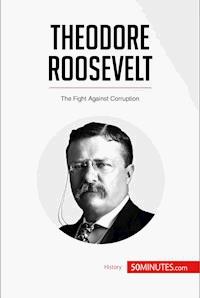
Keen to learn but short on time? Get to grips with the life of Theodore Roosevelt in next to no time with this concise guide.
50Minutes.com provides a clear and engaging analysis of Theodore Roosevelt. Roosevelt became US President following the tragic assassination of William McKinley and at a time when industrialisation had led to the rise of capitalism and corruption. Roosevelt made it his mission to improve living conditions for American workers and consumers through commerce regulation, and bolstered American prominence on the international stage using his famous diplomatic tactics.
In just 50 minutes you will:
• Discover Theodore Roosevelt’s difficult youth and rise to prominence against all the odds
• Understand his domestic policy, including regulation of interstate commerce and ‘trust busting’
• Learn more about his foreign policy and use of benevolent imperialism and diplomacy to intervene in cases from the independence of Panama to the Russo-Japanese War
ABOUT 50MINUTES.COM | History & Culture
50MINUTES.COM will enable you to quickly understand the main events, people, conflicts and discoveries from world history that have shaped the world we live in today. Our publications present the key information on a wide variety of topics in a quick and accessible way that is guaranteed to save you time on your journey of discovery.
Das E-Book können Sie in Legimi-Apps oder einer beliebigen App lesen, die das folgende Format unterstützen:
Seitenzahl: 27
Veröffentlichungsjahr: 2017
Ähnliche











Theodore Roosevelt
Key information
Born: 27 October 1858 in New York.Died: 6 January 1919 in New York.Political party: Republican.Dates of election:14 September 19018 November 1904.Length of term: seven years.Main achievements:Modernisation of the presidencyTrust regulationBill on railroad ratesLaw on monitoring the food and drug industriesMaking the Navy central to American diplomacyThe beginning of benevolent imperialism in the United States.Introduction
In 1901, at the age of 42, Theodore Roosevelt became the youngest president in the history of the United States. Full of energy and an excellent public speaker, he was a charismatic leader who never thought twice about disrupting the rules of the presidency. Unlike his predecessor, Roosevelt defended his own political initiatives, readily keeping his distance from his party’s ideology. He would do this even more during his second term, which would be one of the most prolific in terms of legislative production in American history.
During his career, he also transformed domestic policy by increasing the number of measures that were part of the Progressive movement. On an international level, he considerably strengthened the role played by his country in the global order of the early 20th century and contributed to the assertion of American imperialism.
A great protector of nature, war hero and defender of the working classes, he remains popular to this day and is considered to be one of the most significant residents of the White House: this is attested by the presence of his effigy next to George Washington (1732-1799), Thomas Jefferson (1743-1826) and Abraham Lincoln (1809-1865) on Mount Rushmore. But the fact that his reputation is intact is also due to his unusual path through life.
Biography
Photograph of Theodore Roosevelt, 1904.
A frail young man with an incredible destiny
Theodore Roosevelt Jr. was born on 27 October 1858 into a wealthy family. He was the second child of Martha Bullock (1835-1884), who came from a long line of politicians, and Theodore Roosevelt Sr. (1831-1878), an influential man who was close to the then president, Abraham Lincoln. He was affected by congenital problems that made him a frail child. Asthma attacks would mean he would have to fight hard for his health throughout his life.
Despite this handicap, Roosevelt was a dynamic and curious child who threw himself into reading many books of various genres. Being unable to receive a normal education due to his fragile health, he had the advantage of being home-schooled.
During his adolescence, still suffering from his fragility, he decided to start intensive physical training and began boxing. The sport enabled him to strengthen his body and, gradually, he managed to overcome his asthma attacks, which became less frequent.
In 1876, he began studying law at Harvard and became a member of the Republican Party. Although his health was improving, a doctor warned him that he had to lead a quiet life and aim for a sedentary occupation. However, Roosevelt did not heed the doctor’s words.




