


36,99 €
Mehr erfahren.
- Herausgeber: John Wiley & Sons
- Kategorie: Geisteswissenschaft
- Serie: Blackwell Foundations of Communication Theory Series
- Sprache: Englisch
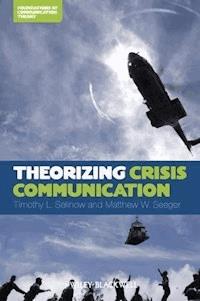
Theorizing Crisis Communication presents a comprehensive review and critique of the broad range of theoretical frameworks designed to explain the role of communication in the development, management, and consequences of natural and man-made crises. * Brings together the variety of theoretical approaches emerging in the study of crisis communication into one volume for the first time. * Summarizes theories from such diverse perspectives as rhetoric, risk management, ethics, mass communication, social media, emergency response, crisis outcomes, and warning systems, while presenting clear examples of how the theory is applied in crisis communication research * Presents theoretical frameworks generated by research from many disciplines including sociology, psychology, applied anthropology, public health, public relations, political science, organizational studies, and criminal justice * An essential tool for a comprehensive understanding of the onset, management, response, resolution, and ultimate meaning of these devastating world events
Sie lesen das E-Book in den Legimi-Apps auf:
Seitenzahl: 473
Veröffentlichungsjahr: 2013
Ähnliche



















Table of Contents
Foundations of Communication Theory
Title Page
Copyright
Notes on Authors
1 Introduction to Crisis Communication Theory
Defining Crisis
Defining Communication
Theory
Plan for This Book
Conclusion
2 Theories of Communication and Crisis Development
Assumptions of Stage Models
Three-Stage Model
Fink’s Four-Stage Cycle
Turner’s Six-Stage Sequence of Failure in Foresight
Crisis and Emergency Risk Communication
Conclusion
3 Theories of Communication and Warning
Detection of Risks
Functional Approaches to Communication and Warning
Hear-Confirm-Understand-Decide-Respond Model
Protective Action Decision Model
Integrated Model of Food Recall
Emerging Warning Systems
Conclusion
4 Theories of Communication and Crisis Outcomes
Organizational Learning
Sensemaking
Organizational Legitimacy
Situational Crisis Communication Theory
Discourse of Renewal
Conclusion
5 Theories of Communication and Emergency Response
Assumptions of Communication and Emergency Response
Chaos Theory and Emergent Self-Organization
Theories of Communication and Crisis Coordination
Communication and Community Resilience
Four-Channel Model of Communication
Conclusion
6 Theories of Communication and Mediated Crises
News Framing Theory
Focusing Events
Uses and Gratifications Theory
Crisis News Diffusion
Diffusion of Innovations
Conclusion
7 Theories of Influence and Crisis Communication
Apologia
Image Repair
Kategoria
Dramatism
Narrative Theory
Conclusion
8 Theories of Communication and Risk Management
Mindfulness
High Reliability Organizations
Precautionary Principle
Cultural Theory
Risk Communication as Argument
Conclusion
9 Theories of Crisis Communication and Ethics
Ethics
Crisis Communication as an Ethical Domain
Responsible Communication
Significant Choice
The Ethic of Care
Virtue Ethics
Justice
Applications of Moral Theory to Crisis
Conclusion
10 Using Theories of Crisis Communication
Minimization of Communication in an All-Hazards Approach
The Practicality of Theory in Understanding Crisis Communication
The Pathway for Inspiring Meaningful Change
Successful Connections Linking Theory-Based Research and Practitioners
Promising New Lines of Research
Persistent Challenges
A Final Word
Index
Foundations of Communication Theory
Series Editor
Marshall Scott Poole (University of Illinois, Champaign-Urbana)
Editorial Board
James Aune (Texas A&M University); Robert T. Craig (University of Colorado at Boulder); Leah Lievrouw (University of California Los Angeles); Alan Rubin (Kent State University, Emeritus); David Seibold (University of California Santa Barbara)
The Foundations of Communication Theory series publishes innovative textbooks that summarize and integrate theory and research for advanced undergraduate and beginning graduate courses. In addition to offering state-of-the-art overviews in a broad array of subfields, authors are encouraged to make original contributions to advance the conversation within the discipline. Written by senior scholars and theorists, these books will provide unique insight and new perspectives on the core sub-disciplinary fields in communication scholarship and teaching today.
Published
Organizational Change: Creating Change Through Strategic Communication, Laurie K. Lewis
Theorizing Crisis Communication, Timothy L. Sellnow and Matthew W. Seeger
Forthcoming
Foundations of Media and Communication Theory, Leah Lievrouw
Managing Privacy, Sandra Petronio
Foundations of Organizational Communication, Linda Putnam and Scott Poole
Dilemma-Centered Political Communication, Herbert W. Simons
This edition first published 2013
© 2013 John Wiley & Sons, Inc
Wiley-Blackwell is an imprint of John Wiley & Sons, formed by the merger of Wiley’s global Scientific, Technical and Medical business with Blackwell Publishing.
Registered Office
John Wiley & Sons Ltd, The Atrium, Southern Gate, Chichester, West Sussex, PO19 8SQ, UK
Editorial Offices
350 Main Street, Malden, MA 02148-5020, USA
9600 Garsington Road, Oxford, OX4 2DQ, UK
The Atrium, Southern Gate, Chichester, West Sussex, PO19 8SQ, UK
For details of our global editorial offices, for customer services, and for information about how to apply for permission to reuse the copyright material in this book please see our website at www.wiley.com/wiley-blackwell.
The right of Timothy L. Sellnow and Matthew W. Seeger to be identified as the authors of this work has been asserted in accordance with the UK Copyright, Designs and Patents Act 1988.
All rights reserved. No part of this publication may be reproduced, stored in a retrieval system, or transmitted, in any form or by any means, electronic, mechanical, photocopying, recording or otherwise, except as permitted by the UK Copyright, Designs and Patents Act 1988, without the prior permission of the publisher.
Wiley also publishes its books in a variety of electronic formats. Some content that appears in print may not be available in electronic books.
Designations used by companies to distinguish their products are often claimed as trademarks. All brand names and product names used in this book are trade names, service marks, trademarks or registered trademarks of their respective owners. The publisher is not associated with any product or vendor mentioned in this book. This publication is designed to provide accurate and authoritative information in regard to the subject matter covered. It is sold on the understanding that the publisher is not engaged in rendering professional services. If professional advice or other expert assistance is required, the services of a competent professional should be sought.
9780470659298 (hardback)
9780470659304 (paperback)
9781118485927 (ebk)
9781118485910 (ebk)
Library of Congress Cataloging-in-Publication data is available for this book.
Cover image: Rescue team stand below as a helicopter lifts up logistical supplies at the peak of Mount Salak, near Sukabumi, Indonesia, May 13, 2012, following the crash of a Russian Sukhoi Superjet. Photo © REUTERS/Beawiharta Beawiharta.
Cover design by RBDA
Notes on Authors
Timothy L. Sellnow is Professor of Communication and Associate Dean for Graduate Studies in Communication at the University of Kentucky. Dr. Sellnow’s interdisciplinary research on risk and crisis communication appears in an array of refereed journals, handbooks, and edited volumes. He has also co-authored five books on risk and crisis communication. Dr. Sellnow frequently serves as a consultant for Fortune 500 companies in the food industry and government agencies such as the United States Department of Agriculture (USDA) and Department of Homeland Security (DHS) on risk and crisis communication planning.
Matthew W. Seeger is Dean of the College of Fine, Performing and Communication Arts and a Professor of Communication at Wayne State University in Detroit. His work on crisis, risk and communication has appeared in more than 100 journal articles, book chapters, and conference proceedings. Dr. Seeger is the author or co-author of six books on organizational communication ethics and crisis and risk communication. Dr. Seeger also frequently serves as advisor to the auto industry, manufacturing organizations and government agencies, including the Centers for Disease Control and Prevention (CDC) on topics related to crisis management.
1
Introduction to Crisis Communication Theory
Crises are increasingly important social, political, economic and environmental forces and arguably create more change more quickly than any other single phenomenon. Crises have the potential to do great harm, creating widespread and systematic disruption. But they may also be forces for constructive change, growth and renewal. They can quickly reshape institutions, create shifts in demographics and populations, alter ecosystems, undermine economic stability and change widely held beliefs. Understanding these events, therefore, is critical. A significant component of that understanding involves clarifying the role of communication processes in the onset, management, resolution and meaning of crises.
Recent examples, including the 9/11 terrorist attacks, Hurricane Katrina and the 2004 Indian Ocean tsunami, illustrate the rapid change that happens following a crisis. The events of 9/11 precipitated not only a fundamental rethinking of federal policy but also created the most comprehensive reorganization of the US federal government to occur in decades. Hurricane Katrina saw a major demographic shift in New Orleans and created new understandings of risk and the role of governments in response to disasters. The 2004 tsunami claimed as many as 230,000 lives in 14 countries, wiped away entire communities, and created widespread economic and environmental damage. It also called attention to the risks associated with tsunamis and development in coastal areas. Historically, the worst crises have been earthquakes and infectious disease pandemics. The 1918–1919 influenza, or Spanish flu, pandemic is estimated to have infected 500 million people worldwide and may have resulted in more than 20 million deaths. The worst earthquake of the twentieth century occurred in Tangshan China in 1976. Official death tolls indicate that about 255,000 people lost their lives and another 150,000 were injured. Crises, big and small, natural and human-caused, are inevitable; in fact, many scholars suggest that they are occurring with greater frequency and causing more harm than they have in the past (Perrow, 1984; Seeger, Sellnow and Ulmer, 2003).
While it is impossible to avoid all crises and disasters such as earthquakes and tsunamis, some can be avoided and most can be more effectively managed. Crisis management is a well-established practice drawing on a variety of fields including medicine, sociology, psychology, engineering, logistics, political science and criminal justice, as well as communication. Agencies, both public and private, such as the Federal Emergency Management Administration (FEMA) and the Red Cross, have a critical role in creating crisis response capacities. Crises are by definition interdisciplinary events and often reach across regional, cultural, economic and political boundaries. Some researchers have pointed out that this interdisciplinary aspect has made integration of research and practice more challenging (Pearson and Clair, 1998). Along with communication, integration, coordination and cooperation are critical to negotiating these boundaries and to effective crisis management and response.
Crisis communication theories problematize the messages and meaning construction process in all forms of human interaction and coordination that surround these threatening and high uncertainty events. Because crises are, by their nature, unpredictable, theorizing about them creates many challenges. In some ways, every crisis may be seen as an entirely anomalous and unique event that, by definition, defies any systematic explanation. It is common to see a crisis as just an accident, an unusual combination of events that could not happen again. Conversely, the fact that crises occur at an increasing and alarming frequency allows scholars to observe similarities, patterns and relationships across many occurrences. Many theoretical crisis frameworks described throughout this book were developed for specific types of events, including warning theories and evacuation models for hurricanes and recall models for contaminated food (Chapter 3). In many cases, scholars have also found that these approaches have utility for understanding other kinds of crisis. Increasingly, efforts are directed toward developing broader, more encompassing theories, using what is sometimes called an all hazards approach. This approach begins by understanding that all events described as crises will have some common elements, such as threat, uncertainty and the need for an immediate response, and that common response contingencies will be required.
Lesen Sie weiter in der vollständigen Ausgabe!
Lesen Sie weiter in der vollständigen Ausgabe!
Lesen Sie weiter in der vollständigen Ausgabe!
Lesen Sie weiter in der vollständigen Ausgabe!
Lesen Sie weiter in der vollständigen Ausgabe!
Lesen Sie weiter in der vollständigen Ausgabe!
Lesen Sie weiter in der vollständigen Ausgabe!
Lesen Sie weiter in der vollständigen Ausgabe!
Lesen Sie weiter in der vollständigen Ausgabe!
Lesen Sie weiter in der vollständigen Ausgabe!




