


189,99 €
Mehr erfahren.
- Herausgeber: Thieme
- Kategorie: Fachliteratur
- Sprache: Englisch
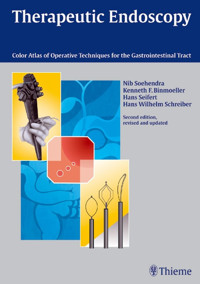
This important full-color atlas, written by pioneers in the field, provides complete, superbly illustrated coverage of both new and established techniques in GI endoscopy. Now fully updated with the newest interventional procedures. The book uses more than 500 high-definition watercolors derived from operative photographs which simulate the physician's cognitive visual experience while performing the procedures, and thus recreating both the look and "feel" of actual surgery. The accompanying text leads you step-by-step through each operation, and highlights both special tips and potential pitfalls. Thorough and usefully illustrated, this unique book will prove indispensable for all gastroenterologists and endoscopic surgeons. New topics include: Endoscopy mucosal en bloc resection for early gastrointestinal cancers, self-expandable metallic enteral stents, self-expandable metallic stents for Klatskin tumor, treatment of intraabdominal abscesses, and more.
Das E-Book können Sie in Legimi-Apps oder einer beliebigen App lesen, die das folgende Format unterstützen:
Seitenzahl: 209
Veröffentlichungsjahr: 2004
Ähnliche



















Library of Congress Cataloging-in-Publication Data is available from the publisher
1st English edition 1998
1st German edition 1997
1st Italian edition 1999
© 2005 Georg Thieme Verlag,Rüdigerstrasse 14, 70469 Stuttgart, Germanyhttp://www.thieme.deThieme New York, 333 Seventh Avenue,New York, NY 10001 USAhttp://www.thieme.com
Cover design: Martina Berge, ErbachIllustrations by Franziska von Aspern, HamburgTypesetting by primustype Hurler, NotzingenPrinted in Germany by Appl, Wemding
ISBN 3-13-108262-3 (GTV)ISBN 1-58890-214-5 (TNY) 1 2 3 4 5
Important note: Medicine is an ever-changing science undergoing continual development. Research and clinical experience are continually expanding our knowledge, in particular our knowledge of proper treatment and drug therapy. Insofar as this book mentions any dosage or application, readers may rest assured that the authors, editors, and publishers have made every effort to ensure that such references are in accordance with the state of knowledge at the time of production of the book.
Nevertheless, this does not involve, imply, or express any guarantee or responsibility on the part of the publishers in respect to any dosage instructions and forms of applications stated in the book. Every user is requested to examine carefully the manufacturers’ leaflets accompanying each drug and to check, if necessary in consultation with a physician or specialist, whether the dosage schedules mentioned therein or the contraindications stated by the manufacturers differ from the statements made in the present book. Such examination is particularly important with drugs that are either rarely used or have been newly released on the market. Every dosage schedule or every form of application used is entirely at the user's own risk and responsibility. The authors and publishers request every user to report to the publishers any discrepancies or inaccuracies noticed. If errors in this work are found after publication, errata will be posted at www.thieme.com on the product description page.
Some of the product names, patents, and registered designs referred to in this book are in fact registered trademarks or proprietary names even though specific reference to this fact is not always made in the text. Therefore, the appearance of a name without designation as proprietary is not to be construed as a representation by the publisher that it is in the public domain.
This book, including all parts thereof, is legally protected by copyright. Any use, exploitation, or commercialization outside the narrow limits set by copyright legislation, without the publisher's consent, is illegal and liable to prosecution. This applies in particular to photostat reproduction, copying, mimeographing, preparation of microfilms, and electronic data processing and storage.
“Science and art belong to the world as a whole, and the barriers of nationality vanish before them.”
J. W. von GoetheMaximen und Reflexionen, 1821
This book is dedicated to those who have contributed innovative ideas and experiences to the field of endoscopy. Thanks to them, endoscopy has attained a defined, classic role as a diagnostic and therapeutic modality to the benefit of many patients.
Preface
Interventional endoscopy has made new strides since the first edition of this book six years ago. In the second edition we have incorporated novel procedures that have entered the mainstream. We have kept the same didactic format, using richly detailed color illustrations to tell the procedural story. The artist's work is accompanied by legends that elaborate on each procedural step. The book's text follows a standardized format that we hope the reader will find practical and easy-to-navigate.
This book seeks to portray the realistic therapeutic capabilities of endoscopy in its day-to-day practice. It is based on many years of professional endoscopic accomplishments, scientific studies, personal experience, and the outcome of critical interdisciplinary teamwork. It reflects the current state of diagnostic and interventional gastrointestinal endoscopy and its related responsibilities.
Each chapter covering a therapeutic procedure is categorized into the following key segments: General definition of the clinical entity, indications, prerequisites, instruments, technique, and procedural limitations and complications.
An informed and cooperative patient, a correct diagnosis and indication, and meticulous, skillful technique are critical to the success of the endoscopic procedure. Thorough knowledge of the endoscopic anatomy and pathological conditions is also a fundamental prerequisite.
We used original anatomic-endoscopic drawings to portray the technical concepts and details of the procedure. These are didactically more informative than photos or sketches based on photos. The drawings provide a synthesis of the endoscopist's view and the technical approach and interpretation. The text is concise and the legends to the figures highly detailed. The contents of the book aspire to translate the precise spoken word into a lucid form.
Thanks and recognition are also due to our illustrator, Franziska von Aspern; her combination of subject knowledge and artistic talent made the translation of endoscopic reality into pictorial images possible. Her skill was decisive to the success of this book.
We thank Thieme Publishing Group for their continued support in making the 2nd edition possible.
Hamburg and San Francisco Nib Soehendra
Kenneth F. Binmoeller
Contents
1 Foreign Body Extraction
General
Indications
Prerequisites
Instruments
Technique
Instruments
Technique
Extraction from the Esophagus
Extraction from the Stomach
Extraction from the Rectum
Complications
2 Bougienage and Balloon Dilation
General
Indications
Prerequisites
Placing the Guidewire
Instruments
Technique
Instruments
Technique
Bougienage
Balloon Dilation
Endoscopic Incision of Stenotic Rings
Complications
3 Esophageal Stent Placement
General
Indications
Prerequisites
Instruments
Technique
Plastic Stent Replacement
Expandable Stent Placement
Sealing of Esophageal Fistulae
Complications
4 Percutaneous Endoscopic Gastrostomy (PEG)
General
Indications
Prerequisites
Instruments
Technique
Instruments
Technique
Placement of a Jejunostomy Tube through a PEG
Complications
5 Enteral Tube Placement
General
Indications
Prerequisites
Instruments
Technique
Complications
Complications
Enteral Stent Placement
6 Nonvariceal Bleeding
General
Indications
Prerequisites
Instruments
Technique
Hemoclip
Complications
7 Treatment of Esophagogastric Varices
General
Indications
Prerequisites
Instruments
Technique
Complications
8 Endoscopic Retrograde Cholangiopancreatography (ERCP)
General
Indications
Prerequisites
Instruments
Technique
Cannulation of the Papilla
Difficult Cannulation
Special Considerations
Reaching the Papilla
Cannulation Technique
Complications
9 Sphincterotomy
General
Indications
Prerequisites
Instruments
Technique
Bile Duct Sphincterotomy
Pancreatic Sphincterotomy
Complications
10 Biliary Stone Extraction
General
Indications
Prerequisites
Instruments
Technique
Complications
11 Biliary Stent Drainage
General
Indications
Prerequisites
Instruments
Technique
Complications
Stent Replacement
12 Pancreatic Duct Stenting and Stone Extraction
Stenting
General
Indications
Prerequisites
Instruments
Technique
Complications
Pancreatic Duct Stones
13 Pancreatic Pseudocyst Drainage and Stenting of Pancreatic Duct Leaks and Fistulas
Pancreatic Pseudocyst Drainage
General
Indications
Prerequisites
Instruments
Technique
Complications
Management of Pancreatic Leaks and Fistulas
14 Papillectomy
General
Indications
Prerequisites
Instruments
Technique
Complications
15 Polypectomy in the Colon
General
Indications
Prerequisites
Instruments
Technique
Complications
16 Resection of Early Cancer (Mucosectomy)
General
Indications
Instruments
Technique
Complications
17 Endoscopic Septotomy of Zenker's Diverticulum
General
Indications
Prerequisites
Instruments
Technique
Complications
Index
1
Foreign Body Extraction
General
A variety of foreign bodies may accidentally or intentionally enter the gastrointestinal (GI) tract. In about 90% of cases, however, they spontaneously pass out through the GI tract. The remaining 10% comprise sharp, pointed, or bulky objects, which can cause local trauma or chemical damage to the mucosa. Nearly all such foreign bodies can be extracted with a flexible endoscope.
Indications
An emergency indication for endoscopic extraction is an impacted foreign object. Acute obstruction of the esophageal lumen can cause aspiration pneumonitis or pressure on the esophageal wall resulting in perforation and mediastinitis. Foreign objects can become impacted in the esophagus at the three physiologic levels of narrowing: the cricopharyngeal sphincter, aortic arch, and diaphragmatic hiatus. Objects that reach the stomach and are likely to pose a risk of mechanical or toxic injury should also be removed without delay. In addition, objects that remain in the stomach for more than 72 hours should undergo early endoscopic extraction since their spontaneous passage is unlikely. A bezoar requires debulking by endoscopic fragmentation to facilitate its removal.
Prerequisites
Prior to endoscopic extraction of a foreign body, information regarding the type, form, and size of the foreign body is required to plan the strategy of removal and to select the instruments to be used.
A plain radiograph of the upper GI tract may not always adequately localize the foreign body, and therefore a contrast study may be necessary. If a perforation is suspected, a water-soluble contrast agent like Gastrografin is preferred. The colon may also require evaluation with a contrast enema study. If an esophageal foreign body is suspected, then a plain radiograph of the chest should also include the neck as it is not unusual for foreign bodies to impact at the cricopharyngeal sphincter.
Children and uncooperative adults often require general endotracheal anesthesia so that the procedure can be carried out safely and successfully.
Instruments
Apart from pediatric and therapeutic upper endoscopes, the endoscopic armamentarium should include a variety of forceps (crocodile, rat-tooth, etc.), snares, Dormia baskets, and a long overtube.
Technique
An overtube is recommended when removing pointed or sharp objects to avoid damage to the esophagus and pharynx. Small or slippery objects should also be removed through an overtube. It is safest to insert the overtube over a guidewire, using an appropriately sized bougie (generally 45-French) as an obturator. If the foreign body occludes the lumen completely and prevents guidewire placement, then the overtube can be preloaded over the endoscope and pushed into place after the endoscope has been inserted across the pharynx. In such a case, a therapeutic gastroscope should be used to reduce the step formation between the endoscope and the overtube.
Extraction from the Esophagus
(Figs. 1–6)
Fig. 1a, b Extraction of a coin from the esophagus.
a In children, a coin often impacts at the level of the cricopharyngeal sphincter.
b A coin with an elevated edge is easy to grasp and extract with the rat-tooth forceps. Coins with a smooth edge can be grasped with rubber-coated prongs.
Fig. 2 A solid food bolus or a fruit seed can be removed with a Dormia basket. These foreign bodies impact typically just proximal to peptic strictures.
Fig. 3 A soft food bolus (e.g., meat) can also be removed with simple endoscopic suction, which can be enhanced by applying a cylinder attachment to the tip of the endoscope (same device as used for variceal rubber-band ligation). Another alternative is to use the large-channel (6-mm) therapeutic gastroscope.
Fig. 4a, b The technique of pushing an esophageal bolus into the stomach is principally hazardous. If used, this technique must be performed with extreme caution.
a The endoscopic view is centered on the bolus. Gentle pressure is applied to advance the bolus.
b Forceful advancement can result in perforation, particularly if the bolus is situated proximal to a stricture. The endoscope may also be displaced laterally and may thus perforate the esophageal wall.
Fig. 5 Dentures with sharp hooks should be removed through an overtube. A rat-tooth forceps, polypectomy snare, or Dormia basket can be used for their retrieval.
Fig. 6a–c Extraction of a bone.
a Chicken or fish bones tend to lodge horizontally in the esophagus. An alternative to using an overtube is to attach a plastic parachute cover (piece of latex or silicon glove) to the tip of the endoscope.
b The plastic parachute is opened with the aid of a thread and air insufflation.
c An accessible portion of the foreign body is grasped and cautiously mobilized from the esophageal wall with a forceps, retracted into the parachute, and then extracted.
Extraction from the Stomach
(Figs. 7–16)
Fig. 7a–c Extraction of a pin from a stomach filled with food.
a The foreign body can be localized under fluoroscopy and subsequently retrieved with a foreign body forceps or a tripod grasper.
b An approach that can avoid the need for fluoroscopy is to first clear the stomach of food with the 6-mm-channel endoscope. Alternatively, turning the patient into the right lateral position will shift the stomach contents from the fundus to the antrum, thus enabling visualization of the pin.
c The pin is grasped directly below the head with the polypectomy snare.
Fig. 8 Short pins can be removed without an overtube. The snare should be extended a good distance from the endoscope to allow sufficient mobility of the pin during removal, minimizing the risk of laceration. A small Dormia basket can also be used for this maneuver.
Fig. 9a, b
a Small batteries warrant immediate removal because of the high risk of local and systemic toxicity. The smooth surface can be grasped with a basket. An overtube should be used since the battery may dislodge during passage through the hypopharynx and lodge in the trachea.
b Alternatively, a retrieval net is used.
Fig. 10 Marbles necessitate prompt removal because of the toxicity of their color coating. The Dormia basket is used to engage spherical objects like marbles.
Fig. 11a, b Prisoners sometimes swallow open safety pins together with food (e.g., bread) as a manipulative measure for secondary gain.
a Endoscopic extraction requires the use of a long overtube.
b The safety pin is grasped with the rat-tooth forceps. The endoscope is withdrawn together with the pin into the overtube and removed.
Fig. 12a, b Razor blades (usually broken in half) are commonly swallowed by prisoners, psychotic or mentally retarded people.
a Extraction is performed with an overtube to protect the esophagus.
b The blade is securely grasped with a rubber-coated forceps.
Fig. 13a–d Cutlery items are also commonly swallowed by prisoners and psychotic patients. Spoons are sometimes used to induce vomiting during which they are accidentally swallowed.
a A fork is horizontally lodged in the stomach. The prongs press into the stomach wall.
b It is easier to approach the fork from the handle end, then to slide the snare up to the prongs.
c, d The pronged end of the fork is pulled into the overtube for safe removal.
Fig. 14a–c Piecemeal reduction of large phytobezoar. A large snare is used to fragment the bezoar into smaller pieces so that these can pass spontaneously. Trichobezoars are more difficult to remove. Clumps of hair are removed with a rat-tooth forceps. Preliminary placement of an overtube will avoid repeated intubation of the cricopharynx.
Fig. 15 Body packers may smuggle illicit drugs by swallowing them in plastic wrappings or tubes. Such packets can be removed with a snare, cautiously to avoid damaging the wrapping.
Fig. 16 The buttress of a percutaneous endoscopic gastrostomy (PEG) can get lodged in the pylorus or the duodenum. Extraction is possible with a snare or rat-tooth forceps (shown here).
Extraction from the Rectum
(Figs. 17)
Fig. 17 Foreign bodies inserted into the rectum (carrots, cucumbers, vibrators) can usually be removed with a large snare.
Complications
Perforation is the most serious complication that can result from endoscopic foreign body extraction. This usually occurs when removal is difficult or requires excessive force. As a rule, objects obstructing the esophageal lumen should not be pushed into the stomach. Sharp or pointed objects that can lacerate the mucosa should always be removed through an overtube.
Injury to the GI wall, whether due to pressure necrosis, a tear, or a difficult extraction, should be promptly investigated with a radiographic contrast study using a water-soluble contrast agent to rule out a perforation. The possibility of a delayed perforation caused by tissue necrosis should also be kept in mind. Dietary restrictions and acid-suppressive or mucosa-protective drug therapy may be indicated, and the patient (or responsible next of kin) should be informed about the risk of delayed perforation.
The risk of a foreign body aspiration during extraction also deserves emphasis. Apart from using an overtube, endotracheal intubation is recommended for patients at increased risk for aspiration. This also includes the patient who is not fasting and particularly if intravenous sedatives are administered prior to the endoscopic procedure.
2
Bougienage and Balloon Dilation
General
Bougienage or pneumatic dilation is commonly performed for the treatment of benign and malignant strictures of the esophagus, and occasionally for pyloric or colonic strictures. Biliary and pancreatic duct strictures are also amenable to dilation. Repeated dilation is usually necessary to achieve a satisfactory long-term therapeutic result.
Indications
The main indication is a benign, fibrotic stricture of the esophagus. The etiology is usually peptic (recurrent reflux esophagitis) or postoperative (anastomotic stricture). Bougienage is also often indicated prior to stent placement for malignant strictures of the esophagus or bile duct. Benign strictures of the bile duct (postoperative, sclerosing cholangitis) and pancreatic duct (chronic pancreatitis, posttraumatic) are candidates for bougienage or pneumatic dilation if the stricture is short (see Chapter 11, Biliary Stent Drainage, and Chapter 12, Pancreatic Duct Stenting and Stone Extraction). Stenoses in other locations (pylorus, rectum, colon, or gastrointestinal [GI] and biliodigestive anastomoses) are less common indications that require a further workup before general recommendations can be made. The role of endoscopic dilation for strictures of chronic inflammatory diseases such as Crohn's disease and diverticulitis needs to be assessed on a patient-to-patient basis, taking into account the endoscopic and radiographic findings and the risk–benefit ratio as compared with surgical options.
Pneumatic dilation is an alternative to surgical cardiomyotomy for the treatment of achalasia. Repeated dilations are usually required. Intramural injection of botulinum toxin is an endoscopic alternative that may achieve results similar to those of pneumatic dilation.
Prerequisites
A preliminary radiographic contrast study is recommended to provide an anatomic „road map.“ A small-diameter gastroscope is used for the initial evaluation. Biopsies are obtained to determine the nature of the stricture. Since a negative biopsy does not rule out malignancy, repeat biopsies may be required after dilation before a stricture can be labeled as benign.
The majority of benign strictures require repeated sessions of dilation over a prolonged period of time. Patient education and compliance are therefore important requirements of endoscopic therapy. Patient compliance can be enhanced by minimizing the level of procedural discomfort. Most dilation procedures can be performed under intravenous sedation on an outpatient basis. Procedures are initially repeated at 3- to 4-day intervals and then at 2- to 3-week intervals.
Perforation is the most common and dangerous complication that can follow bougienage or pneumatic dilation. Appropriate patient selection, correct choice of instruments, and a cautious technique are the key factors in avoiding perforation.
Instruments
The most widely used bougies for esophageal dilation are the flexible Savary-Gilliard bougies made of PVC (polyvinyl chloride). These come in diameters ranging from 5 to 20 mm. Bougies made of stiffer plastic material may occasionally be required for extremely tight or infiltrating strictures.
The diathermic needle knife, the argon plasma-coagulator, or the Nd:YAG laser can be used to incise fibrotic ring strictures.
TTC (through-the-channel) balloon dilators can be inserted through the biopsy channel of the endoscope and are available in diameters ranging from 6 to 25 mm. Larger balloon dilators with diameters of 30, 35, and 40 mm, which are used for the treatment of achalasia, are inserted over a guidewire. An alternative to the balloon dilator is a balloon that is attached to the end of the endoscope. In contrast to balloon dilators, which are made of low-compliance plastic polymers, the balloon attached to the endoscope is made of latex rubber and consists of three layers.
Biliary and pancreatic duct strictures can be dilated with Teflon dilators or hydrostatic balloons (see Chapter 11, Biliary Stent Drainage).
Bougienage of strictures initially entails the placement of a Savary-Gilliard guidewire across the stricture through the biopsy channel of the endoscope. The wire is available with or without calibrations, the former wire being mandatory if dilation is performed without fluoroscopy. Hydrophilic guidewires commonly used for the biliary and pancreatic ducts (260 cm long, 0.035 or 0.038 in, J-shaped tip) are also used for negotiating long, tight, and tortuous strictures.
A pediatric endoscope (outer diameter of 5.3 or 7.9 mm) may be necessary to pass a tight or difficult stricture (e.g., for endoscopic guidewire placement prior to bougienage).
Technique
Bougienage should always be performed over a guidewire. Therefore, proper placement of the guidewire is the key to a successful and safe procedure. Balloon dilation with smaller TTC balloons are performed under direct endoscopic guidance. The choice of the balloon or size of the dilator depends upon the tightness of the stricture. This can be judged by the radiologic and endoscopic appearance of the stricture and the resistance encountered during passage through the stricture.
Placing the Guidewire
If the stricture can be negotiated with the endoscope, guidewire placement is performed directly under endoscopic guidance. Sometimes, the guidewire itself may assist the passage of the endoscope through the stricture (Fig. 18a–d). Stiffened by the guidewire, the distal end of the endoscope can be cautiously maneuvered through the stricture.
If the stricture cannot be negotiated with the endoscope, the guidewire has to be inserted under fluoroscopic guidance. A hydrophilic biliary guidewire is recommended for angulated or otherwise difficult strictures (Fig. 19). Once a pathway is established, different techniques can be used to dilate the stricture (Figs. 20–22).
Fig. 18a–d Endoscopic guidewire placement.
a Most strictures can be negotiated with a 5.3-mm or 7.9-mm pediatric endoscope. If the lumen is seen but resistance is encountered during passage, a guidewire is used to assist the passage of the endoscope. The flexible spring-loaded end of the EderPuestow wire is advanced from the endoscope and carefully inserted a short distance in the lumen of the stricture. The metal wire stiffens the endoscope tip and serves as a guide for the endoscope.
b The endoscope is maneuvered through the stricture.
c The guidewire is positioned in the antrum. The endoscope is then gradually withdrawn under vision, allowing the wire to bend along the greater curvature.
d The guidewire is simultaneously advanced as the endoscope is withdrawn. The distal and proximal borders of the tumor are recorded.
Fig. 19 High-grade stricture (residual lumen less than 5 mm) that cannot be negotiated with a pediatric endoscope. Using fluoroscopy, a hydrophilic biliary guidewire (260 cm long, 0.035 or 0.038 in, J-shaped tip) is negotiated through the long and tortuous stricture.
Fig. 20 Dilation over a hydrophilic guidewire is possible with small-diameter bougies (up to 30-French). The stricture should be inspected after dilation with a small-diameter endoscope to rule out deeper tears.
Fig. 21a, b The hydrophilic guidewire, which is not as stiff as the metal guidewire, is not suited for bougienage of tight or infiltrating strictures.
a A radiopaque 9-French catheter is inserted over the hydrophilic guidewire, through which the hydrophilic wire is exchanged for the more rigid Eder-Puestow wire.
b Bougienage is performed over the Eder-Puestow wire under fluoroscopic guidance.
Fig. 22 Bougienage of a pin-hole stricture carries a substantial risk of perforation. An alternative approach is to insert a small-diameter (9-French) feeding tube through the stricture over a guidewire and to leave it inside for a period of several days. The stricture will spontaneously dilate. Bougienage can then be performed in the standard manner.
Bougienage
Bougienage of benign and malignant esophageal strictures does not strictly require fluoroscopy, especially if the position of the guidewire is secured. In such a case, a calibrated wire is essential to monitor the guidewire's position (Figs. 23, 24).
Bougienage must be performed with a feel for what constitutes excessive resistance. A feeling of recoil during advancement of the bougie signals an increased risk of inducing deep tears or a perforation. Fluoroscopy is not a substitute for careful bougienage and may even provide a false sense of security and divert the endoscopist's attention away from the feel of resistance encountered.
Fig. 23 Bougienage requires the assistance of two nurses. One nurse, positioned at the patient's head, keeps the oropharynx clear of secretions and holds the guidewire securely at the mouthpiece. The other nurse provides instrumental assistance to the endoscopist. Continuous monitoring by pulse oximetery is mandatory for procedures performed under intravenous sedation.
Fig. 24 Bougienage is generally performed without fluoroscopy. The extent of the stricture is first determined endoscopically. The bougie is then advanced until the stenosis is passed, which is indicated by a feeling of give and also by the length of the bougie inserted. Markings along the calibrated guidewire also provide a reference point for the exact position.
Perforation typically occurs during passage of the first bougie, hence the first bougienage is the most crucial. As a rule, it is always better to err on the side of a smaller-sized bougie. The bougie sizes for subsequent dilations can then be judged depending upon the resistance encountered during the first bougienage. A stenosis that can be easily passed with a 7.9-mm pediatric endoscope usually permits safe passage of a 10-mm bougie.
After the first session of dilation is completed, the stricture should be inspected endoscopically to determine the local effect. This can be quite variable. In the case of fresh postoperative strictures, malignant stenoses or strictures pretreated with radiotherapy or chemotherapy, the tissues are usually fragile and therefore more prone to developing deep tears or even a perforation. The endoscopic finding after the first dilation determines the planning of subsequent therapy (intervals, bougie size).




