


2,99 €
Mehr erfahren.
- Herausgeber: Jentas Ehf
- Kategorie: Gesellschafts- und Liebesromane
- Sprache: Englisch
INTRIGUE. TENSION. LOVE AFFAIRS: In The Historical Romance series, a set of stand-alone novels, Vivian Stuart builds her compelling narratives around the dramatic lives of sea captains, nurses, surgeons, and members of the aristocracy. Stuart takes us back to the societies of the 20th century, drawing on her own experience of places across Australia, India, East Asia, and the Middle East. BUDAPEST: Exciting city of the old Austro-Hungarian empire ... famed for its gypsy violinists and romantic atmosphere. But when Dr. Stacey Heriot went to Budapest for her eagerly awaited holiday, she found the city a place of intrigue, mystery and danger. Desperately in need of help she turned to Major Max Harrap – abrupt and distant when they first met – later, perhaps too attentive…
Das E-Book können Sie in Legimi-Apps oder einer beliebigen App lesen, die das folgende Format unterstützen:
Veröffentlichungsjahr: 2022


















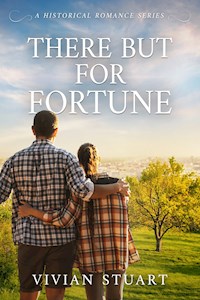
There But for Fortune
There But for Fortune
© Vivian Stuart, 1966
© eBook in English: Jentas ehf. 2022
ISBN: 978-9979-64-481-1
This book is sold subject to the condition that it shall not, by way of trade or otherwise, be lent, resold, hired out, or otherwise circulated without the publisher’s prior consent in any form of binding or cover other than that in which it is published and without a similar condition, including this condition, being imposed on the subsequent purchase.
All contracts and agreements regarding the work, editing, and layout are owned by Jentas ehf.
____
For Géza Ferenc (Kim), who will probably never read it, and for his father, also Géza Ferenc, and my onetime colleagues at the Balogh Institute of Pathology in Baross utca, who—alas!—most certainly will not, I offer for what it is worth this little fantasy.
CHAPTER ONE
They arrested Stephen Kelen in Budapest during the early hours of Monday, July the fifth. I heard the news of his arrest on my car radio as I was driving back to Dr. Adams’ surgery in Fairfax, after being called out to a confinement. The thought of my own impending visit to Budapest, as a tourist, was pleasantly uppermost in my mind as I switched on the radio, with the intention of listening to the weather forecast. Instead, I heard the last part of the announcement about Stephen and I listened to it in stunned disbelief.
It always seems so much more shocking when disaster befalls a person one knows. I didn’t know Stephen Kelen well, but I had met him several times at his sister’s house and, because I had found him an attractive and interesting man, I had made a tentative promise to dine with him when I reached the Hungarian capital. But now . . .
‘Dr. Kelen is a lecturer at Fairfax University, in Yorkshire,’ the disembodied voice of the news-reader stated, with professional lack of emotion. ‘It is understood that he was in charge of a party of British undergraduates attending an international Students’ Conference in Budapest at the time of his arrest. Although no specific charges have yet been made against him, it is believed that the doctor is being held on suspicion of having engaged in subversive activities against the Hungarian State. He is a naturalised British subject and the British Consul has requested an interview with him, permission for which has so far not been granted . . .’ there was a pause, followed by the weather forecast.
I leaned forward to switch off the radio, no longer even mildly interested in what the weather was likely to do.
This was the last day of my six weeks locum tenens for Dr. Adams and the old doctor had promised to relieve me of responsibility for his busy medical practice at midday, to enable me to catch the twelve-fifty Pullman to London. At midnight the tourist flight, on which my seat had been booked, would leave London Airport for Vienna, but . . . I glanced at the clock on the dashboard. It was still only nine-fifteen and Stephen Kelen’s sister—whose second child was due to be delivered within the next week or ten days—remained my responsibility. If she had heard the news-flash, Margaret Dacres would be beside herself with anxiety and almost certainly in need of whatever comfort and reassurance her family doctor could offer her. I hesitated and finally turned in the direction of the University.
Even if she hadn’t been listening to the nine o’clock news, I thought, someone would undoubtedly have told her what had happened by this time, since bad news always travels fast. Margaret, or Meg, as she was affectionately known, was in fact Stephen Kelen’s stepsister, but I knew that she was devoted to him. Her husband, Tom—also a lecturer at the University —was away, depositing their elder child with his parents in Newcastle, and not expected back until some time in the evening, which meant that Meg would be alone. She had plenty of friends, of course, but the University had gone down for the summer vacation and most of the dons and their wives were away. Still, I decided, there was bound to be someone I could leave with her—the daily woman, if no one else was available— until Tom got home.
Fairfax is one of the new universities, situated in what had once been the stately home of the local lord of the manor in a picturesque village of old, stone-built houses about three miles out of town. Tenancy of several of these beautiful village houses had been acquired by a fortunate few of the staff—the Dacres among them—and as I drew up outside Meg’s newly painted front door, I found myself admiring the charm of her garden, gay with roses of the old-fashioned, sweet-smelling cottage variety.
‘To come here,’ Stephen Kelen had said, I remembered, ‘is like turning the clock back two centuries, to what was undoubtedly a better world . . .’ and I wondered, as I walked up the narrow paved path to the door, whether he was thinking of this place now. Perhaps, poor man, he was.
Meg’s daily woman, Mrs. Holroyd, admitted me. ‘Why, Doctor,’ she exclaimed, clearly startled, ‘you’ve been quick! It’s not ten minutes since I phoned t’surgery for you.’
‘You mean you asked me to call?’
‘Aye.’ She stood back, eyeing me gravely. ‘I had to, for Mrs. Dacres. You’ll have heard about that stepbrother of hers, on t’radio? It seems they’ve arrested him.’
‘Yes, I heard it just now,’ I told her, ‘that’s why I came. I didn’t know you’d called me . . . I haven’t been back to the surgery, you see. I came straight here as soon as I heard about Dr. Kelen.’
‘I’m real glad you did,’ Mrs. Holroyd said feelingly. ‘Very insistent that I was to get you, Mrs. Dacres was. She didn’t want old Dr. Adams, although he offered to come, seeing you were out on a case. It must be Dr. Stacey Heriot, she said, and no one else, and I was to say it was urgent.’
‘Is Mrs. Dacres very upset?’ I asked.
‘Aye, Doctor, she is. But you’d best see her for yourself. She’s in her bedroom, I made her go back to bed. You know your way up, don’t you? I’ll put t’kettle on. She’s not had a thing to eat, poor young soul, but maybe she’ll take a cup of tea now you’re here. I’ll bring a tray up, any road.’
I thanked her and went upstairs. The house was small, just two bedrooms and an attic on the upper floor and a minute cubby-hole of a bathroom, where I paused to wash my hands and prepare a syringe in case of need, before tapping on Meg’s door.
‘Come in.’ Her voice sounded strained and unhappy, but she smiled when she recognised me and said, as Mrs. Holroyd had done, ‘You have been quick! Bless you for coming, Stacey . . . it is good of you, because I know you’re leaving here today. But I simply had to see you, I . . . have you heard about Stephen?’
‘Yes, on the radio.’ I studied her anxiously as I seated myself in the chair at her bedside. Meg was very pale and her eyes were red-rimmed from weeping, but she had herself under careful control and she shook her head as I reached out automatically to feel for her pulse.
‘I’m all right . . . just terribly worried, that’s all. But you needn’t bother about me, I’m not going into early labour or anything like that. And I won’t delay your holiday, I promise you . . . that’s the last thing I’d want to do.’
‘But I thought . . . I mean, Mrs. Holroyd did say you’d sent for me——’
‘Yes, I did. But not on my own account, Stacey, on Stephen’s. I . . . that is, I want to ask a great favour of you. You’re perfectly at liberty to refuse, of course, but’ —Meg sighed—‘I hope you won’t.’
I guessed what she was about to ask me to do and my heart sank. I had first made her acquaintance as a patient when I had taken over Dr. Adams’ practice, six weeks before. We had become friends and I had seen a good deal of Meg and her husband, both socially and professionally, during my locum; the fact that my surname—Heriot—was the same as Meg’s before her marriage was an added bond between us. We weren’t related, though, and I really knew very little about her and still less about her stepbrother. I liked them, it was true, particularly Meg, but . . .
‘A favour, Meg?’ I echoed, trying not to sound too reluctant. ‘I suppose that means you want me to try and see Stephen when I’m in Budapest?’
She grasped my hand eagerly. ‘Well, yes, it does. I thought . . . that is you’re going to Budapest anyway, aren’t you, for your holiday? It’s all arranged, your flight booked and everything?’
‘Yes, that’s right, bu . . .’ I was beginning to wish that it were not, although I had been looking forward to my Hungarian holiday with the keenest anticipation for almost six months. ‘I don’t think there’s a hope of my being allowed to see him. They won’t even give the British Consul permission to visit him, and——’
‘But you could try.’ Meg’s blue eyes held the glint of tears, as they met mine beseechingly. ‘Oh, Stacey, please, at least you could try! Since you’re going to be in Budapest in any case, it wouldn’t hurt you to try, would it? You’ll be there as a genuine tourist, you wouldn’t be running any risk.’
I might be running a very grave risk, I thought uneasily, but for Meg’s sake, I did not say so. ‘I suppose I could ask to see him,’ I admitted, ‘if I knew who to ask. But I’m very much afraid that it wouldn’t do any good, Meg. However, if it would relieve your mind, I’ll see the British Consul as soon as I arrive and find out what’s being done to help Stephen.’
‘Thanks,’ Meg acknowledged miserably. ‘I’d go myself, if it weren’t for this . . .’ she gestured to her distended abdomen and bit back a sigh of frustration. ‘Obviously I can’t, in the circumstances, can I? Young Dacres has timed his arrival rather badly.’
‘No, you can’t possibly go.’
‘When I remembered that you were going . . . oh, it seemed providential, like an answer to prayer. I realise it’s an awful lot to ask of you, but I’ve no one else to ask and . . . Stephen is innocent, whatever charges they bring against him, I’d stake my life on that.’ Meg spoke earnestly, her small, intelligent face unusually grave. ‘Believe me, Stacey, he isn’t involved in any sort of conspiracy and he’s not a spy, I give you my word.’
I believed her, since she was evidently speaking the truth, so far as she knew it, but I couldn’t help wondering how much she knew or, for that matter, how much Stephen Kelen had told her. Spies—or agents, as they were more often called these days—didn’t, as a rule, confide even in their nearest and dearest. They kept their own counsel and endeavoured to behave so normally that no one suspected them of being more than they appeared to be . . . that was part of their stock in trade, an essential part of their camouflage. As if she sensed my unvoiced scepticism, Meg’s fingers tightened about mine.
‘You’ve met him, Stacey, and . . . he’s simply not the type, is he? All Stephen cares about is his work here, the University and that precious Conference of his. That was the reason he went to Budapest, the sole reason, he had no ulterior motive . . . he simply wanted to attend the Students’ Conference because he believed in it, because he had faith in what it could achieve. He’s honestly not a spy. He’s not even against the present government of Hungary any more.’
‘Any more?’ I challenged sharply.
Meg shrugged. ‘Well, he is Hungarian. He took part in the 1956 uprising, that was why he came to England, he was a refugee. But all that was ten years ago and he was only a boy when it happened—a nineteen-year-old student at the University of Budapest. Nearly all the students were involved in the uprising, Stephen wasn’t the only one.’
‘But he was one of the freedom fighters?’
‘Yes, I think so,’ Meg admitted. ‘He doesn’t ever talk of it. Why should he? It’s over and he’s a British subject now, his home is here. He never thought of going back to Hungary . . . if it hadn’t been for that wretched Conference, he never would have gone back. I tried to persuade him not to go, but he assured me that there was no reason why he shouldn’t. He had nothing to fear, he said . . . those who took part in the uprising had been pardoned and, in any case, they rose against the Russians, not against their own government, so . . .’ There was a knock on the door and she broke off, as Mrs. Holroyd came in with a laden tray. I took it from her and, when Meg had accepted a cup of tea and a slice of home-made cake, she nodded with evident satisfaction and left us with the reminder that she was in the kitchen, if we should need her.
I poured myself some tea and resumed my seat . . . and my questions, because, if I were to try to help Stephen Kelen, I had to know more about him. Meg told me that his father had been a distinguished musician, who had died just before the uprising.
‘His name was Ferenc Kelen,’ she said. ‘Stephen’s mother, Magda, is a darling. She had a pretty ghastly time escaping from Hungary . . . she broke both bones in her right arm and, from lack of proper attention, the arm didn’t heal and became infected. That was how she met my father . . . he was a consultant at St. Mark’s in London and he operated on her soon after she arrived. It was quite a shock to the family when Father announced that he was going to marry a Hungarian refugee, but it was a very happy marriage and we all loved Magda as soon as we met her. Stephen, too . . . ’ Meg caught her breath on a sigh. ‘They’re part of my family now, Stacey.’
‘Yes, I see.’ I drank my tea slowly, thinking hard. ‘Your stepmother . . . have you been in touch with her since you heard that Stephen had been arrested?’
‘I telephoned my father. He’ll break the news to her gently, when he thinks she’s fit to stand it. She’s not strong, you see, she had a bad heart and is almost an invalid, but she’ll have to be told, I suppose.’
The faint hope I had cherished that Stephen’s mother might be able to intervene on his behalf faded abruptly. Further questioning elicited the fact that no one else in Meg’s family was in a position to make the journey to Budapest—certainly not within the next twelve hours, as I was going to—and I began to resign myself to the inevitable.
‘You said, a few minutes ago, that you didn’t know who to ask about seeing Stephen,’ Meg volunteered suddenly. ‘Apart from the British Consul, I mean.’
‘No, I don’t. Although the Consul will presumably be able to tell me.’
‘I could ask Magda . . . or ask my father to find out from her. You wouldn’t have time to go and see them, before you leave, I suppose? They live in Sussex now—Father’s retired.’
‘My plane leaves at midnight,’ I objected.
Meg’s face fell. ‘Then obviously you wouldn’t. But you could ring me up from London—or even from the airport, before you take off—and I’d give you all the information I’d been able to obtain. Names, anything that might be of use to you . . . introductions, if you like, to friends of Magda’s.’
‘Yes, all right, I’ll ring you from London.’ I tried to sound confident and enthusiastic and failed miserably. Meg eyed me with contrition. ‘I really am sorry to ask you to do this,’ she said. ‘Only there just isn’t anyone else. Oh, Stacey, I’m so grateful . . . you’ve no idea what a weight you’ve taken off my mind.’
‘I’ve done nothing to earn your gratitude yet,’ I pointed out, feeling ashamed. ‘And I may not be able to, even when I get to Budapest. You do understand that, don’t you, Meg?’
‘You’ve said you’ll try,’ she answered. ‘That’s enough, because I know you will try. And I know that it will help Stephen if you’re able to visit him.’
‘If they’ll let me visit him. They may not . . .’ I glanced surreptitiously at my watch. I should have to get back to the surgery soon—there were certain notes I had to give Dr. Adams, my call-list to hand over and my packing to complete. ‘I’m not a relative of his and I——’
‘Stacey!’ Meg sat up so quickly that she almost upset her teacup. ‘How stupid of me not to have thought of that before! Of course, you must say you’re Stephen’s stepsister . . . it’s the obvious answer, and they’ll have to allow you to see him, if you’re a relative.’
‘But I’m not,’ I countered, taking the cup from her. ‘And they’d very soon find out I wasn’t if I——’
‘No,’ Meg put in, with conviction. ‘Your surname’s Heriot and so was mine before I married Tom. Oh, Stacey, don’t you see . . . the Hungarians won’t have any way of proving you’re not Stephen’s stepsister, not at once, anyway, even if they bother to check. And they probably won’t because your passport will almost certainly satisfy them . . .’ I attempted to argue, but she cut me short, and eventually, much against my better judgement, I agreed. Certainly if I were seriously to attempt to see Stephen Kelen when I reached Budapest, I should have a better chance of obtaining permission to do so if I said I was his stepsister.
Although it probably wouldn’t arise, I told myself, as, aware that time was running short, I rose to take my leave of Stephen’s real stepsister. The radio announcement had said that the British Consul had been refused permission to visit him, which meant if other, similar cases were anything to go by, that no one would be allowed to see him . . . not even a sister or a wife. At any rate, not for some time, and my visit to Hungary was only supposed to last for eighteen days. I would try to see him, having promised Meg I would, but if I failed, she could scarcely blame me.
I turned, holding out my hand, but Meg was writing busily on the back of an old envelope. ‘There,’ she announced, thrusting it into my hand, ‘I’ve made a list of the family, in case you should need it. My father is Sir Andrew Heriot, F.R.C.S., and Magda, of course, is Lady Heriot now. I believe her name was Bethler before her marriage to Stephen’s father and I think her family were wealthy landowners at one time. I have one sister called Stella, who’s engaged but not married, and an elder brother, John. But you’ll be able to study the list in the train and I’ve written down their addresses for you. Again bless you and thank you, Stacey! Don’t forget to ring up from London, will you?’
‘I won’t,’ I promised. ‘Au revoir, Meg. I hope all goes well with you and young Dacres when the time comes. It should, but I’ll ask Dr. Adams to look in on you tomorrow, when he’s on his round, just in case.’
Returning to the surgery, I found Dr. Adams awaiting me with some impatience. Some new calls had come in and he was anxious to answer them before starting his morning surgery. We dealt with our business swiftly, he handed over my cheque, thanked me and hurried out to the car. I completed my packing and, having bidden the necessary farewells, was ready and Waiting when the taxi I had ordered came to take me to the station.
My journey to King’s Cross was uneventful. I bought a paper at King’s Cross, but although Stephen’s arrest was reported on the front page, the report told me very little more than I had learnt from the radio. It did, however, make quite a lot out of his having been a freedom fighter during the Hungarian revolt of 1956 and it also traced his father’s very distinguished career, as a violinist and as a composer of international repute.
I read the report in a taxi, on my way to my parents’ flat in Chelsea, where I had an early meal and picked up my tickets and passport. I had considered telling my father of the promise Meg Dacres had wrung from me, but finally decided against it. He had been in court all day and he was tired . . . besides, I knew that it would worry him, so apart from mentioning that I had met Stephen Kelen, I said nothing, and both he and my mother came to the air terminal to see me off. I was early, so I rang Meg from a public phone box, jotting down the information she gave me in my diary. There wasn’t much—the names of one or two people, resident in Budapest, who had been close friends of Stephen’s parents and to whom she had promised to write, in order to introduce me, and that of a Laszlo Kulka, at the Ministry of Justice on whom, Meg assured me, her stepmother had said I could rely.
By the time I had finished my call, the members of my party were gathering round their coach, a dark-haired courier checking their tickets and urging them to go on board. At first glance, they all looked ordinary enough. There were about thirty of them, the majority women, who included the usual sprinkling of fashionably dressed, middle-aged American matrons, and several elderly couples, some British, the rest— judging by their accents—Australian, American or Canadian. About a dozen appeared to be roughly in my age group . . . three married couples, four young women travelling together, whom I decided were probably American school teachers on vacation, and two unattached men, one British and the other Australian.
The courier inspected my tickets and passport, took charge of my suitcase and invited me to join the rest of the party in the coach. He had a strong accent but spoke English very fluently, treating me to a beaming smile and assuring me, expansively, that I was going to enjoy myself.
‘I shall be with you throughout the tour, Dr. Heriot, so if there is anything you want, you have only to tell me. My name is Kovacs, Imre Kovacs or, as we say in Hungarian . . . Kovacs Imre. And I am always at your service.’ Continuing to smile, he bowed me into the coach before turning to greet a late arrival who appeared, much flustered, at his elbow.
I took a seat at the rear, immediately behind the four teachers, who were laughing and talking gaily, and the unattached Australian, after inspecting me covertly from behind his newspaper, rose and seated himself beside me.
‘Looking forward to the trip?’ he asked.
‘Well . . . yes, I think so,’ I answered, with more honesty than I had intended to display.
His brows rose in his tanned, pleasant face. ‘You don’t sound too sure.’
‘Well, I——’
‘I know, I know,’ he said ruefully. ‘You reckon I’m a wolf, trying to make a pass at you before we’ve even left the ground. But I’m not, I give you my word . . . there’s nothing of the wild Colonial boy about me.’
‘Isn’t there?’ I challenged, catching his mood and amused, in spite of myself, by his approach. At least it was disarming. ‘How can I be sure of that?’
He nodded his crew-cut fair head emphatically.
‘Scout’s honour,’ he asserted, ‘and may I be struck down if it isn’t true. Oh, the spirit is willing enough, but I just seem to lack the knack, somehow . . . or the killer-instinct. I put women on pedestals and worship them. It’s probably my upbringing . . . very strict Presbyterian. Anyway, you looked . . . well, you looked understanding, the kind of girl who wouldn’t bite my head off if I spoke to you. And I mean that as a compliment. But . . . his eyes were very blue and innocent as they met mine. ‘I’ll go away if you want me to. I know how fussy the British are about being properly introduced.’
The coach started and, to my own surprise, I found myself smiling back at him. ‘No, I don’t want you to go away,’ I answered, again with honesty. I was suddenly afraid of what might lie in store for me at the end of this journey and it was oddly comforting to have someone to talk to, someone to laugh with, in whose easygoing company I could relax and pretend to myself that I was going on a perfectly ordinary holiday. The thought of Stephen Kelen, languishing in a Hungarian prison cell, which had haunted me ever since I had heard the news of his arrest, faded a little and became less oppressive.
My companion offered his hand. ‘Maybe we ought to introduce ourselves,’ he suggested. ‘I’m Nicholas Russell, but my friends call me Nick . . . or Old Nick, depending on how friendly they’re feeling. And you’re . . .’
‘Stacey Heriot,’ I supplied, accepting his proffered hand.
‘Unusual name, Stacey. But it’s pretty and I like it because it suits you.’ Nick Russell grinned. ‘You’re rather unusual, I reckon.’
This was shameless flattery, but for no reason that I could have explained, I didn’t resent it. ‘Thank you,’ I acknowledged. ‘It is kind of you to say so, Mr. Russell.’
‘Nick,’ he reminded me. ‘Hell, I don’t go for all this British formality! And I don’t intend to address you as Miss Heriot . . . Stacey. That would be a waste of a pretty name, wouldn’t it? Tell me, what do you do for a living, presuming that you have to work for one? No, wait . . . let me guess. It’s a little game I often play, trying to decide what people do, just by looking at them.’
The coach halted at a light signal and he turned in his seat to study me solemnly. ‘Educated accent, intelligent, air of competence and assurance. Good clothes but practical, and flatheeled shoes . . . hm, what does that give us? Definitely a career woman, I should say, and a dedicated one. A barrister, maybe . . . I can just picture you in a wig and gown, charming some old judge off his bench. No? Probation or Personnel Officer? I’m getting warmer. It’s a job where you meet people, isn’t it?’
‘Yes,’ I confirmed. ‘And my father is a barrister, so you weren’t too far out in your first guess.’
‘Ah . . .’ he looked thoughtful. ‘Wait a minute, I believe I’ve got it. The essential clue . . .’ he raised my hand, turned it palm uppermost, making a great pantomime of sniffing and wrinkling his nose. ‘Nails cut short, hands very clean and smelling ever so faintly of antiseptic . . . you’re a doctor.’
I laughed. ‘Yes, I’m a doctor.’
The lights changed and the coach moved slowly into the traffic. ‘What kind of a doctor are you?’ Nick Russell asked curiously. ‘In general practice or working in a hospital?’
‘Well, I’ve been doing a locum for a G.P. in Yorkshire,’ I told him, ‘but that was really to fill in time. I did my training at St. Vincent’s—here in London—and I’m going back there as an obstetrical registrar in September, with the idea of working for my M.R.C.O.G. I wasn’t sure if that was a good idea at first . . . it means an awful lot of work, you see. But after six weeks’ experience as a G.P., I’ve convinced myself that it is a good idea . . . for me, anyway.’
‘You’re ambitious, then?’
I denied it. ‘No, not really. It’s just that I prefer working in a hospital, although I quite enjoyed the locum while it lasted. But that’s enough about my job—what do you do?’
‘Your turn to have three guesses now, Doctor,’ my new acquaintance returned. ‘Put your powers of observation and deduction to the test . . . what do you think I do?’
He was obviously the outdoor type, I decided. The tan on his cheeks wasn’t of recent origin and he had the air of a man who was in the peak of physical condition. He was tall and lean, without an ounce of superfluous flesh on his big, muscular body. The loose-fitting grey suit he wore was expertly tailored, the material expensive . . . a farmer, perhaps, or more probably, a station owner in the Australian outback? I, too, looked at his hands, but they offered no clue, save that they were slim and well kept, although I recalled that the palm I had held when we shook hands a few moments before had been calloused. I tried various guesses, to each of which he shook his head, evidently enjoying my failure to place him.
‘I’ll give you a clue,’ he offered. ‘When I’m on the job, I wear a beard.’
‘A beard?’ I echoed, puzzled.
‘Yeah . . . a real beaut ginger one. But I had to shave it off for Wimbledon.’
‘You mean you’re a tennis player?’
Nick Russell shrugged. ‘Only incidentally. I played at Wimbledon, but I didn’t get beyond the third round . . . I was out of practice, couldn’t expect to. Tennis is kind of a sideline, you see. I have to travel around a lot in my job.’
‘Then you’re a sailor?’
‘Nope . . . you’re stone cold. Give up?’
‘I think I’ll have to . . . unless you’re a poet or a pop singer.’
His deep, full-throated laughter was infectious.
‘Heaven forbid! No, I’m a construction engineer, strictly practical and with both feet on the ground. I build bridges and dams and even roads, sometimes . . . help to, that is. I’ve just spent two and a half years working on an irrigation scheme in the Northern Territory, with only the odd week’s leave in the city when things slackened off a bit and I could spare the time. Mostly I couldn’t, so I promised myself I’d take a real, slap-up holiday when the job was finished. A visit to the Old Country, with Wimbledon first on the list, and then a chance to see something of Europe. And, as you’ll observe, here I am.’
‘On your way to Budapest?’ I questioned. ‘But why choose Hungary, of all places? I should have thought you’d want to see Paris first. Or Italy . . . Florence and Venice, Naples, Capri. Or Switzerland, even.’
‘Give me time, Stacey,’ Nick pleaded. ‘I’ve only just made a start and I’ve another three months to fill in. But I chose Hungary because that’s where my folks came from originally. Oh, I was born in Australia, I’m a dinki-di Aussie, make no mistake about that. My dad, too, he’s second generation, doesn’t speak a word of the language. But my mother came out just before the war.’
‘As a refugee?’
‘Yeah. I reckoned I’d like to go and see where she came from . . . it’s a little place called Visegrad on the Danube, not far from Budapest. You can get there in a few hours on a Danube steamer and it’s one of the trips they advertise on this tour, so I booked myself on it. Normally I like to take a car and wander around, going where I please, but you can’t do that in the Iron Curtain countries, can you?’ Nick shrugged. ‘Or so I was told. They like to keep track of their tourists, and although theoretically you can take a car and go just where the spirit moves you, in practice I heard there were snags. So I reckoned an organised tour was the best bet. And at least, on this one, the excursions are optional and you aren’t always being herded into a coach with a whole mob of your fellow tourists and being taken to visit museums.’
This was also what had attracted me in the travel agent’s brochure and I said so. Nick Russell beamed at me.
‘Great minds,’ he observed, ‘think alike, don’t they? I’m hoping to play a little tennis and go for a sail on Lake Balaton . . . or even take a canoe down the Danube. Ever done any canoeing?’
I shook my head. ‘No.’
‘It can be fun. Maybe we could hire a canoe and paddle up to Visegrad, instead of going by steamer. Would you fancy that?’
‘Well, I suppose there has to be a first time for everything. Yes, I think I would fancy it.’
His smile widened. ‘You’re a woman after my own heart. Funny, I just knew we were going to hit it off when I saw you step on board this coach . . . there was something about you. That was why I plucked up the courage to come and sit beside you.’
‘Does that take very much courage?’ I asked mildly.
‘Too right it does, in England,’ he assured me with a wry grimace. ‘I’ve been mistaken for a wolf in full cry when all I was trying to do was ask the way somewhere! Anyway, I hope, for my sake, that they’ve had the foresight to seat us together in the airplane.’
But they hadn’t. We were booked on a scheduled night flight by the Dutch KLM airline and there were a number of other passengers, in addition to our party. When after a short wait in the departure lounge, our efficient little courier shepherded us through passport control and Customs to the airliner, every seat was taken. Nick was allocated one at the rear, some distance from mine, but I was not altogether sorry. I had been up very early and I found suddenly that I was feeling extremely sleepy. Nick Russell was an amusing and stimulating companion, but the grey-haired American matron who now occupied the seat beside me seemed likely to prove more restful . . . and rest, just then, was what I wanted.
We exchanged a few polite remarks before take-off and then, when we were airborne and were informed that we might release our seat-belts and smoke if we wished, we both refused the stewardess’s offer of coffee and sandwiches and began to make preparations for slumber.
‘Airplanes have a real soothing effect on me,’ my new companion announced, smothering a yawn. ‘I guess we’ll have a pretty long day tomorrow and I certainly do want to be fresh for the coach tour of Vienna, don’t you?’ She tilted back her seat with the skill of an experienced airtraveller and slipped a small, inflatable plastic cushion behind her head. A few minutes later, she was neatly and tidily asleep, not a hair of her elaborate coiffure out of place.
I endeavoured to follow her example, but—perhaps because I was over-tired—sleep eluded me for some time. I had the aisle seat and most of my fellow passengers seemed to have decided to drink the coffee they had been offered or else to order some sort of nightcap. The two stewardesses went busily back and forth, to the accompaniment of clinking glasses and the subdued hum of conversation, cigarettes were lighted and the estimated time of our arrival in Vienna announced, over the airliner’s amplifying system, by the Captain.
I had just managed to accustom myself to these small disturbances and was dozing off when I was startled into wakefulness once more by hearing my name called over the amplifier. The announcement was made first in Dutch, which I did not understand, and then in English. ‘There is a radio message for Heriot. Will this passenger be so good as to come to the flight deck? Thank you. Mr. Heriot, if you please . . . to the flight deck.’
I scrambled awkwardly to my feet. It seemed rather unusual to call a passenger to the flight deck, in order to receive a message which could have been written down and delivered by one of the stewardesses, but I suppose there must be some reason for it. And the ‘Mr.’ must be a mistake, or possibly whoever had made the announcement had meant ‘Dr. Heriot’. Sleepily I started to move in the direction of the flight deck, trying not to disturb those whose seats I had to pass and wondering whether Meg could have sent me a message concerning her stepbrother. I had reached the end of the aisle when a tall man, whose face I glimpsed indistinctly in the dimmed light of the passenger cabin, attempted to thrust past me with a murmured apology.
‘Excuse me, if you don’t mind . . .’ his accent was English, of the clipped, public school variety which, I felt sure, Nick Russell would have described irreverently as ‘lah-di-dah’.
‘Yes?’ I turned to face him a trifle stupidly, my brain still clouded by the mists of sleep.
‘I want to get past you . . .’ he gestured to the door of the flight deck at my back. ‘They have a message for me.’
‘You mean . . .’ I was struck by the coincidence. ‘You mean that your name is Heriot?’
‘Of course it is, otherwise I shouldn’t be answering to it, should I?’ His tone was impatient, almost rude. ‘Now if you wouldn’t mind——’
‘My name is also Heriot,’ I informed him, with what dignity I could muster. ‘So it is possible that the message may be for me and——’
The tall stranger cut me short abruptly. ‘You are not Mr. Heriot, one presumes? And it so happens that I’m expecting a message—an urgent one—and I should like to take delivery of it, with your permission, of course. Thank you.’
He spoke with heavy sarcasm, making no attempt to conceal the fact that he considered me a nuisance and probably halfwitted into the bargain. I stood aside, feeling at once foolish and nettled by his unnecessary rudeness, and he opened the door to the flight deck and disappeared, closing it firmly behind him. As he passed me, I saw that he was dark and not at all bad-looking—a man of about thirty-three or four, dressed in a sober pinstripe suit of unmistakably Savile Row cut, with which he wore one of the few regimental ties I was able to recognise, that of the Brigade of Guards. He looked a typical Guards officer, I decided, not without malice. Only the bowler hat and the impeccably rolled umbrella were needed to complete the picture, but these, no doubt, were with his luggage.
I returned to my seat, resuming it carefully and silently, but my companion didn’t stir. Heriot wasn’t a particularly common name, I thought, and wondered whether he could be a relation of Meg’s. She had mentioned a brother, older than herself, whose name was I hunted in my handbag for the envelope she had given me. Yes, the brother’s name was John, but she had supplied no information about him, beyond the bare statement that he was thirty-three and unmarried.
One of the stewardesses came up to me, with coffee on a tray. ‘I see you are awake,’ she said softly. ‘Perhaps you would like this now?’
This time I accepted her offer gratefully. ‘Thank you very much. Actually I was asleep, but the announcement about the radio message—the one for Heriot—wakened me. My name is Heriot, you see.’




