


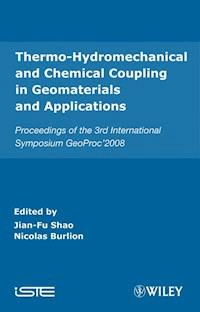
Thermo-Hydromechanical and Chemical Coupling in Geomaterials and Applications E-Book
298,99 €
Mehr erfahren.
- Herausgeber: John Wiley & Sons
- Kategorie: Wissenschaft und neue Technologien
- Sprache: Englisch
GeoProc2008 collects the proceedings of the International Conference on Coupled T-H-M-C (thermal, hydraulic, mechanical, chemical) Processes in Geosystems.
Sie lesen das E-Book in den Legimi-Apps auf:
Seitenzahl: 1022
Veröffentlichungsjahr: 2013
Ähnliche




















Table of Contents
Preface
Keynote Lectures
Physical Mechanics of In-Pore Phase Transition
1. Introduction
2. Phase Transition within a Porous Solid
3. Unsaturated Poroelasticity
4. Drying shrinkage and freezing expansion
5. Conclusion
6. Acknowledgements
7. References
Localized Failure in Brittle Rock
1. Introduction
2. Background
3. True triaxial data
4. Predictions of failure angle
5. Comparison with data
6. Discussion
7. Conclusions
8. Acknowledgments
9. References
Coupled Analysis of Chemo-Mechanical Processes
1. Introduction
2. General description of the formulation
3. Example of application of the THMC formulation
4. A chemo-mechanical model for expansive clays
5. Conclusions
6. Acknowledgements
7. References
Drilling Into the San Andreas Fault
1. Introduction
2. Frictional strength and heat flow
3. Fault stress state and pore pressure distribution
4. Discussion
5. Acknowledgment
6. References
Section 1. Fundamentals of Mechanics of Porous Media
A Numerical Model for CO2 Wells Ageing through Water/Supercritical CO2/Cement Interactions
1. Introduction
2. Selected experimental features to be reproduced by the reaction-transport model
3. Modelling of the Portland cement-CO2 fluids interactions
4. Results
5. Conclusion
6. References
Study on Shear Stress-Strain Model for Unsaturated Soil
1. Introduction
2. Hyperbolic Shear Stress-strain Model and Its Deficiency
3. New Stress-strain Model Establishing for Unsaturated Soil
4. Mathematical Property of the New Model
5. Comparisons with Laboratory Tests
6. Conclusions
7. References
How Lead Affects the Hydraulic and Microscopic Properties of a Smectite
1. Introduction
2. Material and methods
3. Results
4. Physico-chemical study
5. Conclusion
6. References
Study of Settlements in a Granular Medium by a Probabilistic Approach
1. Introduction
2. Probabilistic model
3. Formulation of the diffusion equation and modelling
4. Equation of diffusion and displacements in a granular medium
5. Parametric study, influence of the diffusion coefficient D
6. Conclusion
7. References
Mechanics of a Soil, a Dynamically Coupled Solid-Water Gas System.
1. Introduction
2. Soil model
3. Dynamic coupling
4. Incremental approach
5. Conclusion
6. References
Mechanics of a Soil, a Dynamically Coupled Solid-Water Gas System.
1. Introduction
2. General stress-strain components
3. Water-gas mixture
4. Isotropic undrained
5. Conclusion
6. References
Mechanics of a Soil, a Dynamically Coupled Solid-Water Gas System
1. Introduction
2. Isotropic compression
3. Shear
4. Branch of linear shear
5. Triaxial test
6. Conclusion
7. References
Simulation and Contrastive Analysis of Typical Pollutant Transporting
1. Introduction
2. Test design
3. Tests process and the result analysis
4. Conclusions
5. Acknowledgement
6. References
Section 2. Experimental Characterization of Coupled T-H-M-C Processes in Porous Media
Gas Retention Phenomenon in Dry or Partially-Saturated Concrete: Permeability Assessment
1. Introduction
2. Theory
3. Experimental methodology
4. Results and Discussion
5. Conclusion and further work
6. References
Simultaneous Measurement of Expansion and Water Humidity Sorption on Montmorillonitic Clays
1. Introduction
2. Materials and methods
3. Results and discussion
4. Conclusions
5. Acknowledgements
6. References
Effect of Temperature on Migration of Gas and Brine in Compacted Salt
1. Introduction
2. Experimental Approach
3. Numerical Approach
4. Results and Discussion
5. Conclusion
6. References
The effect of Wetting Conditions on the Mechanical Strength of Chalk
1. Introduction
2. Test Materials, Fluids and Methods
3. Results and discussion
4. Conclusions
5. References
Induced Geometry in Chalk during Hydrochloric Acid Stimulation
1. Introduction
2. Theory and experimental set-up
3. Results and discussion
4. Conclusion
5. References
An Experimental Investigation of the Evolution of Rock Poromechanical Properties Associated with Chemical Alteration Processes
1. Introduction
2. Evolution of petrophysical properties induced by chemical alteration
3. Geomechanical characterization
4. Evolution of geomechanical properties induced by chemical alteration
5. Conclusions
6. Acknowledgements
7. References
Electrokinetic Treatment of a Natural Silt in Saturated and Unsaturated Conditions
1. Introduction
2. Material, testing equipment and procedures
3. Experimental programme
4. Conclusions
5. Acknowledgements
6. References
Normal Stress-Induced Permeability Reduction of a Fracture in a Large Granite Cylinder
1. Introduction
2. Theoretical aspects
3. Experimental results
4. Conclusion
5. Acknowledgements
6. References
Experimental Study of the Water Permeability of a Partially Saturated Argillite
1. Introduction
2. Bure argillite
3. Experimental set-up and method
4. Experimental results
5. Conclusion
6. Acknowledgements
7. References
Application of the Maturity Concept for the Prediction of Restrained Autogenous Shrinkage of Cement Pastes
1. Introduction
2. Background: the maturity concept
3. Experimental program
4. Results and discussions
5. Conclusions
6. References
Laboratory Experiments on Thermal Effects on Clay Rocks
1. Introduction
2. Thermal expansion and contraction
3. Pore-water pressure response to heating
4. Temperature influence on deformation
5. Conclusions
6. Acknowledgements
7. References
Mechanical Compaction of Porous Sandstone: an Experimental Study using Acoustic Emission (AE) Monitoring
1. Introduction
2. Materials and Methods
3. Results and discussion
4. Conclusions
5. References
An Analysis of the Pulse Test and the Light of Residual Hydraulic Potentials
1. Introduction
2. Governing equations
3. Numerical results
4. Conclusion
5. Acknowledgements
6. References
Section 3. Constitutive Models for T-H-M-C Coupling and Multi-scale Approaches
Formulating Material Properties in Coupled Hydro-Mechanical Modeling
1. Introduction
2. Numerical model
3. Non-linear elastic compressibility applied to a consolidation problem
4. Elasto-plastic material behavior in a triaxial test
5. Conclusion
6. References
Partially Coupled Fluid Flow Modeling for Stress Sensitive Naturally Fractured Reservoirs
1. Introduction
2. Review of literature
3. Methodology
4. Results/Discussion
5. Conclusion
6. References
7. Figures
Poromechanical Modeling of Hygric Shrinkage and Crystallization Swelling in Layered Porous Materials
1. Introduction
2. Experimental work
3. Modeling
4. Results
5. Conclusions
6. References
Fan-shaped Model of Clay Swelling Process
1. Introduction
2. Fan-shaped model of clay swelling process
3. Model of filtration in clays
4. Conclusion
5. References
Early Age Autogenous Deformations of Cement-Based Materials
1. Introduction
2. Experimental study
3. Micromechanics modelling
4. Analysis and discussion of the experimental and numerical results
5. Conclusions
6. References
Identification of the Hydro-Mechanical in-Situ Properties of Tournemire Argillite from Mine-by-test Experiment
1. Introduction
2. Theoretical model
3. Model setup
4. Materials parameters
5. Comparison of results
6. Influence of rock mass viscoplastic behaviour
7. Conclusion
8. References
Model of Coupled Thermo-Hydraulic Transport in Bentonite Based on Mobile and Immobile Water Phase
1. Introduction
2. Governing physical principles
3. Material parameters and functions
4. Numerical code implementation
5. Simulation of the UPC heating experiment
6. Acknowledgements
7. References
Orthotropic Anisotropic Damage Coupled Modeling of Saturated Porous Rock
1. Introduction
2. Continuous damage model
3. Calibration of model parameters
4. Hydraulic mechanical coupled damage
5. Conclusion
6. References
Numerical Evaluation of Effective Transport Properties of Random Cell Models: Two-Point Probability Approach
1. Introduction
2. Formulation of the numerical technique
3. Microstructure generation
4. Determination of the two-point probability function
5. Evaluation of effective properties and the appropriate sample size
6. Conclusions
7. References
Section 4. Numerical Modeling of T-H-M-C Processes
Numerical Analysis of the Desaturation Process at the Argillaceous Toumemire Site (France)
1. Introduction
2. Numerical Model
3. Model Setup
4. Simulation
5. Sensitivity study
6. Comparison with measurements
7. Conclusion
8. References
Numerical Study of the Influence of Fractures on the EDZ around a Nuclear Waste Emplacement Drift
1. Introduction
2. Modelling of near field model domain
3. Modelling steps
4. Concluding remarks
5. Acknowledgements
6. References
Modeling THM Processes in Rocks with the Aid of Parallel Computing
1. Introduction
2. THM processes and their finite element analysis
3. Parallel finite element analysis
4. An example of parallel TM computations
5. Mixed finite element modelling of Darcy flow
6. Conclusions
7. References
Influence of Excavation of Disposal Tunnel on the Near-Field Coupled Thermal, Hydraulic and Mechanical Phenomena
1. Introduction
2. Description of the numerical code
3. Calibration of bentonite and rock property
4. THM analysis of the near field
5. Summary
6. References
The Probabilistic Method: An Efficient Tool to Take into Account the Parameters Variability of Modeling for Durability Design Process
1. Introduction
2. The chloride ingress
3. Variability of the model parameters
4. Calculation of probability of failure
5. Practical application
6. Conclusion
7. References
The Influence of Fractures in the Wall-Block Model Domain in the EDZ using an EPCA Code
1. Introduction
2. Constitutive relation of cell element and HM coupling model
3. Fracture representation in numerical modelling
4. Linear elastic response
5. Elasto-plastic analysis
6. Concluding remarks
7. Acknowledgements
8. References
Simulations of the Thermo-Hydro-Mechanical Behavior of an Annular Reinforced Concrete Structure Heated up to 200°C
1. Introduction
2. Description of the MAQBETH mock-up
3. THM governing equations
4. Numerical Results
5. Conclusions
6. Acknowledgments
7. References
Hydraulic Modeling of Unsaturated Zones Around Three Openings at the Argillaceous Tournemire Site (France)
1. Introduction
2. Description of code
3. Model setup
4. Modeling results
5. Conclusions
6. References
Modeling of Non-Isothermal THM Coupled Processes In Multi-Phase Porous Media
1. Introduction
2. Equations of the problems
3. Numerical scheme
4. Simulation of FEBEX type repository
5. Conclusions
6. References
Scale and Stress Effects on Permeability Tensor of Fractured Rocks with Correlated Fracture Length and Aperture
1. Introduction
2. Deformability of the single fractures with correlation between aperture and trace length
3. Numerical study on permeability REV using UDEC
4. Results
5. Discussion and Conclusion
6. Acknowledgment
7. References
3D Fully Coupled Multiphase Modeling of Ekofisk Reservoir
1. Introduction
2. The complex mechanical behaviour of chalk
3. The PASACHALK constitutive model
4. Numerical 3D model of the Ekofisk field
5. Conclusion
6. Acknowledgements
7. References
Evolution of Permeability in Siliceous Rocks by Dissolution and Precipitation Under Hydrothermal Conditions
1. Introduction
2. Conceptual model
3. Numerical simulations
4. Conclusions
5. Acknowledgements
6. References
Are Uncertainties on the Spatial Distribution of Rock Properties Influential in Coupled Reservoir/Geomechanical Modehng?
1. Overview of the problem
2. Description of the case study
3. Discussion of results
4. Conclusion and further work
5. Acknowledgments
6. References
Thermo-Hydro-Mechanical Behavior of Concrete at High Temperature
1. Introduction
2. Thermo-hydro-mechanical model
3. Numerical simulation
4. Conclusions
5. References
Development of Loads in a Shaft Foundation in Salt Rock due to Seasonal Temperature Changes
1. Introduction
2. Layout of the shaft
3. TM modeling-theory: verification of the determining processes
4. TM modeling of a shaft in rock salt
5. Modeling results
6. Conclusions
7. Acknowledgements
8. References
An Analytical Model to Calculate the Stress Field Induced by a Thin Axisymmetric Producing Reservoir
1. Introduction
2. Mathematical model outline
3. Stress distributions induced by depletion
4. Conclusions
5. References
Time and Chemical Effects on Rock Sample Failure
1. Introduction
2. Subcritcal crack growth and time dependent failure model
3. Laboratory experiments to determine subcritical crack growth parameters
4. Numerical modeling of time dependent failure
5. Discussion and conclusions
6. Acknowledgment
7. References
Effects of Pore Pressure on Failure Process and Acoustic Emissions of Rock Specimen with Pre-existing Random Imperfections
1. Introduction
2. Constitutive relation and model
3. Numerical results and discussions
4. Conclusions
5. References
Modeling the Three-dimensional Hydraulic Performance of a Prototype Repository System within Fractured Crystalline Rock
1. Introduction
2. Hydraulic modeling
3. Prototype repository project in Äspö
4. Conclusions
5. Acknowledgements
6. References
Numerical Simulation of Laboratory Coupled Shear-Flow Tests for Rock Fractures
1. Introduction
2. Experimental study – laboratory coupled shear-flow tests
3. Numerical simulations
4. Results
5. Conclusions
6. References
Section 5 - T-H-M-C Processes in Durability Mechanics of Concrete and Structures
Ultra High Performance Fibre Reinforced Concrete Activation Energy
1. Introduction
2. Material
3. Influence of curing conditions on compressive strength and degree of hydration
4. Prediction of UHPFRC compressive strength under different curing temperatures
5. Activation energy of the tested UHPFRC
6. Conclusions
7. References
Modeling of Mechanical Behavior of Steel Fibre-Reinforced Concrete in a Chemical Evolution Context
1. Introduction
2. Experiments
3. Presentation of the model
4. Model fitting
4. Conclusion
5. Acknowledgments
6. References
A Model for Hydration-Drying Interactions in the Concrete Cover
1. Introduction
2. Presentation of the hydration model
3. Modelling of drying-hydration interactions
4. Results and discussion
5. Conclusions
6. References
Performance Assessment of a Mortar Added with High Calcareous Filler Amounts
1. Introduction
2. Experimental methodology
3. Results and discussion
3.2. Compressive strength and Young's modulus
4. Conclusion
5. Acknowledgments
6. References
Modeling of Isothermal Drying Process in Cementitious Materials
1. Introduction
2. Isothermal drying modelling
3. Modelling analysis
4. Conclusions
5. References
Separation of Damage Mechanisms in Concrete at High Temperature
1. Introduction
2. Modeling
3. Identification of damage mechanisms
4. Conclusions
5. Bibliography
Experimental Analysis of Concrete Structures Affected by DEF
1. Background and motivations
2. Experimental programme
3. Original techniques and specific devices
4. Conclusions and perspectives
5. Acknowledgements
6. References
Percolation and Early Age Behavior of Concrete
1. Introduction
2. Percolation threshold and hydration model
3. Computation Methods
4. Results Obtained for the Entire Microstructure
5. Percolation Algorithm
6. Results Obtained for the Entire Microstructure
7. Conclusions
8. References
How can a Crack Opening be Extracted from a Continuous Damage Finite Element Computation? Application for the Estimation of Permeability
1. Introduction
2. Non-local damage approach
3. Non-local strong discontinuity
4. Numerical comparison
5. Validation
6. Conclusions
7. References
Effect of Carbonation on the Hydro-Mechanical Properties of Portland Cement
1. Introduction
2. Experimental methods
3. Results and discussion
4. Conclusion
5. Acknowledgement
6. References
Assessing the Long-Term Behavior of a Radioactive Waste Disposal Tunnel with a Damage Model Incorporating Chemical Degradation Effects
1. Introduction
2. Modelling of chemical degradation
3. Modelling of near field
4. Examination Results
5. Conclusions
6. References
Thermo-Hydro-Mechanical Behavior of a Petroleum Cement Paste: Chemical Degradation Effects
1. Introduction
2. Experimental investigation
3. Presentation of results
4. Conclusions
5. Acknowledgements
6. References
Experimental Study of Water Desorption and Shrinkage in Mortars and Cement Pastes
1. Introduction
2. Desorption curves and shrinkage
3. Experimental set-up
4. Results
5. Conclusions
6. References
Section 6. T-H-M-C in Engineering Applications and In-situ Investigations
Hydro-Mechanical Response of the Tournemire Argillite to the Excavation of Underground Openings: Unsaturated Zones and Mine-by-test Experiment
1. Introduction
2. Tournemire site and its hydro-mechanical characteristics
3. ”Mine-by-test“ experiment
4. ”Unsaturated zones“ experiment
5. Assessment of disturbed zones
6. Conclusion
7. References
The Belgian Supercontainer Concept for Radioactive Waste Geological Disposal
1. Introduction
2. Presentation of the simulations
3. Thermal calculation
4. Thermo-Hydric calculation
5. Conclusions
6. Acknowledgements
7. References
Comparative Simulation Study on THM-induced Changes in Hydrological Properties of Fractured Rock near Nuclear Waste Repositories
1. Introduction
2. Basic THM responses
3. Potential for Fracture-Shear-Enhanced Permeability
4. Estimate of Permeability Change by Fracture Normal Stress
5. Results and Discussion on the Impact of Permeability Changes
6. Conclusions
7. References
Long-term Response of Near-Field BMT Models around a Deposition Hole by BEM
1. Introduction
2. Near-field BMT model
3. Modeling methodology
4. Modeling results
5. Conclusions
6. Acknowledgments
7. References
Assessment of Modeling Approaches for Analysis of Coupled THMC Processes in the EDZ of Geological Nuclear Waste Repositories
1. Introduction
2. Model Setup
3. Approaches for Modeling of EDZ Evolution
4. Simulation Results for EDZ Evolution
5. Discussion
6. References
Hydro-Mechanical Modeling of Seepage in Gotvand Dam Foundation
1. Introduction
2. Geology of Aghajari formation
3. Geotechnical investigation
4. Numerical modeling
5. Results and discussion
6. references
Atomized Rainfall Effect on Stability of Coupling Hydraulic-Mechanical Unsaturated Rock Slope
1. Introduction
2. Unsaturated fluid-solid coupling governing function
3. Computation model
4. Conclusions
5. References
Index of Authors
First published in Great Britain and the United States in 2008 by ISTE Ltd and John Wiley & Sons, Inc.
Apart from any fair dealing for the purposes of research or private study, or criticism or review, as permitted under the Copyright, Designs and Patents Act 1988, this publication may only be reproduced, stored or transmitted, in any form or by any means, with the prior permission in writing of the publishers, or in the case of reprographic reproduction in accordance with the terms and licenses issued by the CLA. Enquiries concerning reproduction outside these terms should be sent to the publishers at the undermentioned address:
ISTE Ltd 6 Fitzroy Square London W1T 5DX UK
www.iste.co.uk
John Wiley & Sons, Inc. 111 River Street Hoboken, NJ 07030 USA
www.wiley.com
© ISTE Ltd, 2008
The rights of Jian-Fu Shao and Nicolas Burlion to be identified as the authors of this work have been asserted by them in accordance with the Copyright, Designs and Patents Act 1988.
Library of Congress Cataloging-in-Publication Data
GeoProc'2008 (2008 : Lille, France)
Thermo-hydromechanical and chemical coupling in geomaterials and applications : proceedings of the 3rd international symposium GeoProc'2008 / edited by Jian-Fu Shao, Nicolas Burlion.
p. cm.
Includes bibliographical references.
ISBN 978-1-84821-043-1
1. Rock mechanics--Mathematical models-Congresses. 2. Soil mechanics--Mathematical models-
Congresses. I. Shao, Jian-Fu. II. Burlion, Nicolas. III. Title.
TA706.G473 2008
624.1'51--dc22
2008016125
British Library Cataloguing-in-Publication Data
A CIP record for this book is available from the British Library
ISBN: 978-1-84821-043-1
Local Organization Committee
Jian-Fu Shao Chairman
Nicolas Burlion Co-Chairman
Thomas Rougelot Secretary
D. Kondo
F. Skoczylas
International Scientific Committee
E. Alonso (Spain)
J. Carmeliet (Belgium)
A.H.-D. Cheng (USA)
K. T. Chau (Hong Kong)
O. Coussy (France)
E. Detoumay (USA)
L. Dormieux (France)
M. Dusseault (Canada)
D. Elsworth (USA)
X.-T. Feng (China)
A. Gens (Spain)
R. M. Holt (Norway)
Y. Jiang (Japan)
L. Jing (Sweden)
P. Landais (France)
C.F. Lee (Hong Kong, China)
C.I. Lee (Korea)
R.W. Lewis (UK)
J. Liu (Australia)
D. Lydzba (Poland)
G. Meschke (Germany)
I. Neretnieks (Sweden)
H. Niitsuma(Japan)
Y. Ohnishi (Japan)
A. Onaisi (France)
S. Pietruzczak (Canada)
G. Pijaudier-Cabot (France)
J.-C Rougiers (USA)
J. Rudnicki (USA)
B. A. Schrefler (Italy)
P. Selvadurai (Canada)
O. Stephansson (Sweden)
K. Su (France)
H. Thomas (UK)
M. Wallner (Germany)
J. Wang (China)
S.-J. Wang (China)
H. Xie (China)
W. Xu(China)
Q.Yang (China)
J. H. Yin (Hong Kong)
J. Zhao (Switzerland)
R. Zimmerman (Sweden)
Preface
The international conference GeoProc’2008 is the third one of a series of GeoProc, which started in Stockholm in 2003 and continued in Nanjing in 2006. The objective of these conferences is to provide an international forum of exchanges and discussions on the recent advances in experimental investigations, fundamental developments and numerical modelling of thermo-hydromechanical and chemical (THM-C) couplings in geo-systems. Indeed, realistic and robust modelling of THM-C coupling phenomena are fundamental for many engineering applications, such as standard geotechnical engineering and natural risks analyses and management, geological storage and disposal of radioactive and toxic waste, exploration of complex reservoir in the oil industry, sequestration of acid gas as CO2, durability analyses of infrastructures in civil engineering, etc.
Compared to the previous conferences, GeoProc’2008 extends to the THM-C modelling in cement-based materials and structures and their interactions with geological system. The main topics of GeoProc’2008 cover the following topics:
Fundamentals of mechanics of porous media
Experimental characterization of coupled T-H-M-C processes in porous media
Constitutive models for T-H-M-C coupling
Numerical modelling of T-H-M-C processes
Multi-scale approaches
In situ investigation
T-H-M-C processes in durability mechanics of concrete and structures
T-H-M-C in engineering applications (radioactive waste disposal, geothermal reservoirs, oil and gas engineering, geological systems, geotechnical and environmental engineering, hydraulic and hydropower engineering, natural hazards and environments, mining engineering)
This book contains 4 keynote lectures and 70 scientific papers written by authors coming from 23 countries. All the contributions have been reviewed by the members of the GeoProc’2008 scientific committee. The proceedings include many papers written by experts recognised internationally in their respective fields. These provide a wealth of information, which would be useful not only for researchers but also for practising engineers.
Special thanks go to all members of the scientific committee for their valuable supports to this conference. The efforts of all the contributing authors and all the persons who assisted in organizing the conferences are gratefully acknowledged.
Nicolas BURLION
Jian-Fu SHAO
Co-Chairs of GeoProc’2008
Physical Mechanics of In-Pore Phase Transition
O. Coussy1
1Université Paris-Est, Ecole des Ponts Institut Navier
6-8 Av. Blaise Pascal - Cité DescartesF 77455 Marne-la-Vallée Cedex [email protected]
ABSTRACT: In this paper we show how the mechanics of confined phase transition within a deformable porous solid can be addressed in a unique framework, whatever the phase transition considered, either the liquid-gas transition involved in the drying of porous materials or the liquid-solid transition involved in their freezing. Indeed, owing to stability considerations a hydrostatic stress is shown to ultimately prevail within the solid crystal phase so that the latter behaves like a compressible elastic fluid as long as only in-pore phase transition is involved. The extension of saturated poroelasticity to unsaturated conditions allows us to work out appropriate constitutive equations to capture the deformation resulting from in-pore phase transition within an elastic porous solid, while the use of homogenization schemes provides estimates of the unsaturated poroelastic these constitutive equations involve. The prediction of the drying shrinkage or that of the deformation due to cryosuction during freezing reveals the significant effect of the pore size distribution, since the intensity of both the deformation and the elastic energy that the solid matrix can store strongly depends upon the homogenization scheme.
Lesen Sie weiter in der vollständigen Ausgabe!
Lesen Sie weiter in der vollständigen Ausgabe!
Lesen Sie weiter in der vollständigen Ausgabe!
Lesen Sie weiter in der vollständigen Ausgabe!
Lesen Sie weiter in der vollständigen Ausgabe!
Lesen Sie weiter in der vollständigen Ausgabe!
Lesen Sie weiter in der vollständigen Ausgabe!
Lesen Sie weiter in der vollständigen Ausgabe!
Lesen Sie weiter in der vollständigen Ausgabe!
Lesen Sie weiter in der vollständigen Ausgabe!
Lesen Sie weiter in der vollständigen Ausgabe!
Lesen Sie weiter in der vollständigen Ausgabe!
Lesen Sie weiter in der vollständigen Ausgabe!
Lesen Sie weiter in der vollständigen Ausgabe!
Lesen Sie weiter in der vollständigen Ausgabe!
Lesen Sie weiter in der vollständigen Ausgabe!
Lesen Sie weiter in der vollständigen Ausgabe!
Lesen Sie weiter in der vollständigen Ausgabe!
Lesen Sie weiter in der vollständigen Ausgabe!
Lesen Sie weiter in der vollständigen Ausgabe!
Lesen Sie weiter in der vollständigen Ausgabe!
Lesen Sie weiter in der vollständigen Ausgabe!
Lesen Sie weiter in der vollständigen Ausgabe!
Lesen Sie weiter in der vollständigen Ausgabe!
Lesen Sie weiter in der vollständigen Ausgabe!
Lesen Sie weiter in der vollständigen Ausgabe!
Lesen Sie weiter in der vollständigen Ausgabe!
Lesen Sie weiter in der vollständigen Ausgabe!
Lesen Sie weiter in der vollständigen Ausgabe!
Lesen Sie weiter in der vollständigen Ausgabe!
Lesen Sie weiter in der vollständigen Ausgabe!
Lesen Sie weiter in der vollständigen Ausgabe!
Lesen Sie weiter in der vollständigen Ausgabe!
Lesen Sie weiter in der vollständigen Ausgabe!
Lesen Sie weiter in der vollständigen Ausgabe!
Lesen Sie weiter in der vollständigen Ausgabe!
Lesen Sie weiter in der vollständigen Ausgabe!
Lesen Sie weiter in der vollständigen Ausgabe!
Lesen Sie weiter in der vollständigen Ausgabe!
Lesen Sie weiter in der vollständigen Ausgabe!
Lesen Sie weiter in der vollständigen Ausgabe!
Lesen Sie weiter in der vollständigen Ausgabe!
Lesen Sie weiter in der vollständigen Ausgabe!
Lesen Sie weiter in der vollständigen Ausgabe!
Lesen Sie weiter in der vollständigen Ausgabe!
Lesen Sie weiter in der vollständigen Ausgabe!
Lesen Sie weiter in der vollständigen Ausgabe!
Lesen Sie weiter in der vollständigen Ausgabe!
Lesen Sie weiter in der vollständigen Ausgabe!
Lesen Sie weiter in der vollständigen Ausgabe!
Lesen Sie weiter in der vollständigen Ausgabe!
Lesen Sie weiter in der vollständigen Ausgabe!
Lesen Sie weiter in der vollständigen Ausgabe!
Lesen Sie weiter in der vollständigen Ausgabe!
Lesen Sie weiter in der vollständigen Ausgabe!
Lesen Sie weiter in der vollständigen Ausgabe!
Lesen Sie weiter in der vollständigen Ausgabe!
Lesen Sie weiter in der vollständigen Ausgabe!
Lesen Sie weiter in der vollständigen Ausgabe!
Lesen Sie weiter in der vollständigen Ausgabe!
Lesen Sie weiter in der vollständigen Ausgabe!
Lesen Sie weiter in der vollständigen Ausgabe!
Lesen Sie weiter in der vollständigen Ausgabe!
Lesen Sie weiter in der vollständigen Ausgabe!
Lesen Sie weiter in der vollständigen Ausgabe!
Lesen Sie weiter in der vollständigen Ausgabe!
Lesen Sie weiter in der vollständigen Ausgabe!
Lesen Sie weiter in der vollständigen Ausgabe!
Lesen Sie weiter in der vollständigen Ausgabe!
Lesen Sie weiter in der vollständigen Ausgabe!
Lesen Sie weiter in der vollständigen Ausgabe!
Lesen Sie weiter in der vollständigen Ausgabe!
Lesen Sie weiter in der vollständigen Ausgabe!
Lesen Sie weiter in der vollständigen Ausgabe!
Lesen Sie weiter in der vollständigen Ausgabe!
Lesen Sie weiter in der vollständigen Ausgabe!
Lesen Sie weiter in der vollständigen Ausgabe!
Lesen Sie weiter in der vollständigen Ausgabe!
Lesen Sie weiter in der vollständigen Ausgabe!
Lesen Sie weiter in der vollständigen Ausgabe!




