


Erhalten Sie Zugang zu diesem und mehr als 300000 Büchern ab EUR 5,99 monatlich.
- Herausgeber: BoD - Books on Demand
- Kategorie: Geisteswissenschaft
- Serie: Artistic Research - Critical Neurodiversity Studies
- Sprache: Englisch
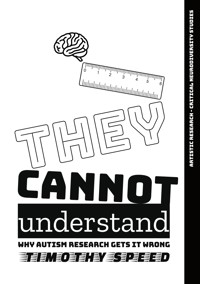
One cannot exist and be understood at the same time - with this sentence, the neurodivergent artist, researcher and activist Timothy Speed opened the field of Autistic Epistemology: a new mode of thought in which autism is not the object of knowledge, but its origin. He fuses Critical Autism Studies, Artistic Research and Systems Theory into a unified ontology of resonance. Speed is among the few thinkers who do not merely theorise posthumanism, but live it. An overlooked systems theorist of our time - speaking of resonance long before Hartmut Rosa, unfolding an understanding of reality as cyclical, embodied interaction that links economic, social and energetic processes and, like Nobel Prize-winning theorists of market and behavioural economics such as Mokyr, Aghion and Howitt, anticipated the end of linear rationality and the necessity of a relational economy. His work is not simply a contribution to autism research; it is a fundamental theory of perception, labour and existence in the age of overstimulation. It belongs to the line of paradigmatic shifts that do not speak about deviation, but generate knowledge from within it - comparable to Fanon, Haraway, Deleuze or Manning. Speed exposes the ontological gap between the neurodivergent and the neurotypical and transforms not only the Double Empathy Problem, but our understanding of masking and of reality itself. They cannot understand shows that every existence is a distortion - and that neurodivergence might be the key to recognising this fracture as a generative force.
Sie lesen das E-Book in den Legimi-Apps auf:
Seitenzahl: 259
Veröffentlichungsjahr: 2026
Das E-Book (TTS) können Sie hören im Abo „Legimi Premium” in Legimi-Apps auf:
Ähnliche













content:
One cannot exist and be understood at the same time – with this sentence the neurodivergent artist, researcher and activist Timothy Speed opened the research field of Autistic Epistemology – a new mode of thought in which autism is not an object but an origin of knowledge. He connects Critical Autism Studies, Artistic Research and Systems Theory into a unified ontology of the resonant. Speed belongs to the few thinkers who do not theorize posthumanism but live it. One of the overlooked systems thinkers of our time – who spoke of “resonance” long before Hartmut Rosa, unfolding an understanding of reality as cyclical, embodied interaction, which brings together economic, social and energetic processes and thus – similar to the Nobel Prize–winning economists of market and behavioural economics Mokyr, Aghion and Howitt – anticipated early on the end of linear rationality and the necessity of a relational economy. He delivers not only a contribution to autism research but a fundamental theory of perception, work and existence in the age of overstimulation. His work stands in the line of paradigmatic turns that do not speak about deviation but generate knowledge from within it – comparable to Fanon, Haraway, Deleuze or Manning. Speed reveals the ontological rift between neurodivergent and neurotypical people and transforms not only the Double Empathy Problem, but also our understanding of masking and of reality itself. They cannot understand shows that every existence is a distortion – and that neurodivergence might be the key to understanding this refraction as a creative force.
content
Attitude and Incommensurability
The hardness against the foreign/other
The Normative as an Attempt against Ambiguity
The Shift of Being
Consequences for science
Questions of Co-Creation and Autonomy
Consequences
From Loss of Reality to normalized Violence
NT and ND, two modes as dissociative objectification vs. associative embodiment
From Spectrum to Liminality
Transformative Masking – The Art of Reality-Creation
What would happen if ADHD and Autism were not understood as separate Disorders, but as Variants of the same Masking?
The Diversity Threshold and Metastable Diversity — Or: How to Build an Ecosystem
Field Experiments and Integrated Spectrum
All is Dynamics and Synergy — Kreutzbruck’s Approach
The Psychodynamic Field and Double Bind as Defense
Defense Reactions in NT Psychology
The political Dimension of Neurodivergence
The Recognition of the Shift – The Liberation of the Neurodivergent
On the evolutionary “Usefulness”
Suppression of Neurodivergent Voices and the Work of Melanie Yergeau
Mythological Existence – The Open and the Determined
Artistic Research
Artistic research uses aesthetic procedures — montage, performance, material experimentation — as independent methods of knowledge production. In doing so, the artist does not remove themself from the epistemic process. Knowledge does not emerge only in later interpretation, but in the act of making itself: thoughts become visible and audible, hypotheses can be provisionally embodied. Rather than collecting data, artistic research creates situations in which theory and practice fold into one another. In this way, it exceeds the classical separation of disciplines and makes phenomena experienceable before they are measured. The contents of this book are based on artistic research.
Neurodivergent research
is the specific method of inquiry practiced by some autistic researchers. This approach produces perceptual profiles that deviate from the “statistical norm” — yet precisely through that deviation reveal new patterns. Research from a neurodivergent position deliberately employs this atypical filter as a methodological advantage: hyperfocus replaces large-scale instruments; pattern-sensitivity detects correlations that disappear in the background noise. Instead of compensating for deficits, idiosyncratic cognition is understood as an additional measuring device. This generates unexpected questions, radical cross-connections, and compresses disciplinary boundaries into new terrain. This book is an important contribution to Critical Autism Studies (CAS), because here the specific perspectives of autistic researchers gain epistemic relevance.
Attitude and Incommensurability
Neurodivergence — which includes not only autism and ADHD — is often treated in the West as if it were merely a hypersensitivity to the modern world. In Japan, autism is also called 自閉症 (jiheishō), which literally translates as the syndrome of shutting oneself away.
Decades ago, when no one yet knew that I am autistic (AuDHD), the school newspaper wrote about me:
“We wish him another world.”
It revealed a certain desire to get along without autistic people — because we create friction, because we are a living challenge to the prevailing conditions.
I was born in the early 1970s in Middlesbrough, England, the son of an Austrian mother and an English father. That makes me a child and grandchild of the industrial age — the birthplace of capitalism. My great-grandfather William Robert McMaster was a metalworker at Sir B. Samuelson & Co.; his son-in-law, my grandfather, was a foreman, as his own father before him had been a machinist. Most of the family lived from iron in one form or another, back when steel was still in its infancy, after their families had been deprived of grazing rights during the Enclosure movement to force them into the factories of the 19th century.
Thus, in my DNA there is, alongside neurodivergence, also the foundational act of violence with which capitalism began: the expulsion from paradise — from self-determined work and provision.My birthplace, then known as Ironopolis (Middlesbrough), inspired, alongside other industrial centres of that time, Karl Marx and Friedrich Engels. Marx wrote Das Kapital as a reaction to the northern English cities with their filth of overcrowded misery, in which there was no middle class, but only industrialists and exploited workers. Fritz Lang shot in Germany the film Metropolis, which was likewise shaped by accounts of these dystopian cities.
A world founded on maximal profit, with machine-humans who toiled around the clock for a grand future, while for them 30 represented the average life expectancy.
At some point in this era, neurodivergence entered the bloodline of my ancestors and led in them, who were never aware of it, to an almost militant loyalty to principles and hardness, which is typical for neurodivergent people in the 18th and 19th centuries. There was no understanding, no comprehension, just as there were no academics, let alone cultural workers. Among them were many self-made engineers, tinkerers, inventors. Ironopolis was also a stronghold of innovative founders. Thus, many found refuge in niches in which they mostly operated machines alone, or researched innovations in a monotropically focused way.
With the end of Ironopolis’s heyday, my family shifted from iron to oil. In the 1980s my father rose quickly from sheet-metal worker to Offshore Installation Manager on a North Sea oil platform.
He was hard, very hard, believed Hitler had done good work, had men with earrings punished by hosing them down with the fire hose on the helicopter deck and was in every respect homophobic. The boys from Ironopolis understood this attitude as part of their identity. The working conditions tolerated no contradiction. Safety was enforced through hardness, but not through systemic diligence, which ultimately became fertile ground for many accidents and catastrophes. Patriarchal structures on the one hand, maximum submissiveness on the other and in between a whole lot of alcohol.
In 1988, I was 15 at the time, I stood in the living room of my parents and held a piece of thermal paper in my hands. It came from a paper roll that recorded radio messages. On the paper it said:
“Mayday Mayday, Piper Alpha burning…”
It was the 6th of July, when the Piper Alpha suffered the largest offshore disaster in the history of oil extraction. 167 people died, only 61 survived the drilling-platform accident.
In the investigation report it was later stated that one of the causes for the escalation of the fire, alongside the massive failure of the safety systems, also lay in the fact that the other platforms directly connected to Piper Alpha did not shut down the connecting pipelines. They did not act because shutting down would have caused damage of several million dollars. Therefore they pumped more and more fuel to Piper Alpha. They waited partly 90 minutes for consultation with the bosses on the mainland and entangled themselves in neurotypical hierarchies while their colleagues burned in the inferno. A whole container sank with 80 people to the bottom of the North Sea.
My autistic-shaped father (never diagnosed), however, shut down the supply line to Piper Alpha immediately. It was utterly irrelevant to him what others thought about it. A million-dollar loss did not concern him. Right or wrong were for him absolute magnitudes. He was also good at breaking off relationships abruptly. But on that day he, together with the few who likewise acted, probably saved several lives.
He did not speak a single word to me for the next twenty years. Because I am an artist, an intellectual, not a real man, but a disgrace in his eyes. In Ironopolis they would have beaten me to death.
Violence and pain, enduring, pushing through, carrying on — that has always been my life. Contradictions, distortions, alienation and hardness — as I understand it today — are the consequences of generations wrestling with a world that demands neurotypical, white, patriarchal functioning all the way to self-denial and self-destruction.
The feeling of alienation, of suppression and distortion seems to me characteristic of our time. We have narrowed ourselves so drastically, in a capitalist madness of one-sidedness, that fear and violence accompany every change and try to prevent every opening. To deny the dark, black stain, the ethical fault lines — that is no longer possible for me, as an autistic person and descendant of the inhabitants of Ironopolis. That is what made me an activist, and it feels as if the reality of Ironopolis pursues me like a curse. What is right? What is wrong? Questions that confronted me as well.
The hardness against the foreign/other
In Germany, where I live today, the acceptance of diversity is rapidly decreasing. It has come to that again.1 Dark times have returned and with them the same reflex of the higher earners, who speak of personal responsibility and by that mean the next wave of exploitation and discrimination of those below them, those who are existentially prevented by them again and again.
Only 45 percent of the population still see diversity as enrichment. It disrupts frictionless production and threatens their jobs, from which they can barely live. These are the harbingers of neo-fascist tendencies, from which more and more countries in the West are affected. The hatred against the “others” is rising and political murders (Melissa Hortman & husband to Charlie Kirk) are increasing alarmingly. All of this is also the consequence of what I already described 25 years ago in Society Without Trust, namely the dominance of material norms over ambiguity, over life itself, which destroys complexity and with it truth. It is a neurotypical shadow in which the potential of the other is suffocated in order to control and consolidate position within the group. Privilege again determines life chances. The old monster is back.
The narrowing and solidification is what constitutes identity in the neurotypical, patriarchal. This leads to two opposing experiences of existence. On the one side the solid, the concrete, the single determining element, the hard reality. On the other side — that is, at the margins — there the rigidity leads to distortion, to a one-sided reference to the norm. The margins are bent, caricatured, over-stretched into masks or marginalized.
The one acts as if it had nothing to do with the other, as if the interaction did not exist.
In a neurotypical and material worldview one can line up and add objects. Growth is an infinite line. The one has no effect on the other. Objects are considered isolated, as severed units. This is the consequence of a specific imprinting of brains and neurological networks that we call neurotypicality. It is the result of centuries of organization of society and power. It is constructed as a dominant worldview in order to stabilize models of domination within it. One can therefore say that politics has inscribed itself into biology. With every blow, with every violent suppression, narrowing, shifting and distortion were transmitted genetically and evolutionarily to the next generation.
If something is defined, then its potential disappears. It becomes limited. The solid forms a distortion filter: habitats, worlds, realities in which what is defined as solid shifts all other parts in relation to it, because the limitation of one potential always narrows the potentials of all other connections. The idea of an independent, free space is an illusion. This means, as I explain extensively in The Physics of the Poor, that every existence, with increasing densification, means a distortion of all other existences, and the more dominant the one solidification, the more strongly the margins are shifted.
Because we are a unity that can only stretch, but not tear into independent objects within itself. At first only a thesis, which we will deepen further in the course of the book.
The narrowing does not only push others out, it dams up energy until the whole structure shifts. The phenomenon can — I have elaborated on it very deeply in my book The Physics of the Poor — be described as a shift of being. By this I mean that oppression is more than violence of one object against another, but also deformation of the self. It is a relational process. The one shaping is not separated, isolated, from the deformation, but is part of it.
Because the oppressor is part of the same body that he believes he rules, he does not stand outside the relationship. He does not simply press on a foreign body, but on his own structure, which he thereby distorts. Oppression is not a one-sided movement, but a feedback process that binds perpetrator and victim in the same field. Whoever pushes the stranger away at the same time pulls at himself. The violence returns as deformation.
Because the potential that is prevented thereby takes complexity and diversity away from the entire space. Violence narrows us all, because solidification counteracts potential.
This changes not only the individual but the shape of the whole. The process of existence itself thus becomes a phenomenon of dynamics — without fixed localization, without object-related quality. This is central to understand. If being is a solidification, as a process, then it is at the same time a dwindling, a loss of space and dimension. Thus existence becomes the implication of an absence, and this leads to a processual response in which the difference between object and potential becomes the space of being itself. Consciousness is the difference, the gap, which overturns itself into space. This absence implies existence and consequently cognition as a permanent missing the mark — as the incessant striving to reach oneself without ever fully possessing oneself. For the absolute thing is the object minus everything else. If the thing in this way also loses every relation to the world, it becomes a dead nothing. Consciousness therefore can be neither thing, nor everything, nor nothing, but that which exists when potential and object can never stabilize.
Masks that fight for authenticity, which in this struggle can only ever bring forth new masks. Everyone searches for themselves and, through their own existence, blocks every new generation from an independent, undistorted view of themselves.
The Normative as an Attempt against Ambiguity
For brains, the fact that space is implicitly the gap seems to be something difficult to bear, because it cannot be calculated. Neurotypicality, the direct consequence of this, lives from linear causalities, that is, from the idea that something great, powerful does something and that then has a linear effect on all others, but never on the observer himself. In this way power would remain pure and untouched. This has led to a neural networking that filters out details and establishes overarching perceptions even before they enter consciousness as perception (predictive coding). Neurotypicality leads to a relation to reality that pre-emptively simulates and replicates existing power structures and filters out immediate interaction, actual experience, deviations and contradictions. Thus everything has its external order and everyone has an externally assigned place within it. The gap, the contradiction, are to be avoided.
Truth here is often a question of status. Something is defined, but it is not lived. What is often lived are only the resulting lies.
The universe of neurotypicality assumes a big bang. Effect is attributed solely to the power of a few and value assessment is based on abstract claims of justice, which are more simulation than reality. This norm has literally been beaten into humanity. The only problem is that neurodivergent people fall out of this relation to the world and autistic people are almost immune to it, that is, they see the details, the contradictions, the dishonesty everywhere directly and have to react to it. Because they live in embodiment, in distortion. They cannot distance themselves from it, cannot abstract from it, because their strong senses bind them to the body, to an embodied being.
One could say, we are born in potential and live with potential. We embody it. We are directly touched by it.
In the neurotypical, on the other hand, the world is constructed as a closed globe, as a sphere made up of summed things. From an autistic perspective, I do not experience the origin of the universe as an object, but as ungraspability, as a dynamic full of gaps and questions. Existence is therefore fundamentally a relation between potential, a something and a nothing. Only the directly lived relationship leads in embodiment to a concrete reality. For it is an expression of the stretching and deformation in the shared field. The objects in it belong to no one, are not real as property assets. Power therefore appears to me like an immature relation to reality. Like the attempt to control the masks from the outside instead of moving within the structure of distortion itself.
Potential contains the possibility of something and nothing in equal measure. I call this state of the unstable whole, which is potential and at the same time a single object, the singularity. This means that everything and nothing are contained in the potential, in a singularity. But it would be wrong to understand this as a static everything. Like an archive, for example. No, it is profoundly dynamic, for within it something is continually forming, in reflections of opposites. We call this dialectic. Light or dark, warm or cold, left or right. Like fire or vortex, these are temporally limited processes that consume themselves in dialectic, for the answer to the ever-present gap, shift or deviation is becoming, and becoming constantly questions fixed existence, cancels it. The unstable relation that brings forth existence necessitates that gap, a free space inherent in every seemingly solid thing and which determines its mortality. Existence is an eternal flow, and everything that is fixed distorts what we regard as existence, what we experience as the increase of difference, of contradiction.
If we distinguish between isolated neurotypical existence and autistic, neurodivergent and embodied existence, which is itself situated in the waves of shifting, as non-local momentum, not a thing but a form of existing as relational experience instead of as object, it becomes clear that autistic people stand ontologically in a different place.
The Shift of Being
What, then, does the shift of being (Seinsverschiebung) mean? By it I mean the fundamental distorted-ness of every existence. The autistic person fundamentally challenges our understanding of the original, of authenticity, because their mode of being — at least as I experience it, not all autistic people stand ontologically at the same point — does not strive within the distortion primarily toward the original as a state, which is not rarely postulated as the normal, but rather toward a becoming in a new, immediate, originary relation and embodiment. The authentic is the becoming, not the having-been. It is not about replication, the norm, the simulation as an anchor of being, but about the wager of never being able to arrive completely.
In neurotypicality a couple could lie in a double bed and have separate blankets. One side would tug at it and the other would notice nothing. Singularity, by contrast, is a relation to the world with one shared blanket. One partner immediately notices what is happening with the other. In the sense of growth one cannot pull on one side without pushing someone else on the other side into the cold, or even out of the bed. The blanket is the singularity, the shared basis of existence. The blanket is not a metaphor for relationship, but an ontological one: no one can stabilize their own existence without displacing the existence of everyone else.
Let us assume the blanket could remember all nights and would store all movements, and thus every new night would react to all earlier nights. A highly complex pattern would emerge, which would influence and coshape all further patterns. At the same time this “pattern” does not truly exist, it is not fixed, but consists only in relation, in dynamics that are temporary.
But what would being, resonance and identity mean in such a world?
For all future movements of the blanket and of the people underneath it would also be, to some extent, pre-formed, determined (everything) and at the same time open potential (nothing). In this connection, however, there would be no direct recognition or experience of the movements of the other person under the blanket, because there are no longer any separate units. Every movement would be both human (potential) and blanket (memory) at the same time. Thus every night would be the birth of a new existence, on each side of the blanket, which distorts the counterpart through its own movement. Through singularity there is no longer any directness of transmission, but only a tugging at the potential, at the possibility, which through the shifting becomes concrete existence.
What counts is what is lived, because only that has embodiment, a wave pattern, an existence. There is no overarching reference of a truth or a rule, but only a singularity that has become blurred, from which we all somehow emerge.
In this relation I see the relationship between neurotypicality and neurodivergence. In They Cannot Understand, I pursue the thesis that existence and understanding are not simultaneously possible. Because existence is an embodied experience and not a dimension observable from the outside. The observer exists only as a further distortion of the total embodiment.
For if one understands existence as something solid, as the tugging at the blanket — which, as I will elaborate, is central in the neurotypical mode as well as in systems significantly shaped by it such as capitalism — then as developmental potential dwindles, the capacity to integrate complexity and consciousness dwindles likewise, while being compensated by exorbitantly one-sided growth. And if one takes the dominant and thus relevant as a lens, not only is the rest of reality shifted, but also the recognition of one’s own self becomes blurred. For mirroring or feedback can always only be a further distortion in itself, because there is no externalizable position independent of a movement.
The material, the strong tugging at the blanket, as if truth could thereby be fixed, as if one’s own existence would thereby become concrete, pushes singularity into the background, along with the more complex relations. The gain in existential sharpness of the isolated identity always goes hand in hand with the loss of one’s own potential, through which the self becomes to some extent invisible. Whoever tugs at the blanket smooths the folds that testify to the “earlier,” more complex order. The one tugging plunges into neurotypical subjectivity, from which it tries to free itself through objective construction. Yet in doing so it never reaches the restoration of potential, but loses itself in reflections of its own solidification. Only when, metaphorically speaking, one moves the blanket less and less does the differentiation of movements become finer and represent more and more of singularity, through which the self and the counterpart first become perceivable in their full potential and being, even though this is not an absolute process but an eternal one.
Conversely, the fear of the foreign, or the excessive material fixation and limitation, becomes at the same time the reduction of that diversity in which reality first becomes differentiable. That neurotypical filter of consciousness carries, according to the theory of this book, a shadow, a refusal of reality and a narrowing that can dissolve or open only in the open interplay with neurodivergent people.
Neurotypicality believes in an authenticity, derives value and relevance from it, which is constructed in object categories and in doing so loses relational complexity. The neurodivergent is able to expand the striving for fixed identity in favour of relational ability. Together they can, as I would like to show later, loosen the rigidity of distortion, become a jointly lived body, find a more mature form of being.
Consciousness is thus the level on which this phenomenon — the real relation between NT and ND — is located, while consciousness itself escapes locality, but neurotypicality is an answer to the fear of ambiguity that, in predictive coding, in narrowing, implies its own reality, its own self-contained sphere, which it takes to be everything, that is, to be potential itself, and in which it confuses itself with that. The linear growth expansion of capitalism, for example, is also a misunderstanding of the nature of potential, namely the ambiguity of being more, not the potency of having as much as possible of the one thing.
This phenomenon of rupture with reality through narrowing and densification of existence I therefore call the shift of being. It is the reason why NT (neurotypical) and ND (neurodivergent) cannot understand one another, because the neurotypical as solidification and narrowing strategy on the neuronal level paradoxically represents a “disturbance” of potential, in which autistic people appear in projection as ill and do not become visible in a larger context. They are physically distorted by the solidification. These processes are, see my book The Physics of the Poor, not merely a philosophical consideration but predominantly a physical-ontological one that concerns consciousness itself.
Neurotypicality constantly tugs at the blanket and thus builds a solid sphere through which autistic people can only become visible as extreme distortion. This lies in the nature of neurotypicality but not in the nature of autism.
This later also leads to a fundamentally different understanding of masking. Not as an attempt to adapt to the norm, or even to protect oneself from stigma, but as embodied shifting within a field in which one side structurally dominates.
What has been said so far emphasizes predominantly the aspect of shared connectedness that results from the blanket, that is, from singularity. But how exactly do these distortions, this masking, behave? What does the shifting mean for the one who shifts, and for the one who is shifted?
I would like to clarify this with another example, in which we imagine a universe made of letters. All conceivable letters constitute the singularity. In it, however, they exist as still unnamed, not yet crystallized potentials that act dynamically upon one another. Every object fixation, that is, every definition of a letter, becomes an act of violence against potential. For what was previously an infinite possibility of curves and lines now becomes something quite concrete. A pattern emerges, and the nature of a pattern is that it binds free associations. As soon as something is narrowed — let us call it “G” — it falls out of singularity, out of that state in which everything and nothing lie indistinguishably within one another. In the moment in which “G” becomes a fixed object, it disappears as open potential. An existence comes into being which is placed in front of singularity like a filter, like a sphere, an independent reality. A G-world.
There is therefore no existence without reference. The potential is still implied in G, but not realized. All other letters shift (shift of being) in order to compensate for the absence of G as potential.
The disappearance of G as potential does not remain local. For in the background there is still the resonance with singularity. The distortion thus causes further shifts in the system, because the G-world also discolours other potentials. In order to keep “G” as a fixed object in the system, the entire networked world — all other “letters” — must reconfigure themselves within the new frame of reference to compensate for the loss of the “G-potential,” because they are in resonance with singularity, which implies a difference that in such a system (a shared blanket) is never left unanswered. Resonance produces alignment toward singularity in the face of the difference that shifting generates. This is called synchronization by resonance coupling.
Resonance means that a system reacts particularly strongly to vibrations of a certain frequency — its natural frequency. This natural frequency is still contained in the potential, therefore in singularity. The amplitudes that are touched by the shift are amplified. Physically this means: resonance enforces approximation, a closing of the difference, the gap, because resonance smooths differences. That means: with the fixation of “G” (as the new filter) A, B, C … to Z (newly filtered) are distorted in the shared new filter (G-world), because they now stand in relation to a fixed but potential-deprived element. As a result, shifts occur on all levels.
Therefore the neurotypical tends toward the representative, toward the symbol, while autistic people frequently tend toward embodiment. For solidification simultaneously creates an existence in placeholders that, when lived, are never what they stand for.
Existence is therefore always a process of distortion. The original, which can only be the potential, is excluded, that is, can never be reached.
Existence therefore means absence of potential, and at the same time presence of kinship and difference. Kinship, because shaped by the same filter. The G-world makes all letters kin with G in the G-distortion.
All this strives toward a rounding-off, which then leads to the formation of a sphere, a world closed in on itself, that blocks off part of the potential, thus becomes less complex, yet cannot entirely detach from it, and therefore remains in resonance, which results in everything within the sphere (world) ultimately also being shaped by the gap, by the difference that results from the departure from potential. Thus this re-creation as a field remains unstable, sustains itself only as a process, like a stone thrown into water, creating waves that eventually run out until the water again mirrors the rest of the world, not only the curvature caused by the stone. That is, everything that exists means at the same time a distortion not only of one’s own existence but also of all other forms of existence in one world (sphere). The distortion is relational.
A forest, to take another example, is in this sense nothing other than the attempt to recreate the universe with wood. It is the universe through the filter of wood. The determination forest removes other potentials of being from the space. What remains is wood. The forest is a materialized, solidified abstraction that has fallen out of an infinite potentiality — the state of singularity. But this solidification also distorts the entire field in which it exists. In the forest only particular beings, forms, existences can realize themselves — those whose potential is limited in relation to the filter forest in order to be able to exist in it at all. Here we see the reasons why ecosystems are limited in themselves, and why everything that comes from outside — from a different limitation — leads to problems of compatibility and to the shifting of affordances (Gibson). The docking points are missing because the foreign does not fall under the same distortion. It is not a shared embodiment.
It is not the same masking.




