


Erhalten Sie Zugang zu diesem und mehr als 300000 Büchern ab EUR 5,99 monatlich.
- Herausgeber: The History Press
- Kategorie: Geisteswissenschaft
- Sprache: Englisch
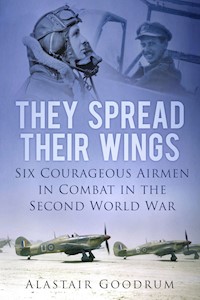
What turns an ordinary man into an extraordinary one? The answer lies in the stories of six teenage volunteers for Second World War aircrew who exchanged school uniform for Air Force Blue and took a giant step into the unknown. Based on original research from flying log books, diaries and family archives, this collection of true tales describes the men's training for those coveted 'Wings'; the nervous excitement of that first sortie over enemy territory; and flying into the hell of an enemy flak barrage and fighters. From the skies over Europe to jungles and deserts, all endured hardship, adventure and danger. They experienced action under enemy fire, wounds, burns and crash-landings, escape and evasion in occupied territory, and the privations of life as a POW. Seventy years on and these brushes with death are by any measure hair-raising encounters that turned adolescents into men – some of whom survived the war, while others paid the ultimate price.
Sie lesen das E-Book in den Legimi-Apps auf:
Seitenzahl: 440
Veröffentlichungsjahr: 2013
Das E-Book (TTS) können Sie hören im Abo „Legimi Premium” in Legimi-Apps auf:
Ähnliche




















Contents
Title Page
Acknowledgements
Introduction
Fighter Boys
1 Flying Tin-Openers
Fg Off Alfred Howard Mayhew Clark: Pilot, No 6 Squadron
2 Train-Busting Over the Reich
Fg Off Jack Cheney: Pilot, Nos 532 & 25 Squadrons
3 The Flying Farmer
Wg Cdr Walter Dring: Pilot, Nos 56 & 183 Squadrons
Bomber Boys
4 Jumping the Wooden Horse
Flt Lt James Gordon Crampton: Pilot, No 214 Squadron
5 Blitzed, Burned but Unbroken
Sqn Ldr Alan Kenneth Summerson: WOp/AG, Nos 150 & 88 Squadrons
6 Guest of the Gestapo
WO Arthur ‘Joe’ Edgley: Rear Gunner, No 15 Squadron
Bibliography
Previous Books by Alastair Goodrum Published by the History Press:
Copyright
ACKNOWLEDGEMENTS
I wish to thank the following people for their kindness and generosity in permitting me to access and use written and photographic material from their archives and for their personal reminiscences about the airmen in this book:
Paul R. Becker, relating to his father’s work on the Second World War Turbinlite project.
Peter Brett, for memories of his time flying the Hawker Typhoon operationally during the Second World War.
Richard Boston, Uppingham School archivist.
Howard Clark, of A.H. Clark (Farms) Ltd, for material relating to his uncle, Fg Off Alfred Howard Mayhew Clark.
Mrs Barbara Crampton and her daughter Rachel, relating to Jim Crampton. Thanks also to Ted Crampton for memories of his brother Jim.
Arthur Edgley, for allowing me to visit and chat about his experiences during his time in the RAF and as a POW; Jonathan Falconer for permission to use material about Arthur from his book Stirling Wings; and John Reid for his help with all things Stirling and for photographs relating to Arthur’s story.
Mrs Sybil Summerson, widow of Sqn Ldr Alan Summerson, for detailed information about her husband’s long career in the RAF; John Summerson for material relating to his brother, Alan; John Evans and the Pembroke Dock Sunderland Trust for particular help relating to Alan Summerson’s service in Sunderland Flying Boats; and Peter Gosling for material from his article about Alan, published in Air Enthusiast in September/October 2004.
John Rowe and his wife Susan, daughter of Wg Cdr Walter Dring, for detailed information and images relating to her father’s distinguished career; and Peter Dring for personal recollections of his cousin Walter.
I would also like to acknowledge the help given by the editor and staff of the Lincolnshire Free Press and Spalding Guardian for local newspaper archive material; the president and council of Spalding Gentlemen’s Society for the use of museum archive material relating to local airmen; Andy Thomas, Peter Green, Ken Ellis and Dale Parker (www.aquatax.ca) for aircraft images from their collections; and finally Amy Rigg with Abigail Wood and the team at The History Press, who have helped me to bring this project to fruition.
INTRODUCTION
What turns an ordinary man into an extraordinary one? Read this collection of the exploits of six airmen caught up in extraordinary personal and operational circumstances during the Second World War and you will soon discover the answer.
These unassuming chaps, people you might rub shoulders with anywhere in the land, were once – a lifetime ago – the backbone of the Royal Air Force and they represent the thousands who volunteered for aircrew during the Second World War. All were young men; most still in their teens when they volunteered. Many cast off school uniform one day and put on Air Force Blue the next, taking a step into the unknown; yes, it was an adventure, but one with a hugely tempting prospect – the opportunity to fly.
What follows are the emotional, action-packed journeys of six airmen through flying training in England or Canada, then war in the air campaigns over Europe, the Middle East and the Far East. We meet and accompany each character through his early family life. We relive with him the nervous anticipation of joining up, then going solo in the air for the first time; the patient hours of training; the pride of gaining those coveted ‘Wings’; the excitement of that first operational posting and becoming part of a close-knit team. Then we wait impatiently with our men before feeling the adrenaline rush of their first sortie over enemy territory, waiting and wondering what the next ‘op’ might bring. That is not the end of the story, though; it’s only a beginning, as some are shot down in enemy territory and those that survive experience hardship and adventures they could never have imagined.
Without doubt such men would dismiss accolades of ‘hero’ or ‘extraordinary’ out of hand and say with a shrug, ‘We just did what we had to do.’ Viewed from a distance of seventy years, however, these brushes with death, actions under enemy fire, dangers from wounds and injury, perils of escape and evasion in occupied territory, and privations of life in POW camps, will be judged by any measure as hair-raising adventures denied to most of us in modern times. As in any adventure involving armed conflict, it turned adolescents into men, some of whom returned safely while others paid the ultimate price. All are remembered with affection and pride through the stories that follow.
1
FLYING TIN-OPENERS
Flying Officer Alfred Howard Mayhew Clark
Alfred Howard Mayhew Clark – known to his family and friends as Howard – was born in the Lincolnshire village of Moulton Eaugate, near Spalding, on 31 March 1922 into a long-established farming family. He was a farmer’s son who wanted to become a racing driver, but due to the turbulent times in which he grew up, he became a fighter pilot instead.
Howard’s first taste of the wider world came in 1930 as a boarder at Ashdown House Preparatory School in Sussex, where he soon displayed a competitive spirit both in the classroom and on the sports field. His letters home show how proud he was of his achievements in class and how he was already keen on cricket, football and athletics. Pupils at Ashdown were encouraged to write letters and it is due to the enthusiasm with which Howard took to this task that, by continuing to do so into adult life, such a comprehensive picture of his life has come to light – and indeed it has to be said that his parents and family reciprocated this keenness.
In July 1931, for example, he wrote about Sports Day: ‘I am going in for the 100 yards (under ten), four-legged race, sack race, long jump, egg & spoon (under ten), and 200 yards (under ten); so I am going in for quite a lot.’ The year 1934 saw Howard moving on to The Knoll, a boarding school in Woburn Sands, Bedfordshire. Here he developed an interest in hockey and earned himself a place in the school team. In February 1935 his competitive spirit was much in evidence when he wrote home: ‘We have had some good games of hockey this last week. On Monday I shoot one goal, Friday: three and Saturday: one.’ In June that year he was in the cricket team and wrote anxiously to ensure his parents visited when he was playing a match.
Alfred Howard Mayhew Clark, as a schoolboy wearing his hockey colours at Uppingham School, May 1940. (Clark Collection)
Aged 14 now, in September 1936 Howard went to Uppingham Public School where he joined West Deyne boarding house, the house in which his father, Capt A.H. Clark, had been taught back in 1907. Howard’s younger brother, Bertram, also joined the same house a few years later and his nephew, Howard, continued the family tradition in 1969. Sport still featured much in Howard’s letters home; in 1936 he was playing rugby – and scoring tries – and by 1940 it was clear he was a good all-round athlete and team sport player. In June of that year he was runner-up in the school sports championship – winning the Guthridge Cup for the quarter-mile – and was awarded his hockey colours. His letters also show his resolve to do well in his School Certificate exams and an awareness of the current war situation, not least due to air raids in the local area and economy measures imposed at the school: ‘We don’t have to wear straw hats any longer because they can’t get any more straw to make new ones from, and we only get five ounces of sugar a week and it doesn’t last long,’ he wrote.
In an undated letter, written to his parents during May 1940, comes the first indication of Howard’s interest in joining the armed forces: ‘I enclose a cutting from yesterday’s Times about the RAF. They want people from 18 to 28, as you will see, for pilots.’ It seems that in his characteristically decisive way Howard had made up his mind what he should do and got on with it, for in his next letter he wrote:
I passed my interview into the Air Force last Monday. The bloke (a Flight Lieutenant) recommended me for a pilot or an observer, which are the two best things that you can get, because to be either of these you are an officer. He asked lots of questions and filled in lots of forms … and I have a thing signed by him exempting me from any selection boards and things … all I have to do now is pass the medical examination. Well, I hope that School Cert isn’t too difficult. It doesn’t matter about having it for the RAF but they like you to have passed in maths with a credit if possible, which I think I can do.
Thus Howard Clark, his exams behind him, left Uppingham School during that summer of 1940 to join the RAF with an ambition to fly fighters. There is a gap in his letters between June and December 1940 but this is most likely due to him killing time at the family home awaiting, like thousands of his contemporaries, the call to report for duty. That call came in December 1940, when Howard was ordered to report to No 3 Recruit Centre at RAF Padgate – through whose notorious portals many were to enter and have their rough edges rubbed off! Howard emerged from Padgate as No 1125783 AC2 A.H.M. Clark and began the long and tortuous journey along the path to becoming a fighter pilot. His first few months’ service, rubbing shoulders with every type of the nation’s youth and every type of RAF drill instructor, came as something of a shake-up to him, but no doubt this would have resonated with all those who went before him and those afterwards.
His first move after Padgate was to No 9 Receiving Wing (RW) at Stratford-upon-Avon. The main purpose of RWs was to provide a pool of manpower with which to feed the Initial Training Wings (ITW), which were the starting points for aircrew training. Here he was allocated to No 3 Flight, No 2 Section and by 22 December was housed in the appropriately named Shakespeare Hotel. He wrote home:
It is a pretty awful place and hundreds of folks are here, not many of them stay here. I expect that it will get better as we move on. I don’t look like having a very good Christmas! The food is better than at Padgate but the worst of it is that you have to queue up for it for so long before you get it.
Later, he wrote again:
Yesterday I was vaccinated, inoculated for typhoid and tetanus and had a whole lot of blood taken to find my group. All this took precisely five minutes! Now we have got such stiff arms we can hardly get dressed. I have got a uniform but as no single part fitted, it has gone to be altered so I am back in ordinary clothes again. We are only issued with two pairs of socks so if you want to start knitting you can start with socks. Apparently, although they tell you that you only stay here for a few days it is most likely you stay for a month. I will probably leave on January 18 … possibly to go to Scarborough … a new training place. The beds are frightfully hard. We are up at 06.30, breakfast at 07.15, lunch at 12.30, tea at 16.30. The food is not too bad but I go out every night and get some sort of a meal because the only dinner provided is a mug of soup and dry bread. The canteen is very bad and miles away from here, so we don’t go to it.
There was little respite when his posting came to No 10 ITW at Scarborough, where he arrived on 5 January 1941 in 4in of snow and freezing weather. Howard was placed in No 1 Flight of No 3 Squadron and accommodated in the Crown Hotel. By the end of that month he was coping with the theoretical instructional courses and doing well in maths (‘passed maths with 87%; … morse code 94%’) and navigation. The food was still lousy and he and his compatriots took extra meals at a nearby hotel. His spirits were raised, however, when he was issued with a white band to put round his forage cap, which signified an airman under aircrew training. ‘This makes us a bit different from the ordinary AC2s,’ he wrote.
As a growing, energetic lad the subject of food always loomed large and on 24 February 1941 he wrote:
The food does not improve and you can’t buy any fruit in Scarborough for love nor money. The pork pie was jolly good thanks and so were the sweets. As we don’t get off ‘till 19.00 it’s very difficult to get anything because the shops are shut. Everyone has to go out at night and get some more food from somewhere. The best canteen is the Salvation Army, it’s better than the YMCA and the ordinary canteens. The socks are lovely. They have got some heat on in this place now … and the mattresses arrived on Thursday so we can sleep at nights now.
During February, Howard spoke of the next stages of training, telling his parents:
I think we are almost sure to get sent abroad for flying training, as they are now needing more and more aerodromes in England for active service aerodromes as the number of aircraft in the country is increasing so rapidly. Actually, the squadrons who are a week in front of us in this course, have already been asked to volunteer for training either in Canada or South Africa. I think I shall volunteer for Canada if I get the chance.
In the event, Howard was stuck in Scarborough until the end of April, the reason probably due to delays in the Elementary Flying Training School (EFTS) training programme caused by lots of bad weather earlier in the year. A letter dated 6 May 1941 locates him in Wilmslow at a despatch centre waiting to be posted abroad. He travelled that night to Scotland for embarkation but due to enemy air raids had to spend three nights in Kilmarnock, sleeping on the floor of the Town Hall, before he could board ship and sail from the Clyde on 10 May 1941. The next time the family heard from him was via a cablegram dated 22 May, saying he had arrived safely in Canada.
True to form, it was not long before a letter arrived at the family home. On 25 May Howard brought the family up to date:
It was good food on the ship. Masses of cigarettes at 1/6 [one shilling and sixpence] for sixty – they are duty free you see. I arrived in Toronto on 24 May and it was a thirty hour train journey from Halifax [in Nova Scotia], via Montreal. We expect to stay ten to fourteen days here. Billeted in the Exhibition Grounds, waiting to be posted to an Elementary Flying Training School near here. You’ve no idea what it is like out here – no blackout or rationing or anything, it’s really marvellous to see all the lights again. The Canadians are awfully good to us; treat us like guests, make us feel very welcome. Everybody out here almost lives on Coca Cola and ice cream sodas and various milk shake concoctions. All these are iced and are jolly good. Everything out here is iced! I have gone halves with another fellow who came out with me and we have bought a car for the equivalent of about £10. There is a big fun fair by the lake – like Blackpool – and Niagara Falls is only eighty miles from here. I am looking forward to starting flying very much indeed.
Howard had reached No 1 Manning Pool/Depot RCAF, located in the Coliseum part of the impressive Toronto Exhibition Grounds. Here he would become just one more anonymous airman among the thousands of trainees being split up and despatched to the plethora of flying training stations throughout Canada.
Events now moved apace. Howard left Toronto on 27 May and arrived at No 1 EFTS at a place called Malton, Ontario, and he told his parents he was now a Leading Aircraftman (LAC) and learning to fly the de Havilland Tiger Moth. Less than two weeks later he wrote again, telling them proudly: ‘I have been doing quite a lot of flying and I went solo yesterday [5 June 1941] for the first time.’ And a week later: ‘I have been going solo quite a lot since my first one. Have done about 750 miles in the car – no gas [petrol] rationing.’
At the end of June he wrote:
I am getting along OK with flying. I’ve got forty hours in now, twenty of them solo. This course finishes in a fortnight. It’s still hot here and I fly in my shirt sleeves and you have to go up to 7,000 or 8,000 feet to keep cool even in an open cockpit.
Pilot under training Howard Clark with his car, at No 1 EFTS in Malton, Canada, May 1941. (Clark Collection)
Howard was coming to a crucial period. The end of the course was looming and on 7 July the time for exams arrived. He was confident he would do well and expected to leave Malton mid-month for his next posting, a Service Flying Training School (SFTS) where he would fly the twin-engine Avro Anson. After a forty-eight-hour pass he reported for duty at No 5 SFTS at Brantford aerodrome, about 45 miles from Toronto. He said: ‘I’m flying Ansons now. They are really rather nice. I thought I would not like them much after the Tiger Moth but I have changed my mind, although they seem rather like driving an old ten-ton lorry after a sports car.’ By the end of August Howard moved on to the senior course. Having completed all his night and cross-country flying exercises, and with eighty-five hours in Ansons and sixty-five in Tiger Moths, he was about to be awarded the coveted ‘Wings’. That eagerly awaited event arrived in the form of a parade at Brantford on 22 September 1941 and on 4 October he cabled his parents to tell them he had been commissioned and was now 109112 Pilot Officer Howard Clark.
At this juncture there is a break in correspondence, but the next letter shows that much had taken place in the meantime; he wrote it on 8 December 1941 from the officers’ mess of No 52 Operational Training Unit (52 OTU) RAF Aston Down, near Cirencester in Gloucestershire – a Spitfire OTU. He was back in England and had at last achieved his dream of becoming a fighter pilot.
By building up his hours on the Spitfire during the month, Howard seems to have gained experience and confidence to such an extent that in January 1942 he was asked to remain as an instructor for two more months. While disappointed not to be going to a squadron, he nevertheless relished the prospect of putting in more hours in the Spitfire and felt it should give him a better chance of being posted into action with a ‘crack’ fighter squadron. After a few days’ leave this chance seemed to materialise when, on 15 March 1942, he wrote to his parents from RAF Blackpool, No 4 Personnel Despatch Centre, where he was waiting to go overseas, to say he had been posted to the ‘Middle East Pool’ in Egypt. He was destined to twiddle his thumbs – a situation he described as ‘stooging’ – in Blackpool until 21 March:
Sat 21/3 Left Blackpool at 8.30pm for Greenock – all night travelling. Bloody awful. Very cold, bloody draughty carriage. Soon ate all the food provided. 1/6-worth of bully beef sandwiches. Sun 22/3 Arrived Gourock 9am. Wrong place. Eventually arrived Greenock at 10.30am. Embarked on SS Alcantara [22,000 tons]. Pretty bloody boat. B-awful cabins.
This former cruise-ship-turned-trooper sailed at midnight on 23 March to join a convoy off Ireland for the run down to Freetown, capital and principal port of Sierra Leone in West Africa. Their southerly progress was most visibly marked by the gradual increase in temperature and Howard was in shirt and shorts and complaining about the heat by the time the ship tied up in Freetown on 6 April. His patience was tested still further when, the next day, he and his travelling companions left the Alcantara to embark on the SS New Northland (3,400 tons) – a tramp steamer that would make the Alcantara seem positively luxurious:
Loading cargo and taking on native troops. The boat is B----- awful, we are all very, very browned off, still on this B----- Altmark [a pointed reference to the captured German prison ship] it is full of cockroaches and beetles, water supply only on for one hour a day. Found a mosquito in my porridge at breakfast. We keep being told we are sailing tomorrow, always tomorrow.
His feelings were summed up in a note, written on the back cover of his diary: ‘FREETOWN IS THE A***HOLE OF THE WORLD.’ The ship sailed on 15 April for the port of Takoradi in the Gold Coast (now Ghana), escorted by one corvette. By the 19th it was even hotter and the bar had run dry. The New Northland docked in Takoradi on 19 April and Howard was able to slake his thirst for a beer during a run ashore. Upon his return he discovered that his party was to remain on board and sail the next day to Lagos in Nigeria, which was reached a day later. Their arrival being unexpected, they were ordered to sleep on board. ‘God, what organisation,’ wrote an exasperated Howard. However, things perked up when they vacated the New Northland on 23 April and were taken to the Royal Hotel and ‘had a wizard dinner’. Howard was accommodated in a villa annexe of the hotel, cooled by a breeze off the sea, with excellent food, swimming and a number of sporting clubs (such as the Apapa and Tkoya) to break the monotony of waiting for the flight to Cairo. There were 300 airmen waiting with him for a flight, but his turn came at 11.35 on 29 April and he winged his way across Africa in an American C–47 (DC–3 or Dakota).
Howard Clark’s course at No 5 SFTS Brantford, July to September 1941. Howard is seventh from the left on the front row. (Clark Collection)
Newly qualified pilot Howard Clark with an Avro Anson after his ‘Wings’ parade, No 5 SFTS Brantford, Canada. (Clark Collection)
Plt Off Howard Clark at No 52 OTU Aston Down, England, December 1941. (Clark Collection)
After leaving Lagos, the first stop, of one hour at 15.10, was at Kano in the north of Nigeria; ‘an incredible place,’ wrote Howard, ‘fed on goat meat. One whole goat costs two shillings, a chicken costs one penny and a dozen eggs cost half a penny.’ The next leg was from Kano to Maiduguri in the east of the country, where they arrived at 18.10. ‘We are stopping at the Pan American Airways place. Wizard food in darkest Africa.’
After an overnight stop the aircraft left Maiduguri at 05.45 bound for El Geneina, which Howard described as ‘hot and miles from anywhere’. It was 950 miles east of Kano in Anglo-Egyptian Sudan close to the border with what is now Chad. They touched down at 09.45 for an hour before pressing on to El Fasher, another 200 miles east – ‘hotter still’ – arriving at 11.55. They departed half an hour later for Khartoum, 500 miles to the north, where they landed at 16.35 on 30 April. With another overnight rest, Howard was on his way again at 08.00 the next morning, heading for Cairo. The DC–3 flew via Wadi Halfa, landing at Heliopolis airport, Cairo, at 14.30 on 1 May. Howard stayed at the Metropolitan Hotel where, once again, he found he had to kick his heels for a while. In one of his letters home, on 4 May, he said: ‘I have been in Cairo now for about three days. A pretty good spot but frightfully expensive. I expect to go out into the desert any day now.’ His optimism was, however, misplaced since he was ordered to go to the Almaza Transit Camp (No 22 Personnel Transit Centre), located on an airfield on the outskirts of Cairo, where he was billeted to await his next posting. There followed another period of waiting, while the powers that be decided what to do with him. He wrote in his diary: ‘bags of pilots out here and no planes for them to fly’, and this situation would only change when the desert campaign hotted up and aircrew casualties began to rise. While he was ‘stooging’, Howard made the best of it and spent his time ‘meeting Old Uppingham types’, sightseeing (Pyramids and Sphinx), cinema-going or playing golf, tennis, cricket and swimming at the Gezira Sporting Club, a huge social facility on a large island in the Nile in central Cairo used by officers and European civilians. After three weeks, this way of life began to pall somewhat and he complained: ‘Still no news [of posting], horribly browned off. Hope to god I leave here soon; want to fly.’ To relieve the monotony of the transit camp he spent a week’s leave at the New Hotel in Cairo, but returned to Almaza when that finished because his foot had been causing him trouble since 24 May (no explanation given) to the extent that he needed to see the medical officer (MO). He was told to rest it for four or five days, which he did willingly because he was anxious for it not to affect his posting. Although it was still playing him up on 13 June, by the 16th he noted it was ‘almost better now’.
A refreshing cuppa for Howard Clark at the Gezira Sporting Club, Cairo, 1942. (Clark Collection)
By 18 June 1942 the Allied situation in the desert war had deteriorated and everyone was retreating eastwards towards the Alamein Line. A few days later Tobruk fell to the Germans; things were looking grim and for Howard his time had come. On Sunday 21 June he was interviewed by Sqn Ldr Kettlewell and told he was posted to No 6 Squadron to fly the Hawker Hurricane. He was to report to the squadron at Shandur, an airfield close to the Little Bitter Lake on the Suez Canal, on Tuesday 23 June 1942. It was two months since he had arrived in Cairo and eighteen months since he had joined the RAF.
* * *
No 6 Squadron, after months of relative inactivity, had moved to Shandur on 10 May to convert to the Hurricane IID anti-tank aircraft. The squadron then moved out with nine Hurricane IIDs to Gambut in Libya on 4 June, operating as part of No 239 Wing of the Desert Air Force: No 6 Squadron with Hurricane IID; Nos 112 and 3 Squadrons (RAAF) with Curtiss P–40 Kittyhawk fighter-bombers; Nos 250 and 450 Squadrons (RAAF) with Kittyhawk fighters. Here the squadron began ground attack operations in support of Free French forces in the critical battles in the ‘Cauldron’ around Bir Hacheim. The Hurricane IIDs of No 6 Squadron made their operational debut on 7 June, west of Bir Hacheim, although the enemy was not engaged on that occasion. By 18 June, however, the squadron had been pulled back and was operating from Landing Ground (LG) 102, Sidi Haneish airfield, having vacated Gambut in a hurry to keep ahead of the advancing Germans.
Like the Eighth Army, the Desert Air Force was being built up with men and materials in preparation for a big counter-offensive and Plt Off Howard Clark was just one small pawn in that grand strategy. Thus, along with another nine fresh-faced English, Australian, New Zealand and American pilots, Howard proceeded to Shandur airfield. Here they became part of the Western Desert Air Force (usually abbreviated to Desert Air Force) and underwent intensive training on the Hawker Hurricane IID with No 6 Squadron’s training flight.
The Hurricane IID, the aeroplane that Howard would fly, was the outcome of experiments to determine if existing 40mm armour-piercing (AP) cannon shells could be used effectively by aeroplanes against tanks and other armoured fighting vehicles. The 40mm cannon was a weapon of relatively light weight and Hawker found it was entirely practicable to install one beneath each wing of a Hurricane; thus, the Mk IID version came into being. A standard Hurricane Mk II was adapted to become a pure ground attack machine by removing all but two of the wing-mounted. 303in machine guns; these two were retained to fire tracer ammunition as an aid for sighting the two 40mm cannon mounted in pods, attached one on each side to the specially strengthened under-wing hard points. Two designs of 40mm cannon were originally considered for this project: a Vickers ‘S’ and a Rolls-Royce ‘BF’ model. Ammunition to feed the former was contained in a spring-loaded drum magazine, while the latter was belt-fed. The drum-feed became the preferred option as it was more reliable and the ‘S’ drum held fifteen rounds per gun compared to twelve in the ‘BF’ version. Although about 200 of the RR/BF version were built, after several mishaps due to breech explosions it was discarded for the Hurricane IID in favour of the Vickers ‘S’ gun. Almost all of the IIDs produced were sent to overseas squadrons and during May 1942, No 6 Squadron – at that time under the command of Wg Cdr Roger Porteous in Egypt – was the first to receive the aircraft for combat operations.
The batch of new pilots began their training at Shandur airfield under the watchful eye of Wg Cdr Stephen Dru Drury, who had been in charge of this particular weapons project since its inception. Now he was helping to bring it into service as soon as possible. Under his guidance, pilots learned how to handle the tricky tendency of the Hurricane’s nose to drop, resulting from the recoil of the 40mm guns when fired. It was necessary to take minor corrective action to ‘catch’ and correct this tendency before the next salvo (one pair of shells) could be lined up and fired because flying at about 50ft above the ground left little room for error. The 40mm guns were aimed using the usual Mk II reflector sight and tracer rounds from the simultaneous firing of the machine guns gave a good indication of the impact point. Although the gun’s range was quoted as over 2,000 yards, the range at which the 40mm gun became most effective was about 1,000 yards and with practice, it soon became clear that it was possible to get two salvos off before overrunning a target. During training it was even found that a third salvo could be fired on some occasions. With solid, tungsten-tipped AP shells as standard, it was possible to penetrate 55mm armour plate. A downside to this lethal weapon system was that when the guns and an engine sand filter were installed on a Hurricane IID, its speed was reduced by about 40mph.
Tank-buster Hawker Hurricane IID armed with two 40mm cannon, the type flown by Howard Clark with No 6 Squadron in the Western Desert. (J. Cheney Collection)
At the beginning of January 1942 the squadron went to Helwan in preparation for a move to Iraq, by which time it had reached an all-time low point with just one lone Hurricane Mk I left on its inventory. However, all was not lost because in the end the squadron did not go to Iraq, but remained in Egypt instead. It took up residence on LG 224, also known as LG Kilo 26 and later as Cairo-West, to await re-equipment with the Hurricane IID. The airfield was located near the Cairo to Alexandria road, about 16 miles west of Cairo itself. Once all the air and ground personnel and the first batch of the long-awaited new aircraft had been brought together at this location, on 20 April 1942 it moved out as a squadron to its initial operating base at Shandur to begin training with the new Hurricane IID.
With five weeks’ training under its belt, No 6 Squadron was declared ready for battle and in mid-May was sent forward to Gambut airfield near the coast – about 30 miles south-east of Tobruk and 400 miles west of Alexandria – to begin operations against the enemy once again. However, in the fluid situation then existing in the desert war, the squadron was under constant orders to move – forward or backward(!) – at two hours’ notice. In common with many of these desert landing grounds, Gambut had several ‘satellite’ airstrips and it acquired a dubious reputation as ‘the worst ‘drome for dust in the desert’.
The Hurricane IID had its baptism of fire with No 6 Squadron on 8 June 1942 when several tanks and vehicles were destroyed with the new weapon. While extremely effective, the very nature of the type of attack profile carried out by the Hurricane IID left it exposed to enemy air opposition. Major Hugh Rice, a former army air liaison officer (ALO) with No 6 Squadron, recalled:
The Hurricane IIDs were few in number and vulnerable and were therefore never sent out without medium or top cover. As a result, the planning of a strike was a relatively complicated job, particularly as the covering squadrons were themselves pretty busy on routine work. Only targets that were certain to be identifiable at low level, which were not in the thick of the heaviest flak and whose existence and location were absolutely certain, were attacked. This policy resulted in a very high percentage of successful operations, with great damage to enemy armour and with low casualty rates.
As the battle moved forward, the IIDs were sent out unescorted [due] to the reduction in enemy air resistance and the difficulty of getting escort from different airfields when the whole air force was moving forward daily. By the time the Tunisian show was over, casualties had reached a worrying level and the IID was clearly past its prime.
In that short period the Hurricane IID was extremely effective – particularly when its pilots were given timely information, accurate directions and had top cover – at unblocking localised enemy armoured obstructions encountered by the Eighth Army.
During June 1942 this initial contingent of pilots, ground crew and aircraft, effectively comprising ‘A’ Flight No 6 Squadron, gradually retreated eastwards to LG 102 Sidi Haneish, located adjacent to the main Libyan coastal highway, 20 miles east of Mersa Matruh and 240 miles west of Cairo. The squadron’s base organisation was sent to No 239 Wing HQ sharing LG 91 Amriya (or Amiriya), an airfield on the Alexandria–Cairo road, 15 miles west of Alexandria. On 24 June, Desert Air Force HQ ordered ‘B’ Flight to take its batch of new pilots and aircraft from Shandur forward to join ‘A’ Flight at Sidi Haneish. Once again, though, in the fluid situation and with Sidi Haneish now under regular air attack, this signal was countermanded on the 25th and ‘B’ Flight moved to LG 91 Amriya instead. This was now the base for No 7 (South African) Wing which was composed of Nos 6 (Hurri IID), 127 (IIB) and 274 (IIB) RAF Squadrons and No 7 SAAF (Hurri IIB) Squadron.
Next day, while ‘B’ Flight moved west to join ‘A’ Flight at Amriya, Howard had his first thirty-five-minute Hurricane sortie in ‘a rather ropey Mark I’ with the training flight back at Shandur. All the ‘new boys’ received lectures in tank recognition. Meanwhile, ‘A’ Flight was in action searching for a squadron of enemy tanks reported to the west of Mersa Matruh. None were found but a convoy of lorries, armoured cars, guns and troop carriers was attacked with some success by Wg Cdr Porteous and four other pilots. In the evening of the 26th, No 211 Group HQ ordered all aircraft to pull back immediately to landing ground LG 106 at El Daba near Ghazal, 50 miles east of Sidi Haneish. The ground personnel were to follow at first light the next morning. With a stop at Fuka landing strip (LG 17) en route – the ground party scrounging rations, equipment and tents as they went – the air and ground echelons were safely installed at Ghazal by evening on the 27th, just in time to be bombed again, fortunately without damage to life or equipment.
Despite hopping from one airstrip to another at extremely short notice, during June 1942 No 6 Squadron claimed twenty-six tanks, thirty-one armoured troop carriers and large numbers of other vehicles destroyed. Field Marshal Erwin Rommel was pushing hard in his drive eastwards and that thorn in his side, Tobruk – now without fighter and ground attack cover because those units had had to pull so far back – fell to Axis forces on 21 June. There were periods of several days or even a week when No 6 Squadron did not mount anti-tank operations. This is perhaps not so surprising in view of the need for care in mounting their type of sorties, which required the co-operation of one or more other squadrons as escort, and the extreme fluidity of the ground war at this time. The Hurricane fighter squadrons and Hurri-bombers were still in the thick of it and wrested air supremacy – or at least air superiority – from the Luftwaffe. However, the Afrika Korps was thrusting towards Alexandria and rolling the Eighth Army back day after day. But Rommel’s lines of communication and supply were stretched thinly and in August 1942, the Eighth Army acquired a new commander: Lt Gen Bernard Montgomery. As the opposing forces reached a natural ‘funnel’ that squeezed the effective fighting front into a narrow gap between the sea in the north and the ‘depressions’ region to the south, El Alamein would become Montgomery’s ‘line in the sand’. This was where he would make his stand.
While all this action and retreating was going on, Howard was still at Shandur trying to put in some flying hours, but there was little chance due to a shortage of aircraft and a large number of new pilots trying to fly, so he filled in time playing cricket. On 27 June three of the new boys each flew a Hurricane IID to the squadron at LG 106, but within another twenty-four hours ‘A’ Flight was ordered all the way back to join ‘B’ Flight at LG 91 Amriya. Still waiting to go into action, Howard took the opportunity to go sightseeing in Suez town, which he described as ‘pretty horrible, although the French Club was OK’.
The ground fighting situation was now so grave that on 30 June Air HQ Egypt sent a ‘Most Immediate’ signal to all squadrons to the effect that: ‘Every available aircraft is immediately to be made serviceable, to be armed and where applicable be made ready to carry bombs. Major inspections may be ignored during the present crisis.’ The following day, ‘B’ Flight of No 6 Squadron began its withdrawal from LG 91 back to Shandur and a couple of days later, on 3 July, Howard managed to get airborne for thirty minutes in a Hurricane I, to practise low flying. He was putting in more hours swimming in the Suez Canal than he was in a Hurricane! On 4 June he had another forty minutes of low flying; on the 6th fifty-five minutes formation flying and then on the 7th, wonder upon wonders, he finally got to fly in a Hurricane IID: first forty minutes familiarisation in BD136, then thirty minutes in BD979 during which he fired the machine guns. To round off what must have felt like his best day so far, he carried out a one-hour, twenty-minute operational patrol in Hurricane Mk I, Z4350, over the Alexandria port area. Next day Howard had forty-five minutes formation flying in IID, BD979, and on 10 July he was let loose in IID, BD136, to fire its 40mm cannon on the range for thirty minutes – he was delighted with his performance, too. The main part of the squadron was still mounting operational sorties from LG 91 Amriya as part of No 239 Wing, where the squadron war diarist noted: ‘so far all is well and we are holding the Alamein Line all right. Every day we are here means we are getting safer as our defences are getting reinforcements from the 9th Army and the Australians.’ Everyone was optimistic that the Germans could be held then thrown back. Even Howard wrote: ‘the general opinion out here is that we shall be in Tripoli in six months.’ He had another sortie over the range firing the 40mm cannon in IID, BD979, on 11 July.
With the ground situation still fluid, on 28 July the squadron was ordered to LG 89, but this strip was still in the Amriya area – one of a number of LGs in this general vicinity – and described as ‘just across the road’ from LG 91. Here the squadron, under the control of No 244 Wing, occupied the LG alongside No 7 Squadron, South African Air Force (7 SAAF), who operated Hurricane Mk Is with bombs, and it was intended that the two squadrons should co-operate in due course.
In a letter to his parents dated 1 August, Howard told them of his couple of days’ leave in Alexandria and how it had been ‘damn nice to have a bath’. He also mentioned that the two ground crew of his aircraft came from Boston, Lincolnshire, and since Howard flew his first operational sortie in a Hurricane IID on 6 August, it seems likely he would have moved out into the desert a few days earlier. The squadron war diarist recorded that first sortie as follows:
6.8.42. At about 08.30 this morning, Wg Cdr Porteous [squadron CO], Sqn Ldr Weston-Burt, Flt Lt ‘Pinky’ Bluett, Carswell and Sgts Robey and Wilcox, carried out an anti-tank sweep over the southern sector of the German front but located no target. It was the initiation run for the last two named and here’s hoping they all have better luck next time. A similar ‘nursery’ sweep was made at 12.17 hours with same result and the participants were Fg Off Julian Walford, Plt Offs MacDonald, Jones, Freeland, Clark and Sgt Hastings.
In his next letter home, dated 7 August, Howard only remarked that he was very fit and losing some weight, he thought; he would not have been able to get any comments on operational matters past the censor anyway. On the 11th, however, he wrote to say his flight had returned to base – believed to mean Shandur – for a week’s ‘rest’. The squadron diary stated that on 9 August, ‘C’ Flight had moved to Shandur for a week’s refresher training, so it can be construed by this that Howard was in ‘C’ Flight.
A training incident on the firing range at this time illustrates just how ‘hairy’ one of these 40mm firing runs could be. On 14 August it was noted in the squadron diary:
Plt Off Petersen crashed Hurricane IID at 11.00 hours while firing at a screen target. He was slightly injured and the accident attributed to failing to pull up in time after firing. The attack was being carried out at ten feet and the starboard wing root and airscrew struck one of the railway lines [an upright] supporting the target. Landing was made wheels up and the aircraft was Cat B.
‘C’ Flight returned to LG 89 on 16 August and, interestingly, on that date it was also mentioned that signal exercises had been carried out between Wadi Natrum and the Delta, to discover if it was possible to vector aircraft (IIDs) on to ground targets by using a Forward Fighter Control unit. In another organisational change, as from 19 August 1942, No 7 South African (SA) Wing was formed and from that date No 6 Squadron came under its administrative as well as operational control. The squadron’s holding of aircraft was increased to twenty (IID); two Hurricane Is were to be allocated for training and one flight was to be retained at Shandur for training. This latter would be designated ‘D’ Flight.
Howard’s real baptism of fire came at the close of the Battle of Alam el Halfa in which Erwin Rommel mounted what became his last major offensive against the Eighth Army. This battle was the result of a German effort to surround British forces gathered in the area of El Alamein. The Battle of Alam el Halfa began on 30 August 1942 and lasted until 6 September when Rommel’s attack was repulsed. Rather than chase his enemy, Montgomery took this opportunity to hold this line of defence in order to consolidate and train his forces and assimilate intelligence presented to him by the top secret ‘Ultra’ system, so that he could make an all-out attack on Rommel at a time of his own choosing.
On 31 August all squadrons received a personal signal from the air officer commanding (AOC-in-C) that, ‘Everyone must do his utmost and more than his utmost. The enemy this time can and must be finally crushed.’ However, things had quietened down somewhat for No 6 Squadron at LG 89 – to the extent that in a letter dated 1 September, Howard wrote: ‘It is still pretty hot here and … a lot of dust storms. We don’t do much out here except read and play cards and we do a lot of both these.’ Things changed later that day: the commanding officer (CO) led an attack by three IIDs against three tanks and thirty mechanised transport vehicles, but with little visible result. A similar operation was mounted the next day but once again the tanks could not be found, although two of the three pilots hit an armoured car and machine-gunned some troop transports.
As the German forces began to fall back, on 3 September No 6 had a good day when six IIDs attacked eight enemy tanks and other armoured vehicles, claiming hits on five tanks, one armoured car and a lorry. Howard was not on that particular op, but his chance came on 5 September, when six IIDs set out to engage a formation of enemy tanks. Flying Hurricane IID, BP168, Plt Off Clark was one of six aircraft led by Wg Cdr Porteous that took off from LG 89 at 10.12 to attack a group of nine enemy tanks located north of Lake Maghra. Fifteen minutes later, ground control instructed Porteous to orbit the target area and change altitude due to a formation of enemy fighters in the vicinity. No 127 Squadron provided top cover with its Hurricane IIBs and engaged twenty-five Bf 109s and Macchi MC202s. This was a potentially dangerous situation for the IIDs of No 6, so the controller ordered them and their close escort squadron to return to base where they all landed safely at 11.12, without having engaged the tanks.
By this time the German thrust had run out of steam, Montgomery sent a signal thanking the RAF for its splendid co-operation during the operations that began on 31 August and No 6 was back twiddling its thumbs – while Montgomery made ready for the next, key battle. This hiatus brought yet another reorganisation when, on 8 September, No 7 (SA) Wing and its squadrons, including No 6 Squadron, were ‘rested’, its squadrons – with the exception of No 6 – moved away to Kilo 8, Heliopolis. No 6 Squadron, probably because it had only been back in ‘the line’ for a couple of months, was ordered to remain at LG 89 under the temporary control of No 243 Wing. For the next three weeks it was to maintain one flight at operational readiness; one flight on refresher training at Shandur; and one flight on seven days’ leave. ‘D’ Flight still functioned as the ‘training flight’ at Shandur. As a result of all this, Howard spent his leave in Cairo, ‘having a marvellous time, playing squash quite a lot at the Gezira Club and spending no end of money’.
At the beginning of October 1942 it was back to the serious business. The Alamein Line had stabilised but German armour was still probing Allied defences, so Howard Clark went back into action on 5 October. Escorted by twelve Hurricanes of No 238 Squadron, he and two other IIDs took off at 09.00 to attack three enemy armoured cars somewhere in the southern sector. No 1 (SAAF) Squadron provided top cover and it took on several Bf 109s that tried to intercept the ground attack formation. The armoured cars proved impossible to locate but various other vehicles were hit before the three IIDs returned to base.
With the general lack of activity, Howard started to grow a moustache ‘for something to do’. There was even some rain to cool things down a bit: ‘it is the first [rain] I have seen since I left West Africa in April. It makes everything a terrible mess in the desert and runs into our tents and dugouts.’ A sign that things were beginning to hot up again came on 9 October when No 274 Squadron arrived at LG 89 and set up camp on the north-west corner of the airfield. Next day, No 127 Squadron flew in to LG 89 and occupied the south-east corner. Both these squadrons operated the Hurri-bomber.
No 6’s CO, Wg Cdr Porteous, had spent much time recently in Cairo, discussing yet more reorganisation with senior officers at HQ. He returned to LG 89 on 11 October with the news that No 6 Squadron was to reduce to two-flight status. Confirmation came in a signal on 13 October ordering No 6 Squadron and No 7 (SAAF) Squadron (both IID) to sever connections with No 7 (SA) Wing and operate as an independent, purely anti-tank wing, with operational control being exercised by Wg Cdr Porteous, who would report to HQ 211 Group. No 7 (SAAF) Squadron duly took up residence at LG 89 on 19 October. Coinciding with this latest shuffle was another exercise, lasting several days, involving the squadron in the Wadi Natrum area with the aim of trying out methods of ground control, this time including the use of AMES (radar) equipment, for its ground attack operations.
At midnight on 20 October, all leave was stopped. Then, at 14.30 on 23 October, Wg Cdr Porteous called all squadron pilots and officers together in the mess for a briefing about the forthcoming offensive and he read out the following message from the AOC-in-C:
For the defence of Egypt I called for a supreme effort. You gave and gave magnificently. We now pass to the offensive. Once again it is for each one of us wherever our duty calls us, to do our utmost and more. Our duty is clear, to help our comrades in the Army in their battle and relentlessly to smash the enemy in the air, on land and at sea. With the inspiration of a great cause and cold determination to destroy an evil power, we now have our great opportunity to strike a decisive blow to end this war. On with the job.
At 22.00 that same night, Montgomery’s offensive to drive Rommel’s forces out of North Africa began with the opening barrage of the Battle of El Alamein (sometimes referred to as the Second Battle of El Alamein). Fifteen Hurricane squadrons were involved, in addition to many other bomber and fighter types, providing day- and night-fighter cover, ground strafing and dive-bombing. However, the most effective ground attack aircraft was the Hurricane IID, as flown by No 6 Squadron and No 7 (SAAF) Squadron – the latter having re-equipped from No 6 Squadron’s holdings. Although Howard did not participate in operations during the next few days, both squadrons were soon in the thick of battle on the 24th, No 6 Squadron claiming at least sixteen enemy tanks. On the 26th it claimed five tanks, five armoured cars, a half-track and a lorry; on the 28th they scored two tanks, two half-tracks, seven lorries and a wireless truck; and on the 29th three lorries and a half-track. Flak was intense on all these ops but only two aircraft were lost with both pilots escaping safely. On the 28th the squadron was ordered to detach six IIDs to LG 37 to give support to the 9th Australian Division. ‘A’ Flight’s seven aircraft were sent to fulfil this mission but returned a day later without having been called into action.
On 2 November 1942 a general signal was received by the squadron:
Eighth Army broke through enemy positions this morning. All units to check mobility.




