


59,99 €
Mehr erfahren.
- Herausgeber: Thieme Medical Publishers
- Kategorie: Fachliteratur
- Sprache: Englisch
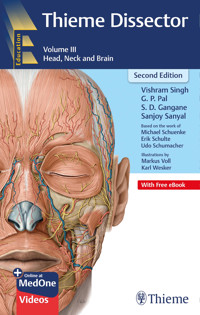
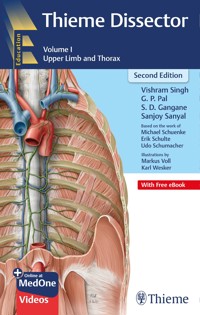
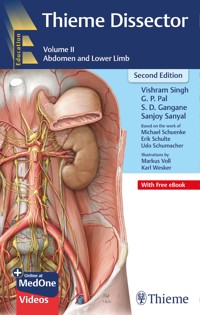
<p><em>Thieme Dissector, Second Edition</em> is a richly illustrated and detailed three-volume manual for guiding students and teachers in the dissection lab. It is enriched with intricate illustrations of the human anatomy created from the clinician’s perspective. These illustrations and the carefully researched and structured text elucidate the layer-by-layer dissection of each region of the human body in a stepwise manner.</p> <p>The volumes have been created by renowned experts in the field: Dr. Vishram Singh, Dr. G. P. Pal, Dr. S. D. Gangane, and Dr. Sanjoy Sanyal. The text of the volumes flows lucidly through well-defined sections in each chapter. These sections have also been made visually distinct to aid access. The authors have aimed to make the reading of these volumes educative, interesting, and visually engaging.</p> <p><strong>Salient Features of the Second Edition</strong></p> <ul> <li><strong>Updated videos:</strong>Provides access to more than 100 new videos on Thieme MedOne to facilitate learning, understanding, and comprehension. These videos enhance the scope of understanding the topic under discussion.</li> <li><strong>Dissection screenshots</strong>:Most relevant and duly labelled screenshots from the cadaveric dissection videos are presented at suitable places within the text to provide better insight into the steps of dissection.</li> <li><strong>Radiographs:</strong>Includes newly added radiographs to help broaden the gamut of interpretation of the anatomy.</li> <li><strong>New section</strong>:A new section on “Vertebral Column” has been added to Volume I for extensive coverage of the back region.</li> </ul> <p>This book includes complimentary access to a digital copy on <a href="https://medone.thieme.com./">https://medone.thieme.com.</a></p><p><strong>Publisher's Note: Products purchased from Third Party sellers are not guaranteed by the publisher for quality, authenticity, or access to any online entitlements included with the product.</strong></p>
Das E-Book können Sie in Legimi-Apps oder einer beliebigen App lesen, die das folgende Format unterstützen:
Veröffentlichungsjahr: 2024
Ähnliche

















To access the additional media content available with this e-book via Thieme MedOne, please use the code and follow the instructions provided at the back of the e-book.
Thieme Dissector
Second Edition
Volume III
Head, Neck and Brain
ThiemeDissector
Second Edition
Volume IIIHead, Neck and Brain
Vishram Singh, MBBS, MS, PhD (hc), MICPS, FASI, FIMSA Adjunct Professor Department of Anatomy KMC, Manipal Academy of Higher Education Mangalore, Karnataka, India; Editor-in-ChiefJournal of the Anatomical Society of India; Member, Federative International Committee for Scientific Publications (FICSP) International Federation of Association on Anatomists (IFAA) Geneva, Switzerland
G. P. Pal, MBBS, MS, DSc, FASI, FAMS, FNASc, FASc, Bhatnagar Laureate Director Professor Department of Anatomy Index Medical College; Emeritus Professor MGM Medical College Indore, Madhya Pradesh, India
S. D. Gangane, MBBS, MS, FAIMS Professor and Head Department of Anatomy Terna Medical College Navi Mumbai, Maharashtra, India
Sanjoy Sanyal MBBS, MS, MSc, ADPHA Provost and Dean Professor and Department Chair Anatomical Sciences Richmond Gabriel University College of Medicine St. Vincent and the Grenadines Canada
Based on the work of Michael Schuenke Erik Schulte Udo Schumacher
Illustrations by Markus Voll Karl Wesker
ThiemeDelhi • Stuttgart • New York • Rio de Janeiro
Publishing Director: Ritu Sharma
Senior Development Editor: Dr. Gurvinder Kaur
Director-Editorial Services: Rachna Sinha
Project Manager: Snehil Sharma
Vice President Sales and Marketing: Arun Kumar Majji
Managing Director & CEO: Ajit Kohli
© 2023. Thieme. All rights reserved.
Thieme Medical and Scientific Publishers Private Limited.
A - 12, Second Floor, Sector - 2, Noida - 201 301,
Uttar Pradesh, India, +911204556600
Email: [email protected]
www.thieme.in
Cover design: Thieme Publishing Group
Cover image source: Voll M and Wesker K
Illustrations by Voll M and Wesker K. From: Schuenke M,Schulte E, Schumacher U, THIEME Atlas of Anatomy.
Page make-up by RECTO Graphics, India
Printed in India by Office Now India Pvt Ltd
5 4 3 2 1
ISBN: 978-93-92819-25-4
Also available as an e-book:
eISBN (PDF): 978-93-92819-30-8
eISBN (ePub): 978-93-92819-35-3
Important note: Medicine is an ever-changing science undergoing continual development. Research and clinical experience are continually expanding our knowledge, in particular, our knowledge of proper treatment and drug therapy. Insofar as this book mentions any dosage or application, readers may rest assured that the authors, editors, and publishers have made every effort to ensure that such references are in accordance with the state of knowledge at the time of production of the book.
Nevertheless, this does not involve, imply, or express any guarantee or responsibility on the part of the publishers in respect to any dosage instructions and forms of applications stated in the book. Every user is requested to examine carefully the manufacturers’ leaflets accompanying each drug and to check, if necessary, in consultation with a physician or specialist, whether the dosage schedules mentioned therein or the contraindications stated by the manufacturers differ from the statements made in the present book. Such examination is particularly important with drugs that are either rarely used or have been newly released in the market. Every dosage schedule or every form of application used is entirely at the user’s own risk and responsibility. The authors and publishers request every user to report to the publishers any discrepancies or inaccuracies noticed. If errors in this work are found after publication, errata will be posted at www.thieme.com on the product description page.
Some of the product names, patents, and registered designs referred to in this book are in fact registered trademarks or proprietary names even though specific reference to this fact is not always made in the text. Therefore, the appearance of a name without designation as proprietary is not to be construed as a representation by the publisher that it is in the public domain.
Thieme addresses people of all gender identities equally. We encourage our authors to use gender-neutral or gender-equal expressions wherever the context allows.
This book, including all parts thereof, is legally protected by copyright. Any use, exploitation, or commercialization outside the narrow limits set by copyright legislation without the publisher’s consent is illegal and liable to prosecution. This applies in particular to photostat reproduction, copying, mimeographing or duplication of any kind, translating, preparation of microfilms, and electronic data processing and storage.
To my students, past and present.
Vishram Singh
To my grandson, Yatharth.
G. P. Pal
To my family and colleagues, for their support; my patients and students, for teaching me to learn from them; the willed body-donors, for their silent altruism to medical science.
Sanjoy Sanyal
Contents
Video Contents
Note from the Authors
About the Authors
1.Introduction and Osteology of the Head and Neck
2.Scalp and Superficial Temporal Region
3.Face
4.Eyelids and Lacrimal Apparatus
5.Posterior Triangle
6.Back of the Neck and Suboccipital Triangle
7.Anterior Triangle of the Neck
8.Parotid Region
9.Temporal and Infratemporal Regions
10.Temporomandibular Joint
11.Submandibular Region and Submandibular Gland
12.Removal of the Brain from the Cranial Cavity, Cranial Meninges, and Dural Venous Sinuses
13.Cranial Fossae
14.Orbit
15.Deep Dissection of the Neck—I: Thyroid Gland
16.Deep Dissection of the Neck—II: Structures under Cover of the Sternocleidomastoid and Posterior Belly of Digastric
17.Deep Dissection of the Neck—III: Root of the Neck
18.Deep Dissection of the Neck—IV: Upper Part of the Cervical Vessels and Nerves
19.Dissection of the Prevertebral Region and Cervical Plexus
20.Pharynx, Palatine Tonsil, and Soft Palate
21.Tongue
22.Nasal Cavity and Paranasal Air Sinuses
23.Larynx
24.Eyeball
25.Ear
26.Joints of the Neck Region
27.Brain—Introduction and its Blood Vessels
28.Brainstem
29.Cerebellum
30.Fourth Ventricle
31.Cerebrum: External Features
32.Structures Seen on the Midsagittal Section of the Forebrain
33.White Matter of the Cerebrum
34.Dissection of the Lateral Ventricle
35.Dissection of Basal Nuclei
36.Sections of the Brain
Index
Video Contents
Video 2.1
Layers of scalp
Video 2.2
Dissection of superficial temporal region
Video 3.1
External nose
Video 4.1
Layers of eyelid, orbicularis oculi muscle, and lacrimal gland
Video 5.1
Posterior triangle of neck
Video 5.2
Lateral aspect of neck, external jugular vein variant, cervical plexus, CN XI, and scalene triangle
Video 7.1
Anterior triangle of neck
Video 7.2
Submental, submandibular, carotid and muscular triangles
Video 7.3
Carotid triangle
Video 8.1
Parotid gland and Parotid duct/Stensen duct
Video 9.1
Infratemporal fossa and pterygomaxillary fissure
Video 9.2
Infratemporal fossa: Part I
Video 9.3
Infratemporal fossa: Part II
Video 11.1
Submandibular region
Video 12.1
Intracranial dural venous sinuses
Video 13.1
Cranial venous sinus, superior sagittal sinus (SSS), cavernous sigmoid petrosal dural folds, clinicals
Video 13.2
Cavernous petrosal sinus, origin, tributaries, cavernous sinus (CS) syndrome, carotid-cavernous fistula (CCF), clinicals
Video 14.1
Salient features of bony orbit
Video 14.2
Ocular muscles, lacrimal gland, and optic nerve
Video 14.3
Orbit extraocular eye muscles and neurovascular structures
Video 15.1
Thyroid gland and its relations
Video 15.2
Larynx and trachea
Video 16.1
Cranial nerves X, XI, XII and ansa cervicalis in neck
Video 17.1
Carotid, jugular, vagus, recurrent laryngeal nerve
Video 17.2
Scalene triangle
Video 17.3
Subclavian vessels, brachial plexus, and scalene triangle
Video 18.1
Last four cranial nerves: Glosso-Pharyngeal vagus, hypoglossal, and accessory nerves in neck
Video 18.2
Carotid arteries
Video 19.1
Cervical plexus
Video 20.1
Laryngopharynx and piriform fossa
Video 21.1
Floor of the mouth
Video 23.1
Larynx–Part 1: external structure
Video 23.2
Larynx–Part 2: internal structure
Video 23.3
Interior of larynx, trachea, laryngopharynx, and piriform fossa
Video 24.1
Exenterated eyeball showing ocular muscles, lacrimal gland, and optic nerve
Video 27.1
Human brain: vertebrobasilar circulation of brain
Video 27.2
Human brain: carotid middle cerebral, and anterior cerebral arteries
Video 27.3
Tracking brain circulation via 2D time of flight angiography (TOF) serial MRI axial slices with narration
Video 29.1
Cerebellar dissection: Part I
Video 29.2
Cerebellar dissection: Part II
Video 29.3
Deep nuclei of cerebellum
Video 30.1
Ventricles of brain
Video 31.1
Hippocampus and fornix
Video 31.2
Papez circuit
Video 32.1
Circumventricular organs, location, cytoarchitecture description
Video 33.1
Caudate nucleus, lentiform nucleus, thalamus, and internal capsule
Video 34.1
Lateral ventricle
Video 35.1
Basal ganglia: Part I
Video 35.2
Basal ganglia: Part II
Note from the Authors
There was a long-felt need of a good dissection manual for first-year undergraduate medical students undertaking the anatomy course. Anatomy is the foundation of all medical subjects, and hence, its thorough knowledge is essential for all students aspiring to become good doctors, especially in surgical fields.
The best modus operandi to learn anatomy is through dissection. Recently, due to information explosion in the medical field, the health sciences curricula have markedly reduced the time allocation for studying and teaching anatomy; yet it is realized by all that the gross structure of the human body, including its three-dimensional conceptualization, must be understood thoroughly before proceeding further to learn medicine.
Therefore, we have made a sincere effort to meet all the needs of the students in creating this three-volume set of dissection manuals. They not only delineate instructions for students to perform perfect dissection but also provide gross anatomy descriptions, supplemented by clinical correlations of gross structures studied during dissection. The textual descriptions are complemented by numerous colored illustrations that will help students recognize significant structures with more precision. To further enhance understanding, the content of the volumes is organized in sections like (a) Learning Objectives, (b) Surface Landmarks, (c) Dissection and Identification, (d) Description of Gross Anatomy, and (e) Clinical Notes. Laced with all these features, we hope that these volumes will be useful not only for medical and dental students but also for teachers of anatomy. The value of these volumes is further enhanced by providing videos at relevant places.
As educators of anatomy, we have tried our best to make these manuals easy for learning. We highly appreciate the contribution of Prof. Poonam Kharb and Mr. D. Krishna Chaitanya in Volume II and Prof. Shabana M. Borate in Volume I. For further improvements, we would sincerely welcome comments and suggestions from all students and teachers.
The second edition of this dissection manual is thoroughly updated with new line diagrams, X-ray pictures, and CT and MRI scans.
All dissection steps are supplemented by dissection videos in all the three volumes for easy understanding of gross and clinical anatomy by the students.
Vishram Singh, MBBS, MS, PhD (hc), MICPS, FASI, FIMSA
The medical curriculum in India requires basic anatomy, along with some other basic subjects, to be taught to students in the first year of the course. This often leads to an information overload for them. For some students, the situation is made even more difficult due to linguistic limitations and late admissions. As a result, there has long been a pressing need for comprehensive teaching resources that create thorough understanding of these courses in a short time span. Specifically for anatomy, one cannot stress enough on the value of a complete and detailed dissection manual that explains basic concepts in a simple and lucid manner, without duplication of facts or unnecessary complexities.
In Volume III, every care has been taken to describe all steps involved in the dissection of the head, neck, and brain in a stepwise manner that is easy to understand for the beginners. Several high-quality illustrations have been used to explain each step. They help show the dissections with a great amount of detailing and clarity. To make the discourse interesting, relevant clinical conditions have also been presented under separate sections called “Clinical Notes.”
Producing a book with hundreds of illustrations is a joint effort by the author and the publisher in a true sense.
I strongly believe that this book will be an invaluable learning resource for students and teachers of anatomy in medical and dental courses.
G. P. Pal, MBBS, MS, DSc, FASI, FAMS, FNASc, FASc, Bhatnagar Laureate
Cadaveric dissection is an integral part of teaching anatomy in medical schools. It offers an unmatched firsthand experience of exploring the structure of organs and their relationship with each other. Thieme Dissector provides a complete account of dissection of human body through a set of three volumes.
The first volume deals with the upper limb and thorax. The introduction of this volume gives general information about preservation of cadaver, instruments required for dissection, and anatomical terms, followed by a discussion on basic tissues of the body. This is followed by 10 chapters on upper limb and 5 chapters on thorax. Each chapter begins with “Learning Objectives,” followed by an introduction to the topic, dissection steps with description of the relevant structures, and clinical notes.
To facilitate understanding of the subject, photographs of actual dissected parts and real dissection videos have been provided. Access to these videos will help and enrich students’ learning process.
My heartfelt gratitude to Dr. Shabana M. Borate, Associate Professor, Department of Anatomy, at Grant Government Medical College and Sir J. J. Group of Hospitals, Mumbai, Maharashtra, India, Dr. Sachin Yadav, Assistant Professor at Grant Government Medical College and Sir J. J. Group of Hospitals, Mumbai, Maharashtra, India, and Dr. Shilpa Domkundwar, Professor and Head, Department of Radiodiagnosis, Grant Government Medical College and Sir J. J. Group of Hospitals, Mumbai, Maharashtra, India, for their untiring efforts in preparation of this volume. I am grateful to the entire team of Thieme Publishers for their constant support, and special thanks to Dr. Vishram Singh sir, who has been the guiding force for all of us in preparation of the Thieme Dissector.
S. D. Gangane, MBBS, MS, FAIMS
Thieme has taken a positive step by introducing this book for imparting anatomy education to medical students worldwide. The process of depicting videos and pictures of actual cadaver dissections in a textbook is indeed a monumental task. It starts with planning of the region to be dissected. This is followed by meticulous dissection of the region itself, which can take hours if not days. Then comes the process of accurate live narration of the dissection of the region on camera, while the video recording is in progress. The back-breaking task of editing and captioning the video frames and clips follows next, because many anatomical and medical terms used in the narration may otherwise be incomprehensible to the student. Since clinical students like content related to radiology, some videos have radiological images embedded within the frames. The relevant still shots from the dissections are then edited and labeled. Finally, of course, comes the task of publishing the finished product.
There are many digital anatomy tools available to the medical academia, ranging in size and versatility from usage in classrooms and digital labs to those used in individual laptops and tablets. Some have virtual reality–like, immersive three-dimensional, or augmented reality applications. They vary in accuracy, comprehensiveness, and versatility. They are good study tools, which are interactive and interesting to use in teaching and learning anatomy. They show body parts and spatial relationships. They are available offline, accessible anytime, anywhere, and can even show rare pathology. They present consolidated anatomy information to suit users’ learning styles. They do not have the legal, ethical, religious, social, regional, and logistical constraints of human cadaver procurement. These factors are weaning away institutions from the hoary art of cadaver dissection.
However, cadaver dissection is still the gold standard for learning human anatomy and surgery. It is the benchmark for measuring the success of newer learning technologies. Cadavers are medical students’ first “patients.” Digital resources are to be considered as supplements to the armamentarium of learning methods in human anatomy. Digital technologies lack haptic qualities of human tissue, which are essential for a surgeon. Therefore, they can never completely replace cadaver dissection for anatomy students and surgical residents under training. Nobody would want to be treated by surgeons who acquired their entire quantum of expertise in operating on the human body through virtual reality alone, just like nobody would want to be flown by an airline pilot whose only flying experience was in the digital flight simulator.
The author is truly gratified knowing that students have learned the subject of anatomy and mastered the intricacies of the human body by watching Thieme Dissector videos and illustrations.
Sanjoy Sanyal, MBBS, MS, MSc, ADPHA
About the Authors
Vishram Singh
(Editor-in-Chief and Author, Volume II, Abdomen and Lower Limb)
Vishram Singh, MBBS, MS, PhD (hc), MICPS, FASI, FIMSA, is currently the Adjunct Professor, Department of Anatomy, KMC, Manipal Academy of Higher Education, Mangalore, Karnataka, India; Editor-in-Chief, Journal of the Anatomical Society of India; and Member, Federative International Committee for Scientific Publications (FICSP), International Federation of Association on Anatomists (IFAA), Geneva, Switzerland.
A renowned anatomist, Prof. Singh has taught undergraduate and postgraduate students at several colleges and institutes, such as GSVM Medical College, Kanpur; King George Medical College, Lucknow; All India Institute of Medical Sciences, New Delhi; and Al Arab Medical University, Benghazi, Libya. He has more than 50 years of experience in teaching, research, and clinical practice. He has various bestselling titles to his credit, such as Textbook of Clinical Neuroanatomy, Textbook of Anatomy—three volumes, and Textbook of Clinical Embryology. He has published more than 20 books and more than 100 research articles in reputed national and international journals.
Prof. Singh has received various recognitions and awards for his contributions in the field of gross anatomy, neuroanatomy, and embryology.
He has been elected Vice President of the Anatomical Society of India many times. He is currently Editor-in-Chief, Journal of Anatomical Society of India (JASI).
G. P. Pal
(Author, Volume III, Head, Neck, and Brain)
G. P. Pal, MBBS, MS, DSc, FASI, FAMS, FNASc, FASc, Bhatnagar Laureate, is currently the Director Professor of Anatomy at the Index Medical College; Emeritus Professor at MGM Medical College, Indore, Madhya Pradesh, India. Dr. Pal is an eminent teacher with almost five decades of teaching experience in various medical colleges of India and the United States.
He has to his credit numerous publications in journals of international repute. He has received several national awards and honors for his research works, which includes Shakuntala Amir Chand Prize of Indian Council of Medical Research (ICMR), Shanti Swarup Bhatnagar Prize of Council of Scientific and Industrial Research (CSIR), and several gold medals, oration awards, and Lifetime Achievement Award by the Anatomical Society of India. He has been elected Fellow at various leading academies of sciences in India—Anatomical Society of India; National Academy of Medical Sciences (New Delhi), National Academy of Sciences (Allahabad), and Indian Academy of Sciences (Bengaluru). His research work is cited in more than 100 standard medical textbooks throughout the world. Recently, his name featured in the list of top 2% scientists of the world. As per a survey conducted by the Stanford University, USA, in 2020, he is ranked as no. 1 Anatomy Scientist in India and 102 in the world.
Dr. Pal has authored many well-received books such as Textbook of Histology, Illustrated Textbook of Neuroanatomy, Medical Genetics, Genetics in Dentistry, General Anatomy, Basics of Medical Genetics, Human Osteology, Genetics for Dental Student, Neuroanatomy for Medical Students, and Thieme Dissector. He has edited First South Asian edition of Grant’s Atlas of Anatomy. He has also coauthored Prof. Inderbir Singh’s Human Embryology from the 7th to 9th editions. For more information about the author and his works, Google “Indian Anatomists - Wikipedia” or “Gaya Prasad Pal - Wikipedia.”
S. D. Gangane
(Author, Volume I, Upper Limb and Thorax)
S. D. Gangane, MBBS, MS, FAIMS, is currently serving as Professor and Head, Department of Anatomy at Terna Medical College, Navi Mumbai, Maharashtra, India. He has been Professor and Head, Department of Anatomy and Genetic Division at Grant Medical College, Mumbai and Sir J. J. Group of Hospitals, Mumbai. This is a unique Anatomy Department offering services to patients having genetic disorders. Prof. Gangane has authored a bestselling book titled Human Genetics which has been widely accepted by faculty and both undergraduate and postgraduate students.
Prof. Gangane has over four decades of teaching experience and has been guiding students for MD Anatomy, and MSc and PhD in Applied Biology courses at the Mumbai University. He has also been a guide for the MD Anatomy and PhD Genetics courses at Maharashtra University of Health Sciences (the State Health University). He has published several articles in national and international journals and is also a coauthor of the recently published Textbook of Pathology and Genetics for Nurses. In addition, he has been on the national advisory board and the executive editorial board for a few journals, including Indian Journal of Anatomy and National Journal of Medical Sciences.
Prof. Gangane has also worked as an Officer of Special Duty (OSD) for the Government of Maharashtra under the Directorate of Medical Education and Research. He is a member of the advisory panel for the South Asian region of the international publishing house, Lippincott Williams and Wilkins. He is the founder Trustee of “Sandnya Sanwardhan Sanstha”, an organization that takes care of mentally challenged children by imparting vocational training and enabling them to lead better lives.
Sanjoy Sanyal
(Contributor of Videos, Volumes I, II, and III)
Sanjoy Sanyal, MBBS, MS, MSc, ADPHA, is the Provost and Dean of Richmond Gabriel University College of Medicine, St. Vincent and the Grenadines, Canada. He is also the Professor and Department Chair of Anatomical Sciences in the same university. With medical degrees from India and the United Kingdom, Dr. Sanyal has 39 years of clinical, surgical, and teaching experience as a surgeon, surgical anatomist, neuroscientist, and medical informatician.
A prolific medical and educational researcher, he has published 25 original research papers in peer-reviewed journals and presented 15 papers in many international conferences in 11 countries. He is the recipient of five Outstanding Professor Awards from several different universities and medical schools.
He is a surgical skills instructor to American Medical Students’ Association (AMSA). He is a life-member of Indian Medical Association (IMA), and annual member of American Association for Anatomy (AAA) and American Association of Clinical Anatomists (AACA). He is a provisional patent holder (January 2014) of a computerized medical program from the United States Patent and Trademark Office (USPTO). He is peer reviewer of several medical journals.
Dr. Sanjoy Sanyal is honorary faculty of the Multimedia Educational Resource for Learning and Online Teaching (MERLOT), a program of the California State University (CSU), Long Beach, partnering with educational institutions, professional societies, and industry. He is Gold-level MERLOT contributor, having authored more than 350 learning materials. He is a member of Virtual Speaker’s Bureau (VSB) of MERLOT. He is also the recipient of Innovative Use of MERLOT award.
With an underpinning philosophy of lifelong learning, his motto is to make each succeeding generation better than the previous.
CHAPTER
1
Introduction and Osteology of the Head and Neck
© THIEME Atlas of Anatomy
Introduction
The head is the upper globular part of the body which contains the brain. The neck is an elongated, cylindrical region of the body which connects the head to the trunk.
The bones of the head and neck region consist of skull, cervical vertebrae, and hyoid bone.
1.The skull forms the skeleton of the head region.
2.The cervical vertebrae form the skeleton of neck region.
3.The hyoid bone is present in the upper part of the neck in front of the third cervical vertebra.
Skull
The skull is formed by many paired and unpaired bones (Table 1.1), most of which unite with each other by sutures. A suture is narrow, linear gap filled with dense, fibrous tissue. Students are suggested to identify various bones of a dry skull and intervening sutures with the help of Figs. 1.1 to 1.5. We may study the dry skull by looking at it from various aspects, that is, from above (superior view), behind (posterior view), front (anterior view), side (lateral view), below (external view of the base), and inside (internal views of the base and the skull cap).
Table 1.1 Bones of skull
Part of skull
Paired
Unpaired
Cranium
Parietal bone, temporal bone
Frontal bone, ethmoid bone, occipital bone, sphenoid bone
Facial skeleton
Nasal bones, lacrimal bones, maxillae, zygomatic bones, palatine bones, inferior conchae
Frontal bone, vomer bone, mandible
Fig. 1.1 Superior view of the skull. 1, Bregma; 2, parietal eminence. (From: Schuenke M, Schulte E, Schumacher U. THIEME Atlas of Anatomy. Head, Neck, and Neuroanatomy. Illustrations by Voll M and Wesker K. © Thieme 2020.)
The skull consists of a brain box/cranium and facial skeleton. The facial skeleton is located beneath the anterior part of the cranium.
Anatomical Position of the Skull
Anatomical position of the skull is obtained by keeping it in “Frankfurt horizontal plane.” This plane is obtained by holding the skull in such a way that the inferior border of the orbit and superior border of external acoustic meatus of right and left sides lie in the same horizontal plane.
Superior Aspect of the Skull
Bones: On the superior aspect of the skull, the scalp covers the parts of the frontal bone, right and left parietal bones, and occipital bone.
Sutures: With the help of Fig. 1.1, identify the coronal, sagittal, and lambdoid sutures in this view. The bregma is the meeting point between the coronal and sagittal sutures, while lambda is the meeting point between the sagittal and lambdoid sutures.
Bony features: Identify the parietal eminence, parietal foramen, temporal lines (superior and inferior), and vertex (highest point of the skull).
Posterior Aspect of the Skull
Bones: With the help of Fig. 1.2, look for the following bones on the posterior aspect of the skull: posterior portions of the parietal bones, upper part of the occipital bone, and mastoid parts of the temporal bone.
Fig. 1.2 Posterior view of the skull. 1, Lambda; 2, parietomastoid suture; 3, occipitomastoid suture; 4, external occipital crest. (From: Schuenke M, Schulte E, Schumacher U. THIEME Atlas of Anatomy. Head, Neck, and Neuroanatomy. Illustrations by Voll M and Wesker K. © Thieme 2020.)
Sutures: Look for the following sutures seen in this view: lambdoidal suture, occipitomastoid suture, and parietomastoid suture.
Bony features: With the help of Fig. 1.2, identify the following bony features on a dry skull: external occipital protuberance, external occipital crest, highest nuchal lines (supreme nuchal lines), superior nuchal lines, and inferior nuchal lines.
Anterior Aspect of the Skull
The anterior aspect of the skull forms the facial skeleton. It consists of forehead, orbits, nasal region, and upper and lower jaws.
Bones: Identify the bones of the facial skeleton with the help of Fig. 1.3. These bones are the frontal bone, right and left nasal bones, right and left zygomatic bones, and right and left maxilla and mandible.
Fig. 1.3 Anterior view of the skull. 1, Frontonasal suture; 2, internasal suture; 3, frontomaxillary suture; 4, nasomaxillary suture; 5, zygomaticomaxillary suture; 6, frontozygomatic suture; 7, intermaxillary suture. Note the median nasal septum (8) formed by vomer and perpendicular plate of ethmoid. 9, Nasal notch. (From: Schuenke M, Schulte E, Schumacher U. THIEME Atlas of Anatomy. Head, Neck, and Neuroanatomy. Illustrations by Voll M and Wesker K. © Thieme 2020.)
Sutures: Look at Fig. 1.3 for the following sutures present in this view: frontonasal suture, frontomaxillary suture, internasal suture, nasomaxillary suture, intermaxillary suture, frontozygomatic suture, and zygomaticomaxillary suture.
Bony features:
1.Forehead: Look for the following features on the forehead: glabella, superciliary arches, and frontal eminences.
2.Orbital opening: It is quadrilateral in shape and presents four margins: supraorbital, infraorbital, lateral, and medial.
3.Malar prominence: It is formed by the zygomatic bone and presents the zygomaticofacial foramen.
4.Anterior nasal aperture: It is piriform in shape. Note the presence of the median nasal septum, anterior nasal spine, and nasal notch of the right and left maxillae.
5.Upper jaw (maxillae): It is formed by the right and left maxillae. Note the bony features, such as the alveolar process, canine eminence, incisive fossa, and canine fossa.
6.Lower jaw (mandible): It is formed by the mandible. Note the features, such as alveolar process, mental foramen, symphysis menti, and mental protuberance.
Lateral Aspect of the Skull
Bones: This aspect of the skull is formed by the cranial and facial bones. Identify the following bones on the lateral aspect of the skull: frontal, parietal, occipital, nasal, maxilla, zygomatic, sphenoid, temporal, and mandible (Fig. 1.4).
Fig. 1.4 Lateral view of the skull. 1, Parietomastoid suture; 2, occipitomastoid suture; 3, superior and inferior temporal lines; 4, supramastoid crest; 5, suprameatal triangle. (From: Schuenke M, Schulte E, Schumacher U. THIEME Atlas of Anatomy. Head, Neck, and Neuroanatomy. Illustrations by Voll M and Wesker K. © Thieme 2020.)
Sutures: Many sutures, which are seen on this aspect, have already been observed while studying the superior, anterior, and lateral views of the dry skull. Hence, we shall study the sutures present in the central region of the lateral view (Fig. 1.4).
Identify an H-shaped suture present in the floor of the temporal fossa. This H-shaped suture is formed by the parietosphenoid, frontosphenoid, and temporosphenoid sutures. A small circular area enclosing this H-shaped suture is called a pterion. Also, identify the parietosquamous (squamous) and parietomastoid sutures, lambdoid suture, and occipitomastoid suture.
Bony features: Identify the superior and inferior temporal lines, zygomatic arch, supramastoid crest, external acoustic meatus, suprameatal triangle, mastoid process, and styloid process.
1.Temporal fossa: This fossa lies above the zygomatic arch. It is bounded above by the temporal lines. The temporal fossa communicates below with the infratemporal fossa.
2.Infratemporal fossa: It is an irregular fossa below the zygomatic arch and behind the maxilla. It communicates above with the temporal fossa deep to the zygomatic arch. It consists of the roof, anterior, medial, and lateral walls, while the posterior wall and floor are open.
3.Pterygopalatine fossa: The junction of the anterior and medial walls shows a fissure called pterygomaxillary fissure. Deep to the fissure lies the pterygopalatine fossa.
(Students should note that infratemporal and pterygopalatine fossae are not properly visualized in these figures. They should study these fossae on a dry skull with the help of their teacher.)
Base of the Skull
You should note that to visualize the base of the skull, it is necessary to detach the mandible from the rest of the skull. The base of the skull is formed, from anterior to posterior, by the maxillae, palatine, vomer, sphenoid, temporal, and occipital bones (Fig. 1.5). For the convenience of description, the base of the skull is divided into anterior, middle, and posterior parts by two imaginary horizontal lines. The first imaginary horizontal line is drawn along the posterior border of the hard palate, and the second line passes through the anterior margin of the foramen magnum.
Fig. 1.5 Base of the skull. 1, Posterior nasal spine; 2, body of sphenoid; 3, basilar part of occipital bone; 4, greater wing of sphenoid; 5, petrous bone; 6, tympanic bone; 7, asterion; 8, external occipital crest. (From: Schuenke M, Schulte E, Schumacher U. THIEME Atlas of Anatomy. Head, Neck, and Neuroanatomy. Illustrations by Voll M and Wesker K. © Thieme 2020.)
Anterior Part of the External Aspect of the Base of the Skull
Bones: It is formed by the alveolar arch of the maxilla and hard palate (Fig. 1.5). Hard palate is formed by the palatine processes of the right and left maxillae and horizontal present in the region are divided into median, right, and l of the palatine bones.
Sutures: present in the region are divided into median, right, and left (median palatine), interpalatine, and palatomaxillary (transverse palatine) sutures form a cruciform suture.
Bony features: Note the following bony features with the help of Fig. 1.5: greater palatine foramen, lesser palatine foramen, incisive fossa, posterior nasal spine, and palatine crest.
Middle Part of the Base of the Skull
Bones: The bones present in the region are divided into median, right, and left areas. In the median area, bones are posterior border of vomer, body of sphenoid, and basilar part of the occipital bone. The bones in the lateral area are medial and lateral pterygoid plates, greater wing of the sphenoid, and temporal bone with its squamous, tympanic and petrous parts.
Sutures: The infratemporal surface of the greater wing of the sphenoid articulates with the squamous part of the temporal bone, posterolaterally, and with the petrous part of the temporal bone, posteromedially (sulcus tubae). Also, look for the squamotympanic fissure, petrosquamous fissure, and petrotympanic fissure.
Bony features: Note the posterior nasal apertures on either side of the vomer and pharyngeal tubercle in front of the foramen magnum. On the lateral side, look for the pterygoid fossa, scaphoid fossa, and hamulus. More laterally, note the tubercle of the root of the zygoma, articular tubercle, and mandibular fossa. Note the tympanic plate forming the posterior nonarticular part of the mandibular fossa.
Posterior Part of the Base of the Skull
Bones: The median area of the posterior part consists of the foramen magnum, which is bounded anteriorly by the basilar part, laterally by the condylar part and posteriorly by the squamous part of the occipital bone. In the lateral area of this part, look for the mastoid and styloid processes.
Sutures: Note the meeting point of the three sutures, that is, the occipitomastoid, lambdoid, and parietomastoid at the asterion.
Bony features: In the median part, identify the foramen magnum, jugular foramen, and occipital condyles. Posterior to the foramen magnum, look for the external occipital crest, protuberance, and nuchal lines with the help of Fig. 1.5. In the lateral part, note the presence of the styloid and mastoid processes.
Internal Aspect of the Skull
When the upper part of the vault of the skull (skull cap or calvaria) is removed, we may see the inner surface of the cranial vault and the interior of the base of the skull.
Inner Surface of the Cranial Vault
Bones and sutures: The various bones and the intervening sutures forming the cranial vault are the same as observed in the superior aspect of the skull (Fig. 1.1).
Bony features: In the midline, note the frontal crest and sagittal sulcus (groove). Many small depressions (granular pits or foveolae) are observed on each side of the sagittal sulcus. The inner aspect of the calvaria shows the presence of grooves for the meningeal vessels (Fig. 1.6).
Fig. 1.6 Inner surface of the cranial vault. (From: Schuenke M, Schulte E, Schumacher U. THIEME Atlas of Anatomy. Head, Neck, and Neuroanatomy. Illustrations by Voll M and Wesker K. © Thieme 2020.)
Interior of the Base of the Skull
The internal aspect of the base of the skull can be divided into three fossae, that is, anterior, middle, and posterior cranial fossae (Fig. 1.7). The posterior border of the lesser wing of the sphenoid, anterior clinoid process and the anterior border of the sulcus chiasmaticus separates the anterior cranial fossa from the middle fossa. The middle and posterior fossae are separated from each other by the superior border of the petrous part of the temporal bone, posterior clinoid process, and dorsum sellae.
Fig. 1.7(a) Interior of the base of the skull. 1, Posterior border of lesser wing of sphenoid; 2, sulcus chiasmaticus; 3, superior border of petrous temporal bone; 4, frontoethmoidal suture; 5, sphenoethmoidal suture; 6, frontosphenoidal; 7, jugum sphenoidale; 8, internal occipital crest; 9, internal occipital protuberance; 10, dorsum sellae. Superior orbital fissure is not seen as it is hidden below the free margin of lesser wing of sphenoid (refer to b). (b) Diagram of left superior orbital fissure as seen through middle cranial fossa. Superior orbital fissure is located between the 1. free margin of greater wing and 2. free margin of lesser wing of sphenoid bone. (Figure a: From: Schuenke M, Schulte E, Schumacher U. THIEME Atlas of Anatomy. Head, Neck, and Neuroanatomy. Illustrations by Voll M and Wesker K. © Thieme 2020.)
Anterior Cranial Fossa
Bones: The anterior cranial fossa is formed by the frontal bone, cribriform plate of the ethmoid, lesser wing of the sphenoid, and the anterior part of the superior surface of the body of the sphenoid (jugum sphenoidale).
Sutures: With the help of Fig. 1.7a, identify the frontoethmoidal, frontosphenoidal, and sphenoethmoidal sutures.
Bony features: In the median region of the floor of the anterior cranial fossa, note the frontal crest, crista galli, cribriform plate of the ethmoid, and jugum sphenoidale. The lateral region of the floor consists of the orbital plate and lesser wing of the sphenoid.
Middle Cranial Fossa
Bones: The median part is formed by the body of the sphenoid. Most anteriorly, the sulcus chiasmaticus is present. Behind the sulcus chiasmaticus, a saddle-shaped depression is present on the superior surface of the body of the sphenoid. It is known as sella turcica. The sella turcica consists of the tuberculum sellae,hypophyseal fossa, and dorsum sellae from anterior to posterior. Laterally, the floor of the middle cranial fossa is formed by three bones, that is, the cranial surface of the greater wing of the sphenoid, squamous, and petrous parts of the temporal bone.
Sutures: At the base of the middle cranial fossa, look for a suture between the greater wing of the sphenoid and the squamous part of the temporal bone, and a suture between the petrous part and greater wing of the sphenoid.
Bony features: The superior orbital fissure (Figs. 1.7b and 1.8a) is a triangular oblique cleft present most anteriorly in the middle cranial fossa. It connects the middle fossa with the orbit. Identify the foramen rotundum, foramen ovale, foramen spinosum, and foramen lacerum. In the median part, identify the hypophyseal fossa.
Fig. 1.8 Bony orbit: (a) Anterior view. 1, Lesser wing of sphenoid; 2, greater wing of sphenoid. (b) View of the medial wall with the lateral wall removed. 1, Frontal process of maxilla. (c) View of the lateral wall with the medial wall removed. (From: Schuenke M, Schulte E, Schumacher U. THIEME Atlas of Anatomy. Head, Neck, and Neuroanatomy. Illustrations by Voll M and Wesker K. © Thieme 2020.)
Posterior Cranial Fossa
Bones: The posterior part of the body of the sphenoid, occipital bone, posterior surface of the petrous temporal bone, mastoid part of the temporal bone, and posteroinferior angle of the parietal bone.
Sutures: The lower end of the lambdoid suture is present between the parietal and occipital bone, the parietomastoid suture, occipitomastoid suture, and petro-occipital suture.
Bony features: The median part of the floor presents the most striking structure, that is, the foramen magnum. The part anterior to the foramen magnum is called clivus. The parts posterior to the foramen magnum are internal occipital crest and internal occipital protuberance. In the lateral part of the floor, identify the internal acoustic meatus, jugular foramen, and transverse sulcus.
Orbital Cavity
The orbit is like a four-sided pyramid. It has a base, an apex, a roof, a floor, a medial wall, and a lateral wall (Fig. 1.8a–c).
The base: The base of the orbit is the orbital opening. It has four margins, that is, upper, lateral, medial, and inferior margins (Fig. 1.3).
The apex: The apex of the orbit lies posteriorly.
The medial wall: From anterior to posterior, the medial wall of the orbit is formed by the frontal process of the maxilla, lacrimal bone, orbital plate of the ethmoid, and body of the sphenoid.
The superior wall or roof: The superior wall is formed mainly by the orbital plate of the frontal bone and posteriorly by the lesser wing of the sphenoid.
The lateral wall: The lateral wall is formed anteriorly by the zygomatic bone and posteriorly by the greater wing of the sphenoid.
The inferior wall or floor: The inferior wall is mainly formed by the maxilla and a small part by the zygomatic bone.
Fissures, canal, and foramina of the orbital cavity: You should note that the orbital cavity communicates with the neighboring regions of the skull through the superior and inferior orbital fissures, optic and infraorbital canals, and various foramina.
Nasal Cavity
The nasal cavity is divided into right and left halves by the vertical median septum (i.e., the nasal septum). Each half of the cavity consists of an anterior opening, that is, the anterior nasal aperture, posterior nasal aperture, lateral wall, medial wall, roof, and floor.
The medial wall: The medial wall (median nasal septum) is formed by the perpendicular plate of the ethmoid, vomer bone, and septal cartilage (Fig. 1.9a).
Fig. 1.9 Bony nose: (a) Bones of the nasal septum (left lateral view). 1, Palatine process of maxilla. (b) Bones of the lateral nasal wall (left lateral view). 1, Sphenoethmoidal recess.
Fig. 1.9 Bony nose: (c) Lateral wall of the nose (left lateral view with nasal conchae removed). 1, Horizontal plate of palatine bone. (d) Coronal section through the skull to show the relative positions of the nasal cavity, orbit, maxillary air sinus, and ethmoidal air sinuses. (From: Schuenke M, Schulte E, Schumacher U. THIEME Atlas of Anatomy. Head, Neck, and Neuroanatomy. Illustrations by Voll M and Wesker K. © Thieme 2020.)
The lateral wall: The lateral wall is formed by three irregular bony projections, that is, the superior, inferior, and middle conchae. The spaces deep to the conchae are called meatuses, that is, the superior, middle, and inferior meatuses (Fig. 1.9b, c).
Roof: From anterior to posterior, the roof is formed by the nasal bone, frontal bone, cribriform plate of the ethmoid, anterior surface of the body of the sphenoid, and ala of vomer (Fig. 1.9a).
Floor: It is formed by the palatine process of the maxilla and horizontal plate of the palatine bone (Fig. 1.9a–d).
Bony features: Students are suggested to identify the following important features: sphenoethmoidal recess, superior, inferior, and middle conchae, bulla ethmoidal, uncinate process, and maxillary hiatus (Fig. 1.9b, c).
The relative positions of the nasal cavity, orbit, maxillary air sinus, and ethmoidal air sinuses are shown in Fig. 1.9d.
Mandible
The mandible is the bone of the lower jaw. It has a horseshoe-shaped body and two vertical broad rami.
Body: The body is U-shaped and has two surfaces and two borders. It consists of right and left halves united in the median plane at the symphysis menti. The upper border of the mandible is also known as the alveolar border. It bears sockets for the teeth. The lower border is also known as the base of the mandible (Fig. 1.10a–c).
Fig. 1.10 Mandible: (a) Anterior view. (b) Posterior view. 1, Genial tubercles; 2, sublingual fossa; 3, mylohyoid groove. (c) Oblique left lateral view. (From: Schuenke M, Schulte E, Schumacher U. THIEME Atlas of Anatomy. Head, Neck, and Neuroanatomy. Illustrations by Voll M and Wesker K. © Thieme 2020.)
Ramus: The ramus of the mandible projects upward from the posterior part of the body. It has four borders (anterior, posterior, upper, and lower), two surfaces (lateral and medial), and two processes (coronoid and condylar).
Bony features: Identify the following bony features of the body of the mandible with the help of Fig. 1.10a–c: mental foramen, oblique line, mylohyoid line, sublingual fossa, and genial tubercles. In the ramus of the mandible, identify the mandibular notch, pterygoid fovea, mandibular foramen, and mylohyoid groove.
Hyoid Bone
Hyoid is a small U-shaped bone present in the upper part of the neck. The hyoid bone consists of a central body and greater and lesser cornua (horn) (Fig. 1.11a–c). It is not attached to any other bone but hangs at the level of third cervical vertebra with the help of the muscles and ligaments. The body has an anterior and posterior surface. Each end of the body is continuous posterolaterally as greater cornua. The lesser cornua are small conical projections attached to the bone at the junction of the body and greater cornu on each side.
Fig. 1.11 Hyoid bone: (a) Anterior view. (b) Posterior view. (c) Oblique left lateral view. (From: Schuenke M, Schulte E, Schumacher U. THIEME Atlas of Anatomy. Head, Neck, and Neuroanatomy. Illustrations by Voll M and Wesker K. © Thieme 2020.)
Cervical Vertebrae
The cervical part of the vertebral column is highly mobile, and its curvature is convex anteriorly. It is made up of seven cervical vertebrae (Fig. 1.12). A cervical vertebra is characterized by the presence of a foramen in each transverse process (foramen transversarium). The first, second, and seventh vertebrae are atypical, while the third, fourth, fifth, and sixth vertebrae are typical.
Fig. 1.12 Cervical spine (left lateral view).* (From: Schuenke M, Schulte E, Schumacher U. THIEME Atlas of Anatomy. Head, Neck, and Neuroanatomy. Illustrations by Voll M and Wesker K. © Thieme 2020.)
*Illustrations in this volume variably depict the artery, nerve, vein either by their full name or through the shortened version, i.e., a., n., v.
Typical Cervical Vertebrae (C3–C6)
A typical cervical vertebra consists of a body and vertebral arch (Fig. 1.13a). The body is relatively small and rectangular shaped. The vertebral arch consists of the pedicle and lamina. The body and vertebral arch enclose a vertebral foramen, which is large and triangular in shape. The vertebral foramen lodges the spinal cord and its meninges. The vertebral arch consists of various processes, that is, the superior and inferior articular processes, transverse processes, and spine. The superior and inferior articular processes are broad and flat (Fig. 1.13b). The transverse processes bear foramen transversarium, which give passage to the vertebral artery. The spinous processes in the typical cervical vertebrae are short and bifid.
Fig. 1.13 Typical cervical vertebra: (a) Superior view. (b) Left lateral view. (From: Schuenke M, Schulte E, Schumacher U. THIEME Atlas of Anatomy. Head, Neck, and Neuroanatomy. Illustrations by Voll M and Wesker K. © Thieme 2020.)
First Cervical Vertebra (Atlas)
The first cervical vertebra is also known as atlas. It is easily identified from the rest of the cervical vertebrae because it is ring shaped, has no body, is the widest of all the other cervical vertebrae, and has no spinous process (Fig. 1.14a). It has two lateral masses joined anteriorly by the anterior arch and posteriorly by the posterior arch. Each lateral mass has a superior articular facet and an inferior articular facet (Fig. 1.14b). The superior facets form the atlanto-occipital joints, whereas the inferior facets form the atlantoaxial joints. The transverse process projects laterally from the lateral mass. It has foramen transversarium which transmits the vertebral artery, vein, and sympathetic nerve.
Fig. 1.14 First cervical vertebra (atlas): (a) Superior view. (b) Anterior view. (From: Schuenke M, Schulte E, Schumacher U. THIEME Atlas of Anatomy. Head, Neck, and Neuroanatomy. Illustrations by Voll M and Wesker K. © Thieme 2020.)
Second Cervical Vertebra (Axis)
It can be easily identified from the rest of the vertebrae because of the presence of dens or odontoid process. The dens is a blunt, conical, toothlike process which projects superiorly from the body of the vertebra (Fig. 1.15a). The spinous process is long, strong, and bifid, and projects posteriorly. The superior articular facets are situated lateral to the odontoid process (Fig. 1.15b,c). The transverse processes are small and lie lateral to the superior articular facets. The pedicle, lamina, and bifid spine are massive and very strong.
Fig. 1.15 Second cervical vertebra (axis): (a) Superior view. (b) Left lateral view. (c) Anterior view. (From: Schuenke M, Schulte E, Schumacher U. THIEME Atlas of Anatomy. Head, Neck, and Neuroanatomy. Illustrations by Voll M and Wesker K. © Thieme 2020.)
Seventh Cervical Vertebra
This vertebra is easily identified from the other cervical vertebra due to the presence of a very long, horizontal spinous process, which is not bifid (ends in a single tubercle). The transverse processes are large and the foramen transversarium is small because it does not provide passage to the vertebral artery (Fig. 1.16).
Fig. 1.16 Seventh cervical vertebra (vertebra prominens): Superior view. (From: Schuenke M, Schulte E, Schumacher U. THIEME Atlas of Anatomy. Head, Neck, and Neuroanatomy. Illustrations by Voll M and Wesker K. © Thieme 2020.)
CHAPTER
2
Scalp and Superficial Temporal Region
© THIEME Atlas of Anatomy
Learning Objectives
At the end of the dissection of the scalp and superficial temporal region, you should be able to identify, understand, and correlate the following clinical aspects:
▪Layers of the scalp: Skin, superficial fascia, galea aponeurotica, loose connective tissue layer, and pericranium.
▪Nerves: Supratrochlear, supraorbital, auriculotemporal, lesser occipital, and great auricular.
▪Vessels: Supratrochlear, supraorbital, superficial temporal, posterior auricular, and occipital.
▪Muscle: Occipitofrontalis muscle and epicranial aponeurosis.
▪Extension of galea aponeurotica (epicranial aponeurosis), or superficial temporal fascia.
▪Temporal fascia, or deep temporal fascia.
Scalp
Introduction
The scalp is defined as the soft tissue covering the vault of the skull. Anteroposteriorly, it extends from the eyebrows to the external occipital protuberance and superior nuchal lines. On the lateral sides, it extends up to the right and left superior temporal lines.
Surface Landmarks
Before starting the dissection, you should quickly identify the following surface landmarks on the cadaver:
1.Supraorbital margin and glabella: Palpate the supraorbital margin deep to the eyebrow and glabella between the two eyebrows in midline (just above the root of the nose).
2.Superciliary arches: The superciliary arch can be palpated just above the supraorbital margin.
3.Frontal eminence: Feel this superolateral prominence on the right and left sides of the forehead.
4.External occipital protuberance, highest nuchal lines, and superior nuchal lines: Feel this protuberance on the posterior aspect of the head (in midline, at the junction of the head and neck). Try to palpate the superior nuchal lines on either side of the occipital protuberance.
5.Superior temporal line: It will be difficult to feel the superior temporal line on the cadaver. You may clench your teeth repeatedly and feel the contraction at the upper border of the temporalis muscle. The upper border of this muscle will give an idea of the temporal line.
6.Zygomatic arch: Palpate this bone between auricle and cheek bone (zygomatic bone).
Dissection and Identification
A. Skin incision and reflection.
1.Shift the head end of the supine cadaver on the edge of the dissection table and place a wooden block under the cervicothoracic junction. This will give you a clear space to work on the occipital region as well.
2.Give a median incision “A” from the root of the nose to the external occipital protuberance. Give a coronal incision “B” starting at the middle of incision “A” up to the auricle on both sides. From the auricle, extend this incision behind up to the mastoid process and in front up to the root of zygoma (Fig. 2.1a, b).
3.Before reflecting the skin, you should know the location of blood vessels and nerves in the superficial fascia of the scalp so that you are careful to protect these structures while reflecting the skin.
4.Reflect the skin in four flaps, beginning at the midline (at the junction of the coronal and midline incisions). Proceed toward the periphery up to the zygomatic arch on either side, eyebrows anteriorly and occipital protuberance posteriorly. You may give additional coronal incisions to reflect the skin in smaller flaps.
5.Reflect the skin carefully as superficial fascia (second layer of the scalp) is very dense at the vertex (because dense strands of fibrous tissue traverse the superficial fascia connecting the undersurface of the skin to the epicranial aponeurosis). It will be really difficult to separate the first three layers and find the nerves and vessels in the second layer (superficial fascia). Therefore, the upper three layers of the scalp may often come together.
Fig. 2.1(a,b) Skin incisions for scalp dissection.
B. Exposure of muscles, blood vessels, and nerves beneath the skin of forehead.
1.Now this is the time to expose the upper part of the orbicularis oculi muscle and frontal belly of the occipitofrontalis muscle beneath the skin of forehead.
2.Identify the nerves and vessels of the scalp as they are running in the second layer of the scalp. It will be really difficult to trace these nerves as they run in dense connective tissue.
3.The location of the nerves and vessels can be assessed as follows:
a.Supratrochlear nerve and vessels are located at a fingerbreadth away from the glabella.
b.Feel the supraorbital notch/foramen and then trace the supraorbital nerve and vessels from here, as they pass upward into the scalp.
c.Feel the zygomatic arch near the auricle and then trace the auriculotemporal nerve and superficial temporal artery from here, as they pass upward into the scalp.
C. Exposure of occipital bellies of occipitofrontalis muscle, nerves, and vessels behind the ear.
1.Turn the cadaver to prone position (face facing downward) so that the posterior part of scalp can be dissected easily.
2.Separate the skin from superficial fascia toward the nuchal lines and external occipital protuberance.
3.Identify the nerves and vessels present in superficial fascia behind the ear. Similarly, see the origin of occipital bellies of occipitofrontalis muscle from highest nuchal lines. Observe the attachment of epicranial aponeurosis to external occipital protuberance. Similarly, trace the attachment of the frontal and occipital bellies with the epicranial aponeurosis.
Layers of the Scalp (Video 2.1)
The scalp consists of five layers (Fig. 2.2):
Video 2.1 Layers of scalp.
Fig. 2.2 Schematic drawing showing layers of the scalp as seen in the coronal section passing through the scalp and skull (also refer to Fig. 12.5).
1.Skin: Note that the skin is thick and adherent to the third layer (epicranial aponeurosis). As the skin of the scalp is hairy, it contains lots of sebaceous glands.
2.Superficial fascia: This layer is dense and fibrous. The fibrous strands bind the skin to the epicranial aponeurosis and contain a number of spaces filled with fat. This layer contains the blood vessels and nerves of the scalp.
3.Occipitofrontalis muscle and epicranial aponeurosis (Fig. 2.3): The flat epicranial aponeurosis is the tendon uniting the frontal and occipital bellies of the occipitofrontalis muscle. The frontal bellies take origin from the skin of the forehead mingling with the upper part of the orbicularis oculi and corrugator supercilii. They are partly united at the midline. The origin has no attachment to the bone. Frontal belly is attached posteriorly to the epicranial aponeurosis. The aponeurosis is attached posteriorly to the external occipital protuberance and the medial part of the highest nuchal lines. The occipital bellies originate from the lateral part of the highest nuchal lines on either side and are inserted on the aponeurosis. On each of the lateral sides, the aponeurosis is attached partly to the temporal line. From here it extends downward as superficial temporal fascia to get attachment on zygomatic arch. The aponeurosis can slide freely on the pericranium (fifth layer of the scalp). The frontal and occipital parts of muscle can move the scalp forward and backward over the vault of the skull.
Note: The above three layers (which are firmly attached to each other) are sometimes called as scalp proper.
4.Layer of loose areolar tissue: This layer of loose connective tissue is placed between the third and fifth layer of the scalp and extends throughout the scalp. This layer gives a passage to the emissary veins.
5.Pericranium: This layer is formed by the periosteum of the cranial bones of the vault.
Fig. 2.3 Occipitofrontalis muscle.
Blood Vessels of the Scalp
Blood vessels of the scalp are mentioned in Table 2.1. They are branches from the external and internal carotid arteries and anastomose extensively with each other in the scalp (Fig. 2.4).
Table 2.1 Blood vessels of the scalp
Name
Source
1.Supratrochlear artery
Branch from the ophthalmic artery (branch of internal carotid artery)
2.Supraorbital artery
Branch from the ophthalmic artery (branch of internal carotid artery)
3.Superficial temporal artery
Branch from the external carotid artery
4.Posterior auricular artery
Branch from the external carotid artery
5.Occipital artery
Branch from the external carotid artery
The names of the veins of the scalp correspond to that of the arteries. They run along with the corresponding arteries. Students should note that these blood vessels run from the periphery toward the vertex and form an extensive anastomotic network in the scalp. Thus, the scalp is richly supplied with blood and sensory nerves.
Nerves of the Scalp
Motor Nerves
The facial nerve (cranial nerve [CN] VII) supplies the motor fibers to the occipitofrontalis muscle. Its temporal branch is present in front of the auricle and innervates the frontal belly, whereas its posterior auricular branch is present behind the auricle and supplies the occipital belly (refer to Fig. 2.4).




