


9,37 €
Mehr erfahren.
- Herausgeber: Sonicbond Publishing
- Kategorie: Geisteswissenschaft
- Serie: On Track
- Sprache: Englisch
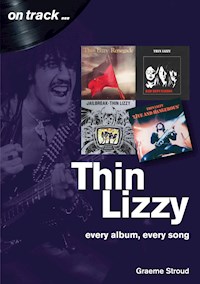
Thin Lizzy emerged as a four-piece in Dublin as the 1960s drew to a close, when guitarist Eric Bell and keyboard player Eric Wrixon, both from Belfast, encountered a band named Orphanage, which included Dubliners Brian Downey on drums and charismatic frontman Philip Lynott. The band evolved through a number of incarnations, through psychedelic power trio of the early years via classic four-piece guitar-toting rockers of the Live And Dangerous era, and ending with their incarnation as heavy metal heroes. With the ever-present Lynott and Downey at its core, Thin Lizzy rose to become one of the most powerful and iconic rock bands in Europe, before the erosive effects of the rock ’n’ roll lifestyle took their toll.
This book presents a history of the band through its music. It covers every song released through official channels, presented in context. From the difficult early years of the early 1970s, which did produce the surprise hit single 'Whisky In The Jar', via their breakthrough album Jailbreak and the heavy rock excesses of the early 1980s, this book follows the evolution of Thin Lizzy and its stellar cast of guitarists, from start to finish, through their music, track by glorious track.
Graeme Stroud is a musician and writer, having played lead guitar in bands and also solo projects since the 1970s. He has written on websites and blogs on many subjects, both musical and non-musical, for several years. He was a reviewer, interviewer and feature writer for Rock Society magazine for five years, specialising in the blues and rock genres. Since 2019, he has performed interviews and written feature articles, gig and album reviews for the rock website VelvetThunder.com. His first book, Status Quo – Song By Song was published in 2017. He lives in Kent, UK.
Das E-Book können Sie in Legimi-Apps oder einer beliebigen App lesen, die das folgende Format unterstützen:
Seitenzahl: 264
Veröffentlichungsjahr: 2020
Ähnliche




















Sonicbond Publishing Limited
www.sonicbondpublishing.co.uk
Email: [email protected]
First Published in the United Kingdom2020
First Published in the United States 2020
British Library Cataloguing in Publication Data:
A Catalogue record for this book is available from the British Library
Copyright Graeme Stroud 2020
ISBN 978-1-78952-064-4
The right of Graeme Stroud to be identified as the author of this work has been asserted by him in accordance with the Copyright, Designs and Patents Act 1988.
All rights reserved. No part of this publication may be reproduced, stored in a retrieval system or transmitted in any form or by any means, electronic, mechanical, photocopying, recording or otherwise, without prior permission in writing from Sonicbond Publishing Limited
Printed and bound in England
Graphic design and typesetting: Full Moon Media
Acknowledgements
The author would like to offer profuse thanks to everyone who helped in compiling this information, including the fanatical fans who support the forums and maintain so many musical websites, blogs, and online commentaries.
The following people merit particular attention:
Stephen Lambe, Brian Stroud, Jim Fitzpatrick, Dirk Sommer and Larry Canavan and everybody at VelvetThunder.co.uk, especially Lee Vickers and Steve Pilkington. And, of course, my wife Caro and our children, Lorelei and Haslem, for getting right behind the project and giving it their unflagging support – thanks and love.
A special shout to John Crookes for going above and beyond! Thanks, John!
Extra special thanks to Brian Downey.
Honourable mentions and heartfelt thanks to all of the following:
Adriano Di Ruscio, Alain Pacaud, Andy Fox, Anthony Booth, Chris Puttock, Colin Hunt, Des Moloney, Glen Prince, Jack van Dijk, Marcel Hartenberg, Jim Cameron, John Carreiro, Justin Young, Keith Campbell, Kevin Curran, Malc Leese, Mats Andersson, Mick Morton, Mike Mooney, Neil Ford, Rade Hendrix, Scott Glazier, Scotty Johnson, Stacy Williamson, Steen Bugtrup, Stephen Gardner, Steve Morris and Trevor Raggatt.
Contents
Introduction
Thin Lizzy
Shades Of A Blue Orphanage
Vagabonds Of The Western World
Nightlife
Fighting
Jailbreak
Johnny The Fox
Bad Reputation
Live And Dangerous
Black Rose: A Rock Legend
Chinatown
Renegade
Thunder And Lightning
Life (Live)
What Phil did next…
What the rest did next…
Compilation Albums
Bibliography
Internet Resources
Introduction
With its back against the wall of the Atlantic Ocean and its face towards Britain and the vast sweep of the Eurasian continent beyond, Ireland is an outsider, the last outpost of Western Europe. Steeped in the musical tradition of Gaelic folk, Ireland has nevertheless contributed some stellar characters to the history of rock, in which the name of Thin Lizzy looms large. And when discussing the rock band Thin Lizzy, it is no mistake to concentrate heavily on its instigator, lyricist and public-facing persona, the late Philip Lynott.
Someone in the market for a Thin Lizzy record or CD will usually be directed to the section marked ‘Hard Rock/Metal’, or something similar. Thin Lizzy were a rock band, but their forays into real hard rock territory were few and far between, mostly in their latter days. Their back catalogue covered everything from melodic rock to soul, prog, folk, fusion and romantic balladry – to concentrate on their hard rock endeavours is to miss out most of their enviable history. Phil Lynott, a fatherless half-caste in a strictly Catholic country, lived bright and fast like a shooting star and burned himself prematurely into oblivion in an atmosphere of alcohol and hard drugs. His early work, though, reveals the soul of a poet.
The circumstances that brought the Lynotts or their ancestors to the Emerald Isle at some point in misty history, creating their character and personality, belong in another book. Still, we must pick up the story at some point, and strange as it may seem when opening the book on this most Irish of bands, we begin not in the Lynott family’s home city of Dublin, nor in the green and grassy Republic of Ireland at all, but in the English industrial heartland city of Birmingham. Thence a teenaged Dublin girl named Philomena Lynott had fled to find work in the aftermath of the most devastating war in history, and there she met and dallied briefly with a man named Cecil Parris from British Guiana. For a young, inexperienced and virginal Catholic girl to break as many taboos as she did is astonishing, nevertheless, she became intimate enough with the older, black foreigner for their brief relationship to leave Philomena pregnant. For sure, the trauma of the Second World War had blunted or demolished many taboos and perhaps excused a radical change in behaviour among the survivors, but tradition was still a mighty foe and Philomena, alone in a foreign country, kept the pregnancy secret from her distant family right up until the birth.
Her son Philip Parris Lynott was born on 20th August 1949 on English soil, at a hospital in West Bromwich near Birmingham. Philomena chased work and accommodation around the Midlands of England, infant in tow, but Philip at four years of age was at last sent back to Crumlin, a district of Dublin, to live with his grandparents Frank and Sarah Lynott.
It is difficult to imagine how this would seem in the staunchly Catholic capital of the Republic of Ireland in the days after the war. An illegitimate, motherless black child could conceivably be the target of all kinds of Dickensian oppression, but incredibly, it seems that although Philomena had suffered degradation and oppression in England for her lifestyle – in fact, she had two more children out of wedlock, both of whom were given up for adoption – Philip was accepted by his family, by his peers and by the community at large in Ireland. He was foreign-looking for sure, exotic even, and the differences were not lost on him, but he escaped any severe persecution and in fact grew up to be cool and popular, black and Irish, “like a pint of Guinness,” as he famously quipped.
Phil got into music at an early age, bought a guitar and also discovered that a boy in a lower year at his school, one Brian Downey, played the drums. While still in their mid-teens, the two lads started playing together up and down the country in a covers band by the name of The Black Eagles, who were good enough to have a Manager and everything. After that combo petered out, Phil went more avant-garde with a band named Kama Sutra, but then success looked in his direction when he was invited by bassist Brendan ‘Brush’ Shiels to front his new band Skid Row. Lynott wasn’t quite 18 when Skid Row played their first gig, but from the point of view of later Lizzy fans, things got even more interesting when guitarist Bernard Cheevers quit the band for a full-time job in civvy street. His replacement was a 16-year-old guitar wizard from the other side of the border in Belfast, named Gary Moore.
Skid Row recorded one single with Lynott singing, a folky, dreamy acoustic guitar ballad named ‘New Faces, Old Places’, with a swinging jazz number named ‘Misdemeanour Dream Felicity’ on the B-side. As fate would have it, Lynott had to take a break to have his tonsils removed; during the hiatus, Shiels took over the frontman duties and Lynott was effectively given the push, leaving Skid row as a trio with Moore on guitar and Noel Bridgeman on drums. Shiels softened the pill though, giving Lynott one of his bass guitars and teaching him how to play.
Armed with his rudimentary new instrumental skills, Lynott was invited to join Brian Downey’s blues band Sugar Shack, who had recorded one successful single in Ireland, a cover of Tim Rose’s ‘Morning Dew’ (originally written and recorded by Bonnie Dobson), with a cover of Cream’s ‘Sunshine Of Your Love’ on the B-side. Coincidentally, Sugar Shack were once supported by a band named Platform Three, which featured a very youthful Gary Moore on guitar.
When the Sugar Shack project splintered, Lynott and Downey formed a new band named Orphanage, with Joe Staunton on guitar and Pat Quigley on bass, until Lynott later took over bass himself. And this, as they say, is where the story really starts. Orphanage were, by all accounts, an ill-disciplined and loose amalgamation of several musicians, any of whom may or may not turn up on any given night. However, popular legend has it that they impressed another Belfast guitarist one night during a pub gig in Dublin.
Eric Bell was only a couple of years older than Lynott, but among a stack of other bands, he had played in an outfit named Shades of Blue and was briefly a member of Them, fronted by singer Van Morrison. Bell was prowling Dublin with keyboard player Eric Wrixon, another former member of Them, looking for decent musicians to form a new band, and when they found a local gig, they went along – the band on stage was Orphanage. Massively impressed both by Lynott’s lyricism and on-stage presence, and Downey’s superb drumming, Bell went backstage after the gig and asked the two lads right there and then whether they would be interested in starting a band with him and Wrixon. They had heard of Bell, who had trodden the same circuit as Gary Moore in Belfast, and agreed. The new four-piece eventually settled on the name Thin Lizzy after a 1950s character named Tin Lizzie from the Dandy comic.
The name itself is worth some attention. The original Tin Lizzie was an unofficial name for the classic Model T Ford motor car, the first car to be built using mass-production techniques in the early 1900s. In 1922, a driver named Noel Bullock entered a battered Model T which he had nicknamed ‘Old Liz’ into a race in Colorado, USA. The beaten-up old relic was assigned the nickname ‘Tin Lizzie’, and actually won the race, which cemented the reputation of the cheap Model T as a durable, reliable workhorse of a motor, and the name Tin Lizzie became well-publicised in the national press.
The Dandy created a story in 1953 about a robot housemaid named Tin Lizzie after the old car. She originally appeared as a prose character but was soon promoted to a picture strip, drawn by an artist named Jack Prout. In conversation with the author, Brian Downey explained how the name came to be applied to their new band:
One day we were sitting in the Countdown Club in Dublin when we were starting off, and I think it was Eric Bell who came up with the idea of Tin Lizzie, like the comic spelling. It was on a kind of a shortlist, and I remember sitting there going ‘Nah, that doesn’t sound too good…’ We went through another few names, but for some reason, we kept coming back. The next day we came back to it as well, because we were trying for a few days to find a name. Then Eric came up with the idea of putting the ‘h’ in. He said, ‘Well in Dublin, nobody pronounces the ‘th’ anyway, so it would just be a little bit of a joke.’ I think we did a couple of gigs calling ourselves Thin Lizzie with an ‘ie’. But we put the word out to promoters that we had changed the name again, it’s not ‘ie’ it’s ‘y’, but promoters still used the ‘ie’ for ages it seemed. But it was Eric Bell who came up with the idea; like myself, he was a Beano aficionado. We used to have comics in the van going to gigs as well; we were big comic guys.
The spelling was changed from Lizzie to Lizzy before they hit the big time, but they were still Lizzie when their first single was released.
In any case, both Orphanage and Bell were well-known enough for the new band, almost a supergroup in today’s terms, to be hotly anticipated, and their formation was announced in the press. Recollections differ as to where their first gig was played; either a school hall in Cloghran or in St Anthony’s Hall in Clontarf. Downey clearly recollects it as the Cloghran venue, but is aware that there is some disagreement, as he explains:
I think it was Cloghran, it was outside of Dublin as far as I remember. A lot of people do remember that gig in St. Anthony’s Hall though, including our ex-Manager Terry O’Neill, who mentioned to me years ago that was our first gig, though I always had the idea that we played in Cloghran first. I think maybe we could have done a quick half-hour in St. Anthony’s, a really quick gig, because I really can’t remember it, and then maybe played the official gig at Cloghran? So I’m not really sure, but it’s definitely one of those two gigs!
The four-piece dossed together in the upper floor of a block in Clontarf, on the seaward side of Dublin, close to the castle that would feature on their first album. They managed to wangle some free time at the new Trend studio by promising to record a song written by the owner, John D’Ardis. The song was called ‘I Need You’ and ended up as the B-side to their debut single, a Lynott composition named ‘The Farmer’, released under the name Thin Lizzie in 1970. Parlophone had been talking about signing the band, but the single flopped as debut singles shall, selling less than 300 copies, and the label bailed. Eric Wrixon left the band before the single was released and floated around Europe before eventually rejoining his previous band Them. Thin Lizzy were now evolving into a guitar-based power trio on the template of Cream, Ten Years After, or The Jimi Hendrix Experience.
Lizzy was being managed at this time by Terry O’Neill, who was finding it difficult to stump up the necessary cash to keep the band buoyant. He approached a local music shop owner named Brian Tuite about co-managing the band, but in the event, Tuite teamed up with Peter Bardon, who provided the financial clout, to take on the job. Tuite was friends with one of Decca’s A&R men, and arranged for him to come and view a soul singer named Ditch Cassidy – but replaced Cassidy’s usual backing band with Thin Lizzy. Decca signed Cassidy to one of their subsidiaries to do a single, but Lizzy ended up with a full recording contract. Thanks to Tuite, it was the start of the big adventure, as they relocated to London to record their debut album.
Thin Lizzy
Released: UK 30 April 1971, US 14 July 1971
Label: Decca (London in US)
Recorded at: Decca Studios, West Hampstead, London, January 1971
Philip Lynott: Vocals, bass guitar, rhythm guitar, acoustic guitar
Eric Bell: Lead guitar, twelve-string guitar
Brian Downey: Drums, percussion
Ivor Raymonde: Mellotron on ‘Honesty Is No Excuse’
Produced by: Scott English
Album duration: 39 minutes
This album did not chart
Recorded over the course of five days at Decca’s West Hampstead studio, in a smoky haze of dope as was de rigeur at the time, Thin Lizzy’s debut long-player was released on 30 April 1971, with the band name corrected to the current spelling. Radio 1’s ever-reliable mentor of new talent John Peel contributed some airplay, and Radio Luxembourg’s Kid Jensen got right behind it immediately, but there are few if any hummable melody lines or hooks, and nothing really for the commercial record-buying public to get hold of. The free-form nature of the singing seems to have freed the musician side of the band from any constraints though – they, therefore, weave complex, trippy and ambient strands of anything that comes to mind, and the lyrics are laid gently on top like a sleeping princess.
There was obviously no point in hammering away at the tunes with straight 4/4 rock precision, so Downey plays the drums like a musical instrument; his imaginative percussion manages to make the drums a part of the instrumentation rather than a solid base from which to launch an aural attack. It’s quite challenging to pigeonhole the musical style; in fact, it is more prog-folk than rock.
Truthfully though, based on this first offering, it’s difficult to see how the early band had garnered such an awesome reputation for their hard-rocking live shows. This set is quiet and introspective, even cerebral, and shows Lynott not as a rocker, not even as a songwriter per se, but purely and simply as a poet. True, that was the way of contemporary Irish music in the ‘60s and early ‘70s, and it is easy to imagine some of these songs being crooned by Van Morrison, but less easy to imagine them in the hands of any of the power trios mentioned earlier. Lynott loves to spotlight specific characters by name in his songs, and plenty of locals get a mention on this set.
Album cover
Decca’s art department delved into their archive and pulled out an ingenious photo-collage to use on the cover, credited to David Wedgbury. A photo is taken with a fisheye lens at extremely close quarters of the headlight of a rather dilapidated 1950s motor car in an urban street. The car’s headlight has had another wide-angle photo carefully superimposed on top of it, of apparently the same car from a different angle. The whole melange is placed in a circular frame that takes up most of the cover, with a black background and the words ‘Thin Lizzy’ picked out in bright yellow in the top-left. The band were asked to approve it, while at the same time being told that there was no alternative. “Whether we had given permission or not, I think they would have still used it,” said Brian Downey. “It’s not a brilliant photograph for the first album by any means, but we had no say in the matter, we had to go along with it.” Whatever the technical or artistic merits of the shot, its grimy urban vibe didn’t really make it a must-buy. It is tempting to assume the location is a Dublin backstreet, but in fact, a distant road name-board indicates that the photo was taken in England because the street sign has a white background – Irish road names have a green background. The car (for those who wish to know), is a 1957/58 Vauxhall Victor ‘F’ Series. A completely different sleeve design was used for the US release – a primitive cartoon car is shown careering over a hill which is actually a woman’s naked thigh. Go figure, as they say Stateside.
‘The Friendly Ranger At Clontarf Castle’ (Bell, Lynott 3:02)
It’s clear from the opener that Thin Lizzy had no aspirations for the first bars of their first album to hit anybody like a sledgehammer. The title itself is clearly intended to convey gentle, good-humoured relaxation rather than anything approaching rock. Downey leads off with a gentle tom rhythm that pans deeply from left to right with Bell strumming some ambient chords; Lynott recites a short poem about the ranger in prose as a kind of intro. After a minute or so, the song proper comes in, with Phil singing more, thematically-related poetry over some sweet, deeply-phased chords and staccato bass. Over the course of a mere three minutes, the band drops in and out at will, with Bell playing an overdubbed four-part guitar melody line over a sparse backing at one point – eat your heart out Brian May! The boys spent some time living in a crash pad in the Clontarf district of Dublin which they dubbed Clontarf Castle, down the road as it was from the actual castle itself, but the friendly ranger was Lynott’s pet cat Pippin, whose face markings put Phil in mind of the Lone Ranger. Lynott would go on to name his music publishing company Pippin The Friendly Ranger.
‘Honesty Is No Excuse’ (Lynott 3:40)
The first track stops and this one comes straight in without a break. Musically along similar lines, nevertheless, there is a stylistic change as Lynott sings a complex lyric line in a notably high key. It’s pure Van Morrison at this point. Acoustic guitar strumming and heavy use of the string section underpin a complex and musical number, with Mellotron contributed by session musician Ivor Raymonde, better known as a jazz, classical and big band pianist, before he went on to become a music director at the BBC. There is an interesting conflict, or comparison perhaps, between the lyrics and the title: the singer lays bare his soul, confessing to using one who loved him for his own pleasure and comfort, while singing ‘Honesty was my only excuse’ at the end of every verse. In the title, he simply states that it wasn’t a good enough reason, ‘Honesty Is No Excuse’. Judge as you see fit. Raymonde, we are told, loved the song.
‘Diddy Levine’ (Lynott 7:06)
More acoustic strumming introduces this ballad, while Lynott sings a narrative poem in a semi-speaking style. It’s a kind of reality show sung to music, following the lives of Eunice King (who is a bloke), and his common-law wife Diddy Levine, who has a daughter named Janice from a previous marriage. A complex tale follows Janice as she grows up, and specifically mentions everyone by name. The song takes up three minutes, then unexpectedly morphs into a two-minute free-form Cream-type jam, with a guitar in the right channel playing the riff, while another in the left channel plays solo. The last two minutes extract a moral from the tale along the lines of the-more-things-change-the-more-they-stay-the-same, pushing the whole piece to seven minutes.
‘Ray-Gun’ (Bell 3:06)
Ah, now, here is a proper rock song, starting with a groovy Robin Trower type riff with deep wah, then the band comes in with a funky backing and heavily reverb-soaked lead guitar in the left channel. Quite clearly, if Lynott was the poet with his head in the clouds, Bell was the rocker. The science-fiction aspect is a bit of a red herring here; although the song speaks of someone from another planet, who carries a ray gun, the planet is specifically said to be only 3,000 miles away, and one gets the distinct impression we are talking about an American, probably carrying a run-of-the-mill handgun. The foreigner is castigated right from the start for having no religion, kicking off a theme that would recur time and again over the lifetime of the band. Multiple guitar lines tend to overwhelm the vocals, to be honest, but it’s a welcome breath of life in a pretty pedestrian set. It is also one of the very few Lizzy-penned songs not to have Lynott’s name on the writing credits at all.
‘Look What The Wind Blew In’ (Lynott 3:23)
This is a jazz-chorded but staccato rock-rhythmed up-tempo piece with guitars tending to overwhelm the vocals again. The contemplative lyrics tell of a man who has had lots of lovers without fear or conscience, but now finds himself afraid due to a ‘gale from the north’. The gale that flew in, (not blew in as in the title), was Lynott’s current paramour, one Gale Barber from Belfast in Northern Ireland, who had moved from Ireland to London with Phil and lived with him in West Hampstead. It is certainly an energetic song, with an unaccompanied vocal chorus hook born for audience interaction.
‘Eire’ (Lynott 2:07)
Lynott sings a poem concerning Celts versus Vikings set to a gorgeously ambient but surprisingly complex backing of acoustic and reverb-soaked electric guitars, tom rolls and melodic bass runs. A decently rocking guitar solo fades out barely 2 minutes into the song, which is a shame. The storyline is a bit confusing as it is in two halves separated by hundreds of years. First, it speaks lyrically of the land of Eireann, one of the many variants for the country’s name now usually spelt Eire, and the High King’s fight against the ‘dreaded Vikings’ – probably High King Brian Boru’s defence against the picturesquely-named Sigtrygg Silkbeard and his Norse allies of Orkney and the Isle of Man at the battle of Clontarf in 1014. ‘Of course,’ I hear you cry. But then it name-checks Red O’Donnell and Hugh O’Neill, two heroes in the wars against the English, ‘the Saxon foe’ of Tudor times. The purpose is to cast Eire in a heroic role, as a sturdy opponent of oppression – Lynott was keen to sing the lyrics in Irish Gaelic, and reportedly recorded a take in that language, but that was a step too far for Decca and he re-did it in English.
‘Return Of The Farmer’s Son’ (Downey, Lynott 4:13)
The power trio makes an appearance here; a hard-rocking intro in Cream style with a descending guitar riff and deep bass – this is probably the first introduction to the later Lizzy style, portending songs such as ‘Emerald’ still to come. More poetic content tells of a wayward son proclaiming his love for his widowed father, a good-hearted, hard-working farmer. The singer reminisces about his strictly religious father who would ‘smack him on the ass’ to get him to church.
‘Clifton Grange Hotel’ (Lynott 2:27)
A rim-shot, restrained, almost dance-band drum pattern underscores heavily overdriven guitar. The hotel of the title is not actually mentioned by name in the song, but was a real premises in Manchester run by Philomena Lynott and her partner Dennis Keeley throughout the late ‘60s and ‘70s. Known locally as ‘The Showbiz’ or just ‘The Biz’, the hotel’s clientele were mostly showbiz folk or local celebrities, notably Manchester United footballers. Lynott got to know George Best here, a legend of Manchester United and Northern Ireland and certainly one of the most famous footballers of his generation. The short track name-checks a few regular customers, but basically fades out when they run out of stuff to do.
‘Saga Of The Ageing Orphan’ (Lynott 3:40)
This song has another gorgeous, ambient intro with two acoustic guitars playing harmonising arpeggios. Minimal jazz-brush drums and restrained bass underlie a poem about an ordinary family; Lynott’s uncle Peter is named specifically, reading a book while his mother, Lynott’s grandmother, cooks. In Lynott’s way, the song merges autobiographical details with a misty-eyed nostalgia, seasoned with a twist of sadness. It’s a short poem about the inevitability of ageing, but really it’s all about the music, with some flamenco-influenced guitar in parts. The number does not escalate at all, but is beautiful throughout, with a rising bass line to finish.
‘Remembering’ (Lynott 6:00)
There is a trip once around the toms to start, and the listener can just hear the final syllable of something spoken, as if someone was talking over the intro and they forgot to edit it out. The intro seems to be unrelated to the actual number, which alternates between quiet passages of nostalgic reminiscence and louder passages of bitter realisation. In the quiet passages, the singer reminisces with misty nostalgia about his first girlfriend, when the pair were just children. In the louder sections, he ruefully points out how the two of them have changed so much, and how the old days are lost but not forgotten. Then, at about four minutes, a free-form bass section leads into a psychedelic hard rock dual guitar wig-out with two guitar solos playing at once, one just overdriven, one with overdrive and wah, which gets harder and harder towards the end, eventually finishing on a tight drum and bass crash. This is getting remarkably close to fusion rock. On later editions of the vinyl and on most CD issues, the New Day EP is tacked on to the end of the record, with its song ‘Remembering (Part Two)’, and this song is rebranded as ‘Remembering (Part One)’.
Associated material
‘The Farmer’ (Lynott 3:37)
An Ireland-only release on the Parlophone label on 30 July 1970 before the band signed with Decca, this was Thin Lizzy’s first single, recorded at Trend Studio in Baggott Street, Dublin, under the name Thin Lizzie. This drawling western country ballad is underpinned by Eric Wrixon’s Hammond and piano and sets a scene that Lynott would come back to again and again: a cowboy song, a tale of outlaws of the old west. Lynott starts with a spoken section where he puns on the band’s name, saying “I do appreciate y’all comin’ – specially you Skinny Lizzy!” No farmer is ever mentioned in this song, which concerns a wake held for the protagonist’s mother, including whiskey bought with the proceeds of a bank heist. This song was eventually included on the 2010 expanded CD version of the debut album.
‘I Need You’ (D’Ardis 4:06)
Released on 30 July 1970 as the B-side of the above single, this song features a decent but relatively standard, disappointed love-lyric written by the studio owner John D’Ardis (spelt ‘Dardis’ on the record). A horn section introduces an up-tempo rock’n’roller with tinkling piano. Some groovy drum rolls and great guitar soloing contribute to what is actually a really good, and surprisingly lengthy 1960s pop song, which would have been a hit if Georgie Fame or Alan Price had done it. It doesn’t sound much like Thin Lizzy because it simply isn’t – D’Ardis and some mates had already recorded the backing track and it was presented as a fait accompli; Lynott added the vocals written by D’Ardis and Bell overdubbed some guitar parts.
‘New Day’ EP
Released 20 August 1971. The fact is that Thin Lizzy the album didn’t sell in anything like the numbers Decca demanded of their burgeoning stars, and they weren’t of a mind to bankroll a second effort without wringing the cloth out a bit more. They ended up agreeing to a four-track EP, which was recorded at Decca’s West Hampstead studios in June 1971 and was released as New Day on 20 August – it didn’t really do any better than the album, but it didn’t do any worse either, and the standard was good enough to convince Decca to agree to a second full-length offering. CD editions of the first album tend to include the four EP songs as bonus tracks, so they have become associated in many people’s minds with that record, but in some ways, they have more in common with the next LP, especially as production duties were handled by Nick Tauber, as on the next two albums. Tauber had actually been involved in mixing the first album in an uncredited capacity, but perhaps the most momentous thing about New Day was that it represents the first professional album cover art from one Rodney Matthews, who would go on to create classic artwork for a whole raft of stars from the New Wave Of British Heavy Metal, and Magnum in particular. Lizzy had played a college gig in Bristol and a local booking agent mentioned Matthews’ name. At the college, a poster he had done for another gig took their eye, but Decca refused to shell out for a picture sleeve, so Lizzy financed it themselves – a jolly-faced sun peers above the horizon in a cartoonish fashion reminiscent of The Beatles’ Yellow Submarine art, a style pretty well unrecognisable from Matthews’ later work. The songs from the EP are listed below…
‘Dublin’ (Lynott 2:26)
From the New Day EP, another wistful poem about lost love, tied in with a wistful nostalgia over the city itself that Lynott left behind. No bass or drums feature on this track, just intimate vocals over acoustic guitar, with a heavily-reverbed electric guitar in the background – in fact, Lynott recorded it on one occasion with no musical backing at all, simply as spoken poetry. Rod Mayall contributes some celeste to this musical version, which sounds a bit like a glockenspiel in the intro.
‘Remembering (Part Two): New Day’ (Downey, Bell 5:05)
From the New Day EP, up-tempo folk-rock with rapid backing, nothing to do with the original ‘Remembering’, except in so far as it turns over a new leaf and contemplates the future with optimism. The band messes about with the timing somewhat; it misses a beat at the end of each section, playing a shorter bar. There is no conventional drum kit on this one, but wicked high tom or timbale work all the way through, and some pretty nifty guitar shredding. This could be a potentially great live track, but the vocals are mixed low for some reason. It is easy to hear the origins of some later folk-rock acts; The Waterboys come to mind.
‘Old Moon Madness’ (Lynott 3:53)
From the New Day




