


18,99 €
Mehr erfahren.
- Herausgeber: John Wiley & Sons
- Kategorie: Fachliteratur
- Sprache: Englisch
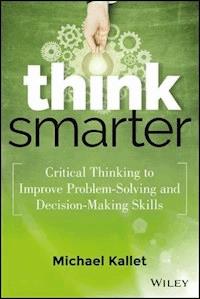
Train your brain for better decisions, problem solving, and innovation Think Smarter: Critical Thinking to Improve Problem-Solving and Decision-Making Skills is the comprehensive guide to training your brain to do more for you. Written by a critical thinking trainer and coach, the book presents a pragmatic set of tools to apply critical thinking techniques to everyday business issues. Think Smarter is filled with real world examples that demonstrate how the tools work in action, in addition to dozens of practice exercises applicable across industries and functions, Think Smarter is a versatile resource for individuals, managers, students, and corporate training programs. Thinking is the foundation of everything you do, but we rely largely on automatic thinking to process information, often resulting in misunderstandings and errors. Shifting over to critical thinking means thinking purposefully using a framework and toolset, enabling thought processes that lead to better decisions, faster problem solving, and creative innovation. Think Smarter provides clear, actionable steps toward improving your critical thinking skills, plus exercises that clarify complex concepts by putting theory into practice. Features include: * A comprehensive critical thinking framework * Over twenty-five "tools" to help you think more critically * Critical thinking implementation for functions and activities * Examples of the real-world use of each tool Learn what questions to ask, how to uncover the real problem to solve, and mistakes to avoid. Recognize assumptions your can rely on versus those without merit, and train your brain to tick through your mental toolbox to arrive at more innovative solutions. Critical thinking is the top skill on the wish list in the business world, and sharpening your ability can have profound affects throughout all facets of life. Think Smarter: Critical Thinking to Improve Problem-Solving and Decision-Making Skills provides a roadmap to more effective and productive thought.
Sie lesen das E-Book in den Legimi-Apps auf:
Seitenzahl: 314
Veröffentlichungsjahr: 2014
Ähnliche



















Contents
Preface
Acknowledgments
Section I: Introduction and the Framework for Critical Thinking
Chapter 1: What Is Critical Thinking?
Benefits of Critical Thinking
Chapter 2: When to Use Critical Thinking
Chapter 3: The Framework and Tools
Clarity
Conclusions
Decisions
Section II: Clarity
Chapter 4: Empty Your Bucket
The Bucket
Getting Started with
Emptying Your Bucket
Chapter 5: Inspection
Getting Started with
Inspection
Chapter 6: Why?
Why
Why?
Ask
Why
to Distinguish
This
from
That
Ask
Why
to Get to a Root Cause
Ask Why to Get to “I Don’t Know”
Ask Why to Get to Because!!
Getting Started with
Why
Chapter 7: So What?
So What:
Your Company or Product
Your
So What
Getting Started with
So What
Chapter 8: Need
What Is the Necessity?
Great Teams and Need
Need and Survival
Getting Started with
Need
Chapter 9: Anticipatory Thinking
What’s Next?
Getting Started with Anticipatory Thinking
Chapter 10: What Else?
What Else Could This Be?
Getting Started with
What else
Chapter 11: The Ingredient Diagram
Ingredients of Your Headscratcher
Getting Started with the
Ingredient Diagram
Chapter 12: Vision
What Is Your Vision?
Getting Started with
Vision
Chapter 13: The Thinking Coach
The Role of a Thinking Coach
Why Be a Thinking Coach?
Examples of a Thinking Coach
If You Have the Experience, Why Not Communicate That?
Ten Rules of a Thinking Coach
Getting Started with
Being a Thinking Coach
Chapter 14: Summary of Clarity
Clarity: Getting Clear about Your Headscratcher
Getting Started
Practice
Clarity: Not about Solving the Problem
When Am I Done with Clarity?
Can I Use Critical Thinking by Myself and Not with a Group?
Section III: Conclusions
Chapter 15: It’s All about the Premise
Deduction
Induction
It’s All about the Premise
Chapter 16: Facts
Facts
Are Absolute Truth
Use
So What
with Facts
Fact or Not Fact?
Chapter 17: Observations
Observations Are Abundant
Chapter 18: Experiences
Your Experiences
So What?
Chapter 19: Beliefs
Beliefs
—Your Value System
When Beliefs Are Different
Chapter 20: Assumptions
Assumptions Are Key
Chapter 21: The Conclusion
Creating the Premise
The Stronger the Premise, the More Reliable the Conclusion—and the More Confidence You’ll Have in It
Jumping to Conclusions
Where Do Personalities Fit In?
Which Conclusion Is Right?
Getting Started with
Conclusions
Chapter 22: Credibility
How Credible Is the Premise?
Credibility of Facts and Observations
Why Do People Lose Credibility?
Getting Started with
Credibility
Chapter 23: Consistency
The Consistency of Your Premise Components
Getting Started with
Consistency
Chapter 24: Triangular Thinking
Estimating the Unknown
Getting Started with
Triangular Thinking
Chapter 25: Change
The Premise and Change
Helping People Accept Change
Getting Started with
Change
Chapter 26: Influencing and Persuading
Using the Premise to Influence
Using the Premise to Persuade
Maybe You Need to Be Persuaded?
Getting Started with
Influencing
and
Persuading
Section IV: Conclusions and Innovation
Chapter 27: Outside-the-Box Thinking
Ask
What If
and
What Other
Getting Started with
Thinking Outside the Box
Chapter 28: Abductive Thinking
An Educated Guess
Old Dog Thinking
Knowledge with No Experience
Old Dog Thinking Cures
Getting Started with
Abductive Thinking
Chapter 29: Impossible Thinking
Thinking about How to Accomplish the Impossible
Getting Started with
Impossible Thinking
Chapter 30: Summary of Conclusions
Creating Solutions
Getting Started
Sorry, You’re Not Quite Done!
Section V: Decisions
Chapter 31: Who, Need, and When
Whose Decision Is This, Anyway?
Need, Again!
When Does This Decision Need to Be Made?
Getting Started with
Who
,
Need
, and
When
Chapter 32: Criteria
Without Criteria, Nothing Is Decided
Getting Started with
Criteria
Chapter 33: Risk
What’s the Risk?
11 Risk Factors
Using the 11-Factor Model
What Is Too Risky?
Getting Started with
Risk
Chapter 34: Summary of Decisions
Taking Action
Getting Started
Are We Done Yet?
Critical Thinking Summary and Suggestions
About the Author
Index
End User License Agreement
List of Illustrations
Figure 3.1 The Three-Step Critical Thinking Process
Figure 3.2 Automatic versus Critical Thinking
Figure 3.3 The Critical Thinking Framework
Figure 4.1 A Filled Bucket
Figure 4.2 An Empty Bucket
Figure 6.1
This
and
That
Figure 6.2 The Root Cause
Figure 11.1 Distance to Gas Fill-Up—Ingredient Diagram
Figure 11.2 Productivity Ingredient Diagram
Figure 15.1 The Conclusion Process
Figure 21.1 The Conclusion Process
Figure 24.1 Estimating a Schedule with Multiple Perspectives
Figure IV.1 The World of Conclusions (Solutions)
Figure 27.1 The Box
Figure 27.2 The 9-Dot Puzzle
Figure 28.1 Strong Inductive Reasoning at Work
Figure 33.1 Evaluating Risk
Pages
iii
iv
v
vi
xi
xii
xiii
xiv
xv
xvi
xvii
xviii
1
2
3
4
5
6
7
8
9
10
11
12
13
14
15
16
17
18
19
20
21
22
23
24
25
26
27
28
29
30
31
32
33
34
35
36
37
38
39
40
41
42
43
44
45
46
47
48
49
50
51
52
53
54
55
56
57
58
59
60
61
62
63
64
65
66
67
68
69
70
71
72
73
74
75
76
77
78
79
80
81
82
83
84
85
86
87
88
89
90
91
92
93
94
95
96
97
98
99
100
101
102
103
104
105
106
107
108
109
110
111
112
113
114
115
116
117
118
119
120
121
122
123
124
125
126
127
128
129
130
131
132
133
134
135
136
137
138
139
140
141
142
143
144
145
146
147
148
149
150
151
152
153
154
155
156
157
158
159
160
161
162
163
164
165
166
167
168
169
170
171
172
173
174
175
176
177
178
179
180
181
182
183
184
185
186
187
188
189
190
191
192
193
194
195
196
197
198
199
200
201
202
203
204
205
206
207
208
209
210
211
212
213
214
215
216
217
218
219
220
221
222
Guide
Cover
Table of Contents
Begin Reading
think smarter
Critical Thinking to Improve Problem-Solving and Decision-Making Skills
Michael Kallet
Cover image: ©tumpikuja/iStockphoto
Cover design: Michael J. Freeland
Copyright © 2014 by Mike Kallet. All rights reserved.
Published by John Wiley & Sons, Inc., Hoboken, New Jersey.
Published simultaneously in Canada.
No part of this publication may be reproduced, stored in a retrieval system, or transmitted in any form or by any means, electronic, mechanical, photocopying, recording, scanning, or otherwise, except as permitted under Section 107 or 108 of the 1976 United States Copyright Act, without either the prior written permission of the Publisher, or authorization through payment of the appropriate per-copy fee to the Copyright Clearance Center, 222 Rosewood Drive, Danvers, MA 01923, (978) 750-8400, fax (978) 646-8600, or on the web at www.copyright.com. Requests to the Publisher for permission should be addressed to the Permissions Department, John Wiley & Sons, Inc., 111 River Street, Hoboken, NJ 07030, (201) 748-6011, fax (201) 748-6008, or online at www.wiley.com/go/permissions.
Limit of Liability/Disclaimer of Warranty: While the publisher and author have used their best efforts in preparing this book, they make no representations or warranties with respect to the accuracy or completeness of the contents of this book and specifically disclaim any implied warranties of merchantability or fitness for a particular purpose. No warranty may be created or extended by sales representatives or written sales materials. The advice and strategies contained herein may not be suitable for your situation. You should consult with a professional where appropriate. Neither the publisher nor the author shall be liable for damages arising herefrom.
For general information about our other products and services, please contact our Customer Care Department within the United States at (800) 762-2974, outside the United States at (317) 572-3993 or fax (317) 572-4002.
Wiley publishes in a variety of print and electronic formats and by print-on-demand. Some material included with standard print versions of this book may not be included in e-books or in print-on-demand. If this book refers to media such as a CD or DVD that is not included in the version you purchased, you may download this material at http://booksupport.wiley.com. For more information about Wiley products, visit www.wiley.com.
Library of Congress Cataloging-in-Publication Data:
Kallet, Mike, 1953–
Think smarter : critical thinking to improve problem-solving and decision-making skills / Mike Kallet.
p. cm.
ISBN 978-1-118-72983-0 (hardback); ISBN 978-1-118-86435-7 (ebk);
ISBN 978-1-118-87125-6 (ebk)
1. Problem solving. 2. Decision making. 3. Critical thinking. I. Title.
HD30.29.K35 2014
658.4'03—dc23
2013044790
Lesen Sie weiter in der vollständigen Ausgabe!
Lesen Sie weiter in der vollständigen Ausgabe!
Lesen Sie weiter in der vollständigen Ausgabe!
Lesen Sie weiter in der vollständigen Ausgabe!
Lesen Sie weiter in der vollständigen Ausgabe!
Lesen Sie weiter in der vollständigen Ausgabe!
Lesen Sie weiter in der vollständigen Ausgabe!
Lesen Sie weiter in der vollständigen Ausgabe!
Lesen Sie weiter in der vollständigen Ausgabe!
Lesen Sie weiter in der vollständigen Ausgabe!
Lesen Sie weiter in der vollständigen Ausgabe!
Lesen Sie weiter in der vollständigen Ausgabe!
Lesen Sie weiter in der vollständigen Ausgabe!
Lesen Sie weiter in der vollständigen Ausgabe!
Lesen Sie weiter in der vollständigen Ausgabe!
Lesen Sie weiter in der vollständigen Ausgabe!
Lesen Sie weiter in der vollständigen Ausgabe!
Lesen Sie weiter in der vollständigen Ausgabe!
Lesen Sie weiter in der vollständigen Ausgabe!
Lesen Sie weiter in der vollständigen Ausgabe!
Lesen Sie weiter in der vollständigen Ausgabe!
Lesen Sie weiter in der vollständigen Ausgabe!
Lesen Sie weiter in der vollständigen Ausgabe!
Lesen Sie weiter in der vollständigen Ausgabe!
Lesen Sie weiter in der vollständigen Ausgabe!
Lesen Sie weiter in der vollständigen Ausgabe!
Lesen Sie weiter in der vollständigen Ausgabe!
Lesen Sie weiter in der vollständigen Ausgabe!
Lesen Sie weiter in der vollständigen Ausgabe!
Lesen Sie weiter in der vollständigen Ausgabe!
Lesen Sie weiter in der vollständigen Ausgabe!
Lesen Sie weiter in der vollständigen Ausgabe!
Lesen Sie weiter in der vollständigen Ausgabe!
Lesen Sie weiter in der vollständigen Ausgabe!
Lesen Sie weiter in der vollständigen Ausgabe!
Lesen Sie weiter in der vollständigen Ausgabe!
Lesen Sie weiter in der vollständigen Ausgabe!
Lesen Sie weiter in der vollständigen Ausgabe!
Lesen Sie weiter in der vollständigen Ausgabe!
Lesen Sie weiter in der vollständigen Ausgabe!
Lesen Sie weiter in der vollständigen Ausgabe!
Lesen Sie weiter in der vollständigen Ausgabe!
Lesen Sie weiter in der vollständigen Ausgabe!
Lesen Sie weiter in der vollständigen Ausgabe!
Lesen Sie weiter in der vollständigen Ausgabe!
Lesen Sie weiter in der vollständigen Ausgabe!




