


Erhalten Sie Zugang zu diesem und mehr als 300000 Büchern ab EUR 5,99 monatlich.
- Herausgeber: Atlantic Books
- Kategorie: Geisteswissenschaft
- Sprache: Englisch
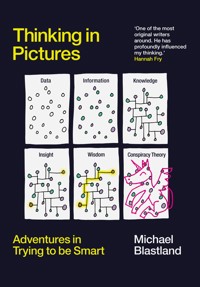
'One of the most original writers around. He has profoundly influenced my thinking.' Hannah Fry Why thinking in pictures? Short answer: because the words seem to need help. If you sample the many smart-thinking books to hit the shelves recently, they all promise a smarter, more rational you, and it all seems just pages away. But if the books are that good, why are there so many? And have they succeeded in moving the dial of people's reasoning? Using illustrations and photographs, Michael Blastland shows how pictures can help put ideas to the test, making them vivid, showing them in action. Part guide, part gallery, Thinking in Pictures is a brilliantly original and witty introduction to smart-thinking - how to use it and when to question it - for anyone trying to make sense of a puzzling world.
Sie lesen das E-Book in den Legimi-Apps auf:
Seitenzahl: 331
Veröffentlichungsjahr: 2023
Das E-Book (TTS) können Sie hören im Abo „Legimi Premium” in Legimi-Apps auf:
Ähnliche



















Also by Michael Blastland
The Hidden Half: How the World Conceals its Secrets
The Norm Chronicles:
Stories and Numbers About Danger (with David Spiegelhalter)
The Tiger That Isn’t:
Seeing the World Through Numbers (with Andrew Dilnot)
Joe: The Only Boy in the World
First published in hardback in Great Britain in 2023 by Atlantic Books, an imprint of Atlantic Books Ltd.
Copyright © Michael Blastland, 2023
The moral right of Michael Blastland to be identified as the author of this work has been asserted by him in accordance with the Copyright, Designs and Patents Act of 1988.
All rights reserved. No part of this publication may be reproduced, stored in a retrieval system, or transmitted in any form or by any means, electronic, mechanical, photocopying, recording, or otherwise, without the prior permission of both the copyright owner and the above publisher of this book.
The picture acknowledgements on p. 327 constitute an extension of this copyright page.
Every effort has been made to trace or contact all copyright holders. The publishers will be pleased to make good any omissions or rectify any mistakes brought to their attention at the earliest opportunity.
10 9 8 7 6 5 4 3 2 1
A CIP catalogue record for this book is available from the British Library.
Hardback ISBN: 978-1-83895-746-9
E-book ISBN: 978-1-83895-747-6
Printed in Great Britain
Atlantic Books
An imprint of Atlantic Books Ltd
Ormond House
26–27 Boswell Street
London
WC1N 3JZ
www.atlantic-books.co.uk
For Kitty, Cait and Katey
If I can’t picture it, I can’t understand it.
Albert Einstein
Contents
1 Why thinking in pictures?
2 Unjoin your dots
First, you
3 Un-count your sheep
Data ain’t nature
4 But count in human
Context, every time
5 Beware nature’s fake news
Chance will fool you
6 But treasure the funnies
Order tells you something; so does disorder
7 Focus, but don’t
Seeing what you’re missing
8 Draw the tiger
Own your ignorance
9 Mind your pictures
The sketchpad in the head
10 Think bad thoughts
Expecting the unexpected
11 Think twice upon a time
Stories: love them and mistrust them, both
12 Think in bets
Make peace with uncertainty
13 Don’t trust
Seek trustworthiness
14 Get a new attitude
Work your curiosity
15 Last thoughts
Read on
Notes
Acknowledgements
Image credits
Short answer: because some people see better that way. They think visually. Maybe you’re one of them.
But also for a stranger reason: because the words about thinking seem to need help.
To see what I mean, sample a few of the many hot pop-science books to hit the shelves lately which all promise a smarter, more seeing, more rational you. No need to read this list, just imagine the blaze of light:
•Rationality by Steven Pinker
•Calling Bullshit by Jevon West and Carl Bergstrom
•How to Make the World Add Up by Tim Harford
•How to Read Numbers by David Chivers and Tom Chivers
•The End of Bias by Jessica Nordell
•How to Decide by Annie Duke
•The Great Mental Models, Volume 1 by Rhiannon Beaubien and Shane Parrish
•Noise by Daniel Kahneman, Olivier Sibony and Cass Sunstein
•Anthro-Vision by Gillian Tett
•Thinking Better by Marcus du Sautoy
•Super Thinking by Gabriel Weinberg and Lauren McCann
•Emotional: The New Thinking About Feelings by Leonard Mlodinow
•The Skeptics’ Guide to the Universe by Steven Novella
•How to Think by Tom Chatfield
•Think Again by Adam Grant
•The Scout Mindset by Julia Galef
•The Irrational Ape by David Grimes
There are more – lots – plus blogs, articles, podcasts, videos and a million tweets.
How this wave of DIY cleverness grew so big, I’m not sure. It seems partly to have begun with psychological research in the 1970s on decision-making that gave new impetus and a sciencey vibe to the ancient and satisfying art of telling other people they were wrong. Then a little over a decade ago, this became a genre with a name – smart-thinking – and now there’s no end to it. See deeper, reason better, make sense of numbers, avoid bias and noise, improve decisions, spot fakery… It’s all there on the shelves or online, and it can all be yours.1
Reading a heap of these books, I thought: ‘Hmm, they’re good, mostly.’ Then, piling them on top of the others I’d racked up over the years: ‘So much smartness, so many answers.’
But something about that pile of books has also begun to bug me. So many answers, true, but still a nagging question: do they actually, like… you know… work? That’s to say, have all these books succeeded in moving the dial of people’s reasoning and understanding about the world? Or are they like the promises in glossy magazines: a new, slimmer you, every month?2
Not sure how we’d measure trends in the general savvy relative to the volume of advice, but on the one hand here’s all this rationality and truth-seeking, sometimes pitched as the one manual you need to rewire your brain, while on the other hand the world still seems angry and puzzled, maybe even at a new peak of stupid according to one smart-thinker who says we’ve grown more outraged and less reflective.3 Meanwhile, policy and business blunders seem as prolific as ever, every side says it knows but none can agree, and even science is said to be going through a replication crisis of gross un-smartness among some of the smartest, most well-trained thinkers of all.4 Why, with so much smart-thinking, isn’t there more smart-thinking? Why, if the books are that good, are there so many?
Not least, have they helped me? Sure, I’ve picked up ideas and techniques, but why after years of self-improvement am I still not a decision-making, bias-spotting, rational paragon, dammit? Getting ideas off the page somehow doesn’t seem so easy.
So I began casting around for reasons. Maybe the books/ blogs, etc., don’t work because the ideas are crap; they’re a fad, a pile-in, out to make a buck from readers craving the elixir of clever. Or maybe they do work, or work OK-ish, but they’re three-quarters hype, or preaching only to that famous small band of the converted. Or are they written by a bunch of relatively rich blokes (mainly) trying to claim reason as their own, passing it off as universal, objective and apolitical when maybe it’s no such thing? Or is it precisely because the forces of stupidity are on the rise that we’re seeing a smart fight-back? Maybe the books are vitally distinctive, every one, but this is a long, slow crawl into the light because we’re so set in our dumb ways. Maybe it really is like DIY: easy to say, ‘I’ll just fix that leak’ – in practice not so ‘just’.
Though truth be told, I was only trying to find fault with the books because I wanted to write another (gotta justify adding to the pile). Smart-thinkers call this ‘motivated reasoning’, meaning that the way I was assessing the evidence was corrupted by self-interest. Motivated reasoning is bad, they say; you fail to see things as they really are because you’re too invested in finding an answer you like. Since no one writing about thinking wants to be accused of bad thoughts, I paused, agonized… then realized I could call it ‘constructive criticism’ instead, which sounded cool, and carried on, asking, ‘What else?’ – what are the books missing? Because either they needed a ‘What else?’ or I did.
Cut to the chase: after long reflection about where the genre was going wrong, I finally concluded…
It wasn’t – probably. Not really. It had its faults (one in particular we’ll come to), and there’s hype and junk out there for sure, but many of the books were good after all, no denying. Maybe this is just a tough gig in an unforgiving world.
Ah well, no harm asking.5
This lot, shrunk, plus pics, etc.
Then around this time, one idle afternoon, I came across one of the pictures that eventually found its way into this book – and did a double-take. The picture (of a bicycle chicane on a footpath; you’ll see it on page 168) could almost have been designed to illuminate some aspect of smart-thinking out in the wild, or it could if you chose to see it that way and you’d just been reading what I had. ‘Huh, it fits!’ I thought, in my best Cinderella. ‘Picture… thousand words… whaddyaknow!’
And in that moment – pure chance – a vague idea: that maybe the books could say it better if they showed it too, with pictures; a small hope for a struggling cause.6
Thinking… but in pictures. Because pictures can make ideas vivid, less abstract, a kind of thinking incarnate. Or they can work as metaphors that offer a new way of seeing an old idea. Then there’s Einstein’s line: ‘If I can’t picture it, I can’t understand it’ (you, me, Bert… same page). So maybe pictures could bring more clarity.
We could call it ‘pic-thinking’ – like ‘quick-thinking’ – as you can often take in a picture at a glance. And not only quick, but lasting; images stick in the mind, they’re place-holders for more extensive thoughts, and the mind needs something to stick because as neurologists tell us it’s made of yoghurt.
That’s the big sell, so let’s immediately cut it down to size. We all struggle, there are no easy answers to how to think, and we’re not about to bring a new dawn of rational and respectful deliberation with a shot of a bike chicane. But given the struggle, all methods to the pump I say. If there are marginal gains to be had, let’s have them. That’s the story, anyway, and that’s how I decided to keep an eye out for pictures that I’d stick above the desk if I wanted a portrait gallery of smart-thinking.
‘Sounds like this might even fly,’ I thought for nearly ten seconds… Except then came the practicalities. Such as: who’s it for then, this picture book?
Partly for those not too steeped in smart-thinking; an intro – or maybe a refresher or stock-take – for anyone wondering what to make of the pile of books. But even the cognoscenti might be curious about the pics, and maybe about the author’s two cents, as there are opinions here, too – more on that in a minute. And anyway the problems at the simple end of knowing stuff have a curious way of being the same at the hard end, too. Or maybe the book would appeal to those, like me, curious about how to communicate ideas. While if you think it’s a gimmick, that’ll be because you’re biased and irrational and need a new picture book to set you straight. So that’s about everyone, then.
OK, next practicality: pictures of what, exactly?
Not graphs or charts. And not mind-maps or icons or any of the usual diagrammatic visualizations of ideas that you find in business school (with a couple of partial exceptions). That’s another book. And no cheesy literality – like illustrating an ‘open mind’ with a cartoon image of a tin-opened head.7
Otherwise, all sorts – old, new, drawings, photos, memes; maybe not spectacular, just hoping to be vivid and useful, and with luck the odd ‘aha!’ – meaning the choice is bound to be personal. You might see other things in these pictures, or you might see nothing relevant and wonder what the author’s been on. If you can find better – and I bet you can – do.
But that slightly ducks the question about what kind of pictures, and this is where things get serious. Bear with me here, because the real issue turns out to be this: if you want to picture an idea, you need to be clear what the idea is. What’s its essence?
Obvious, really. But that question – and the surprising difficulty in answering it – entirely shapes this book. It might also help to explain smart-thinking’s struggles. Why? Because the more you try to clarify smart-thinking, the more you realize how messy it is.
Too often while thinking about the essence of a smart-thinking idea – how to describe or picture it, if we boil it down – a small, militant voice interrupted, ‘Hang on… How reliable is this idea really? Isn’t the truth sometimes the opposite?’
Example: motivated reasoning is bad. That’s a big theme in smart-thinking. Yet some of the most profoundly good things that ever happened – name a few… female suffrage, the fight against slavery – were surely helped at times by people who grabbed any evidence that served the cause, their reasoning and judgement being fiercely motivated and their minds slammed shut (another supposed Bad Thing), and most of us would find it absurd, even offensive, to say they should have been more open. Less motivated, more open-minded – on slavery?
So, are we sure the bads are reliably bad? David Hume (eighteenth-century thinker) famously seemed to say that the bad of motivated reasoning wasn’t bad at all, it was right and proper: ‘Reason is, and ought to be the slave of the passions, and can never pretend to any other office than to serve and obey them,’ he wrote.8 And while people argue with Hume or say he didn’t mean what he seems to mean, because we can separate legitimately motivated and passionate goals and values (‘end slavery!’) from how we reason towards them (‘now, some coldly rational tactics to achieve abolition…’), you can easily find another thinker who’ll tell you that motivation and reasoning are wholly entangled at every stage and bound to be that way.9
And yet critics of motivated reasoning describe mixing up motive and reason like it’s a thought-crime. And they have a point. Sometimes we’re so motivated to find the answer we want that we’ll stampede the evidence into the dust for it. So one day motivated reasoning stinks, the next it’s OK, maybe good, another it can’t be helped. Which? When? Is it possible to use motivation – which we need – without abusing reason? In short, values, passions, motivation and reason… it’s complicated. Get into the academic thickets about whether we should idealize value-free science, for example, and you might never emerge.10
Similarly, if it’s smart to be open-minded, how open-minded must we be towards people who seem malevolent, or just wildly wrong or reek of bad faith? Or should we never assume that until we’ve talked with an open mind to every last conspiracy theorist? And if we are going to say that some things have manifest clarity, so sod this open-mind business, which, when exactly, under what terms? Sometimes, to make sense of smart-thinking, you need a good philosopher.
There are lots of cases like this and they make smart-thinking messier than it looks; not a manual of technical fixes, but a bunch of hints – some strong, many not, with limits, maybe disputed, conflicting, contextual, nuanced, often tricky to put into use, with devil in the detail. Many a smart-thinking virtue has an opposite virtue; books disagree, of course they do; ideas change. And out in the wild, essences are often elusive. And while few rules are universal – so, in a way, what do you expect? – this is much more than one or two edge cases.
The quickest parallel is with proverbs, which also deal in timeless wisdom, or claim to. ‘A stitch in time saves nine,’ says one; except another verges on the opposite: ‘Look before you leap.’
Oh, thanks, you say: fat use you are, with your wisdom of caution and wisdom of speed. Which? When? Smart-thinking can be similar. Picking its examples carefully, one book tells us – and tells us like it’s a slam-dunk – that quick, intuitive thinking is the way to go (Blink by Malcolm Gladwell11), so trust your gut (but first train it to have the right kind of speedy intuitions); another, that quick-thinking is riddled with bias and ideally you should think more slowly and reflectively (Thinking, Fast and Slow by Daniel Kahneman12). Blink v. Think, it’s been called.
But which, when? Some say we should Blink when we have sound experience to inform a snap-judgement; except that others ask how you can know if your experience is sufficient for the problem at hand unless you Think first. And while you’re mulling over that one, along comes another to say Don’t Trust your Gut, trust data,13 (though it says sometimes your gut turns out to be right). Then up pops The Economist magazine to tell us that judging when it’s right to use gut instinct will often be decided by… gut instinct.14 Er… right. Does that also mean we must first train our instincts about gut instincts? Wheels within wheels or what?
Confused? Good. Rational reaction if you ask me. The problem is it’s all these, like the proverbs. Quick-thinking can be riddled with bias. But quick-thinking – maybe using rules of thumb or trained intuition – can also be brilliantly efficient, even lifesaving, and maybe the only option for flesh-andblood humans under pressure. Unsurprisingly, experts also find the right choice of Blink and Think a puzzle.15 Some cases are easy, many are not.
Here’s another. Some smart-thinking tells us that the power of data is how it reveals the facts. True. ‘The data don’t lie’ is a phrase you hear. But other smart-thinking tells us data can be a snake-pit. Also true. Statistics can be treacherous. So there’s a balance of both ambition and hazard: using the power of data versus being used by the power of data; loving numbers for their insights or trashing them as lies, damned lies and statistics. Since no number speaks for itself, how deep must we go to know which is which, especially when many are both at the same time? Some numbers are easy to see through, many aren’t.
Likewise, we’ll see traps in reading too much into the results of chance, and in reading too little and overlooking its power to change everything; we’ll see the wonder in simplification, and the jeopardy; the genius in spotting patterns and the delusion. For example, Marcus du Sautoy writes in Thinking Better about the huge value of pattern-spotting, citing the stock market as a case in point; Nassim Taleb writes in The Black Swan about the huge risks of pattern-spotting, citing the stock market as a case in point.
You can even finish up wondering if the very exhortation to think smart or be sceptical could be double-edged and partly responsible for the current popularity of conspiracy theories, or self-anointed citizen scientists who decide after an evening online that they know more about Covid-19 than the virologists.
What this messiness tells us is that while smart-thinking ideas make sense sometimes, at other times they can easily fail or be misapplied. But the worst of it is how we can know which of those times we’re in: is this one when smart-thinking idea X rules or not? Or put it another way: smart-thinking has great answers if only we can be sure of the question. Trouble is, life doesn’t define its questions for us on our terms; it doesn’t present its problems pre-labelled to suit the fixes we already have in mind. All of which is to say that smart-thinking may be smart but, in the unforgiving noise of life, it’s often close to screw-up.
How close? Perilously close. There are two nasty facts here with implications for smart-thinking that some of it hasn’t clocked. First, even the most trained, acclaimed modern thinking has a horribly mixed track record. The replication crisis noted a few pages back has seen too many findings in science – including medicine – fail to stand up when retested (some always fail, but the level of failure has been too systematic for comfort, not something you can put down to chance). The reckoning has so far been most severe in psychology – exactly where smart-thinking science began in the 1970s. Why are the findings failing? The list is long. There’s soul-searching about everything from statistical competence in research to how experiments are designed, the quality of causal inferences drawn from data, research and publishing incentives, transparency, honesty and fraud, you name it, including a failure to self-correct efficiently. One writer-researcher – and not on the lunatic fringe, but credible and mainstream – says much of the scientific process is ‘deeply corrupted’.16
Just to point out the obvious here: this is science. This is elite smart-thinking, often highly numerate and skilled at finding things out. And it’s frequently, dangerously, unfit for purpose. Amos Tversky said: ‘Whenever there is a simple problem that most laymen fall for, there is always a slightly more sophisticated version of the same problem that experts fall for.’17 The replication crisis is the disaster movie of that quote. And by the way, some say there’s a new replication crisis on the way in artificial intelligence and machine learning.18 And while a huge amount of science is also robust and wonderful, and in the long run discovering faults should help because we can now improve how we do it, for those who say scientific method is our salvation it’s a pain, as it shows how easily smart method is corruptible, too – consciously or not. So when trying to explain why we know stuff, the answer ‘Because… science’ is often not good enough. Which is intimidating. Because if science is often not good enough, how smart do we have to be?
And just to complicate things in case they’re not already, the ideas kicking around to improve science are as much about smartening systems as individuals; about how research is organized, incentivized and published, because people in a bad system can read all the smarts they like and be no further on. Thinking is not simply a private affair.19
Second nasty fact: smart-thinking itself isn’t immune to suddenly falling into doubt long after being all the rage. Example: one breakthrough of the last decade – ‘nudge theory’ – now faces the suspicion that published research into how well it works was skewed in its favour, among other doubts.20 While this doesn’t prove it useless, it could be far less powerful than claimed, though nudgers will no doubt fight back. Another example: a whole slate of cognitive biases known as priming and stated as facts by one of the smart-thinking bibles has turned out suspect.21
Bluntly, then, smart-thinking can be disputed or even plain wrong (controversial opinion: I thought Noise, Daniel Kahneman and others’ latest, hugely acclaimed smart-thinking blockbuster half right, but basically half wrong22).
Another hitch, maybe the worst: the very idea that we can train people in general smarts is in doubt. Read this from a recent research paper and wonder if the whole enterprise is doomed:
Considerable research has been carried out in the last two decades on the putative benefits of cognitive training on cognitive function and academic achievement. Recent meta-analyses… have led to a crystal-clear conclusion: the overall effect of far transfer is null [‘far transfer’ means how well the lessons turn into general skills that people can use in new contexts; ‘null’ means nothing, zero, i.e. they don’t]… Despite these conclusions, the field has maintained an unrealistic optimism about the cognitive and academic benefits of cognitive training… We demonstrate that this optimism is due to the field neglecting the results of meta-analyses and largely ignoring the statistical explanation that apparent effects are due to a combination of sampling errors and other artifacts.23
Ouch! Not least because the claim here is that assessments of the value of cognitive training were themselves cognitively weak. Kinda funny, no? Or sad. One or two other credible verdicts are less gloomy,24 but hardly gushing; and yes, this is ‘cognitive training’, not ‘smart-thinking’, but if you think they’re different enough not to overlap, you’re overthinking.
Not for a millisecond, by the way, am I anti-science or research, or smarter thinking. The question is how to do it all better. But the trouble with that is it leads us ever deeper into wonk territory, where in science, for example, it’s about which incentives encourage better-quality research, and what analytical methods and experimental designs work best for what purposes – and that hurts even to say it. For the rest of us, this becomes an ever less-accessible, technical swamp of high-end expertise. For we wannabe writers, it’s similarly bad news: if full-blooded science struggles to think clearly, to make sense of evidence properly, to work out what’s up and how to find out, what chance pop science can do it? All of which makes you wonder if smart-thinking raises our expectations too high, raises our sense of sophistication more than the substance and just makes us smug.
Bottom line: this business often starts easy, but gets hard, fast. And yet, strangely, the books are not nearly so good at exploring their limits. If you don’t realize this early on, smart-thinking might turn you into one more arrogant jackass, except now with added jargon and more books. Sorry, did you come here for simple answers reduced to pretty pictures? Course not, you’re smarter than that.
Even so, you’re not here to be told our efforts are futile, and there’d be little point in a book like this that declared itself a waste of time. So what do we do about the messiness, and how will this book help?
The upshot for the smart-thinking ideas themselves is not that they’re necessarily wrong or useless – they can be brilliant, and sometimes simple – but we need to recognize their status as ideas, often artful as much as technical,25 often contested, vulnerable to error and revision, and use them flexibly, with humility, sensitive to context, trying to balance their inconsistent strengths and weaknesses by coming at problems from different sides, always aware of their limitations and ours.26
The upshot for this book? Mainly it left me feeling that the most pressing need in smart-thinking is to use it – but to watch it, especially to watch our expectations. Some smart-thinking has always been like this, sceptical, hesitant, warning of overconfidence, and this book shares that emphasis, maybe pushes it, with a nervous streak about smart-thinking itself.
And the upshot for the pictures? At first I wondered if the messiness might wreck the whole scheme, until it occurred to me that pictures could be pretty good at illustrating mess and ambiguity. They bring it to life, showing the tricky detail and context where the action often is. The problem is that smart-thinking can sound too clean, but when we see what it has to work on, that brings home the truth of one of my favourite book titles of all time: I Think You’ll Find it’s a Bit More Complicated Than That.27 Pictures can help us see both the ambition in smart-thinking and the potential gremlins, by showing us ideas in the wild. They too are often riffs on ‘use it, but watch it’, trying to be constructive as we attempt to bring out more of the awkward trade-offs and practical realism of seeing it how it is.
And one more point worth stressing: it’s easy to see all this as an inconvenience, a pain even. My advice is to resist that mood. It is too defeatist. If you think you like smart-thinking and not merely the reputation for it, then you should relish the act of thinking. Complication is hard, but inherently interesting. So don’t feel intimidated. Dive in.
In practice, each chapter picks a theme in smart-thinking – usually with a sceptical edge, because that’s my own bias – then adds a picture to suggest how it works in the wild, includes a few stories or examples, then throws in a few simple challenges to try to make you think again, and not just nod. You’ll find one chapter points your thinking this way, another that. Sometimes a chapter goes both ways at once. All include objections to their own main theme. And, frankly, tough. Few all-purpose basics work every time.
Have this thought tattooed somewhere: There is no royal road to truth or reason. The biggest difference between this book and some of its kind – apart from the pictures – is how itchy it is about answers, all of them, including its own. Its paradoxical message is that too many case studies in the smart-thinking lit are too neat, and this stuff is often messy, so we need simple ways to see how. The overall aim, I decided, would be to be unsettling, but not paralysing,28 to use smart-thinking while doubting it. All told, a tall order, but here goes.
Now you realize you’re not in for an easy answer, it could be tempting to turn cynic, ranting on your way out that nothing works. Not clever. Cynicism is useless and boring. If your only trick is destruction – and cynicism does nothing but knock things down – then you soon live in a ruin. And anyway cynicism is nothing like scepticism. Healthy scepticism is more like a workshop where we put competing ideas to the test – both the ideas we don’t like and the ideas we do, testing them equally – knowing that in the end they can all be flawed, but we must still make decisions.29
It’s like having dragonfly eyes, one of the best of the books says,30 seeing through many lenses at once, taking none for granted. How does a problem look using this piece of smart-thinking? Hold that. Now how about if we see it with another? OK, so which way do we fly? If there’s one metaphor that new readers could take to heart before diving in, I’d make it dragonfly eyes. You’ll hear about them often. Here’s a picture. Stick it above the desk.
Dragonfly eyes make smart-thinking as much about attitude, judgement, uncertainty and trade-offs as how to spot a cognitive bias. There’s not one easy path to the light; instead, we move towards the best trade-off we can find, making bets, arguing, using flawed evidence and imperfect strategies. Smart-thinking gives us ideas, that’s all; how to use them at any moment is our own balancing act – no book can do that for us.
The dragonfly view. From Joshua van Kleef, Richard Berry and Gert Stange, ‘Directional Selectivity in the Simple Eye of an Insect’, Journal of Neuroscience, 12 March 2008.
If anybody… by any so-called objective thinking, imagines they can conquer doubt, they are mistaken.
Søren Kierkegaard
Thinking in Pictures aims to give you a few of these ideas as memorably as it can, but adds danger signs and alternatives, then encourages you to weigh them all up. That means being sceptical of this book, too. The truth is – and don’t I know it – that it, too, could be wrong in a hundred ways. But if you want pat answers that work every time, you’re looking in not just the wrong book, but the wrong world.
I’ve also thrown in a few playful exercises and a steer into those other books, if the curiosity takes you – because the books often do say good stuff… mostly. And this is a short book that doesn’t pretend to say it all.31
So that’s it: pics, big themes from the world of smart-thinking, my two cents. You can go now, look at the pictures.32
Try this
Just as a run out, to get into the habit, take the dragonfly view to heart… and come up with a few reasons why it’s a bad steer. That’s right: argue with me.
Stop making sense. The original image (boxes 2 and 3) was by Hugh MacLeod at the design consultancy Gaping Void, who sent it to their email list, where it acquired a life of its own.
There’s a story that still bothers me from more than thirty years ago. I was a newbie reporter for a provincial newspaper when a guy came in with a haunted look and a revelation to ‘blow the lid off’ County Hall.
Social services were plotting to kill him.
‘They’re taking over my mind.’
‘Wow,’ I said, searching his face.
They were forcing him to drive into oncoming traffic; he could feel the temptation, he said, and his hands mimed a slow turn of the wheel.
First thought? ‘Sh*t! Is this guy actually on the road? He could die.’
Second thought: ‘I could die.’
Then he said: ‘The police told me I was paranoid.’
‘They did?’
‘But you’d be paranoid if someone was trying to kill you.’ … and I thought: ‘Hang on, that actually makes sense. Yes, yes, you would be paranoid if someone was trying to kill you.’ And yes, I know it’s an old joke, but I think he was sincere.
He’d joined the dots.
Joining the dots is what we say we do when we put together pieces of evidence to work out what’s up. ‘Join the dots!’ people urge, when they think we’re failing to catch on. That’s what smart people do, they join the dots.
Good. Except… even the most delusional have an internal logic based on evidence of some kind. Everyone does. Some of it really might be logical. We’re all joining the dots – you, me, my man – connecting information, looking for pattern and meaning, and when we think we’ve found it, we think we’ve found it. ‘You’re so naive,’ a guy said to my partner when she had her Covid jab. He’d joined the dots. So had she.
That should be troubling. It means, on the money or deluded, rational or not, professor or loon (or maybe both), on the inside it all feels the same. Do you trust that feeling? Why? Because you’re clever?
As we talked, my man struck me as clever. His cleverness was worse than useless. It helped him justify joining his dots. All he really knew was that the dots made sense to him. It’s all any of us knows to begin with, and it’s often not much. We’re quick to see patterns and meaning, quick to find reasons why one thing connects with another; it’s a kind of human genius, but it treads on thin ice. Once suspected, patterns real and imagined are absurdly easy for the clever to think they can confirm; once we unleash our amazing powers of reasoning, everything can be made to fit. As Richard McElreath of the Max Planck Institute once said: ‘Never rely on being clever.’1
OK, thanks for the warning, you say, but I still think I can spot a pink flying unicorn when I see one (thus instantly relying on being clever, duh!). Sure about that?
We don’t have to go the whole they’re-trying-to-killme conspiracy hog to move past the wisdom box into delusion. We do it in a thousand small ways. As the books tell you, the list of human fallibilities is long: memory can be a fantasist, perception is easily duped (see optical illusions) and, maybe worst of all, people are said to be a wandering fog of cognitive biases that distort evidence. There are dozens of these biases and the books go on about them, some are about nothing else; but just one bias makes the point, the biggest and simplest, and you might already know it: confirmation bias (closely related to ‘myside bias’). It goes a little like this: we gleefully seize evidence that confirms what we already think or want to believe, and find reasons to dismiss whatever doesn’t.
Easy to see the potential tension with truth. As one member of the rational-thinking royalty put it: ‘Of the fifty-odd biases discovered… forty-nine are cute quirks, and one is destroying civilization. This last one is confirmation bias.’ That’s a little harsh on the forty-nine, but has the priority right. The ‘destroying civilization’ line is because confirmation bias supposedly makes civil-war partisans of us all. Whatever our side, we find evidence to confirm we’re right. Next thing, we decide the other lot must be idiots or evil.2
Smart-thinkers argue about whether we’re stuck with our cognitive glitches – less Homo sapiens, more Homer Simpson, said one3 – or can learn to see past them. Let’s glide over all that and say that, right now, doesn’t matter. All we need agree at this stage is that we’re highly fallible – at perpetual risk of seeing pink unicorns – and that’s one thing most smart-thinkers do agree on, or they’d be out of a job. It’s true this only gets us so far; it doesn’t tell us what to do about our fallibility. But still, it’s a vital step. Without it, nothing jolts our tendency to self-regard – and our self-regard needs jolting daily.
This is a recurrent theme in smart-thinking: the need to give cosy presumptions a repeated kick. The books almost all say it. You see it so often it’s tedious. But that’s another danger – that we think we’re now well placed to do the kicking, we grow complacent, we know this, we’re clever, we’ve read the books…
That is, the jolt must be never-ending. Looking for a picture to give it, I chose this one because it tricks us, playing to our vanity only on further reflection to laugh at us. Did you look at the sequence of pictures – how data can be turned into knowledge, and knowledge into wisdom – and think, ‘Yeah, yeah, so true… ’ And then did you laugh at the joke in the last frame that sets apart the wise who know all this (i.e. you) from the conspiracist fools and all those other wackos – and did you smile because you know which side you’re on, being clever. And so did you congratulate yourself on being the kind of rationalist who doesn’t cross the line into the unicorn box? Well, did ya, punk?
Excellent. Because you just outed yourself as one more of the deluded. So did I, as that was my first instinct. We all like to think we’ve earned our place in the wisdom box, more or less, but we’re all liable to bias, misjudgement and complacency, meaning that we’re the joke. Told twice to begin with self-reflection – ‘unjoin your dots’, ‘first, you’ – you still looked and smirked at how this picture mocked someone else. So wrong again, sucker on your own hype, because as far as I’m concerned, it mocks you and me, and we didn’t see it. We joined the wrong dots even as we basked in joining the right ones.
On reflection, maybe my man and I were not so far apart. Maybe high-status, peer-reviewed science from august institutions published in big-name journals that turns out to be questionable is sometimes not far apart, either. Maybe smart-thinking, too.
In other words, one of the best acts of scepticism for the budding smart-thinker is to be sceptical of your own smart-thinking and reading – including this book, and all the books.
So make this picture your reminder of the often-scary proximity of wisdom and flying unicorns, rationality, irrationality, obvious and fake, logic and error; how there are dangers everywhere and one of the worst is our own ever-so-smart reasoning, but how we hate to think this means me. As a poet once said: ‘Nothing dies harder than the desire to think well of oneself.’4




