


9,99 €
Mehr erfahren.
- Herausgeber: 50Minutes.com
- Kategorie: Religion und Spiritualität
- Serie: History
- Sprache: Englisch
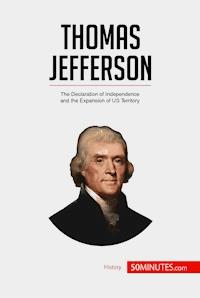
Keen to learn but short on time? Get to grips with the life of Thomas Jefferson in next to no time with this concise guide.
50Minutes.com provides a clear and engaging analysis of Thomas Jefferson. Thomas Jefferson was the third President of the United States and one of America’s founding fathers. His legacy is still visible today through the Declaration of Independence and the University of Virginia, which he founded. But his greatest achievement was one that laid the foundations for American identity; the conquest of the West.
In just 50 minutes you will:
• Learn about Thomas Jefferson’s life and his time as the third President of the United States
• Identify his involvement in the creation of the Declaration of Independence and his other great achievements
• Understand how he was responsible for doubling the size of American national territory thanks to the Louisiana Purchase and the conquest of the West
ABOUT 50MINUTES.COM | History & Culture
50MINUTES.COM will enable you to quickly understand the main events, people, conflicts and discoveries from world history that have shaped the world we live in today. Our publications present the key information on a wide variety of topics in a quick and accessible way that is guaranteed to save you time on your journey of discovery.
Das E-Book können Sie in Legimi-Apps oder einer beliebigen App lesen, die das folgende Format unterstützen:
Seitenzahl: 30
Veröffentlichungsjahr: 2017
Ähnliche










Thomas Jefferson
Key information
Born: 13 April 1743 in Albermarle County (Virginia).Died: 4 July 1826 in Monticello (Virginia).Political party: The Democratic-Republican Party.Dates of election: 17 February 18015 December 1804.Length of presidency: 8 years.Main achievements:Drafting of the Declaration of IndependenceLimiting the federal government's powersThe Louisiana PurchaseThe Lewis and Clark Expedition.Introduction
Thomas Jefferson was one of America's Founding Fathers. Like George Washington (1732-1799), under whom he served as Secretary of State between 1789 and 1795, Jefferson was a landowner hailing from Virginia. Jefferson not only contributed to the development of the Virginia state constitution, he was a talented political writer and the principal author of the Declaration of Independence.
He served as vice president under John Adams (1735-1826) before being elected as president in 1801. While his predecessors had established a federalist basis for the American system, Jefferson entrenched the institutions of power in a resolutely republican ideology.
He is also responsible for the United States' purchase of Louisiana, which doubled the size of American national territory. Furthermore, his initiatives were the first chapter of the epic tale which would come to construct the American identity, namely the conquest of the West, led by Meriwether Lewis (American soldier and explorer, 1774-1809) and William Clark (American explorer, 1770-1838). A cultivated intellectual with a thirst for knowledge, Jefferson dedicated the latter stages of his life to founding the University of Virginia.
Did you know?
The term “Founding Fathers” refers to the 56 signatories of the Declaration of Independence, including John Adams, Benjamin Franklin (American philosopher, physician and statesman, 1706-1790) and Thomas Jefferson.
Biography
Portrait of Thomas Jefferson by Mather Brown.
A privileged upbringing
Thomas Jefferson was born on 13 April 1743 in Albemarle County. His father Peter Jefferson (1708-1757) was a planter, surveyor, commander of the local militia and political actor. His mother Jane Randolph (1721-1776) hailed from a rich Virginian family. The young Thomas therefore grew up in a wealthy and respected family in a well-healed social sphere. In 1757 when he was just 14, his father died, leaving the young Thomas to inherit the plantation.
In 1760, he began attending William and Mary College, where he received a rigorous classical education, ranging from philosophy to the ancient languages - for which he had a particular passion - and from literature to science. This education was strongly influenced by Enlightenment thinking, which posits reason as the central and utmost source of authority. Jefferson then set his sights on a legal career, taking the Virginia bar in 1767. His scholarly output was more greatly appreciated by his contemporaries than his talents as an orator, and Jefferson quickly established himself in the professional and intellectual sphere. His approach to law, characterised by a more socio-political perspective, was particularly noted by those around him.
Entrance onto the political scene
In 1792 Jefferson married Martha Wayles Skelton (1748-1782), the widowed daughter of a prominent attorney. The two set up their little home in the heart of Jefferson's plantations, which he had named Monticello. He had an avid interest in architecture and took it upon himself to extend and reconstruct the building over several years. It eventually stood as a vast structure inspired by Venetian and French architecture.
Photograph of Monticello as it currently stands.
As a member of the Virginia House of Burgesses (which was to become the state General Assembly), Jefferson distinguished himself through his strong standpoint against British colonial rule. It was with this political outlook that he drafted




