


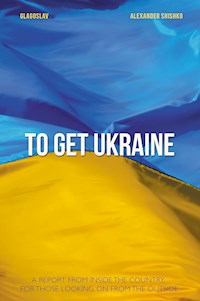
9,99 €
Mehr erfahren.
- Herausgeber: Glagoslav Publications B.V.
- Kategorie: Geisteswissenschaft
- Sprache: Englisch
Since Maidan in Kyiv and Russian presence in the Crimea, Ukraine has never been the same. In 2014, the country is deeply divided by the conflict imposed on the Ukrainians. But since nobody actually asked the nation, author Oleksandr Shyshko decided to take matters into his own hands and look for the answer to the ultimate question – who are the Ukrainians and what do they want.
Shyshko spent his time researching the national identity of native Ukrainians, and as he went he stumbled on a discovery that led to yet another question – where is Ukraine going, the so-called Quo vadis? of the Ukrainian people. His findings and critical comments gave birth to this new book that is now for the first time being published in English. To Get Ukraine.
Das E-Book können Sie in Legimi-Apps oder einer beliebigen App lesen, die das folgende Format unterstützen:
Seitenzahl: 474
Veröffentlichungsjahr: 2018
Ähnliche




















TOGETUKRAINE
AREPORT FROM INSIDE THE COUNTRY, FOR THOSE LOOKING ON FROM THE OUTSIDE
Glagoslav Publications
TO GET UKRAINE
A REPORT FROM INSIDE THE COUNTRY, FOR THOSE LOOKING ON FROM THE OUTSIDE
byOleksandr Shyshko
Translated by Huw Davies
Book created by Max Mendor
© 2014, Oleksandr Shyshko
© 2015, Glagoslav Publications, United Kingdom
Glagoslav Publications Ltd
88-90 Hatton Garden
EC1N 8PN London
United Kingdom
www.glagoslav.com
ISBN: 978-1-78437-942-1 (Ebook)
A catalogue record for this book is available from the British Library.
Glagoslav Publications neither shares nor assumes responsibility for author’s political and other views and opinions as expressed in or interpreted from this book.
This book is in copyright. No part of this publication may be reproduced, stored in a retrieval system or transmitted in any form or by any means without the prior permission in writing of the publisher, nor be otherwise circulated in any form of binding or cover other than that in which it is published without a similar condition, including this condition, being imposed on the subsequent purchaser.
Foreword by the author
I would like to stress that all the views set out in this book are my own personal opinions. Plenty of my compatriots would disagree with some of them. Yet I also know that many of them share my assessments of the events and processes taking place.
There will no doubt be some who will feel entitled to express stronger opinions, giving vent to more radical and aggressive views, evaluating facts from the past and the present day and passing judgment, in an uncompromising way, on aspects of society, saying who is in the right and who is in the wrong, and ‘judging’ the public figures of the past and the present.
One thing is certain: I am not going to foist my opinion on readers, nor am I willing to get dragged into arguments. I am going to set out my own personal opinion about my country, its past and its present, and it is for you to decide for yourself to what extent it coincides with your own personal impressions of Ukraine.
I have taken the step of offering my vision to readers from other countries for a number of reasons.
Firstly, I am getting on a bit now, and I have spent most of my life in this country; I love it, and genuinely think of myself as a Ukrainian. My narrative is thus a report by a Ukrainian, for people from other countries.
Secondly, unlike many of my fellow citizens, I have driven all over the country in my time, and have even covered quite a bit of it on foot. I have been to all of Ukraine’s big cities, as well as dozens of small towns, villages and hamlets. In the past I used to make these trips on business, but nowadays I tend mostly to travel as a tourist. So I am fairly knowledgeable not only about my home and my hometown, but also about the country as a whole.
Thirdly, I have had occasion to spend time in other countries. In my time I have visited New York, Miami, Vienna, London, Istanbul, Amsterdam, Bremen, Belgrade, Budapest, the Canary Islands, Hawaii, the Seychelles…the list goes on. This was simply the way my life panned out: my business affairs and a natural sense of curiosity led me to visit various parts of the world and gave me an insight into the way various peoples live. I am therefore aware of the things my country has in common with these other countries, and the ways in which it differs from them.
Fourthly, when I was younger I used to attend lectures alongside Arabs, Vietnamese, Nigerians, Ethiopians, Bulgarians, Czechs and Cubans. In later years I had occasion to work with people from America, the United Kingdom, Australia, Hungary, France, Switzerland, India, Pakistan and Japan.
I would like to think that I have managed, to a certain extent, to grasp the differences in mentality between these various nations, and to form an awareness of specific aspects of the way in which the Ukrainian people interpret the world around them.
The fifth reason is that I spent the first part of my life in Soviet Ukraine, when my country was one of the many nations incorporated into the Soviet Union, and the second part in the independent Ukraine which came into being in 1991, when the state of ‘Ukraine’, like a phoenix from the flames, was reborn once again. I say ‘once again’ because for many centuries, attempts to assert Ukrainian statehood had met with failure, in spite of the efforts and sacrifices made by Ukrainian patriots.
I therefore decided to reflect upon what happened in the past and what is happening now, and to have a think about where the country known as ‘Ukraine’ is headed. People aged under 30 find it hard to do this: their worldview was formed in a new era.
People approaching the age of eighty are unable to talk about such issues calmly. Just think about it: a little over 20 years ago, when a fundamental shift in the socio-economic order in the country occurred, their careers were already coming to an end, and they were looking forward to a quiet retirement surrounded by the beaming faces of their grandchildren.
And suddenly all that was turned upside down…
The mighty Soviet empire came crashing down, and Ukraine became an independent state. But was this something to be welcomed by the elderly, who in an instant lost everything they had saved up over the course of decades of life and work? They felt oppressed, as though the ancient Chinese curse, “May you live in a time of change!” had been put on them.
And here I am, right in between these two generations. I am glad that I lived to see the day when information is available that has not been put through ideological filters. After all, the younger generation – and this is quite natural – is not in a position to be able to comprehend just how drastically things have changed, and how deep the impact of these changes has been. But I can recall a great deal, I find it easy to reflect on it, and I do not seek to thrust my opinion on readers, it is for you to form your own conclusions…
I am going to attempt to draw a small ethnographic, historical, economic and cultural portrait of my native land. I have heard many times what people from other countries think of us. Can I now tell you how we see ourselves, and give you ‘an insider’s view’?
It may be that some readers will begin to think more highly of us after reading my book. After all, we are all neighbours, when it comes down to it. You can fly right round the world these days in a day or even an hour, depending on your chosen method of transport. It’s nice to be able to see for yourself that your neighbours are a good lot.
If there are readers who end up feeling disillusioned, so be it. This book is in no way intended as a brochure, nor is it a tourist guidebook which wants to say: “Come and visit us and give us some of your money.” Those who wish to do business with us must be given an opportunity to achieve greater success in their business affairs by gaining a better understanding of their Ukrainian partners. And those who, after reading this book, refuse to have anything to do with Ukraine whatsoever, ought to thank me for saving them a good deal of unpleasantness.
In my narrative I sometimes refer to people whose names will mean nothing to you. Some of them are long-forgotten here, too. The collective memory of every nation holds onto images of great leaders, generals and heroes whose names mean nothing to the rest of the world, but who are extremely significant to that particular people. To relate the country’s history without mentioning these names would result in a dry and formal narrative, which would lack authenticity. It is beside the point that all the historical figures of note have long since been rated and ranked in order by their descendants. The descendants always seem incredibly sure about which historical figures were in the right and which were in the wrong.
Let us not protest that the history of human civilization has been one continuous battle, in which everyone is pitted against everyone else. At any given moment there will be someone who is the victor and someone who is on the losing side. History is always written by the victors. But the victor is different every time, and therefore history is rewritten once again – is this not the way it works in your countries too?
I have therefore tried to steer clear of long-held clichés when forming judgments about our Ukrainian heroes. You won’t find any reference to the opinions of established authors on this subject in my book, either: I decided for myself which names to mention, which ones to omit, and how to evaluate them. Any similarities between my judgments and those commonly held are therefore purely coincidental.
Why are we required to provide proof that we exist?
I must say it feels strange to be starting to tell the story of the Ukrainian people with an explanation of the fact that we are, indeed, a nation.
The Ukrainian people have an ancient history, a culture dating back to primordial times, an authentic language and, as many would assert, a distinct national character. Over the course of many centuries, however, the territory of present-day Ukraine, either in full or in part, has been incorporated into several empires, and on each occasion those running the empire have attempted to integrate the local population into their system of values, and destroy Ukrainians’ sense of their own national identity.
Their efforts led to a situation in which a nation of many millions, living on a vast area of land, became almost invisible. It is enough to make one wonder how we managed to preserve our authenticity and our collective historical memory.
To this day many people in Europe and North America describe anyone who lives beyond the eastern border of the EU as Russian. The term ‘Ukrainians’ is not one with which the average man in the street, as opposed to politicians or historians, is overly familiar.
I have even grown accustomed to the fact that a large number of the foreigners I know do not think of Ukrainians as a separate nation, and were unaware of the existence of the Ukrainian language. It is hardly surprising: over the course of the last three centuries, when the territory of Ukraine formed part of the Russian empire, and throughout seventy years of Soviet rule (with Moscow the centre of power, again), a colossal ideological, financial, propaganda-spreading and penal machine was in operation, the objective of which was to crush the Ukrainians’ awareness of their own national identity.
I am minded of a good friend of mine from Moscow. Thirty years ago he tried to convince me, in all seriousness, that the Ukrainian language was dying out, and disappearing, and that before long everyone would be speaking Russian. There would be no distinct nationalities, either, just a single, unified people.
This, as it happens, was the official policy in the USSR: to establish a new historical community, the ‘unified Soviet people’, whose members would all converse in the same language – and Russian had been chosen as this language. I was brought up in the Soviet ideological environment, and this policy appealed to me greatly. It made the state in which I lived at the time seem limitless, from Brest in the West to Khabarovsk in the East, from the Baltic Sea to the Tian Shan mountain range. It was comforting to think that you were a tiny part of such a mighty phenomenon.
Be that as it may, the Ukrainian roots deep within my soul forced me, committed Komsomol member as I was, to object to what my friend back then in Moscow said: “What do you mean, the Ukrainian language will disappear? We teach children in our schools in Ukrainian, we have huge areas where Ukrainian is not just the only language people speak: they think in it, too, we have our own Ukrainian literature, both classic and modern. I enjoy reading books written in Ukrainian myself, given that I’m bilingual, and take pleasure in hearing the language, with its luscious sounds, precision and melodic tone.”
What one must understand is that the official Soviet ideology sought to water down the Ukrainian people’s self-recognition by citing the shared past of these two peoples – the Russians and the Ukrainians. The idea was put about that Russians and Ukrainians share the same roots, that they are brother-peoples who were torn asunder by a whim of history, but then reunited once again. The Russians were of course portrayed as the more senior, and the Ukrainians as the younger of the two peoples.
I’m afraid my Russian friend may not have too many positive things to say about Ukraine today. It is always hurtful when events unfold in completely the opposite way to the one you forecasted.
In the last 20 years a different historical narrative has become accessible to Ukrainians, one that has not been dissected by the official imperial historians, but is founded on evidence and documents which were previously subject to a ban on being freely studied. It has suddenly emerged that Ukrainians and Russians are not the same, and are far from being brothers: there is reason to believe that they are not even particularly closely related, but are simply neighbours, who have had very different attitudes towards one another throughout history.1
In 1991 it became clear that the Communists had failed to form a single people. When the USSR collapsed, the economic disparities and political ambitions of the regional leaders caused a whole series of conflicts and wars between countries whose citizens had until recently referred to one another as ‘brother-peoples’. Nationalist tensions began to ferment, and bones of contention going back a hundred years were recalled. One must not forget, either, the ‘assistance’ provided by foreign states, which had an interest in stepping up their influence in the former Soviet republics.
Interestingly, the formal liquidation of the Soviet Union took place by a mutual decision by the leaders of Russia, Ukraine and Belarus. As for whether they were driven, at that moment, by an awareness of the historical inevitability that the Communist empire would disintegrate, or by personal ambition, and the desire to become a head of state – head of a small state, admittedly, but one that would be their own – is for history to decide. The die was cast, and the process of political delimitation had begun. Above all, however, the process of the dividing up of the single economic complex of a vast country had begun, and this was to have devastating consequences for the people.
I can well understand where the Russians – or rather, the Russian citizens of the Russian Federation – are coming from. It is one thing for us Ukrainians to feel that we have found independence from an empire; it is quite another for the central nation in that empire to come to terms with the fact that it has lost its spheres of influence, and that its former vassals want to negotiate with it on an equal footing. This is quite distressing for people who have always seen themselves as the more senior, more important partner, and looked on the others as younger and in need of wise guidance.
And I know that such feelings can be attributed not only to the effect of the official Russian propaganda machine, which inflates them out of all proportion, creating the notion of the ‘ungrateful’ Ukrainians. This reaction is as natural as the reaction of people living in a metropolis to declarations of independence by its colonies. It is not as if European nations need to be told about this. There have been ample occasions in the history of the European countries when they have experienced precisely this feeling.
We, on the other hand – the Ukrainian people – are obliged to begin our story by identifying ourselves, and by explaining we ought not to be lumped together with other nations. What are we to do? To a large extent, Ukrainians themselves are to blame for the fact that their national identity has become so blurred.
The Ukrainian people have had so many opportunities throughout history to assert and strengthen their statehood. They have another such opportunity now.
In the past, the failures of the national project were rooted not only in the aggression of the country’s neighbours, but in the lack of outstanding and lasting national leaders, and in the people’s inability to put to one side local, regional, narrow interests, to forget insults, both real and imagined, suffered by their ancestors, and to advance, on the basis of the common idea of national independence and territorial integrity.
We shall see how things work out on this occasion.
Who are the Ukrainian people?
I do not intend to begin an academic debate about the origins of the Ukrainian people, the sources of Ukrainian statehood or the process of forming a Ukrainian national and literary language. I shall merely set out my understanding of these phenomena, which is founded on a study of many official and less official sources. It may be that some readers will seek to put their own interpretation on the facts I am going to set out – and they are entitled to do so.
Today’s political leaders love to cite incidents from history in order to back up their theories. Often, though, their wilful interpretation of historical facts has a pragmatic, utilitarian objective.
I would not feel the need to venture into historical episodes, were it not for the attempts by the leaders of neighbouring states to justify their present-day political ambitions by citing history, and coming up with statements such as: “this territory belongs to us by rights,” or “these regions were historically part of our state”. It is easy to understand the desires they have: the land is incredibly good land, fertile and offering very thick soil; it is in a favourable geographical location, and deep rivers run across the country from north to south; it has a moderate, temperate climate, with no tornadoes or earthquakes to worry about, and it has both low mountains and useful minerals. And in the modern world, the fact that it has infrastructure, industry, a well-qualified workforce and a high level of education among the population, it makes perfect sense to try to convince Ukraine to join all manner of unions and associations – preferably to such an extent that it loses its sovereignty altogether.
Before we once again get lost in a tangle of political and historical intrigues, let us first establish what we mean when we refer to the Ukrainian people.
There can be no doubting the fact that we are Europeans. In any event, of the five points in four different countries which lay claim to the title of ‘The geographical centre of Europe’, two are located on Ukrainian soil. Our history was bound up in the history of the other European countries, this land and this people have been part of empire after empire, have enjoyed independence and statehood for a short period (in the historical sense) and then fallen once again into the clutches of its more powerful neighbours.
Since ancient times, Ukrainians have lived in the central and eastern part of European territory, adjoining two seas – the Black Sea and the Azov. The kernel of the ethnic territory of the Ukrainian people has always been situated inside the territory of Ukraine itself.
Let us not join in with the various Ukrainian historians and enthusiasts who have estimated that there have been 80 different states on the territory of Ukraine in…12,000 years. It begins to look a little bit made up.
All the same, which civilizations can we find traces of on this land?
There are some signs that the Cimmerians (remember Conan the Barbarian? He was a Cimmerian) may have lived on this land 2500 years ago. They were followed by the Skiffs, the Goths, the Huns and the Sarmates…
And then at last these lands were settled by the Veneti, the Antes and the Sclavines – these were the names given by Byzantine authors to people from the tribes which were later given the name of ‘Slavs’. This supposedly took place in the 5th century AD, i.e. some 1600 years ago. The Slavic race is considered to have originated in the north-western areas of present-day Ukraine. The Slavs were of course divided into tribes, each with its own name. One of them, for example, is known in Russian as the polyane, and this name no doubt came from the word for field, polye.
The Polyane tribes were founded at the site of the capital of Ukraine – the city of Kiev. According to various experts, the city was founded at some point in the 5th to 7th centuries AD. It was a very good site from a strategic point of view, being at higher altitude than the surrounding area, on the banks of a broad river, the Dnieper, with its abundant waters. According to legends written down many centuries later, the city was founded by three brothers, the leaders Kiy, Shchek and Khoriv, with the city getting its name from the eldest of these three. This is the story told to tourists visiting the city, and several hills and streets in the city are to this day named after the middle brother and the youngest brother; there is also a stream in the city named after their sister, ‘Lybid’ (meaning Swan), which was once abundant with water but has now run dry and is hidden away inside a sewer.
Alternative accounts, which do not have quite the same legendary status, but which are cited in the written sources, indicate that Kiev was ruled by the commanders of Varangian brigades. As many of my readers will be aware, the Varangians were bandits from Scandinavia, who seized power over the Slavic peoples and laid the foundations for statehood on their land.2
The ‘Scandinavian’ hypothesis is not particularly convincing, however.
The Slavs had in fact invited the Varangian leaders to govern them, so they were probably very similar to the Slavs in terms of their language, culture and outer appearance. It is very doubtful that Rurik, who was invited by the northern Slavs and the Finno-Ugric peoples to govern them and to defend their land from attacks by their neighbours, was descended from the Scandinavians – a people with a completely different language and culture and different gods.
The most likely theory is that the Varangians were descended from the Slavic peoples of the Obotrites, who lived on the banks of the Baltic Sea (which was then known as the Varangian Sea), who were skilled and warrior-like, and were adept at seafaring. They lived more by war than by peaceful labours, and were therefore better warriors and had better weapons than their enemies. They plundered enemy territory and protected their own kind. The people working the land, who had founded a settlement at the site of present-day Kiev, were certainly in need of such protection.
Among the rulers of Kiev who are often evoked are the Varangian Askold and the warrior Rurik. Prince Oleg, a relative of Rurik’s who killed Askold, and Rurik’s son Igor, who ruled Kiev after Oleg, were also Varangians – of that there is no doubt.
And what of their descendants? Often we find among their number some outstanding leaders, and occasionally some who were not particularly successful or capable. Under their guidance the city grew larger and stronger, then collapsed and grew weak; by turns it was a capital city then a province. They invaded neighbouring states, established diplomatic relations with them and married the daughters of Byzantine emperors, Scandinavian kings and Huns from nomadic tribes (Cumans). In a word, the DNA of the local aristocracy consisted of an extremely diverse range of material.
Take Prince Yaroslav, for example, who ruled Kiev between 1016 and 1054. Yaroslav himself was married to the daughter of a Swedish king; one of his daughters, Anna, married the Henry I, King of France, and the other married Andrei I, King of Hungary; his sister Maria married the Polish king Casimir I; and his son married a Byzantine princess. Kiev’s rulers were eager to intermarry with powerful ruling dynasties from neighbouring states, and the latter were no less eager, for their part, to establish ties with the powerful state on the banks of the Dnieper.
These lands were known as Rus, and chroniclers from other areas referred to the people who lived on them variously as Rusins, Rutens or Roksolans. It is very unlikely they thought of themselves as a fully-formed ethnic group, or that they identified themselves as belonging to a particular tribe, region or principality. The area was surrounded by Lithuania to the north, Poland to the west, Muscovy to the east and, to the south, the Wild steppes and some nomadic tribes.
Since Kiev was seen as the most important city in Rus, and its ruler – the prince – was known as the ‘Grand Prince’, the city was at the centre of intense conflicts between the Rurikoviches themselves. As a result, the city was burned to the ground several times and its people were massacred, and the competing grandsons and great-grandsons of the great Kievan princes departed for the north-west and founded new cities, new fortresses and new duchies. It was in this manner, for example, that the Grand Duchy of Moscow came into being – a duchy which was at loggerheads with the duchy of Kiev practically from the very outset. The people of the Duchy of Moscow bore no relation to the Slavs from an ethnic point of view – most of them were descended from Urgo-Finnish tribes – but their conflicts with the Duchy of Kiev were not inter-ethnic ones. All of the princes fought each other for power and for territory which they would be able to tax. This was known as ‘feudal fragmentation’, and is something you will have read about in your history books.
Eventually, the princes and the population of Rus, who would one day become the Ukrainian people, preoccupied as they were with internecine warfare, proved unable to resist an invasion by nomadic tribes from the East, led by the grandson of Ghengis Khan, Batu Khan. Their invasion in 1240 found Kiev without a prince and without an army. By then, the former capital of the Great Dukedom was already ruled by Danila Galitsky, whose court was six hundred kilometres west of Kiev. The people of Kiev tried to defend the city against the Mongols but were defeated, and Kiev was razed to the ground once again.
In a manuscript housed at the Gustinsky monastery (in the Chernigov Region, 160 km from Kiev), a historian refers to the warlike nature of the ‘rusian’ people, which had led to infighting, and to the fact that great troubles were brought to the ‘Russian land’ from Poland, Lithuania and Moscow: “Since it first came into being, our Rusian people has always had to do battle, and began by mastering the art of weaponry, and then, at the time of the duchies, this warlike people waged war unceasingly, either with the peoples surrounding it – the Greeks, the Polovtians or the Pechenegs – or, failing that, with one another.
And this continued until the Tatar Tsar Baty (that was the name given to Batu Khan in Rus) laid waste to our land, and great damage was done by the Liakhs, Lithuania and Moscow, and by the infighting.”
The origins of the name Ukraine
In ancient times, a substantial part of the territory we now know as the Ukrainian state was called ‘Rus’, or the ‘Rusian land’. One often sees the names ‘White Rus’, ‘Black Rus’ and ‘Red Rus’ on maps from those times. So where did the word ‘Ukraine’ come from?
The similarity between Ukraine and the Russian word okraina, meaning a place removed from the centre, has prompted a handful of jingoistic Russian historians to come up with the theory that the name ‘Ukraine’ stands for a place which is on the outskirts by comparison with the central, Muscovite land.
This is pure fantasy, of course. When the word ‘Ukraine’ was first used, there were not yet any traces of even a small Duchy of Moscow, and Russia’s future capital, Moscow, was a border outpost for Kievan princes at the edge of Ukraine. These lands were known as Rus right up until the mid-16th century, as countless documents and manuscripts testify. The word ‘Ukraine’ dates back to the 12th century, however, and simply meant ‘country’. The oldest of all the documents containing the word ‘Ukraine’ is the so-called Hypatian Codex (a copy of an ancient manuscript found at the Ipatiev Monastery outside Kostroma). The manuscript tells of the heroic death of the Prince of Pereyaslavl3, Vladimir Glebovich, in 1187, reporting: “Ukraine grieved for him very much.”
The term ‘Ukraine’ was well-known in European countries, too. Levassaire de Beauplan, who served in the Polish-Lithuanian Commonwealth from 1630 to 1647, refers, in his work ‘A description of Ukraine’, to a Ukrainian territory, “which lies between the borders of Muscovy and Transylvania.” The traditional names Rus and Rusian lands continued to be used to describe the Ukrainian lands which were part of the Polish-Lithuanian Commonwealth.
Russian Imperial historians later coined the term velikoross (i.e. veliky russky, meaning ‘great Russian’) to describe the people of the state of Moscow, and maloross (i.e. Russian as well, but ‘little’, ‘junior’) – to describe the people of Ukraine.
It was for this reason that our people began to go by the name of Ukrainians – so as to avoid being ‘little Russians’: after all, the epithet ‘Russians’ had already been appropriated by a different people.
Rus, Muscovy and Ukraine
Disputes over the origins of 800-year-old words still give rise to fresh offence and accusations today. When jingoistic nationalists in modern-day Russia start spouting ideas about Ukraine being the okraina – the area on the fringes, the part which was broken off and which is home to the lost younger brothers of the great Russian people, the swift response they get are snide and well-directed remarks to the effect that the ethnonym ‘Russian’ is a ‘stolen’ name, and that the core component of the people who lived in the muscovite lands were of Urgo-Finnish descent, rather than being Slavs. As for the population of the territory which eventually came to be known as Moscow, Muscovy, the manuscripts tell us that they were not Slavs and that this was not Rus, but that other peoples lived here, who had to pay a levy to Rus: the Chud, Merya, Ves, Muroma and Cheremis peoples; and that the lands of Suzdal, Vladimir and Rostov, which eventually came to be known as Muscovite land, were never referred to as Rus and were not considered to be Rus.4
Russia has roughly the same attitude in respect of the historic and cultural legacy of Kievan Rus as the one adopted in relation to the legacy of the Roman Empire by its former colony, Romania.
We are living in the 21st century, though.
To focus the debate on the issue of which people inherited the legacy of the south-western part of the Eastern European flatlands in the time of the Duchies of Kiev, Chernigov and Pereslavl a thousand years ago is tantamount to arguing about whether the French are descended from the Franks, or the people of Germany from the Germanic tribes.
The author is well aware that the multi-ethnic Russian Federation is currently one of the biggest states in the world, that it has a huge say on the fate of the world, and that the world is obliged, whether it likes it or not, to listen to what it says. We are linked to the population of our northern neighbour by a huge number of financial ties and blood-ties. Had the Russian leaders exhibited a little less imperial ambition, Ukraine would be more than happy to work with Russia, in true neighbourly fashion. The constant attempts to put Ukraine back inside the womb of the Russian Empire have led to a situation today when Ukrainians say to themselves: “The Russians aren’t our brothers.”
Ukraine, it must be acknowledged, has not yet identified once and for all the route it must follow, is experiencing serious economic hardship and is not coping all that well with the challenges of the modern world. But we are not Russia and Moscow is not our capital. What’s more, we have accumulated plenty of grudges against the Kremlin’s power over the course of history, and the more Russia strives to bring the Ukrainians back under their guardianship, the more we call these grudges to mind.
Let us return, though, to the 13th century. The cavalry of Batu-Khan, after reaching the Andriatic Sea during a seven-year military campaign, returned to its native steppes. The north-western duchies, which were ruled by the descendants of Rurik, were not included within the nomads’ state, which was known as Ulus Dzhuchi, but served as a base for the acquisition of material wealth in the form of a levy collected on a regular basis. In some cases, moreover, their princes chose instead to become allies of the nomads.
The famous 13th century warrior Alexander Nevsky, who fought the Swedes, the Livonians and the Teuton knights, put in a great deal of diplomatic effort to strengthen ties with the rulers of Ulus Dzhuchi, and called on their military support on several occasions in order to restore order over his subjects, including his own sons, who were trying to organize the resistance against the Golden Horde. As a result he was canonized by the Russian Orthodox Church.5
Paradoxically, the invasion by the hordes from the east brought an end to the infighting which had sapped the strength from the north-western duchies of Suzdal, Vladimir, Tver, Kostroma, among others. The unifying centre of these lands was the duchy of Moscow, whose rulers proved to be more talented, far-sighted and cunning than the others.
Ultimately, the fall of the Mongol Empire, and the defeat of the army of Tokhtamysh the Hun, the ruler of the Golden Horde, by Timur, the conqueror from Central Asia, and the resistance put up by the defeated peoples, including the people of the Great Duchy of Moscow, meant the beginning of the end for the Golden Horde, and its eventual disappearance.
And in the 16th century it was not the dukes of Moscow and Vladimir who were requesting the reins of power from the Huns of the Golden Horde; rather, a direct descendant of Ghenghis Khan, Sain-Bulat, agreed to serve the Russian Tsar, converted to the Christian faith, married a Russian countess and, for an 11-month period in 1575-1576, bore the title Grand Duke of Moscow named Simeon Bekbulatovich.
The Golden Horde’s State was destroyed, but the Turkic peoples residing on its territory (Bulgarians, Mari, Tatars and so on from the Volga region) were still very much there. The Europeans described all the peoples living to the east of the duchy of Moscow as Tatars, and it was towards the east that the duchy of Moscow, whilst it was growing stronger and flourishing, directed most of its efforts as regards conquering new land. The ‘Tatars’ therefore became no more than component parts of the population of an ever-expanding kingdom with Moscow at its centre, which, over time, started to become known as Russia.
The territory which was later to become Ukraine was laid waste to by Batu Khan’s invasions. The Horde controlled land to the south of Kiev and to the east and west, as far as the Dunai. Its core population consisted of the Kipchak (also known as the Cumans). It is beyond doubt that over the following centuries, in the post-Horde period, this population was involved in the formation of the Ukrainian genotype. The duchy of Kiev probably existed in name only. Prince Alexander Nevsky, who was referred to above, bore the title of Grand Duke of Kiev from 1249 to 1263, but who was much bothered about a city that had been destroyed and burnt to the ground?
The only duchy which was still going in the Ukrainian territory at the time was the Galitsko-Volyn duchy, under the leadership of the most wise ruler Danila I Galitsky. An ancestor of Rurik, who had become a fully-fledged duke at just 10 years of age, this outstanding politician and military leader built up, developed and defended his state. He received permission from the Roman Catholic Pope to be known as the King of Rus. At one time his territory stretched along the Dnieper and Dunai rivers and across the Carpathians, which made it the biggest state in Europe at the time. Danilo resisted Mongol expansion with varying degrees of success, but managed to save his kingdom from destruction.
His son, Lev, ruled for another 32 years, although to do so he had to form an alliance with the Golden Horde and do battle against Lithuania, Poland and Hungary. For 30 years, Lev Danilovich was, among other things, the Grand Duke of Kiev, though this was of course with the blessing of the Huns from the Horde.
Their ancestors, however, were unable to preserve the achievements of their forefathers.
In the 14th – 16th centuries, most of the Ukrainian lands were annexed by the duchy of Lithuania, and after the signing in 1569 of the so-called Lyublinsk Union, the Polish eagle, spreading its wings, formed an alliance with the Lithuanian State called the Rzeczpospolita (the Polish-Lithuanian Commonwealth), which incorporated modern-day Ukraine within its borders, and got caught up in a lengthy confrontation with the state of Moscow. This confrontation ultimately ended with the victory of the Russian empire, and to Ukraine being annexed to the victors’ territory. There were still two hundred years to go before that happened, however.
In the meantime, the Ukrainian and Polish peoples began to co-exist within a single state. These centuries of co-existence were characterised by common battles against the Ottomans, the Tatars and Moscow. It must be said, however, that the history of these two co-existing peoples – the Ukrainians and the Poles – over several centuries included not only examples of cooperation, but also periods of irreconcilable national and religious enmity, which led to there being countless victims on both sides.
Who stopped us from forming an alliance with Poland?
A fateful role on the historical fate of the Ukrainian and Polish peoples was played by the political ambitions of rulers acting from the outside. Poland was one hundred percent a catholic country. The Vatican had set the Polish crown the task of ensuring that Catholicism flourished in the east. In the Ukrainian territories this mission was put into effect by all possible means. People who were not members of the Catholic Church were considered inferior to Catholics, and suffered all kinds of persecution – not only the lower classes and peasantry but also the wealthy and military classes.
The Ukrainian people (who at that time called themselves ‘rusins’, from the word Rus), were adherents of the Greco-Byzantine, orthodox faith, unlike the population of the Rzeczpospolita.
Among the leaders of the Rzeczpospolita there were a fair few cold-blooded, clear-headed sorts individuals who suggested that Catholics and those of the Orthodox faith should be put on an equal footing, and that the Rzeczpospolita of two peoples (to give it its full title) be turned into a Rzeczpospolita of three peoples6.
The arrogance of the so-called Polish military and aristocratic class (the so-called ‘gentry’) and a stubborn desire not to recognize the Rusin (Ukrainian) gentry as an equal, coupled with the strong differences as regards religion (the attempts to enforce Catholicism on the Orthodox population of the Ukrainian lands) led, ultimately, to a civil war in the mid-17th century, and to the breaking off of a sizeable part of the land populated by the Ukrainians from the Rzeczpospolita.
The state of Muscovy had become attractive in the eyes of both ordinary Ukrainian peasants and Cossacks, and the Cossack officers, due to the orthodox religion which held sway there. And when the Cossack state, which had come into being during the insurrection in 1648-1654 in Ukraine’s Left-bank area, became a protectorate of Moscow, the Ukrainians acquired not only allies who shared the same faith as them, but also equal rights. The senior Cossack leaders were given the same rights as the nobility. This came to embody its eternal desire to be given confirmation of its achievements, of its standing; to achieve what the Polish crown had refused to give it. It is not surprising, therefore, that the Ukrainians evinced plenty of signs of loyalty to the Russian empire.
The Cossacks
It should be noted that the Rzeczpospolita recognized the special nature of the Ukrainian lands, and that a specific state was formed on this territory: the so-called Hetmanshchina, ruled over by the most senior military commander, the Hetman. The fact that its special status was recognized was due in large part to an attempt by the Polish crown to turn the Ukrainian lands into a buffer zone, to protect Polish territories from incursions by the Ottoman Empire.
The first Hetman was of course a Pole – Predslav Lyantskoronsky.
And it was this Pole who enabled a class of people to be established in Ukrainian land that became, and remains to this day, a symbol of our people, our freedom and our sense of identity: the Cossacks.
One of the chroniclers writes: “King Sigismund I the Old despatched Lyantskoronsky to Ukraine to gather some men, and along with these men he made a very successful attack against the Tatars and the Turks. And then this warlike people began to call itself ‘Cossacks’ and began venturing into the Tatar lands on its own.
The Cossacks selected a military leader from among their own number, “in accordance with their ancient custom”, spent their summers in Zaporozhye7 and catch fish, which they leave to dry in the sun, “and then in winter they disperse and go back to their own cities,” i.e. in winter they return home to Ukraine, and “in summer they meet up again” in Zaporozhye.
This manuscript pertained to the year 1516.
The term ‘Cossack’ had existed long before this date, of course. Cossacks were men, of course; they were free, naturally; and they were always armed. What options were open to a free, armed man at that time? He could either become a mercenary, a security guard or a highwayman. The Cossacks were all three of these things.
The Cossack brigades were very much a mixed bag: they might include both Slavs-Rusins, and Turkic nomads. If one’s looking for a group that paid no heed to ethnic origins, the Cossacks certainly tick that box! The only condition for joining the Cossack brotherhood was to adopt the Orthodox faith.
When it came to transforming them into a powerful and well-organized military force, however, equipped with guns which were very advanced by the standards of the day, key roles were played by both the Polish Hetman, Lyantskoronsky, and the Lithuanian prince and Kosh chieftain Dashkevich, who had enlisted to serve the Polish king.
In 1550 the Polish king appointed the rusin Dmitry Vishnevetsky – the son of a nobleman from Volinsky – as praepostor (i.e. ruler) in the Cherkassian and Kanevsky territories (a huge expanse in the centre of Ukraine). Vishnevetsky assembled a large force of Cossacks and in 1552, after leaving the area, they boarded ships and set off for the island of Khortytsia.8 There, using his own money, Vishnevetsky built a wood-and-earth castle, which historians consider to be the prototype for the Zaporozhian Sich – an autonomous Cossack settlement, a military order of a kind, which served as both sword and shield for the Rzeczpospolita along its south-eastern borders.9
Soon the “father of Ukrainian Cossackhood” began to construct an entire city on the island, surrounding it with moats and erecting ramparts around it. When the Sech was built, the Cossacks built columns made of oak for the walls and towers along the tops of the ramparts.
Vishnevetsky was elected Hetman by the Cossacks and sent letters to the King of Poland, Sigismund, and to Tsar Ivan the Terrible in Moscow, requesting their help in his great invasion of the Crimea. The Crimea was at that time inhabited by Tatars. The Crimean Khanate was a subject of the Ottoman rulers, and warriors from the Crimea had for centuries committed incursions into lands settled by the Ukrainians, in order to plunder them and capture people for use as slaves. Neither the Polish ruler nor the ruler of Moscow came to the aid of the Ukrainian hetman, however. Nevertheless, in 1556 the Hetman made his attack on Ochakov and, by laying waste to the surrounding area, managed to rescue a considerable number of prisoners. This feat was followed by many other victories. Under Vishnevetsky’s leadership, the Cossacks captured all of the steppes, from the Bug right up as far as the Don.
Ukraine’s first attempt to gain independence
By a twist of fate, Dmitry Vishnevetsky’s grandson, Ieremiah, was the main opponent to the much-celebrated leader of the Cossacks and peasants, Zinovy Khmelnitsky, who led the Ukrainian people in an uprising in 1648-1656, as they reacted against economic and religious oppression by the Catholic gentry.
These two noble characters, Khmelnitsky and Vishnevetsky, who had studied at the same Jesuit college, both of whom were full of merit, talent and wit, and whose achievements on behalf of the Rzeczpospolita were not to be scoffed at, now found themselves in opposing camps. The Rusin nobleman Vishnevetsky had adopted the Catholic faith, and the Rusin nobleman Khmelnitsky was orthodox. Khmelnitsky did not have the break-up of the Rzeczpospolita as his objective: he merely wished to defend the rights of the Rusin orthodox gentry. Ieremiah Vishnevetsky, meanwhile, who was an extremely wealthy magnate, and owned vast swathes of Ukrainian land, spoke out for equality between the Rusin gentry and the Polish gentry.
It was not to be however: the “party of war” won the day in Poland – a party which was not prepared to make any compromises and was demanding that the rebels be put down at any cost.
The rebellion which followed the long and bloody battle ended in the formation of a Cossack state led by Khmelnitsky, on part of the Ukrainian lands on both banks of the Dnieper. This leader’s authority was so great that the people gave him a new name: Bogdan, i.e. danniy Bogom, God-given. Bogdan Khmelnitsky demonstrated the qualities of a great politician, diplomat, general and state-builder, and his memory was honoured by every subsequent generation of Ukrainians.
The truth of the matter was that the Cossacks never had the opportunity to create a sovereign state. The reason for this is simple: the most common form of power in the 17th century was the monarchy, in which power was inherited. In Poland the monarchs were elected, but all the candidates were members of royal families. As far as most of the leaders of Europe’s nations were concerned at the time, Khmelnitsky was no more than a rebellious army officer.
There was not a single European nation which would have recognised a Cossack state.
As for Poland, she characterised the Ukrainians’ rebellion as a revolt by a rabble against the sacred institute of the monarchy. Khmelnitsky, a wise man when it came to politics, was perfectly aware of this.
In an attempt to find support, and with the aim of protecting the newly-formed state, Khmelnitsky made overtures to Moscow’s tsar, and in 1654 he signed an agreement which saw the Cossack state becoming a protectorate of Russia – and being afforded a considerable amount of autonomy.
Alas, after the death of this outstanding leader in 1657, the Ukrainian people proved incapable of handling his legacy correctly and with due care. To put it simply, they began to fight amongst themselves. Many refused to recognise the hetmans who were elected, and the latter were overthrown and killed. The country, which was not particularly big in any case at that time, was split into two parts along the Dnieper. Understandably, the country’s neighbours – the Rzeczpospolita, Muscovy and the Ottoman Empire – were quick to get involved in this infighting, always pursuing their own ends, of course, when they did so.
This period of mutual destruction, which later came to be known as the age of ‘Ruin’, went on for thirty years, and the Hetman’s mace (the symbol of power) changed hands fifteen times between leaders of varying degrees of merit. Some of them aligned themselves with Moscow, others with Warsaw, and others still with Istanbul. There were some outstanding politicians and generals among them, such as Ivan Vygovsky and Pyotr Doroshenko. Even the efforts of these men, however, were to prove fruitless.
The outcome was the same as it always is in such situations. Russia and Poland signed a peace agreement and carved up the Ukrainian land: the land on the left bank of the Dnieper was given to Russia, and the land on the right bank – to Poland. This meant that part of the Ukrainian people were now ruled by the tsars in Moscow and the rest was ruled by the Poles, and Ukraine’s prospects for acquiring independence as a state had been lost. On the right bank of the Dnieper the Ukrainians were subjected to constant pressure and attempts to have the Polish nationality and the Catholic religion imposed on them. On the left bank the tsars in Moscow gradually began to erode the autonomy of the Cossack state.
Ukraine’s second attempt to gain independence
The period of Ruin came to an end with the election of Ivan Mazepa, an outstanding warrior, diplomat and state-builder, as hetman in 1687.
He attempted to pull Ukraine free from Muscovy’s grasp right at the start of the 18th century. This attempt was made during the war between Russia and Sweden. As one might expect, Mazepa was declared a traitor by the tsar, and the Cossack capital and Mazepa’s residence, the town of Baturin, was razed to the ground, and its citizens beheaded. A year later, the Swedish forces and the Ukrainian supporters of Mazepa, who had helped the Swedes, suffered a crushing defeat at the hands of an army led by the young Peter I, in the environs of the Ukrainian city of Poltava.
This story is not as simplistic as it might seem. Why is it that in present-day Ukraine, Mazepa is seen as someone who fought for the independence of the Ukrainian people, rather than as a traitor?
Ivan Mazepa was a vastly experienced politician; he was a well-educated, cultured and wealthy man, a landowner who enjoyed the full trust of the Russian tsar. It was obvious to him, however, that Peter the Great was bent on a policy of restricting Ukraine’s autonomy and depriving her of any independence whatsoever. As it turned out, Mazepa was absolutely right.
Preoccupied with the Northern War against Sweden, the Tsar refused to assist Mazepa against Poland. Peter ordered that the towns on the right bank of the Dnieper, which had been captured during the rebellion against the Poles by the Cossack generals Gurko (Palii) and Samus, be returned to the Polish crown. Mazepa was forced to arrest Palii, who did not want to submit to the Tsar’s orders and return the land which had been conquered at the expense of Cossack blood. Moreover, the Moscow tsar had concluded an everlasting peace with the Polish king August II the Strong. The peace between Moscow and Poland could be seen, however, as merely the latest carving up of the Ukrainian land. Hetman Mazepa had every reason to consider Peter’s actions as a violation of a sovereign’s duties towards a subject state, something which entitled him to seek the patronage of a different sovereign; the ruler Mazepa chose was the King of Sweden, Charles XII.
Mazepa was in the same situation as the one Khmelnitsky had faced. From the point of view of feudal rights, he could leave the sovereign, thereby failing to fulfil his obligations, but his only option would be to join a different sovereign. The King of Sweden was a suitable choice because Sweden was a long way away, and, whilst formally a protectorate of Sweden, Ukraine would acquire far more autonomy than it would under Russia.
Since history is always written by the victors, and the Northern War was won by Russia, one can understand why the Ukrainian hetman was slandered as a traitor for the next three hundred years. In independent Ukraine, by contrast, there are streets named after him in the big cities and he is depicted on one of the Ukrainian banknotes.
Prior to the Battle of Poltava, the Ukrainian Hetmans enjoyed a certain amount of independence. After Mazepa was defeated, the Tsar of Moscow Peter I decided that Ukraine was too wilful and must be ruled over far more brutally. For the next two hundred years, therefore, Ukraine was divided up into separate governorates, which were ruled by governors appointed by the monarch.
The Ukrainian Cossacks still bear a grudge against Peter I from those times, in their historical memory, over the fact that thousands of Cossacks were forced to dig the Ladoga Canal, north-west of Russia’s new capital, St Petersburg. Many of them died of disease in the process. Digging the land was a humiliating task for these Cossack warriors.
The Ladoga Canal was of great importance to the Russian Empire: it was supposed to provide safe passage for merchant vessels on an important trade route from the Volga River to the Baltic Sea. The Canal was built extremely badly, because some Dutch engineers hired to assist with the project made some miscalculations. But many lives were lost. There is a view that is fairly widely held in Ukraine that the labour of Ukrainian Cossacks was the decisive factor in the construction of the Russian Empire’s new capital – the city of St Petersburg. It is said that St Petersburg was built “on the bones of Cossacks”. Such talk is probably inspired more by works of literature than by historical facts, however. But as for the idea that the Ladoga Canal was dug by Ukrainian Cossack regiments – that is a fact.
The left bank of Ukraine under Russian rule
In the years following the Battle of Poltava, the Ukrainians had to fight for survival. The country had been ravaged by war and by an epidemic of the plague.
Russia brought a constant state of war to the Hetman’s territory (the left bank of the Dnieper), Russian generals took charge of Cossack regiments, and the hetman was appointed by order of the tsar. Russia’s policy in relation to Ukraine became distinctly colonial. Handling of all domestic and foreign issues was transferred to the Little Russia Collegium, which had been set up in St Petersburg. In 1720, a ban was introduced on the printing of books in Ukraine. Restrictions were imposed from all sides on Ukraine’s foreign trade ties.
Be that as it may, even the Hetmans appointed by order of Peter I – Ivan Skoropadsky, Pavlo Polubotok and Danilo Apostol – tried with all their might to defend the Cossacks’ political and economic rights, but were unsuccessful. Polubotok was arrested and died in a torture chamber in the Peter and Paul Fortress outside St Petersburg. Danilo Apostol was also arrested, and only survived because Peter I died and the Hetman was released from prison.
In 1734 the post of Hetman was abolished altogether. Several years later, Peter I’s daughter, Elizaveta, restored this post, not without the influence, of course, of her morganatic spouse, the Cossack from Zaporozhye Alyosha Rozum (also known as General-Field-marshal Aleksei Rozumovsky), and appointed his brother Kirill as hetman.




