


18,49 €
Mehr erfahren.
- Herausgeber: The History Press
- Kategorie: Geisteswissenschaft
- Sprache: Englisch
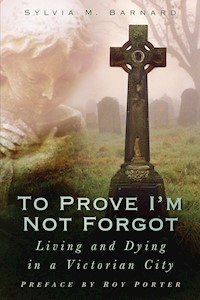
With the growth of English cities during the Industrial Revolution came a booming population too vast for churchyards. Beckett Street Cemetery in Leeds was to become the first municipal cemetery in the country. This study relates how the cemetery was started and run, and describes the developing feuds between denominations. The author draws upon newspaper articles, archive material and municipal records to tell the stories of many of the people who lie there, from tiny infants, soldiers and victims of crime to those who perished in the great epidemics of Victorian England. The study throws new light on the occupations and pastimes of the inhabitants of Victorian cities, their problems with law and order, their attitudes to children, education and religious provision.
Das E-Book können Sie in Legimi-Apps oder einer beliebigen App lesen, die das folgende Format unterstützen:
Veröffentlichungsjahr: 2009
Ähnliche




















TO PROVE I’M NOT FORGOT
TO PROVE I’M NOT FORGOT
Living and Dying in a Victorian City
SYLVIA M. BARNARD
For David
Disclaimer: Every effort has been made to trace the copyright holders of all images reproduced within this work. However, we apologise for any erroneous use of copyrighted material and would welcome contact from the original copyright holder.
First published by Manchester University Press in 1990
This revised edition published in 2009
The History Press
The Mill, Brimscombe Port
Stroud, Gloucestershire, GL5 2QG
www.thehistorypress.co.uk
This ebook edition first published in 2013
All rights reserved
© Sylvia M. Barnard, 1990, 2009, 2013
The right of Sylvia M. Barnard to be identified as the Author of this work has been asserted in accordance with the Copyrights, Designs and Patents Act 1988.
Preface copyright © 2000 Roy Porter. Reproduced by permission of the author c/o Rogers, Coleridge & White Ltd., 20 Powis Mews, London W11 1JN.
This ebook is copyright material and must not be copied, reproduced, transferred, distributed, leased, licensed or publicly performed or used in any way except as specifically permitted in writing by the publishers, as allowed under the terms and conditions under which it was purchased or as strictly permitted by applicable copyright law. Any unauthorised distribution or use of this text may be a direct infringement of the author’s and publisher’s rights, and those responsible may be liable in law accordingly.
EPUB ISBN 978 0 7524 9629 0
Original typesetting by The History Press
Contents
Preface
Acknowledgements
Chapter One
Decline and Fall
Chapter Two
Down Those Mean Streets
Chapter Three
Saving Souls
Chapter Four
A Chapter of Accidents
Chapter Five
The Great and the Good
Chapter Six
Architect, Lawyer, Left in the Lurch
Chapter Seven
Better Dead than Red
Chapter Eight
Just a Song at Twilight
Chapter Nine
Gone to the Bad
Chapter Ten
In Loving Memory
Notes
Death Notices, Obituaries and Inquest Reports
Appendix A: Mid-century burial law and the development of municipal cemeteries in England and Wales
Appendix B: The Cost of Death
Appendix C: Morbidity and Mortality
Appendix D: Victorian Institutions
Further Reading
Preface
How difficult we find it to face up to death, to talk about it even. The mere physical proximity of the dying and the dead discomforts us acutely. Perhaps that is why the very old are nowadays shunted off into terminal wards to die and, once dead, their remains are, at a growing rate, cremated, leaving nothing behind but roses and ashen memories.
Things were far otherwise with the Victorians. Exactly like countless generations of Christians before them, they lived in a world in which existence was a struggle, disease was rife, and death struck without warning or mercy. Unable to hide themselves from death, they felt no need, no compulsion, to hide the dead. Far from it. From the domestic deathbed drama to the stately funeral, decked out with all the pomp and circumstance of mourning, our forebears celebrated death as the great climax of the mortal lifespan of each Christian soul; every exit became a solemn, ritual re-enactment of those grand truths of the Christian Gospel: the impermanency of the flesh and the triumphal progress of the immortal soul into life eternal. Indeed, the rites of passage for the departed were highly public events, and (we might sceptically observe) more attention, more expense, often seems to have been lavished on subjects once deceased than when they toiled as factory workers, exhausted themselves out as wives and mothers, or sacrificed their lives under foreign suns for their queen. The theatre of death finally accorded them a more glorious role than when they played their parts on life’s stage.
And of no site is this truer than of the tomb. Aghast at life’s brief transience, our forebears wanted the grave at least to be permanent, solid, a rock of ages fortified against the sieges of time. The grave needs must be a worthy memorial of the dead, a warning to the living (‘As I, so you’), and a fingerpost to all, pointing to what was higher and nobler.
Precisely because the grave ought properly to be an emblem of eternity, earnest and improving Victorians were appalled at the treatment they saw all too commonly meted out to the corpses of their recently deceased nearest and dearest: their coffins stacked in overcrowded crypts and vaults, or packed promiscuously into fetid parish churchyards. In what was perhaps their first and boldest act of slum clearance, Victorian burial reformers developed the cemetery, snugly sequestered in suburbia, the first of the garden cities, a sylvan, planned and peaceful final resting-place for those whose lot in life, all too often, had been smoke, stench and struggle.
Amongst the earliest, and the grandest, of the corporation cemeteries the Victorians built was that in Leeds. In her meticulous and moving recreation of the founding and fortunes of what the locals came to know as ‘Beckett Street’ or ‘Burmantofts’, Sylvia Barnard superbly restores to life this Victorian celebration of death, now almost completely disappeared: the stately funeral cortège, the plumed horses, the streets lined with silent mourners, the Dead March from Saul, the gravestone chiselled with urns and angels, all eloquent with pious inscriptions and hopes for futurity. Over the last ten or fifteen years, inspired by the pioneering researches of such French scholars as Michel Vovelle and Philippe Ariès, British historians have belatedly taken up the study of the iconography of rites for the dead. In her sensitive Death, Dissection and the Destitute: a Political History of the Human Corpse (London: Routledge & Kegan Paul, 1987), Ruth Richardson in particular has emphasised the overwhelming sense of the sanctity of the corpse, felt by the ordinary men and women of nineteenth-century England. Such penetrating insights into the Victorian way of death are fleshed out and further developed by Sylvia Barnard’s close-up study of daily life in one single dormitory for the departed.
Death was, as every Christian learnt, the great leveller. All manner of men, all walks of life, from brewers to bargees, concert violinists to vagabonds, were interred in Leeds’ municipal cemetery. Some died rich in days; others entered the grave before ever reaching the cradle. No small number were struck down in their prime by sudden and shocking providences: drownings, traffic accidents, fires, poisonings; one tombstone commemorates the pathetic end of Mary Jane Duckworth, aged eight, run down and killed by an empty hearse, returning from Beckett Street itself. Fittingly, many of those most closely involved with the building and administration of Burmantofts chose to be buried alongside its spreading beeches and sycamores.
But if death levelled in a common mortality, the rules, rituals and respectabilities of Victorian burial reinforced all those hierarchies of class and confessional boundaries which the Victorians upheld so stoutly to maintain divisions amongst the living. The scale and situation of the turfy plot (predictably, first-class graves were on the highest ground), the quality of the stone, the height of the obelisk, the lavishness of the mason’s design and inscription – all eloquently bespoke the ranks and divisions of the city itself. For the labouring poor, special cut-price ‘guinea graves’ were devised, so tightly crammed together that they became for all the world like a mocking reproduction of the back-to-backs in which their tenants once had dwelt. More shameful still was that enduring object of terror, the pauper grave – a mass pit which, even in the present century, was sometimes used to house higgledy-piggledy some two dozen bodies.
In thus recognising that the culture of death replays life itself, in seeing the cemetery as a kind of Pompeii, or as a frozen glacier slice of time, lies the special insight of this poignant book. For Sylvia Barnard’s inventory of the dead, grave by grave, acre by acre, above all opens windows upon the living. Every corpse was once a householder, and many of them have been resurrected by the author’s dedicated investigations in local archives, directories and newspapers, to afford us a Lowry-like panorama of the teeming life of the living in Leeds before the Grim Reaper gathered in his harvest.
Tall tombstones have their stories to tell; above all, their lapidary inscriptions perpetuate positive and tangible identities, established through civic chauvinism, fierce family and district loyalties, and pervasive occupational pride (Elizabeth Stamp’s headstone noted: ‘Mother of Oates Brothers, Saddlers, Leeds’ – thus serving as an original advertising medium!). Such memorials tell of self-made folks (not a few of whom worshipped their maker), and sturdy independence (Samuel Smiles long worked in Leeds, though he was not buried in Beckett Street); but they also commemorate lives dedicated to civic munificence and Christian charity. And alongside such clashing but perhaps finally cohesive values, the cemetery’s administrative and financial records afford further insights into the throbbing activities, growing pains, and tension points of the Victorian city: we encounter endless, niggling interdenominational conflicts being waged (Church v. Chapel, Consecrated v. Unconsecrated ground) within what was ostensibly an ecumenical civic amenity; we glimpse devotion to duty, but also scandals over perks and pensions; we see bureaucratic entrenchment and petty penny-pinching, but, occasionally, benefactors digging deep into their own pockets to cope with hard cases – these contradictions, these enigmas, of Victorian lives are captured by the author’s tireless researches, intimate local expertise, witty pen and compassionate eye.
Victorian values have been much commended to us of late. As Sylvia Barnard herself emphasises, to endorse them would, however, mean reinstating an official face often stony, censorious, and sanctimonious. Blessed were the successful and the respectable. The cemetery’s governing boards rarely flinched from what they saw as their duty of passing severe last judgements on fallen women and feckless labourers, dead or alive. Even employees who long and loyally served the cemetery itself were often denied a respectable resting place, replete with name and inscription. Yet one feature of life in industrialising Leeds, shining out from this study, could certainly bear emulation today. Burmantofts’ burial books checked in the dead with dignity and a faith in records. Aldermen gave faithful and conscientious service; registrars, clerks and gravediggers performed their duties with punctilious pride. Overall, the Beckett Street enterprise exudes a sense of mission, which far transcends mere bureaucratic zeal or Benthamite efficiency, and which conveys a community of shared, public values and, ultimately, a sense of accountability beneath a common Maker.
Respect for the dead, that collective ‘lest we forget’, is perhaps the bedrock of civilisation and citizenship. It is certainly the hallmark of authentic history. Sylvia Barnard’s remarkable and readable book is offered ‘in loving memory’ of those huddles of humanity who were the making of Victorian Leeds. At last, these individuals have arisen from their graves, and in the following pages, can be traced retreading those paths – rarely ones of glory – that finally led to Burmantofts.
Roy Porter
The Wellcome Institute for the History of Medicine, London
Acknowledgements
My greatest debts are to my husband, David Barnard, for his patient support and unstinting practical help; to Shirley Thorpe, for her tireless assistance in research and for the many useful suggestions her considerable local knowledge enabled her to make; and to Richard Freeman, for sharing the results of his intensive survey of the cemetery and its memorials.
At Leeds Central Public Library’s Reference Department, Mrs Heap and the other members of staff answered my questions courteously and competently, and fetched me innumerable volumes and microfilms from their Aladdin’s Cave. The officers of the Cemeteries Department of Leeds City Council have given me much help and hospitality. I am indebted also to Mr R. Remaynes of the Community Programme, to Mr I. Dewhirst of Keighley Public Library, to Dr B. Elliott of the Victorian Society, and to the staff of Leeds City Archives and of Cusworth Hall Museum, Doncaster.
The task of extracting information from the Burial Registers has been greatly eased by the work of the transcribing team; my thanks to my daughter and son Gillian and Nicholas Barnard, Louise Burns, Eileen Churchill, Brenda Green, Kay and Keith Gurney, my parents George and Mollie Hagedorn, Doreen Harris, Mary Jeffrey, the late Les Marks, Tonia Mason, Elizabeth Ogden, Beryl Pearce, José Roberts, Connie Samwell, Barbara Spencer, Shirley Thorpe, Charles Wallace and Barbara Worthington.
I am grateful for family information from Mr E. Baines, Mrs A. Broad and Mr A. Smith, Mrs E. Busch and other descendants of the Kidney family, Mrs E. L. Green, Mrs G. Hall, Mrs E. Janson, Mrs M. T. Mulart, Mrs C. Samwell and Mr and Mrs S. Temple. Mr E. J. Boys kindly allowed me to make use of his painstaking research on ‘Chargers’ and other soldiers of the Crimean War, and Mr F. Dalby, formerly of the ‘Leeds Pals’, gave me permission to use extracts from Private Pearson’s verse memoirs. Mrs H. Irving advised on the selection of the illustrations. From T. E. Tilley Ltd., Stone Masons, I received help with memorial prices, and Mrs R. Evans translated the Welsh epitaph. The Harrogate Charge of the Light Brigade Society and the Humber Keel and Sloop Preservation Society also supplied information, and cemetery officials throughout England and Wales have taken much trouble over my enquiries.
To the Leeds Town Councillors of 1842, who resolved to establish Beckett Street Cemetery, and to the Leeds City Councillors of 1985, who reversed the decision to clear it, my deepest thanks.
Chapter One
Decline and Fall
Be sure you lay me there he said
In that sweet lovely spot
And strew with flowers my grassy bed
To prove I’m not forgot.
Henry Parker, 1871
On 14 August 1845, a Thursday, a melancholy little group of people gathered behind a baby’s tiny coffin in Joy’s Fold, Leeds, at the meeting-place of Marsh Lane and the road to York. Half a century before, this had been the foldyard of a farm; now it was a collection of higgledy-piggledy, run-down cottages housing some of the less well-to-do working people of the town.
As they made their way northwards along the road called Burmantofts (named after the plots belonging to the burgesses or ‘borough-men’ of Leeds long ago), John and Hannah Hirst and their friends passed a few of the regimented brick rows of cramped terraced dwellings known as ‘back-to-backs’, where industrial Leeds was stretching greedy fingers out into the countryside. Yet there were still good large houses to be seen, standing in pleasant, tree-shaded gardens – Burmantofts Hall and Grove to the left, then Springfield House on the right, where Nippet Lane, dry and dusty, branched off towards the stream called Stoney Rock Beck. Passing the little wood down at the Accommodation Street crossroads, the road, now called Beckett Street, led straight on up the hill, where another short block of working-class homes stood on the left. To the north of Skinner Lane, down in the valley, the Hirsts could see the growing outcrop of housing known as ‘Newtown’, but along Beckett Street there was open country. True, the site for the new House of Recovery to replace the old fever hospital in Vicar Lane (which had been uncomfortably close to the most unhealthy area of the city) had been purchased, and in due course a dignified building costing £7,000 would rise behind the stone walls, but its completion was still, on that August day, a long way off.
The little procession was now moving along the powdery road past the brickfields which lay to left and right of Beckett Street. Clay had been dug and turned the previous winter so that bricks to fuel the Leeds housing boom could be moulded here, set out in rows to dry, and then taken to be baked in Mr Boothman’s kiln, a little further on by the roadside. Beyond the brickfields, at the top of the hill, the end of their journey was in sight. It had taken barely twenty minutes to make the sad, slow passage from Joy’s Fold out into the countryside.
Rising out of the fields on the right were the eight-foot high walls of the new Leeds Cemetery, the stones sparklingly clean in the summer air; this was the day of its opening, and the small group of mourners were bringing the body of nine-month-old Thomas Hirst for burial. The first set of heavy iron gates stood open beside the sexton’s lodge, but the Hirsts and their little band went on to the further entrance, for they were Nonconformists, and the part of the cemetery nearer the town was for the use of Church of England members only. As they went in past the second lodge, the Dissenters’ chapel stood before them, simple, heavy and buttressed, twin to the Anglican chapel which they could see over on the other side. All around was grass, as there had not yet been time for trees to grow or formal planting to become established; but the main avenues and walks had taken shape and the outline of grave plots had been measured and marked out. The grazing at the new cemetery had been let to Mr John Robson, of Thwaite Gate, whose sheep had helped ensure the grass would be trim for the arrival of the first clients.
John and Hannah were met by the Registrar, a Baptist minister in his thirties named Jabez Tunnicliff of whom the city, and indeed the nation, were to hear more. He was a kindly, bespectacled man with a Midlands accent, perhaps a little self-conscious on this, the first day of his new and unusual responsibility. The sexton, William Wright, had dug and prepared the grave, the very first in the cemetery, which lay towards the back, not far from the pebbly track known as Stoney Rock Lane. Of course, it was only a common grave; John earned a meagre living from the cloth industry as a ‘stuff singer’ and could not possibly have afforded a private grave and a permanent memorial. He had six other children to support, and this simple funeral, with the cheap hearse and small coffin and the various fees, had already taken a huge bite from his week’s wages. The ceremony over, and a little bunch of wild flowers, gathered by the wayside, laid down to mark the newly dug grave, a feeling of desolation stole over the Hirsts at having to leave their baby all alone in this empty sixteen-acre field with scarcely any sound to be heard but the sighing of the breeze and the splashing of the neighbouring beck.
Another ten days were to go by before the grave was opened again for the body of six-year-old Mary Ann Atkinson, and yet more before the Anglican section received its first interment. Little did John Hirst think, on that sad day, that less than a year later the eightieth interment in the new cemetery would be of Hannah herself in a neighbouring grave to her son’s.
It was a bold, yet necessary step the Leeds Town Council had taken in setting up this cemetery. In common with all other industrial areas, the city had seen a huge increase in population as births outnumbered deaths and as agricultural labourers abandoned the land in search of work in the new factories. In 1801 there were 53,270 people in the borough of Leeds; by the time of the 1841 census there were 152,054. The influx into towns with primitive water supply and sewerage systems, inadequate housing and very limited facilities in their few churchyards for disposal of the dead, brought with it appalling health problems. Many churchyards were in a dreadful state, raised high above ground level by layer upon layer of burials, with the effluvium from bodies seeping into the water supply of neighbouring dwellings, and with the poor remains frequently mangled and disturbed to make room for more. The example most often quoted is that of the scandalous Enon Chapel, opened in 1823 near the Strand, London, where it is said that 12,000 bodies, hacked about to save space, were stacked in the vault, separated by a simple wooden floor from the worshippers in the chapel above – who not infrequently had to be taken, fainting, into the fresh air.
In Leeds itself, the parish churchyard was said by Town Councillors ‘to have induced relatives to commit atrocities that would disgrace the most barbarous people’.1 An energetic and humanitarian surgeon and factory inspector named Robert Baker, who supplied a good deal of material from Leeds for Edwin Chadwick’s great Report on the Sanitary Condition of the Labouring Population of Great Britain, wrote in 1842 that the burial-grounds of the Parish Church were overfull and in a disgusting state, and condemned unreservedly the unhealthy practice of interring the dead near the habitations of the living.2 He later laid evidence before the Burial Grounds Committee, which was debating whether to order the final closure of the old churchyards:
I was in the ground last Wednesday collecting information, and the sexton took me to a grave which they were then digging, for the interment of a female; two feet below the surface they took out the body of a child, which was said to be an illegitimate child, and it had been buried five years; below that and two feet six inches from the surface, were two coffins side by side, the father and the brother of the person who was then going to have the inter-ment; the father was buried in 1831; the coffins were opened, the bones were in a state of freshness ... they were thrown on the surface, and at that time, the person came in who was going to have the interment; he spoke to me about it, and made use of this expression, ‘Look! These are the skulls of my Father and my Brother, and the bones of my relations, is not this a bad business? It cannot, I suppose, however, be helped; I must have a family grave.’ He was very much shocked; he stayed there a short time, and then went away a little distance ... He knew they were the skulls of his Father and Brother, because it was a family grave; – the bottom part of the Coffin was chopped up and thrown on the surface, and I examined it. The residue was in an effervescent, putrescent state; after the bottom part of the Coffin had been taken out, a little soil was taken out again, and there were two other coffins side by side, containing the mother and grandmother of the same person. These coffins were broken up in my presence and thrown out, and then there was gravel underneath; all these bodies had been buried at the short distance of two feet six inches; and then, at a depth of one foot six inches more, lay others below them, on gravel, and they were thrown on to the grave side, in the way I have described to the Committee. I asked the sexton whether it was absolutely necessary that this should be, and his answer was, that it was quite impossible it should be otherwise; that it was not a single occurrence but was an every day occurrence, when they had to inter in that ground.3
Since the graveyards of the churches could no longer cope, it was clear that new and separate burial-grounds would have to be set up. Cemeteries (the name is taken from a Greek word meaning ‘dormitory’) had existed in Britain well before the nineteenth century. The Dissenters, who strongly objected to having to be buried in consecrated Anglican ground, had had their own cemetery in London, Bunhill Fields, as early as the seventeenth century; Edinburgh’s citizens were buried from the eighteenth century in the cemetery on Calton Hill. In Norwich a far-sighted Nonconformist clergyman had established an undenominational cemetery, ‘The Rosary’, in 1821, which, however, was slow to capture custom.
Influential voices, particularly that of London barrister G.F. Carden, were raised during the 1820s and 1830s in support of the establishment of cemeteries, and their arguments quickly won support. There was a rush to promote joint-stock companies which would not only provide for the hygienic and acceptable disposal of the dead, but would also put healthy dividends into the pockets of the shareholders. The Liverpool Necropolis of 1825 was soon followed by the dramatic St James’s Cemetery, also in Liverpool, scenically laid out in a disused quarry; Glasgow’s Necropolis (1832) was high on a hill, and its commanding situation and splendid monuments earned the praise of Queen Victoria and Prince Albert when they visited the city. In London, Kensal Green Cemetery, also opened in 1832, and patronised by royalty, was the first of a string of great cemeteries which included Highgate, Nunhead and Abney Park. Leeds also had its private General Cemetery Company, which in 1835 laid out St George’s Fields at Woodhouse with an imposing portico and a mortuary chapel in the Grecian style.
What did the early Victorians want of their last resting-places? Hygiene, aesthetics and security all played a part – well-drained soil, pleasingly landscaped grounds (if possible on a sloping site which would give interest to the scene), safety from the feared body-snatcher, the dignity of a permanent memorial. The cemetery was considered an ideal place for a Sunday afternoon stroll, combining good views (especially in such places as Highgate, where one could see right across London, and Undercliffe, perched on an escarpment in Bradford) with an uplifting moral experience: ‘And when you come my grave to see, Prepare yourselves to follow me’ ... ‘Praises on gravestones are but vainly spent; A life of goodness is a lasting monument’ ... ‘Pause! Reflect! Pass on!’ Yet the majority of city-dwellers were in no financial position to purchase fine private graves, nor was the idea of making a profit out of death wholly approved of, and it was not long before Acts of Parliament passed in the 1850s made it possible for parishes and towns to set up Burial Boards and establish municipal cemeteries. Appendix A demonstrates the enthusiasm with which local authorities grasped at this new solution to an old problem. From 1860, says Dr Curl in A Celebration of Death, ‘most cemeteries in Britain were established by public authorities, and were utilitarian, hygienic, and for the most part uninteresting’.4
Several years before this legislation, however, Leeds Town Council, prodded by Robert Baker, had made its own far-sighted move. Although White’s Directory of 1837 describes the new privately owned General Cemetery as ‘for persons of all religious denominations’, Baker did not agree: ‘It is true that in Leeds we have a large and excellent cemetery, founded by a company of proprietors a few years ago, and situated out of the town; but it is only used by the Dissenters, no part of it having been consecrated for the use of the Church.’ Clearly, Leeds needed burial-grounds which anyone would feel able to use, and which would accommodate the poor as well as the rich. The Leeds Burial Bill, passing through Parliament along with the public health reforms of the Leeds Improvement Bill, was commended by the Leeds Mercury on 11 July 1842 as an innovatory measure (‘This is, we believe, the first bill that has passed in England conferring upon the Town Councils the power of imposing rates for the purpose of the general interment of the dead’). On 2 July the same newspaper had emphasised both the philanthropic and practical purposes of burial-grounds on the rates; ‘a certain source of revenue to the Town Council’, the measure also formed ‘a precedent for providing Burial Ground in all parts of the kingdom for persons of all religious persuasions on equitable terms, protecting all just rights, without inflicting injury on any denomination’. On 16 July 1842 the Council obtained its Act of Parliament ‘for Providing Additional Burial Grounds in the Parish of Leeds in the West Riding of the County of York’, and the way was open for new cemeteries to serve the townships of Leeds and Hunslet. It took just over three years from the Act of Parliament to the opening of those iron gates in Beckett Street.
The Burial Act Committee set up on 3 August 1842 consisted of seventeen aldermen and councillors, and their deliberations make fascinating reading. The first task was, with the help of Mr Child, the Borough Surveyor, to fix upon a suitable site. After several had been considered, tested and rejected, they had what they wanted in two adjoining fields belonging to the MP William Beckett Esq., one of eleven acres and one of five, the price asked being some £210 per acre. On 22 September 1843 there was a site visit to York Cemetery to get ideas on the layout, the buildings, the format of the registers, the costs and charges, and soon advertisements were being placed in the Leeds Mercury and Leeds Intelligencer, inviting firms to tender for the various works.
Long and agonised arguments took place over what to us today would seem relatively trivial matters. What, for instance, was to be done about the mortuary chapels?5 Since the burial ground was to consist of two separate portions, one for Anglicans and one for Dissenters, there must be two chapels; but should they be separate buildings, or two chapels under one roof? After changing their minds several times, the members of the Committee opted for the former, commissioning Chantrell and Shaw as architects, and although the buildings were identical, local custom referred to them (incorrectly) for ever after as ‘the Church’ and ‘the Chapel’. The Bishop of Ripon, whose ancient see included what had once been a tiny settlement by the Aire and was now the major industrial city of Leeds, had to approve the plans for laying out the Consecrated portions of the Leeds and Hunslet grounds; in January 1844 a deputation of councillors waited upon him and were ‘much pleased with his Lordship’s courtesy and urbanity’, so much so that they felt themselves able to agree to most of the small alterations which he proposed, such as the lengthening of the chapel windows – although ‘in the opinion of this Committee the Act of Parliament does not provide for the expence of a Bell’!6 On 20 September 1844 Mr Jacob Verity was paid the sum of seven guineas for work which included ‘setting boundary stones’ between Consecrated and Unconsecrated portions.
Social divisions which make a modern reader feel slightly uncomfortable were also incorporated into the layout – first-class graves on top of the hill, fifth or lowest at each end. Fees were constantly revised before the cemetery opened, but show a wide range. The charge proposed on 6 December 1844 for a Nonconformist pauper, for instance, ‘buried at the expense of the Township’, was a mere 3s 6d, but an Anglican in a private grave in Ground 1 would pay £2 for the land and 16s for the interment – 50 per cent more for non-residents. Even between the tiny corpses of the stillborn there was discrimination – 5s in Ground 1, only 1s in Ground 5.
Contracts were prepared for the businesses which had offered acceptable tenders. After two firms were discovered to have made mistakes in estimating for the masonry work on lodges and chapels (such mistakes seem to have resulted in the Committee’s immediately rescinding acceptance and taking the next firm’s offer, even though it was higher than the corrected tender),7 Mr Charles Drury received the contract at £1,330 15s. The job of erecting the outer walls, to be eight-feet high instead of seven at the Bishop of Ripon’s request, was given to Mr John Walsh, who quoted 28s a rood (five and a half yards). However, this gentleman did not prove entirely satisfactory, for the minutes record on 26 July 1844 that ‘this Committee having found that Mr. Walsh has been deviating from his Contract in not using Mortar in building certain portions of the boundary wall around the Leeds Burial Ground and although the Committee think the wall is not seriously injured by the deviation yet RESOLVED that the sum of £5.0.0. be deducted from the amount to be paid to Mr. Walsh to mark the displeasure of this Committee for his having done so’.
A good deal of thought went into the commissioning of the registers from Mr Henry Woodhead Walker – among them eight Royal Folio books, to be printed at the head of each page ‘Register of Vaults and Graves in the Leeds Burial Ground’, two Imperial Folio books headed ‘Register of Burials in the Leeds Burial Ground’, and two Imperial Folio books of certificates of grave purchase, all these bound in the best Russia leather, surmounted with brass at the top corners, and varying in price from £11–16 each.
It is unfortunate that an equal amount of care did not go into selecting employees who could write neatly and spell correctly, for while the first clerk of the Consecrated section kept well-written and orderly records, the corresponding Unconsecrated register is an untidy mess of illegible writing, erasures and corrections, with extraordinary orthography such as ‘Sharlotte’, ‘soilder’ and ‘Cavielier Street’. We do not know for certain who was responsible for filling in the registers for, although the Burial Grounds Committee minutes seem to show clearly that it was originally the sexton’s job, the handwriting does not always correspond with a change in this post; in the case of the Unconsecrated register, suspicion must fall on the Revd Tunnicliff, whose early education, as we shall see later, had been rather neglected. If the sextons were keeping the registers, they may perhaps have been overworked, for they seem to have combined the duties of clerk and gravedigger – which included all paperwork when the grave was ordered, receiving and accounting for the payments, making the graves (with assistance in digging where necessary), cleaning the chapel windows and cleaning and dusting the furniture, keeping the grass avenues and walks clear, and locking and unlocking the gates.8 The slovenly keeping of the records evidently continued for many years, for a sub-committee of the Burial Grounds Committee had some astringent comments to make in 1881. The report on ‘Registers of Burial’ ran:
These registers are kept by the Sextons, but inasmuch as the Burial Grounds Act, 5 and 6 Victoria, cap. 103, section 51, provides;–
That all Burials in the Consecrated part of any such Burial Ground shall be registered by the chaplain of such Burial Ground if a Chaplain shall be appointed thereto,
Your Sub-Committee would strongly urge the desirability of carrying this provision into effect. They do so for the following reasons, namely: – 1st. – The Registers would doubtless be more neatly kept than they now are, and would, at any rate, be free from the very defective spelling which at present mars their pages. 2nd. – They would then be the means of an additional check for the Borough Accountant in the Audit of the Burial Grounds Accounts, which at present they are not; as in some instances the registers are signed by the Chaplain a week after the interments have taken place, he merely taking the word of the Sexton that the Burials are correctly recorded. And 3rd. – It is desirable that the extracts from the Registers which are applied for from time to time, and for which the Registrar charges a fee of 3s. 7d, should be made by a person who can write a tolerably fair hand, and who can, at any rate, spell his words correctly.9
So bad did the situation become in the Consecrated portion that in 1885 a clerk, one Arthur Foster, was employed to correct the errors in the records. For several months he worked painstakingly on comparing the Burial and Grave Registers with each other and with the Rough Order Books, ‘trying’ in the grounds to see whether graves blank in the register were in fact occupied, and peering at the memorial cards of recent burials under their glass shades. In fact, he felt obliged to apologise to the Burial Grounds Committee at the end of his report for the length of time he had taken to set matters right, but his list of errors rectified (including no fewer than 528 graves in which one sexton, Sinclair, had made interments without entering any particulars in the Grave Registers) must have exculpated him. The incumbent sexton, William Bates, had made 1,065 mistakes in four years and two months of office, mostly by copying up the Grave Register from the Rough Order Book instead of from the more accurate Register of Burials. ‘Found mistakes in spelling in a very many instances,’ chided Mr Foster, ‘and some of the pages in a somewhat blotted and dirty condition.’10 Some years later the Committee wished to set in motion a similar exercise for the other half of the cemetery, but by then so many of the order books and other documents had gone missing that the task could not be attempted.
The Registrar and Clerk for the Unconsecrated section in 1845 were appointed by councillors’ votes, Revd Jabez Tunnicliff having a clear lead with twelve votes over his nearest rival’s nine for the position of Registrar;11 his colleague on the other side was Revd Henry Pass Wright, and the two clerks were William Wright (Unconsecrated) and Richard Hodgson Pickard, the sexton from the Parish Church. It was the privilege of the Bishop of Ripon to approve the appointment of the staff of the Consecrated side, and there was a clear difference in management from the start, the Anglican Chaplain being non-resident, whilst sometimes the Registrars of the other side not only lived in the North Lodge, but even controlled the grave-digging side of the business.
As we have seen, the first burial took place in the Unconsecrated section on the day the cemetery opened, but things moved slowly at first. The Leeds annalist Mayhall comments:
The new ground provided by the town council at Burmantofts was opened in August, 1845, for the burial of the dead, but owing to a dispute respecting the fees to be paid to the vicar and the clerk in orders but few interments took place therein, and the old ground continued to be used until the 30th of November, 1847, when the bishop of the diocese on the recommendation of the vicar, consented to the closing of those places.12
The Revd W.F. Hook, DD, Vicar of Leeds, was entitled, under the Burial Grounds Act, to a surplice fee of 1s for every Anglican burial in the cemetery, such as he received for interments in the parish churchyard; the Town Council, which paid an annual stipend of £80 to the chaplain appointed to the Consecrated portion, not unreasonably expected him to come to some accommodation with them over commutation. There was a major row between the redoubtable Vicar and the Burial Grounds Committee under its chairman Alderman Luccock, with letters, minutes and printed pamphlets flying back and forth like poisoned arrows. It seems to have been sparked off by the problems which gave rise to the following minute of the Committee on 10 February 1847: ‘Resolved, that the Reverend the Vicar be informed that on the 26th January and several following days part of the Consecrated portion of the Leeds Burial Ground was in a very disgraceful condition, the sides and ends of several coffins being rendered visible, and the effluvium rising from the decomposition of the bodies apparent at a considerable distance.’ The Vicar refuted any responsibility for the Consecrated section or its employees, but the dispute bared bones of contention. The Town Council had seen the institution of a municipal cemetery as a solution to the problem which had arisen when Dissenting ratepayers blocked the proposal to levy a rate for a new ecclesiastical burial-ground, but the extra charges were now penalising Anglicans. Furthermore, they resented reference to profit, which they claimed they would never be able to make, and to their privileges, which they described as ‘that of being abused by yourself in words polite’!13 The Vicar, on the other hand, had a possible loss of income to bemoan, for he got nothing from the interments of Dissenters, who, had they been buried in the parish churchyard, would have had to pay his fees like everyone else.
The stalemate over burials continued until Councillor Joseph Richardson, a Methodist upholsterer and Liberal representative of the West Ward, dragged the question into the open by means of letters to the newspapers and debates in Council. While the parochial burial-grounds were still open, receiving 2,000 bodies annually, a mere 137 people had been buried at the new cemetery at a grossly unrealistic average cost to the ratepayer of over £5 8s 6d each. On 14 August 1847, when typhus or ‘Irish Famine’ fever was rife in the town, the Leeds Times reported a fierce argument in the council chamber, some attacking Dr Hook for his reluctance on a point of principle to close the churchyards, others blaming the Council itself for not having come to an accommodation with him over the contentious shilling. Mr Richardson related the prevalence of fever in the Kirkgate ward to the proximity of the parish churchyard, where, he claimed, nearly all the cases from the town’s hospitals and institutions had been interred. Goulden’s Buildings, Goulden’s Square and Back York Street had been especially stricken. ‘It is all through the accumulation of the Irish,’ growled Councillor Bulmer, which was true, but not helpful, and earned him a sharp rebuke from Councillor Carr, who pointed out that the Irish were Christians and human beings like themselves. Alderman Gaunt thought the Bishop should have closed the churchyards even if the Vicar lost a hundred pounds a year thereby; was that a reason for destroying the lives of her Majesty’s subjects? Polarised as they were on the question, the councillors eventually had to agree that their duty to the townsfolk must be paramount, and the Vicar was offered the sum of £30 in commutation of the surplice fees, so that he felt able to agree to petition the Bishop for the quid pro quo of closure.
This was not quite the end of the matter, since there were many relatives who insisted on the continued use of family vaults and graves. In 1851 the simmering pan of discontent boiled over once again with the prosecution of the Revd Samuel Kettlewell for illicitly burying William Wigglesworth at the Parish Church, the consequent declaration by the justices that the Council’s closure notice was invalid, and the threat of further prosecutions unless the Bishop of Ripon finally agreed to end the use of the churchyards.14 Despite the intervention of over forty Leeds medical men who signed a declaration that there could be nothing injurious to the public health in interment three feet below the surface in these private graves,15 the Burial Grounds Committee finally managed to reach an agreement with the clergy which virtually eliminated further burials at the oldest Leeds churches. It had been a long haul.
Once the churchyard of St Peter’s was closed, the two cemeteries (the Leeds General Cemetery Company’s at Woodhouse and the Corporation’s Leeds Cemetery at Beckett Street) were the major sites for burial in the town. The Unconsecrated part of Beckett Street Cemetery was considerably less popular than the Consecrated. On 11 August 1849 the Leeds Intelligencer had reported a Burial Grounds Committee meeting at which members had been informed that the income of the Unconsecrated portion was insufficient to defray expenses. (In fact, by the date of the meeting the Unconsecrated section had had 1,057 burials, compared with 1,883 on the other side.) The measure proposed to reduce expenditure seems extraordinary. William Wright, the clerk and sexton, was to be removed from his office, and Revd Tunnicliff, the registrar, was to occupy Wright’s lodge – like him, free of rent, rates or other charges, and with coal, gas and water supplied – and to perform some of Wright’s duties such as receiving orders and setting out and measuring graves. (Presumably he was not expected also to dig them.) The only charge which could be brought against Wright was that he had made headstones for other cemeteries in his spare time, which was causing complaints from local stonemasons of unfair competition, and that he had continued to do this despite an order from the Committee to desist. Alderman Luccock defended Wright, saying that ‘the ground had got into its present good condition mainly through the zeal and ability of Mr. Wright. He had taken great pleasure in keeping his ground neat and in always having the graves dry, and he [Mr. Luccock] believed Mr. Wright had succeeded in giving universal satisfaction.’ He pointed out, too, that ‘with all respect for Mr. Tunnicliffe – and he had no doubt he had discharged his duties as registrar as well as anybody could possibly do – he was totally unfit to discharge the duties of clerk and gravedigger, and was as incompetent to set out a grave and to superintend the proper draining of the ground as he [Mr. Luccock] should be’. Councillor David Newton, backing the original motion, ‘entered at some length into the history of the whole question’, and ominously mentioned Mr Tunnicliff’s claim that he had been so insulted by Wright that if the sexton were to stay he must resign his own office. Alderman Luccock had heard nothing about any insult to Mr Tunnicliff, and renewed his praise ofWright, stating that ‘he was a man of warm temperament, but a better servant the town never had’. Tempers rose, or as the Leeds Mercury put it, ‘a rather warm altercation ensued’! In the end this unfair expedient was not adopted, and the Committee - despite some foreboding as to how the parties concerned would be able to work together after this nasty episode – agreed to accept a deficiency of £200–300 a year on the Unconsecrated side, and to keep William Wright on at a reduced level of wages. Sadly, though, this was only a temporary respite, for on 5 March 1857 a minute of the Burial Grounds Committee records that Wright applied for a higher rate of remuneration and instead got the sack; so the Revd Tunnicliff was able to move into the North Lodge after all.




