


9,49 €
Mehr erfahren.
- Herausgeber: Michael Pronko
- Kategorie: Religion und Spiritualität
- Serie: Tokyo Moments
- Sprache: Englisch
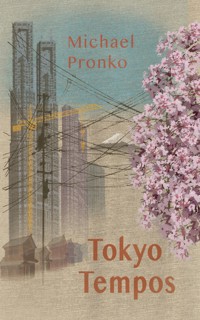
Tokyo Tempos
In Tokyo Tempos, award-winning mystery writer Michael Pronko writes about the mystery of everyday Tokyo life. He takes his three decades of living, writing, and teaching in Japan and delves into what it’s like living with Japanese food, seasons, ceremonies, rules, and trains.
The pithy, pointed writings in Tokyo Tempos offer a reminder of how even huge cities like Tokyo live and breathe with the loves, hopes, pleasures, and puzzling meanings of the people who live there.
Tokyo Tempos is the fourth in the Tokyo Moments Series.
Motions and Moments
“Pronko takes the sweeping size, bustle, and chaos of Tokyo and makes it small, introspective, and personal.” Independent Publisher
Tokyo’s Mystery Deepens
“A rare glimpse of the structure and nature of Tokyo's underlying psyche.” Midwest Book Review
Beauty and Chaos
“An elegantly written, precisely observed portrait of a Japanese city and its culture.” Kirkus Reviews
As for the Detective Hiroshi series set in Tokyo: “If there’s a better crime series set in Japan, I’ve not yet read it.” Crime Thriller Hound
“The city of Tokyo is very much a character in its own right. It's not the tourist hotspots we see, but the real city with the food and drink which the locals consume. It's glorious.” The Bookbag review of Tokyo Traffic.
BookLife Review wrote that Pronko’s sixth novel, Shitamachi Scam, “does as good a job of taking us on a trip through Tokyo as Simenon does through Inspector Maigret's Paris.” So, join Pronko on an enlightening non-fictional trip through Tokyo.
Das E-Book können Sie in Legimi-Apps oder einer beliebigen App lesen, die das folgende Format unterstützen:
Seitenzahl: 262
Veröffentlichungsjahr: 2024
Ähnliche
















Tokyo Tempos
ALSO AVAILABLE BY MICHAEL PRONKO
Memoirs on Tokyo Life
Beauty and Chaos: Slices and Morsels of Tokyo Life (2014)
Tokyo’s Mystery Deepens: Essays on Tokyo (2014)
Motions and Moments: More Essays on Tokyo (2015)
The Detective Hiroshi Series
The Last Train (2017)
The Moving Blade (2018)
Tokyo Traffic (2020)
Tokyo Zangyo (2021)
Azabu Getaway (2022)
Shitamachi Scam (2023)
Tokyo Tempos
By Michael Pronko
Copyright © 2024 Michael Pronko
First English Edition, Raked Gravel Press
All rights reserved worldwide. This book may not be reproduced in any form, in whole or in part, without written permission from the author.
Formatting by BEAUTeBOOK www.beautebook.comn
Cover Design © 2024 Andy Bridge www.andybridge.com
Tokyo Tempos
by Michael Pronko
Raked Gravel Press 2024
“Rome was a poem pressed into service as a city.”
— Anatole Broyard
* * *
“We don't see the world as it is. We see it as we are.”
— Anais Nin
* * *
“Tokyo. You hear about it. You go see it. And a window opens up into a whole new thing. And you think: What does this mean? What do I have left to say? What do I do now?”
— Anatole Broyard
Preface
Writing Finds Me
One evening
One evening years ago, after a drinking party with students, I was heading through Shinjuku Station with one of my students who took the same train line. Suddenly, I took her arm and shuffled out of the rush of people. I pulled my pen and notebook from my pocket to scribble down an idea that had just clicked.
She was an aspiring journalist (and later become one, and a teacher too), but she was then perhaps not used to people stopping in the swirl of the world’s busiest station. We were just two of the 3.6 million passengers that pass through the station every day. She waited patiently, though, as Japanese students are trained to do, until I was done scribbling my notes. “An essay found me, and I didn’t want it to escape,” I sheepishly explained.
She looked at me and laughed. “Sensei, does that happen all the time?” “Just at odd times,” I said. “But you have to get it down before it disappears.”
If I were a quicker-thinking teacher, I would have quoted Francis Bacon: “Write down the thoughts of the moment. Those that come unsought for are commonly the most valuable.” I learned that the hard way—write it down, or it’ll disappear.
About ten years ago, I eased out of a decade-plus of writing for Newsweek Japan, The Japan Times, and other publications and switched my focus to novels. Since then, I’ve written one novel a year, with an annual word count not so different from those busy years. Still, it was a nice change of canvas size.
The novels in the Detective Hiroshi series drew heavily on what I’d written about in those earlier pieces. And though I like the characters in my stories, I’ve missed writing directly in my own voice. When do I get to say what I think? When is it my turn? This book is my turn. It’s what didn’t disappear.
Tokyo’s vastness
I don’t think anyone could claim to know Tokyo completely. This is the fifth book I’ve written about Tokyo life, and I don’t think I’ve captured even a small portion of it. But that’s OK. Being complete is one thing; being interesting is another. Even after twenty-plus years, I find the city a fascinating place to live, write, and think.
In that sense, this is a guide into and an account of my journey through Tokyo. But it’s not exactly a travel book; it’s more about how my heart and mind respond to Tokyo life as I wander, work, and live here every day.
If you want a history of Tokyo, there are plenty of those. I love reading them. And if you want explanations and analyses, to be “assured of certain certainties,” as T.S. Eliot wrote, you can find those too. You can climb to the top of too-tall buildings for a panoramic view of the vastness, but those spots leave you distant from what’s happening. But I want to write close to life. It’s there that I find the most interesting and meaningful insights.
In the train system in the Tokyo metropolitan area, there are always multiple ways to get from one place to another—faster ways, cheaper routes, easier transfers, longer waits, and nicer walks. You have to choose. These writings are my choice of routes for the journeys through the heart of Tokyo. It’s not that I saw Tokyo completely. It’s that I tried to experience it fully.
Seeing Tokyo
Henry David Thoreau said, “It’s not what you look at that matters; it’s what you see.” That’s definitely true in Tokyo, where looking is unavoidable, but seeing takes effort. As the Zen Buddhists say, a finger pointing at the moon is not the moon. Words pointing at Tokyo are not Tokyo, granted. But words can point in directions that reveal life’s delightful and intriguing parts. Words are a way to see inside Tokyo.
Tokyo resists neat summations. Its contradictions refuse resolution. Tokyo is known for its centrifugal energies as much as its cleanliness and order. But I like that inability to see everything. Taking it in pieces is fine. Sharing snippets and vignettes is a large part of the urban experience.
I’m writing to people who have visited, have lived here, or will visit or live here, and maybe want to think more about the city. But I also want to share Tokyo with those who might say, “I would never live in a place like that.” Readers are always armchair travelers in some sense, so wherever you are, enjoy the reading, thinking, or rethinking, wherever you may be.
Over the years
The first three books in the Tokyo Moments series, Beauty and Chaos, Tokyo’s Mystery Deepens, and Motions and Moments, won awards and good reviews for their personal and offbeat approach to Tokyo. Since 2015, when the last book in this series was published, millions of tourists have poured through Japan; the reader might even be one of them. The photos and videos posted of Japan multiply constantly. So why not just take more pictures? I could do that.
So, is this book better than Instagram? That’s hard to say. I like visuals, but I like language too. Instagram elevates marvelous shots of slivers of the world that you might never otherwise see. Writing articulates ideas and thoughts about slivers of the world in ways you might not think of. I think both are valuable. The writings in this volume are snapshots of my experience, but words explore the ideas that flow from those experiences.
Most visitors flying into Japan were probably introduced to the country through movies or manga. Those visual story forms are one way to reflect on life in Japan, but there are others. Whether fiction or nonfiction, novels, old or new films, manga or anime, there is a massive literary and cultural reflection on Tokyo life. That’s maybe as it should be. Richness produces richness.
Living in Tokyo for a large chunk of my life, I feel that richness every day. “Everything I see or hear is an essay in bud. The world is everywhere whispering essays,” said Alexander Smith, essay writer and theorist. In Tokyo, that whisper is often multiple whispers at the same time. Which bud should be plucked first? Images work their magic, and words work theirs.
Writing Tokyo
The first third of my life was singularly American. Since then, I suppose I’ve been transnational, traveling and living in different countries, usually in densely urban spaces. I like nature and the countryside just as much as the city, but Tokyo is where I’m writing from, what I write about, and what shapes my view. It’s been that way for a while.
Wherever I was, traveling the world, teaching in Beijing, and studying in the States, inner compulsion kept me writing. And then, in Tokyo, I got some lucky breaks. When I settled in Tokyo, I wrote for a start-up online magazine called Tokyo Q. From there, I got invited to write a column for Newsweek Japan. That column ran from 2003 to 2014. A small publisher gathered my columns into book form in Japanese—three times. Then, I put them into English as the Tokyo Moments series.
I also wrote about art and architecture for Artscape Japan and did a few TV shows based on my essays for NHK and Nihon Television. I wrote about jazz for a magazine in Italy, for Blue Note Japan, and helped found a bilingual print magazine called Jazznin. I wrote about music for The Japan Times and took on whatever writing opportunities arrived in my inbox. And did I mention my day job at a university teaching literature?
Then the overload of deadlines finally pushed me to take a break from short-form writing. The weekly task of pulling together a set of ideas about serious topics was constant and intense. Christmas and New Year and personal vacations were no exception. Newspapers and magazines don’t have holidays. The experience of writing to weekly deadlines was a lesson in discipline, dedication, concision, and compression. It was a period of breathing out without enough breathing in. I’ve finally caught my breath.
I kept the jazz writing, though. You can see that on my website, Jazz in Japan. Jazz has remained a refuge and an infusion of creativity for me. It’s the hardest thing to write about in some ways, as words always fail to capture the music, but it keeps me working on finding the right words.
Writing the novels in the Detective Hiroshi series reminded me that novels can contain almost anything—real places, fake places, conversations, descriptions, arguments, historicizing, and editorializing. Novels run on both logical patterns and emotional pressures. However, essays have a self-contained focus that is more personal and revealing, intimate and confessional, and unresolved. I like both.
And you may ask yourself…
Meanwhile, Tokyo keeps updating itself, tearing down buildings, opening new train stations, building new train lines, leaving some good things behind, and finding new ones. There’s little sense of impending doom or economic collapse here. Of course, it’s lurking behind the rushing around. The pandemic bankrupted many stores, bars, and restaurants but dropped rents so new ones could start. Somehow, Tokyo keeps repairing its small parts as the whole keeps moving forward.
When I wrote about Tokyo in novel form, the city often served as the setting. But in these essays, I bring Tokyo out of the background to see it for what it is. I want to ground myself in the city’s sense-seducing power and consider, as in the Talking Heads song “Once in a Lifetime,” “Well, how did I get here?” As a philosophy major in Tokyo, that question comes up often.
Thoughts and insights have their own duration and scope, like a prayer or confession. I let some of the essays in this collection find their own length but kept each one short enough to finish in the time it takes to go from one express train station to the next. I don’t want to bury the zing of curiosity in wordiness, but I don’t want to force the brevity, either. I don’t have a grand, unified theory of Tokyo, but I do have observations and insights.
The writing is rooted in decades of living here, trying to see without giving up the pleasure of looking. I’ve chosen topics that I think go to the heart of life here. Many of the essays emerge from aspects of Tokyo that the casual visitor or the busy-minded resident might not notice. Some meander, while others head right to the point. Some are contemplative rather than argumentative. Others wonder without the need to conclude. That fits Tokyo, which seems different every day.
Arthur Benson, in a 1922 essay called “The Art of The Essayist,” said: “It will be seen, then, that the essay need not concern itself with anything definite; it need not have an intellectual or a philosophical or a religious or a humorous motif; but equally none of these subjects are ruled out. The only thing necessary is that the thing or the thought should be vividly apprehended, enjoyed, felt to be beautiful, and expressed with a certain gusto.”
Gusto. That’s what these writings strive for—a delight in Tokyo’s enigmas, an embrace of Tokyo’s often-hidden nature, and a comfort with the intensity and complexity of the place. Enjoy!
Part OneLiving Here
Introduction
Over the past few decades, I’ve probably stopped noticing as many things as I’ve started noticing. As time passes, the freshness of certain experiences washes away. The mind sees the same things, accepts them as normal, and stops thinking about them. I always hate losing that sense of fresh shock and off-balance confusion about life here, but there might be no better way to survive the onslaught of sensory input. If you don’t look too much, you can save a lot of energy. If you look too closely, the city can drain you and send your mind whirring. I try to find a balance.
Most quintessential Tokyo experiences seem “normal” to me now, but many of those essentials are always at risk of losing their normalness and becoming unfamiliar again. I’m not sure how or why certain experiences that have become part of living in Tokyo suddenly strike me as unique, questionable, engaging, and deserving of being written about. But they do.
The critic and theorist Victor Shklovsky had this to say about the normalizing of life and what response we might make to it: “Habitualization devours objects, clothes, furniture, one's wife, and the fear of war. If all the complex lives of many people go on unconsciously, then such lives are as if they had never been. Art exists to help us recover the sensation of life; it exists to make us feel things.” I couldn’t agree more.
Responding to the world keeps them from disappearing—not from existing in any physical sense, of course. The world remains. But things can quickly lose their intrigue and meaning. When that happens, we lose any clear way toward understanding them. The topics in this section are drawn from everyday experiences and situations, but ones that I feared could quickly slip down the drain of “Oh, that. Well, of course.”
There’s a lot of danger in “of course.” It’s the danger of losing the vitality in the world and our reaction to it. Ironically, the longer things persist in our lives, the weaker meanings they offer. But they can be excavated, dusted off, set before us, and reconsidered. In this section, “Living Here,” I want to re-consider these everyday experiences to rediscover the meanings I found and still find before they get lost forever. If you notice a sense of desperation or urgency here, I suppose there is one.
Train Time
The doors shut with a familiar whoosh, everyone balances themselves, settles in, then the motion, too subtle to notice at first, begins. There is a floating sensation, my feet lifting, my mind lifting, the city falling away on both sides.
Some people find Tokyo’s trains an annoyance. The Chuo Line—“my” train—is crowded and often late. Other people may use their train time to snooze, text, shop, game, or watch some sports/drama/film unfold on a hand-size screen. For me, train time is meditative.
I reflect on the day ahead or the day done, on the people in gentle motion, the passing stations, the city beyond. I like the train’s lulling sound as I’m moved around the city, wrapped in sensations, taken away from all the stuff I have to do, and put close to people I don’t have to know.
I’m not sure if, like Walt Whitman, I contain multitudes, but Tokyo trains definitely do. I think of other passengers as a mantra of lives not lived. It’s unsettling to consider all the paths not taken, all the stations unvisited, the areas left untrod. But it’s a good unsettling. I like the human hive of a Tokyo train, watching the social dance around me, sensing the meanings in small actions, being drawn in by the magnetism of human complexities.
At times, I feel discomfited by the density of the human possibilities spread out before me. The panoply of people is a recitation of life’s vast choices. There are hundreds of people on a single train who live other lives, do other things, think other thoughts. My train ride includes an exhibit of lives I’ll never see more than a few minutes of. It’s not speed dating; it’s speed observation.
It’s just as Joni Mitchell sings in Hejira, “I see something of myself in everyone.” Watching people in various states of sleepiness, I position myself on the continuum of fatigue. Seeing their clothes, I can tell what they’re doing that day. From the wrinkles in their brows, I sense their day’s pressures and compare them to mine. Of course, they’re observing everyone else too, only they do it more discreetly. Train time is the last mirror before job, school, or meeting significant others.
Salarymen, students, retirees, and workers tend to follow their assigned forms, but their inner lives go unseen. That’s where diversity resides. Everyone is so different inside, so unique, so quick to get off at the next station. Is that what a city means? Is that what Tokyo trains mean? It’s a writer’s koan to ponder, process, and store for future narrative use. The train is a bookstore filled with stories being lived.
Some days, it seems all people do is peck peck peck on their little screens, lost in the bounce of colorful moving objects, but in fact, people often read. Their hands form little desks. Pecking means not reading, scrolling means skimming, but often, the eyes of the readers move calmly and regularly over the writing below. You can tell they’re reading by how their eyes move, their neck angles, and their body unwinds. I like to see people engrossed by some inner drama or info intake. It’s as amazing as watching someone dream.
I love being so close to the human form, the bodily manifestations of balance and proportion and beauty. I must turn away from it sometimes—it’s too much anatomy. Pick a part of the human body you like best, and your ideal of it will appear within the week. The train becomes a life-drawing class, everyone posing, me sketching with mental pencils. How do you get people to look right? Well, they already do.
I marvel at Japanese consumer culture’s power to keep everyone clothed so well. Tokyo’s consumer kaleidoscope, with shapes and colors spinning into new patterns, is usually demure. Some days, it seems like it’s all sensible, easy black. But then an outfit pops up that is color-filled and stunning. On the train, at least, bad taste is the frame around good taste.
Entering a Tokyo train is entering the consumer world of beer smiles, fake doctors, bright-colored hopes, and exclamatory faces. Our desires return to us in the overhead stretch of advertising. Video screens over the doors dish out snippets of news, weather, products, quizzes, anointing us all in the religion of buying that flows through every train car. “No thanks,” I say to most of them.
There is more to the daily train journey than the consumer world and the to-and-from of work, play, or home. It is more than densely packed people. The train burrows into the heart of Japan, a hard-to-reach destination with its distancing psyche and odd habits. On the train, I am inside another level of Japanese society and culture. I’m surrounded by it. I’m as welcomed and rejected as anyone who pays their several hundred yen, but I have to figure it out for myself.
I find that in-it-but-not-of-it oddly comforting. I like that I’m not like everyone around me. It forces my foreignness back onto me. And yet we’re on the same train, eyeing and pushing each other. It’s comfortingly democratic—one person, one space. Train time is for comparing and contrasting, sorting through what matters and what doesn’t. I close my eyes and feel the car burrow into the underground labyrinths of Japan, better than a Parisian café for people watching, better than channel surfing or internet scrolling for image overload.
I always try to see past the protective masks to get to the bullying boss, the pressure to pass exams, and the irritations of the day’s impositions. For the duration of the ride, the worst worries of life are stilled and dormant, channeled into minute gestures. People primp their hair, fiddle with cellphones, check themselves in the reflection of the window, their concerns held like extra shopping bags. Watching people on Tokyo trains reminds me that it’s not all Disney and light.
Some people on trains are blithely indifferent to train time and more resistant to observation and analysis. I study them too. Their masks are so complete, so effective. Not everyone’s worried. Many accept their uniforms, their commute, the crowd, and their lives probably, without a care or thought, happy to do what needs to be done, to dress how one is supposed to dress as they travel across the city in the safe armor of conformity.
Or so it seems. Trains are all about seeming. I find it humbling to be just one more body, one more part of the crowd. And not much more. I like that self-effacing feeling of being repositioned in the urban universe of Tokyo. The train accepts all, none denied.
I feel jealous of the kids commuting to school, giggling over finger games, sharing video screens, plowing through thick adult legs, cramming test info, or napping in refusal. They move so easily on the train. I’m envious that it’s such a natural environment for them. It’s not quite that for me. They know they belong on the train and always will. I belong differently—by choice.
Adults too, ease into the space. Friends, lovers, family, the entire spectrum of social dyads, drop into natural train mode. In the daytime, they’re restrained. But at night, loud and loose with drink after a long izakaya chat, they talk, joke, touch each other’s forearms, and release their thoughts in the last few minutes before their stop. I like that too. I try to overhear their whispered conversations. The tone of their voices harmonizes with the sounds of the train to make Tokyo train music, the calm echoes of the rigors of the Tokyo day.
Even when relaxing, though, the train is intense. Tokyo trains are the place where, as Thirdspace theorist Edward Soja said, “everything comes together… subjectivity and objectivity, the abstract and the concrete, the real and the imagined, the knowable and the unimaginable, mind and body, consciousness and the unconscious, everyday life and unending history.” On Tokyo trains, the polarities resolve for the duration of the ride before disembarking to become tensions once again.
For me, the downtime on the train is a bit like the Jewish Sabbath, not a day but an hour or two of non-action. It’s time to rethink, reflect, reimagine. I don’t do anything. There’s no cleaning, cooking, working, or turning on light switches. The train is a time to STOP doing things and start being something.
Maybe the urban planners had that in mind. I don’t mean the government bureaucrats or cityscape architects, but the social forces that gave rise to the urban transit system. There’s a demand from some deep well inside us for a space in motion, a place to be together where opposites meet, for the hope to get somewhere in life and return home again.
Without trains, Tokyo would not be itself, Tokyoites would not be themselves, and I wouldn’t be myself in Tokyo. Bodies need moving, and minds need moving too. Among the millions of Tokyo spaces, the train is the one space I can’t live without. I like taking the time to check in on humanity. I walk off the train restored, content that everyone’s all right.
Can You See Fuji from There?
From my backyard, officially, I can see Mount Fuji. The iconic volcano rising from the plains southwest of Tokyo and Yokohama, is a stunning site no matter where you stand. But when I say I can see it from my house, I draw jealous gasps of “Really?” from Tokyoites. Saying you can see Mount Fuji from your house is like saying you have a view of Central Park to New Yorkers or a view of the harbor to Hong Kong-ers.
Everyone knows where Fuji is. After all, it’s the most iconic image of Japan, coming in ahead of kimonos, chopsticks, and sushi. Because of the low plains surrounding it, Mount Fuji is visible from very far distances, and even as a small bump on the horizon it is instantly recognizable.
Everyone in the Tokyo area has a feeling for just where Mount Fuji is, like Muslims always know in which direction Mecca lies. Many people can catch the occasional glimpse of Fuji from where they pass by a break in apartment complexes, a window in an office walkway, or a small hill or elevated bridge.
But those are just quick peeks. It’s not always easy to find a place in Tokyo or Yokohama where you can sit down to leisurely contemplate the setting sun throwing Fuji’s elegant curves into evening relief. If it were an everyday thing, maybe there would be more contemporary poems and paintings of Fuji.
It would be hard to think of a new, fresh way to represent the iconic volcano. As it is, images of Fuji are relegated to color illustrations, ersatz woodblock print images, or fixed-up high-res photos. And to pop culture and advertising and names of companies and products. You can’t really see Fuji because you see it all the time.
To be honest, to see Fuji from my house, I have to lean over the edge of the balcony or hoist myself up on my rickety cinderblock garden wall. It’s a stretch, but it’s there. Recently, a repair project on the power lines meant cutting down a bunch of trees. The lines went back up, but the trees stayed down. So now, I don’t have to lean quite so far to catch a glimpse.
That view, even leaning and stretching for it, always packs a “wow.” Set alone across the plains of Kanto, Mount Fuji is a unique bit of geography that rises up majestically, like a question to ponder. But is that because it’s impressive in itself, or because I see some copy of Fuji’s volcano lines somewhere during the day, on a tea bottle or truck siding? In that sense, you can see an image of Fuji almost everywhere anytime.
I can see more directly from around the corner, where a sliver of a hillside park offers a bench with a little note about this being yet another “Fujimi” spot. “Fujimi,” or “place to see Mount Fuji,” is a word describing all manner of places all through the Tokyo, Yokohama and Kanto region. There must be thousands, even millions, of Fujimi Roads, Fujimi Parks, Fujimi Hills, Fujimi Resorts, Fujimi Apartments. You get the idea. You could draw concentric lines of possible sighting spots.
That little moniker boosts not just the prestige, but also the price of whatever it attaches to. Many of those places still have an actual view of Mount Fuji that has not been blocked by building developments. Maybe you can see it from one side of the building, which justifies the name. Or more likely, you used to be able to see it fifty years ago, but not after the last apartment went up.
And yet, Tokyo and Yokohama sprang up from nothing after the war and plastered the skyline with whatever was immediately needed, not what was aesthetically optimal. Daily Fuji-viewing became shuttered by progress and one of the staple ironic tourist photos has long been a shot of factory smokestacks dotting the landscape from the Shinkansen tracks all the way to Fuji.
My very first view of Mount Fuji on the way to Kyoto shocked me. Even more factories dotted the plains, puffing out smoke, not inspiring many woodblock prints. You don’t have to be a nihilist poet to figure out the symbolism there. In many ways, the irony of that first impression has remained.
My view out back is also congested. I have to edit out quite a bit of the view, not to mention all the obstructions in my head, to enjoy the elegance of the sun setting behind the poetry-inspiring slopes. To really see Fuji, I have to mentally erase the neighbor’s house, a tangle of electric power lines, an ironwork scaffold for the lines, baseball field lights, and a couple of high-rise apartment buildings. After that, it’s a clear view.
By this point in Japan’s development, there are hardly any straight shots of Fuji left. Advertising photos and documentary footage have to be doctored to remove the clutter. Of course, you can travel to one of the gorgeous mountain lakes that surround Fuji like a necklace. But that means going on a special trip. It’s worth it, of course, and people travel for just that reason. They buy expensive resort homes with picture windows. Fair enough.
Lots of people trek up and over it too, though the saying goes that everyone should climb Mount Fuji once, but only a fool would do it twice. Meanwhile, seeing images of Mount Fujii is something that happens incalculable times. It happens every day, though it’s more often ignored as part of the background of life here, nothing special while the actual Fuji is something very special.
So, what is Mount Fuji? An image, a memory, a constructed symbol, an icon of value, power and constancy? Fuji has become an image in people’s minds, one that can be seen only indirectly, or in pieces, never whole. Mount Fuji seems to rise as much from past images as from the plains below.
Maybe it was always so. The first mention of Fuji goes back to the Manyoshu, the oldest collection of poems in Japanese from the eighth century AD. Nowadays, the poems have been turned to advertising. I picture the samurai of old Edo riding out to the Musashino plains, where I live, for hunting, and stopping their horses to look at Fuji as it must once have been—untrammeled and unobstructed. But even the samurai are swept up into advertising, their own symbol of whatever the ad campaign might need.




