


3,49 €
Mehr erfahren.
- Herausgeber: Michael Pronko
- Kategorie: Lebensstil
- Serie: Tokyo Moments
- Sprache: Englisch
“Tokyo is as complex as a long novel, as confusing as an avant-garde film and, sometimes, as strikingly beautiful as calligraphy.”
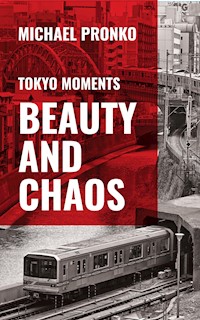
Part memoir, part travelogue, and part culture guide, Beauty and Chaos taps into the daily mysteries and poignant moments that make living in Tokyo a baffling delight. After two-plus decades writing, teaching, and living in Tokyo, American novelist and literature professor, Michael Pronko, reveals what’s beneath the gleaming, puzzling exteriors of the biggest city in the world.
Whether contemplating Tokyo’s bonsai houses, pachinko parlors, chopstick ballet, or the perilous habit of running for trains, Pronko explores Tokyo’s back alleys and curious interactions to find the city’s deeper meanings and daily pleasures.
Tokyo emerges a fascinating city full of chaotic commotion and serene beauty—one of the most amazing, confusing places in the world.
Gold Award eLit Awards for Essays/Creative Non-Fiction
Gold Award Non-Fiction Author’s Association
Gold Award First Place Reader’s Favorite for Cultural Non-Fiction
Best Nonfiction Books of 2015 Doing Dewey
“A clear-eyed but affectionate portrait of a city that reaches beyond simple stereotypes. An elegantly written, precisely observed portrait of a Japanese city and its culture.” Kirkus Reviews
More at: www.michaelpronko.com
Sie lesen das E-Book in den Legimi-Apps auf:
Seitenzahl: 224
Veröffentlichungsjahr: 2014
Ähnliche
















Beauty and Chaos:
Slices and Morsels of Tokyo Life
By Michael Pronko
Raked Gravel Press 2014
Beauty and Chaos: Slices and Morsels of Tokyo Life
By Michael Pronko
First EPUB Edition, 2014
Copyright © 2014 Michael Pronko
First English Edition, Raked Gravel Press
First Japanese Edition, Media Factory publishers, 2006
All rights reserved worldwide. This book may not be reproduced in any form, in whole or in part, without written permission from the author.
eBook formatting by FormattingExperts.com
Cover Design © 2014 Marco Mancini, www.magnetjazz.net
ISBN 978-1-942410-03-4
It was like a metaphor.
Cees Nooteboom
You must stay drunk on writing so reality cannot destroy you.
Ray Bradbury
Tokyo is an empire of signs.
Roland Barthes
Tokyo is an empire of relations.
Saiichi Maruyama
Confusion is a virtue.
Chinese saying
Table of Contents
Part One: Fastidious Refinement, A Meticulous Love of Life
No Space Left Unmapped
Automatic Tea Ceremony
Floods of Advertising—On Sale Now!
What’s Your Bag?
Life Delivered to the Door
Half Empty or Half Full? Walls of Bottles
Waiting to Blossom—Cherry Tree Maps
How I Ended Up Here
Part Two: A Beautiful Confusion
Frames of Emptiness
Clothing That Shouts—T-shirt Words
Standing Libraries
Reading the Signs
The Point of Point Cards
The Noisiest Time of Year
Ordered Around—Public Rules
The Delicate Ritual of Small Change
A Big Bowl of Japan
Part Three: Scenes from the Train
The Paperback-Cellphone hypothesis
The Pumpkin Train—Late Night Commuting
Hanging On the Meaning
The Ebb and Flow of Human Motion
All the World’s a Stage-Train Platforms
Slideshow Lives, Glimpses Inside
Both Directions at Once, Change in the City
Tokyo’s Million Marathons
No Time to Spare—Schedules
Part Four: Beauty and Chaos, Slices and Morsels of Tokyo Life
Souvenirs from the Land of Impulse—Don Quixote
Elegant Eating—the Art of Chopsticks
What Goes Around Comes Around—Pachinko
The Tradition of Banners
The Summer Whispers and Calls
Bathing in Kanji—Hanging Menus
Pink Power
Floating in a Sea of Words
Singing in the Rainy Season
Part Five: A Maze of the Mind
Up and Down and Down and Up—City of Stairs
A-maze-ing Tokyo
The Shiny and the Rough
Escalators to Heaven
The Love of Small Places
Around and Around—Going in Circles
Bonsai Buildings
Part Six: After Words
Seeing the City, Reading the City
The City Provokes Me—Why I Write These
Japan and Me
After Words and Thanks
Glossary
Dedication
Also by Michael Pronko
About the author
Part One
Fastidious Refinement, A Meticulous Love of Life
No Space Left Unmapped
Maps are an essential part of life in Tokyo. Every bookstore carries a wide selection of city maps, tourist maps, graphic atlases for driving, walking, or train-ing, and map-laden guidebooks for everything from historical walks to shopping streets to bar hopping. Department stores post floor-by-floor layouts, restaurants hand out enticingly mapped flyers, and office building lobbies post diagrams as often as office numbers. Cell phones access on-screen maps, websites magnify and customize maps, while computerized navigation maps in cars and taxis even talk!
Then there are the train maps—of all the different lines, of the station interiors, of the station exits, of the train car doors most convenient to transfer at different stations down the line, and of the areas surrounding the exits. Racks offer glossy paper maps of the nearest chome. Then, once outside the station, there are those quaint, half-rusty metal maps clamped onto fences that show every small slice of nearby territory in hand-painted detail.
What kind of a city would spawn so many maps? I am not sure which amazes me more—the level of detail or their omnipresence. This peculiarly Tokyoite obsession is more than just practicality, I think. Of course, even the most experienced commuter or hardened shopper needs a map from time to time, but something more is at work with all these maps.
I notice this affection/obsession most often at the wide banks of ticket machines at stations. Plastered above the machines are huge megalopolis-wide train maps. The colors, ovals, balloons, varying marks, differing versions, brief annotations, and highly simplified lines all struggle to clarify the complexities of the train systems. These are not easy to use, of course, but people stand and stare longer than they really need to verify their direction. They seem to take pleasure in just following the flow of lines, considering alternative routes, mulling over the journey, and pondering how the immense sprawl of the city can be condensed into three white panels.
On the train, I always stand where I can see the diagram of train lines stretched over the door. They hang there not just for ease, but majestically, like a cryptic Buddhist saying over a wooden temple door. I notice other commuters also staring at these maps or gazing at the single-line list-map of station names. Rather than just whiling away a boring commute, they seem to be enjoying the accumulating passage of each station as they ride along. The map at times seems better than the city itself passing outside, or at least more comprehensible.
On Tokyo’s streets, I often see perplexed people searching for places. They surreptitiously check the map in hand against the concrete confusion of actual cityscape. Even normally reserved Tokyoites chuckle when at last they find the right place, sometimes even pointing with glee at the actual place that has appeared, finally, almost magically, right in front of them. When that happens, the map has worked its navigational trick, so that one feels like a world-class adventurer. Though Tokyo’s territory is perhaps the most thoroughly gone over cartographically of any in the world, from an individual standpoint, it very often feels unexplored.
Part of that constant newness of Tokyo comes from its visual plane of surfaces, outsides, windows, side streets and odd cut-ups of space that make it hard to process. To get anywhere, the mind has to exclude the unnecessary and focus on the relevant. Maps reflect this mental process perfectly. They offer a kind of self-locating comfort—a reassurance through artistic simplification. The Yamanote line, which in fact coils around awkwardly like a dead snake, becomes a prim, perfect oval with colored lines spinning out in all directions like sunrays. The style is smoothed and rounded, almost cute. Some harried days, without that near-comic compactness, the city would just be too overwhelming.
After all, Tokyo is NOT a comforting city of straight, easy-to-follow lines. Its logic, if there is one, is hidden deep. Yet, on maps, the city seems to make perfect sense. The jangled, frazzling chaos of the city appears neat and ordered. All is connected; all is positioned. The gargantuan proportions of the city can be taken in at a glance. Maps allow us to step back from time to time with a welcome two-dimensional abstraction.
Maps then are something like X-rays. They strip down the city to its essence and reveal its inner structure. They remove the bewildering surface distractions of Tokyo and let us see the city very differently. Maps trim away the extras to reveal the inner connections, and, more importantly, its intangible beauty. Maps offer an aesthetic sense of permanence amid the constant, at times aggravating, flow of trains, people, bikes, cars and construction. Maps remind us that the city, despite its ongoing self-renewal, has continuance, like a plant that grows back in the same way, no matter how often you cut it.
But perhaps the most intriguing part of Tokyo’s maps is the smallest—the little red marker that says, “You are here.” That point helps locate oneself in the middle of the hustle-bustle of the city with startling reality. No one ever really sees the city as a map does; even the tallest skyscraper offers only half-angled views and the street allows only baffling, too-human-sized perspectives. So whenever I look at a map of Tokyo, (and fortunately, I get to look rather often), I relish first the grand, impossible, top-down perspective, and then I search for that little red marker, that lets me think to myself, yes, I really am here.
Automatic Tea Ceremony
Whenever you need a drink in Tokyo, you need not walk far. Vending machines sprout up like metal mushrooms in every once-empty stretch of urban space. A lone vending machine poking up in the middle of a park, breaking up a block-long temporary construction wall, or set into the fence of a soon-to-be-developed plot of land would surprise no Tokyoite. The surprise is when you can’t find one.
My first reaction to all these machines was how many, how ugly and how tacky-cheap they were. Cigarettes, condoms, alcohol, flowers, tickets and even rice can all be had at the drop of a coin and the poke of a button. Buying any of these from a machine seemed to be a symbol of the cold, distancing forces of technology and so-called convenience. These white boxes of wasted energy stood as a testament to the dehumanizing forced-feeding style of Japanese consumerism, just another way to con another 100 yen from my pocket and avoid wages for employees.
Gradually, though, I realized the genius of these brief, little pleasure centers. To stop and have a cold something at any of the white behemoths bolted into concrete corners and onto underused walls is anything but alienating. Rather, in the midst of the mad flow of Tokyo, a slim syringe of cold tea is highly restorative. Stopping to suckle a canful of fluid helps to insert into the jabbering, adult conversation of commuting a pause, a breath, the open silence of a Japanese sentence that speaks volumes. In Tokyo, slowing the flow by stopping to take a moment for re-hydration or sugar loading is very needed at times.
What you really get for 100 yen, or 110 or 120 yen, is a cold, wet shiver of stationary comfort, or a warm-up in the cold when the machines switch to hot drinks, and a moment of quietude before charging back into the fray. If you were to completely stop in a café, say, it would be harder to re-start the engines and get going again. Drink vending machines are like the little cups of water handed to marathon runners as they pass by. They are comfort stations in the ekiden rush of Tokyo life. Grab one and run on.
Of course, you could do that at any of the kissaten coffee shops or small shops everywhere and anywhere in Tokyo, but that’s different. Entering into the interior of another space, public as it is, means entering into a whole realm of conventions and obligations. The mere task of ordering an ice coffee sometimes just seems too much. Vending machines remain entirely outside of all social engagement. They are neater, quicker, smoother, and less trouble. Simple and satisfying, they sanction anonymity. They require no polite language exchanges.
That doesn’t mean cold, distant and inhuman, however. The very simplicity is transformative; the clinking drop of the coin becomes a gurgling drop of liquid, the primal human intake, individual desire, pure self-centeredness. It is very human indeed, like a fantasy where one can stand and drink and relish the illusion of the importance of one’s own personal inner narrative of need.
After all, the machine is only the outward symbolic front of human input. An entire network of social, psychological, economic, and technological complexity is contained behind the cheerful, bulbous front of drink machines. One night, I saw six men hefting a pristine new machine up a flight of stairs in a station. It took them about five minutes per stair, even with the special stair-climbing handcart they used. The vending machine was like a miniature pre-fab building, only more complex.
Caretakers of the machines come around during off hours, wheeling heavy stacks of boxed cans. It is also always a little shocking to see them open the machine for re-stocking or repair. Seeing the revealed innards, the sharply poised sprockets, the punched steel dividers and wild springy wires is almost obscene. We relish the normal covering up, the unexposed magic of the machine, the colorful membrane of functionality. Once the cover’s shut, the machines have a cuteness and compactness that appeals to the heart of most Tokyoites.
Yet, the vending machine purchase is not really a loss of traditional, social interaction. It might seem the crude negation of the elaborate rituals of shared eating and drinking ceremonies or the chatty stopover along the ancient Tokaido highway, but the root is the same. What seems a little tacky, cold and impulsive is also very practical, comforting and spiritual. The blend of human and mechanical, ritual and relaxed, aesthetic and practical are as different as watching a historical drama on TV is from going to see kabuki at a theater. But at heart, vending machines are a kind of rough, commonplace reincarnation of the refined delicacy of that most Japanese of cultural expressions—the tea ceremony.
To me, this feels curiously spiritual, offering a hint of animism and the resignation of re-established ritual. Out of respect, and a kind of awe, for this mysterious production of pleasure, drinkers, coin droppers, lots and lots of them all over Tokyo, bow deferentially to the modern shrine to technology. To pick up the can from the black receptacle at the bottom of the machine, a respectful bow of the entire body is unavoidable. With the slim metal slot substituting for the wooden collection box of a temple, and the button and buzz substituting for a rope and bell, the machine seems to waken the hiding gods to hear our petty little silent prayers, as shrine goers do all over the country, and come down and out to enjoy with us a moment of fleeting delight.
Floods of Advertising—On Sale Now!
Every so often in Tokyo, I step completely into an advertisement. At least it feels that way when an entire train is engulfed in an all-over promotional campaign. When every single spot inside a train features one new product’s image over and over, I know that once again, I have been swallowed up by the Japanese concept of shinhatsubai.
Shinhatsubai is a potent concept. A kind of advertising madness that springs from the world of commercial consumerism, shinhatsubai campaigns blanket the visual space of Tokyo with a peculiar kind of energy. In Tokyo’s high-energy market, shinhatsubai stands as one of the most characteristic expressions of Tokyo’s consumer mindset. In Europe and America, too, newness appeals, and sells, but in Tokyo, newness seems an obsession.
What amazes me most is how any new item of any sort can be put on sale? Where would it fit? Every shelf in every store in Tokyo is so jammed to rush-hour-like capacity with products and more products. There isn’t even any room for more shelves, nor more stores either. So when I see the shinhatsubai, I wonder where anything could possibly fit.
Of course, old products have to be taken away. Retired or out-of-date products disappear quietly into obscurity, while advertising directs everyone’s attention to newness. An entire product cycle of birth and death recurs over and over again, with each shinhatsubai advertising sounding like the over-enthusiastic pride of a new baby announcement.
Many products appear regularly or seasonally. A new style of beer is concocted at least every season, like some quarterly report on beer factories, despite beer being perhaps the oldest product in the history of civilization. Gum, lipstick, and video games, all constantly have the necessity of shinhatsubai. Every week or so bright new flavors, splashy new colors, and clever new ways to video-kill new characters appear in these ads.
Something about shinhatsubai, though, seems very different from stereotypical Japanese character. Normal people would never jump out and thrust their meishi name cards at you or shout wildly at you on first meeting. Just the opposite, Japanese are usually calm, quiet and reserved—exactly opposite to how shinhatsubai slaps you in the face with attention grabbing techniques.
The techniques of shinhatsubai advertising, too, seem unlike Japanese aesthetics. The lettering feels loose, wild and extravagant. The kanji seem to burst from the page, shooting up to the right or across the top with breathless excitement. For me, that electric kind of lettering feels so different from the graceful curves and elegant kanji usually respected in Japanese culture.
The smiles on the faces and the pose of the bodies, too, feel fake and contrived. Like with beer, there is simply nothing new in human bodies, but the nubile young women posed with enticing voluptuousness try hard to create the illusion of newness. The body language of shinhatsubai models conveys over-enthusiastic messages that lack the appeal of natural looks.
Then, there are the little give-aways. Key rings, folders, jackets, small boxes, and plastic containers, all sent for “free.” Those little brand products further the advertising into other areas where the average advertisement could never reach—into homes, out on picnics, into cars, and deep in purses. The feeling of “shin” must disappear in all those places pretty quickly.
There is a backlash in Japan, though, too. Non-advertised goods have their own appeal and sense of elegance. Whether these goods are high-class or fureeta fashion, they refuse advertising to gain a kind of non-advertised notice. Their appeal lies outside of or beyond the predictable confines of shinhatsubai presentation. “I don’t know that” becomes the alternative to shinhatsubai, and can be just as appealing.
All this newness seems the harmless diversion of a commercial fantasy. The impression one gets from all the shinhatsubai campaigns is that products are constantly being created with tremendous novelty, yet, in reality, most products have only the slightest of developments. They just loudly label themselves “new.” The emphasis of shinhatsubai is really not on the first kanji, shin, for “new” but on the last, bai for “sale.” It just takes a lot of advertising energy to pretend otherwise.
What’s Your Bag?
In Tokyo, most people carry more than one bag, often more than two. All over the city, well-designed store bags dangle from people’s hands in what amounts to a huge, mobile, display of bag craft. Tokyoites always have a standard purse, work or school bag, but most days they also carry an extra bag from a store. The practicality of these bags is the least of it; the meanings, uses and quality are appraised and understood. You can see people’s pride in strutting along the street with a good store bag—or two—or three—in hand. Bags are an essential part of Tokyo life.
In Tokyo, part of the pleasure of purchasing anything is the bag. Quality matters and quality is a carefully studied business. When purchasing anything at a store, Japanese wait apprehensively for their first look at the bag. Does it have a good handle? Is it laminated? How strong is it? Will the bottom folds become pushed out and bloated? Where and when can the bag be re-used? The quality, both of material and design, varies with the price of the store. Some stores overshoot their level by offering exceptional bags, but typically it’s a perfect fit. People know they will be proudly using those bags many times for many purposes.
Every Japanese home has an area reserved for carefully saving these bags to be re-used. My home has four bag storage sections: one for cheap bags that could be used for trash; one for bags that are nice enough for close friends or self-use; a premium bag area for high-quality, well-designed bags to enhance small gifts; and lastly, a super-secret space for really superior bags to be used only for extremely special occasions, or perhaps never even used at all. I have an entire shelf in my office for received bags that can be re-used when lending students or colleagues a book, CD or other little item. Once a year or so, I sort through them and throw out the worst, re-folding the good ones and putting them neatly in order.
Some of these bags will be saved for years—waiting for just the right moment, the right gift and the right person to be given their bag “life” back again. Picking the right bag and returning it to the citywide bag circulation that runs through Japan like an alternate economic system is always a special pleasure. It can take considerable time before leaving the house to find just the right bag. Taking something “naked” would be embarrassing. Giving away a longtime favorite bag can be distressing, but receiving an unexpected great one is a pleasure.
Bags are practical and functional of course; saving and re-using them is part of the mottainai attitude of never being wasteful, one of Japan’s most obdurate values. Choosing just the right one to re-use, though, is an important and tricky ritual. The crinkly sound of some bags makes them too noisy; others are too slippery or too thick. Some have a strange feel or do not fit what you are carrying or giving. The lettering, colors, tape over the top, handle, and “fold-ability” all interact for a complex set of considerations that match the perfect bag to the situation.
Tokyoites are careful about their appearance, so bags often match their outfits, in color, style or texture. In western countries, the thing inside is most important; any old outer bag will do. For Japanese, an extra store bag works like a small accent to what they wear, an important accessory, a statement. The coy passion for wrapping in public, knowing there is something inside, also creates an alluring intrigue. I always wonder what exactly is in all those bags. Bags make a statement with simple flair and a whiff of mystery.
Most of all, bags reveal how much Japan is at heart still very much a gift-giving society. The bags form an essential part of the gift-giving ritual. The levels and types of bags are as complex as the grammar of Japanese verbs for giving and receiving. Most beginning Japanese language texts for foreigners would do better to leave out the confusing lessons on verbs for giving and receiving, ageru, morau and sashiageru, which takes years to master in any event, and instead just put in drawings of appropriate bags for different social situations. Having the right polite language is always good, but giving a gift in the wrong bag is a major social gaffe. To avoid such embarrassment, people save bags for whatever contingency might arise in the complex system of gift-giving manners.
These bags are the modern version of the traditional multi-purpose cloth furoshiki: they wrap, enhance, carry, contain, hide, and show off. Bags replicate traditional aspects of Japanese psychology and culture with modern convenience. Compared to the purses, briefcases, and uniform schoolbags, which are obligatory giri bags that hold necessities, job stuff and serious things, these re-used shop bags are dedicated more to fun. They could be called ninjo (the opposite of obligation—human feeling) bags, filled with desired purchases, an extra possession, a small gift, or a borrowed item to be returned—in short, they are filled with humanity and feeling. Perhaps Tokyoites need to always keep those two realms separate and distinct.
I am sure, too, that if a huge earthquake ever hits Tokyo, as it is predicted to do, that all these bags will save lives. They would store things cleanly, distribute rice, protect feet, or carry water. In a post-earthquake world, with so many things sure to be lost, these millions of bags will still be performing their many practical and social functions for a long time to come.
Life Delivered to the Door
When I first moved to Japan, a friend gave me a huge microwave oven and the two of us carried it up the station stairs and crammed on to a rush hour train. The three of us—two foreigners and a huge box—took up a lot of room, so people really scowled as they stumbled around us.
During that first year, I hauled everything from large suitcases from Narita to overstuffed chairs from Shibuya to a heavy, old-style computer from Akihabara—all on the trains. I felt everyone staring at me with pity and contempt for using up more than my share of the public train, but I didn’t quite know what to do about it. As an American, I was used to carrying everything in my own car.
Finally, I discovered the brilliance of takuhaibin delivery services and my problems were solved. It’s a system I’ve come to rely on and marvel at. Takuhaibin trucks are everywhere. Every neighborhood street, mansion entrance and office building driveway has trucks stopping by off and on all day delivering packages.
Traditionally, of course, delivery has always been part of Japan’s urban culture. In the Heian-era Kyoto of Genji Monogatari, love poems were sent all over the city from lover to lover. Now, though, in this age of materialism, everyone sends things instead.
What really amazes me is how the packages actually get to where they are going. In Tokyo, streets are like mazes and addresses like math puzzles. Takuhaibin delivery people, like modern-day samurai, act directly without hesitation—actually running, usually, right to the door. How millions of packages a day can move from one point to another without being lost is a kind of miracle. Packages are flowing constantly from place to place all over Tokyo, like blood cells, barely seen under the urban skin but essential to the life of the city.
The other day, I stepped down to the street to take a peek inside the truck. Though I embarrassed the driver, what I saw was an unbelievable level of organization. The various-sized packages were laid out in the back of the truck just like the various-sized houses and apartments along the route. I realized the entire city, the entire country, is completely mapped out, with every address entered in the master navigation system and the high-tech hand-held computer module the drivers carry, just ready and waiting to be delivered to.
But if it was just practicality, the appeal would be limited. Takuhaibin also saves embarrassment. Carrying things on the train, as I used to, lets thousands of passing people see what you bought and where. While some consumers like parading a name-brand bag on their arm, most Japanese like their purchases to remain discreet. The bland safety of the takuhaibin’s dull brown paper allows anything to be privately sent and received.
Also important is that people can easily send a present to a friend, relative or colleague without the social complexities of actually visiting in person. Tokyoites may have moved away from traditional visiting rituals of the past, but they still like to send gifts. Takuhaibin keeps alive the customs of New Year’s and mid-summer gifts, of sending thank-you and other purposeful gifts. Without takuhaibin, social relations would become even more distant.




