


19,99 €
Mehr erfahren.
- Herausgeber: ibidem
- Kategorie: Geisteswissenschaft
- Serie: Studies in English Literatures
- Sprache: Englisch
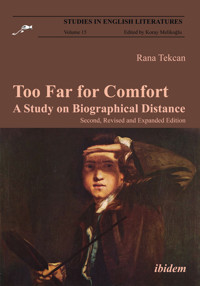
The dynamic between the biographer and the subject is, perhaps, one of the most fascinating aspects of biography as a genre. How does the biographer stage the illusion that is the narrative life, the illusion that the subject assumes a living form through words? In contrast to purely fictional forms, biography writing does not allow total freedom to the biographer in this creative act. Ideally, a biography`s backbone is structured by accurate historical facts. But its spirit lies elsewhere. The way a biographer captures the spirit of a subject is intriguingly shaped by the historical distance between the two. We find three types of distance in biographical narrative: First, where the biographer and the subject personally know one another; second, where the biographer is a near contemporary of the subject; and third, where biographer and subject are distinctly separated; in some cases, by hundreds of years. In this revised and expanded edition, Rana Tekcan explores how some of the most accomplished biographers manage to recreate “life” across time and space. She looks at their illusionary art through the narrative strategies in Samuel Johnson`s Life of Savage, James Boswell`s Life of Johnson, Lytton Strachey`s Eminent Victorians, Michael Holroyd`s Lytton Strachey, Park Honan`s Jane Austen, and Andrew Motion`s Keats.
Das E-Book können Sie in Legimi-Apps oder einer beliebigen App lesen, die das folgende Format unterstützen:
Seitenzahl: 300
Veröffentlichungsjahr: 2015
Ähnliche




















ibidem Press, Stuttgart
Table of Contents
Acknowledgements
I owe a debt of gratitudetoProf. Manuel Schonhorn of Southern Illinois University, Carbondale who introduced me to biographical studies; to Prof. Cevza Sevgen, my doctoral supervisor at Boğaziçi University, who guided me throughthis work;to the faculty members at Istanbul Bilgi University Comparative Literature Department who daily create the most congenial work environment any academic can wish for; to thestaff atIstanbul Bilgi University Library who provided prompt and informed research support; and finally, to Koray Melikoğlu, my editor, who gave thoughtful and meticulous editorial assistance.
Parts of this book were used in a presentation, subsequently published, for the“Life Writing” Symposiumheld at Haliç University, Istanbul, 19-21 April 2006 (see bibliography).
Foreword
To understand just one life, you have toswallow the world.
Salman Rushdie,Midnight’s Children
Biographers are curious people. Their business is other people’slives.They stand at the crossroads of human curiosity and a certain kind of generosity: By plunging into the life of another, they try to realize an individual’s ultimate attempt at understanding, reconstructing, even recreating the life of another individual, atcapturing the essence of a life and a mind. At the same time, by making this attempt public, they gratify the curiosity of other individuals.
Biographers have to face the daunting task ofdealing with all sorts of diversematerial such as letters, diaries,orinterviews. Most of them visit the places where their subjects have lived, travel to where they have travelled, read what they have read. This is a way totraceimagine,and finally, to reconstruct the subject’s life. The final outcome does not reflect a simple listing of discovered facts, but a series of choices specificto the rendition of the subject bythe biographer. This is at the heart of the phenomenon of multiple biographies of the same subject. Each biographerimagines andrecreates the subject through the available material. Since no two people interpret the same material in quite the same way, no two recreations are the same. Therefore, there are as many subjects as there are biographies of that subject.The extent of this multiplicity of biographical interpretation should be illustrated in some detail before a discussion of thenarrative dynamicbetween the biographer and the subject is attempted.
Multiple biographies of the English novelist Jane Austen may well be used for this purpose. Since her death in 1817, Jane Austen’s lifehas inspiredquite a number ofbiographical writings. Austen’s letters to her sister Cassandra and occasionally to other family members, memoirs,family papers,parish registers and other similar documents are among the standard sources utilized by her biographers,and no groundbreaking new material has been discovered since William Austen-Leigh and Richard Arthur Austen-Leigh publishedJane Austen, Her Life and Letters, A Family Recordin 1913.[1]Yet, since then, each of her subsequent biographers must have felt that the previous biographies lacked in certain aspects, that they somehow failed to present their subject“as shereallywas”.
Deeply privateand reticent by nature, Jane Austen –the much wondered about “lady” who wrote the greatly admired[2]novels– certainly did not volunteer any information on herself. The first biographical information on the author came out almost as a necessity. One of her older brothers(incidentally, her favourite), Henry Austen felt himself obliged to respond to the many inquiries about the private life of the author after her death. He added a “Biographical Notice of the Author” to the 1817 (title page 1818) posthumous joint publication ofNorthanger AbbeyandPersuasion. In it he describes his sister in the following manner:
Her stature was that of true elegance. It could not have been increased without exceeding the middle height. Her carriage and deportment were quiet, yet graceful. Her features were separately good. Their assemblage produced an unrivalled expression of that cheerfulness, sensibility, and benevolence, whichwere her real characteristics. Her complexion was of the finest texture. It might with truth be said, that her eloquent blood spoke through her modest cheek. Her voice was extremely sweet. She delivered herself with fluency and precision. Indeed she was formed for elegant and rational society, excelling in conversation as much as in composition. [...] She had not only an excellent taste for drawing, but, in earlier days, evinced great power of hand in the management of the pencil. [...] She was fond of dancing, and excelled in it. [...] Though the frailties, foibles, and follies of others could not escape herimmediate detection, yet even on their vices did she never trust herself to comment with unkindness. Faultless herself, as nearly as human nature can be, she always sought, in the faults of others, something to excuse, to forgive or to forget. She never uttered either a hasty, a silly or severe expression. [...] She was thoroughly religious and devout; fearful of giving offence to God, and incapable of feeling it towards any fellow creature. (31-33)
The affectionate brother-as-biographer depicts Austen as the ideal “spinster” sister: elegant, sensible, benevolent, cheerful, dutiful, quiet, accomplished and religious. She appears to be the epitome of perfection very much in line with the norms for unmarried women at the turn of thenineteenthcentury. Yet, biographical research brings to light the natural fact that not everyone who knew her was so adoring. An old family friend from Hampshire, a Mrs. Milford, remembered Austenat a timewhen her authorship began to be known. Miss Milford, her daughter, wrote the following in a letter:
I have discovered that our great favourite Miss Austen is my country-woman; that Mama knew all her family very intimately; and that herself is an old maid (I beg her pardon – I mean a young lady) with whom Mama before her marriage was acquainted. Mama says she was then the prettiest, silliest, most affected husband-hunting butterfly she ever remembers and a friend of mine who visits her now says that she has stiffened into the most perpendicular, precise, taciturn piece of “single blessedness” that ever existed, and that till “Pride and Prejudice” showed what a precious gem was hidden in that unbending case, she was no more regarded in society than a poker or a fire screen or any other thin, upright piece of wood or iron that fills its corner in peace and quiet. The case is very different now; she is still apoker but a poker of whom everyone is afraid. It must be confessed that this silent observation from such an observer is rather formidable…a wit, a delineator of character, who does not talk is terrific indeed.(W.and R.A.Austen-Leigh, rev. ed. 198-99)
Biographers need to decide what they will do with both the statement of the brother and the statement above. How are they to be reconciled?Shouldthey be reconciled? One way is to ignore one of them altogether. Another is to interpret them in a way supportingthe biographer’s overall picture of the author that will come across in the biography. In herOnly a Novel:The Double Life of Jane Austen(1972), Jane Aiken Hodge fits Mrs. Milford’s “the prettiest, silliest, most affected husband-hunting butterfly” comment within her vision of Austen living a conforming public life on the one hand and a private creative life on the other. She keeps silent about the rest:
I like to think that this report might have been superficially correct, though basically false[…]what was intended as criticism was in fact high praise. It shows how successfully Jane Austen had embarked on her double life. Young ladies were supposed to be pretty, and silly, and on the catch for husbands. Jane Austen had decided to conform. And as “an artist can do nothing slovenly”, she was naturally, the prettiest and silliest of them all. (46)
Hodge tiesMrs Mitford’sstatement to Austen’s own statement on artistry and presents her actions as conscious social choices. Six years later another biographer, Lord David Cecil comments on the Milford letter in hisA Portrait of Jane Austen:
On examination these sharp words turn out to have little evidence to support them. For one thing, Mrs. Milford left the Steventon district when Jane was only ten years old, so that she can only be speaking on hearsay. For another, the description [...] is at variance with everything else we know about Jane Austen. Whatever false impression she may have made at twelve years old, it is incredible that the grown-up Jane Austen, the Jane Austen who, within a few years, was to create such devastating embodiments of silliness and affectation as Lucy Steele and Isabella Thorpe, should herself have ever appeared as affected, let alone silly. Or husband-hunting; though, like most girls of her age, she probably considered any young man she met in the light of a possible husband. Altogether Mrs. Milford’s account must be considered mainly worthless. Personally, I should be sorry to regard it as wholly worthless. I like to think there was a time in Jane Austen’s life when she could be called a pretty butterfly. I know of no other women writer of the first rank who has been similarly described. (67)
Although Cecil dismisses the document at first, he cannot keep himself from commenting on it in a way that supports his own vision of the author as a well-adjusted woman who would shun folly in any shape or form. He gives credit to the statement,in the manner of an understanding father, by making the readerimaginea livelier,true-to-lifeyoung girl whohad the artisticvisionas well as the social experience to write the sparklingPride and Prejudice.
The theme of love and marriage is also an important concern for Austen biographers. Since her sister Cassandra burnt the letters that are commonly supposed toincludethese subjects, and very little else is known about the love life of one of the most successful writers of love, the biographers have to make do with what they have. It is a known fact that the son of a wealthy family friend, Harris Bigg-Wither proposed to Austen. He was accepted. However,the followingmorning Austen apologized and withdrew her acceptance. This change of heart –or mind– is easily accepted by female biographers. Elizabeth Jenkins, for example, simply writes, “[when] it came[…]to marrying without love, she could not do it” (102). Male biographers, on the other hand, have a harder time accepting her refusal of a wealthy man from a good family at a time in her life when it could have been a much-needed financial and social relief. Park Honan spends six pages justifying the decision and ends up almost apologizing for Austen.
Even the letters that are generally considered reliable can acquire different meanings depending on the way they are read. Austen writes toher sisterCassandra about the book she is planning to write, then says “Now I will try to write of something else, and it shall be a complete change of subject – ordination” (Chapman 298). For a long time, it was thought that Austen was referring toMansfield Parkin which Edmund Bertram’s ordination carries great import. Scholars commented that Austen was announcing a total change of subject in her new novel, and that her primary concern was ordination. This was considered the standard interpretation. But, later on, a more careful reading of the letter and a closer attention to punctuation revealed that when Austen wrote about the change of subject, she merely meant that she was changing the subjectin her letter, the ordination she would be writing about was not Edmund Bertram’s fictional ordination, but the very factual ordination ceremony of Austen’s elder brother James Austen (Honan 336). Biographical researchers can get so excited when they think that they have found new information that they may misread a text.
There are also deliberate misreadings. John Halperin, author ofThe Life of Jane Austen, seems to have started writing with an intention to bring forth a side of Austen many readers do not know existed, and many Austen scholars do not want to accept. This sensationalist approach leadsto misquotations such as exchanging‘possible’for the original word‘impossible’while quoting from Henry Austen’s “Biographical Notice” (Halperin 5), which reversed the meaning.Halperinwants to emphasize Austen’s less than perfect relationship with her mother. He quotes from Austen’s letter to Anne Sharp (Thursday, 22 May 1817) which she wrote during her last illness (344). In this letter, Austen talks about her appreciation of her sister and brothers for theirkindness and care during her illness; but Halperin claims that she does not mention her mother. This is presented as proof of thecoldnessthat existed between themeven just beforeAusten’sdeath. In order to prove his point, Halperin convenientlyomits this sentencewhich comes further on in the letter: “I have not mentioned my dear Mother; she suffered much for me when I was at the worst, but is tolerably well. [...] In short, if I live to be an old Woman, I must expect to wish to die now; blessed in the tenderness of such a Family [...]” (Chapman 203). He presents Jane Austen as a bitter, sarcastic, frustrated spinster; the biography is full of words like “pettiness,”“nastiness,” “mean spiritedness” and “cold-hearted.” This is Halperin’s Austen.
Which is therealAusten? Maybe all or maybe none. Yet one thing is certain: There are as many Austens as there are Austen biographies, and there can be no “definitive biography” exceptin the blurbs that grace the covers of biographies themselves.
This brief look at the roots of the elusiveness of the subject in biography as a genre reveals that the earlier statement –that there are as many subjects as there are biographies– can be reworded in a way that would put the issue more accurately: there are as many subjects as there are biographers. Access to biographical material is an important factor in the differences between biographies; nevertheless, given exactly the same material to work with, no two biographers will draw the same conclusions. Therefore, the key is the interpretation of the biographer. After all, each attempt at writing the life of a subject is unique in that each carries the imprint of theinterpretive and creative faculties of a biographer’s mind.
The main interest of this book is thevarious ways of recreating the“biographicalself”in narrative, in other words, the intricate relationship of the biographerwiththe subject. What exactly does a biographer do when s/hegives shape to a lifein a biography? This is a question widely ignored both by readers and reviewers of biography. Most reviews of biographies in literary magazines and journals –and there are many,since biography is a highly popular genre–ignorethe narrative strategies and styles of the biographies as if theywere directly lookingat the content. But what is content without form? It is biographical form that gives shape to the biographical subject. Without it no illusion of a living and breathing person can be created on paper. The recreation of the biographical subject is a complex endeavourand requires a complex narrative. In contrast to purely fictional forms, biography writing does not allow total freedom to the biographer in the creative act. Ideally, a biography’s structure or backbone is formed by accurate historical fact – in that sense, it claims a kinship with history. But its soul lies elsewhere. Since the concern is life,something more is needed. This “something more” is desired both by writers and readers of biography: It is the vivid sense of alived life; nothing dry, cold or dead, but a well-rounded, vibrant impression of a life that is left in the air after one turns over the last page of a biography of literary value.
Each biographer uses different narrative strategies to create this impression; however, s/he is, once again, unable to exercise total freedom. The use of these narrative strategies cannot be arbitrary. It is dictated by what will be called the “distance” between the biographer and the subject in terms of time and space (Alpers12). Distance serves as a centrearound which the issues of biographer and subject relationship can be discussed. Looking at biography in terms of distance also enables us to divide this diverse genre into three main categories for closer analysis.
In the first category, the distance is close – almost non-existent. The biographer is personally acquainted with the subject and writes the biography either at the time when the subject is alive or not much later than his/her death. In most of these cases the biographers are relatives or close friends of the subject. No matter who they are, they have firsthand knowledge of their subjects and more often than not, have access to personal documents. Many biographers and readers consider such an acquaintance as an advantage, yet “its accompanying liability of nearly unavoidable bias has almost as oftenbeenviewed as a challenge, sometimes even an outright obstacle, tothemodern ideal of skeptical objectivity” (Parke 4).
The biographers in the second group are near contemporaries of their subjects. Although they do not know them personally, they “either possess, or [are] equipped to acquire, a thorough understanding of the [...] subject’s background and sphere of activities” (Alpers 12).
The biographers in the final category are distinctly removed from their subjects. Let alone knowing them personally, some of themdo noteven have a chance to know what their subjects look like.Although this might seem like a disadvantage, in certain cases it might actually be a blessing in disguise.Safely removed from the subjects as well as their close relatives and friends,sometimes by hundreds of years, these biographers enjoy a kindofcreative freedomaway from the watchful eyes of fierce protectors of biographical material whom biographers from the other two categories sometimes have to fight against.
Twobiographies from each category are selected for this study. The purpose is firstly, to doat least somejustice to the immense variety of the genre; secondly, and more importantly, to illustrate how the approach to the subject and the employment of narrative strategies may vary under similar circumstances. It will be noted that five out of these six biographies are literary biographies in the sense that they are biographies of literary figures. This selection is not deliberate, since the book will not concern itself with any specific or common attribute of the subjectsthemselves. What is deliberate though is that they all satisfy the second definition of the term: They all are biographies ofconsiderableliterary quality.
1Eating and Drinking with the Subject: Johnson’sLife of Savageand Boswell’sLife of Johnson
Nobody can write the life of a man, but those who have eat and drunk and lived in social intercourse with him.
SamuelJohnson,TheLife of Samuel Johnson LL.D.
There is a group of biographers who are historically placed at such a privileged moment that they are able to see their subjects with their own eyes. Does it follow that the strongest asset of any biographer is his/her personal knowledge of the subject – as Anthony Alpers says with reference to Robert Browning’s famous line, “the author once saw Shelley plain, and there is no substitute for that” (12)? Whether this unique situation is an advantage or a disadvantage in disguise has been a topic for debate. There are cases where the personal relation between the biographer and the subject produces disaster. The biographers in such cases are mostly relatives or close friends who may be just too close to write a reliable narrative. The commemorative instinct reigns above all other likely and often imperative considerations such as adherence to facts or objectivity. The outcome is a panegyric full of tiresome praise, distortions of fact and covering of faults.
Despite the possible abuses of the “distanceless” biographer-subject relationship, some of the genre’s most famous examples are included in this category. The biographers in these works manage somehow to curb, transform, or masterfully disguise their basic commemorative instinct. This might be the most complicated author-subject relationship in literature since the intention of writing the biography of someone one knows is never pure, unambiguous or whollyaltruistic. The debate of objectivity is hardly won by the biographer. In the midst of such emotional entanglement choices are not easily made when time comes to express faults or weaknesses without offering justifications. These complications aside, personal knowledge is invaluable to the creation of the sense of immediacy and livedlife. Managing to recreate this immediacy on paper is the touchstone of any successful biography. These biographers are lucky: What is there to make the retelling of a life more vividthan knowing the subject’s favourite walk,favouritefood, the absolutelyfavouritepoem, the tone of his/her voice when s/he speaks or the look on his/her face when s/he gets angry? Naturally each biographer uses this advantage in his/her own way, in certain cases the intimacy itself is reason enough to write a biography.
Within this category it will be interesting to look at two well-known examples of the genre: Samuel Johnson’sLife of Richard Savageand James Boswell’sLife of Johnson. Both biographers personally knew their subjects in varying degrees and both used this intimate knowledge to find their own way of creating a vivid portrait on paper. As Homburger and Charmley claim inThe Troubled Face of Biographythese works “[seek] to do what only the greatest art has ever done: to convey the feel of an individual’s experience, to see the world as a single person saw it” (xi), their advantage being the opportunity to stand together with their subjects, at least for a certain amount of time, and look at the same world with them. Let us start with one of the most seemingly odd biographical pairs.
In 1777, a group of London based booksellers came together to publish a collection of works by English poets. They were a competitive group since a similar task was recently completed by a group of Edinburgh booksellers. However, that particular edition was criticized for its small print and errors. These London booksellers were determined to make a better effort. They would attach the name of one of the most illustrious literary figures of the land tothe production of their series whichwould ensure profitable sales. With this in mind, they approached the then sixty-eight year old DrSamuel Johnson (1709-1784). He was to write a biographical preface for each of the poets featured. Johnson agreed. He was no stranger to biography by then. He was both a practitioner with a series of lives written for theGentleman’s Magazineand a theoretician with two major essays on biography inThe RamblerNo:60 (1750)andThe IdlerNo:84 (1760)under his belt. Johnson’s prefaces were published under the titlePrefaces Biographical and Critical to the Works of the English Poets; but they came to be known by the titleLives of the English Poets(1779-1781). Shakespeare, Milton, Dryden, Pope, Addison, Gray, Swift are some of the names on this list of poets. However, there is one name among them that is not very readily recognized today: Richard Savage. Why would Johnson add Savage to this list? Is this the generosity of a talented man to one who is less accomplished than himself or did he consider him equal to the others? Any answer we try to find will mislead us if we ask the question thinking Savage as an integral part of this group of literary figures, forLife of Richard Savagedoes not actually belong to the series.
To place this work in its right context we need to go back thirty-threeyears to 1744. We alsoneed to leave behind the older Johnson,whose name attached to any work assures profits, and go to a young Johnson who is just starting out in London, a Johnson who is just emerging from the position of a Grub Street hack “who signed his letters in 1738 ‘impransus’ – supperless” (Holmes 9).
Johnson was writing anonymously for theGentleman’s Magazine. By 1742 he had published a short series of lives of scholars, physicians, scientists, priests, and others. A year later his friend,the poet Richard Savage,died, and in 1744 Johnson wrote his biography.This work,alongside poems like “London” and “The Vanity of Human Wishes,” which he signed openly,established Johnson as a figure of major literary force and fame.
Why pick Savage who was little more than a frustrated genius even for his contemporaries? For the answer we need to look in two different directions. One is personal: Savage was a friend of Johnson’s youth. Together they suffered poverty. Johnson made it, but Savage never did. After a life of misfortune, misunderstanding, waste, and self-destruction Savage died in prison, penniless and virtually friendless. Johnson used biography to justify Savage’s ways to the public, to clear his name for posterity. Ironically, he made his friend immortal through literature, something which Savage himself was unable to realize with his own claim to genius and his literary output.
The second direction is Johnson’s moralistic approach to biography which he later formulated in the two essays he wrote forThe RamblerandThe Idler. InThe RamblerNo:60he writes:
I have often thought that there has rarely passed a life of which a judicious and faithful narrative would not be useful. For, not only every man has, in mighty mass of the world, great numbers in the same condition with himself, to whom his mistakes and miscarriages, escapes and expedients, would be of immediate and apparent use; but there is such a uniformity in the state of man, considered apart from adventitious and separable decorations and disguises, that there is scarce any possibility of good or ill but is common to human kind. (95)
If so, what better material for a biographycouldthere be than Savage’s life? Savage claimed that he was the illegitimate son of Earl Rivers and Anne Countess of Macclesfield. His parentage was never acknowledged and he never got the inheritance which he believed was due to him. He lived a life of poverty with occasional bubbles of good fortune which burst just as soon as they materialized.
Johnson opens his rendition of this “fit for fiction” life with an echo of his moralistic approach. He makes a general statement about the human condition. This is not a conventional opening for a biography. The common practice is to introduce the subject directly, in the very first paragraph. Here, we find that the introductory paragraph does not highlight an individual but what may be considered common to humanity in general, indicating that Johnson is particularly interested in the extent to which this life will awaken empathy in others, and provide them with instruction and comfort.
In this opening section Johnson states that power or fortune does not guarantee happiness. The ordinary person who possesses much of neither,falls into the mistake of believing the opposite and thinks himself unfortunate. Life is full of examples to the contrary. Since power and fortune are “extrinsic,” it is understandable that they do not bring happiness. But one expects more from “intrinsic” attributes such as “intellectual greatness.”AlthoughSavage was unable to gain either power or fortune,Johnson implies that he was a literary gemand thus blessedwith “intrinsic” value;however,the biography will show that this advantage is not enough either. Hence Johnson definesLife of Savageas “a mournful narrative.”In the beginning, the Savage Johnson sees is a gifted man who suffers in life because of misfortunes beyond his control:quite an accurate statement for the early part of Savage’s life, it turns out. However, Johnson seems to have never doubted the accuracy of Savage’s claim to the family name which has since been discredited by subsequent research; and actually the misfortunes of Savage’s later years were mostly a result of his own behaviour. Therefore, the premise Johnson opens with is somewhat contradictory to what follows, but this ambiguity is the dynamic which makes this particular biography work.
Inhis biography of Samuel Johnson,Walter Jackson Bate observes that“Johnson loved biography before every other kind of writing. It gives us, he said, ‘what comes near to us, what we can turn to use’” (xix). Johnson’s alchemy is toturn an ordinary life story into a moral narrative useful for others. For him, this is biography’s mainraison d’etreas a genre. So, before we actually see Savage, we find Johnson’s moral stamp justifying this biography, assuring the reader that it will be worththewhile.
Johnson the master prose writer was aware that long moralizing would not make a good read. True to the “instruct and delight” motto, he confines the introduction to four short, compact paragraphs and starts the actual narrative of the life with a gossipy, attractive sentence, illustrating his full awareness of the entertaining, voyeuristic aspect of the genre, which he is notashamed to use.
In the year 1697, Anne Countess of Macclesfield, having lived for some time upon very uneasy terms with her husband, thought a public confession of adultery the most obvious and expeditious method of obtaining herliberty; and therefore declared thatthe child with which she was then great was begotten by the Earl Rivers (501).
Johnson came from Lichfield, the place he had left as an unsuccessful school-master, to London in 1737. He was twenty-seven years old. There he metthis alleged child of Earl Rivers,the forty year old Richard Savage. By then Savage was one of the most notorious figures of the London literary scene.
They were close friends for two years, just before Savage left for Bristol in 1739 through the insistence of his friends. It was interesting that“no one, at any time, or in any place, ever left a first-hand account of seeing Johnson and Savage together. It was from the start, an invisible friendship” (Holmes 35). No matter how “invisible,” the friendship left a mark on Johnson.Hisown biographers find it puzzling. Sir John Hawkins writes, “with one person, however, he commenced an intimacy, the motives to which, at first view, may probably seem harder tobeaccounted for than any one particular in his life. The person was Mr. Richard Savage” (51-52). Boswell, Johnson’s best-known biographer, writes the following when the time comes to introduce Savage:
[...] a man, of whom it is difficult to speak impartially, without wondering that he was for some time the intimate companion of Johnson; for his character was marked by profligacy, insolence, and ingratitude: yet, as he understandably had a warm and vigorous, though unregulated mind, had seen life in all its varieties, and been much in the company of the statesmen, and wits of his time, he could communicate to Johnson an abundant supply of such materials as his philosophical curiosity most eagerly desired and as Savage’s misfortunes and misconduct had reduced him to the lowest state of wretchedness as a writer for bread, his visits to St. John’s Gate naturally brought Johnson and him together. (Boswell 118)
Jealous of anything and everything that has a chance of coming closer to Johnson’s heart than himself, Boswell dismisses the friendship. He turns it into a calculated act on Johnson part: Since Johnson is avidly curious about human experience, Savage must have been a good source for the future writer – why else would Johnson befriend such a creature? And, of course, Johnson must have never sought Savage’s company – he must have been forced into acquaintance by being much thrown together because of their similar financial situations.
But Boswell does not leave it at that; he goes out of his way to make alengthynote on Hawkins’s sensitive and acute observation in his own biography hinting that Johnson had been charmed by Savage:
Sir John Hawkins gives the world to understand, that Johnson, ‘beingan admirer of genteel manners, was captivated by the address and demeanour of Savage, who as to his exterior, was, to a remarkable degree, accomplished.’ Hawkins’sLife, p. 52.But Sir John’s notions of gentility must appear somewhat ludicrous, from his stating the following circumstance as presumptive evidence that Savage was a good swordsman: ‘That he understood the exercise of a gentleman’s weapon, may be here inferred from the use made of it in that rash encounter which is related in his life.’ The dexterity here alluded to was, that Savage, in a nocturnal fit of drunkenness, stabbed a man at a coffee-house, and killed him; for which he was tried at the old Bailey, and found guilty of murder. (Boswell 118)
Boswell is blinded byhis own prejudice. Although it may have been hard to understand for Boswell, Johnsonwascaptivated by the charismatic Savage. They shareda short periodof their lives when Johnson was quite vulnerable. The young Johnson probably saw similarities between himself and this aging poet: He was most uncertain as to the outcome of his move to London. He knew he was talented, but his talents had not yet born fruit. His grotesque physical appearance, convulsions –remnants of a childhood illness– and episodes of deep depression greatly marginalized him as a young man. He was extremely poor and most definitely angry at his misfortunes. And, in Savage, he found someone together with whom he would be angry at the world. As would be expected from a man of Johnson’sacuity, he was not unaware of Savage’s faults, and being frank in youth as in old age, he did not shy away from criticism where he thought criticism was due.




