


28,99 €
Mehr erfahren.
- Herausgeber: John Wiley & Sons
- Kategorie: Geisteswissenschaft
- Serie: Architectural Design Primer
- Sprache: Englisch
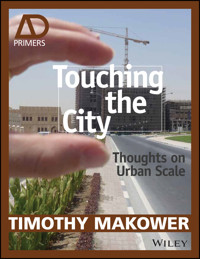
Scale in cities is relative and absolute. It has the ability to make us feel at home in the world or alien from it; connected or disconnected. Both large and small scale in cities can be beautiful; both are right, neither is wrong. Whilst accepting that prescription is no answer, 'getting the scale right' – at an intuitive and sensual level – is a fundamental part of the magic of architecture and urban design. Touching the City explores how scale is manifested in cities, exploring scale in buildings, in the space between them and in their details. It asks how scale makes a difference.
Travelling from Detroit to Chandigarh, via New York, London, Paris, Rome and Doha, Tim Makower explores cities with the analytical eye of a designer and with the experiential eye of the urban dweller. Looking at historic cities, he asks what is good about them: what can we learn from the old to inform the new? The book zooms in from the macro scale of surfing Google Earth to micro moments such as finding fossils in a weathered wall. It examines the dynamics and movement patterns of cities, the making of streets and skylines, the formation of thresholds and facades, and it also touches on the process of design and the importance of drawing. As the book's title, Touching the City, suggests, it also emphasises the tactile – that the city is indeed something physical, something we can touch and be touched by, alive and ever changing.
Sie lesen das E-Book in den Legimi-Apps auf:
Seitenzahl: 281
Veröffentlichungsjahr: 2014
Ähnliche




















Contents
Acknowledgements
Foreword
Scaling the XXL
Introduction
Zooming In
Under the Table
Intermediary Scale
To Connect or Dis-connect
References
1: On Scale and Size
Detroit
Centredness
Motor City
Definitions
The American Dream
After the Boom
Moving Out
Today and Tomorrow
References
2: On Scale and Movement
Paris 1925
Absolutes and Relativities
The Car: A Deceptive Measure
The Train: Recalibrating the City
Bikes and Neighbourhoods
Walkable City – Msheireb, Doha
Air and Ether
References
3: On Scale and Edges
Far Too Far
City Carved
Liquid Space
Stitching the City
At Home in the City
Outdoor Rooms
References
4: On Scale and Grain
Jigsaws and Patchworks
New Order and the Dangers of Repetition
On Fine and Coarse Grain
Urban Jazz
On Grain and Directionality
History Speeded Up
On Patina
References
5: On Scale and Form
On Footprint
Responsive Form
Grandeur and Intimacy
Blow Up
Two Big Domes
On Drawing
References
6: On Scale, Skeletons and Surface
Skin and Bones
The Unité d’Habitation
Le Modulor
Geometry and Proportion
The Grand Order
Micro-Order
References
7: On Scale and Detail
Within the Thickness of the Wall
Montepulciano and Todi: Muscle or Frill
Venice, Rome and Doha
Like Nature
References
Conclusion
From Nature
All Change
Reprise
Epilogue
References
Select Bibliography
Index
Picture Credit
End User License Agreement
Guide
Cover
Table of Contents
Foreword
Pages
3
4
5
8
9
10
11
12
13
14
15
16
17
18
19
20
21
22
23
24
25
26
27
28
29
30
31
32
33
34
35
36
37
38
39
40
41
42
43
44
45
46
47
48
49
50
51
52
53
54
55
56
57
58
59
60
61
62
63
64
65
66
67
68
69
70
71
72
73
74
75
76
77
78
79
80
81
82
83
84
85
86
87
88
89
90
91
92
93
94
95
96
97
98
99
100
101
102
103
104
105
106
107
108
109
110
111
112
113
114
115
116
117
118
119
120
121
122
123
124
125
126
127
128
129
130
131
132
133
134
135
136
137
138
139
140
141
142
143
144
145
146
147
148
149
150
151
152
153
154
155
156
157
158
159
160
161
162
163
164
165
166
167
168
169
170
171
172
173
174
175
176
177
178
179
180
181
182
183
184
185
186
187
188
189
190
191
192
193
194
195
196
197
198
199
200
201
202
203
204
205
206
207
208
209
210
211
212
213
214
215
216
Touching the City
Thoughts on Urban Scale
TIMOTHY MAKOWER
©2014 John Wiley & Sons Ltd
Registered office
John Wiley & Sons Ltd, The Atrium, Southern Gate, Chichester, West Sussex, PO19 8SQ, United Kingdom
For details of our global editorial offices, for customer services and for information about how to apply for permission to reuse the copyright material in this book please see our website at www.wiley.com.
The right of the author to be identified as the author of this work has been asserted in accordance with the Copyright, Designs and Patents Act 1988.
All rights reserved. No part of this publication may be reproduced, stored in a retrieval system, or transmitted, in any form or by any means, electronic, mechanical, photocopying, recording or otherwise, except as permitted by the UK Copyright, Designs and Patents Act 1988, without the prior permission of the publisher.
Wiley publishes in a variety of print and electronic formats and by print-on-demand. Some material included with standard print versions of this book may not be included in e-books or in print-on-demand. If this book refers to media such as a CD or DVD that is not included in the version you purchased, you may download this material at http://booksupport.wiley.com. For more information about Wiley products, visit www.wiley.com.
Designations used by companies to distinguish their products are often claimed as trademarks. All brand names and product names used in this book are trade names, service marks, trademarks or registered trademarks of their respective owners. The publisher is not associated with any product or vendor mentioned in this book. This publication is designed to provide accurate and authoritative information in regard to the subject matter covered. It is sold on the understanding that the publisher is not engaged in rendering professional services. If professional advice or other expert assistance is required, the services of a competent professional should be sought.
Executive Commissioning Editor: Helen CastleProduction Editor: Tessa AllenAssistant Editor: Calver Lezama
ISBN 978-1-118-73772-9 (paperback)ISBN 978-1-118-73758-3 (ebk)ISBN 978-1-118-73769-9 (ebk)ISBN 978-1-118-73770-5 (ebk)ISBN 978-1-118-94769-2 (ebk)
Acknowledgements
It is impossible to put into words my gratitude to Sibella, Noah, Sylvie and Bonnie for the support they have given to this project, and for putting up with me writing while eating porridge at the breakfast table. Graciela Moreno of UCL and Helen Castle of John Wiley & Sons have been central to the work; without them it would not have happened. Also thanks are due to Miriam Murphy, Caroline Ellerby, Calver Lezama and Edward Denison. I would specially like to thank my parents Peter and Katharine, my brother Andrew and his family, Richard and Anne, and Randle and Amanda, Charlotte and Alice Baker Wilbraham and Paul Randour for their cherished encouragement.
Great thanks go to Bob Allies and Graham Morrison for giving me my foundation in architecture and urbanism, and to all those at Allies and Morrison whom I have worked with over the years. I would also like to thank Mike Hussey of Almacantar, Greg Tillotson and Alastair Baird of Barratt London, Roger Madelin and David Partridge of Argent, Shem Krey and Ramez and Motaz Al Khayyat of UrbaCon, Yousef Al Horr of GORD, Saad Al Muhannadi of Qatar Foundation and Issa Al Mohannadi of Qatar Tourism Authority, Alaa Larri and Fatima Fawzi and my other former colleagues at Msheireb Properties, and Bassam al Mannai and Othman Zarzour of the Supreme Committee for Delivery and Legacy.
Many thanks also for support and help from Mohammad Ali Abdullah, Ibtehaj Al Ahmadani, Bez Baik, Ben Barber, Oliver Barratt, Adrian and Vero Biddell, Peter Bishop, Alain de Botton, Claire Bufflier, Ed Carr, Mark Cazalet, Annie Chillingworth, Chris Choa, Alan Cobb, Tom Cornford, Kees Christiaanse, Hina Farooqi, Terry Farrell, Paul Fisher, Simon Gathercole, Clare Gerrard, Daniel and Olivia Gerrard, Kerry Glencorse, Ana Gonzalez, Mariana Heilmann, Jerry Herron, Mark Hewitt, Hendrik Heyns, Niall Hobhouse, Kelly Hutzell, Ibrahim Jaidah, Charles Jencks, Shalini John, Anna Joynt, Crispin Kelly, Sasha and James Kennedy, Chris Lee, Annabel Lord, Donna MacFadyen, James Meek, Chris Millard, James and Mary Miller, Velina Mirincheva, Lucy Mori, Mohsen Mostafavi, Jean Nouvel, Chris Panfil, Tom and Katie Parsons, Fred Pilbrow, Jorn Rabach, Hafid Rakem, John Rose, Martin and Harriet Roth, Fatma Al Sahlawi, Rami al Samahy, Paulo Sousa, Stephen Taylor, Pete Veale, Tim Wells, Oliver Wong and Carter Worth.
Foreword
Scaling the XXL
The essence of scale is that it is simultaneously finite and infinite. When we observe a building from the perspective of scale, we observe it as it is, embedded in its localised context. But we are also aware of the fact that at the lower end of the scale its details do not end with the doorknob, and that at the upper end of the scale it is part of a neighbourhood, a city, a country and a greater economic and political region.
In architecture and urbanism, scale thus oscillates between the tangible and the material on the one hand and the abstract and the conceptual on the other. Good design reflects this parallel (in-)finite quality, the relation between the scale of observation and the universe, and the relation between the detail and the overarching concept. Bad design is merely S, M, L, XL or even XXL!
Proportion plays a key role in this reciprocal reflection. When, as a continental European, I first saw English and American early 20th-century architecture, I asked myself why is it mediated by such a strong feeling of scale, until I realised that it was designed in feet and inches, whereas continental modernist buildings were designed using millimetres, centimetres and metres, which in its minutiae is proportionally dead. I then understood Le Corbusier’s urge to conceive the Modulor.
Billboard in Chelsea, New York, 2013Manhattan vacillates successfully between scales like no other city in the world, with its urban grid providing an essential touchstone. Chelsea – once an industrial area of wharfs, distilleries and factories – is now an ‘upscale’ residential, retail and gallery district.
The awareness of this parallel (in-)finity may also be the reason that most successful urban design projects are designed by architects and not by planners. Urban designers tend to grow out of architects, as their projects become larger and more complex, constantly calibrating their work with multiple scale-levels, from the strategic or tactical and the material to the abstract and conceptual. In this way they can even make their XXL project become tangible at a giant scale, or, as Tim Makower asserts here in his Conclusion, have the potential to bring together ‘the notion of the child and the giant in us all’.
Kees Christiaanse
Kees Christiaanse is Chair of Architecture and Urban Design at ETH Zurich and Programme Leader of the Future Cities Laboratory Singapore ETH Centre for Sustainable Development. Previously a Partner at OMA in Rotterdam, Christiaanse founded KCAP Architects&Planners in 1989. KCAP is based in Rotterdam and has two branch offices in Zurich and Shanghai.
Introduction
‘No pattern is an isolated entity. Each pattern can exist in the world, only to the extent that it is supported by other patterns: the larger patterns in which it is embedded, the patterns of the same size that surround it, and the smaller patterns which are embedded in it.’
Christopher Alexander, A Pattern Language, 19771
London from the air, 2012Big shapes: river, Roman roads and parks.
Richard Rogers and Renzo Piano, Centre Pompidou and Place Beaubourg, Paris, 1977 (photographed in 2012)
Lesen Sie weiter in der vollständigen Ausgabe!
Lesen Sie weiter in der vollständigen Ausgabe!
Lesen Sie weiter in der vollständigen Ausgabe!
Lesen Sie weiter in der vollständigen Ausgabe!
Lesen Sie weiter in der vollständigen Ausgabe!
Lesen Sie weiter in der vollständigen Ausgabe!
Lesen Sie weiter in der vollständigen Ausgabe!
Lesen Sie weiter in der vollständigen Ausgabe!
Lesen Sie weiter in der vollständigen Ausgabe!
Lesen Sie weiter in der vollständigen Ausgabe!
Lesen Sie weiter in der vollständigen Ausgabe!
Lesen Sie weiter in der vollständigen Ausgabe!




