


0,99 €
Mehr erfahren.
- Herausgeber: Catherine Russell
- Kategorie: Geisteswissenschaft
- Sprache: Englisch
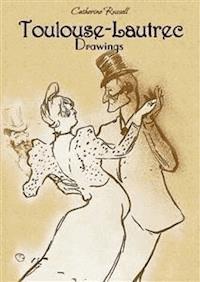
Toulouse-Lautrec painted quickly, using its neutral tone and conveying action and atmosphere in a few economical strokes. In later years graphic works took precedence and his paintings were often studies for lithographs. In Toulouse-Lautrec’s drawings of dancers and horses, his dancers appear like from a few twists and whirls. He does not draw the dancer, but her movement. He is best known as a storyteller of the nightlife of Paris. Toulouse-Lautrec did not only picture the world of the dancers and prostitutes from outside view: he just lived in that world. He frequently charged a room in a brothel, where he made drawings of the prostitutes and their clientele. The men in his drawings and posters are often caricatures but, by contrast, the women are drawn with much warmth and empathy; with only a few pencil strokes Toulouse-Lautrec renders their mood and a character.
Das E-Book können Sie in Legimi-Apps oder einer beliebigen App lesen, die das folgende Format unterstützen:
Veröffentlichungsjahr: 2015
Ähnliche



















Toulouse-LautrecDrawings
ByCatherine Russell
Foreword and AnnotationsbyCatherine Russell
First Edition
Copyright © 2015 byCatherine Russell
*****
Toulouse-LautrecDrawings
*****
Foreword
Toulouse-Lautrecwas the son of a wealthy nobleman, a directsuccessorof the counts of Toulouse. His eccentric father lived in provincial luxury, hunting with falcons and collecting exotic weapons.
Toulouse-Lautrec fell and broke both legs when he was a child. His legs did not heal properly; his torso developed normally, but his legs were permanently deformed. His stunted growth has traditionally been seen as the result of this accident, but more recently doctors have theorized that it may have been the result of a rare genetic abnormality.
He showed an early gift for drawing. Encouraged by his first teachers, the animal painters Rene Princeteau and John Lewis Brown, Toulouse-Lautrec decided in 1882 to devote to painting, and that year he left for Paris, where he studied with Bonnat and Cormon and set up a studio of his own when he was 21. He settled in Montmartre, where he stayed from then on.
Toulouse-Lautrec habitually stayed out most of the night, frequenting the many entertainment spots about Montmartre, especially the Moulin Rouge cabaret, and he drank a great deal. His loose living caught up with him: he suffered a breakdown in 1899, and his mother had him committed to an asylum at Neuilly. He recovered and set to work again. He died on Sept. 9, 1901,at the family estate at Malrome.
As a youth he was attracted by sporting subjects and admired and was influenced by the work of Degas. He admired and was influenced by Japanese prints. His own work is, above all, graphic in nature, the paint never obscuring the strong, original draftsmanship. He detailed the music halls, circuses, brothels, and cabaret life of Paris with a remarkable objectivity born, perhaps, of his own isolation. As an observer and recorder of aspects of working-class women's life and work (washerwomen, prostitutes, dancers, singers) he ranks with Daumier, Degas, and Manet.
His garish and artificial colours, the orange hair and electric green light of his striking posters, caught the atmosphere of the life they advertised. Toulouse-Lautrec's technical innovations in colour lithography created a greater freedom and a new immediacy in poster design. His posters of the dancers and personalities at the Moulin Rouge cabaret are world renowned and have inspired countless imitations.
After a life of enormous productivity (more than 1,000 paintings, 5,000 drawings, and 350 prints and posters), debauchery, and alcoholism, Toulouse-Lautrec suffered a mental and physical collapse and died at the age of 37.
An aristocratic, alcoholic dwarf known for his louche lifestyle, Henri de Toulouse-Lautrec created art that was inseparable from his legendary life.He painted quickly, frequently in thinned oil paint on unprimed cardboard, using its neutral tone as a design element and conveying action and atmosphere in a few economical strokes. Japanese prints inspired his oblique angles of vision, near-abstract shapes, and calligraphic lines. In later years graphic works took precedence; his paintings were often studies for lithographs.
There is a sense of movement in Toulouse-Lautrec’s drawings of dancers and horses. His dancers appear from a few twirls and swirls. He does not draw the dancer, but the motions. His lithographs and sketches of Loie Fuller consist of little more than abstract shapes, in which we can barely detect a head and a pair of legs. When he was commissioned to make a series of lithographs with a horse racing theme, The Jockey (1899), Toulouse-Lautrec does not start from an anatomically correct horse, but tries to capture the strength and speed of the horses in motion. By choosing this particular viewing angle he puts the viewer as it were on one of the trailing horses.
Henri de Toulouse-Lautrec is best known as a chronicler of the nightlife of late 19th century Paris. He used to frequent the nightclubs and cafés of Montmartre, befriending the dancers and prostitutes, making countless sketches as they comb their hair or just lie in bed. Toulouse-Lautrec did not picture the world of the dancers and prostitutes from outside: hejust lived inthatworld.From time to time he rented a room in a brothel, where he made drawings of the prostitutes and their clientele.Withonlya few pencil strokes Toulouse-Lautrec renders a mood and a character. The men in his drawings and posters are often caricatures of power with large protruding chins and noses and big fat faces. By contrast his women are drawn with much warmth and empathy.
AnnotatedDrawings
JockeyatGalop
1878,Watercolor and graphite, 12.38 x 15.55 cm,Los Angeles County Museum
Two Riders on Horseback
1879–81, Pen and blue ink and graphite, 16.21 x 19.99 cm,The Metropolitan Museum of Art
The early career of Toulouse-Lautrec was largely shaped by his first teacher, René Princeteau, a close family friend who was a deaf-mute and a painter of fashionable sporting pictures. The elegantly outfitted riders in this sketch may have been observed on the artist's family estate in Albi, in southern France, where his eccentric and aristocratic father kept a full stable. Lautrec's love of animals would last throughout his life, and a number of his mature works depict horses ridden by jockeys or controlled by circus trainers.
Riders
Early 1880s, Pencil, watercolour and white,22.2x30.2 cm,Hermitage Museum




