


4,99 €
Mehr erfahren.
- Herausgeber: Livia Emerson
- Kategorie: Lebensstil
- Sprache: Englisch
What if the clothes you wear every day are quietly damaging your skin, disrupting your hormones, and exhausting your immune system — without you ever realizing it?
In 2026, the biggest shift in textile safety is about to hit the fashion industry.
PFAS bans. Dye restrictions. Microplastic crackdowns.
Brands are scrambling. Labels are changing.
And for the first time, what you wear may be riskier than what you eat.
Toxic Clothes exposes the hidden chemicals woven into everyday fabrics:
PFAS-coated leggings, toxic dyes in dark colors, microplastic-heavy fleece, body-reactive synthetics, wrinkle-free resins, flame retardants, antibacterial finishes, and “performance” coatings that cling to your skin for hours.
Most people have no idea that:
- Their night sweats come from synthetic fibers
- Their rashes come from dyes
- Their fatigue comes from chemical shedding
- Their breakouts come from “quick-dry” activewear
- Their children’s sleep issues come from treated pajamas
Are you ready for what’s coming?
In this eye-opening, deeply practical guide, bestselling author Livia Emerson takes the overwhelming science behind modern clothing and turns it into a clear, human, empowering roadmap you can follow immediately — without throwing away your wardrobe or overspending.
Inside this book, you’ll discover:
• The truth about PFAS, dyes, synthetics, and fabric coatings — and how they interact with your skin in real time
• Why certain clothes make you itch, sweat, break out, or feel exhausted — and how to fix it fast
• How the 2026 textile rules will transform labels, materials, and what brands can legally hide
• Why recycled polyester is NOT the “green” solution you’re being sold
• The real reason dark leggings, fleece, padded bras, and shapewear are high-risk
• How to detox your wardrobe without replacing everything
• A 7-day plan that instantly reduces your exposure
• How to build a long-term safe wardrobe without spending more money
This book is not about fear.
It is about awareness—the kind of awareness that protects your skin, your energy, your hormones, and your future.
If you want clearer skin, fewer reactions, better sleep, calmer sweat patterns, and a home that supports your health instead of undermining it…
If you want to finally understand what’s touching your body every single day…
If you want to stay ahead of the biggest textile reform in decades…
This is the book you’ve been waiting for.
Your skin will thank you.
Your future self will thank you.
Your family will thank you.
Clothing safety is changing forever — make sure you’re ready.
Das E-Book können Sie in Legimi-Apps oder einer beliebigen App lesen, die das folgende Format unterstützen:
Veröffentlichungsjahr: 2025
Ähnliche













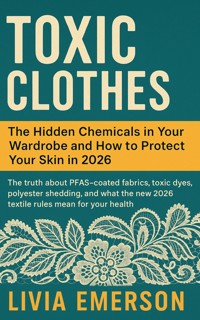
TOXIC CLOTHES
The Hidden Chemicals in Your Wardrobe and How to Protect Your Skin in 2026
© 2025 Livia Emerson
All rights reserved. No part of this book may be reproduced, stored, or transmitted in any form or by any means—electronic, mechanical, photocopying, recording, or otherwise—without prior written permission from the author.
This publication is intended for informational purposes only. It does not provide medical, dermatological, or legal advice. Readers should consult qualified professionals for specific concerns regarding health, allergies, or regulatory compliance. Any regulatory references (including 2026 guidelines) are based on publicly available information at the time of publication and may be subject to updates or regional variations.
Edited, formatted, and published independently by the author.Printed in the United States of America.
Written by Livia Emerson
About the Author
How to Use This Book
A Letter to the Readers
CHAPTER 1 — The Hidden Chemistry of Modern Textiles
CHAPTER 2 — What Touches Your Skin: The Real Risks No One Talks About
CHAPTER 3 — PFAS-Coated Fabrics: Why 2026 Changes Everything
CHAPTER 4 — Toxic Dyes: The Color Problem
CHAPTER 5 — Polyester Shedding and the Microfiber Crisis
CHAPTER 6 — The Finishes You Never See: The Hidden Coatings That Touch Your Skin Every Day
CHAPTER 7 — The Clothes You Wear the Longest
CHAPTER 8 — The Hidden Truth Behind Clothing Labels
CHAPTER 9 — Building Your 2026-Safe Wardrobe
CHAPTER 10 — What “PFAS-Free” Really Means in 2026
CHAPTER 11 — How Washing Changes Your Clothes (And Your Exposure)
CHAPTER 12 — Detergents, Softeners, and What They’re Really Doing to Your Skin
CHAPTER 13 — Building a Safe Wardrobe: Fabrics, Colors, and the 2026 Rules of Healthy Clothing
CHAPTER 14 — How to Detox Your Current Wardrobe Without Replacing Everything
CHAPTER 15 — The 2026 Textile Laws: What Changes, What Doesn’t, and What You Need to Know
CHAPTER 16 — Future-Proofing Your Home and Wardrobe Beyond 2026
CHAPTER 17 — The Smart Shopping Checklist: How to Choose Safe Clothes in 2026 and Beyond
CHAPTER 18 — The Long-Term Wardrobe Plan: How to Stay Safe for Years Without Spending More
FINAL CLOSING — A Safer Future Starts in Your Closet
ACKNOWLEDGMENTS
AUTHOR’S NOTE
A Gentle Invitation to Leave a Review
Follow Me
Final Letter to the Reader
Useful Resources
7-Day Wardrobe Detox Plan
Copyright Page
CHAPTER 2 — What Touches Your Skin: The Real Risks No One Talks About
Your skin is the first place your clothes tell their story.Not the fabric. Not the color. Not the style.The skin — that silent messenger that reacts long before your mind understands what’s happening.
Most people think of skin reactions as something dramatic:a rash, a breakout, redness that appears overnight.But in reality, the earliest signs are far more subtle.A little dryness on your arms.A small itch behind your knees.Irritation around your waistband.A burning sensation after exercising in leggings that used to feel fine.
These moments seem small, easy to dismiss, easy to blame on weather, stress, lotions, or detergent.But your skin is smarter than you think.It notices what you ignore.It absorbs more than you realize.And it reacts to clothing chemistry long before the symptoms become visible.
This chapter is about understanding that connection — the one the clothing industry has hidden in plain sight for decades.
Your Skin Is Not Just a Shield — It’s a Gateway
The skin is often described as a barrier.A wall.A protective layer.
But that’s only half the story.
Your skin is also porous, reactive, alive.It absorbs lipophilic (fat-loving) molecules.It releases sweat and heat that can increase chemical migration.It has microchannels, hair follicles, and pores that allow substances to enter.
The skin is not impermeable.It is selective.And some chemicals know exactly how to move through it.
Sweat, friction, and heat — everyday conditions when wearing clothes — all increase the ability of chemicals to leave the fabric and enter your skin. This is especially true for PFAS, disperse dyes, finishing resins, antimicrobials, and microplastic particles.
Why Clothing Chemicals Affect the Skin So Quickly
You don’t apply clothing like you apply skincare.You wear it.For hours.In heat.Under pressure.While moving.While sweating.While sleeping.
This creates the perfect environment for chemical transfer.
1. Heat opens the skin.When your body warms up, your pores expand slightly.Blood flow increases.Your skin becomes more permeable.
2. Moisture increases chemical migration.Sweat breaks down coatings, dissolves dyes, and releases chemicals that would otherwise remain bound to fibers.
3. Friction creates micro-abrasions.Think inner thighs, waistbands, bra straps, underarms, neckline.These areas absorb chemicals more easily because friction weakens the skin barrier.
4. Occlusion traps chemicals against the skin.Leggings, sports bras, shapewear, tights, and compression wear create a warm, moist microclimate.This accelerates absorption dramatically.
These mechanisms are well documented in dermatology research — but hardly ever communicated to consumers.
Symptoms You Thought Were “Just You”
Most people never connect their clothing to their symptoms.Clothing seems too harmless, too ordinary.
But watch closely.Your skin is giving you clues.
Here are the early signs of textile-related irritation that most people ignore:
persistent itching in areas where synthetic fabrics sit tightredness after wearing new clothesdryness or flaking around waistbandseczema flare-ups for no apparent reasonsmall bumps on the arms or chestburning sensation during workoutsdiscomfort that gets worse in heatirritation under bra strapsrashes in the inner thigh areairritation from black, navy, or red fabricsworsening of eczema in winter clothesbreakouts where backpack straps sit on the shouldersswelling or redness after wearing athletic wearskin feeling “hot” or “angry” after certain outfitsMost people blame detergent, food, stress, or even sensitivity to sunlight.But often, the real culprit is the fabric touching them for twelve hours a day.
Why Synthetic Fibers Are High-Risk for Sensitive Skin
Polyester, nylon, elastane, rayon, acrylic — almost every synthetic fiber has potential irritants embedded in its structure:
residual solvents from manufacturingdisperse dyesfinishing resinsPFAS or DWR coatingsmicroplastic sheddinganti-odor chemicalsanti-bacterial finishesheat-activated treatmentsWhen these fibers break down — during movement, sweating, or washing — your skin becomes the first point of contact.
Synthetic fabrics also trap heat and moisture against the skin.This weakens the skin barrier, making it easier for irritants to penetrate.
People with eczema, dermatitis, psoriasis, allergies, or reactive skin are especially vulnerable. But even people with “normal” skin can develop reactions after repeated exposure.
The Hidden Role of Disperse Dyes
If you’ve ever noticed that black leggings itch more than grey ones, or that a navy sports bra irritates your chest but a cotton one doesn’t, you’ve already experienced the effect of disperse dyes.
Disperse dyes are designed to bind to synthetic fibers.They penetrate deeply.But they also migrate under heat and sweat.
This is why the most problematic colors are often:
blacknavy bluedeep redforest greenbright blueThese pigments are among the most chemically reactive in the textile world.In sweat and friction zones, they’re even more likely to cause irritation.
Skin Barrier Damage: The Slow, Silent Erosion
When the skin barrier weakens, you may not see anything dramatic at first.It begins as dryness, tightness, dullness.
But here’s what happens beneath the surface:
Micro-tears form from friction.The skin loses moisture.The lipid barrier thins.Irritants penetrate more easily.Redness becomes chronic.Sensitivity increases with each exposure.




