


50,99 €
Mehr erfahren.
- Herausgeber: John Wiley & Sons
- Kategorie: Fachliteratur
- Serie: Wiley Trading Series
- Sprache: Englisch
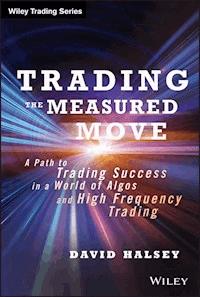
A timely guide to profiting in markets dominated by high frequency trading and other computer driven strategies Strategies employing complex computer algorithms, and often utilizing high frequency trading tactics, have placed individual traders at a significant disadvantage in today's financial markets. It's been estimated that high-frequency traders--one form of computerized trading--accounts for more than half of each day's total equity market trades. In this environment, individual traders need to learn new techniques that can help them navigate modern markets and avoid being whipsawed by larger, institutional players. Trading the Measured Move offers a blueprint for profiting from the price waves created by computer-driven algorithmic and high-frequency trading strategies. The core of author David Halsey's approach is a novel application of Fibonnaci retracements, which he uses to set price targets and low-risk entry points. When properly applied, it allows traders to gauge market sentiment, recognize institutional participation at specific support and resistance levels, and differentiate between short-term and long-term trades at various price points in the market. * Provides guidance for individual traders who fear they can't compete in today's high-frequency dominated markets * Outlines specific trade set ups, including opening gap strategies, breakouts and failed breakout strategies, range trading strategies, and pivot trading strategies * Reveals how to escape institutional strategies designed to profit from slower-moving market participants Engaging and informative, Trading the Measured Move will provide you with a new perspective, and new strategies, to successfully navigate today's computer driven financial markets
Sie lesen das E-Book in den Legimi-Apps auf:
Seitenzahl: 301
Veröffentlichungsjahr: 2013
Ähnliche



















TRADING THEMEASURED MOVE
Founded in 1807, John Wiley & Sons is the oldest independent publishing company in the United States. With offices in North America, Europe, Australia and Asia, Wiley is globally committed to developing and marketing print and electronic products and services for our customers' professional and personal knowledge and understanding.
The Wiley Trading series features books by traders who have survived the market's ever changing temperament and have prospered—some by reinventing systems, others by getting back to basics. Whether a novice trader, professional, or somewhere in-between, these books will provide the advice and strategies needed to prosper today and well into the future.
For a list of available titles, visit our website at www.WileyFinance.com.
TRADING THEMEASURED MOVE
A Path to Trading Success in a World of Algos and High-Frequency Trading
David M. Halsey
Cover image: © iStockPhoto.com/© Teekid Cover design: Paul McCarthy
Copyright © 2014 by John Wiley & Sons, Inc. All rights reserved.
Published by John Wiley & Sons, Inc., Hoboken, New Jersey. Published simultaneously in Canada.
No part of this publication may be reproduced, stored in a retrieval system, or transmitted in any form or by any means, electronic, mechanical, photocopying, recording, scanning, or otherwise, except as permitted under Section 107 or 108 of the 1976 United States Copyright Act, without either the prior written permission of the Publisher, or authorization through payment of the appropriate per-copy fee to the Copyright Clearance Center, Inc., 222 Rosewood Drive, Danvers, MA 01923, (978) 750-8400, fax (978) 646-8600, or on the Web at www.copyright.com. Requests to the Publisher for permission should be addressed to the Permissions Department, John Wiley & Sons, Inc., 111 River Street, Hoboken, NJ 07030, (201) 748-6011, fax (201) 748-6008, or online at www.wiley.com/go/permissions.
Limit of Liability/Disclaimer of Warranty: While the publisher and author have used their best efforts in preparing this book, they make no representations or warranties with respect to the accuracy or completeness of the contents of this book and specifically disclaim any implied warranties of merchantability or fitness for a particular purpose. No warranty may be created or extended by sales representatives or written sales materials. The advice and strategies contained herein may not be suitable for your situation. You should consult with a professional where appropriate. Neither the publisher nor author shall be liable for any loss of profit or any other commercial damages, including but not limited to special, incidental, consequential, or other damages.
For general information on our other products and services or for technical support, please contact our Customer Care Department within the United States at (800) 762-2974, outside the United States at (317) 572-3993, or fax (317) 572-4002.
Wiley publishes in a variety of print and electronic formats and by print-on-demand. Some material included with standard print versions of this book may not be included in e-books or in print-on-demand. If this book refers to media such as a CD or DVD that is not included in the version you purchased, you may download this material at http://booksupport.wiley.com. For more information about Wiley products, visit www.wiley.com.
Library of Congress Cataloging-in-Publication Data:
Halsey, David M., 1977- Trading the measured move : a path to trading success in a world of algos and high frequency trading / David M. Halsey. pages cm. — (Wiley trading series) Includes index. ISBN 978-1-118-25183-6 (cloth); ISBN 978-1-118-28713-2 (ePDF); ISBN 978-1-118-28332-5 (ePub) 1. Investment analysis. 2. Algorithms. 3. Program trading (Securities) 4. Electronic trading of securities. I. Title. HG4529.H356 2014 332.64′20285—dc23
2013029212
I would like to dedicate this book to my dad, who taught me that excellence is a habit and that there is no such thing as luck. What others mistake as luck is where preparation meets opportunity.
CONTENTS
Cover
Half Title
Series Page
Title Page
Copyright Page
Dedication
Preface
Who This Book Is For and Why It's Important
Fibs Make the Moves
Acknowledgments
Chapter 1: Today's Trading Environment
Players on the Field
The Algo Brothers
Where Are You?
Chapter 2: Inside the Hidden Market
Deep Roots
Fibonacci Basics
Fibs Make the Moves
Why Do Fibs Work?
Fibs in the Real World
In Summary
Chapter 3: Drawing a Road Map
A Mountain Range of Price
Obstacles in the Road: Pivot Points
Navigating Trends
Long and Winding Roads
Chapter 4: More Tools for Trading Power
Watching the Clock (and the Calendar)
Tick Tock
The Tape and the DOM
The DOM (Depth of Market)
A Full Toolkit
Chapter 5: The 90 Percent Factor—Executing Your Trade
Priorities and Job One
What's the Risk, What's the Reward?
A Brief Pit Stop
Preparing the DOM
Crossing the Starting Line
Running Off the Road
When Multiple Contracts Just Aren't Possible
Why 90 Percent?
Chapter 6: Three Types of Trade Setups
The Traditional 50 Percent Measured Move
The Extension 50 Percent Measured Move
The 61.8 Percent Failure
Why Is This Important to Your Trading?
Chapter 7: Using Multiple Time Frames to Trade
Time Frames and Russian Dolls
The Path of Least Resistance
Trading the Trend
What Time Frame Should We Look At?
Why Is This Important to Your Trading?
Chapter 8: Three Entry Strategies for Retracements
The Goal
The Three Entry Strategies
The Progression of Entries
Why Is This Important to Your Trading?
Chapter 9: The Seasonality of Markets and the Best Times to Trade
The Big Picture
A Money Manager's Year
The Days
The Hours (Best and Worst Times to Trade)
The Worst Times to Trade
The Typical Money Manager
Why Is This Important to Your Trading?
Chapter 10: Tools for the NYSE
Lagging versus Leading Indicators
Tools for the NYSE
Using All the Tools Together
Why Is This Important to Your Trading?
Chapter 11: Tick Extremes and Divergences
The Types of Tick Extremes
Tick Divergences
Why Is This Important to Your Trading?
Chapter 12: Profiting from Gap Fills
What Is a Gap?
The Types of Gap Fill Scenarios
Gap Fills to Avoid
Gap Fill Percentages
The Gap Fill Workflow and Filter
Entries
When Gaps Don't Fill
What to Do?
Why Is This Important to Your Trading?
Chapter 13: How to Manage Positions and Take Profits
The Rule for Measured Moves
The Distance Formula
Trailing a Series of Measured Moves
After the Confirmation of Trend
Using the –23 Percent Profit Target: Take Profit on the Time Frame You Entered the Trade
Why Is This Important to Your Trading?
Chapter 14: Risk Management (Advanced Trade Management)
Bob the Trader
Curtis the Contractor
Risk per Trade
How Many Futures Contracts Should I Trade?
Stop Placement
The Free Trade
The Reduced-Risk Trade
Why Scale Out?
Pick an Instrument and Focus on It
Trading the News Is Gambling
Why Is This Important to Your Trading?
Chapter 15: The Inner Trader
Mentality
Money Management
Emotions
How Long Does It Take for a New Trader to Trade Well?
Attitude
Trading Well versus Trading for Profit and Emotional Capital
The Phases of Measured Moves
The Series of Measured Moves
Basic Traditional Measured Moves
The Progression of Measured Moves
Why Is This Important to Your Trading?
Chapter 16: The Trading Plan
The Four Legs of a Trading Strategy
Why Trading Rules
General Trading Account Rules
Gap Fill Trading Rules
American (NYSE) Session Trading Rules
European (Euro) Session Trading Rules
Setups
A Trading Journal
Why Is This Important to Your Trading?
Bringing It all Together
About the Author
Index
PREFACE
In today's financial markets, each time a retail trader places a stock, options, or futures trade, he or she enters a world dominated by massive amounts of capital allocated by algorithms designed by brilliant mathematical minds and running on the ultra-fast computers of the world's largest financial institutions. Through years of research and trading experience I have discovered a means by which an individual retail trader can face that daunting competition and win. This book provides you with both the broad background and the necessary details of how to trade courageously and profitably in today's markets.
■ Who This Book Is For and Why It's Important
Traders at all levels of experience will benefit from reading this book. Advanced traders will be familiar with most of the book's terminology but most likely will not be familiar with its new and unique approach to the use of Fibonacci retracements within a series of measured moves or with the structure of nested measured moves across multiple time frames. For beginning traders, a glossary provides definitions and basic information regarding all technical terms used in the book. Armed with this information, beginners will be able to understand and implement the methodology detailed in the book's body. Intermediate traders who might have floundered in today's market while testing indicator after indicator and method after method will find relief in this book's clear, precise, and proven methodology. All traders will benefit from sidebars that tell stories of my personal experiences that lead to specific discoveries and aha moments in the development of this methodology.
Algorithmic trading strategies based on sophisticated quantitative analysis and often employing high frequency trading (HFT) tactics have in recent years given enormous market advantages to the largest financial institutions in the world. Put simply, in the world of trading and investing, the quants, as they are known, have changed the rules for the foreseeable future and have placed the individual retail trader at an unprecedented disadvantage—that is, unless that trader learns a new way of trading that strives to ride the waves created by the quants' trading activity with confidence and to capture consistent profits along the way. This book offers the individual trader a blueprint for creating such a trading plan built on a dynamic framework of fundamental principles flexible enough to support his or her own trading personality.
■ Fibs Make the Moves
Through years of exhaustive research combined with trial-and-error trading on the playing field of futures, options, and equities, I have identified an undiscovered set of trading rules commonly used by the quants. Armed with this knowledge, I developed a unique and powerful methodology for successfully navigating this new and previously uncharted trading environment. At the core of this methodology is the measured move, as described by Fibonnaci retracements. Put simply, Fibs make the moves. The reason that this is so is that the trading activity of the quants makes it so. The methodology here offers a means for the retail trader to ride the coattails of massive amounts of institutional money and to make substantial profits along the way.
My trading methodology surrounds the concept of Fibonnaci-based measured moves with a kit of tools specialized for each trading instrument. Through my research I have unveiled the personalities of a wide range of trading instruments, each created by the movement of substantial amounts of institutional capital each trading day. In order for a retail trader to profit from riding the coattails of this capital, the trader must know which market internals the institutional algorithms are tracking. For example, when trading the ES futures contract based on the Standard & Poor's (S&P) 500 stock index, the quants habitually buy or sell based not on Fibonnaci levels alone but also based on New York Stock Exchange (NYSE) tick, particularly at the extremities of its range. The Bank index, which tracks the Nasdaq's largest financial components, is critically useful as a gauge of overall market sentiment. Finally, the use of tick charts (not to be confused with NYSE tick) and the fine art of tape reading allow a trader to make accurate judgments on price movement for specific instruments based on institutional participation or lack thereof.
This book makes the case that in today's new trading environment of institutional algorithms and high-frequency trading the traditional lagging indicators such as moving average convergence/divergence (MACD) and stochastics used by most retail traders do not work. The quants don't use them, so retail traders shouldn't use them either. Instead, retail traders who read this book should learn to use what the quants use—Fibonnaci-based measured moves and market internals specific to each trading instrument. Armed with a solid understanding of each along with a fully prepared, attentive, and realistic psychological inner state, the retail trader can enter today's trading environment as a successful and profitable participant.
ACKNOWLEDGMENTS
I would like to thank my wife for helping me along the way in the writing of this book. Without her, it would not have been possible. I would also like to thank my editor Jennifer MacDonald for putting up with me during the editing process and her amazing patience. Without her accountability and motivation, the book would not be possible.
CHAPTER 1
Today's Trading Environment
Descent of the Pit and Ascent of the Screen
In the opening moments of Floored, James Allen Smith's incisive documentary about the decline of Chicago's trading pits, two telling statistics flash across the screen:
Lesen Sie weiter in der vollständigen Ausgabe!
Lesen Sie weiter in der vollständigen Ausgabe!
Lesen Sie weiter in der vollständigen Ausgabe!
Lesen Sie weiter in der vollständigen Ausgabe!
Lesen Sie weiter in der vollständigen Ausgabe!
Lesen Sie weiter in der vollständigen Ausgabe!
Lesen Sie weiter in der vollständigen Ausgabe!
Lesen Sie weiter in der vollständigen Ausgabe!
Lesen Sie weiter in der vollständigen Ausgabe!
Lesen Sie weiter in der vollständigen Ausgabe!
Lesen Sie weiter in der vollständigen Ausgabe!
Lesen Sie weiter in der vollständigen Ausgabe!
Lesen Sie weiter in der vollständigen Ausgabe!
Lesen Sie weiter in der vollständigen Ausgabe!
Lesen Sie weiter in der vollständigen Ausgabe!
Lesen Sie weiter in der vollständigen Ausgabe!
Lesen Sie weiter in der vollständigen Ausgabe!




