


22,99 €
Mehr erfahren.
- Herausgeber: John Wiley & Sons
- Kategorie: Fachliteratur
- Sprache: Englisch
Clear, actionable guidance toward managing a major leadership change
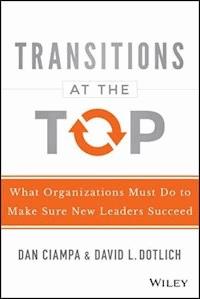
Transitions at the Top is an insightful, informative guide to navigating a change in leadership. A smooth transition is critical to both the health of the organization and the success of the new leader, but good planning and strong strategy can help organizations come out fresher and more driven on the other side. This book provides the specific principles, guidelines, and actions that boards, C-suite executives, and HR leaders need to guarantee a successful CEO transition. Continuity is key as one leader passes the mantle to a successor, and this book spans the steps and events that take place from when the candidate accepts the offer, all the way through the point where a critical mass of followers have accepted him or her as the established leader. Coverage includes guidance on who should be engaged in the process, as well as role-specific advice for each member of the transition management team.
Many books have been written to advise new incoming CEOs, but there is little guidance available for the organization as a whole. This book provides actionable advice on smoothing the transition without breaking stride.
- Maintain continuity during leadership transitions
- Strengthen focus on culture, systems, and processes
- Engage all influential executives in smoothing the transition
- Lay a foundation to help the new leader succeed
The transition management team plays a crucial role in maintaining the health of the organization during a time of major change. Strong strategy becomes critical when an organization is in flux, and high engagement is key. Transitions at the Top provides expert insight, clear guidance, and a solid plan for a smoother transition.
Das E-Book können Sie in Legimi-Apps oder einer beliebigen App lesen, die das folgende Format unterstützen:
Seitenzahl: 437
Veröffentlichungsjahr: 2015
Ähnliche



















Table of Contents
Title Page
Copyright
Dedication
Preface
Note
Acknowledgements
Introduction
The Transition Challenge
The Roots of Failure
Notes
Chapter 1: Complexity and Critical Crossroads
Complexity
Summary
Chapter 2: Three Destructive Myths
Myths Plaguing Transitions at the Top
How Transition Myths Bar Productive Thinking
Leaving Tough Questions Unanswered
Summary
Note
Chapter 3: Errors of Execution
Relationship between Incumbent and Successor
Preparing for Only One Transition
Mismanaging the Transition Process
Summary
Notes
Chapter 4: The Board's Role
Directors as Major Players
Oversight for the Transition
Managing Relationships
Cultural and Political Attention
Summary
Notes
Chapter 5: The CEO's Role
Controlling the Steps and Pace
Ensuring Other Players Do What They Must
Self-Management and Self-Awareness
Summary
Notes
Chapter 6: The CHRO's Role
Great Senior Staffing Support
Help for the New Leader
Methods and Mechanisms for Relationships
Summary
Notes
Chapter 7: The Senior Manager's Role
Shaping Organization Opinion
Delivering Support
Building Winning Relationships
Summary
Chapter 8: Summary
Note
Index
End User License Agreement
Pages
i
ii
iii
iv
xiii
xiv
xv
xvi
xvii
xix
xx
xxi
xxii
1
2
3
4
5
6
7
8
9
10
11
12
13
14
15
16
17
18
19
20
21
22
23
24
25
26
27
28
29
30
31
32
33
34
35
36
37
38
39
40
41
42
43
44
45
47
48
49
50
51
52
53
54
55
56
57
58
59
60
61
62
63
64
65
66
67
68
69
70
71
72
73
74
75
76
77
78
79
80
81
82
83
84
85
86
87
88
89
90
91
92
93
94
95
96
97
98
99
100
101
102
103
104
105
106
107
108
109
110
111
112
113
114
115
116
117
118
119
120
121
122
123
124
125
126
127
128
129
130
131
132
133
134
135
136
137
138
139
140
141
142
143
144
145
146
147
148
149
150
151
152
153
154
155
156
157
158
159
160
161
162
163
164
165
166
167
168
169
170
171
172
173
174
175
176
177
178
179
180
181
182
183
184
185
186
187
188
189
190
191
192
193
194
195
196
197
198
199
200
201
202
203
204
205
206
207
208
209
210
211
212
213
215
216
217
218
219
220
221
222
223
224
225
226
227
228
229
230
231
232
233
234
235
236
237
238
239
240
241
242
243
245
246
247
248
249
250
251
252
253
254
255
257
258
259
260
261
262
263
256
264
265
266
Guide
Cover
Table of Contents
Foreword
Introduction
Begin Reading
List of Illustrations
Figure I.1: Framework for Transition Success
Figure 1.1: The Way People Do Things Around Here
Figure 3.1: RASI Chart
Figure 3.2: First Draft That the CHRO and CFO Reviewed with the CEO to Begin the Process
Figure 4.1: The Board's Transition Role
Figure 5.1: The CEO's Transition Role
Figure 5.2: Transition Phases
Figure 6.1: The CHRO's Transition Role
Figure 6.2: Roles and Relationships
Figure 7.1: The Senior Managers' Transition Role
List of Features
Transitions at the Top Fail Because
Transition Myths
The Transition is over When
Errors of Execution
Praise for Transitions at the Top
“Without a doubt, corporations have raised their game on the use of various techniques to improve the likelihood that externally hired talent will succeed in their most business-critical roles. What many companies haven't done, however, is to spend the same amount of time on building a set of transition practices to further increase the probability these executives will thrive and prosper in their new roles and in their new companies. The cost of a failed transition is monumental, and comes in the form of missed market opportunities, a loss of business momentum, reputational damage, and potential damage to the credibility of the CEO and/or the company's board of directors. Fortunately, Dan Ciampa and David Dotlich outline a practical, compelling playbook that if properly executed, will substantially increase the chance of success in senior leadership transitions. A timely and important book on a very important subject.”
L. Kevin CoxChief Human Resources OfficerAmerican Express CompanyDirector - Kraft Foods GroupDirector - Corporate Executive Board
“Senior transitions are seminal events but are often botched, at great cost to the company and its shareholders. Too often succession decisions are made by a board, with those crucial first months then left entirely to the new manager to navigate. This book takes a different vantage point and illuminates the critical role of the company, its board, and senior managers in making sure those vital successions work. Written in a straightforward, practical manner, a must read for all involved.”
Ken LeiblerCEO Liberty Financial Companies and former President American Stock ExchangeDirector - Northeast UtilitiesTrustee - Putnam Investments Funds
“Transitions at the Top is a welcome, long-overdue addition to our thinking about leadership and transitions. Far too little attention has been paid to the dynamics and consequences of CEO succession, especially to the critical role the organization plays in driving success or failure. As Ciampa and Dotlich clearly demonstrate, the costs of botched succession processes are very high. And what it takes to make them work is not rocket science, nor is it overly costly or burdensome. It just takes discipline, clarity about roles, and unswerving commitment to the right principles and processes. Follow their advice and the result will be world-class succession planning and implementation. This is a book that every CEO, Board member and senior HR executive should read.”
Michael WatkinsAuthor “First 90 Days”Co-Founder Genesis Advisors
Transitions at the Top
What Organizations Must Do to Make Sure New Leaders Succeed
Dan Ciampa and David L. Dotlich
Cover Image: ©iStock.com / -1001-
Cover Design: Michael J. Freeland
This book is printed on acid-free paper.
Copyright © 2015 by Dan Ciampa and David L. Dotlich. All rights reserved
Published by John Wiley & Sons, Inc., Hoboken, New Jersey
Published simultaneously in Canada
No part of this publication may be reproduced, stored in a retrieval system, or transmitted in any form or by any means, electronic, mechanical, photocopying, recording, scanning, or otherwise, except as permitted under Section 107 or 108 of the 1976 United States Copyright Act, without either the prior written permission of the Publisher, or authorization through payment of the appropriate per-copy fee to the Copyright Clearance Center, 222 Rosewood Drive, Danvers, MA 01923, (978) 750-8400, fax (978) 646-8600, or on the web at www.copyright.com. Requests to the Publisher for permission should be addressed to the Permissions Department, John Wiley & Sons, Inc., 111 River Street, Hoboken, NJ 07030, (201) 748-6011, fax (201) 748-6008, or online at www.wiley.com/go/permissions.
Limit of Liability/Disclaimer of Warranty: While the publisher and author have used their best efforts in preparing this book, they make no representations or warranties with respect to the accuracy or completeness of the contents of this book and specifically disclaim any implied warranties of merchantability or fitness for a particular purpose. No warranty may be created or extended by sales representatives or written sales materials. The advice and strategies contained herein may not be suitable for your situation. You should consult with a professional where appropriate. Neither the publisher nor the author shall be liable for damages arising herefrom.
For general information about our other products and services, please contact our Customer Care Department within the United States at (800) 762-2974, outside the United States at (317) 572-3993 or fax (317) 572-4002.
Wiley publishes in a variety of print and electronic formats and by print-on-demand. Some material included with standard print versions of this book may not be included in e-books or in print-on-demand. If this book refers to media such as a CD or DVD that is not included in the version you purchased, you may download this material at http://booksupport.wiley.com. For more information about Wiley products, visit www.wiley.com.
Library of Congress Cataloging-in-Publication Data is on file.
ISBN 9781118975084 (Hardcover)
ISBN 9781118975114 (ePDF)
ISBN 9781118975091 (ePub)
To Bruce Henderson, Chris Argyris, and Dick Beckhard. Friends who, over the years, took the time to react, challenge, and guide through my various transitions.
Dan Ciampa
Preface
It's never smooth or easy to transfer power from one leader to a successor. The incumbent may not be ready to leave because he believes there's more to do, but his board of directors insists. Or the board may not have the experience or patience to fulfill its accountability of ensuring leadership continuity. Or the search process may not be coordinated effectively by the human resources department, which may also fail to devise a useful, efficient onboarding program for the new leader. Or the organization may not be prepared for the changes that a leadership handoff brings, including the senior managers who may resist the new leader because one of them expected to be promoted or because a leadership change will threaten their power. For the new leader hired from the outside, especially one taking the chief executive officer (CEO) title for the first time, these gaps in thinking and execution by the company she is joining can cause her to fail. And the challenges become even more difficult to overcome when the leadership transition coincides with a change in strategic direction. In fact, changes in leadership are often made to seek changes in company strategy.
Before deciding to write this book, we asked ourselves whether the topic of transitions at the top deserved the effort that would have to go into it and whether another book on leadership was needed. We believe that most books do nothing more than repeat what has already been said and offer nothing novel to the question they pretend to answer. Indeed, most books should be articles. In the final analysis, our readers will be the judges of whether it adds something worthwhile. But, it is important to explain why we believe this book is needed.
We decided to write it (and to write a book rather than an article) because leadership transitions are complex, seminal events that herald a new era in the life of a company, and too many of them fail. As we'll show, when they fail, the costs are enormous—financially in lost revenue, strategically in misguided direction, operationally in loss of stability and predictability, culturally in damage to relationships and coalitions, and perhaps most tragic, personally in derailed careers. Transitions are big deals, and when they go wrong it is a setback for everyone involved.
Some failures happen because the new leader offered the top job was not ready for it yet and didn't have the help needed to overcome his shortcomings. But, we believe at least as often, the transition fails because the company doesn't do its part to ensure it succeeds.
Our experience suggests two core propositions. First, company missteps are a significant contributing factor to the high failure rate of executives at the top. They are as potent a reason for failure as what the incoming leader does or does not do. Second, the success rate of leadership transitions will not improve until CEOs who are preparing to pass the reins, boards that hire or promote successors and oversee the handoff, and the senior managers most involved in the hiring and assimilation of new leaders more fully understand what the hiring organization must do and avoid to improve the chances of success.
Right from the Start,1 which Dan coauthored, was published in 1999 to introduce the topic of the new leader's role and responsibility in a transition at the top. It broke new ground as it offered a framework, examples of successes and failures, and advice to those hired as the number two expecting to succeed the CEO or those entering directly into the top position. In that book's conclusion, a section called “Implications for Future Research” suggested that the company's role be a topic that should be included in the responsibilities of the board, CEO, and the human resources department. The success of Right from the Start spawned other books on related topics, including principles of leadership succession, details of the transition process, and models and programs for senior-level onboarding. In 1999 there was no substantial onboarding market; today, it is a multibillion-dollar market for consultants worldwide. But, while these areas have been explored, there has been nothing written on the company's role in leadership transitions, at least from the literature searches we have done. So, we decided to write this book because it's time to explore this issue in a serious way. We also wrote this book because in our years of experience advising boards, CEOs, and senior teams, we continue to observe many implicit obstacles to the successful transfer of power, which are neither surfaced openly nor dealt with directly. Inherent in the pages that follow is our belief that even though companies state they want new leaders to succeed, they lack a working model of support, feedback, openness, and continuous improvement necessary for those new in a top position to succeed. Such a working model is required to counter an environment of competitiveness, silos, and more concern for enhancing one's own power than for what is good for the entire organization—conditions that characterize day-to-day life in most organizations and have the effect of rejecting the assimilation and contribution of new executives. We also recognize that, once embedded in the organization's culture, they are not easy to change. Indeed, in addition to years of advising others, we have experienced firsthand how difficult it is to change behavior and comfortable habits as members of boards of directors and as chairmen and CEOs. Our own attempts, frustrations, successes, and mistakes at getting top-level transitions right are embedded in the model we've proposed.
We hope this book sparks a host of new conversations among boards and executive teams about how to improve leadership transitions in their organizations. We hope also to add significantly and importantly to the literature so that the major players involved in a senior-level transition and those to whom they turn for help are better prepared. We do so first by detailing the problems associated with leadership transitions that lie within or are created by companies that hire or promote new leaders into the most senior position. Second, we define the roles and responsibilities of the key players involved and explore the interaction between them. Third, throughout the book we offer principles, guidelines, and specific actions that companies should employ to have the best chance for their leadership transitions to succeed.
As important as why we wrote this book is to point out that it is not a how-to manual for transitions. Neither all the potential hurdles that can block a successful handoff nor all the ways they can be overcome are provided here. It would be disingenuous for us to attempt such a thing because it would suggest that transitions at the top are simple. In fact, they are very complex in ways we explain in the chapters that follow.
This book concentrates on “planned transitions.” By this we mean the handoffs that occur from an incumbent executive, usually the CEO, to a successor while both are on the job. We stress, however, that most of the issues confronting CEOs and successors during planned transitions emerge in similar form for other senior-level transitions, such as chief operating officer, division president, or executive or senior vice president. As a result, we hope to interest the broadest audience of readers who may be involved in various ways in the transitions of their organizations.
Our opinions are offered primarily to the following groups of readers:
Members of boards of directors, especially lead directors, nonexecutive chairs, and heads of compensation and nomination and governance committees who must oversee and ultimately be accountable for top-level succession.
CEOs and executive chairpersons, whose legacies in large part depend on the management of a successful transition.
Chief human resources officers (CHROs) who are usually called on to manage the transition, coordinate its various parts, and provide the necessary in-house staffing and counsel.
Senior managers who form the execution cadres that will make the agendas of new leaders in their organizations work and who must prepare the organization for the transition.
New leaders who, in addition to how they must prepare on their own, need to know what they should expect from a well-run transition.
Senior partners in private equity or venture capital firms who want to ensure the highest quality of execution by the individuals hired to lead businesses in which they invest and the boards that oversee them.
Consultants and academics will find much of interest and relevance about the company's role in transitions and related issues of leadership, governance, business policy, strategy, organization culture, and human capital/talent management.
We hope we have provided the most authentic and seasoned portrayal possible of senior leader handoffs. In that we have seen successes and failures of many transitions from inside executive suites and boardrooms, including our own, we cite a host of actual examples to make our points. In a few cases we identify companies and executives by name. In most cases, however, we agreed not to identify individuals or their companies by name. We believe this approach permitted the leaders with whom we talked to describe their experiences and emotions, both positive and negative, with candor. Even so, none of the cases are fictional. Each example happened just as we have recorded it. One or the other of us participated in, witnessed, or discussed directly with key participants everything we have described.
Note
1
D. Ciampa and M. Watkins,
Right from the Start: Taking Charge in a New Leadership Role
(Harvard Business School Press, 1999), 3.
Acknowledgements
When something takes as long to be shaped as has this book, the list of people who contribute time, criticism, and ideas is long. First, of course, are the people whom we've had the opportunity to help and the privilege to work with over the courses of our careers. They turned to one of us to help during a time of great importance to their careers and organizations. Some were chairpersons or directors on boards that were in the midst of or were preparing for a top-level handoff; some were CEOs expecting to pass the baton to a successor; some were in charge of human resources functions, trying to add value for the CEO, the board, and the successor plus strengthen the culture of their organizations all at the same time; some were senior managers adapting to a change in leadership; and, some were the new leaders who hoped to move to the top spot or had taken over. Whatever their positions, we tried to give it our best information and counsel and help them face the problems that had to be solved and challenges that had to be met. As we worked together with them, we learned from them as much as they drew from us. The cases, propositions, and conclusions in , of course, could not have been developed otherwise; and for that, we are grateful.
Lesen Sie weiter in der vollständigen Ausgabe!
Lesen Sie weiter in der vollständigen Ausgabe!
Lesen Sie weiter in der vollständigen Ausgabe!
Lesen Sie weiter in der vollständigen Ausgabe!
Lesen Sie weiter in der vollständigen Ausgabe!
Lesen Sie weiter in der vollständigen Ausgabe!
Lesen Sie weiter in der vollständigen Ausgabe!
Lesen Sie weiter in der vollständigen Ausgabe!
Lesen Sie weiter in der vollständigen Ausgabe!
Lesen Sie weiter in der vollständigen Ausgabe!
Lesen Sie weiter in der vollständigen Ausgabe!




